서 론
POEMS 증후군은 1 9 5 6년에 C r o w에 의해서 처음으로 기술되었고, 이후 F u k a s e등에 의해서 더 잘 알려졌다.1 Polyneuropathy, organomegaly, endocrinopathy, M - s p i k e와 skin changes를 특징으로 하는 이 질환은 다발신경병증을 일으키는 드문 원인중의 하나이지만,
P O E M S증후군에서 다발신경병증은 진단을 위해 필수적 이며 가장 흔한 첫 증상으로 알려져 있다. 그럼에도 불구 하고, 상기 증후군에서 보이는 다발신경병증의 전기진단 학적 이상의 특징에 관한 연구는 매우 드물다.2 이에 저자 들은 P O E M S증후군으로 진단된 환자들을 대상으로 실시 된 신경전도검사 결과를 분석해 상기 증후군에서 보이는 다발신경병증의 전기진단학적 특징을 밝히고자 본 연구를 진행하였다.
대상과 방법
본 연구는 서울대학병원에서 POEMS 증후군으로 진단 받은 1 2명의 환자들(Age, 52.9±11.1 years,
POEMS 증후군의 임상적, 전기생리학적 특성
서울대학교 의과대학 신경과학교실, 관동대학교 의과대학 명지병원 신경과
민주홍・홍윤호 ・이광우
Clinical and Electrophysiological Features of the Patients with POEMS Syndrome
Joo-Hong Min, MD, Yoon-Ho Hong, MD, Kwang-Woo Lee, MD, PhD.
Department of Neurology in Seoul National University Hospital, College of Medicine, Seoul National University, Department of Neurology in Kwandong Univerisity Myong-ji Hospital, College of Medicine, Kwandong University*
Backgrounds and objectives: POEMS (polyneuropathy, organomegaly, endocrinopathy, M protein, and skin changes) syndrome is the rare cause of polyneuropathy. Although the polyneuropathy is essential for the diagnosis of the disease, the pattern of electrodiagnostic abnormalities has not been characterized in detail. The purpose of this study was to elu- cidate the features of nerve conduction abnormalities in POEMS syndrome. Methods: We reviewed the medical records and nerve conduction studies (NCS) of 12 consecutive patients with POEMS. Results: A total of 68 motor and 46 sen- sory nerves were examined. Compound muscle action potentials (CMAPs) and sensory nerve action potentials were abnormally attenuated or not elicited in majority of motor and sensory nerves (80.88% in motor, and 82.6% in sensory nerves). Frequency of the nerves with no potential was significantly higher in lower limbs than in upper limbs (p<0.01 in both motor and sensory nerves), and CMAP amplitude was more reduced in lower limbs than in upper limbs (p<0.01). Conduction slowing was very frequently observed with 95% and 76% of motor and sensory nerves, respec- tively, having the abnormally reduced values of conduction velocity. Distal motor latencies were abnormally prolonged in 75% of motor nerves, and terminal latency indices were significantly higher in patients than in normal controls (p <
0.05). Conduction block was observed only in 5% of motor nerves. Conclusions: NCS in POEMS syndrome showed characteristic patterns, in which conduction abnormalities were more frequently and severely affected in the lower limbs, and more predominantly in the intermediate nerve segments than in the distal portions. The recognition of these characteristic patterns may be helpful in early diagnosis of polyneuropathy in POEMS syndrome.
Key Words: POEMS syndrome (Polyneuropathy, Organomegaly, Endocrinopathy, M-spike and skin changes), Nerve conduction study
Address for correspondence Kwang-Woo Lee, MD, PhD.
Department of Neurology, Seoul National University Hospital,
28 Yongon-Dong Chongno-gu, Seoul, 110-744, Korea
Tel : +82-2-760-3215, Fax : +82-2-3672-7553
E-mail : [email protected]
Female:Male, 8:4)을 대상으로 하였다 (1998. 5- 2002. 12). POEMS 증후군의 진단은 A n g e l a3등 에 의 해서 제시된 기준을 따랐다. 즉, 진단을 위해서는 두 개의 주 기준과 적어도 한 개의 부 기준이 만족되어야 하는데, 주기준은 감각운동성 다발신경병증 ( s e n s o r i m o t o r p o l y n e u r o p a t h y )과 단일클론성 혈장증식성 질환( m o n- oclonal plasmaproliferative disorder)의 증거이며 부 기준은 경화성 골병변 (osteosclerotic bone lesion), Castleman 병, 장기의 비대 (비장비대, 간비대, 또는 림 프절증), 부종, 내분비질환, 피부병변과 유두부종 등이었 다.3이 때, 당뇨와 갑상선 기능이상은 정상인에서의 높은 유병률 때문에 이것만으로는 부 기준에 포함되지 않았다.
신경전도검사( N C S )는 표면자극과 기록을 사용하는 표 준측정방법 (standard techniques of surface stimu- lation and recording (Nicolet Viking IV))을 사용하
였다. 피부온도는 3 1 . 0°C 이상으로 유지되었고, 정중신경 (median nerve), 척골신경 (ulnar nerve), 비골신경 (peroneal nerve), 후경골신경 (posterior tibial nerve) 에 대해서 원위 운동신경 잠복기 (distal motor latency
; DML)와 운동신경전도속도 ( M N C V )를 측정하였다. 원 위자극거리 (distal stimulation distance)는 정중신경 과 척골신경에 대해서 5 cm였고, 비골신경에 대해서는 8 cm, 후경골신경에 대해서는 10 cm이었다. 운동신경전도 속도(motor nerve conduction velocity, MNCV)는 정 중신경과 척골신경에 대해서는 손목에서 팔꿈치까지, 비 골신경은 발목에서 비골의 머리 (head of fibula)까지, 후경골신경은 발목에서 다리 오금 (popliteal fossa)까지 의 구간에 대해서 각기 측정하였다. 추가적으로, 척골신 경에서는 팔꿈치의 위 아래에서, 비골신경에서는 비골의 머리 위아래에서 측정하였다. 전도블록 ( c o n d u c t i o n
Table 1. The clinical and laboratory characteristics of POEMS syndrome patients. (N=12)
Characteristics Frequency (%)
Polyneuropathy 100
Organomegaly 100
Splenomegaly 75
Lymphadenopathy 66.7
Hepatomegaly 50
Castleman disease 16.7
Endocrinopathy 100
Adrenal insufficiency 58.3
Hypothyroidism 58.3
Hypogonadism 41.7
Gynecomastia 12.5 (of men)
Diabetes mellitus 8.3
Hyperparahyroidism 8.3
Hyperthyroidism 8.3
Monoclonal plasma cell dyscrasia 100
M component on serum protein electrophoresis 100
Bone lesions 41.7
Osteosclerotic only 66.7
Mixed sclerotic and lytic 16.7
Lytic only 16.7
Skin changes 100
Hyperpigmentation 91.7
Hypertrichosis 41.7
Thickening 25
Hemangioma/telangiectasia 16.7
Papilledema 8.3
Extravascular volume overload 91.67
Peripheral edema 83.3
Ascites 41.7
Pericardial effusion 41.7
Pleural effusion 25
Other features 66.7
Thrombocytosis: platelet count ≥ 450×10
3/μL 33.3
Polycythemia: hemoglobin ≥ 15 g/dL in women and ≥ 17 g/dL in men 8.3
Clubbing 8.3
b l o c k )은 C M A P의 음성진폭 (negative amplitude) 에 서 5 0 %이상의 감소 또는 음성면적 (negative area)의 4 0 %이상 의 감소가 있으면서 근위자극시 원위자극시에 비해서 CMAP 지속기간 ( d u r a t i o n )의 3 0 %미만의 변화 를 만족 시킬 때로 정의하였다.4 감각신경전도속도 (Sensory nerve conduction velocity, SNCV)는 정중 신경과 척골신경에서는 각각 두 번째 손가락과 다섯 번째 손가락에서 손목까지 정방향으로 (orthodromically) 측 정하였고, 비복신경에서는 장딴지 중간부위 ( m i d - c a l f ) 부터 외측 복사뼈 (lateral malleolus)까지 역방향으로 (antidromically) 얻어졌다. 말단 구간 (terminal seg- m e n t )과 중간 구간 (intermediate segment)의 전도속 도를 비교하기 위해서 각각의 운동신경에 대한 말단잠복 기지수 (Terminal latency indices; TLI)를다음 공식에 의하여 구하였다: TLI=terminal distance (mm)/
[(DML (ms)×MNCV (m/second)].5정상 TLI 데이터는 2 4명의 건강한 자원자 들로부터 얻었으며,6T L I외의 모든 측정치는 정상치의 상한치 또는 하한치의 백분율로 표시 하였다. 통계적 유의수준은 p value 가 0.05 미만인 경우 로 정의하였고, 전위 형성이 관찰되지 않은 신경의 빈도 에 대해서 chi-square test를 사용하여 상하지간의 차
이, 운동 및 감각신경간의 차이를 비교하였고, 신경전도 속도 및 말단잠복기, 진폭은 S t u d e n t’s t-test 또는 Mann-Whitney U test를 사용하여 분석하였다 ( S P S S 1 0 . 0 ) .
결 과
본 연구의 모든 환자들은 진단 당시 P O E M S증후군의 다섯 가지 특징을 모두 보이고 있었다. 임상적인 특징과 검사결과는 Table 1에 요약되어있다. 다발신경병증은 가 장 흔한 첫 번째 증상이었고 (66.7%), 그 다음으로는 요통 과 (16.7 %) 부종 (8.3%) 등이 있었다. 다발신경병증의 증 상으로는 대칭적이며 하지에서 심한 이상감각 ( p a r e s- t h e s i a )이 가장 많았고 (62.5 %), 그 외에 원위부의 근력 약화 ( 2 5 % )가 있었다.
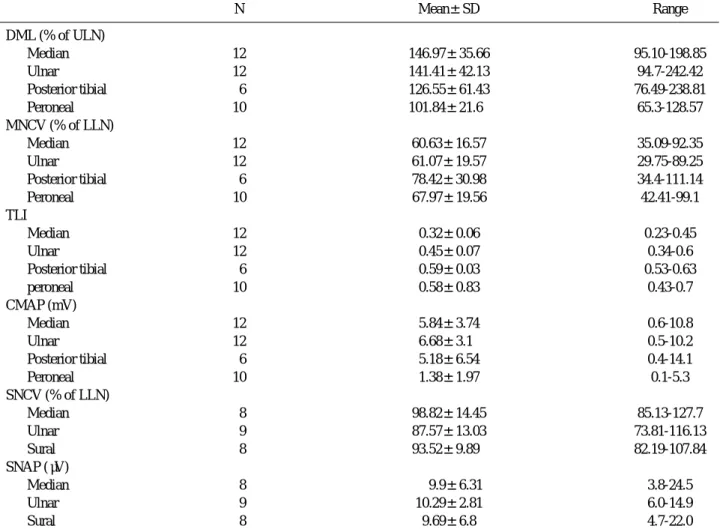
NCS 는 6 8개의 운동신경과 4 6개의 감각신경에 대해서 시행하였고, 그 결과는 Table 2에 요약되어 있다. CMAP 은 검사한 모든 운동신경의 80.9 % (55/68)에서 정상치 의 하한치보다 더 감소하였거나 전위가 관찰되지 않았고, S N A P은 검사한 감각신경의 82.6 % (38/46) 에서 비정 상적으로 감소하거나 전위 형성이 관찰되지 않았다. 전위
Table 2. The NCS results in patients
N Mean ±SD Range
DML (% of ULN)
Median 12 146.97±35.66 95.10-198.85
Ulnar 12 141.41±42.13 94.7-242.42
Posterior tibial 06 126.55±61.43 76.49-238.81
Peroneal 10 101.84±21.60 65.3-128.57
MNCV (% of LLN)
Median 12 60.63±16.57 35.09-92.35
Ulnar 12 61.07±19.57 29.75-89.25
Posterior tibial 06 78.42±30.98 34.4-111.14
Peroneal 10 67.97±19.56 42.41-99.1
TLI
Median 12 0.32±0.06 0.23-0.45
Ulnar 12 0.45±0.07 0.34-0.6
Posterior tibial 06 0.59±0.03 0.53-0.63
peroneal 10 0.58±0.83 0.43-0.7
CMAP (mV)
Median 12 5.84±3.74 0.6-10.8
Ulnar 12 6.68±3.10 0.5-10.2
Posterior tibial 06 5.18±6.54 0.4-14.1
Peroneal 10 1.38±1.97 0.1-5.3
SNCV (% of LLN)
Median 08 98.82±14.45 85.13-127.7
Ulnar 09 87.57±13.03 73.81-116.13
Sural 08 93.52±9.890 82.19-107.84
SNAP (μV)
Median 08 009.9±6.31 3.8-24.5
Ulnar 09 10.29±2.81 6.0-14.9
Sural 08 09.69±6.80 4.7-22.0
N, number of examined nerves; DML, distal motor latency; MNCV, motor nerve conduction velocity; TLI, terminal latency index;
CMAP, compound muscle action potential; SNCV, sensory nerve conduction velocity; SNAP, sensory nerve action potential
가 관찰되지 않은 빈도는 운동신경에서 41.2 % (28/68), 감각신경에서는 45.7 % (21/46)였다. 전위가 관찰되지 않은 운동신경은 하지에서(63.6%, 28/44) 상지( 0 / 2 4 )보 다 통계적으로 유의하게 많았다(p<0.01, chi-square test). 전위가 관찰되지 않은 감각신경도 역시 하지에서 (63.6%, 14/22) 상지보다 (29.2%, 7/24) 더 빈번하여 유 의한 차이를 보였다(p<0.01, chi-square test).
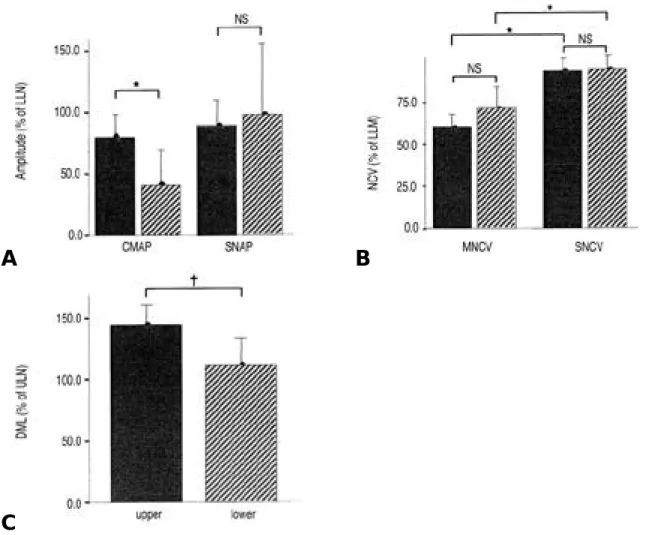
전위가 관찰되지 않은 신경을 제외한 후, CMAP의 크 기는 상지보다 하지에서 유의하게 더 감소( p < 0 . 0 1 )되어 있었으나, SNAP의 크기는 상지와 하지에서 유의한 차이 를 보이지 않았다(Fig. 1A). 상지와 하지의 신경전도속도 는 유의한 차이가 없었으나, 상지 및 하지에서 각각 감각 신경보다 운동신경에서 유의한 신경전도속도의 감소 ( p < 0 . 0 1 )가 관찰되었다(Fig. 1B). DML는 전체 운동신경 의 75% (30/40) 에서 연장( p < 0 . 0 5 )되었고, 하지보다는 상지에서 오히려 더 심하게 연장( p < 0 . 0 5 )된 것으로 관찰 되었다(Fig. 1C). 원위부와 중간부위( i n t e r m e d i a t e d
s e g m e n t s )의 신경전도속도의 차이를 알아보기 위해 구 한 말단잠복기지수( T L I )는 정상대조군에 비해서 환자군 에서 유의하게 높았다(p<0.01)(Fig. 2). 전도블록은 상지 운동신경의 4.2 % (1/24), 하지 운동신경의 6.3% (1/16) 에서만 각기 관찰되었다.
고 찰
본 연구에 포함된 환자들은 P O E M S증후군의 다섯 가 지 특징을 모두 보이고 있었는데, 이는 첫 증상의 발현시 기와 진단적인 평가시기와의 간격이 평균 1 8개월(±1 4 . 3 Mon, Range 4~48 months)로 진단이 다소 지연되었기 때문으로 볼 수 있으나, 몇몇 환자들은 매우 진행이 빨라 병의 경과가 환자들마다 매우 다양함을 확인할 수 있었 다. 환자들의 대부분( 7 5 % )에서 첫 증상으로 다발신경병증 에 의한 대칭적인 손발저림을 확인할 수 있었는데, 이는 이전의 논문들에서 언급한 결과( 5 1 ~ 8 4 % )와 유사하였다.1 ,7
Figure 1. Comparisons of NCS parameters between upper and lower limbs in patients with POEMS syndrome. Compound muscle action potential (CMAP) amplitude is significantly reduced in lower limbs than in upper limbs, where as sensory nerve action poten- tial (SNAP) amplitude is not different between upper and lower limbs (A). There is no difference in conduction velocity between upper and lower limbs for both motor and sensory nerves, whereas conduction velocity is significantly lower in motor than in sensory nerves ( B). Distal motor latency (DML) is more predominantly prolonged in upper limbs than in lower limbs. All parameters are expressed as the percentage of the relevant upper (ULN) or lower (LLN) limit of the normative values(C). Bars show means. Error bars show 95.0% confidence interval (CI) of mean. *: p<0.01, †: p<0.05 using Mann-Whitney U test.
A
C
B
본 연구 결과는 몇 가지 흥미로운 사실을 보여준다고 할 수 있다. 첫 번째는 신경전도검사의 이상이 상지보다는 하지에서 더 자주 그리고 더 심하게 나타났다는 점이다.
전위가 관찰되지 않은 경우는 운동신경과 감각신경 모두 하지에서 더 많았고, CMAP은 상지보다 하지에서 더 심 하게 감소되어 있었다. 한편, SNAP 크기와 M N C V , S N C V의 감소정도는 상하지에서 차이가 없었지만, 이의 해석에는 주의를 기울여야 할 것이다. 왜냐하면, 이들 측 정치의 분석에는 전위가 관찰되지 않는 심하게 손상된 신 경들이 제외되었기 때문이다. 실제로 전위 형성이 관찰되 지 않았던 신경들은 하지에서 더 빈번하였던 점을 고려한 다면 선택오차로 인해 위와 같은 결과가 초래되었을 것으 로 추정하는 것이 더 타당할 것이다. 상지에서 더 연장된 D M L의 경우도 같은 이유로 설명될 수 있다. 신경전도검 사의 이상이 하지에서 더 뚜렷한 점은 POEMS 증후군에 서 보이는 임상적 특징, 즉 감각장애와 근력약화가 원위 부 하지에서 시작되어 점차 상지로 진행하는 소견과 부합 하는 것으로 볼 수 있다.1또한, 병리학적으로도 하지에 분 포한 신경에서 더 심한 축삭의 소실(axonal loss)이 관찰 된 것도 같은 맥락에서 생각해 볼 수 있다.8
본 연구의 두 번째 흥미로운 결과는 POEMS 증후군의 다발신경병증에서 신경전도검사 결과, 신경전도속도가 원 위분절보다는 중간분절에서 심하게 감소되어 있다는 것이 다. 이러한 신경중간분절에서의 특이적인 운동신경속도의 감소는 POEMS 환자들에서 TLI 값이 정상인에 비해 유 의하게 증가된 결과로 확인할 수 있으며 이는 최근 S u n g 등의 보고와도 일치하는 부분이다.2 또한, 본 연구 결과에 서 신경전도속도의 감소가 감각신경보다 운동신경에서 더
뚜렷한 점도 이를 뒷받침하는 증거로 볼 수 있다. 즉, 운 동신경전도가 감각신경전도 속도보다 유의하게 저하된 본 연구 결과는 POEMS 증후군의 다발신경병증에서 감각신 경섬유와 운동신경섬유의 병적 과정에 대한 감수성( s u s- c e p t i b i l i t y )의 차이가 아니라, 단순히 신경전도속도를 측 정하는 방법과 중간분절에서 특이적인 신경전도속도의 저 하 때문일 것으로 보는 것이 더 타당하다. 즉, 운동신경전 도속도는 중간구간을 사용해서 측정되나, 감각신경전도속 도는 더 원위구간에서 측정되기 때문이다. 이들 결과는 축삭성 다발신경병증 (axonal polyneuropathy) 또는 면 역 매개성 탈수초성 다발신경병증 ( i m m u n e - m e d i a t e d demyelinating polyneuropathy)과 구분되는 P O E M S 증후군 다발신경병증의 전기생리학적 특징으로 볼 수 있 다. 즉, 축삭성 다발신경병증의 경우 Dying-back 또는 왈러변성(wallerian degeneration)으로 인해 신경의 말 단부위가 가장 많이 손상되며, 면역매개성 신경병증은 혈 신경장벽(blood nerve barrier)이 상대적으로 부족하여 항체나 세포관련면역반응에 취약한 근위부나 말단부위 신 경구간이 주로 침범된다. 따라서, POEMS 증후군의 다발 신경병증에서 관찰되는 신경중간분절에 비교적 특이적인 전도 이상 소견은 이들 일차적인 축삭성 다발신경병증이 나, 면역매개성 탈수초성 다발신경병증과는 질적으로 다 른 어떤 병적 요인의 존재를 암시하는 것으로 유추해 볼 수 있다. 한편, 전도블록은 전체 운동신경의 5% (2/40)에 서 관찰되었고, 이는 역시 이전 논문에서 제시한 값( 6 % ) 과 매우 유사하다.2 따라서, 전도블록은 P O E M S에서는 매우 드문 소견이며 이 또한 염증성 탈수초성 다발신경병 증과 같은 면역 매개성 국소성 탈수초성 다발신경병증과 는 질적으로 다른 병리기전의 존재를 시사하는 것으로 볼 수 있다.2
결론적으로, POEMS증후군에서 다발신경병증은 특징 적인 전기진단학적 소견을 보이며, 이를 정리하면 상지보 다 하지에서 더 빈번하고 심한 전도 이상과, 신경 원위분 절보다 중간분절에서 뚜렷한 전도속도의 감소로 정리할 수 있다. 이러한 특이적인 신경전도검사의 이상소견은 P O E M S증후군에서 다발신경병증의 아직 밝혀지지 않은 발병기전과 관련되어 있을 것으로 추측할 수 있으며, 상 기 결과와 같은 특징적인 신경전도이상 소견은 P O E M S 증후군의 조기 진단에 도움이 될 수 있을 것이다.