Article http://dx.doi.org/10.14478/ace.2015.1059
산업부산물인 순환골재 및 순환골재 /제강슬래그 조합을 이용한 수용액상에서의 중금속 제거 특성
신우석⋅김영기*,†
국립한경대학교 해양과학기술연구센터, *국립한경대학교 화학공학과 (2015년 5월 8일 접수, 2015년 6월 24일 심사, 2015년 7월 8일 채택)
Removal Characteristics of Heavy Metals from Aqueous Solution by Recycled Aggregate and Recycled Aggregate/Steel Slag Composites as Industrial Byproducts
Woo-Seok Shin and Young-Kee Kim*,†
Institute of Marine Science and Technology Research, Hankyong National University, Anseong 456-749, korea
*Department of Chemical Engineering, Hankyong National University, Anseong 456-749, korea (Received May 8, 2015; Revised June 24, 2015; Accepted July 8, 2015)
초 록
본 연구에서는 순환골재와 순환골재/제강슬래그 조합을 이용하여 수용액상에서 Cr6+과 As3+ 흡착 특성을 평가하였다.
순환골재와 제강슬래그의 주요 성분(CaO, SiO2, Al2O3, Fe2O3)이 각각 91%와 86.9% 함유되어 흡착제로서 유리한 조성 을 가지고 있다. 순환골재와 순환골재/제강슬래그 조합에 있어서 Cr6+과 As3+의 동역학적 평형은 각각 180 min과 360 min 이후에 도달하였다. 동적흡착결과를 유사 1차 모델과 유사 2차 모델로 분석한 결과 두 모델 모두 더딘 평형 결과 를 나타냈다. 순환골재와 순환골재/제강슬래그 조합에 있어서, 평형흡착 실험은 Freundlich 모델에 잘 부합했고, Cr6+보 다 As3+의 흡착량이 더 높았다. 용액의 pH가 6에서 10으로 증가함에 따라서 As3+의 흡착률은 증가하는 것으로 나타났 다. 한편, Cr6+는 감소를 나타냈다. 본 연구 결과를 통해 순환골재 및 순환골재/제강슬래그 조합은 중금속(Cr6+, As3+)을 효율적으로 제거할 수 있는 흡착제로 판단된다.
Abstract
This study examined the adsorption characteristics of heavy metal ions (Cr6+, As3+) in an aqueous solution using recycled aggregate (RA) and recycled aggregate (RA)/steel slag (SS) composites. The RA and SS are favorable for the absorbent be- cause it contains about 91% and 86.9%,respectively, which are some of the major adsorbent ingredients (CaO, SiO2, Al2O3
and Fe2O3) for heavy metal. Kinetic equilibrium of Cr6+and As3+ in RA and RA/SS composites reached within 180 min and 360 min, respectively. The kinetic data presented that the slow course of adsorption follows the Pseudo first and second order models. The equilibrium data were well fitted by the Freundlich model and showed the affinity order of As3+ > Cr6+. The results of As3+ also showed that the adsorption capacity slightly increased with increasing pH from 6 to 10. Meanwhile, the adsorption capacity of Cr6+ was slightly decreased. From these results, it was concluded that the RA and RA/SS composites can be successfully used for removing the heavy metals (Cr6+ and As3+) from aqueous solutions.
Keywords: recycled aggregate, steel slag, adsorption, industrial byproducts, heavy metal
1)1. 서 론
중금속은 쉽게 분해되거나 안정화되는 물질이 아니기 때문에 토양, 지하수 및 지표수를 통해 주변지역으로 배출될 경우 환경과 생태계에 심각한 피해를 줄 뿐 아니라 인체에 치명적인 영향을 미치게 되므로 중금속에 대한 적절한 처리가 절실히 요구되고 있다[1,2]. 지난 수십
† Corresponding Author: Hankyong National University, Department of Chemical Engineering, Anseong 456-749, korea Tel: +82-31-670-5206 e-mail: [email protected]
pISSN: 1225-0112 eISSN: 2288-4505 @ 2014 The Korean Society of Industrial and Engineering Chemistry. All rights reserved.
년간 중금속 제거를 위한 연구는 다양한 분야에서 이루어져 왔고, 인 구증가와 더불어 산업발달에 의해 배출되는 다양한 폐수에 존재하는 중금속을 정화하고자 하는 연구는 많은 결과를 보여주고 있다[3-6]. 현 재 폐수로부터 물리화학적 중금속 제거 기술로는 여과, 흡착, 화학적 침전 및 이온 교환 등이 대표적으로 알려져 있다[6,7]. 또한, 생물학적 방법으로는 산화에 의한 추출(bioleaching), 흡착⋅축적, 기화/휘발화, 산화물 이온의 환원 등이 대표적인 (중)금속 제거를 위한 방법들이다 [8]. 이 중에서도 활성탄을 이용한 흡착 방법은 폐수로부터 중금속을 제거할 수 있는 가장 유용한 방법으로 인식되고 있다. 그러나 활성탄 은 제거 효율은 높지만, 경제적으로 많은 부담을 안고 있다. 따라서, 저 비용이면서 효율적이고 재사용이 가능한 흡착제 개발이 필요하다.
최근 산업활동에서 배출되는 폐기물 및 부산물의 증가는 사회⋅환
경적으로 다양한 문제를 야기시키고 있어, 이러한 문제점을 해결하기 위해 산업 부산물 재사용 운동이 널리 확산되고 있으며 이러한 운동 가 운데 중금속 제거에 흡착제로 이용되는 정화 기술들이 보고되고 있다[5].
특히, 건설폐기물에서 나오는 부산물인 순환골재(Recycled Aggregate)는 산성광산배수 중화처리[9], 영양염류(질소, 인)를 차단하는 소재로의 재 활용[10,11]뿐만 아니라, 수용액상에서의 중금속 흡착제거에 대한 연구 가 진행되고 있다[12,13]. 특히, 순환골재를 이용한 중금속 제거에 관 한 기존 연구들을 보면 대부분이 Pb, Cd, Cu, Ni 등과 같은 양이온성 중금속 제거에 집중되어 있어 음이온성 중금속(Cr, As)에 대한 연구는 매우 제한적으로 이루어지고 있다. 한편, 알칼리성 산업부산물인 제강 슬래그(Steel Slag)는 제강과정에서 용제로 투입되는 석회석의 영향으 로 CaO 성분비가 높기 때문에 알칼리 공급능력이 클 뿐만 아니라 자 체 물리화학적 특성으로 인하여 중금속 흡착 능력도 우수한 소재로 알려져 있기 때문에 중금속의 제거 능력을 향상 시키는 작용도 할 것 으로 기대하고 있다[14,15]. 대부분의 흡착제들은 모든 중금속에 우수 한 흡착능을 보이는 것이 아니라 특정 중금속에 한정되는 단점을 갖 고 있다. 이러한 단점을 보완하기 위해 서로 다른 흡착제들을 조합해 서 사용함으로써 이러한 문제점을 해결할 수 있다고 판단된다.
이에 본 연구에서는 수용액상 내 혼합 중금속(Cr6+, As3+) 제거를 위 해 순환골재 및 순환골재/제강슬래그 조합의 중금속 제거 특성을 살 펴보았다. 이를 위하여 평형 및 동적 흡착실험을 수행하였고, pH에 의 한 흡착 특성과 담수와 해수에서의 중금속 흡착 특성을 평가하였다.
2. 실 험
2.1. 실험재료
순환골재(Recycled Aggregate)는 경기도 화성시에 있는 (주)다원환 경에서 생산된 순환골재를 사용하였고 제강슬래그(Steel Slag)는 (재) 포항산업과학연구원을 통해 제공된 포항제철의 제강슬래그를 사용하 였다. 실험에 사용된 흡착제들은 실험 전 증류수에 3회 세척하여 불순 물을 제거하고, 105 ℃의 오븐에서 24 h 건조 후 18∼10 메쉬(testing sieve, Chung Gye Sang Sa, Korea) 체질하여 입경분포가 1.0∼2.0 mm 크기로 체가름 후 사용하였다. 이러한 크기는 해양오염퇴적층에 피복 소재로 이용 시 태풍, 홍수, 해일 등과 같은 인위적인 이번트가 발생 하더라도 피복소재들이 재부유하거나 쓸림 현상을 최소화하기 위해 사용하였다. 흡착제의 물리화학적 특성을 분석하기 위해 X-ray fluo- rescence spectrometry (XRF, XRF-1700, Shimadzu Co., Kyoto, Japan) 와 Fourier transform infrared spectroscopy (FT-IR, VERTEX 70;
Bruker, Germany), Scanning electron microscopy (FE-SEM, S-3500N, Hitachi Co., Tokyo, Japan) 분석을 실시하였다.
2.2. 실험방법
흡착제를 이용한 중금속 원소들의 흡착특성을 조사하기 위하여 사 용한 용액은 Cr6+와 As3+ (1000 mg/L; Accustandard Inc.) 표준원액 용 액을 실험 농도에 맞게 증류수로 희석 및 혼합하여 사용하였다. 중금 속 실험방법은 신과 김(2013)이 이용한 방법을 사용하였다[12]. 시간 에 따른 혼합 중금속의 동역학적 흡착 실험은 0.5 g의 흡착제(단, 순환 골재/제강슬래그 조합은 각각 0.25 g을 혼합 사용하였음)와 50 mg/L 의 혼합 중금속 용액(pH 4) 30 mL를 50 mL 튜브에 넣고 25 ℃, 100 rpm의 조건으로 10, 30, 60, 120, 360, 720 min 교반 후 농도를 분석하 였다. 농도에 따른 평형 혼합 중금속 흡착실험은 5, 10, 25, 50, 75, 100 mg/L의 혼합 중금속 용액농도에서 동역학적 흡착실험과 동일한 조건으로 24 h 교반 후 분석하였다. pH에 의한 중금속 흡착 특성을 살펴보기 위해서 50 mg/L의 혼합 중금속 용액을 1 M HNO3와 1 M
NaOH로 pH를 6, 8, 10으로 조절하였고, 교반 시간, 흡착제 주입량 및 용액의 부피는 평형 흡착과 동일한 조건으로 실험을 수행하였다. 흡 착제 주입량에 의한 실험은 순환골재를 0.1, 0.5, 1, 2 g 넣고 50 mg/L 의 혼합 중금속 용액(pH 4) 30 mL와 교반시켰다. 교반 후 모든 시료 는 3 µm 정량여과지(Advantes No. 6, Japan)로 여과 후 희석하여 ICP-MS (Agilent 7500 Series, USA)로 측정하였다. 한편, 해수에서 흡 착제들에 의한 중금속 흡착 특성을 검토하기 위해 여과지를 이용해 여과한 해수에서의 흡착 실험을 수행하였다.
2.3. 데이터 분석
흡착제의 제거성능은 제거율(%)로 나타내었다.
× (1)
Co는 실험 전 농도(mg/L), C는 실험 후 농도(mg/L)를 나타내고 있다.
흡착제의 동역학적 흡착실험결과는 유사 1차 모델(Pseudo first-or- der model)과 유사 2차 모델(Pseudo second-order model)을 이용하여 분석하였다[16,17].
exp (2)
(3)
여기서 Qt는 시간 t일 때 여재 단위질량당 흡착된 중금속의 양 (mg/g), Qe는 평형상태에 도달하였을 때 흡착제의 단위질량당 흡착된 중금속의 양(mg/g), K1은 유사 1차 반응 상수(1/min), K2는 유사 2차 반응 속도 상수(g/mg/min)이다.
등온 흡착 실험결과는 Freundlich model과 Langmuir model을 이용 하여 분석하였다.
(4)
(5)
S는 단위질량의 흡착제당 흡착된 중금속의 양(mg/g), C는 평형 상태 에서 액상의 중금속의 농도(mg/L), KF는 분배계수(L/g), n은 Freundlich 상수, KL은 결합 에너지와 관련된 Langmuir 흡착상수(L/mg), Qm은 단 위 질량의 흡착제 당 중금속의 최대 흡착량(mg/g)이다.
KF, n, KL, Qm은 실험 결과에 Freundlich model과 Langmuir model 을 적용하여 값을 구하였다.
3. 결과 및 고찰
3.1. 흡착제들의 물리화학적 특성
순환골재는 CaO, SiO2, Al2O3, Fe2O3는 각각 36.2, 38.4, 9.9, 6.0%를 보였고 제강슬래그는 CaO, SiO2, Fe2O3는 각각 30.0, 16.3, 40.6%를 보 였다(Table 1). 이러한 구성 성분들이 높은 소재들은 중금속 제거에 적합한 흡착제로 알려지고 있다[18]. 한편, 순환골재와 제강슬래그의
Components SiO2 Al2O3 TiO2 CaO Fe2O3 MgO Na2O P2O5 MnO K2O Surface areas (m2/g)
RA 38.4 9.9 0.4 36.2 6.0 - 1.5 0.1 - - 5.981
SS 16.3 - - 30.0 40.6 - - 2.1 - - 0.188
Table 1. Physical and Chemical Properties of RA and SS
Initial concentaration 50 mg/L
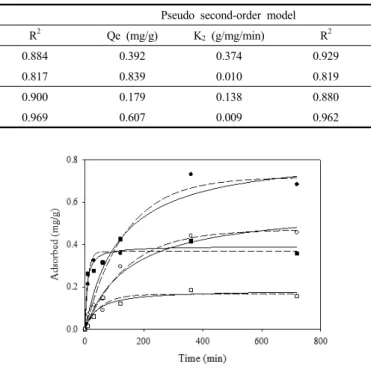
Pseudo first-order model Pseudo second-order model
Qe (mg/g) K1 (1/min) R2 Qe (mg/g) K2 (g/mg/min) R2
RA Cr6+ 0.367 0.098 0.884 0.392 0.374 0.929
As3+ 0.718 0.007 0.817 0.839 0.010 0.819
RA/SS composite Cr6+ 0.159 0.022 0.900 0.179 0.138 0.880
As3+ 0.479 0.006 0.969 0.607 0.009 0.962
Table 2. Kinetic Model Parameters of Pseudo-first-order and Pseudo-second-order Equations and Experimental Results
Figure 1. SEM image of adsorbents. (a) recycled aggregate, (b) steel slag.
(a)
(b)
Figure 2. FT-IR spectrum of adsorbents before heavy metal adsorption. (a) recycled aggregate, (b) steel slag.
Figure 3. Comparison of the measured and modeled adsorption time profiles for mixed heavy metal ions at pH 4. Symbols: (■) Cr6+-RA, (●) As3+-RA, (□) Cr6+-RA/SS composite, and (○) As3+-RA/SS composite.
Lines : pseudo-first-order model (dashed line) and pseudo-second-order model (solid line).
비표면적은 각각 5.981, 0.188 m2/g으로, 순환골재가 제강슬래그보다 넓은 비표면적을 보이고 있지만 일반적인 활성탄에 비해서는 매우 좁 은 비표면적을 나타내고 있는 것을 알 수 있었다. 순환골재(Figure 1(a))와 제강슬래그(Figure 1(b)의 표면 미세구조(SEM)를 관찰한 결과 를 나타내고 있다. 순환골재 및 제강슬래그는 활성탄과 달리 표면이 작은 입자들로 거칠게 표면이 형성되었을 뿐 다공성은 찾아볼 수 없 었다. Figure 2는 순환골재와 제강슬래그에 있어서 표면 관능기 특성
을 FT-IR 스펙트럼을 이용하여 그 변화를 나타내었다(Figure 2). 순환 골재와 제강슬래그의 FT-IR 스펙트라는 400∼4000 cm-1 범위에서 평 가되었다. 양 흡착제에서 비슷한 관능기 특성을 보여주고 있으며, 특 히 3400, 1000 cm-1 범위에서 공통적으로 피크를 보이고 있다. 먼저, 3300∼3400 cm-1에서 강한 밴드를 나타내고 있지만 이러한 피크의 대 부분은 물에 의한 영향 때문이라고 사료된다[19]. 게다가 강한 피크를 보이고 있는 1000 cm-1 피크는 비대칭의 Si-O-Al의 결합 또는 평면 Si-O 결합과 관련이 있다[20,21].
3.2. 동역학적 흡착 실험
순환골재와 순환골재/제강슬래그 조합에 있어서 교반시간에 따른 중금속 흡착 특성을 나타낸 결과(Figure 3), Cr6+의 경우 180 min 정도 에 평형에 도달하였지만 As3+인 경우는 360 min 경과 후 평형에 도달 하였다. 비슷한 연구인 적니(Red mud)와 석회석(Lime stone)을 가지 고 Cr6+과 As3+의 흡착실험에서는 각각 1440 min과 360 min 후 평형 에 도달하는 결과를 보였다[22]. 유사 1차 모델과 2차 모델을 이용한 분석 파라메타 결과를 Table 2에 나타낸 결과를 보면, 순환골재인 경 우 유사 1, 2차 모델의 평형 흡착량은 Cr6+ 있어서 각각 0.367, 0.392 mg/g을 나타내었고, As3+에서는 각각 0.718 mg/g과 0.839 mg/g을 보 였다. 또한, 순환골재/제강슬래그 조합인 경우에는 유사 1, 2차 모델의
Heavy mels Freundlich model Langmuir model
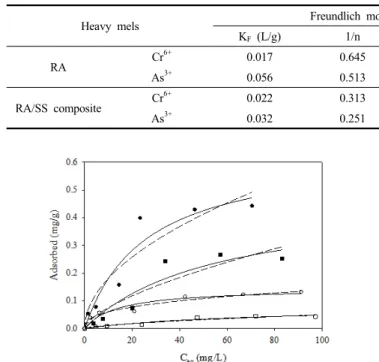
KF (L/g) 1/n R2 Qm (mg/g) KL (L/mg) R2
RA Cr6+ 0.017 0.645 0.861 54.740 0.470 0.898
As3+ 0.056 0.513 0.984 25.685 0.643 0.920
RA/SS composite Cr6+ 0.022 0.313 0.975 8.556 0.089 0.912
As3+ 0.032 0.251 0.990 4.892 0.095 0.923
Table 3. Parameters for Freundlich and Langmuir Model Obtained from Equilibrium Sorption Experiments
Figure 4. Equilibrium adsorption data and model for mixed heavy metal ion. Symbols: (■) Cr6+-RA, (●) As3+-RA, (□) Cr6+-RA/SS composite, and (○) As3+-RA/SS composite. Lines : Freundlich model (dashed line) and Langmuir model (solid line).
Figure 5. Effect of solution pH on adsorption capacity for RA and RA/SS composite.
평형 흡착량은 Cr6+ 있어서 각각 0.159, 0.179 mg/g을 나타내었고, As3+에서는 각각 0.479 mg/g과 0.607 mg/g을 보였다(Table 2). 평형 흡 착량은 유사 1차 모델보다 유사 2차 모델의 경우가 높았다. 한편 As3+
인 경우는 Cr6+보다 높은 평형 흡착량을 보였다. 순환골재와 순환골재/
제강슬래그 조합의 유사 1차 모델과 유사 2차 모델의 상관계수(R2 >
0.817)는 중금속에서 비교적 잘 부합하고 있음을 알 수 있었다(Table 2).
3.3. 평형 흡착 실험
Cr6+과 As3+ 혼합 중금속의 평형흡착실험은 Figure 4 같이 Freundlich 모델과 Langmuir 모델을 적용하였다. Table 3에서와 같이 Freundlich 모델에서 순환골재의 분배계수(K)는 Cr6+ (0.017 L/g), As3+ (0.056 L/g)로 순환골재/제강슬래그 조합에서 보인 Cr6+ (0.022 L/g), As3+
(0.032 L/g)와 비교하면 Cr6+인 경우는 순환골재보다 순환골재/제강슬 래그 조합인 경우가 높은 흡착량을 보인 반면 As3+의 경우는 순환골 재인 경우가 더 높은 흡착량을 보였다. 양 흡착제에서 1/n 값은 1보다 작은 값을 형성하여 전체적으로 강한 흡착경향을 나타내었다[23,24].
Langmuir 모델의 적용에서는 최대흡착량(Qm)이 순환골재인 경우는 Cr6+ (54.740 mg/g), As3+ (25.685 mg/g)로 순환골재/제강슬래그 조합 에서 보인 Cr6+ (8.566 mg/g), As3+ (4.892 mg/g)와 비교하면 순환골재 인 경우가 순환골재/제강슬래그 조합보다 더 높은 흡착량을 보였다 (Table 3). Freundlich 모델과 Langmuir 모델의 상관관계(R2)을 비교해 보면 전체적으로 Langmuir model 보다 Freundlich model에서 더 높은 값을 보였다(단, 순환골재 Cr6+는 제외). 순환골재 및 순환골재/제강슬 래그 조합의 흡착 실험 결과는 단층흡착을 가정한 Langmuir model보 다 다층흡착을 가정한 Freundlich model이 더 잘 부합되는 것으로 나 타났다[3].
3.4. pH의 영향
Cr6+과 As3+의 혼합 중금속 용액의 pH 변화에 따른 중금속 흡착특 성 실험 결과를 Figure 5에 나타냈다. 순환골재인 경우 Cr6+과 As3+의 pH가 6에서 10으로 상승하여도 각각 0.19 mg/g∼0.16 mg/g, 1.59 mg/g∼1.67 mg/g을 나타내고 있어 큰 흡착량의 변화는 없었다. 한편 순환골재/제강슬래그 조합인 경우에는 Cr6+과 As3+의 pH가 상승함에 따라 Cr6+ (0.38 mg/g∼0.31mg/g)은 미미한 감소를 나타내었고 As3+
(1.57 mg/g∼2.15 mg/g)는 증가하는 경향을 보였다(Figure 5). 즉, pH 증가에 따른 Cr6+의 흡착량은 감소한 반면 As3+의 흡착량은 pH가 증 가할수록 증가하는 경향을 보였다. 이러한 결과는 기존 연구에서도 비슷한 결과를 보여주고 있다[25,26]. 게다가 Cr6+과 As3+의 흡착량 특 성을 보면 Cr6+보다 As3+의 흡착량이 높은 것을 알 수 있으며, 단일 순 환골재를 사용할 때보다 순환골재/제강슬래그 조합을 사용하여 흡착 실험을 한 경우가 더 높은 흡착량을 보이고 있다. 이러한 결과는 Table 1에서 보여주고 있는 순환골재(P2O5; 0.1%)와 제강슬래그(P2O5; 2.1%)의 구성성분 중에 인(P2O5) 성분에 영향을 받은 것으로 순환골 재보다 제강슬래그가 다량 함유하고 있어 이러한 인 성분이 비소의 흡착에 영향을 주어 흡착량을 증가시킨 것으로 사료된다[27].
3.5. 해수와 담수 차이에 의한 중금속 제거율에 대한 영향 해수와 담수를 이용하여 순환골재 및 순환골재/제강슬래그 조합의 중금속 제거 특성을 비교하였으며, 실험결과는 Figure 6에 나타냈다.
Cr6+보다 As3+에서 높은 제거율을 보이고 있고, 해수보다 담수에서 더 높은 제거율을 나타내고 있다. 이러한 결과는 해수 내 존재하는 다양 한 미량성분(Ca2+, Mg2+ 등) 원소들에 의한 이온교환, 산화환원, 용해 등의 영향을 주어 흡착제의 구성 물질과 반응 및 변환되어 중금속 제 거에 영향을 미치는 것으로 판단된다[28,29].
3.6. 타 흡착제와의 비교
Table 4에는 타 흡착제와 본 연구에서 사용된 흡착제와의 흡착량을
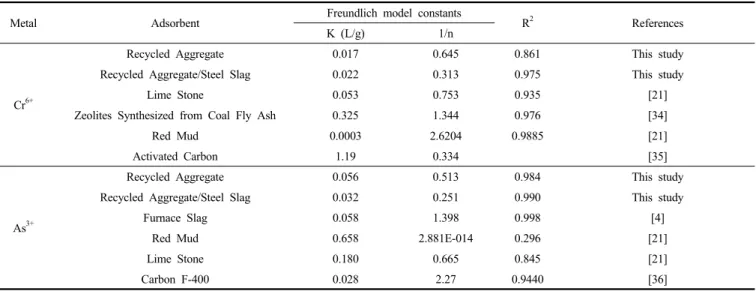
Metal Adsorbent Freundlich model constants
R2 References
K (L/g) 1/n
Cr6+
Recycled Aggregate 0.017 0.645 0.861 This study
Recycled Aggregate/Steel Slag 0.022 0.313 0.975 This study
Lime Stone 0.053 0.753 0.935 [21]
Zeolites Synthesized from Coal Fly Ash 0.325 1.344 0.976 [34]
Red Mud 0.0003 2.6204 0.9885 [21]
Activated Carbon 1.19 0.334 [35]
As3+
Recycled Aggregate 0.056 0.513 0.984 This study
Recycled Aggregate/Steel Slag 0.032 0.251 0.990 This study
Furnace Slag 0.058 1.398 0.998 [4]
Red Mud 0.658 2.881E-014 0.296 [21]
Lime Stone 0.180 0.665 0.845 [21]
Carbon F-400 0.028 2.27 0.9440 [36]
Table 4. Comparison the Adsorption Capacity and Adsorption Affinity between Recycled Aggregate and Other Adsorbent
Figure. 6. Removal rate of heavy metal in sea water and fresh water by RA and RA/SS composite. SW : Sea Water, FW : Fresh Water.
비교한 결과를 나타내었다. Cr6+에 있어서 본 연구에서 사용된 순환골 재와 순환골재/제강슬래그 조합인 경우 광물인 석회석과 산업 부산물 인 적니(Red mud)와는 비슷한 결과를 나타내고 있지만 전처리된 fly ash 및 일반 활성탄과 비교해 보면 흡착량이 떨어지는 것을 알 수 있 다. 한편, 순환골재와 순환골재/제강슬래그 조합에 있어서 As3+인 경우 는 타 흡착제와 비교해서 비교적 낮은 흡착량을 보였다(Table 4). 하지 만 순환골재 및 순환골재/제강슬래그 조합에 있어서 Cr6+와 As3+의 흡 착 강도를 나타내는 1/n은 타 흡착제와 비교해서 강한 흡착 특성을 나 타내고 있다[23,24]. 즉, 1/n 값은 입자와 오염물질간의 흡착강도를 나 타내면 일반적으로 그 값이 0.1∼0.5의 범위에 존재할 때 피흡착제는 흡착이 용이하고 2 이상이면 난흡착성이라고 알려져 있다[23,24]. 또한 경제적인 측면에서 볼 경우에도 일반적인 상업적 분말 활성탄 및 입상 활성탄의 가격은 각각 20,000 US $/ton, 3,300 US $/kg인[30,31] 반면 순환골재와 제강슬래그의 격은 각 지역마다 차이를 보이지만 평균적 으로 각각 2.66, 30 US$/ton의 가격을 나타내고 있어 비용적인 면에서 도 매우 효율적인 흡착제라고 판단된다[32,33].
4. 결 론
본 연구에서는 산업 부산물인 순환골재와 제강슬래그를 이용하여 중금속(Cr6+, As3+)의 흡착 특성을 살펴보았다. 순환골재와 제강슬래그
표면의 물리⋅화학적 특성을 살펴본 결과 표면은 거친 상태를 보였으 며 주요 구성성분은 SiO2, Fe2O3, CaO이며, 흡착에 관여하는 표면 관 능기는 Si-O 밴드가 기여하고 있음을 알 수 있었다. 연구결과 Cr6+인 경우, 순환골재 및 순환골재/제강슬래그 조합에서 모두 180 min 후 평 형에 도달하였지만 As3+인 경우에는 360 min 후 평형 흡착에 도달하 였다. 순환골재인 경우 유사 1, 2차 모델의 평형 흡착량은 Cr6+ 있어서 각각 0.367, 0.392 mg/g을 나타내었고, As3+에서는 각각 0.718 mg/g과 0.839 mg/g을 보였고, 순환골재/제강슬래그 조합인 경우 Cr6+에서 각 각 0.159, 0.179 mg/g을 나타내었고, As3+에서는 각각 0.479, 0.607 mg/g을 보였다. 순환골재 및 순환골재/제강슬래그 조합의 중금속 평 형흡착 결과 Langmuir 모델보다 Freundlich 모델에 잘 부합하는 특성 을 보였다. Freundlich 모델에서 순환골재와 순환골재/제강슬래그 조 합의 평형흡착량은 각각 Cr6+(0.017, 0.022 L/g), As3+(0.056, 0.032 L/g) 로 Cr6+보다 As3+에서 더 높은 흡착량을 보였다. pH 변화에 따른 실험 에서는 순환골재보다 순환골재/제강슬래그 조합에서의 흡착량이 컸으 며, Cr6+보다 As3+에서 높은 흡착 특성을 보였다. 해수에서의 실험결과 해수보다 담수 조건에서 더 높은 흡착 제거율을 보였다.
감 사
이 논문은 2015년 해양수산부의 재원으로 한국해양과학기술진흥원 의 지원을 받아 수행된 연구임(지속가능 해양오염 퇴적물 정화기술 개발).
References
1. W. L. Lindsay, Chemical equilibria in soils, J. Wiley and Sons, New York, USA (1979).
2. Z. R. Holan and B. Volesky, Biosorption of lead and nickel by bi- omass of marine algae, Biotechnol. Bioeng., 43, 1001-1009 (1994).
3. K. S. Hui, C. Y. H. Chao, and S. C. Kot, Removal of mixed heavy metal ions in wastewater by zeolite 4A and residual products from recycled coal fly ash, J. Hazard. Mater., B127, 89-101 (2005).
4. C. T. Oh, S. S. Rhee, T. Igarashi, H. J. Kon, W. T. Lee, and J.
B. Park, Sorption characteristics of arsenic on furnace slag by ad-
sorption isotherm and kinetic sorption experiments, J. Kor.
Geotech. Soc., 26, 37-45 (2010).
5. M. Ahmaruzzaman, Industrial wastes as low-cost potential adsorb- nets for the treatment of wastewater laden with heavy metals, Adan. Colloid Interf. Sci., 166, 36-59 (2011).
6. F. Fu and Q. Wang, Removal of heavy metal ions from waste- water: A review, J. Environ. Manag., 92, 407-418 (2011).
7. M. Jr. Horsfall and A. A. Abia, Sorption of cadmium (II) and zinc (II) ions from aqueous solutions by cassava waste biomass (manihotsculenta Cranz), Water Res., 37, 4913-4923 (2003).
8. W. S. Shin and Y. K. Kim, Bioremediation of contaminated sed- iemnts using microorganism, KIC News, 17, 1-7 (2014).
9. J. B. Kim, J. I. Oh, and C. S. Park, AMD (Acid Mine Drainage) neutralization using recycled-concrete aggregates, J. Kor. Sco.
Environ. Engin., 24, 21-30 (2002).
10. M. Hyodo, T. Kuwabara, S. Sato, and T. Nonaka, Recycling of fine demolished concrete as functional overlying sand, The Japanese Society of Irrigation, Drainage and Rural Engineering (JSIDRE), 257, 19-25 (2008).
11. M. Hyodo, T. Kuwabara, S. Sato, and T. Nonaka, Recycling of fine demolished concrete as functional overlying sand, Japanese Society of Irrigation, Drainage and Rural Engineering (JSIDRE), 257, 19-25 (2008).
12. W. S. Shin and Y. K. Kim, Removal characteristics of Mixed heavy metals from aqueous solution by recycled aggregate as con- struction waste, J. Kor. Soc. Mar. Environ. Energy, 16, 115-120 (2013).
13. N. J. Coleman, W. E. Lee, and J. J. Slipper, Interactions of aque- ous Cu, Zn and Pb ions with crushed concrete fines, J. Hazard.
Mater., 121, 203-213 (2005).
14. J. Simmons, P. Ziemkiewicz, and D. C. Black, Use of steel slag leach beds for the treatment of acid mine drainage, Mine Water Environ., 21, 91-99 (2002).
15. W. S. Shin and Y. K. Kim, Stabilization of mixed heavy metals in contaminated marine sediment using steel slag, J. Navig. Port Res., 38, 269-275 (2014).
16. Y. S. Ho and G. McKay, Thesorption of lead (II) ions on peat, Waster Res., 33, 578-584 (1999a).
17. Y. S. Ho and G. Mckay, Pseudo-second-order model for sorption processes, Proc. Biochem., 34, 451-465 (1999b).
18. C. H. Weng and C. P. Huang, Treatment of metal industrial waste water by fly ash and cement fixation, J. Environ. Eng., 120, 1470-1487 (1994).
19. A. Allahverdi and E. N. Kain, Construction wastes as raw materi- als for geopolymer binders, Inter. J. Civil Eng., 7, 154-160 (2009).
20. N. J. Clayden, S. Esposito, A. Aronne, and P. Pernice, Solid state 27Al NMR and FTIR study of lanthanum aluminosilicate glasses, J. Non-Cryst. Solids, 11, 258-268 (1991).
21. J. D. Ortego and Y. Barroeta, Leaching effects on silicate polymer- ization, A FTIR and 29Si NMR study of lead and zinc in Portland cement, Environ. Sci. Technol., 25, 1171-1174 (1991).
22. K. Kang, S. J. Park, W. S. Shin, B. H. Um, and Y. K. Kim, Removal of synthetic heavy metal (Cr6+, Cu2+, As3+, Pb2+) from water using red mud and lime stone, J. Kor. Sco. Environ. Eng., 34, 566-573 (2012).
23. J. Weber and C. T. Miller, Organic chemical movement over and through soil. In: B. L. sawhney and K. Broen (eds.). Reactions and movement of organic chemicals in soils, SSSA special publication 22, Soil Sci. Soci. Amer., Madison, 305-334, Wisconsin (1989).
24. C. K. Na, M. Y. Han, and H. J. Park, Applicability of theoretical adsorption models for studies on adsorption properties of adsorb- ent(I), J. Kor. Soc. Environ. Eng., 33, 606-616 (2011).
25. H. S. Altundogan, S. Altundogan, F. Tumen, and M. Bildik, Arsenic removal from aqueous solutions by adsorption on red mud, Waste Manange., 20, 761-767 (2000).
26. K. V. Gupta, M. Gupta, and S. Sharma, Process development for the removal of lead and chromium form aqueous solutions using red mud-an aluminium industry waste, Wat. Res., 35, 1125-1134 (2001).
27. S. W. Yun, S. I. Kang, H. G. Jin, H. J. Kim, and C. Yu, Leaching characteristics of arsenic and heavy metals and stabilization effects of limestone and steel refining slag in a reducing environment of flooded paddy soil, J. Agric. Life Sci., 45, 251-263 (2011).
28. V. Hatje, T. E. Payne, D. M. Hill, G. McOrist, and G. F. Birch, Kinetics of trace element uptake and release by particles in estuar- ine waters: effects of pH, salinity, and particle loading, Environ.
Inter., 29, 619-629 (2003).
29. N. Z. Misak, H. F. Ghoneimy, and T. N. Morcos, Adsorption of Co2+ and Zn2+ ions on hydrous Fe(III), Sn(IV), and Fe(III)/Sn(IV) oxides, J. Collid Interf. Sci., 184, 31-43 (1996).
30. G. Atun, G. Hisarli, W. S. Sheldrick, and M. Muhler, Adsorptive removal of methylene blue from colored effluents on fuller's earth, J. Colloid Interf. Sci., 261, 32-39 (2003).
31. C. A. Toles, W. E. Marshall, L. H. Wartelle, and A. McAloon, Steam- or carbon dioxide-activated carbons from almond shells:
physcial, chemical and adsorptive properties and estimated cost of production, Bioresour. Technol., 75, 197-203 (2000).
32. KORAS, http://www.koras.org/05/value.jsp (2008).
33. http://www.alibaba.com
34. C. Jihan, L. Yonglin, C. Peng, L. Kai, S. Qiyu, and Z. Xiangyong, Preliminary study on zeolite materials used to control of heavy metal pollution during the culture of mud clam Tegillarca granosa L., Aquacult. Res., 46, 1426-1435 (2015).
35. K. Selvi, S. Pattabhi, and K. Kadirvelu, Removal of Cr(VI) from aqueous solution by adsorption onto activated carbon, Bioresour.
Technol., 80, 87-89 (2001).
36. D. Mohan, C. U. Pittman Jr, M. Bricka, F. Smith, B. Yancey, J.
Mohammad, P. H. Steele, M. F. Alexandre-Franco, V. Gomez-Serrano, and H. Gong, Sorption of arsenic, cadmium, and lead by chars pro- duced from fast pyrolysis of wood and bark during bio-oil production, J. Colloid Interf. Sci., 310, 57-73 (2007).