Abstract. Background: Methylenetetrahydrofolate reductase plays a central role in converting folate to methyl donor for DNA methylation. Recently, methylenetetrahydrofolate reductase (MTHFR C677T and A1298C) mutations were discovered to be associated with childhood acute lymphoblastic leukemia (ALL), as well as colon cancer, lymphoma, esophageal and stomach cancer. Therefore, it was hypothesized that the MTHFR polymorphisms are associated with the risk of childhood ALL in the Korean population. Patients and Methods: DNA samples taken from 66 patients with ALL and 100 age-matched controls were analyzed using the polymerase chain reaction-restriction fragment length polymorphism (PCR-RFLP) assay for detection of MTHFR C677T and A1298C mutations. Results: The frequency of the AC genotype for MTHFR A1298C polymorphism was significantly different between the controls and the cases (OR, 2.22; CI, 95% 1.09-4.51, p=0.03). The 1298AC+CC genotype was also significantly different (OR, 2.11;
95% CI, 1.06-4.22; p=0.049). There was, however, no significant difference for MTHFR C677T polymorphism and combined genotype frequencies between the two groups. Conclusion:
Although no consistent results on associations between MTHFR
A1298C polymorphism and ALL in the populations studied were obtained, the A1298C polymorphism, at least in Koreans, may be a genetic determinant among childhood ALL patients.
5,10-Methylenetetrahydrofolate reductase (MTHFR) converts 5,10-methylenetetrahydrofolate into 5-methyltetrahydrofolate, and provides the methyl group for homocysteine in methionine synthesis. MTHFR C677T polymorphism, in which valine is substituted for alanine, and MTHFR A1298C polymorphism, in which alanine is substituted for glutamate, showed a 20 – 30% reduction in enzyme activity as well as an association with an increased risk of hyperhomocysteinemia.
It has been reported that the elevation of homocysteine in the blood is associated with an increased risk of arteriosclerosis, myocardial infarction, venous thrombosis and neural tube defect (1). An aberration of folate metabolism causes uracil misincorporation into DNA, leading to the breaking of DNA during uracil excision repair, and increases the risk of chromosomal aberrations, which presumably represents the onset of the leukemogenic process.
In addition to various vessel diseases, MTHFR polymorphism is associated with acute lymphoblastic leukemia (ALL) (2-4). It is also associated with an increased risk of recurrent spontaneous abortion, placental abruption and placental infarction. Folate supplementation during pregnancy was shown to prevent ALL in children (5). In spite of the influence of MTHFR polymorphism on ALL, there were no consistent results among the populations studied. Therefore, whether MTHFR mutations (C677T and A1298C) are associated with childhood ALL patients in Koreans was investigated.
2879 Correspondence to: Doyeun OH, MD, Institute for Clinical
Research, College of Medicine, Pochon CHA University, Yatap- dong 351, Bundang-gu, Seongnam 463-712, South Korea. Tel: 82- 31-780-5217, Fax: 82-31-780-5766, e-mail: [email protected] or [email protected]
Key Words: Acute lymphoblastic leukemia, ALL, methylene- tetrahydrofolate reductase, MTHFR, polymorphism.
A
NTICANCERR
ESEARCH 26: 2879-2882 (2006)Association of the Methylenetetrahydrofolate Reductase Polymorphism in Korean Patients with
Childhood Acute Lymphoblastic Leukemia
NAM KEUN KIM1, SO YOUNG CHONG2, MOON JU JANG2, SEUNG HO HONG3, HEUNG SIK KIM4, EUN KYUNG CHO5, JUNG AE LEE6, MYUNG JU AHN7, CHUL SOO KIM8and DOYEUN OH1,2
1
Institute for Clinical Research and
2Department of Internal Medicine, Bundang CHA General Hospital, College of Medicine, Pochon CHA University;
3
Department of Science Education, Jeju National University Education, Jeju;
4
Department of Internal Medicine, School of Medicine, Keimyung University Dongsan Medical Center;
5
Department of Internal Medicine, Gachon Medical School, Gil Medical Center, Incheon;
6
Department of Internal Medicine, Kangdong Sacred Heart Hospital, Hallym University Medical Center, Seoul;
7
Department of Internal Medicine, Hanyang University College of Medicine, Seoul;
8
Department of Internal Medicine, Inha University Hospital, Incheon, South Korea
0250-7005/2006 $2.00+.40
Patients and Methods
Patients. Sixty-six patients with childhood ALL were recruited from those who visited six different hospitals from two regions in South Korea: Incheon, Seoul and Seongnam in the northern region and Daegu in the southern region. The patients included 39 males and 27 females with a mean age of 9.03 years (range from 1 to 15 years) from July 1996 to June 2002. The control group consisted of 100 individuals randomly selected following health screening to exclude those with a history of malignant neoplastic and thrombotic diseases.
Their ages, as the patients, ranged from 1 to 15 years. All the study subjects gave their written informed consent.
MTHFR genotyping. DNA was extracted from leukocytes with a DNA extraction kit (QIAmp blood kit, Qiagen) according to the manufacturer’s protocol. The MTHFR C677T and A1298C genotypes were identified, as described in Krajinovic et al. (3).
Statistical analysis. The distribution of genotypes was tested for the Hardy-Weinberg equilibrium and for selection against a particular genotype, using the ¯2-test. Differences of allele and genotype frequencies between the cases and the controls were also compared using the ¯2-test. Statistical significance was accepted at p=0.05. All statistical analyses were performed using the Statistical Analysis System software 8.2 (SAS Institute, Inc., NC, USA).
Results
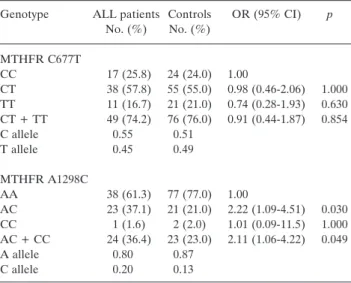
The genotype distributions of MTHFR C677T and A1298C polymorphic loci did not deviate significantly from the Hardy-Weinberg equilibrium in either group (Table I). The frequency of the AC genotype in the A1298C polymorphism
was significantly different between the control and case groups (p=0.03). The odds ratio (OR) of the 1298AC genotype for the 1298AA genotype between the case and control group was 2.22 (95% CI, 1.09-4.51). The distribution of the 1298AC+CC genotype also showed a significant difference between the two groups (p=0.049). The OR of the 1298AC+CC genotype between the case and control groups was 2.11 (95% CI, 1.06-4.22). The genotype frequency of MTHFR C677T, however, was not significantly different between the control and case groups.
The frequencies of combined MTHFR C677T and A1298C genotype polymorphisms are provided in Table II. There were no significant differences in frequencies of the combined genotypes between the two groups. The ORs of the CC+AC, CC+CC, CT+AA, CT+AC and TT+AA combined genotypes for CC+AA between the control and case group were 2.00 (95% CI, 0.53-7.61; p=0.336), 1.00 (95% CI, 0.08-13.0; p=1.00), 0.95 (95% CI, 0.33-2.73; p=1.00), 2.31 (95% CI, 0.71-7.46;
p=0.246) and 1.05 (95% CI, 0.33-3.36; p=1.00), respectively.
Discussion
Association studies between MTHFR polymorphisms and ALL were elucidated in several populations. Skibola et al. (6) reported that individuals within the English population with the MTHFR genotypes 677TT, 1298AC and 1298CC had a lower risk of adult ALL, but not that of acute myeloid leukemia. Weimels et al. (7), in an English study, also found a protective role of the 677T and 1298C variant alleles in a subset of childhood leukemias. Franco et al. (8) suggested that the MTHFR 677CT heterozygote was only linked to a significant two to four-fold decreased risk of developing childhood ALL in the Brazilian population. These studies from 1999 to 2001 hypothesized that MTHFR polymorphism may reduce uracil misincorporation in DNA, lowering the risk of chromosome breaks and, consequently, decreasing the risk of developing leukemia.
A
NTICANCERR
ESEARCH 26: 2879-2882 (2006)2880
Table I. Frequencies of MTHFR C677T and A1298C polymorphisms in the study subjects.
Genotype ALL patients Controls OR (95% CI) p No. (%) No. (%)
MTHFR C677T
CC 17 (25.8) 24 (24.0) 1.00
CT 38 (57.8) 55 (55.0) 0.98 (0.46-2.06) 1.000 TT 11 (16.7) 21 (21.0) 0.74 (0.28-1.93) 0.630 CT + TT 49 (74.2) 76 (76.0) 0.91 (0.44-1.87) 0.854
C allele 0.55 0.51
T allele 0.45 0.49
MTHFR A1298C
AA 38 (61.3) 77 (77.0) 1.00
AC 23 (37.1) 21 (21.0) 2.22 (1.09-4.51) 0.030 CC 1 (1.6) 2 (2.0) 1.01 (0.09-11.5) 1.000 AC + CC 24 (36.4) 23 (23.0) 2.11 (1.06-4.22) 0.049
A allele 0.80 0.87
C allele 0.20 0.13
Frequencies of 1298AC heterozygote (OR=2.22; 95% CI, 1.09-4.51;
p=0.03) and overall (1298AC+CC) (OR=2.11; 95% CI, 1.06-4.22;
p=0.049) of the A1298C polymorphism are significantly different between ALL patients and controls.
Table II. Frequencies of combined MTHFR C677T and A1298C genotype polymorphisms in the study subjects.
MTHFR ALL patients Controls OR (95% CI) p C677T/A1298C No. (%) No. (%)
62a(100.0) 100 (100.0) CC/AA 7 (11.3) 14 (14.0) 1.00
CC/AC 8 (12.9) 8 (8.0) 2.00 (0.53-7.61) 0.336 CC/CC 1 (1.6) 2 (2.0) 1.00 (0.08-13.0) 1.000 CT/AA 20 (32.3) 42 (42.0) 0.95 (0.33-2.73) 1.000 CT/AC 15 (24.2) 13 (13.0) 2.31 (0.71-7.46) 0.246 TT/AA 11 (17.7) 21 (21.0) 1.05 (0.33-3.36) 1.000
aFour DNA samples were not amplified in the MTHFR A1298C genotyping.
After these earlier studies, several papers suggested associations between MTHFR polymorphisms and ALL. In those of French-Canadian origin, the 677TT/1298AA and 677CC/1298CC individuals were associated with a reduced risk of ALL (3). Zanrosso et al. (9) reported that the 677T allele was linked to a decreased risk, whereas the 1298C allele presented an elevated risk factor of ALL in Brazilian non-white children.
On the other hand, polymorphisms in the MTHFR gene were not associated with childhood ALL in the German population (10, 11). In addition, none of the variations were found to significantly affect the risk of developing childhood ALL in Portugal (12).
Recent studies have reported on the response of the MTHFR 677T variant allele to chemotherapy. The MTHFR 677T variant allele was significantly associated with a relapse of childhood ALL, but not with toxicity or infection in the American population (13). The A1298C polymorphism was, however, not linked to altered risks of relapse, toxicity or infection. Dutch pediatric patients with the MTHFR 1298AC variant and ALL showed decreased methotrexate sensitivity (14). In the Greek population, the MTHFR 677T allele showed a statistically significant protective effect against ALL and the 677CC genotype was also associated with three parameters;
white blood count, plasma alanine aminotransferase levels and hemoglobin levels (15).
In conclusion, the MTHFR 1298AC and 1298AC+CC genotypes were associated with increased risk of developing childhood ALL, whereas the C677T polymorphism did not significantly affect this risk in the Korean population. Our data confirm and extend the previous findings by Zanrosso et al. (9), who reported the 1298C allele to an elevated risk factor in Brazilian non-white children. The evidence for the role of the MTHFR 1298C allele in ALL susceptibility, however, was less consistent among the populations studied.
Therefore, future studies should include larger sample sizes and factors relating to both genetics and nutrition to explain the discrepancies among populations.
Acknowledgements
This work was partly supported by the Korea Research Foundation Grant (MOEHRD) (KRF-R05-2003-000-12250-0) funded by the Korean Government.
References
1 Botto LD and Yang Q: 5,10-Methylenetetrahydrofolate reductase gene variants and congenital anomalies: a huge review. Am J Epidemiol 151: 862-877, 2000.
2 Carroll WL, Bhojwani D, Min DJ, Raetz E, Relling M, Mavies S, Downing JR, Willman CL and Reed JC: Pediatric acute lymphoblastic leukemia. Hematology 102-131, 2003.
3 Krajinovic M, Lamothe S, Labuda D, Lemieux-Blanchard E, Theoret Y, Moghrabi A and Sinnett D: Role of MTHFR genetic polymorphisms in the susceptibility to childhood acute lymphoblastic leukemia. Blood 103: 251-257, 2004.
4 Robien K and Ulrich CM: 5,10-Methylenetetrahydrofolate reductase polymorphisms and leukemia risk: a HuGE minireview.
Am J Epidemiol 157: 571-582, 2003.
5 Thompson JR, Gerald PF, Willoughby ML and Armstrong BK:
Maternal folate supplementation in pregnancy and protection against acute lymphoblastic leukaemia in childhood: a case-control study. Lancet 358: 1935-1940, 2001.
6 Skibola CF, Smith MT, Kane E, Roman E, Rollison S, Cartwright RA and Morgan G: Polymorphisms in the methylene- tetrahydrofolate reductase gene are associated with susceptibility to acute leukemia in adults. Proc Natl Acad Sci USA 96: 12810- 12815, 1999.
7 Weimels J, Smith RN, Malcolm G, Taylor M, Eden OB, Alexander FE and Greaves MF: United Kingdom Childhood Cancer Study Investigators. Methylenetetrahydrofolate reductase (MTHFR) polymorphisms and risk of molecularly defined subtypes of childhood acute leukemia. Proc Natl Acad Sci USA 98: 4004-4009, 2001.
8 Franco RF, Simoes BP, Tone LG, Gabellini SM, Zago MA and Falcao RP: The methylenetetrahydrofolate reductase C677T gene polymorphism decreases the risk of childhood acute lymphocytic leukaemia. Br J Haematol 115: 616-618, 2001.
9 Zanrosso CW, Hatagima A, Emerenciano M, Ramos F, Figueiredo A, Felix TM, Segal SL, Guigliani R, Muniz MTC and Pombo-de-Oliveira MS: The role of methylenetetrahydrofolate reductase in acute lymphoblastic leukemia in a Brazilian mixed population. Leukemia Res 30: 477-481, 2006.
10 Thirumaran RK, Gast A, Flohr T, Burwinkel B, Bartram C, Hemminki K and Kumar R: MTHFR genetic polymorphisms and susceptibility to childhood acute lymphoblastic leukemia. Blood 106: 2590-2591, 2005.
11 Schnakenberg E, Mehles A, Cario G, Rehe K, Seidemann K, Schlegeberger B, Elsner HA, Welte KH, Schrappe M and Stanulla M: Polymorphisms of methylenetetrahydrofolate reductase (MTHFR) and susceptibility to pediatric acute lymphoblastic leukemia in a German study population. BMC Med Genet 6: 23, 2005.
12 Oliveira E, Alves S, Quental S, Ferreira F, Norton L, Costa V, Amorim A and Prata MJ: The MTHFR C677T and A1298C polymorphisms and susceptibility to childhood acute lymphoblastic leukemia in Portugal. J Pediatr Hematol Oncol 27: 425-429, 2005.
13 Aplenc R, Thompson J, Han P, La M, Zhao H, Lange B and Rebbeck T: Methylene-tetrahydrofolate reductase polymorphisms and therapy response in pediatric acute lymphoblastic leukemia.
Cancer Res 65: 2482-2487, 2005.
14 de Jonge R, Hooijberg JH, van Zeist BD, Jansen G, van Zantwijk CH, Kaspers GJL, Peters FGJ, Ravindranath Y, Pieters R and Lindemans J: Effect of polymorphisms in folate-related genes on in vitro methotrexate sensitivity in pediatric acute lymphoblastic leukemia. Blood 106: 717-720, 2005.
15 Chatzidakis K, Goulas A, Athanassiadou-Piperopoulou F, Fidani L, Koliouskas D and Mirtsou V: Methylenetetrahydrofolate reductase C677T polymorphism: association with risk for childhood acute lymphoblastic leukemia and response during the initial phase of chemotherapy in a greek patients. Pediatr Blood Cancer 41: 141-151, 2005.
Received April 4, 2006 Accepted June 5, 2006 Kim et al: MTHFR Polymorphism and Childhood ALL Risk
2881