Comparison of Outcomes according to the Time of Initial Surfactant Treatment for Very Low Birth
Weight Infants: A Multicenter Study
Na Mi Lee, M.D.
1, Jung Ju Lee, M.D., Ph.D.
2, Chun Soo Kim, M.D., Ph.D.
3, Eun Ryoun Kim, M.D., Ph.D.
4, Jae Won Shim, M.D., Ph.D.
5, Jae Woo Lim, M.D., Ph.D.
6, Min Hee Kim, M.D.,
Ph.D.
7, Sang Kee Park, M.D., Ph.D.
8, and Young Ah Lee, M.D., Ph.D.
9Department of Pediatrics, College of Medicine, Chung-Ang University
1, Kims Pediatric Clinic
2, Department of Pediatrics, Keimyung University College of Medicine
3, Department of Pediatrics, Sung-Ae General Hosptal
4, Department of Pediatrics, Kangbuk Samsung Hospital, Sungkyunkwan University School of Medicine
5, Department of Pediatrics, Konyang University College of Medicine
6, Department of Pediatrics, Konkuk University College of Medicine
7, Department of Pediatrics, Chosun University College of Medicines
8,
Tomkid Pediatric Clinic
9Purpose : The prophylactic surfactant treatment has been found to improve patient outcomes, compared to the rescue treatment. We performed a multicenter study to determine the relationship between the timing of the initial surfactant treatment and patient outcomes.
Methods : One hundred and seventy one neonates, born at eight different centers, from January 1, 2004 to December 31, 2005, were enrolled. The included subjects were gestational age less than 34 weeks, birth weights less than 1500 g and had respiratory distress syndrome (RDS) that received surfactant. First, a group that received surfactant within two hours after birth was compared to a group that received surfactant after two hours. Next, a group that received surfactant within 30 minutes after birth was compared to a group that received surfactant after 30 minutes.
Results : The mean time after birth at which the initial surfactant was administered to neonates was 140.0 ± 114.3 minutes. The incidence of patent ductus arteriosus (PDA), duration of ventilatory support and hospital days were significantly reduced in the group that received surfactant within two hours after birth. The incidence of PDA and duration of ventilatory support were significantly reduced in the group that received surfactant within 30 minutes after birth.
Conclusion : Surfactant treatment should be provided to premature infants, as soon as possible.
Key Words : Pulmonary surfactant, Very low birth weight infants, Respiratory distress syndrome, Newborn
접수 : 2010년 11월 9일, 수정 : 2012년 2월 20일 승인 : 2012년 5월 24일
주관책임자 : 이정주, 210-080 강원도 강릉시 임당동 114-2 김정호소아과의원
전화 : 033)645-7512, 전송: 02)3010-6978 E-mail : [email protected]
Korean J Perinatol Vol.23, No.2, June, 2012
mortality of very premature newborns.
2Although it has been established that treating RDS with surfactant improves clinical outcomes, many newborns still require mechanical ventilation, which can cause lung injury in preterm infants with RDS, and contribute to the development of chronic lung disease and bronchopulmonary dysplasia (BPD).
1An important question remains concerning the optimal timing of the treatment. There are two basic approaches to the treatment: prophylactic treatment and rescue treat
ment.
3Prophylactic treatment is defined as the Respiratory distress syndrome (RDS) is the single
most important cause of illnesses and deaths in preterm infants.
1However, since surfactant replace
ment therapy has been available as a safe and an
effective therapy of immaturityrelated surfactant
deficiency, since the early 1990s, it has been shown, by
careful randomized trials, to reduce the morbidity and
administration of surfactant through an endotracheal tube, at the time of the initial resuscitation after delivery. Rescue treatment is defined as the admini
stration of surfactant to an intubated baby, several hours after birth and after RDS has been diagnosed.
4Many studies have been performed with regards to the optimal timing of the surfactant treatment and have found that the prophylactic treatment is better than that of the rescue treatment. Yet controversy remains over how to select infants for the prophylactic treat
ment, and how soon after birth to initiate the therapy.
We conducted a multicenter study, at eight centers, to determine the relationship between the timing of the initial surfactant treatment and its associated prog
nosis.
Materials and Methods
1. Study centers
This trial was conducted in the neonatal intensive care units of Gangneung Asan Hospital, Kangbuk Samsung Hospital, Konkuk University Medical Center, Konyang University Hospital, Keimyung University Dongsan Medical Center, DongA University Medical Center, SungAe Hospital, and Chosun University Hos pital in the Republic of Korea. These Hospitals have level 2 and level 3 NICUs that have been es
tablish ed on the national basis, in South Korea. The trial was approved by the institutional review boards of all eight centers.
2. Subjects
One hundred and seventy one neonates who were born in the above eight centers, from January 1, 2004 to December 31, 2005, with birth weights of less than 1,500 g, diagnosed with RDS by clinical and radio
graphic criteria, and received surfactant treatment
were included. RDS was defined as clinical respiratory distress in the presence of chest radiographic evidence of lung field granularity, small lung volumes and air bronchograms as well as fractional inspired con
centration of oxygen (FiO
2) of 0.4 or more, and a ventilator mean airway pressure of 7.0 cm or more of water, or both. Twenty five neonates, with Apgar scores of 03 and who were initially treated with surfactant more than 9 hours after birth, were excluded. One hundred and forty six out of 171 neonates were eligible for the study. All patients received surfactant after diagnosis as RDS. Early rescue therapy is defined as receiving surfactant within 2 hours after birth, and late rescue therapy is defined as receiving surfactant 2 hours later after birth.
Patients diagnosed with RDS received surfactant endotracheally, at a dose of 120 mg/kg. Five aliquots were instilled in each of the following five positions: to the right upper up, the right lower up, the left upper up, the left lower up and the supine. We used Surfac
ten
®(Surfactant, JW pharmaceutical, Mitsubishi Pharma Corporation, Japan)
3. Methods
A retrospective analysis was made of all patients.
The information included the time at which the infants received surfactant of the first dose. First, we divided the early and delayed rescue treatment groups on the basis of 2 hours (time that received surfactant after birth), and thereby, compared the variables and outcomes of these groups.
2Next, we divided the early rescue treatment group on the basis of 30 minutes (time that received surfactant after birth), and com
pared the variables and outcomes of these groups. We compared the survival rate, frequency of pneumo
thorax, BPD, intraventricular hemorrhage and patent
ductus arteriosus (PDA), and the duration of treatment with mechanical ventilation and hospital days between the two groups.
The diagnosis of BPD was made in the infants who needed supplemental oxygen at 36week post
menstrual age (gestational age <32 weeks) or for more than 28 days after birth (gestational age ≥32 weeks) with consistent radiographic changes (persis
tent hazy opacification or cystlike pattern of density and lucency). BPD was also identified only in the in
fants who survived more than 28 days after birth. PDA was diagnosed by echocardiography, and only symptomatic case was identified. Intraventricular hemorrhage was diagnosed by brain ultrasonography, and only highgrade (≥grade III) intraventricular hemorrhage was identified.
4. Statistics
Data are expressed as the mean±SD. We analyzed the data with the paired ttest, chisquare test and KaplanMeier survival curves. A P value of less than 0.05 was considered significant. Statistical analyses were performed using Stata 8.0 statistical software.
Results
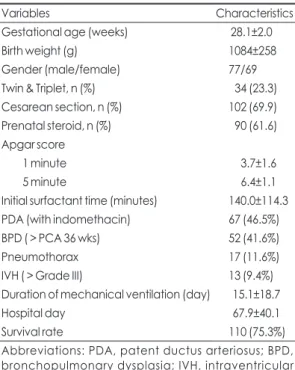
A total of 146 neonates with RDS that were born in the eight participating hospitals, from January 2004 to December 2005, were included in the study. There were 77 males and 69 females. Twin and triplet births accounted for 34 neonates (23.3 %). One hundred and two neonates (69.9%) were delivered by cesarean section. Ninety of the neonates (61.6%) were born to mothers that were treated with antenatal steroids (Table 1).
The mean value of time after birth when the initial surfactant was administered to the neonates was 140.0
±114.3 minutes. Sixty seven neonates (46.5%) were treated with indomethacin for a PDA, and fifty two neonates (41.6%) were diagnosed with BPD. The number of patients that had pneumothorax and intra
ventricular hemorrhage was 17 and 13, respectively.
The mean duration of mechanical ventilatory support was 15.1±18.7 days and for the hospital days was 67.9
±40.1 days. One hundred and ten neonates (75.3%) survived (Table 1).
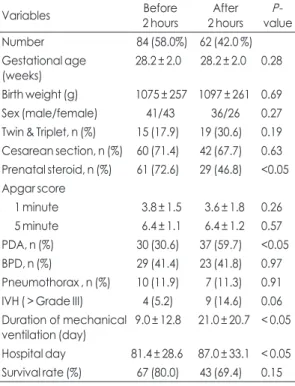
The group that received surfactant within 2 hours after birth included 84 neonates (58.0%); the group that received surfactant after 2 hours included 62 neonates (42.8%). There were no differences between the groups with regard to gestational age, birth weight, gender, multiple births, cesarean section delivery, and Apgar scores. Antenatal steroids were administered more to the infants in the early rescue treatment group than in the delayed rescue treatment group. However,
Table 1. Patient Characteristics at Birth and Their Outcomes
Variables Characteristics
Gestational age (weeks) 28.1±2.0
Birth weight (g) 1084±258
Gender (male/female) 77/69
Twin & Triplet, n (%) 34 (23.3)
Cesarean section, n (%) 102 (69.9)
Prenatal steroid, n (%) 90 (61.6) Apgar score
1 minute 3.7±1.6
5 minute 6.4±1.1
Initial surfactant time (minutes) 140.0±114.3 PDA (with indomethacin) 67 (46.5%)
BPD ( > PCA 36 wks) 52 (41.6%)
Pneumothorax 17 (11.6%)
IVH ( > Grade III) 13 (9.4%)
Duration of mechanical ventilation (day) 15.1±18.7
Hospital day 67.9±40.1
Survival rate 110 (75.3%)
Abbreviations: PDA, patent ductus arteriosus; BPD,
bronchopulmonary dysplasia; IVH, intraventricular
hemorrhage
statistically significant (Fig. 1, 2).
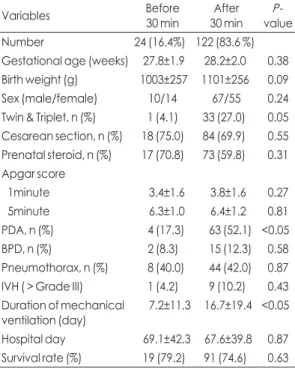
The group that received surfactant within 30 min
utes after birth included 24 neonates (16.4%), and the group that received surfactant after 30 minutes in
cluded 122 neonates (83.6%). There were no signi
ficant differences in the gestational age, birth weight, gender, multiple births, cesarean section deliveries, antenatal steroid therapy, and Apgar scores between the two groups. In addition, there were no differences in the survival rate, frequency of pneumothorax, BPD, intraventricular hemorrhage and duration of hospital days. The incidence of PDA, however, was significantly reduced in the group that received surfactant within 30 minutes, and the duration of ventilator support was also significantly shorter (Table 3). The KaplanMeier survival curves for the duration of ventilator support the outcomes of these groups showed no significant
differences in the survival rate and the frequency of pneumothorax, BPD and intraventricular hemorrhage.
The frequency of PDA was significantly reduced in the group that received surfactant within 2 hours, and the duration of ventilator support and hospital days were also significantly shorter in such group (Table 2). The KaplanMeier survival curves, for the survival analy
sis, duration of ventilatory support and hospital days were used to compare the two groups using the log rank test. The results showed that the duration of ventilator support was significantly shorter in the group that received surfactant within 2 hours after birth. In addition, the KaplanMeier survival curves showed that the number of hospital days was shorter in the group that received the first dose of surfactant <
2 hours after birth. However, this difference was not
Table 2. Comparison of the variables and outcomes according to treatment group
Variables Before
2 hours After 2 hours P-
value
Number 84 (58.0%) 62 (42.0 %)
Gestational age
(weeks) 28.2 ± 2.0 28.2 ± 2.0 0.28 Birth weight (g) 1075 ± 257 1097 ± 261 0.69
Sex (male/female) 41/43 36/26 0.27
Twin & Triplet, n (%) 15 (17.9) 19 (30.6) 0.19 Cesarean section, n (%) 60 (71.4) 42 (67.7) 0.63 Prenatal steroid, n (%) 61 (72.6) 29 (46.8) <0.05 Apgar score
1 minute 3.8 ± 1.5 3.6 ± 1.8 0.26
5 minute 6.4 ± 1.1 6.4 ± 1.2 0.57
PDA, n (%) 30 (30.6) 37 (59.7) <0.05 BPD, n (%) 29 (41.4) 23 (41.8) 0.97 Pneumothorax , n (%) 10 (11.9) 7 (11.3) 0.91 IVH ( > Grade III) 4 (5.2) 9 (14.6) 0.06 Duration of mechanical
ventilation (day) 9.0 ± 12.8 21.0 ± 20.7 < 0.05 Hospital day 81.4 ± 28.6 87.0 ± 33.1 < 0.05 Survival rate (%) 67 (80.0) 43 (69.4) 0.15 Abbreviations: PDA, patent ductus arteriosus; BPD, bronchopulmonary dysplasia; IVH, intraventricular hemorrhage
Fig. 1. Comparison of the duration of ventilator support by initial time of surfactant treatment.
Fig. 2. Comparison of hospital days by initial treatment
time of surfactant.
surfactant should be given as the prophylactic treat
ment or as the rescue treatment.
24, 913Kendig et al.
performed a multicenter randomized trial and con
cluded that the survival was improved in the group that was treated with prophylactic surfactant, parti cularly in the subgroup of patients delivered at 26 weeks of gestation or earlier.
10Egberts et al. also reported that prophylaxis should be considered as the best thera
peutic approach for those newborns with an increased risk for developing RDS and BPD.
11Infants that receive prophylactic treatment had a decreased risk of pneumothorax, pulmonary interstitial em physema, BPD, mortality, and death.
2, 4, 1014The mean time after birth when the initial surfactant was administered to the neonates was 140.0±114.3 min, in our study. In the case of infants with very low and hospital days were used to compare these two
groups, using the log rank test; the result showed that the duration of ventilatory support was significantly shorter in the group that received surfactant within 30 minutes after birth. However, the number of hospital days showed no significant difference (Fig. 3, 4).
Discussion
Artificial surfactant that can be administered through the trachea was introduced by Fujiwara et al
5in the 1980’ s, and has been widely used since then. As a result, the treatment with surfactant has significantly improved the neonatal morbidity and mortality.
2, 69Many investigators, however, have raised the question concerning the timing of the initial surfactant treat
ment. Various studies have investigated whether the Table 3. Comparison of the Variables and Outcomes according to Treatment Group
Variables Before
30 min After 30 min P-
value
Number 24 (16.4%) 122 (83.6 %)
Gestational age (weeks) 27.8±1.9 28.2±2.0 0.38 Birth weight (g) 1003±257 1101±256 0.09
Sex (male/female) 10/14 67/55 0.24
Twin & Triplet, n (%) 1 (4.1) 33 (27.0) 0.05 Cesarean section, n (%) 18 (75.0) 84 (69.9) 0.55 Prenatal steroid, n (%) 17 (70.8) 73 (59.8) 0.31 Apgar score
1minute 3.4±1.6 3.8±1.6 0.27
5minute 6.3±1.0 6.4±1.2 0.81
PDA, n (%) 4 (17.3) 63 (52.1) <0.05 BPD, n (%) 2 (8.3) 15 (12.3) 0.58 Pneumothorax, n (%) 8 (40.0) 44 (42.0) 0.87 IVH ( > Grade III) 1 (4.2) 9 (10.2) 0.43 Duration of mechanical
ventilation (day) 7.2±11.3 16.7±19.4 <0.05 Hospital day 69.1±42.3 67.6±39.8 0.87 Survival rate (%) 19 (79.2) 91 (74.6) 0.63 Abbreviations: PDA, patent ductus arteriosus; BPD, bron chopulmonary dysplasia; IVH, intraventricular hemorrhage
Fig. 3. Comparison of the duration of ventilatory support by initial time of surfactant treatment.
Fig. 4. Comparison of hospital days by initial time of sur-
factant treatment.
birth weight, born from 1996 to 2003 at Gangneung Asan Hospital, the mean time for the initial surfactant was 285 min, and the rate of providing initial surfactant within 2 hours after birth was only 11%. On the other hand, in a large North American cohort, among 47,608 infants with less than 30 weeks gestation, born between 1998 and 2000, 27% received surfactant in the delivery room, and 44% received surfactant by 30 minutes of age.
3The first dose of surfactant was administered at a median time after 50 minutes from birth. By comparison, the mean time of the initial surfactant treatment was late in Korea. The prophy
lactic surfactant treatment is covered by insurance in premature infants of gestational age 30 weeks or birth weight of 1,250 g in Korea. As such, the time of surf
actant treatment is much faster.
Prophylactic administration of surfactant offers the theoretical advantage of replacing surfactant before the onset of respiratory disease, decreasing the need for ventilator support and avoiding secondary baro
traumas, which may result in even shorter periods of assisted ventilation. Such concerns have been con
firmed by numerous studies.
9, 12, 1517In our study, the duration of ventilatory support was significantly shorter in the group that received surfactant within 30 minutes, and within 2 hours after birth, than the group that received surfactant after 30 minutes and 2 hours after birth, respectively, even though we used the surfactant as the rescue treatment.
Studies that compared the surfactant treatment on the basis of 2 hours after delivery have concluded that the early treatment leads to a decreased risk for acute pulmonary injury (pneumothorax and pulmonary inter stitial emphysema) and a decreased risk of neo
natal mortality, as well as BPD, compared to the delay
ing treatment of such infants until the established RDS has developed.
1, 1821In a Korean study, the early sur
factant replacement group was shown to have a decreased duration of ventilatory support.
22However, some studies did not show a difference in hospital days.
19, 20However, the results of our study showed that the number of hospital days was significantly reduced when surfactant was received within 2 hours;
however, not in the group that received surfactant within 30 minutes.
This study has important limitations. Despite the study design being a multicenter study, the limitation mostly stems from its small sample size and its retrospective design. Perhaps a larger group of infants would have resulted in different outcomes for the group that received surfactant within 30 minutes of birth.
In conclusion, early surfactant treatment was asso
ciated with a decrease in the duration of ventilatory support and hospital days. Future studies should focus on the obstacles of providing early surfactant treat
ment. Our findings suggest that surfactant should be provided prophylactically, as soon as possible after birth.
References
1) Stevens TP, Harrington EW, Blennow M, Soll RF. Early surfactant administration with brief ventilation vs. selective surfactant and continued mechanical ventilation for preterm infants with or at risk for respiratory distress syndrome.
Cochrane Database Syst Rev 2007:CD003063.
2) Engle WA. Surfactant-replacement therapy for respiratory distress in the preterm and term neonate. Pediatrics 2008;
121:419-32.
3) Horbar JD, Carpenter JH, Buzas J, Soll RF, Suresh G, Bracken MB, et al. Timing of initial surfactant treatment for infants 23 to 29 weeks' gestation: is routine practice evidence based? Pediatrics 2004;113:1593-602.
4) Morley CJ. Systematic review of prophylactic vs rescue surfactant. Arch Dis Child Fetal Neonatal Ed 1997;77:F70-4.
5) Fujiwara T, Maeta H, Chida S, Morita T, Watabe Y, Abe T.
Artificial surfactant therapy in hyaline-membrane disease.
Lancet 1980;1:55-9.
6) Ten centre trial of artificial surfactant (artificial lung expand- ing compound) in very premature babies. Ten Centre Study Group. Br Med J (Clin Res Ed) 1987;294:991-6.
7) Reininger A, Khalak R, Kendig JW, Ryan RM, Stevens TP, Reubens L, et al. Surfactant administration by transient intubation in infants 29 to 35 weeks' gestation with res- piratory distress syndrome decreases the likelihood of later mechanical ventilation: a randomized controlled trial. J Perinatol 2005;25:703-8.
8) Bae CW, Kim YM. Surfactant Therapy for Neonatal Res- piratory Distress Syndrome: Experience in Korea Over 15 Years. Korean J Pediatr 2004;47:940-8.
9) Suresh GK, Soll RF. Current surfactant use in premature infants. Clin Perinatol 2001;28:671-94.
10) Kendig JW, Notter RH, Cox C, Reubens LJ, Davis JM, Maniscalco WM, et al. A comparison of surfactant as immediate prophylaxis and as rescue therapy in newborns of less than 30 weeks' gestation. N Engl J Med 1991;324:865-71.
11) Egberts J, Brand R, Walti H, Bevilacqua G, Breart G, Gardini F. Mortality, severe respiratory distress syndrome, and chronic lung disease of the newborn are reduced more after prophylactic than after therapeutic administration of the surfactant Curosurf. Pediatrics 1997;100:E4.
12) Kattwinkel J, Bloom BT, Delmore P, Davis CL, Farrell E, Friss H, et al. Prophylactic administration of calf lung sur- factant extract is more effective than early treatment of respiratory distress syndrome in neonates of 29 through 32 weeks' gestation. Pediatrics 1993;92:90-8.
13) Soll RF. Prophylactic natural surfactant extract for prevent- ing morbidity and mortality in preterm infants. Cochrane Database Syst Rev 2000:CD000511.
14) Schmidt R, Markart P, Ruppert C, Wygrecka M, Kuchen- buch T, Walmrath D, et al. Time-dependent changes in pul- monary surfactant function and composition in acute respi- ratory distress syndrome due to pneumonia or aspiration.
Respir Res 2007;8:55.
15) Ikegami M, Wada K, Emerson GA, Rebello CM, Hernandez RE, Jobe AH. Effects of ventilation style on surfactant metabolism and treatment response in preterm lambs. Am J Respir Crit Care Med 1998;157:638-44.
16) Jobe AH, Ikegami M. Mechanisms initiating lung injury in the preterm. Early Hum Dev 1998;53:81-94.
17) Jobe AH, Ikegami M. Surfactant and acute lung injury. Proc Assoc Am Physicians 1998;110:489-95.
18) Yost CC, Soll RF. Early versus delayed selective surfactant treatment for neonatal respiratory distress syndrome.
Cochrane Database Syst Rev 2000:CD001456.
19) Rojas MA, Lozano JM, Rojas MX, Laughon M, Bose CL, Rondon MA, et al. Very early surfactant without mandatory ventilation in premature infants treated with early conti- nuous positive airway pressure: a randomized, controlled trial. Pediatrics 2009;123:137-42.
20) Escobedo MB, Gunkel JH, Kennedy KA, Shattuck KE, Sanchez PJ, Seidner S, et al. Early surfactant for neonates with mild to moderate respiratory distress syndrome: a multicenter, randomized trial. J Pediatr 2004;144:804-8.
21) Ghaemi S, Mohamadymasodi M, Kelishadi R. Evaluation of the effects of surfactant replacement therapy in neonatal respiratory distress syndrome. Zhongguo Dang Dai Er Ke Za Zhi 2009;11:188-90.
22) Lee YS, Lee JH, Lee SG. A Study on the Effects of Early
Surfactant Replacement and Gentle Ventilation in the
Treatment of Respiratory Distress Syndrome. Korean J
Pediatr 2005;48:1096-101.
= 국 문 초 록 =
다기관 연구를 통한 극소저체중출생아에서 초기 폐표면활성제 투여의 시간에 따른 결과 비교
중앙대학교 의과대학 소아청소년과
1, 김정호 소아청소년과의원
2, 계명대학교 동산의료원 소아청소년과
3, 성애병원 소아청소년과
4, 성균관의대 강북삼성병원 소아청소년과
5, 건양대학교 의과대학 소아청소년과
6, 건국대학교병원 소아청소년과
7, 조선대학교 의과대학
소아청소년과
8, 개구쟁이소아과
9이나미1·이정주2·김천수3·김은령4·심재원5·임재우6·김민희7·박상기8·이영아9