Secular Trends in Ischemic Stroke Characteristics in a Rapidly Developed Country
Results From the Korean Stroke Registry Study (Secular Trends in Korean Stroke)
Keun-Hwa Jung, MD, PhD; Seung-Hoon Lee, MD, PhD; Beom Joon Kim, MD;
Kyung-Ho Yu, MD, PhD; Keun-Sik Hong, MD, PhD; Byung-Chul Lee, MD, PhD;
Jae-Kyu Roh, MD, PhD; Korean Stroke Registry Study Group
Background—A dynamic change in industry, lifestyle, and healthcare structure brings a corresponding change in disease patterns. Limited data exist with respect to secular trends in stroke epidemiology in Korea, a rapidly developed country.
Methods and Results—We analyzed individual patient data registered the Korean Stroke Registry, a nationwide hospital-based stroke database, between January 2002 and November 2010. Mortality data were obtained from a national death certificate system. Linear or logistic regression analyses were performed to assess secular trends. A total of 46 098 patients were included in this study. Mean⫾SD age was 66.1⫾12.3 years, and 57.6% of the patients were men.
Over the 9-year period, patient ages steadily increased by 0.24 year annually (P⬍0.001). Risk factor proportions of hypertension, diabetes, smoking, and prior stroke declined slightly (P⬍0.05 for all). However, dyslipidemia frequency showed a complex pattern of an initial decline and then an increase. For relative proportions of subtypes, cardioembolism increased, small vessel occlusion decreased, and large artery atherosclerosis remained stable. Still, intracranial stenosis overwhelms extracranial stenosis, but extracranial stenosis is on the rise. Arrival within 3 hours increased from 20% to 29%, and reperfusion therapy increased from 5.3% to 7.0%. Age-adjusted all-cause mortality did not decrease at 30 days but decreased at 1 year over time.
Conclusions—During the first decade of 21st century, stroke characteristics in Korea changed, likely because of increased lifespan, westernized lifestyle, and improved public awareness. Stroke experts need to cope with these distinguishing trends to establish a better strategy for prevention and acute therapy. (Circ Cardiovasc Qual Outcomes. 2012;5:327-334.)
Key Words: ischemia 䡲 stroke 䡲 trends 䡲 Korea 䡲 registries
S
troke is a major health burden worldwide.1–5Expansion of the aged population and alarmingly increasing vascu- lar risk factor prevalence in the child and middle-aged populations undoubtedly forecast an exponential increase of stroke burden in the near future.3,4 Rates of cardiovascular risk factors and disease phenotypes vary not only by ethnic group, but also across the socioeconomic state of a nation.5 The Korean economy has continued a stable and strong growth during the past 3 or 4 decades, and rapid industrial and societal changes have imposed a great impact on disease patterns.6It is widely supposed, but has not been systemati- cally explored, that multiple domains of risk factors, stroke subtypes, and public awareness of and response to acute stroke have changed in Korea. Experiences from Korea canbe informative in establishing stroke prevention strategies and acute care systems in other rapidly developing countries.
Hospital-based stroke registries have well-recognized lim- itations in generalizability and ability to estimate incidence and prevalence of populations. However, in contrast to population-based epidemiological studies, they generally en- sure more-accurate and comprehensive data with regard to demographics, risk factors, stroke etiology, admission pat- tern, provided care, and clinical outcomes. Accordingly, stroke registries are well suited to defining the secular trends of these multiple domains. The Korean Stroke Registry (KSR) is a multicenter, prospective, hospital-based stroke registry. Launched in 2002, the KSR has collected nationwide data to gain insight into stroke diagnosis and care.7 In the
Received August 25, 2011; accepted February 21, 2012.
From the Department of Neurology, Seoul National University Hospital, Seoul, South Korea (K.-H.J., S.-H.L., B.J.K., J.-K.R.); Department of Neurology, Hallym University Sacred Heart Hospital, Anyang, South Korea (K.-H.Y., B.-C.L.); and Department of Neurology, Ilsan Paik Hospital, Inje University, Goyang, South Korea (K.-S.H.).
The online-only Data Supplement is available at http://circoutcomes.ahajournals.org/lookup/suppl/doi:10.1161/CIRCOUTCOMES.111.963736/-/DC1.
Correspondence to Jae-Kyu Roh, MD, PhD, Department of Neurology, Seoul National University Hospital, 101, Daehangno, Jongno-gu, Seoul 110 –744, South Korea, e-mail [email protected] or Byung-Chul Lee, MD, PhD, Department of Neurology, Hallym University, College of Medicine, 896, Pyungchon, Anyang City, 431-070, South Korea, e-mail [email protected].
© 2012 American Heart Association, Inc.
Circ Cardiovasc Qual Outcomes is available at http://circoutcomes.ahajournals.org DOI: 10.1161/CIRCOUTCOMES.111.963736 327 by guest on February 10, 2016
http://circoutcomes.ahajournals.org/
Downloaded from http://circoutcomes.ahajournals.org/ by guest on February 10, 2016 Downloaded from http://circoutcomes.ahajournals.org/ by guest on February 10, 2016 Downloaded from http://circoutcomes.ahajournals.org/ by guest on February 10, 2016 Downloaded from http://circoutcomes.ahajournals.org/ by guest on February 10, 2016 Downloaded from http://circoutcomes.ahajournals.org/ by guest on February 10, 2016 Downloaded from http://circoutcomes.ahajournals.org/ by guest on February 10, 2016 Downloaded from http://circoutcomes.ahajournals.org/ by guest on February 10, 2016 Downloaded from http://circoutcomes.ahajournals.org/ by guest on February 10, 2016 Downloaded from http://circoutcomes.ahajournals.org/ by guest on February 10, 2016 Downloaded from
present study, we aimed to evaluate recent national trends in clinical characteristics, delay in seeking medical care, reper- fusion therapy, and mortality in patients with acute ischemic stroke in Korea.
WHAT IS KNOWN
● Rapid industrial and societal changes can lead to dynamic changes in risk factors, stroke phenotypes, and treatment.
● Korea has achieved a remarkably high level of economic growth in a short period of time.
WHAT THE STUDY ADDS
● The ages of patients with stroke are steadily increas- ing over time.
● Cardioembolic stroke continues to increase.
● Extracranial artery stenosis is on the rise.
● Arriving at the hospital within 3 hours and reperfu- sion therapy are increasing.
● Age-adjusted all-cause mortality at 1 year is decreasing.
Methods Registry Characteristics
In 2002, the Korean Stroke Society launched a task force comprising stroke specialists in neurology from 26 major university hospitals throughout the country as well as recruited hospitals. To date, the 31 educational general hospitals in Korea have phased in the registry system (online-only Data Supplement Table I). The participating hospitals have registered patients with ischemic stroke or transient ischemic attack (TIA) within 7 days after symptom onset. Stroke was diagnosed through clinical symptoms and relevant findings on CT and MRI scans and magnetic resonance angiography. TIA was defined as a sudden focal neurological deficit that completely resolves within 24 hours. The KSR provides a Web-based database (www.strokedb.or.kr) in which each participating hospital can reg- ister patient data in real time. An attending physician initially enters the data into the registry, and all records are regularly monitored within a 1- to 2-week interval by dedicated faculty members with stroke expertise at each hospital for completeness and consistency.
The steering committee of KSR has monitored data consistency regularly within a 3-month interval and has encouraged consistent registration. Nonetheless, unexpected circumstances, such as change of individual hospital policies and turnover of dedicated staff at each hospital could cause inconsistent registration during a certain period.
The guidelines and procedures of this registry were approved by the Institutional Review Board of the Hallym University Sacred Heart Hospital as a delegate of participating hospitals.
Data Acquisition
We acquired all registered data from 31 centers between January 2002 and November 2010. Exclusion criteria were missing demo- graphic information; incomplete (⬎10%) documentation for all categories; duplication; protocol violations, such as admission after 7 days from onset; and age⬍16 years. For each patient, we collected data on demographics, risk factors, Trial of RRG 10172 in Acute Stroke Treatment (TOAST) stroke subtypes, stroke onset, prehospi- tal delays, initial stroke severity as measured by the National Institute of Health Stroke Scale (NIHSS), radiological findings of intracranial and extracranial stenosis relevant for the index stroke, and in-hospital management. We also obtained mortality data for each patient from the Korean National Vital Statistics system.
Definition of Variables
Vascular risk factors included hypertension, diabetes mellitus, dys- lipidemia, potential source of cardioembolism (CE), smoking, and history of previous stroke. Hypertension was defined as a systolic blood pressure ⬎140 mm Hg, a diastolic blood pressure
⬎90 mm Hg, and current use of antihypertensive agents. Diabetes mellitus was diagnosed through relevant clinical or drug history or biochemical evidence of at least 2 measurements of fasting blood glucose readings of ⬎126 mg/dL. Dyslipidemia was defined as current use of lipid-lowering agents or at least 2 abnormal serum lipid measurements (total cholesterol⬎240 mg/dL or low-density lipoprotein cholesterol⬎160 mg/dL). The presence of a potential source of CE was defined as having 1 of the following high-risk cardiac conditions: mechanical prosthetic valve, mitral stenosis with atrial fibrillation, atrial fibrillation, left atrial or atrial appendage thrombus, sick sinus syndrome, recent myocardial infarction (⬍4 weeks), left ventricular thrombus, dilated cardiomyopathy, akinetic left ventricular segment, atrial myxoma, and infective endocarditis.8 Smoking was defined as a smoking history of⬎2 pack-years or current smoker.
The stroke mechanisms were determined by TOAST criteria as follows8: large artery atherosclerosis (LAA), small vessel occlusion (SVO), CE, stroke of other etiology, and stroke of undetermined etiology. TIA was not classified for a certain etiology in the TOAST criteria. The KSR provides an algorithm protocol for TOAST classification to enhance standardization. All records on stroke subtypes were monitored by faculty members at each hospital for internal consistency and were refined by a regular discussion by the steering committee for external consistency. In LAA subtype, the location of stenosis relevant to the index stroke was classified into intracranial arterial stenosis of anterior circulation (A-ICAS), ex- tracranial arterial stenosis of anterior circulation (A-ECAS), and posterior circulation stenosis. The A-ICAS was defined as⬎50%
luminal narrowing or occlusion of proximal portions of the middle cerebral artery, anterior cerebral artery, and intracranial portion of the internal carotid artery.9 The A-ECAS was defined as ⬎50%
luminal narrowing or occlusion of extracranial portions of the internal carotid artery and common carotid artery.10The posterior circulation stenosis was defined as ⬎50% luminal narrowing or occlusion of the vertebral artery, basilar artery, and posterior cerebral artery.
Statistical Analysis
Baseline characteristics were summarized by mean⫾SD or number and percentage for each calendar year of stroke diagnosis. Annual trends in age, time interval after onset, and NIHSS scores were estimated by linear regression analyses. Age trend was analyzed separately for men and women. For the binary categorical variables, log-linear Poisson models were used to estimate rates of increase by calendar year. Calendar year was treated as a continuous variable in the analysis. The mortality change was adjusted for age using 10-year age intervals. Results are presented as relative risks (RRs) with 95% CIs. All P values are 2 sided, and a 5% level of statistical significance was used. Statistical analyses were performed with SAS STAT version 9.1 software.
Results
Baseline Characteristics of the Patients
A total of 53 542 patients were registered in the KSR during the study period. After a review of the records, we excluded 7444 patients because of missing demographic information and incomplete (⬎10%) documentation for all categories (n⫽2922); duplicate registrations (n⫽2061) from early refer- ral to another hospital, recurrences, or registration errors;
protocol violations (n⫽2461), such as admission after 7 days of onset; and age⬍16 years. The numbers of excluded cases according to each hospital and year are shown in online-only Data Supplement Table I. There were no significant changes 328 Circ Cardiovasc Qual Outcomes May 2012
in the exclusion number among the years or the hospitals, but clinical characteristics of the excluded cases differed from those of the study population with respect to age, risk factors, NIHSS score, and prehospital delay (online-only Data Sup- plement Table II).
Finally, 46 098 patients with ischemic stroke and TIA were included in the current study. The mean age was 66.1⫾12.3 years, and 26 566 (57.6%) were men. Women were older than men (69.2⫾11.9 versus 63.9⫾12.1 years, P⬍0.001). There were 42 981 (93.2%) ischemic strokes and 3117 (6.8%) TIAs.
Hypertension was the most common vascular risk factor (29 266 patients [63.5%]) followed by smoking (33.0%), diabetes mellitus (30.1%), prior stroke (19.7%), potential sources of CE (19.4%), and dyslipidemia (19.3%). Detailed data for the baseline characteristics of the study population are shown in online-only Data Supplement Table II.
Secular Trends
Demographic and Risk Factors
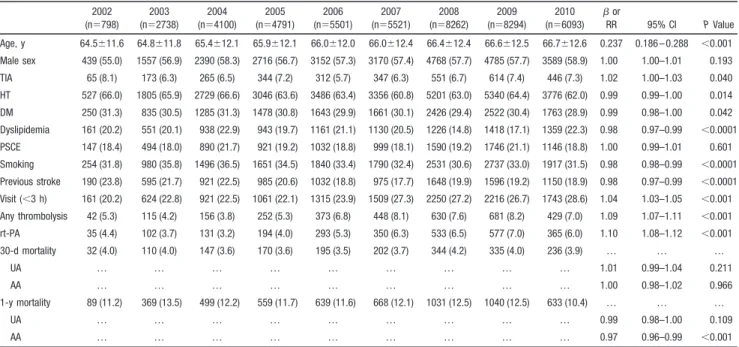
Table 1 and Figure 1 show the secular trends by age, sex, and vascular risk factors expressed as the regression coefficient () and RR from linear and log-linear Poisson regression analysis, respectively. Ages at stroke onset have increased over time (⫽0.237 per calendar-year; 95% CI, 0.186–
0.288; P⬍0.001). When stratified by sex, the increasing trend was more prominent in women than in men (Figure 1). The proportion by sex was not significantly changed (P⫽0.193).
For risk factors, frequencies of hypertension, diabetes melli- tus, smoking, and prior stroke have decreased statistically (P⬍0.001), but the changes were not substantial. A complex pattern was noted for dyslipidemia. Its frequency decreased slowly from 2002 to 2007 and then increased again after
2008. Frequency of potential source of CE remained stable during the study period.
Stroke Subtypes
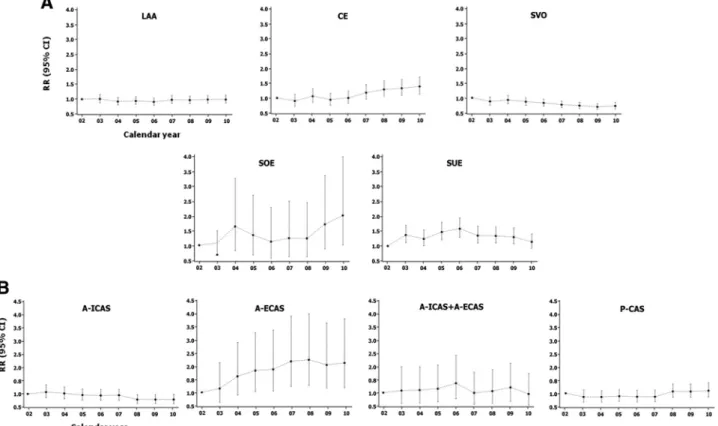
Of 46 098 patients, 36 191 with ischemic stroke were subjected to the stroke subtype analysis after excluding 3117 with TIA (6.8%) and 6790 with missing values based on TOAST classification (14.7%). LAA stroke was the most frequent stroke subtype (36.1%) followed by SVO (25.4%), CE (17.1%), and other (stroke of other etiology, 1.8%; stroke of undetermined etiology, 19.6%). In Poisson regression models, the relative proportion of SVO decreased, with an RR of 0.96 per year (95% CI, 0.95– 0.97) between 2002 and 2010, whereas CE increased, with an RR of 1.06 per year (95% CI, 1.05–1.08) during the same period (P⬍0.001) (Table 2). This trend in the stroke subtype is also shown in Figure 2A. The relative proportion of LAA did not show any directional trend across time periods over the 9 years of the study. Although stroke of undetermined etiology proportions have decreased (RR, 0.99; P⫽0.021), extensive investigation still failed to define stroke mechanisms in one sixth of the patients. Stroke of other etiology proportions have increased (RR, 1.08; P⬍0.001), but its contributions were minute at ⬍3%.
Distribution of Stenoocclusive Lesions
Of 13 061 patients with LAA subtype, angiographic data were available for 11 123 (85.2%). Stenoocclusive lesions relevant for the index stroke were classified into A-ICAS, A-ECAS, A-ICAS⫹A-ECAS (patients with carotid territory stroke having tandem lesions), and posterior circulation stenosis. Between 2000 and 2010, relative proportions of A-ECAS (RR, 1.07; P⬍0.001) and posterior circulation stenosis (RR, 1.04; P⬍0.001) have increased over time,
Table 1. Regression Models of Demographic and Risk Factors, Thrombolysis, and Mortality by Calendar Year of Stroke Diagnosis in Korea, 2002 to 2010
2002 (n⫽798)
2003 (n⫽2738)
2004 (n⫽4100)
2005 (n⫽4791)
2006 (n⫽5501)
2007 (n⫽5521)
2008 (n⫽8262)
2009 (n⫽8294)
2010 (n⫽6093)  or
RR 95% CI P Value
Age, y 64.5⫾11.6 64.8⫾11.8 65.4⫾12.1 65.9⫾12.1 66.0⫾12.0 66.0⫾12.4 66.4⫾12.4 66.6⫾12.5 66.7⫾12.6 0.237 0.186–0.288 ⬍0.001 Male sex 439 (55.0) 1557 (56.9) 2390 (58.3) 2716 (56.7) 3152 (57.3) 3170 (57.4) 4768 (57.7) 4785 (57.7) 3589 (58.9) 1.00 1.00–1.01 0.193 TIA 65 (8.1) 173 (6.3) 265 (6.5) 344 (7.2) 312 (5.7) 347 (6.3) 551 (6.7) 614 (7.4) 446 (7.3) 1.02 1.00–1.03 0.040 HT 527 (66.0) 1805 (65.9) 2729 (66.6) 3046 (63.6) 3486 (63.4) 3356 (60.8) 5201 (63.0) 5340 (64.4) 3776 (62.0) 0.99 0.99–1.00 0.014 DM 250 (31.3) 835 (30.5) 1285 (31.3) 1478 (30.8) 1643 (29.9) 1661 (30.1) 2426 (29.4) 2522 (30.4) 1763 (28.9) 0.99 0.98–1.00 0.042 Dyslipidemia 161 (20.2) 551 (20.1) 938 (22.9) 943 (19.7) 1161 (21.1) 1130 (20.5) 1226 (14.8) 1418 (17.1) 1359 (22.3) 0.98 0.97–0.99 ⬍0.0001 PSCE 147 (18.4) 494 (18.0) 890 (21.7) 921 (19.2) 1032 (18.8) 999 (18.1) 1590 (19.2) 1746 (21.1) 1146 (18.8) 1.00 0.99–1.01 0.601 Smoking 254 (31.8) 980 (35.8) 1496 (36.5) 1651 (34.5) 1840 (33.4) 1790 (32.4) 2531 (30.6) 2737 (33.0) 1917 (31.5) 0.98 0.98–0.99 ⬍0.0001 Previous stroke 190 (23.8) 595 (21.7) 921 (22.5) 985 (20.6) 1032 (18.8) 975 (17.7) 1648 (19.9) 1596 (19.2) 1150 (18.9) 0.98 0.97–0.99 ⬍0.0001 Visit (⬍3 h) 161 (20.2) 624 (22.8) 921 (22.5) 1061 (22.1) 1315 (23.9) 1509 (27.3) 2250 (27.2) 2216 (26.7) 1743 (28.6) 1.04 1.03–1.05 ⬍0.001 Any thrombolysis 42 (5.3) 115 (4.2) 156 (3.8) 252 (5.3) 373 (6.8) 448 (8.1) 630 (7.6) 681 (8.2) 429 (7.0) 1.09 1.07–1.11 ⬍0.001 rt-PA 35 (4.4) 102 (3.7) 131 (3.2) 194 (4.0) 293 (5.3) 350 (6.3) 533 (6.5) 577 (7.0) 365 (6.0) 1.10 1.08–1.12 ⬍0.001 30-d mortality 32 (4.0) 110 (4.0) 147 (3.6) 170 (3.6) 195 (3.5) 202 (3.7) 344 (4.2) 335 (4.0) 236 (3.9) … … …
UA … … … … … … … … … 1.01 0.99–1.04 0.211
AA … … … … … … … … … 1.00 0.98–1.02 0.966
1-y mortality 89 (11.2) 369 (13.5) 499 (12.2) 559 (11.7) 639 (11.6) 668 (12.1) 1031 (12.5) 1040 (12.5) 633 (10.4) … … …
UA … … … … … … … … … 0.99 0.98–1.00 0.109
AA … … … … … … … … … 0.97 0.96–0.99 ⬍0.001
Data are presented as mean⫾SD or n (%), unless otherwise indicated. P value and age were analyzed by linear regression and other categorical variables by log-linear Poisson regression. RR indicates relative risk; TIA, transient ischemic attack; HT, hypertension; DM, diabetes mellitus; PSCE, potential source of cardioembolism; rt-PA, recombinant tissue-type plasminogen activator; UA, unadjusted; AA, age adjusted.
Jung et al Secular Trends in Korean Stroke 329
whereas the A-ICAS proportion has declined (RR, 0.95;
P⬍0.001) (Table 2). This trend in the LAA subtype is also shown in Figure 2B.
Interval of Onset to Arrival and Thrombolysis Rate For all patients, the average time interval between symptom onset and admission was 28.4⫾36.0 hours. As shown in online-only Data Supplement Figure I, the time interval has significantly decreased from 31.7⫾37.6 to 26.8⫾33.9 hours between 2002 and 2010 (P⬍0.001 for trend). The proportion of patients admitted within 3 hours of symptom onset has increased over time (RR, 1.04; P⬍0.001) (Table 1, Figure 3A) from 20.2% in 2002 to 28.6% in 2010. In concert with the decline in prehospital delay, intravenous recombinant tissue-type plasminogen activator use increased from 4.4% in 2002 to 6.0% in 2010, and any reperfusion therapy increased from 5.3% in 2002 to 7.0% in 2010 (Table 1, Figure 3B).
Stroke Severity on Admission and Mortality
The average NIHSS score was 4 (interquartile range, 2–9), indicating that the majority of enrolled patients had a mild to moderate stroke severity. For patients arriving within 24 hours from onset, the admission NIHSS score markedly declined between 2002 and 2005 (P⬍0.001) (online-only
Data Supplement Figure II), but it did not further decrease after 2005. Overall, all-cause mortality rates were 4% at 30 days and 12% at 1 year (Table 1). Age-adjusted analyses did not show any significant decline in 30-day mortality (P⫽0.966) but demonstrated a significant decline in 1-year mortality (P⬍0.001) (Figure 3C).
Discussion
Changing trends in stroke epidemiology in Korea should be understood in the context of the country’s extremely rapid economic growth and globalization. Korea has achieved a remarkably high level of economic growth in a short period of time. Its economy is already the 10th largest in the world, and the rapid pace of its economic development over the past 3 decades is the highest according to the Organization for Economic Cooperation and Development.6In this period of transition, rapid industrial and societal changes could lead to dynamic changes in stroke phenotypes. The current nation- wide stroke registry study indicates that even during a 9-year period within the first decade of 21st century, there were notable changes in age, risk factors, stroke subtypes, the public seeking out acute medical care, and reperfusion therapy. Understanding these dynamic trends in patient- and care-related domains could Figure 1. Secular trends for demographic and risk factors among Korean patients with ischemic stroke (2002–2010). The graphs repre- sent age, sex, TIA, and cerebrovascular risk profiles by time period. Estimates were from linear regression (age) or Poisson regression analysis (other variables), with the 2002 group as the reference. DM indicates diabetes mellitus; HT, hypertension; PSCE, potential source of cardioembolism; RR, relative risk; TIA, transient ischemic attack.
330 Circ Cardiovasc Qual Outcomes May 2012
help to guide health providers and policymakers in developing guidelines for stroke prevention and care in Korea as well as in other rapidly developing countries.
The secular changes in demographic and risk factors are likely to impose changes in stroke subtypes, treatment, and outcomes.11Mean age of patients with stroke increased by
⬎2 years from 64.5 to 66.7 years during the 9-year period,
and the increase was greater in women than in men. Popula- tion aging in Korea is projected to be the fastest in the Organization for Economic Cooperation and Development area.6 Aging of the present stroke population might be attributable to an increase in life expectancy of the general Korean population, which increased by⬎4 years from 76.5 years (men, 72.8 years; women, 80.0 years) in 2001 to 80.6
Figure 2. Secular trends for stroke subtypes and distribution of stenoocclusive lesions on angiography in the LAA subtype among Korean patients with ischemic stroke (2002–2010). A, Subtypes of ischemic stroke by time period. B, Distribution of stenoocclusive lesions by time period. Data were from 11 123 subjects who had the LAA subtype. Lesion distribution was classified into A-ICAS, A-ECAS, A-ICAS⫹A-ECAS, and P-CAS. Estimates were from Poisson regression models, with the 2002 group as the reference.
A-ECAS indicates extracranial arterial stenosis of anterior circulation; A-ICAS, intracranial arterial stenosis of anterior circulation; CE, cardioembolism; LAA, large artery atherosclerosis; P-CAS, posterior circulation stenosis; RR, relative risk; SOE, stroke of other deter- mined etiology; SUE, stroke of undetermined etiology; SVO, small vessel occlusion.
Table 2. Regression Models of Stroke Subtypes and Distribution of Stenoocclusive Lesions by Calendar Year of Stroke Diagnosis in Korea, 2002 to 2010
2002 (n⫽700)
2003 (n⫽2510)
2004 (n⫽3774)
2005 (n⫽4229)
2006 (n⫽4290)
2007 (n⫽4277)
2008 (n⫽6082)
2009 (n⫽6406)
2010
(n⫽3923) RR 95% CI P Value LAA 262 (37.4) 950 (37.8) 1299 (34.4) 1494 (35.3) 1462 (34.1) 1572 (36.8) 2204 (36.2) 2363 (36.9) 1455 (37.1) 1.01 1.00 –1.01 0.174 SVO 224 (32.0) 706 (28.1) 1124 (29.8) 1174 (27.8) 1142 (26.6) 1052 (24.6) 1436 (23.6) 1433 (22.4) 915 (23.3) 0.96 0.95–0.97 ⬍0.0001 CE 103 (14.7) 331 (13.2) 589 (15.6) 583 (13.8) 634 (14.8) 744 (17.4) 1157 (19.0) 1252 (19.5) 803 (20.5) 1.06 1.05–1.08 ⬍0.0001 SOE 9 (1.3) 22 (0.9) 79 (2.1) 73 (1.7) 62 (1.4) 68 (1.6) 96 (1.6) 140 (2.2) 101 (2.6) 1.08 1.04–1.11 ⬍0.0001 SUE 102 (14.6) 501 (20.0) 683 (18.1) 905 (21.4) 990 (23.1) 841 (19.7) 1189 (19.5) 1218 (19.0) 649 (16.5) 0.99 0.98–1.00 0.021
LAA Subgroup
2002 (n⫽193)
2003 (n⫽756)
2004 (n⫽1125)
2005 (n⫽1329)
2006 (n⫽1208)
2007 (n⫽1345)
2008 (n⫽1909)
2009 (n⫽2106)
2010
(n⫽1152) RR 95% CI P Value A-ICAS 96 (39.7) 404 (53.4) 570 (50.7) 634 (47.7) 565 (46.8) 633 (47.1) 746 (39.1) 824 (39.1) 452 (39.2) 0.95 0.94–0.97 ⬍0.0001 A-ECAS 12 (6.2) 54 (7.1) 113 (10.0) 152 (11.4) 142 (11.8) 184 (13.7) 268 (14.0) 270 (12.8) 153 (13.3) 1.07 1.04–1.09 ⬍0.0001 A-ICAS⫹A-ECAS 13 (6.7) 55 (7.3) 83 (7.4) 103 (7.8) 111 (9.2) 90 (6.7) 136 (7.1) 170 (8.1) 74 (6.4) 0.99 0.96–1.02 0.650 P-CAS 72 (37.3) 243 (32.1) 359 (31.9) 440 (33.1) 390 (32.3) 438 (32.6) 759 (39.8) 842 (40.0) 473 (41.1) 1.04 1.03–1.06 ⬍0.0001
Data are presented as n (%), unless otherwise indicated. P value was analyzed by log-linear Poisson regression. RR indicates relative risk; LAA, large artery atherosclerosis; SVO, small vessel occlusion; CE, cardioembolism; SOE, stroke of other etiology; SUE, stroke of undetermined etiology; A-ICAS, intracranial arterial stenosis of anterior circulation; A-ECAS, extracranial arterial stenosis of anterior circulation; P-CAS, posterior circulation stenosis.
Jung et al Secular Trends in Korean Stroke 331
years in 2009 (men, 77.0 years; women, 83.8 years).12 The steep increase of age at stroke onset as well as the general population’s life expectancy indicates a continuing increase of elderly patients with stroke who are generally at higher risk for poor prognosis and less responsive to intervention. Ac- cordingly, societal burden of the elderly stroke population would be a significant concern in coming decades in Korea.
Meanwhile, risk factor proportions of hypertension, diabe- tes, smoking, and prior stroke have declined slightly. A recent systematic review indicates a slowly increasing trend in the prevalence in hypertension, diabetes mellitus, and dyslipid- emia in the community.13However, the prevalence in the risk factors can vary depending on survey area, time, and age, sex, and disease distribution of the study population. The ideal stroke registry would be population based. Unfortunately, to date, there has been no systematic investigation for the prevalence of risk factors with respect to Korean ischemic stroke. In practice, it is very difficult to establish such an ideal stroke registry because of methodological and financial lim- itations. The current study is the first detailed analysis to our knowledge that is based on the KSR, which ensures more- accurate and comprehensive nationwide data.
As widely recognized, hypertension was the most predom- inant risk factor in the population, but its prevalence in the stroke population decreased over time. In elderly patients, the occurrence of stroke attributable to hypertension is lower than in younger patients.14The increase of elderly patients with stroke might be one factor that explains the declining trend of hypertension frequency in the stroke population. On the other hand, hypertension is more closely associated with SVO than with CE.15Thus, the relative decrease of SVO and increase of CE would be another factor associated with the declining trend of hypertension frequency. However, taking its high prevalence and proven treatment efficacy in the elderly into account, the finding does not negate the priority of hyperten- sion control for stroke prevention.
Smoking is also a leading risk factor in all stroke sub- types.16It should be noted that one third of the patients with stroke were current smokers or had a history of smoking of
⬎2 years, despite its decreasing trend. Compared with the global stroke population enrolled in REACH (Reduction of Atherothrombosis for Continued Health) Registry,17the pres- ent patients with stroke had a lower rate of current or previous smoking. This low rate is likely attributable to a very low rate of smoking in women. The National Health and Nutrition Survey in 2005 reported that smoking prevalence was 53.3%
in men and 5.8% in women aged⬎15 years in Korea.18This gender difference in smoking prevalence in Korea is much higher than in the US population (22.3% in men and 17.4% in women).19When restricted to the male stroke population, the rate of current or previous smoking was 52.6% and compa- rable to or higher than those of other countries. Because smoking is a major preventable risk factor, educational efforts to prevent or stop smoking should be further encouraged.
In the study, dyslipidemia was found in less than one fourth of patients with stroke, which is lower than the 30% to 50%
observed in other studies.17,20,21However, it should be noted that we used a high threshold of total cholesterol (⬎240 mg/dL) and low-density lipoprotein cholesterol (⬎160 mg/
dL) to define dyslipidemia. When we started the KSR registry, definitions of hypercholesterolemia were not unified worldwide, and our threshold was the insurance reimburse- ment criteria for treating hypercholesterolemia. Therefore, with contemporary criteria applied, the dyslipidemia preva- lence would be greater. Hypercholesterolemia within the REACH Registry was present in 67% of the population in Eastern Europe, whereas it is 45% in Asia. For carotid plaque, the prevalence rates ranged from 45.1% in Western Europe to 20.5% in Asia.17The present observation of a recent increase in dyslipidemia is consonant with the findings of an earlier study that demonstrated an increasing trend in dyslipidemia prevalence in Asians.22 This changing trend indicates an Figure 3. Secular trends for visit within a 3-hour window, thrombolytic therapy, and mortality among Korean patients with ischemic stroke (2002–2010). A, Patients who sought evaluation at the hospital within 3 hours after the onset of symptoms by time period. B, Patients who underwent any thrombolytic and rt-PA therapy by time period. C, Changes in 30-day and 1-year mortality after incident stroke by time period. Estimates were from Poisson regression models, with the 2002 group as the reference. rt-PA indicates recombi- nant tissue-type plasminogen activator.
332 Circ Cardiovasc Qual Outcomes May 2012
adverse transition of vascular risk factors to a more athero- genic profile.
Although the relative proportion of SVO decreased, the proportion of CE increased from 14.7% to 20.5%, which is less than, but still approaching, the 25.6% of CE finding in the German Stroke Data Bank.23Increased physician aware- ness of the importance of CE source detection leading to a more-extensive work-up for this condition would partly explain the increase of CE. Actually, the performance fre- quency of diagnostic modalities, including transthoracic echocardiography, transesophageal echocardiography, and Holter monitoring, tended to increase across time periods over the 9 years studied (online-only Data Supplement Figure III, online-only Data Supplement Table III), but the changes were not substantial. A prior study reported that even after adjusting for age, atrial fibrillation incidence increased during the past 2 decades.24If the incidence continuously increases, the projected number of adults with atrial fibrillation would increase by 3-fold from 2000 to 2050.25 Although atrial fibrillation was rare (0.1%– 0.5%) in middle-aged patients, the prevalence was 3.5% to 9% in elderly patients.6,7 The increasing trend of CE in Korea is likely to be caused by the increased number of elderly patients with atrial fibrilla- tion.25,26 The geographical variations of atrial fibrillation within the REACH Registry have been reported to range from 7.7% in Asia to 16% in North America.17 However, our registry, in which the potential source of CE was classified only into a high-risk or medium-risk source, did not allow us to delineate the change of exact atrial fibrillation prevalence.
CE stroke usually is more disabling and fatal and leads to a higher risk for recurrent stroke than other stroke subtypes.11 In Korea, CE stroke is expected to continue increasing and should be aggressively prevented with optimal antithrombotic therapies.
The frequencies of distribution of intracranial and extracra- nial artery stenosis vary among different races and ethnici- ties.27,28 The ratio of intracranial stenosis to extracranial stenosis was reported be 4:1 in Asian patients with stroke.29,30 In Korean patients with stroke, the A-ICAS is still nearly 3 times the A-ECAS, but the ratio markedly decreased from 6.4-fold to 2.9-fold, and the extracranial stenosis is on the rise. Intracranial and extracranial artery stenoses have differ- ent risk factors and different pathophysiologies.29,30 In an autopsy study of patients with ischemic stroke, unstable plaque was a common cause of extracranial carotid occlusion, but in intracranial occlusion, fibrocalcific narrowing was the main cause of occlusion rather than unstable plaque. 29 Westernization of diet, increasing cholesterol level, and obesity in the general population may contribute to the increase of extracranial carotid disease in Korea. Of note, significant relevant A-ICAS⫹A-ECAS was found in 7% of the LAA subtype. Given that tandem lesions are common in Asian patients with stroke and carry a higher risk for further vascular events or poor outcomes,31,32this patient subgroup would be the subject of future drug or intervention trials.
Prehospital delay is the most important obstacle in thrombolytic therapy. During the study period, hospital ar- rival within a 3-hour window improved by a relative 43%
increase from 20% to 29%, and the thrombolysis rate im-
proved by 1.3-fold from 5.3% to 7.0%. Improved acute care systems and educational programs in the general population and high-risk patients might contribute to these favoring trends. Actually, in 2007, the number of hospital beds;
hospital length of stay; and number of physicians, nursing personnel, and consulting physicians in Korea were beyond those of the Organization for Economic Cooperation and Development average and comparable to a high-income country.33However, patients arriving within the 3-hour win- dow are still fewer than those of other Asian and western countries.34 –36Given that patient or bystander awareness of stroke symptoms have been associated with shorter prehos- pital delays,35,37 expert endeavors to improve public aware- ness should be continued. Early mortality at 30 days was unchanged over time, whereas long-term mortality at 1 year modestly, but significantly decreased. The absence of de- tailed information regarding the cause of death did not allow us to fully explore the reason for the discrepant trends between early and long-term mortality rates. The secular improvement of the overall healthcare system could decrease a long-term mortality rate, but the increase in comorbidities and CE stroke according to advancing age could negate the beneficial effects of other factors. Further studies are required to disclose the precise reasons for mortality trends.
This study has several limitations. The findings were derived from a hospital-based registry, and most participating centers were neurology training hospitals. Therefore, the extrapolation of the findings to the general Korean stroke population might be limited. This study did not include all consecutive patients. Of all registered patients, ⬇5% were excluded from this analysis because of missing information.
In addition, data from patients with stroke who arrived at the emergency department but were not hospitalize were not captured. Nonetheless, this nationwide hospital-based regis- try has many advantages in that it can clarify diagnoses, classify subtypes, assess risk factors related to etiology, and observe treatment and outcomes.
Acknowledgments
We are grateful to the Medical Research Collaborating Center at Seoul National University Hospital for the contribution of statistical methods.
Sources of Funding
The KSR is supported by the Korean Stroke Association (2002–present).
Disclosures
None.
References
1. Rosamond W, Flegal K, Furie K, Go A, Greenlund K, Haase N, Hailpern SM,Ho M, Howard V, Kissela B, Kittner S, Lloyd-Jones D, McDermott M, Meigs J, Moy C, Nichol G, O’Donnell C, Roger V, Sorlie P, Stein- berger J, Thom T, Wilson M, Hong Y; American Heart Association Statistics Committee and Stroke Statistics Subcommittee. Heart disease and stroke statistics—2008 update. Circulation. 2008;117:e25– e146.
2. Mathers CD, Lopez AD, Murray CJL. The burden of disease and mor- tality by condition: data, methods, and results for 2001. In Lopez AD, Mathers CD, Ezzati M, Jamison DT, Murray CJL, eds. Global Burden of Disease and Risk Factors. Washington, DC: World Bank; 2006:45–240.
3. Sarti C, Rastenyte D, Cepaitis Z, Tuomilehto J. International trends in mortality from stroke, 1968 –1994. Stroke. 2000;31:1588 –1601.
Jung et al Secular Trends in Korean Stroke 333
4. Hong KS, Kim J, Cho YJ, Seo SY, Hwang SI, Kim SC, Kim JE, Kim A, Cho JY, Park HK, Bae HJ, Yang MH, Jang MS, Han MK, Lee J, Kang DW, Park JM, Koo J, Yu KH, Oh MS, Lee BC. Burden of ischemic stroke in Korea: analysis of disability-adjusted life years lost. J Clin Neurol.
2011;7:77– 84.
5. Bhatt DL, Steg PG, Ohman EM, Hirsch AT, Ikeda Y, Mas JL, Goto S, Liau CS, Richard AJ, Ro¨ther J, Wilson PW; REACH Registry Investi- gators. International prevalence, recognition, and treatment of cardiovas- cular risk factors in outpatients with atherothrombosis. JAMA. 2006;295:
180 –189.
6. Organization for Economic Cooperation and Development. OECD Economic Surveys: Korea 2010. OECD Web site. http://www.oecd.org/
dataoecd/14/34/45432048.pdf. Accessed April 2011.
7. Lee BC, Roh JK; Korean Stroke Registry. International experience in stroke registries: Korean Stroke Registry. Am J Prev Med. 2006;31:
S243–S245.
8. Adams HP Jr, Bendixen BH, Kappelle LJ, Biller J, Love BB, Gordon DL, Marsh EE III. Classification of subtype of acute ischemic stroke. Defi- nitions for use in a multicenter clinical trial. TOAST. Trial of Org 10172 in Acute Stroke Treatment. Stroke. 1993;24:35– 41.
9. Samuels OB, Joseph GJ, Lynn MJ, Smith HA, Chimowitz MI. A stan- dardized method for measuring intracranial arterial stenosis. AJNR Am J Neuroradiol. 2000;21:643– 646.
10. North American Symptomatic Carotid Endarterectomy Trial Collabo- rators. Beneficial effect of carotid endarterectomy in symptomatic patients with high-grade stenosis. N Engl J Med. 1991;325:445– 453.
11. Kolominsky-Rabas PL, Weber M, Gefeller O, Neundoerfer B, Heu- schmann PU. Epidemiology of ischemic stroke subtypes according to TOAST criteria: incidence, recurrence, and long-term survival in ische- mic stroke subtypes: a population-based study. Stroke. 2001;32:
2735–2740.
12. Statistics Korea. 2009 Life Tables for Korea. Statistics Korea Web site.
http://kostat.go.kr/portal/english/news/1/1/index.board?bmode⫽read
&bSeq⫽&aSeq⫽244586&pageNo⫽1&rowNum⫽10&navCount⫽10
&currPg⫽&sTarget⫽title&sTxt⫽. Accessed April 2011.
13. Park TH, Kim MK, Lee KB, Park JM, Lee SJ, Jung KH, Cho YJ, Lee JS, Lee JY, Bae HJ. Prevalence of risk factors for ischemic stroke in Korean:
a systematic review. J Korean Neurol Assoc. 2009;27:19 –27.
14. Curb JD, Abbott RD, MacLean CJ, Rodriguez BL, Burchfiel CM, Sharp DS, Ross GW, Yano K. Age-related changes in stroke risk in men with hypertension and normal blood pressure. Stroke. 1996;27:819 – 824.
15. Inzitari D, Giordano GP, Ancona AL, Pracucci G, Mascalchi M, Amaducci L. Leukoaraiosis, intracerebral hemorrhage, and arterial hyper- tension. Stroke. 1990;21:1419 –1423.
16. Donnan GA, McNeil JJ, Adena MA, Doyle AE, O’Malley HM, Neill GC.
Smoking as a risk factor for cerebral ischaemia. Lancet. 1989;2:643– 647.
17. Ro¨ther J, Alberts MJ, Touze´ E, Mas JL, Hill MD, Michel P, Bhatt DL, Aichner FT, Goto S, Matsumoto M, Ohman EM, Okada Y, Uchiyama S, D’Agostino R, Hirsch AT, Wilson PW, Steg PG; REACH Registry Investigators. Risk factor profile and management of cerebrovascular patients in the REACH Registry. Cerebrovasc Dis. 2008;25:366 –374.
18. Report on 2005 National Health and Nutrition Survey. Gyeonggi-do, Korea: Ministry of Health and Social Welfare; 2006.
19. Goldstein LB, Bushnell CD, Adams RJ, Appel LJ, Braun LT, Chaturvedi S, Creager MA, Culebras A, Eckel RH, Hart RG, Hinchey JA, Howard VJ, Jauch EC, Levine SR, Meschia JF, Moore WS, Nixon JV, Pearson TA; American Heart Association Stroke Council; Council on Cardio- vascular Nursing; Council on Epidemiology and Prevention; Council for High Blood Pressure Research; Council on Peripheral Vascular Disease;
Interdisciplinary Council on Quality of Care and Outcomes Research.
Guidelines for the primary prevention of stroke: a guideline for healthcare professionals from the American Heart Association/American Stroke Association. Stroke. 2011;42:517–584.
20. Deleu D, Hamad AA, Kamram S, El Siddig A, Al Hail H, Hamdy SM.
Ethnic variations in risk factor profile, pattern and recurrence of non- cardioembolic ischemic stroke. Arch Med Res. 2006;37:655– 662.
21. Sacco RL, Boden-Albala B, Abel G, Lin IF, Elkind M, Hauser WA, Paik MC, Shea S. Race-ethnic disparities in the impact of stroke risk factors:
the Northern Manhattan Stroke Study. Stroke. 2001;32:1725–1731.
22. Gunarathne A, Patel JV, Potluri R, Gill PS, Hughes EA, Lip GY. Secular trends in the cardiovascular risk profile and mortality of stroke admissions in an inner city, multiethnic population in the United Kingdom (1997–2005). J Hum Hypertens. 2008;22:18 –23.
23. Grau AJ, Weimar C, Buggle F, Heinrich A, Goertler M, Neumaier S, Glahn J, Brandt T, Hacke W, Diener HC. Risk factors, outcome, and treatment in subtypes of ischemic stroke: the German Stroke Data Bank.
Stroke. 2001;32:2559 –2566.
24. Miyasaka Y, Barnes ME, Gersh BJ, Cha SS, Bailey KR, Abhayaratna WP, Seward JB, Tsang TS. Secular trends in incidence of atrial fibril- lation in Olmsted County, Minnesota, 1980 to 2000, and implications on the projections for future prevalence. Circulation. 2006;114:119 –125.
25. Nakayama T, Yokoyama T, Yoshiike N, Zaman MM, Date C, Tanaka H, Detels R. Population attributable fraction of stroke incidence in middle-aged and elderly people: contributions of hypertension, smoking and atrial fibrillation. Neuroepidemiology. 2000;19:217–226.
26. Go AS, Hylek EM, Phillips KA, Chang Y, Henault LE, Selby JV, Singer DE. Prevalence of diagnosed atrial fibrillation in adults: national impli- cations for rhythm management and stroke prevention: the AnTicoagu- lation and Risk Factors in Atrial Fibrillation (ATRIA) Study. JAMA.
2001;285:2370 –2375.
27. Li H, Wong KS. Racial distribution of intracranial and extracranial atherosclerosis. J Clin Neurosci. 2003;10:30 –34.
28. De Silva DA, Woon FP, Lee MP, Chen CP, Chang HM, Wong MC. South Asian patients with ischemic stroke: intracranial large arteries are the predominant site of disease. Stroke. 2007;38:2592–2594.
29. Lammie GA, Sandercock PA, Dennis MS. Recently occluded intracranial and extracranial carotid arteries. Relevance of the unstable atherosclerotic plaque. Stroke. 1999;30:1319 –1325.
30. Suwanwela NC, Chutinetr A. Risk factors for atherosclerosis of cervico- cerebral arteries: intracranial versus extracranial. Neuroepidemiology.
2003;22:37– 40.
31. Man BL, Fu YP, Chan YY, Lam W, Hui CF, Leung WH, Wong KS. Use of magnetic resonance angiography to predict long-term outcomes of ischemic stroke patients with concurrent stenoses in Hong Kong. Cere- brovasc Dis. 2009;28:112–118.
32. Wong KS, Li H. Long-term mortality and recurrent stroke risk among Chinese stroke patients with predominant intracranial atherosclerosis.
Stroke. 2003;34:2361–2366.
33. Organization for Economic Cooperation and Development. OECD Health Data 2009: Statistics and Indicators for 30 Countries. Paris, France:
Organization for Economic Cooperation and Development; 2009.
34. Kimura K, Kazui S, Minematsu K, Yamaguchi T; Japan Multicenter Stroke Investigator’s Collaboration. Analysis of 16,922 patients with acute ischemic stroke and transient ischemic attack in Japan. A hospital-based prospective registration study. Cerebrovasc Dis. 2004;18:
47–56.
35. Agyeman O, Nedeltchev K, Arnold M, Fischer U, Remonda L, Isenegger J, Schroth G, Mattle HP. Time to admission in acute ischemic stroke and transient ischemic attack. Stroke. 2006;37:963–966.
36. Derex L, Adeleine P, Nighoghossian N, Honnorat J, Trouillas P. Factors influencing early admission in a French stroke unit. Stroke. 2002;33:
153–159.
37. Kim YS, Park SS, Bae HJ, Cho AH, Cho YJ, Han MK, Heo JH, Kang K, Kim DE, Kim HY, Kim GM, Kwon SU, Kwon HM, Lee BC, Lee KB, Lee SH, Lee SH, Lee YS, Nam HS, Oh MS, Park JM, Rha JH, Yu KH, Yoon BW. Stroke awareness decreases prehospital delay after acute ischemic stroke in Korea. BMC Neurol. 2011;11:2.
334 Circ Cardiovasc Qual Outcomes May 2012
Byung-Chul Lee, Jae-Kyu Roh and Korean Stroke Registry Study Group Keun-Hwa Jung, Seung-Hoon Lee, Beom Joon Kim, Kyung-Ho Yu, Keun-Sik Hong, Results From the Korean Stroke Registry Study (Secular Trends in Korean Stroke) Secular Trends in Ischemic Stroke Characteristics in a Rapidly Developed Country:
Print ISSN: 1941-7705. Online ISSN: 1941-7713
Copyright © 2012 American Heart Association, Inc. All rights reserved.
Greenville Avenue, Dallas, TX 75231
is published by the American Heart Association, 7272 Circulation: Cardiovascular Quality and Outcomes
doi: 10.1161/CIRCOUTCOMES.111.963736
2012;5:327-334; originally published online April 3, 2012;
Circ Cardiovasc Qual Outcomes.
http://circoutcomes.ahajournals.org/content/5/3/327
World Wide Web at:
The online version of this article, along with updated information and services, is located on the
http://circoutcomes.ahajournals.org/content/suppl/2012/04/04/CIRCOUTCOMES.111.963736.DC1.html
Data Supplement (unedited) at:
http://circoutcomes.ahajournals.org//subscriptions/
at:
is online Circulation: Cardiovascular Quality and Outcomes
Information about subscribing to Subscriptions:
http://www.lww.com/reprints
Information about reprints can be found online at:
Reprints:
document.
Question and Answer
Permissions and Rights page under Services. Further information about this process is available in the
which permission is being requested is located, click Request Permissions in the middle column of the Web Copyright Clearance Center, not the Editorial Office. Once the online version of the published article for
can be obtained via RightsLink, a service of the Circulation: Cardiovascular Quality and Outcomes
in
Requests for permissions to reproduce figures, tables, or portions of articles originally published Permissions:
SUPPLEMENTAL MATERIAL
Supplementary Table 1. Source population of the participating hospitals
Hospital 2002 2003 2004 2005 2006 2007 2008 2009 2010 Total
Inclusion Exclusion,%
1 175 239 374 419 0 0 388 341 277
2,213
1,912 301 (13.6)
2 0 0 233 336 226 329 295 0 0 1,419
1,255 164 (11.6)
3 300 445 320 357 349 521 591 881 659 4,423
3,586 837 (18.9)
4 61 346 337 339 338 295 318 329 202
2,565
2,207 358 (14.0)
5 0 0 0 0 0 0 0 0 100 100
93 7 (7.0)
6 61 647 802 0 0 0 655 663 442
3,270
2,893 377 (11.5)
7 0 0 0 68 368 328 376 518 364
2,022
1,783 239 (11.8)
8 0 0 75 153 120 0 131 118 74
671
586 85 (12.7)
9 93 197 222 275 197 0 210 304 207
1,705
1,308 397 (23.3)
10 0 0 0 0 272 206 410 460 337
1,685
1,492 193 (11.5)
11 114 357 0 534 518 540 505 0 336
2,904 (5.4)
2,481 423 (14.6)
12 0 17 441 443 430 233 229 0 191
1,984
1,780 204 (10.3)
13 0 0 0 177 220 208 196 188 131
1,120
872 248 (22.1)
14 0 0 0 0 133 209 291 240 177
1,050
917 133 (12.7)
15 0 0 0 0 107 335 390 332 290
1,454
1,287 167 (11.5)
16 0 148 526 555 440 402 455 606 398
3,530
3,018 512 (14.5)
17 33 277 263 246 0 574 777 659 0
2,829
2,447 382 (13.5)
18 0 6 409 492 614 520 559 482 444
3,526
2,964 562 (15.9)
19 0 0 0 136 187 130 257 287 215 1,212 967
245 (20.2)
20 0 0 0 16 363 0 734 590 380
2,083
1,964 119 (5.7)
21 0 0 135 208 189 194 197 187 159
1,269
1,120 149 (11.7)
22 0 0 0 0 39 32 35 31 56
193
174 19 (9.8)
23 0 0 0 0 158 273 165 197 99
892
829 63 (7.1)
24 0 0 0 0 0 0 117 128 87
332
280 52 (15.7)
25 0 0 0 318 551 565 497 501 306
2,738
2,470 331 (12.1)
26 0 0 0 0 0 0 57 35 19
111
105 6 (5.4)
27 0 0 0 0 0 0 0 177 216
393
340 53 (13.5)
28 57 261 281 362 395 424 406 438 336
2,960
2,475 485 (16.4)
29 0 0 0 0 0 0 124 349 277
750
689 61 (8.1)
30 0 0 0 0 0 0 0 257 212
469
412 57 (12.2)
31 71 232 201 161 285 129 203 236 152
1,670
1,455 215 (12.9)
Total 965 3,172 4,619 5,595 6,499 6,447 9,568 9,534 7,143 53,542
46,098 Exclusion
%
167 (17.3)
434 (13.7)
522 (11.3)
802 (14.3)
995 (15.3)
924 (14.3)
1,305 (13.6)
1,240 (13.0)
1,055 (14.8)
7,442 (13.9)
Supplementary Table 2. Clinical characteristics of study population and excluded cases in the Korean Stroke Registry.
Parameters Study population Excluded cases d/t protocol violation P value
46,098 2,461
Age, yr 66.1±12.3 65.1±14.3 0.001
Male, % 26,566 (57.6) 1,416 (57.5) 0.872
Risk factors
HT 29,266 (63.5) 1,589 (64.6) 0.263
DM 13,863 (30.1) 839 (34.1) <0.001
Dyslipidemia 8,887 (19.3) 455 (18.5) 0.330
PSCE 8,965 (19.4) 292 (11.9) <0.001
Smoking 15,196 (33.0) 741 (30.1) 0.003
Prev. Stroke 9,092 (19.7) 544 (22.1) 0.003
Prehospital delay, hr 28.4±36.0 3062.3±61213.9 <0.001
NIHSS on admission 4 (2-9) 2 (0-5) <0.001
TIA: Transient ischemic attack; HT: hypertension; DM: diabetes mellitus; PSCE: potential source of cardioembolism; NIHSS: National Institute of Health Stroke Scale; P value by Student’s t-test (continuous values with normal distribution), Mann-Whitney U test (non-normal distribution), or chi-square test (categorical values).
Supplementary Table 3. Regression models of performance of diagnostic work-ups by calendar-year of stroke diagnosis in Korea, 2002-2010.
2002 2003 2004 2005 2006 2007 2008 2009 2010
RR
Lower 95%
C.I.
Upper 95%
C.I.
P-value N=798 N=2,738 N=4,100 N=4,791 N=5,501 N=5,521 N=8,262 N=8,294 N=6,093
CT 592 1951 2911 3248 3733 3759 5064 5135 3170
0.96 0.96 0.97 <.0001
(74.2) (71.3) (71.0) (67.8) (67.9) (68.1) (61.3) (61.9) (52.0) MRI
737 2510 3815 4421 5048 4864 7659 8023 5489
1.00 1.00 1.01 0.414
(92.4) (91.7) (93.1) (92.3) (91.8) (88.1) (92.7) (96.7) (90.1) MRA
726 2473 3614 4091 4885 4666 6107 6601 3995
0.96 0.96 0.97 <.0001
(91.0) (90.3) (88.2) (85.4) (88.8) (84.5) (73.9) (79.6) (65.6) TFCA
40 125 251 359 484 571 819 966 521
1.09 1.07 1.10 <.0001
(5.0) (4.6) (6.1) (7.5) (8.8) (10.3) (9.9) (11.7) (8.6)
TTE 335 1368 2479 3204 4066 3749 5192 5992 3314
1.01 1.01 1.02 <.0001
(42.0) (50.0) (60.5) (66.9) (73.9) (67.9) (62.8) (72.2) (54.4) TEE
84 349 474 437 532 493 721 1425 492
1.01 1.00 1.03 0.042
(10.5) (12.8) (11.6) (9.1) (9.7) (8.9) (8.7) (17.2) (8.1) Holter
107 537 826 786 980 1211 1588 2326 1047
1.03 1.02 1.04 <.0001
(13.4) (19.6) (20.2) (16.4) (17.8) (21.9) (19.2) (28.0) (17.2) TCD
402 1357 2253 2747 3575 2785 4164 4832 2681
0.98 0.98 0.99 <.0001
(50.4) (49.6) (55.0) (57.3) (65.0) (50.4) (50.4) (58.3) (44.0)
P-value by log-linear Poisson regression analysis, RR: relative risk, C.I.: confidence interval, CT: computed tomography; MRI/A: magnetic resonance imaging/angiography; TTE: transthoracic echocardiography; TEE: transesophageal echocardiography; TCD: transcranial Doppler; TFCA: transfemoral cerebral angiography