Original article http://dx.doi.org/10.14478/ace.2014.1118
Isoindoline계 황색 화합물의 환경친화적 합성 및 이의 특성
김송혁⋅김재환⋅양석원⋅이원기*⋅이근대**⋅박성수**,†
(주)퍼스트칼라, *부경대학교 고분자공학과, **부경대학교 공업화학과 (2014년 10월 16일 접수, 2014년 11월 24일 심사, 2014년 12월 23일 채택)
Eco-friend Synthesis of Isoindoline Yellow Compound and its Properties
Song Hyuk Kim, Jae Hwan Kim, Seok Won Yang, Won-Ki Lee*, Gun-Dae Lee**, and Seong Soo Park**,†
First Color Co. Ltd., Kyounggi-do 429-914, Korea
*Department of Polymer Engineering, Pukyong National University, Busan 608-739, Korea
**Department of Industrial Chemistry, Pukyong National University, Busan 608-739, Korea (Received October 16, 2014; Revised November 24, 2014; Accepted December 23, 2014)
초 록
본 연구에서는 계면활성제를 사용하지 않는 친환경적 방법으로 붉은 계통의 노란 색상을 띄는 높은 내열성을 가진 isoindoline 화합물을 합성하기 위하여 다양한 반응 온도에서 여러 구조의 isoindoline 유도체를 첨가하여 합성한 후, 이를 고압 반응기에서 온도, 시간을 조절하여 결정화하였다. 시료들의 화학적 구조, 입자 형상 및 크기, 색상, 광학적 특성은 각각 FT-IR, FE-SEM 및 PSA, 색차계, UV-Vis 분광기, 제타 포텐샬을 이용하여 측정하여 비교 분석하였다. 유 도체를 첨가한 후 결정화 처리하여 높은 내열성, 균일한 입도분포, 우수한 분산성의 isoindoline 화합물을 수득하였고 합성 조건에 따른 색상 변화 경향성을 확인할 수 있었다.
Abstract
In this study, to obtain isoindoline compounds with the high thermal resistance and reddish yellow color using an environ- mental friendly method without the use of any surfactants, isoindoline derivatives with different structures were added at vari- ous reaction temperatures for the synthesis and the product was then crystallized by controlling temperatures and times in autoclave. Chemical structures, particle sizes, color differences, and optical properties were evaluated by the means of FT-IR, FE-SEM, UV-Vis spectroscopy, PSA (particle size analyzer) and Zeta potential analyzer. The samples with an enhanced dis- persibility, highly thermal resistance, uniform particle sizes were achieved possibly due to the addition of isoindoline de- rivatives into the crystallization processing mixtures. The color change trend was also observed depending upon synthesis conditions.
Keywords: isoindoline, yellow pigment, P.Y. 139 (Pigment yellow 139), derivatives, pigment
1. 서 론1)
산업 발달에 따른 무분별한 환경오염 및 유해물질 발생으로 친환경 적 인식이 확대되면서 인체에 유해한 크롬, 납 등의 중금속을 원료로 하는 무기 안료의 사용 금지 및 규제가 강화되어 친환경적이면서 무 기안료를 대체 가능한 고기능성 유기안료의 필요성이 확대되었다. 또 한, 급속한 산업의 발전에 따른 다양한 적용 분야에 다채로운 색상이 요구되고 있으며, 한 예로 디스플레이 소재 분야에서는 유기 안료의 정밀한 색상 조절 및 높은 분산 안정성이 필요하다[1].
Isoindoline계 화합물인 pigment yellow 139 (P.Y. 139)는 붉은 계통 의 황색 안료로서 isoindoline 고리에 두 개의 methine bridge (-CH=)를
† Corresponding Author: Pukyong National University, Department of Industrial Chemistry, Busan 608-739, Korea Tel: +82-51-629-6450 e-mail: [email protected]
pISSN: 1225-0112 eISSN: 2288-4505 @ 2014 The Korean Society of Industrial and Engineering Chemistry. All rights reserved.
가지고 있으며, 디아조와 커플러를 합성하여 이들의 커플링 반응을 실 시하는 이단계로 합성되는 아조계 안료와 달리 1,3-diiminosioindoline 과 barbituric acid가 1 : 2 몰비로 한 단계 합성이 가능한 간편한 공정 효율성을 가지고 있다[2,3]. 합성 공정에서 출발 물질인 barbituric acid 의 유도체를 도입하면, 황색, 오렌지색, 갈색 등으로의 다양한 색상 구 현이 가능하며 고유의 안정적인 골격구조를 가지는 고기능성 유기안 료로 우수한 내후성, 내용제성을 가지며 플라스틱, PVC 등에 광범위 하게 사용되며, 260 ℃ 이상의 높은 내열성을 특징으로 무기안료 chrome yellow의 대체 안료로 각광받고 있다[4]. 또한, 높은 착색력에 기인하여 잉크, 페인트 분야 등에도 다양하게 적용이 가능하다.
LCD 녹색 칼라필터에 적용하려면 우수한 분산성뿐만 아니라 안료 의 붉은 계통 색상 및 장파장 영역으로 투과율이 높은 물성을 요구한 다[5]. 즉, 선택적인 색상 조절, 균일한 입도, 높은 분산 안정성, 근적 외선 영역에서의 높은 투과율이 필요한 실정이다. 또한, 상업적인 측 면에서 isoindoline계 화합물의 합성 공정에서는 계면 활성제를 사용 하므로 수질오염, 인체 유해성, 토양 오염 등 환경오염의 문제점을 일
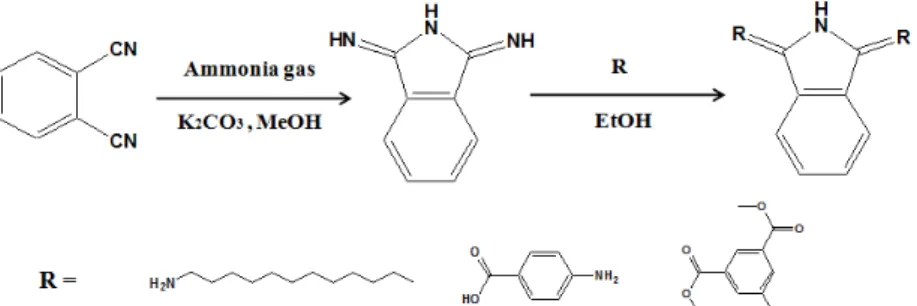
Scheme 1. The synthesis of 1,3-diiminoisoindoline and various isoindoline derivatives; (a) dodecylamine, (b) 4-aminobenzoic acid, and (c) dimethyl-5-amino isophthalate.
Figure 1. Synthetic procedure of isoindoline compound.
으킨다[6-8]. 또한, 계면 활성제의 사용은 분산 안정성은 향상되지만 내열성이 감소하는 단점을 제공하고 있다[9,10].
따라서, 본 연구에서는 상기의 문제점을 해결하기 위하여 계면활성 제 대신 다양한 구조의 isoindoline 유도체를 첨가하여 친환경적으로 isoindoline계 화합물을 합성하였고, 고압 용매 처리 단계에서 결정화 온도 및 시간 조절을 통하여 시료의 입자 크기와 분포, 분산성, 색상, 내열성, 광학적 특성 등을 체계적으로 비교 고찰하였다.
2. 실 험
2.1. 출발물질
본 실험에서는 phtalonitrile (Acros Organics Chemical Co., 98%)를 기본 출발 물질로 사용하였고 potassium carbonate (Alfa Aesar Co., 98%), methanol (Sigma-Aldrich Co., 98%), ammonia gas (Air Products Co., 99%), sodium hydroxide (Sigma-Aldrich Co., 97%), acetic acid (Sigma-Aldrich Co., 99%) 및 barbituric acid (Sigma-Aldrich Co., 99%) 는 모두 정제 없이 그대로 사용하였다. Isoindoline 유도체를 합성하기 위하여 dodecylamine (Alfa Aesar Co., 98%), 4-aminobenzoic acid (Alfa Aesar Co., 99%) 및 dimethyl-5-amino isophthalate (Alfa Aesar Co., 98%)를 모두 정제 없이 그대로 사용하였다.
2.2. 합성
Figure 1의 주어진 순서대로 2.2.1절의 방법으로 1,3-diiminoisoindo- line[11] 전구체를 합성하였고, 2.2.2절에 따라 isoindoline 유도체를 합 성하였고[12], 2.2.3절에 따라 isoindoline 화합물을 다양한 조건에서 합성하였다[2].
2.2.1. 1,3-diiminoisoindoline의 합성
Scheme 1의 1,3-diiminoisoindoline를 합성하기 위하여 둥근바닥 삼 구 플라스크에 methanol 60 mL와 phthalonitrile (10 g, 0.078 mol)을 차례로 투입하고 10 min 동안 교반한 후, 염기성 촉매인 potassium carbonate (0.2 g, 0.001 mol)를 추가로 투입하고, 암모니아 가스로 버 블링하며 약 23 ℃의 초기 온도에서 약 5 ℃/min의 승온 속도로 약 65 ℃까지 가열한 후 약 12 h 동안 반응하였다. 최종 생성물을 감압 여과하고 증류수 약 1000 mL로 세척한 후, 약 60 ℃에서 약 24 h 동 안 건조하여 흰색의 고체 결정(수율 : 약 85%)을 수득하였다.
2.2.2. Isoindoline 유도체의 합성
Scheme 1의 isoindoline 유도체를 합성하기 위하여 둥근바닥 삼구 플라스크에 ethanol 80 mL와 1,3-diiminoisoindoline (2 g, 0.013 mol) 를 먼저 투입하여 약 30 min 동안 교반한 후, isoindoline 유도체 종류 에 따라 dodecylamine (4.81 g, 0.026 mol), 4-aminobenzoic acid (3.56 g, 0.026 mol) 및 dimethyl-5-aminoisophthalate (5.43 g, 0.026 mol)를 각 각 첨가하였다. 이 혼합물들을 약 23 ℃의 초기온도에서 약 30 min 동안 천천히 교반하면서 5 ℃/min의 승온 속도로 약 80 ℃에서 약 12 h 동안 반응하였다. 반응이 종료되면, 반응물을 감압 여과한 후, 증류 수 1000 mL로 세척하였고, 약 60 ℃에서 약 10 h 동안 건조하여 iso- indoline 유도체(수율 : dodecylamine 첨가 유도체 약 74%, 4-amino- benzoic acid 약 17%, dimethyl-5-aminoisophthalate 약 72%)를 수득하 였다.
2.2.3. Isoindoline 화합물의 합성
500 mL 비커에 증류수 100 mL, acetic acid 12 mL를 먼저 투입하 고, 여기에 1,3-diiminoisoindoline (4.35 g, 0.029 mol)을 추가로 투입 하여 약 30 min 동안 교반한 후, 합성된 isoindoline 유도체를 1,3-dii- minoisoindoline과 barbituric acid의 전체 투입량 대비 3 mol%씩 각각 첨가하여 약 30 min 동안 교반하였다. 초기 온도 약 23 ℃에서 반응 온도를 각각 약 0∼60 ℃로 유지하며, barbituric acid (7.42 g, 0.058 mol)를 첨가하여 약 30 min 동안 교반하여 합성하였고, 고압반응기에 서 5 ℃/min의 승온 속도로 결정화 온도를 80∼140 ℃로 1∼6 h 동안 결정화하였다. 최종생성물은 감압 여과하고 증류수 약 1000 mL로 세
Samples a b c
FT-IR spectra (cm-1)
C-N 1232 1274 1257
Aryl-N - 1369 1338
C=O - 1681 1712
C-H Stretch 2850, 2913 - -
N-H 3382 3384 3370
Table 1. FT-IR Data of Various Isoindoline Derivatives; (a) dodecylamine, (b) 4-aminobenzoic acid, and (c) dimethyl-5-amino isophthalate
Samples T1 T2 T3 T4
Reaction Temp. ℃ 0 20 40 60
Zeta potential mV 23.2 26.93 25.03 26.20 Color parameter
L 81.62 81.05 79.31 78.47
a* 17.43 18.55 24.24 24.29 b* 81.68 82.71 83.24 84.58
*color tendency : (+a*, redness), (-a*, greenness), (+b*, yellowness), (-b*, blueness),
acolor lightness
Table 2. Color Difference and Zeta Potential of Samples Synthesized for 30 min at Various Temperature, and then Crystallized at 120 for 1 h
Figure 2. TEM pictures of samples synthesized for 30 min at (a) 0 ℃, (b) 20 ℃, (c) 40 ℃, and (d) 60 ℃, and then crystallized at 120 ℃ for 1 h.
척한 후 약 110 ℃에서 약 10 h 동안 건조하여 황색의 고체 결정(수율 : 약 78∼80%)을 수득하였다.
2.3. 측정
시료들의 화학구조 분석은 FT-IR spectrometer (GX, Perkin Elmer, USA)를 이용하였고, 미세구조는 field emission scanning electron mi- croscope (FE-SEM : JSM-6700F, JEOL, Japan)으로 분석하였으며 par- ticle size analyzer (PSA : Scatteroscope Ⅰ, Qudix, Korea)로 입도 분 포를 측정하였다. 색상은 Hoover’s muller를 이용하여 아마인유에 시 료를 분산하여 전색한 후 color difference meter (SP62, X-rite, USA) 를 이용하여 분석하였다. 색상 열 안정성은 건조기(DO-49L, Dae Heung Scientific Co., Korea)를 이용하여 180∼300 ℃로 시료의 가열 전후의 색상 차이를 비교하였다. 색상 차이가 클수록 색차 수치가 증 가되며 L, a*, b*를 이용하여 계산하고 ⊿E로 표기하였다[13]. 시료의 분산성은 Zeta potential (ELSZ-1000, Otsuka Electronics, Japan)을 사 용하여 제타 전위를 측정하였다[14]. 광학적 특성은 UV-Vis spec- trometer (Optizen POP, Optizen, Korea)를 이용하여 각각 측정하였다.
3. 결과 및 고찰
3.1. 구조 분석
2.2.1절에 언급된 방법으로 합성한 isoindoline 화합물의 전구체인 1,3-diiminoisoindoline 시료의 FT-IR 분석한 결과, (KBr) (vmax cm-1) : 1240 cm-1 (C-N), 3370 cm-1 (N-H)의 흡수 피크가 존재하므로 성공적 으로 합성된 것으로 판단된다[11]. 2.2.2절에 언급된 방법으로 합성한 isoindoline 유도체들의 FT-IR 분석한 결과를 Table 1에 나타내었다.
주어진 표를 살펴보면, (KBr) (vmax cm-1) : 1232∼1274 cm-1 (C-N), 3370∼3384 cm-1 (N-H)의 흡수 피크가 존재하였고, dodecylamine 전 구체를 사용한 시료의 경우에는 2850, 2913 cm-1 (C-H Stretch)의 흡수
피크가 존재하였고, 4-aminobenzoic acid, dimethyl-5-amino iso- phthalate를 사용한 시료의 경우에는 각각 1681, 1712 cm-1 (C=O)의 흡수 피크가 존재하므로 성공적으로 합성된 것으로 판단된다[12]. 한 편, isoindoline 유도체를 무첨가 또는 첨가하여 합성한 시료들의 FT-IR 분석한 결과는 거의 동일하였다. 이는 첨가된 isoindoline 유도 체의 양이 매우 소량이기 때문이라 판단된다.
3.2. 합성 온도 영향
Isoindoline 화합물을 합성할 때, 반응 온도에 따른 영향을 조사하기 위하여 각각 0, 20, 40 ℃ 및 60 ℃로 조절하였고 약 30 min 동안 반 응한 후, 고압 반응기에서 각각 약 120 ℃에서 약 1 h 동안 결정화하 여 시료들을 합성하였다. 합성된 각 시료들의 TEM 사진을 Figure 2에 나타내었고, 시료들의 색상과 제타 전위의 분석 결과를 Table 2에 나 타내었다. 주어진 결과를 살펴보면, 약 0 ℃에서 반응하면 다량의 미 세한 입자가 생성되고 낮은 제타전위 값을 나타내었다. 이는 비표면 적 증가로 입자 상호 간의 Van der Waals 인력이 강하게 발생하여 응 집이 발생하였기 때문이다[15]. 반응 온도가 증가함에 따라 입자가 성 장하는 경향을 나타내었고, 이는 반응 온도가 증가할수록 입자들이 용매에 대한 용해도가 증가하여 입자 상호 간의 회합이 촉진되었기 때문이다[16]. 약 20 ℃의 반응 온도에서 가장 높은 제타전위 값을 나 타내었고, 약 30 ℃ 이상의 반응 온도에서는 큰 입자들이 생성되므로 침강속도가 증가되고, 시료의 분산성이 저하되어 제타전위 값이 감소 하였다[17].
시료의 색상 분석 결과를 살펴보면, 반응 온도가 높아지면 입자가 성장하여 입자 크기가 증가하므로 a* 값의 증가로 reddish, b* 값의 증 가로 yellowish한 색상 변화를 나타내었고, L 값의 감소로 색상의 밝 기는 어두워지는 경향을 알 수 있다.
3.3. 결정화 온도 영향
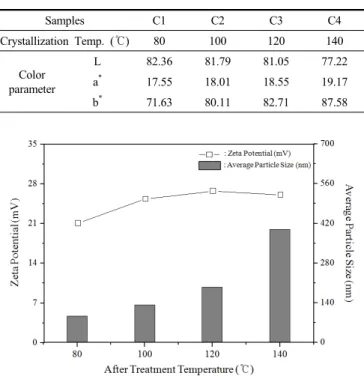
Isoindoline 화합물을 합성할 때, 결정화 온도에 따른 영향을 조사하 기 위하여 약 20 ℃에서 약 30 min 동안 반응한 후, 고압 반응기에서 약 80, 100, 120 ℃ 및 140 ℃에서 약 1 h 동안 각각 결정화하여 시료 들을 합성하였다. 결정화된 시료들의 입자크기, 제타전위 및 색상에 대한 결과들을 Figure 3 및 Table 3에 나타내었다. 주어진 결과를 살펴
Samples C1 C2 C3 C4 Crystallization Temp. (℃) 80 100 120 140
Color parameter
L 82.36 81.79 81.05 77.22
a* 17.55 18.01 18.55 19.17
b* 71.63 80.11 82.71 87.58
Table 3. Color Difference of Samples Synthesized at 20 ℃ for 30 min, and then Crystallized for 1 h at Various Temperature
Figure 3. Zeta potential and average particle size of samples synthesized at 20 ℃ for 30 min, and then crystallized for 1 h at various temperature.
Figure 4. Zeta potential and average particle size of samples synthesized at 20 ℃ for 30 min, and then crystallized for various time at 120 ℃.
Samples D1 D2 D3 D4
Color parameter
L 81.05 77.84 78.42 79.08
a* 18.55 25.76 24.93 23.34 b* 82.71 81.67 80.75 83.37 Table 4. Color Difference of Samples Synthesized at 20 ℃ for 30 min with Various Isoindoline Derivatives, and then Crystallized for 1 h at 120 ℃; (a) D1 : no addition, (b) D2 : dodecylamine, (c) D3 : 4-aminobenzoic acid, and (d) D4 : dimethyl-5-aminoisophthalate
Figure 5. Zeta potential and average particle size of samples synthesized at 20 ℃ for 30 min with various isoindoline derivatives, and then crystallized for 1 h at 120 ℃; (a) D1 : no addition, (b) D2 : dodecylamine, (c) D3 : 4-aminobenzoic acid, and (d) D4 : dimethyl-5-aminoisophthalate.
보면, 결정화 온도가 증가할수록 입자 크기 및 제타전위 값이 증가하 는 경향성을 나타내었다. 이는 결정화 온도가 증가하면, 입자의 크기 가 증가하고, 이로 인하여 입자 간의 인력 감소하여 분산성이 향상되 기 때문이다. 시료의 색상 분석 결과를 살펴보면, a* 값 증가로 red- dish, b* 값의 증가로 yellowish한 색상 변화를 나타내었다. L 값의 감 소로 색상의 밝기는 어두워지는 경향을 알 수 있다.
3.4. 결정화 시간 영향
Isoindoline 화합물을 합성할 때, 결정화 시간에 따른 영향을 조사하 기 위하여 약 20 ℃에서 약 30 min 동안 반응한 후, 고압 반응기에서
약 120 ℃에서 약 1, 2, 4 h 및 6 h 동안 각각 결정화하여 시료들을 합성하였다. 결정화된 시료들의 분석 결과를 Figure 4에 나타내었다.
주어진 결과를 살펴보면, 결정화 시간이 증가하면 시료의 입자 크기 가 약 300 nm에서 약 800 nm 이상으로 성장하지만, 제타전위 값은 약 28 mV까지 증가하다가 감소하는 경향을 나타내었다. 이는 입자 성장으로 인하여 분산성이 저하되어 제타전위 값이 감소하는 것으로 사료된다.
3.5. Isoindoline 유도체 종류별 효과
Isoindoline 화합물을 합성할 때, isoindoline 유도체 종류와 첨가 유 무에 따른 영향을 비교하기 위하여 여러 유도체들을 각각 첨가하여 약 20 ℃에서 약 30 min 동안 반응한 후, 고압 반응기에서 약 120 ℃ 에서 약 1 h 동안 결정화하여 시료들을 합성하였다. 합성된 시료들의 결과들을 Figures 5∼7 및 Table 4에 나타내었다. Figure 5를 살펴보 면, 유도체를 첨가하지 않고 합성한 D1 시료는 약 399 nm의 입자와 약 27 mV의 제타전위 값을 나타내었다. 한편, 유도체를 첨가하여 합 성한 시료는 약 200 nm 이하의 작은 입자를 가지고, 제타전위 값은 증가하였다. 특히, 벌키한 알킬기를 가진 유도체를 첨가하여 합성한 D2 시료는 상대적으로 약 100 nm의 작은 입자와 높은 제타전위 값을 나타내었다. 이는 유도체의 긴 사슬이 시료 입자에 흡착되고 그물망 형태로 입자 상호 간의 재응집을 억제하기 때문이다[15]. 즉, 입체장 애효과가 극대화되어 적층을 방해하여 작은 입자가 생성되고 제타전 위 값이 증가되는 것으로 판단된다. 벤젠고리에 carboxy기, methyl acetate기를 가진 유도체를 첨가하여 합성한 D3와 D4 시료는 입자 크 기가 약 200 nm이었다. 이는 평면구조의 벤젠고리가 치환된 유도체는
Figure 6. Color changes (ΔE) of samples synthesized at 20 ℃ for 30 min with various isoindoline derivatives, and then crystallized for 1 h at 120 ℃; (a) D1 : no addition, (b) D2 : dodecylamine, (c) D3 : 4-aminobenzoic acid, and (d) D4 : dimethyl-5-aminoisophthalate.
Figure 7. UV-Vis spectra of samples synthesized at 20 ℃ for 30 min with various isoindoline derivatives, and then crystallized for 1 h at 120 ℃; (a) D1 : no addition, (b) D2 : dodecylamine, (c) D3 : 4-aminobenzoic acid, and (d) D4 : dimethyl-5-aminoisophthalate.
입자 간의 적층이 용이하여 D2 시료보다 큰 입자가 생성되었고, D1 시료보다는 작은 입자가 생성된 것으로 사료된다[18]. 또한, 주어진 표를 살펴보면, D2와 D3 시료는 a* 값의 증가로 reddish, b* 값의 감소 로 greenish한 색상을 나타내고, D4 시료는 a* 값의 증가로 reddish, b* 값의 증가로 yellowish한 색상을 나타내었다. 또한, 유도체를 첨가하 여 합성하면, L 값의 감소로 색상의 밝기는 어두워지는 경향을 알 수 있다. 이러한 색상의 변화는 유도체가 시료의 발색단인 아조기 (-N=N-)에 영향을 주는 조색단으로 화학 구조의 변화에 기인한 색상 변화로 사료된다[19].
시료들의 색상 열 안정성은 약 180 ℃∼300 ℃에서 각각 열처리하 여 색상 차이(⊿E)를 Figure 6에 나타내었다. D2 시료는 약 3에서 7까 지 색상 변화를 나타내었고, 이는 열에 취약하다는 것을 의미한다[20].
D3와 D4 시료는 약 0.7에서 5까지 색상 변화를 나타내었고, 이는 열 에 안정한 벤젠고리 형태의 치환기를 가진 유도체 구조에 기인되며, carboxy 또는 methyl acetate기는 입자 표면에 흡착하는 특성[15]의 영 향으로 화합물 주위의 유도체가 수지와의 상용성이 향상되어 상대적
으로 색상 열 안정성이 높아진 것으로 사료된다[20]. 시료들의 분광학 적 특성을 Figure 7에 나타내었다. 이를 살펴보면, 유도체들을 첨가하 여 합성한 시료들은 red-shift하는 경향을 나타내는데, 이는 유도체들 에 존재하는 C-O-C, -OCH3, -COOH, 벌키한 알킬기와 같은 치환기에 기인한 심색효과 영향으로 사료된다[21]. 두 개의 methyl acetate 치환 기를 가진 유도체가 존재하는 D4 시료는 한 개의 치환기를 가진 유도 체가 존재하는 D3 시료보다 강한 전자 주게 효과로 인하여 UV 파장 이 변하여 넓은 투과율을 나타내었다[20].
4. 결 론
본 연구에서는 계면활성제를 첨가하지 않고 one-step 공정으로 iso- indoline 화합물을 합성하기 위하여 isoindoline 유도체들을 첨가하여 여러 조건에 반응하고 결정화한 결과 isoindoline 화합물을 성공적으 로 합성하였다. 반응 온도 및 결정화 온도가 증가할수록 시료의 입자 크기와 제타전위 값은 증가하는 경향을 나타내었다. 시료의 색상은 반응 온도가 증가할수록 붉은 계통의 노란색상을 나타내었고, 결정화 시간이 증가할수록 붉은 계통의 푸른 색상을 나타내었다. 또한, iso- indoline 유도체를 첨가하여 합성한 시료는 상대적으로 입자의 크기는 작고 균일하면서 제타전위 값은 증가하였고, 근적외선 투과율이 높았 다. 알킬 구조의 유도체를 첨가한 D1 시료보다 벤젠고리 구조의 치환 기를 가진 유도체를 첨가한 D3, D4 시료가 색상의 열 안정성이 높았다.
감 사
본 연구는 산업통상자원부 산업기술혁신사업과 동남권 광역경제권 선도사업 산업생태계 지원 사업의 지원에 의해 수행되었으며 이에 감 사드립니다.
References
1. M. Marti, G. Fabregat, D. S. Azambuja, C. Aleman, and E.
Armelin, Evaluation of an environmentally friendly anticorrosive pigment for alkyd primer, Prog. Org. Coat., 73, 321-329 (2012).
2. R. Hainz, J. Allaz, and D. Schroeder, Isometric isoindoline yellow pigment, US Patent, 8,075,683 (2011).
3. E. B. Faulkner and R. J. Schwartz, High Performance Pigments, 2nd ed., 221-241, Wiley-VCH, Weinheim, DE (2009).
4. W. Herbst, K. Hunger, G. Wilker, H. Ohleier, and R. Winter, Industrial Organic Pigments: Production, Properties, Applications, 3nd ed., 31-419, Wiley-VCH, Weinheim, DE (2005).
5. K. Baba, T. Mori, and K. Nakatsuka, Photosensitive coloring com- position, and color filter and liquid crystal display panel using the same, US Patent, 6,653,031 (2003).
6. B. Philippe, F. Michel, H. Fritz, and M. A. Mcalpine, isoindoline pigment having improved low shear dispersibility, US Patent, 6,143,067 (2000).
7. M. T. Garcia, I. Ribosa, T. Guindulain, J. S. Laeal, and J. V.
Rego, Fate and effect of monoalkyl quaternary ammonium surfac- tants in the aquatic environment, Environ. Pollut., 111, 169-175 (2001).
8. T. Cserhati, E. Forgacs, and G. Oros, Biological activity and envi- ronmental impact of anionic surfactants, Environ. Int., 28, 337-348 (2002).
9. S. Sangeetha, R. Basha, K. J. Sreeram, S. N. sangilimuthu, and B.
U. Nir, Functional pigments from chromium(III) oxide nano- particles, Dyes Pigments., 94, 548-552 (2012).
10. S. Novaconi and N. Vaszilcsin, Inductive heating hydrothermal synthesis of titanium dioxide nanostructures, Mater. Lett., 95, 59-62 (2013).
11. Z. Iqbal, A. Lyubimtsev, M. Hanacka, and T. Zieglera, Anomerically glycosylated zinc(II) naphthalocyanines, Tetrahedron Lett., 50, 5681-5685 (2009).
12. I. Tamgho, J. T. Engle, and C. J. Ziegler, The syntheses and struc- tures of bis(alkylimino)isoindolines, Tetrahedron Lett., 54, 6114-6117 (2013).
13. E. Makarewicz, P. Cysewski, A. Michalik, and D. Ziółkowska, Properties of acid or alkali treated cadmium pigments, Dyes Pigments, 96, 338-348 (2013).
14. ASTM Standard D 4187-82, Zeta potential of colloids in water and waste water, Am. Soc. for Testing & Mater. (1985).
15. C. H. Hare, Paint film degradation: mechanisms and control, 71-77, The Society for Protective Coatings, Pittsburgh, USA (2001).
16. W. Herbst and K. Hunger, Industrial Organic Pigments, 3rd ed., 12-261, Wiley-VCH, Weinheim. DE (2004).
17. O. Mengual, G. Meunier, I. Cayré, K. Puech, and P. Snabre, TURBISCAN MA 2000: multiple light scattering measurement for concentrated emulsion and suspension instability analysis, Talanta, 50, 445-456 (1999).
18. G. Lincke, Molecular stacks as a common characteristic in the crystal lattice of organic pigment dyes A contribution to the
“soluble-insoluble” dichotomy of dyes and pigments from the tech- nological point of view, Dyes Pigments, 59, 1-24 (2003).
19. G. V. Atodiresei, I. G. Sandu, E. A. Tulbure, V. Vasilache, and R. Butunaru, Chromatic Characterization in Cielab System for Natural Dyed Materials, Prior Activation in Atmospheric Plasma Type DBD, Rev. Chim., 64, 165-169 (2013).
20. J. Choi, C. Sakong, J. H. Choi, Chun Y, and J. P. Kim, Synthesis and characterization of some perylene dyes for dye-based LCD color filters, Dyes Pigments, 90, 82-88 (2011).
21. Y. G. Sıdır, I. Sıdır, H. Berber, and E. Taşal, UV-spectral changes for some azo compounds in the presence of different solvents, J.
Mol. Liq., 162, 148-154 (2011).