https://doi.org/10.20307/nps.2018.24.2.125
125
Chemical Composition and Antioxidant Activity of Algerian Juniperus Phoenicea Essential Oil
Aicha Harhour
1,*, Moussa Brada
1, Marie-Laure Fauconnier
2, and Georges Lognay
31Laboratory of Natural Substances Valorization, University of Djilali Bounaama, Khemis Miliana, Road of Theniet El-Had, 44225, Algeria
2Agro-Bio Chem Department, General and Organic Chemistry, University of Liege, Gembloux Agro-Bio Tech, 2, Passage of deportees, B-5030 Gembloux, Belgium
3Agro-Bio Chem Department, Analytical Chemistry, University of Liege, Gembloux Agro-Bio Tech, 2, Passage of deportees, B-5030 Gembloux, Belgium
Abstract − Berries and branches essential oil of Juniperus phoenicea were obtained by electromagnetic induction heating assisted extraction and by hydrodistillation with a yield varied from (1.2± 0.3 to 2.4 ± 0.7%) and from (0.6± 0.1% to 1.1 ± 0.1%), respectively. forty eight compounds were identified representing (97.2 – 99.7%) of the oil. α-Pinene (40.3 − 67.8%) and δ-3-carene (13.5 – 26.8%) were the main compounds in berries and branches essential oils. Antioxidant activity was evaluated by three means: inhibition of 2, 2-diphenyl-1-picryl hydrazyl (DPPH) free radical, reducing power and β-Carotene/linoleic acid bleaching. The antioxidant activity of essential oils showed IC50 ranging from 67.6± 1.02 μg/mL to 131.5 ± 0.8 μg/mL for berries and from 98 ± 1.25 μg/mL to 166.8± 0.29 μg/mL for the branches. Berries oil show more potent antioxidant activity compared to branches.
This result is supported by the three methods investigated in this work.
Keywords − Juniperus, Essential oil, Electromagnetic induction heating, Hydrodistillation, Chemical composition, Antioxidant activity
Introduction
The genus Juniperus (Cupressaceae) includes many native plants of the Mediterranean regions. In the Algerian flora, five species are present: J. oxycedrus L., J.
Sabina L., J. thurifera L., J. communis L. and J. phoenicea L.
1This last is commonly known in North Africa as “Al aar- aar” and a preparation of its leaves and cones is used as a hypoglycemic regulator, whereas the leaves are used against broncho-pulmonary diseases and as a diuretic.
2-3The J. phoenicea oils of extracted from berries as well as wood are used for the treatment of many diseases like leprosy typhoid and tape worm infections.
3While the dried and powdered fruit can heal skin ulcers and abscesses.
4In Algeria, it is best known for its antidiarrheal activity.
5-6A lot of reports exists dealing with the chemical composition of J. phoenicea essential oils grown in many countries (Table 1). J. phoenicea has been characterized
by the occurrence of monoterpenes with α-pinene as major constituent, although its proportion varied drastically from sample to sample.
5-13The geographical and bioclimatic factors of the region, the extraction process and plant parts used, can partly explain the chemical variability of the J. phoenicea essential oil compositions. Antioxidant activity of essential oils from different juniper species has been established and the potential of these plants as sources of natural antioxidant has been demonstrated.
11,14-19J. excelsa, J. oxycedrus subsp. oxycedrus, J. Sabina and J. phoenicea might be used in the food industry as increasing the shelf-life of raw and processed foods.
17Leaves of J. phoenicea may provide a good source of natural products with interesting medicinal properties.
18And essential oils which could be potential alternatives to synthetic bactericides and as natural antioxidants for foods.
11,14-15The aims of this study were to further analyze the composition of the essential oils of wild J. phoenicea from Ain- Defla (northern Algeria) using GC-FID and GC-MS, as well as to investigate their antioxidant properties. To the authors best knowledge J. phoenecea
*Author for correspondence
Aicha Harhour, Laboratory of Natural Substances Valorization, Uni- versity of Djilali Bounaama, Khemis Miliana, Road of Theniet El- Had, 44225, Algeria.
Tel: +213-782834513; E-mail: [email protected]
essential oil from this region has never been studied before. This work will contribute to the knowledge of a local product that could improve the use of Algerian Juniperus.
Experimental
General experimental procedures – A pressure cooker (5 L, Chimex, China) was used as container for plant material and water. The EMI heating was performed using hot plate (1800 W, Tristar IK6174, EU). A Clevenger apparatus was used for hydrodistillation. Analyses have been undertaken using GC- FID (Thermo – Trace, Interscience, Belgium), GC/MS operated by HP Chem Station software. All the reference molecules used were from Sigma-Aldrich (Germany).
Plant material – Branches and berries of wild J.
phoenecea were collected in the first week of June 2013 in Ain Defla region (- latitude: 36°25’ N; longitude: 2°
21’7” E; Altitude: 365 m). Voucher specimen was deposited
in the Herbarium of the Agronomic Department of Djilali Bounaama University of Khemis Miliana.
Extraction method – The essential oil was extracted using two different methods, in order to introduce the electromagnetic induction heating assisted extraction as a new extraction approach. Therefore, the yield and chemical composition of J. phoenicea extracted by EMI heating were studied and compared with those obtained by classical hydrodistillation.
Hydrodistillation (HD) – 100 g of berries and branches (dried at room temperature ~ 20
oC for 10 days) of J.
phoenicea were submitted to hydrodistillation with a Clevenger apparatus, and extracted during 1.5 hour. The essential oil was collected by decantation, dried over anhydrous sodium sulfate and stored in closed dark vials at 4
oC until analysis.
Electromagnetic induction heating assisted extraction (EMI) – 400 g of berries or branches was subjected to extraction. The system was equipped with a pressure cooker (5 L capacity), placed on an induction plate
Table 1. Major compounds of J. phoenicea essential oils (%) from various countriesCountry Author Plant part
Major compounds α-Pinene δ, 3-
Carene β-
Phellandrene α-cedrol α- Terpinolene
α- Terpinemyl
acetate
α-
Phellandrene limonene manoyloxide
Espagne (7) L 53.5 1.7 5.9 - - - 0.8 T 14.4
(7) L 41.2 1.5 4.9 - - 0.1 0.7 0.6 22
Portugal (7) L 34.1 - 19.2 - - 12.5 3.1 0.2 0.6
(7) L 57.8 - 8 - - 5 1.1 1 -
Italy (8) L 48.9 22.82 10.01 - 0.62 2.61 0.08 - -
B 84.55 3.61 2.56 - 0.38 0.63 0.02 - -
Greece (7) L 41.8 3.5 - - 4.6 0.6 3.5 -
Maroco (9) L 34 21 - - - 6.8 2.2 3.1 -
B 79.1 5.7 - - - 0.9 0.45 14.6 -
(10) L 49.15 1.05 0.98 - - - 7.39 - -
Tunisia (11) L 55.7 10.7 - - - - 0.8 0.7 -
(11) B 80.7 4.5 - - - -
Egypte (12) L 38.2 0.99 - 31.2 - 1.01 - 0.74 -
B 39.3 1.25 4.13 0.47 - 3.36 1.01 - -
Alegria
(5)D L 40.2 0.5 t - - T 14.7 - -
(6) T L 34.5 4.7 22.4 - - 14.7 0.6 1.2 -
(5) S L 54 - 7.3 - - 0.4 - 0.6 -
(13) Ba L 36.5 12.4 4.4 - - - 0.2
(13) Bi L 59 3 0.8 - - - - 0.7 1.6
(13) M L 47.1 - 1.7 - - 0.4 - 0.8 -
(5) Dob et al, 2008; (6) Mazari et al, 2010; (7) Adams et al, 1996; (8) Angioni et al, 2003; (9) Mansouri et al, 2011; (10) Derwich et al, 2011; (11) Ennadjar et al., 2009; (12) El Sawi et al, 2007; (13) Ramdani et al, 2013; L : Leaves; B : Berries; D : Djelfa; T : Tlemcen; S : Stif; Ba : Batna; Bi : Biskra; M : M’sila .
(1800 W), whereas the extraction was carried out in magnetizable conditions. The essential oil was collected by decantation and dried over anhydrous sodium sulfate, and stored at 4
oC in dark glass bottles until use.
Essential Oil analysis – 10 mg of essential oil was dissolved in 5 ml diethyl ether and analyzed by gas chromatography (GC) and by (GC-MS).
GC-FID analysis – The analysis of the oil was carried out by means of an Agilent technology HP GC 6890 system with a flame ionization detector (FID), using a capillary column coated with 5% phenyl-methylpoly- siloxane (30 m × 0.25 mm × 0.25 μm film thickness Agilent Technologies, Hewlett-Packard, CA, USA). Temperature program was as follows: 40
oC during 1 min, then raised in a first ramp to 200
oC at 6
oC/min, followed by a second ramp to 280
oC at 30
oC/min, with a final hold at 280
oC during 2 min. Injection (1 µl) was realized in splitless mode at 280
oC. Detector temperature was fixed at 300
oC;
Carrier gas was helium at 1 mL/min.
GC-MS analysis – GC/MS was performed with an Agilent HP 6890 GC system coupled with an Agilent HP5973 Network Mass Selective Detector. Agilent HP- 5MS capillary column (30 m × 0.25 mm, df = 0.25 m), a split-splitless injector at 250
oC (splitless mode), tempera- ture program: from 40
o- 250
oC at 6
oC/min, mobile phase:
carrier gas was helium at 1 mL/min. The mass spectra have been recorded in EI mode (70 eV), scanned mass range: from 35 to 500 amu. Source and quadrupole tem- peratures were fixed at 230
oC and 150
oC, respectively.
The identification of the components was performed on the basis of chromatographic retention indices and by comparison of the recorded spectra with computed spectral library (Wiley275.L, Adams 2001). For sesquiterpene hydrocarbons, further confirmations were obtained by comparing the mass spectra with literature data.
20-21Retention indices (RI) were calculated according to Joulain and König.
21Antioxidant activity determination – Despite numerous and various methods, only one procedure cannot identify all possible mechanisms characterizing a potential antioxidant. Therefore antioxidant activity of J. phoenicea essential oils has been determined by using three com- plementary assays: inhibition of DPPH free radical (i), reducing power (ii), and β - Carotene/ linoleic acid bleaching (ii).
DPPH assay – The stable 2, 2-diphenyl-1-picrylhydrazyl radical (DPPH) was used. Briefly fifty μL of various concentrations of the samples (from 25 to 100 μg/ mL) in methanol were added to 2 mL of 60 μM methanol solution of DPPH. After an incubation or 30 min at room tem-
perature (20 degrees), the absorbance was recorded at 517 nm.
22-23Butylated hydroxyl toluene (BHT) and ascorbic acid were used as positive controls and blanks have been systematically performed. The inhibition percentage of the DPPH radical by the samples was calculated according to the formula:
% Inhibition = [(Ab – Aa) / Ab] × 100 (1) Where:
Ab: is the absorbance of the blank sample and Aa; is the absorbance of the test sample.
The activity was calculated as 50% inhibition con- centration (IC50) by plotting the inhibition percentage against the sample concentration. A lower IC
50value indicates greater antioxidant activity. Tests were carried out in triplicate.
Determination of the reducing power – The reducing power of the essential oils was determined according to the method of Hseu et al.
24One mL of different con- centrations of the samples (from 25 to 100 μg/mL) were mixed with phosphate buffer (1 mL, 0.2 M, pH = 6.6) and potassium ferricyanide [K
3Fe (CN)
6] (1 mL, 1%). The mixture was incubated at 50
oC for 20 min. One mL of trichloroacetic acid (TCA) (10%) was added to the solution, which was then centrifuged for 10 min at 3000 rpm. The supernatant was and mixed with distilled water (1.5 mL) and FeCl
3solution (150 μL, 0.1%). The absor- bance was measured at 700 nm and compared to the standards. Increased absorbance of the reaction mixture indicated increased reducing power. The assay was carried out in triplicates.
β - Carotene/linoleic acid bleaching assay – The β-
carotene/linoleic acid test evaluates the inhibitory effect of
a compound or a mixture on the oxidation of β-carotene
in the presence of molecular oxygen (O2). A mixture of
β-carotene and linoleic acid was prepared by adding
together 0.5 mg of β-carotene in 1 mL chloroform, 25 μL
pure linoleic acid and 200 mg tween 40. The chloroform
was then completely evaporated under vacuum and 100
mL of pure Hydrogen peroxide was subsequently added
to the residue and mixed to form a clear yellowish
emulsion. 350 μL of various concentrations of sample
(essential oil, BHT and ascorbic acid; 25, 50, 75 and 100
μg/mL) in methanol were added to 2.5 mL of the above
emulsion in test tubes and mixed. The sealed tubes were
incubated in water bath at 50
oC for 2 h together with a
negative control (blank) containing methanol instead of
sample. The absorbance values were measured at 470
nm.
25Antioxidant activity was calculated as percentage of
inhibition (I %) relative to the control using the following
equation:
% I = [A ( β-carotene after 2h assay) /
A (initial β-carotene)] × 100 (2) Where:
A ( β-carotene after 2 h assay) is the absorbance value of β-carotene after 2 h assay remaining in the samples and A (initial β-carotene) is the absorbance value of β- carotene in the beginning of the experiment. The activity was calculated as 50% inhibition concentration (IC
50).
Each assay was made in triplicate.
Statistical analysis – All assays were carried in triplicates and results expressed as means ± standard deviation. IC50-value (µg extract/ml) is the effective concentration which proves 50% of activity, was calculated for each assay. Statistical comparisons were done with Student’s test. Differences were considered to be highly significant at P < 0.01 and significant at P < 0.05.
Result and Discussion
The essential oils of berries and branches of J. phoenicea have been recovered with yields ranging from (1.2 to 2.4%) for EMI heating and from (0.6 to 1.1%) for classical hydrodistillation.
The electromagnetic induction heating assisted extraction showed higher recovery, this innovate process is efficient technique in comparison to hydrodistillation, this efficiency was probably based on the interaction between the speed of the EMI heating and evaporation of the essential oil found in vegetable material.
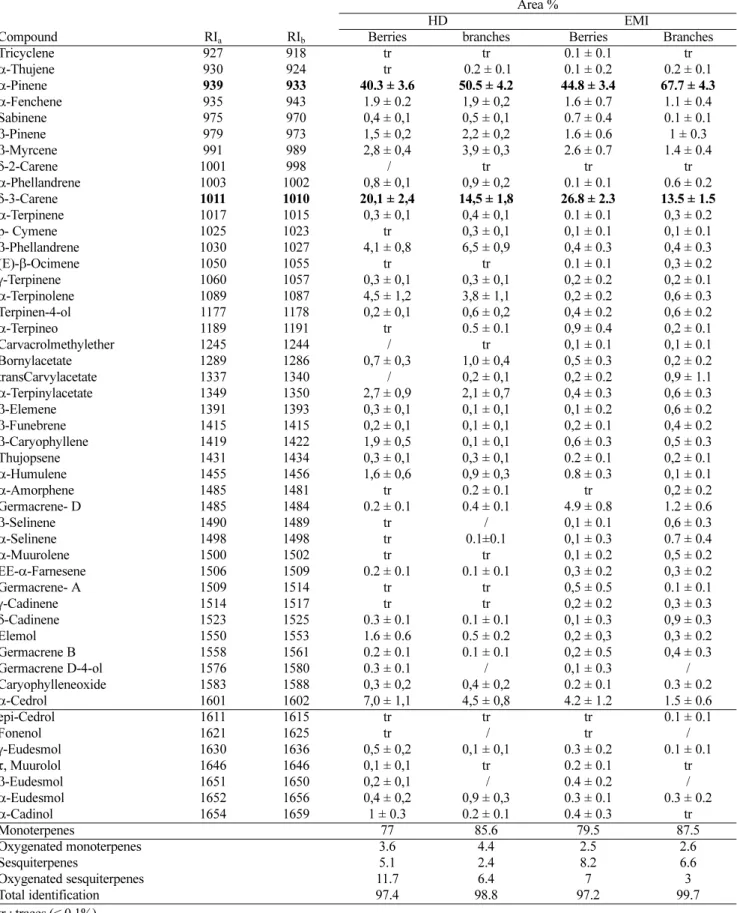
The results of GC-FID and GC-MS analyses are gathered in Table 2, This table showed that 48 components were identified in berries and branches oil representing (97.2 – 99.7%). α-Pinene (40.3 ± 3.6 – 67.7 ± 4.3%) was the major compound in both oils followed by δ-3-carene (13.5 ± 1.5% − 26.8 ± 2.3%) and α-cedrol (1.5 ± 0.6 – 7 ± 1.1%).
The branches oils were richer in α-pinene than berries.
Which consisted mainly of monoterpenoids (hydrocarbons and oxygenated compounds) at (80.6 − 82%). The sesqui- terpenoides were presented in berries oils at (15.2 − 16.8%). While branch oils consisted mainly of monoter- penoids and sesquiterpenoids only 9% of the total oil composition. Chemical compositions of essential oils obtained from berries and branches were slightly different.
According to the literature, one finds no trace of α-cedrol in J. phoenicea essential oil except that from Egypt with α-cedrol proportion of (31. 23%).
12In comparison with literature data, the J. phoenicea essential oils composi- tions were different than those previously investigated
Table 1.
5-15This difference can be related with abiotic factors such as specific climate conditions and phenological stages of the collected plants as well as geographical factors such as altitude and nature of the soil.
Higher amounts of hydrocarbon monoterpenes were detected in the J. phoenicea essential oil isolated by EMI heating (79.5 – 87.5%) compared to HD (77 – 85.6%).
Whereas, the oxygenated monoterpenes were present in high proportions in HD (3.6 – 4.4%) compared to EMI heating (2.5 – 2.6%) essential oil, α-Pinene was the main component in the J. phoencea essential oil but the relative amounts differed for the two isolation methods: (44.81 ± 3.4% − 67.7 ± 4.3%) for EMI heating and (40.3 ± 3.6 – 50.5 ± 4.2%) for HD oils respectively. δ-3- carene and α- cedrol were the two other main components in J.
phoenicea. The highest proportion of δ-3-carene was found in EMI heating essential oil (13.5 ± 1.5 – 26.8 ± 2.3%) compared with HD essential oil (14.5 ± 1.8 – 20.1 ± 2.4%) and α-cedrol is more abundant in HD (4.5 ± 0.8 – 7 ± 1.1%) against (1.5 ± 0.6 – 4.2 ± 1.2%) in EMI heating. Therefore, the EMI heating, highly accelerated the extraction process, without major difference in pro- portions of compounds. In J. phoenicea from eastern Algeria.
13Three chemotypes were identified: α-pinene / terpinolene (i), α-pinene / δ-3-carene (ii) and α-pinene / β-phellandrene (iii). The findings of this study show that the chemical composition of our samples belongs to the second chemo type: α-pinene / δ-3-carene with a significant amount of α-cedrol.
The results of the antiradical capacity of J. pheonicea essential oils and of the standards (ascorbic acid, BHT) are expressed as an inhibition percentage of the DPPH radical at different concentrations (25, 50, 75 and 100 μg/
mL). Abilities of the tested samples to scavenge DPPH•
were assessed on the basis of their IC
50values which were inversely related to their antioxidant capacities, (Table 3).
Berries essential oil (IC
50= 67.6 ± 1.02 μg/mL) has shown
a weak antioxidant activity compared to BHT (IC
50=
18.3 ± 0.8 μg/mL) and acid ascorbic (IC
50= 14.9 ± 1.7
μg/mL). Similarly, the branches essential oil has also a
weak efficiency with an IC
50= 98 ± 1.25 μg/mL. Therefore,
when compared to BHT and ascorbic acid, both oil
samples were clearly less effective than these synthetic
antioxidants. The low antioxidant activity of the examined
oils in DPPH test may be partially due to the dominance
of α-pinene (40.3 − 50.5%) and δ-3-carene (14.5-20.1%)
which are considered as weak antioxidants.
16These
different results might be due differences in the chemical
composition and possible interactions between the volatile
constituents.
Table 2. Chemical composition of J. phoenicea essential oils (mean of three triplicates ± SD)
Area %
HD EMI
Compound RIa RIb Berries branches Berries Branches
Tricyclene 927 918 tr tr 0.1 ± 0.1 tr
α-Thujene 930 924 tr 0.2 ± 0.1 0.1 ± 0.2 0.2 ± 0.1
α-Pinene 939 933 40.3 ± 3.6 50.5 ± 4.2 44.8 ± 3.4 67.7 ± 4.3
α-Fenchene 935 943 1.9 ± 0.2 1,9 ± 0,2 1.6 ± 0.7 1.1 ± 0.4
Sabinene 975 970 0,4 ± 0,1 0,5 ± 0,1 0.7 ± 0.4 0.1 ± 0.1
β-Pinene 979 973 1,5 ± 0,2 2,2 ± 0,2 1.6 ± 0.6 1 ± 0.3
β-Myrcene 991 989 2,8 ± 0,4 3,9 ± 0,3 2.6 ± 0.7 1.4 ± 0.4
δ-2-Carene 1001 998 / tr tr tr
α-Phellandrene 1003 1002 0,8 ± 0,1 0,9 ± 0,2 0.1 ± 0.1 0.6 ± 0.2
δ-3-Carene 1011 1010 20,1 ± 2,4 14,5 ± 1,8 26.8 ± 2.3 13.5 ± 1.5
α-Terpinene 1017 1015 0,3 ± 0,1 0,4 ± 0,1 0.1 ± 0.1 0,3 ± 0.2
p- Cymene 1025 1023 tr 0,3 ± 0,1 0,1 ± 0.1 0,1 ± 0.1
β-Phellandrene 1030 1027 4,1 ± 0,8 6,5 ± 0,9 0,4 ± 0.3 0,4 ± 0.3
(E)-β-Ocimene 1050 1055 tr tr 0.1 ± 0.1 0,3 ± 0.2
γ-Terpinene 1060 1057 0,3 ± 0,1 0,3 ± 0,1 0,2 ± 0.2 0,2 ± 0.1
α-Terpinolene 1089 1087 4,5 ± 1,2 3,8 ± 1,1 0,2 ± 0.2 0,6 ± 0.3
Terpinen-4-ol 1177 1178 0,2 ± 0,1 0,6 ± 0,2 0,4 ± 0.2 0,6 ± 0.2
α-Terpineo 1189 1191 tr 0.5 ± 0.1 0,9 ± 0.4 0,2 ± 0.1
Carvacrolmethylether 1245 1244 / tr 0,1 ± 0.1 0,1 ± 0.1
Bornylacetate 1289 1286 0,7 ± 0,3 1,0 ± 0,4 0,5 ± 0.3 0,2 ± 0.2
transCarvylacetate 1337 1340 / 0,2 ± 0,1 0,2 ± 0.2 0,9 ± 1.1
α-Terpinylacetate 1349 1350 2,7 ± 0,9 2,1 ± 0,7 0,4 ± 0.3 0,6 ± 0.3
β-Elemene 1391 1393 0,3 ± 0,1 0,1 ± 0,1 0,1 ± 0.2 0,6 ± 0.2
β-Funebrene 1415 1415 0,2 ± 0,1 0,1 ± 0,1 0,2 ± 0.1 0,4 ± 0.2
β-Caryophyllene 1419 1422 1,9 ± 0,5 0,1 ± 0,1 0,6 ± 0.3 0,5 ± 0.3
Thujopsene 1431 1434 0,3 ± 0,1 0,3 ± 0,1 0.2 ± 0.1 0,2 ± 0.1
α-Humulene 1455 1456 1,6 ± 0,6 0,9 ± 0,3 0.8 ± 0.3 0,1 ± 0.1
α-Amorphene 1485 1481 tr 0.2 ± 0.1 tr 0,2 ± 0.2
Germacrene- D 1485 1484 0.2 ± 0.1 0.4 ± 0.1 4.9 ± 0.8 1.2 ± 0.6
β-Selinene 1490 1489 tr / 0,1 ± 0.1 0,6 ± 0.3
α-Selinene 1498 1498 tr 0.1±0.1 0,1 ± 0.3 0.7 ± 0.4
α-Muurolene 1500 1502 tr tr 0,1 ± 0.2 0,5 ± 0.2
EE-α-Farnesene 1506 1509 0.2 ± 0.1 0.1 ± 0.1 0,3 ± 0.2 0,3 ± 0.2
Germacrene- A 1509 1514 tr tr 0,5 ± 0.5 0.1 ± 0.1
γ-Cadinene 1514 1517 tr tr 0,2 ± 0.2 0,3 ± 0.3
δ-Cadinene 1523 1525 0.3 ± 0.1 0.1 ± 0.1 0,1 ± 0.3 0,9 ± 0.3
Elemol 1550 1553 1.6 ± 0.6 0.5 ± 0.2 0,2 ± 0,3 0,3 ± 0.2
Germacrene B 1558 1561 0.2 ± 0.1 0.1 ± 0.1 0,2 ± 0.5 0,4 ± 0.3
Germacrene D-4-ol 1576 1580 0.3 ± 0.1 / 0,1 ± 0.3 /
Caryophylleneoxide 1583 1588 0,3 ± 0,2 0,4 ± 0,2 0.2 ± 0.1 0.3 ± 0.2
α-Cedrol 1601 1602 7,0 ± 1,1 4,5 ± 0,8 4.2 ± 1.2 1.5 ± 0.6
epi-Cedrol 1611 1615 tr tr tr 0.1 ± 0.1
Fonenol 1621 1625 tr / tr /
γ-Eudesmol 1630 1636 0,5 ± 0,2 0,1 ± 0,1 0.3 ± 0.2 0.1 ± 0.1
τ, Muurolol 1646 1646 0,1 ± 0,1 tr 0.2 ± 0.1 tr
β-Eudesmol 1651 1650 0,2 ± 0,1 / 0.4 ± 0.2 /
α-Eudesmol 1652 1656 0,4 ± 0,2 0,9 ± 0,3 0.3 ± 0.1 0.3 ± 0.2
α-Cadinol 1654 1659 1 ± 0.3 0.2 ± 0.1 0.4 ± 0.3 tr
Monoterpenes 77 85.6 79.5 87.5
Oxygenated monoterpenes 3.6 4.4 2.5 2.6
Sesquiterpenes 5.1 2.4 8.2 6.6
Oxygenated sesquiterpenes 11.7 6.4 7 3
Total identification 97.4 98.8 97.2 99.7
tr : traces (< 0.1%)
RIa : Retention indices (Adams)
RIb: Retention indices relative to C7-C20 on the HP-5MS capillary column
Table 3 shows the plot of reducing power of J.
pheonicea essential oils in comparison with ascorbic acid and BHT as standards. At the concentration of 100 μg/
mL, the absorbance values of essential oils are 0.305 and 0.386 for berries and branches, respectively. The berries oil has a reducing activity slightly higher than that the branches. Compared to BHT (9.7 ± 1.23 μg/mL) and ascorbic acid (5.7 ± 0.02 μg/mL), the oil samples were less effective than the standards.
This poor performance can be explained by their chemical profile characterized by a very low content of phenolic compounds generally associated to antioxidant activity.
14-15The result of lipid peroxidation inhibitory activity of the essentials oils, assessed by the β-carotene bleaching test are shown in Table 3. The extracts reduced the extent of β-carotene bleaching by neutralizing the linoleate-free radical and other free radicals formed in the system.
25J.
phoenicea essential oils of the branches (IC
50= 119.2 ± 1.01 μg/mL) and berries (IC
50= 98.6 ± 1.12 μg/mL) showed moderate antioxidant activity (Table 3). Nevertheless they were less efficient than ascorbic acid (IC
50= 24.2 ± 0.08 μg/mL) and BHT (IC
50= 99.7 ± 0.02 μg/mL). This activity can be explained by the presence of monoterpenoides indeed the antioxidant activity of an essential oil may be attributed to a complex interaction between different constituents, which may provide additive, synergistic or antagonistic effects, even for those present at low con- centrations.
14Conclusion
In this study, the EMI assisted heating was presented as an extraction method suitable for essential oil extraction.
It resulted a reduced extraction time. Moreover, alteration of essential oil constituents is surely limited in comparison with classical hydrodistillation process (Clevenger appa- ratus). After 55 min of EMI assisted extraction at 140°C, it was possible to collect almost all the existing essential oils from the three samples with a yield of (1.2 ± 0.3 – 2.4 ± 0.7%, w/w), The essential oil of J. phoenicia was rich in monoterpènes belongs to α-pinene / δ-3-carene chemo type with a significant amount of α-cedrol. Overall,
the results of the antioxidant activity of the J. phoenicea essential oils evaluated by three various tests indicate that these oils offered limited potentialities as antioxidant. The highest antioxidant activity was exhibited by the berries oil.
However, complementary investigations are necessary to assess the effectiveness of this oil in food system.
References
(1) Quezel, P.; Santa, S. Nouvelles Flore d’Algérie et des régions Désertiques Méridionales tome II; Centre National de la Recherche Scientifique: France, 1963, pp 34-38.
(2) Bellakhdar, J.; La pharmacopée marocaine traditionnelle; Ibis Press:
Paris, 1997, pp 271-272.
(3) Allali, H.; Benmehdi, H.; Dib, M.A.; Tabti, B.; Ghalem, S.;
Benabadji, N. Asian J. Chem. 2008, 20, 2701-2710.
(4) Boukef, M. K. Les Plantes dans la Médicine Traditionnelle Tunisienne; Agence de Cooperation Culturelle et Technique: Tunis, 1986, pp 18-20.
(5) Dob, T.; Dahmane, D.; Chelghoum, C. J. Essent. Oil Res. 2008, 20, 15-20.
(6) Mazari, K.; Bendimerad, N.; Benkhechi, C.; Fernandez, X. J. Med.
Plants Res. 2010, 4, 959-964.
(7) Adams, R. P.; Barrero, A. F.; Lara, A. J. Essent. Oil Res. 1996, 8, 367-371.
(8) Angioni, A.; Barra, A.; Russo, M. T.; Coroneo, V.; Dessi, S.; Cabras, P. J. Agric. Food Chem. 2003, 51, 3073-3078.
(9) Mansouri, N.; Satrani, B.; Ghanmi, M.; El Ghadraoui, L.; Aafi, A.
Biotechnol. Agron. Soc. Environ. 2011, 15, 415-424.
(10) Derwich, E.; Benziane, Z.; Boukir, A. Int. J. Agric. Biol. 2010, 12, 199-204.
(11) Ennajar, M.; Bouajila, J. ; Lebrihi, A.; Mathieu, F.; Abderraba, M.;
Raies, A.; Romdhane, M. J. Food Sci. 2009, 74, 364-371.
(12) El-Sawi, S. A.; Motawae, H. M.; Ali, A. M. Afr. J. Tradit.
Complement. Altern. Med. 2007, 4, 417-426.
(13) Ramdani, M.; Lograda, T.; Silini, H.; Zeraib, A.; Chalard, P.;
Figueredo,G.; Bouchaala, M.; Zerrar, S. J. Appl. Pharm. Sci. 2013, 3, 22- 28.
(14) Ennajar, M.; Bouajila, J.; Lebrihi, A.; Mathieu, F. ; Savagnac, A. ; Abderraba, M. J. Sci. Food and Agri. 2010, 90, 462-470.
(15) Menaceur, F.; Benchabane, A.; Hazzit, M.; Baaliouamer, A. JBAP.
2013, 3, 87-96.
(16) Bakkour, Y.; El-Achi, N.; Tabcheh, M.; El-Nakat, H.; El Omar, F.
Int. J. Pharm. Life Sci. 2013, 4, 2362-2367.
(17) Stoilova, I. S.; Wanner, J.; Jirovetz, L.; Trifonova, D.; Krastev, L.;
Stoyanova, A. S.; Krastanov, A. I. Bulg. J. Agric. Sci. 2014, 20, 227-237.
(18) Medini, H.; Elaissi, A.; Larbi Khouja, M.; Piras, A.; Porcedda, S.;
Falconieri, D.; Morongiu, B.; Chemli, R. Nat. Prod. Res. 2011, 25, 1695- 1706.
(19) Keskes, H.; Mnafgui, K.; Hamden, K.; Damak, M.; El Feki, A.;
Allouche, N. Asian Pac. J. Trop. Biomed. 2014, 4, S649-S655.
(20) Adams, R. P. Quadrupole mass spectra of compounds listed in Table 3. IC50 values (µg/mL) of J. pheonicea essential oil, BHT and ascorbic acid.
Assays Essential oil of the branches Essential oil of the berries BHT Ascorbic acid
DPPH 98 ± 1.25 67.6 ± 1.02 18.3 ± 0.85 14.9 ± 1.75
Reducing power 166.8 ± 0,29 131.5 ± 0.82 9.7 ± 1.23 5.7 ± 0.02
β-Carotene bleaching 119.2 ± 1.01 98.6 ± 1.12 99,7 ± 0,02 24.2 ± 0.08
order of their retention time on DB-5. Identification of essential oils components by gas chromatography:quadrupole mass spectroscopy;
Allured Publishing Corporation: USA, 2001, 3rd ed
(21) Joulain, D.; König, W. A. J. The Atlas of Spectral Data of Sesquiterpene Hydrocarbons. E.B. – Verlag Hambourg, J. Nat. Prod., 1999, 62(8), 1212-1213.
(22) Burits, M.; Bucar, F. Phytother. Res. 2000, 14, 323-328.
(23) Sahin, F.; Gulluce, M.; Daferera, D.; Sokmen, A.; Sokmen, M.;
Polissiou, M.; Agar, G.; Ozer, H. Food Control 2004, 15, 549-557.
(24) Hseu, Y. C.; Chang, W. H.; Chen, C. S.; Liao, J. W.; Huang, C. J.;
Lu, F. J.; Chia, Y. C.; Hsu, H. K.; Wu, J. J.; Yang, H. L. Food Chem.
Toxicol. 2008, 46, 105-114.
(25) Jayaprakasha, G. K.; Singh, R. P.; Sakariah, K. K. Food Chem.
2001, 73, 285-290.
Received February 15, 2018 Revised March 27, 2018 Accepted March 29, 2018