Influence of Teaching Option and Teaching Experience on Science Teachers' Pedagogical Content Knowledge of Environmental Education
Sharifah Intan Sharina Syed Abdullah*∙Lilia Halim
Abstract: Environmental education is usually taught across the curriculum in most of the countries. This teaching approach has been a challenge for teachers to implement it especially in the Malaysian curriculum context.
Thus, science teachers require effectual Pedagogical Content Knowledge of Environmental Education (PCK-EE).
The purpose of this study was to explore the influence of teaching option and teaching experience on science teachers' PCK-EE. Five components of PCK-EE were investigated in this study, which were: a) knowledge of curriculum, b) knowledge of content, c) knowledge of student, d) knowledge of teaching strategies, and e) knowledge of evaluation. 347 secondary science teachers from the state of Selangor have participated in this survey study. The questionnaire used had 60 items. The findings revealed teaching option has a significant influence on science teachers' knowledge of content (p=0.000); knowledge of student (p=0.000) and knowledge of teaching strategies (p=0.016). In the case of teaching experience, it was found that there is a low correlation on knowledge of content (r=0.174) and knowledge of evaluation (r=0.170) only. Implication of this study leads to the suggestion in enhancing teachers' service training to improve their PCK-EE and subsequently their ability in teaching environmental education across curriculum.
Key words: Pedagogical content knowledge, environmental education, across curriculum approach, secondary science teachers
Universiti Kebangsaan Malaysia, Malaysia
INTRODUCTION
Environmental Education has been the agenda of sustainable development that is expected to foster development of the concept of environment and sensitivity towards the environment, and eventually enhancing the values which stimulate individual and society participation to care for the environment (Cutter, 2002). Based on the timeline of the Decade of Education for Sustainable Development (DESD) plan, implementation of Environmental Education is now in the third phase, which is the identification of the impact and results of the implementation of Environmental Education.
Therefore, few local studies have been conducted to see how well the environmental literacy had shifted among the students and teachers after almost three decades Malaysia implemented Environmental Education across its curriculum.
Among the studies conducted, Ali (1999),
Jamaluddin (2004), Khor (2006) and Ahmad (2008) revealed that teachers' knowledge concerning the environment is insufficient.
Teachers' knowledge were said to be limited to knowledge of some common environmental issues only (Jamaluddin, 2004). Although Khor (2006) argues that the teachers' knowledge on environmental issues is satisfactory, but not for the knowledge of environmental and sustainability concepts, but this situation is worrying as one of the features required for developing effective teaching and learning of environmental education is the quality of teachers' PCK-EE (Kisoglu et al., 2010).
Although an advanced technology has been widely used at the present time to support teaching, but the aspects of pedagogy and teachers' knowledge is still vital for providing significant returns for education development.
The quality of PCK is influence by several factors. Among of the factors are teachers'
*Corresponding author: Sharifah Intan Sharina Syed Abdullah ([email protected])
**Received on 31 July 2012, Accepted on 27 October 2012
teaching option (Meerah, 1998; Sarkim, 2004) and their teaching experience (Nilsson, 2008;
Rasip, 2008; Zainal, 2005; van Driel et al., 1997;
Coble & Azordegan, 2004; Hammond et al., 2005). According to Meerah (1998), compared with an optional teachers, the non-optional teachers have a tendency to experience difficulties during teaching process as their teaching tend to be solely based on theoretical knowledge. Hence, as for teaching environmental education would be a great challenge to most of the teachers in Malaysia because optional teacher for environmental education is unavailable. This is due to the approach used to deliver this education is by integrating environmental content across the existing curriculum. However, based on the concept of science education described by White (2000) and Curriculum Development Centre, Malaysian Ministry of Education (2005a; 2005b; 2005c;
2005d; 2006a; 2006b; 2006c; 2006d), science is one of the most relevant curriculums for delivering environmental education.
In terms of teaching experience, de Jong (2009) explained that this factor might change teachers' PCK as they reflect on their experience from previous teaching for the purpose of improving their future teaching. Moreover, van Driel et al.
(1997) think, most experienced teachers are capable of transforming their knowledge of
general pedagogy into knowledge of specific content and knowledge of teaching strategies.
However, Zainal et al. (2009) criticized this opinion as they believe that experienced teachers may have good knowledge about the learning difficulties of students, but this does not means they are competent at planning a lesson.
Based on the above arguments, the question that arose was whether teaching option and teaching experience did influence the development of PCK-EE of science teachers.
Thus, the aim of the study is to answer three specific questions of study as follows: a) What is the level of PCK-EE that science teachers have?
b) Is there a significant difference between the level of PCK-EE among Biology, Chemistry, Physics and Core Science teachers? and c) Is there a relationship between the level of PCK- EE with science teachers experience?
METHODOLOGY
This survey study was conducted among 347 science teachers from the state of Selangor, in Malaysia which were selected among four groups of teaching option and four groups of teaching experience. The details of the sample distribution are described in Table 1. There were almost an equal number of biology and core science teachers, which each of the group
D
Deemmooggrraapphhyy ooff rreessppoonnddeennttss n Percentage (%)
Teaching option Biology 102 29.5
Chemistry 48 13.8
Physics 91 26.2
Core Science 106 30.5
Teaching experience ≤5 years 109 54.8
6-10 years 61 17.6
11-15 years 50 14.4
> 15 years 46 13.3
Table 1
Sample distribution
represented approximately by 30% of the respondents. Fewer respondents represented chemistry (26.2%) and physics (13.8%) option teacher. As for teaching option, more than half of the respondents are among the teachers that experienced teaching for five years or less, and the rest of them have teaching experience in range between 6 to 10 years (17.6%), 11 to 15 years (14.4%) and more than 15 years (13.3%).
Since PCK-EE is rarely discussed among educational researcher, the idea by White (2000) and Curriculum Development Centre, Malaysian Ministry of Education (2005a; 2005b; 2005c;
2005d; 2006a; 2006b; 2006c; 2006d) on science as a most relevant subject to environmental education was considered. Thus, 60 items in the form of questionnaire were developed based on five components of PCK-EE which were adapted from the Science PCK research instrument developed by Tuan et al. (2000). The components of PCK-EE studied were: i) knowledge of curriculum, ii) knowledge of content, iii) knowledge of students, iv) knowledge of teaching strategies, and v) knowledge of evaluation.
As for knowledge of curriculum and knowledge of content (in this case is on environmental issues), respondents were tested literally through multiple choice questions. Five choices of answers were given for each item, which contain one correct answer, three wrong answers and the last choice is an alternative answer for respondent to admit that they do not know the answer for the question asked. Thus, the wrong answers given by the respondents in these two
components will be considered as teachers' misconception. However, in this study, only the correct answers were took into account to determine the level of PCK-EE among the science teachers. Whereas, knowledge of students; knowledge of teaching strategies; and knowledge of evaluation are gauged through 5 points Likert items (1 = never, 2 = very rare; 3 = sometimes, 4 = often and 5 = very often) based on teachers' teaching practice as suggested by Schmidt (1996) and Al-Maalouli (2009).
Before the actual study conducted, the reliability and validity of the research instrument were tested. The reliability test involved 30 science teachers as respondent, while face and content validity were checked by three environmental education experts. Based on the outcome of the pilot study, four out of five components of PCK-EE indicated strong reliability level as the correlation coefficient value are above 0.90. The reliability coefficient value for each construct is shown in Table 2.
However, validity test from the experts decided that all five components including knowledge of curriculum which indicated moderate level of reliability should be maintained because it was thought to be worth investigation.
To analyze the quantitative data for determining the level of science teachers' PCK- EE, a descriptive analysis based on the mean and standard deviation values were used. The interpretation of mean values to determine the level of PCK-EE is different for each component.
Generally, it was made in categorization into
Table 2
Results of alpha Cronbach reliability test
Component of PCK-EE n item Reliability coefficient value
Knowledge of curriculum 6 0.54
Knowledge of content 27 0.74
Knowledge of students 6 0.91
Knowledge of teaching strategies 14 0.94
Knowledge of evaluation 7 0.90
three groups of level of knowledge. As for the component knowledge of curriculum and knowledge of content, the categorization was based on the maximum total score of correct answer. Whereas, as for component of knowledge of students, knowledge of teaching strategies and knowledge of evaluation, the interpretation of mean values was based on the categorization of average of mean value. Thus, descriptive interpretations referred in this study are as follow:
As for comparing the level of PCK-EE among science teachers with different teaching options;
and to identify the relationship between PCK-EE with experience in teaching, one-way ANOVA test and Spearman rho correlation test were used respectively.
FINDINGS
Overall, Table 4 shows the results of descriptive
analysis to determine the level of PCK-EE according to each construct. For the knowledge of curriculum and knowledge of content components, the mean value was based on the total scores of correct answers given by the respondents. In term of the component for knowledge of curriculum, six items were put forward. Based on the mean value, the average number of correct answer given by respondents for this component was 2.92 (SD=1.16).This value signified that the knowledge of science teachers on environmental education curriculum was at a moderate level. While the mean value of correct answers in the component for knowledge of content was 13.39 (SD=3.18). This indicated that respondents' mastery on knowledge of content is also at moderate level.
As for the knowledge that were measured based on teachers' teaching practice, the mean value for knowledge of students and knowledge of evaluation components were almost
Table 3
Interpretation of mean value
Component of PCK-EE Level of knowledge
Low Moderate High
Knowledge of curriculum 0.00 - 2.00 2.01 - 4.00 4.01 - 6.00
Knowledge of content 0.00 - 9.33 9.34 -18.66 18.67 - 27.00
Knowledge of students
1.00 - 2.33 2.34 - 3.66 3.67 - 5.00 Knowledge of teaching strategies
Knowledge of evaluation
Table 4
Level of science teachers' PCK-EE
Components of PCK-EE n item Mean Std. Deviation Interpretation of mean values
Knowledge of curriculum 6 2.92 1.16 Moderate
Knowledge of content 27 13.39 3.18 Moderate
Knowledge of students 6 2.64 0.81 Moderate
Knowledge of teaching strategies 14 2.21 0.77 Low
Knowledge of evaluation 7 2.65 0.90 Moderate
comparable, which were 2.64 (SD = 0.81) and 2.65 (SD = 0.90) respectively. This value does not differ much from the mean value for knowledge of teaching strategies which is lower at 2.21 (SD
= 0.77).These mean values indicate that respondents' level of PCK-EE on knowledge of students and evaluation was at moderate level, while the level on knowledge of teaching strategies was low.
Comparison of PCK-EE between science teachers of different teaching options
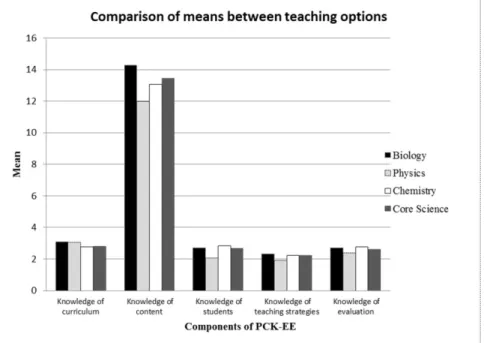
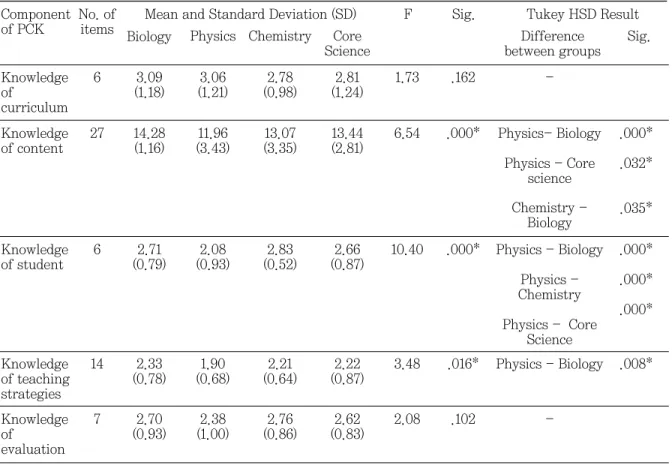
The finding on the comparison of PCK-EE among science teachers' different teaching options is shown in Figure 1 and Table 5.
Overall, the comparison of mean values shows the identical level of five components of PCK-EE among respondents from each teaching option.
However, the graph in Figure 1 illustrates that the mean value for each component of PCK-EE for Physics teachers is quite clearly lower than that of the teachers from other teaching options.
Biology teachers clearly obtained the highest mean value for knowledge of content. When
based on inferential analysis, the p value obtained for the component of knowledge of curriculum and knowledge of evaluation exceeds 0.05 (F (3, 343) = 1.73, p = 0.162 and F (3, 343) = 2:08, p = 0.102) respectively. This finding indicates that there is no significant difference of mean values for knowledge of curriculum and knowledge of evaluation among the four groups of teaching options studied. In addition, the p values for the knowledge of content (F (3, 343) = 6:54, p = 0.000), knowledge of students (F (3, 343) = 10:40, p = 0.000) and knowledge of teaching strategies (F (3, 343) = 3:48, p = 0016) are less than the significant value 0.05 (5%).
That means there are significant differences between the mean values for those three components of PCK-EE among Biology, Chemistry, Physics and Core Science teachers.
Consequently a Tukey Post Hoc test was carried out to identify the differences.
Based on the Tukey Post-Hoc test analysis, it was identified that differences in the level of PCK-EE mainly occur between Biology and Physics teachers. In details, as for the knowledge
Fig. 1 Comparison of mean values between teaching options
of content, there were significant different mean values between Biology and Physics teachers (p = 0.000), Biology and Chemistry teachers (p = 0.035), and Physics and Core Science teachers (p
= 0.032). Whereas for the knowledge of students, Post-Hoc tests revealed significant mean differences among Biology and Physics teachers, Chemistry and Physics teachers, and Biology and Core Science teachers. The significant value of each pairs was p = 0.000.
Comparison of differences between groups for knowledge about teaching strategies showed significant values only for the Biological Physics group (p = 0.000).
Based on the mean values explained above, the biology teachers perform better in the construct related to knowledge of content compared to the other group of teachers. As shown from the analysis of curriculum specification of each subject, it was found that Biology is a subject that is most relevant to apply environmental education in its teaching. Almost all the environmental knowledge themes listed by Hungerford et al. (1994) are applied in the Biology curriculum, particularly in the last two chapters in the Biology Form Four syllabus namely, “Ecosystem Dynamics”and “Endangered Ecosystems'. Almost all of environmental themes have been infused into several subtopics, namely: a) the abiotic and biotic components of ecosystems; b) colonization and succession in the ecosystem; c) the population ecology; d) biodiversity; e) appreciation of the biodiversity;
f) human activities that endanger the ecosystem; g) the greenhouse effect and ozone layer depletion; and h) the development of activities and ecosystem management. Apart from the two main chapters mentioned, there are also several other chapters in the Biology curriculum that are appropriate to apply knowledge about the environment indirectly. For example, through the chapter of knowledge of the human population can be applied.
Similarly, the Core Science curriculum also has
a specific chapter that can apply knowledge about the environment. In the Form 5 syllabus, there are chapters that convey environmental knowledge directly to students. The chapter is
‘ Preservation and Conservation of the Environment’. Through this chapter, environmental themes are conveyed to students through the subtopics a) the balance in nature; b) environmental pollution; c) the preservation and conservation of the environment and pollution control; d) the importance of proper management of natural resources in maintaining balance in nature; and e) practicing responsible attitudes to preserve and conserve the environment. Meanwhile, in other chapters that can be applied as a platform to discuss with students are about the need for proper handling of radioactive substances, the effects of industrial wastes disposal on the environment and etc.
On the other hand, based on the description of the Physics syllabus, it was found that this subject is a subject that can apply the least amount of environmental knowledge in its curriculum. Only a few subtopics were identified to be relevant to Environmental Education. In fact, the subtopics identified were only from the Form 4 syllabus. For example, the subtopic discuss about the need for energy.
As for the knowledge of students, it was found that significant differences exist between Biology and Physics teachers, and also between Biology and Chemistry teachers. Knowledge of students related to environmental education would probably be similar to the knowledge of students in learning biology since the environmental themes and issues are in synergy with Biology compared to the learning and teaching of Physics and Chemistry. Thus, Physics and Chemistry teachers would have less understanding of knowledge of students that would help learning and teaching of environmental education. Finally, the Core Science involves combination of all three science components but only at a surface level.
Whilst, the knowledge needed by teachers on students' existing knowledge, learning styles, learning difficulties, capabilities, strengths, and achievement in environmental education learning could be assumed to be very similar to that required for teaching Biology and Core Science subjects. Thus, this gives an advantage to these two groups of teachers to know their students for teaching and learning environmental education. But, for the Physics and Chemistry teachers, they must explore the knowledge of students more widely in order to integrate environmental knowledge into core subjects they teach, which are different.
For the knowledge of teaching strategies, significant differences were found between Biology and Physics teachers. Biology teachers have a higher level of knowledge of environmental
education teaching strategies. According to Raczynki and Munoz-Stuardo (2007), teachers' teaching strategy involves, among others, choosing languages relevant to the subject content. Thus, according to the findings, somehow it gives an advantage to Biology teachers to implement Environmental Education compared to Physics teacher.
The relationship between PCK-EE with science teachers
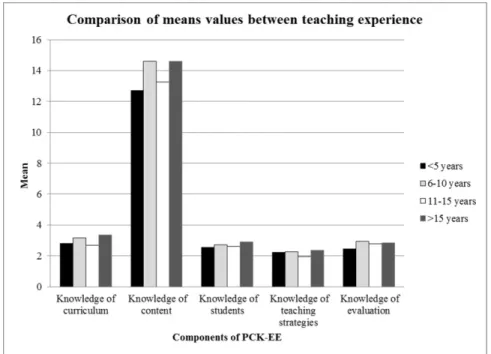
Figure 2 and Table 6 show the descriptive and inferential analysis of the relationship between science teachers' PCK-EE and teaching experience. Comparison of the mean value for five components of PCK-EE did not show a clear trend with teachers' teaching experience.
Component of PCK No. of
items Mean and Standard Deviation (SD) F Sig. Tukey HSD Result Biology Physics Chemistry Core
Science Difference
between groups Sig.
Knowledge of
curriculum
6 3.09
(1.18) 3.06
(1.21) 2.78
(0.98) 2.81
(1.24) 1.73 .162 -
Knowledge
of content 27 14.28
(1.16) 11.96
(3.43) 13.07
(3.35) 13.44
(2.81) 6.54 .000* Physics- Biology Physics - Core
science Chemistry -
Biology
.000*
.032*
.035*
Knowledge
of student 6 2.71
(0.79) 2.08
(0.93) 2.83
(0.52) 2.66
(0.87) 10.40 .000* Physics - Biology Physics - Chemistry Physics - Core
Science
.000*
.000*
.000*
Knowledge of teaching strategies
14 2.33
(0.78) 1.90
(0.68) 2.21
(0.64) 2.22
(0.87) 3.48 .016* Physics - Biology .008*
Knowledge of
evaluation
7 2.70
(0.93) 2.38
(1.00) 2.76
(0.86) 2.62
(0.83) 2.08 .102 -
Table 5
Comparison of PCK-EE between teaching options
* The mean difference is significant at the .05 level.
Although it is noted that the group of more than 15 years experienced teachers recorded the highest mean values in most of PCK-EE components (except in knowledge of evaluation), but the most inexperienced teachers did not
always display the lowest level of knowledge compared to the other groups of teaching experience. For instance, the lowest level in knowledge of curriculum and knowledge of teaching strategies is recorded by respondents
** The correlation is significant at the 0.01(2-tailed) level.
Fig. 2 Comparison of mean values between teaching experience
Table 6
Relationship between PCK-EE and teaching option Component of
PCK No. of
items Mean and Standard Deviation (SD) Spearman rho
correlation value
≤ 5 years 6 - 10 (r)
years 11 - 15
years >15 years Knowledge of
curriculum 6 2.80
(1.31) 3.16
(0.66) 2.68 (1.19) 3.35
(0.74) .091
Knowledge of
content 27 12.73
(3.48) 14.61
(2.50) 13.26
(2.44) 14.61
(2.57) .174**
Knowledge of
student 6 2.56
(0.89) 2.71
(0.59) 2.60
(0.93) 2.89
(0.49) .075
Knowledge of teaching strategies,
14 2.22
(0.83) 2.26
(0.60) 1.94
(0.68) 2.37
(0.80) -.016
Knowledge of
evaluation 7 2.47
(0.90) 2.95
(0.78) 2.77
(0.88) 2.84
(0.90) .170**
who experience teaching between 11-to 15 years (M=2.68 and M=1.94 respectively). Instead, least experienced respondents recorded higher mean values in those two components, which were M=2.80 and M=2.22 respectively.
Based on the inferential analysis, Spearman rho correlation value suggests that only two components of PCK-EE have significant relationship (r <0.01) to teaching experience. The two components were knowledge of content and knowledge of evaluation. In the case of knowledge of content, r = 0.174, n = 347, p = 0.01, while for knowledge of evaluation, r = 0.170, n = 347, p = 0.01. However, both findings suggest that the strength of the relationships is very low. This finding rejects the ideas proposed by van Driel et al. (1997), Coble and Azordegan (2004), Darling-Hammond and Bransford (2005), and Yusminah and Zakaria (2010), who all claimed that more experienced teachers have higher levels of PCK than less experienced teachers. However, the finding of this study supports the ideas of Grosmann et al. (1989) and Zainal et al. (2009), who viewed that the teaching experience of a teacher does not guarantee the development and stability of PCK.
Instead, teaching experience is not the only factors that influence teachers' PCK as a whole but it may influence some of the components (Grosmann et al., 1989). According to Kamtet et al. (2010), teachers who have longer teaching experience may have broader knowledge of content because there is a higher probability that they had taught students from various levels.
Thus, these teachers will need to acquire a greater scope of knowledge of content which covers syllabus of every level of students they are teaching.
As for the knowledge of evaluation component, Brickhouse and Bodner (1992) explained that less experienced teachers is possibly to have lower levels of knowledge of evaluation as they are often confuse between their personal views on the teaching and learning evaluation concept to the realities in the classroom. In contrast,
experienced teachers are thought to be capable in solving problems related to their teaching based on their practical experience, especially in choosing the appropriate method of teaching and learning evaluation in real classroom situations (Nilsson, 2008; Saad, 2009).
One way to resolve problem regards to science teachers' PCK-EE is by improving the structure of teaching training programs. Emphasis should be placed on each component as the mastery of PCK-EE among science teacher as a whole has not reached the desired level. However, according to the overall findings, the knowledge of environmental education teaching strategies needs to be stressed. Science teachers should be taught how to select appropriate teaching strategies that will allow students to understand and relate science knowledge with the integrated knowledge (Mishra & Koehler, 2006). Therefore, it is suggested that teacher training programs, including pre-service and in-service training, to imply the approach or teaching strategies that are proposed to the teachers for teaching environmental education at school. For instance, the teacher training activities could be organized in the form of project based learning, debate/discussion session, educational visit and etc. That way, teachers will found how it is relevant to apply particular teaching strategies into their teaching.
CONCLUSION
PCK-EE is an area of study that gets less attention among researchers and the academia.
In this study, the PCK-EE investigated based on five components: knowledge of curriculum;
knowledge of content; knowledge of students;
knowledge of teaching strategies; and knowledge of evaluation. The study showed that the overall level of PCK-EE among science teachers is moderate. This shows that the content of environmental education in the syllabus of science subjects is insufficient to ensure the teachers to be knowledgeable about the current
environmental issues. Also, their teaching experience is not auspicious to make them to be knowledgeable and skilled in delivering effective environmental teaching. Therefore, science teacher should put an effort to enrich themselves with relevant knowledge from other sources that would help them improving their teaching, and subsequently to encourage environmental learning among students.
Besides, a significant venture should be made by strengthening the current pre-service and in- service teacher training programs. This effort seems to be vital as PCK-EE is required explicitly for teaching environmental education, regardless of the teaching approach. Perhaps the teaching of environmental education would bring a change into the quality of environment and people's living. Furthermore, Delphi study should be carried out with various stakeholders regarding the teaching of environmental education explicitly.
REFERENCES
Ahmad, M. Z. (2008). Implementation of Environmental Education in Geography subject at secondary school. Unpublished doctoral thesis. National University of Malaysia, Malaysia.
Al-Maalouli, R. (2009). Environmental Education curricula teachers' knowledge and practice A field study at the basic teaching schools/ 2nd Circle Damascus city. Damascus University Journal, 25 (1).
Ali, C.K.M. (1999). The level of knowledge on environmental issues among pre-service teachers. Unpublished master's thesis. National University of Malaysia, Malaysia.
Brickhouse, N.W. & Bodner, G.M. (1992). The beginning science teacher: Classroom narratives of convictions and constraints. Journal of Research in Science Teaching, 29, 471-485.
Coble, C., & Azordegan, J. (2004). The challenges and opportunities of the No Child Left Behind Act: Seven strategies for teacher
educators. Action in Teacher Education, 26 (2), 2-14.
Curriculum Development and Centre, (2005a).
Biology Form 4: Integrated Curriculum for secondary school: curriculum specification.
Kuala. Lumpur: Malaysian Ministry of Education.
Curriculum Development and Centre, (2006a) Biology Form 5: Integrated Curriculum for secondary school: curriculum specification.
Kuala. Lumpur: Malaysian Ministry of Education.
Curriculum Development and Centre, (2005b) Chemistry Form 4: Integrated Curriculum for secondary school: curriculum specification.
Kuala. Lumpur: Malaysian Ministry of Education.
Curriculum Development and Centre, (2006b) Chemistry Form 5: Integrated Curriculum for secondary school: curriculum specification.
Kuala. Lumpur: Malaysian Ministry of Education.
Curriculum Development and Centre, (2005c) Physics Form 4: Integrated Curriculum for secondary school: curriculum specification.
Kuala. Lumpur: Malaysian Ministry of Education.
Curriculum Development and Centre, (2006c) Physics Form 5: Integrated Curriculum for secondary school: curriculum specification.
Kuala. Lumpur: Malaysian Ministry of Education.
Curriculum Development and Centre, (2005d) Science Form 4: Integrated Curriculum for secondary school: curriculum specification.
Kuala. Lumpur: Malaysian Ministry of Education.
Curriculum Development and Centre, (2006d) Science Form 5: Integrated Curriculum for secondary school: curriculum specification.
Kuala. Lumpur: Malaysian Ministry of Education.
Cutter, A. (2002). The Value of Teachers' Knowledge: Environmental Education as a Case Study. American Educational Research
Association Annual Conference, New Orleans, USA.
Darling-Hammond, L. & Bransford. J. (2005).
Preparing Teachers for a Changing World: What Teachers Should Learn and Be Able to Do. San Francisco: Jossey-Bass.
Grossman. 1989. Grossman, P. L. (1989).
Learning to teach without teacher education.
Teachers College Record, 91, 191-208.
Hungerford, H.R., Volk, T.L. & Ramsey, J.M.
(1994). A Prototype Environmental Education Curriculum for The Middle School. USA:
UNESCO.
Jamaluddin, R. 2004. Achievement of secondary science teachers in environmental issues. Unpublished master's thesis. Malayan Univerisity, Malaysia.
de Jong, O. (2009). Exploring and changing teachers' pedagogical content knowledge: An overview. In O. de Jong & L. Halim (Eds.), Teachers' professional knowledge in Science and Mathematics education: Views from Malaysia and abroad. Selangor, Malaysia: Penerbit Universiti Kebangsaan Malaysia.
Kamtet, W., Ngamman, J., Liewkongsthaporn, W., Pativisan, S & Dechsri, P. (2010). Assessing Subject Matter Knowledge of Science Teachers.
Retrieved June 20, 2011, from http://www.iaea 2010.com/ fullpaper/415.pdf
Khor, C. Y. (2006). Environmental concerns among preschool teachers in Penang.
Unpublished master's thesis. University Putra Malaysia, Malaysia.
Kisoglu, M., Gurbuz, H., Erkol, M., Akar, M.
S. & Akilli, M. (2010). Prospective Turkish Elementary science teachers Education in Universities. International Electronic Journal of Elementary Education, 2(2).
Meerah, S. M. (1999). Impact of science learning research on curriculum. Selangor:
National University of Malaysia.
Mishra, P. & Koehler, M.J. (2006).
Technological pedagogical content knowledge: A framework for integrating technology in teacher knowledge. Teachers College Record, 108(6),
1017-1054.
Nilsson, P. (2008). Teaching for Understanding: The complex nature of pedagogical content knowledge in pre-service education. International Journal of Science Education. 30 (10). 1281-1299.
Raczynski, D. & Munoz-Stuardo, G. (2007).
Chilean Educational Reform: The Intricate Balance Between A Macro and Micro Policy. In.
W. T. Pink & G. W. Noblit (Eds.), International Handbook of Urban Education. Retrieved March 20, 2010, from http://www.bligoo.com/media/
users/2/113704/files/Latin%20America,%20Raczy nski%20and%20Munoz-Stuardo.pdf
Rasip, I. (2008). Pedagogical content knowledge of Additional Mathematics teachers at secondary school: A case study. Unpublished master's thesis National University of Malaysia, Malaysia.
Saad, N. S. (2009). Mathematics Student Teachers of Teacher Education Programs. In. O.
de Jong & L. Halim (Eds.), Teachers Knowledge in science and Mathematics Education: Views from Malaysia and Abroad. Selangor: Faculty of Education, Universiti Kebangsaan Malaysia.
Sarkim, T. (2004). Investigating Secondary School Physics Teachers A Case Study. Post- Script, 5(1), 82-95.
Schmidt, F. (1996). Statistical Significance Testing and Cumulative Knowledge in Psychology. Implications for Training Researchers Psychological Methods, 1(2), 115- 129.
Tuan, H. L., Chang, H. P. & Wang, K. H.
(2000). The development of an instrument for assessing Students International Journal of Science Education, 22(4), 385-398.
van Driel, J. H., Verloop, N. & de Vos, W.
(1997). Developing Science Teachers Knowledge.
Journal of Research in Science Teaching, 35(6), 673-695.
White. G.P. (2000). New Physics. Retrieved January 15, 2010, from http://www.newphysics 2000.org
Yusminah & Zakaria, E. (2010). Investigating
Secondary Mathematics Teachers Content Knowledge: A Case Study. Journal of Education and Sociology, 32-39.
Zainal, T. Z. T., Ramlee Mustapha & Abdul razak Habib. (2009). Pedagogical content knowledge for the title division among primary school mathematics teachers. Jurnal Pendidikan
Malaysia, 34(1), 131-143.
Zainal, T.Z.T. (2005). Pedagogical content knowledge for the title division among primary school mathematics teachers. Unpublished doctoral dissertation. National University of Malaysia, Malaysia.