≫ 연구논문 ≪
황산용액에서 Alamine 336에 의한 용매추출로 몰리브덴과 텅스텐의 분리
응우엔 타이홍 · 이만승
목포대학교 공과대학 신소재공학과
Separation of Molybdenum and Tungsten from Sulfuric acid Solution by Solvent Extraction with Alamine 336
Thi Hong Nguyen and Man Seung Lee
Department of Advanced Material Science and Engineering, Institute of Rare Metal, Mokpo National University, Chonnam 534-729, Republic of Korea
요 약
황산용액에서 Alamine 336에 의한 몰리브덴과 텅스텐의 분리에 대해 수상의 pH와 추출제의 농도를 변화시키 며 조사했다. 수상의 pH가 3에서 5사이의 범위에서 낮은 농도의 아민에 의해 몰리브덴이 선택적으로 추출되었 다. Alamine 336과 양이온 추출제를 혼합하면 두 금속간의 분리인자가 다음 순서와 같이 증가했다 : D2EPHA >
PC88A > Decanol > Versatic acid. Alamine 336과 D2EHPA의 혼합용매에서 몰리브덴과 텅스텐의 탈거율은 매 우 낮았으나, Alamine 336과 Decanol의 혼합용매의 경우 NH4OH 와 NH4Cl의 혼합용액으로 두 금속을 모두 탈 거할 수 있었다.
주제어 : 몰리브덴, 텅스텐, 분리, 용매추출
Abstract
The separation behaviour of Mo and W from sulfuric acid solution by solvent extraction with Alamine 336 was investigated as a function of solution pH and extractant concentration. Selective extraction of Mo over W by Alamine 336 was obtained in the pH range of 3-5 with low amine concentration. The mixture of Alamine 336 and acidic extractants improved the separation factor between Mo and W and was in the following order: D2EPHA > PC88A > Decanol > Versatic acid. The stripping effi- ciency of Mo and W from the loaded mixture of Alamine 336 and D2EHPA was very poor, while complete stripping of Mo and W was possible from the mixture of Alamine 336 and Decanol by using a mixture of NH
4OH and NH
4Cl.
Key words : Molybdenum; Tungsten; Separation; Solvent extraction
· Received : December 21, 2015 · Revised : January 15, 2016 · Accepted : January 22, 2016 Corresponding Author : Man-Seung Lee (E-mail : [email protected])
Department of Advanced Materials Science & Engineering, Mokpo National University, 1666 Yeongsan-ro, Cheonggye-myeon, Muan-gun, Chonnam, 58554, Korea
ⓒThe Korean Institute of Resources Recycling. All rights reserved. This is an open-access article distributed under the terms
of the Creative Commons Attribution Non-Commercial License (http://creativecommons.org/licenses/by-nc/3.0/), which permits
unrestricted non-commercial use, distribution and reproduction in any medium, provided the original work is properly cited.
1. Introduction
Molybdenum and tungsten are strategic metals used in many applications. The chemical properties of Mo and W are similar to each other and their mixtures are encountered in mineral deposits as well as recycled materials.1) In the recovery of Mo and W with high purity from these sources, separation methods, such as precipitation,2,3) ion exchange4-6) and solvent extraction7-12) have been widely employed. Among these methods, solvent extraction is considered to be more effective than ion exchange in terms of separation efficiency.13) The separation of Mo and W from aqueous solutions is difficult owing to their similar chemical properties.
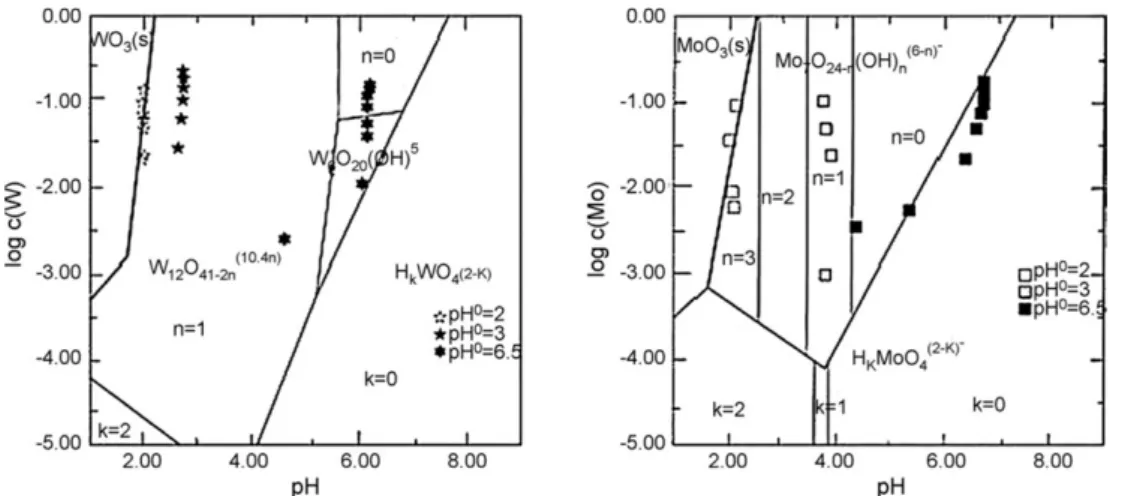
The predominant aqueous species of Mo and W depends on solution pH. Anionic species of Mo and W is predominate at pH >2 (see Fig. 1).12,14-16) When solution pH is lower than 2, a small amount of MoO3 and WO3 exist in the solution. Literature surveys show that three kinds of extractants are employed for the separation of W and Mo, namely acidic7-9) and neutral extractants10), and amines7,11,12). However, during the separation of the two metals by cationic or neutral extractants from acidic solution, tungsten can be precipitated as tungstic acid, resulting in the formation of crud. Therefore, some amount of hydrogen peroxide should be added to acidic solutions to prevent the precipitation of tungsten.
Previous study reported that LIX 63 offers selective
extraction of Mo over W in the equilibrium pH range of 2-6 as a solvating extractant but the extraction efficiency of Mo by this extractant is not high.17) Aliquat 336 can selectively extract W in presence of high concentration of Mo in the pH range of 6-6.518). The disadvantage of employing Aliquat 336 lies in the fact that the co-extraction percentage of Mo is high and thus the purity of W in the stripping solution is low.
It has been reported that tri-octyl/dodecyl amine (Alamine 336) offers high extraction of Mo but little information is available on the extraction and separation behaviour of Mo and W by Alamine 336.
Among the several inorganic acids such as HCl, HNO3, and H2SO4, the charge density of NO3− and Cl− is lower than that of the anionic species of Mo and W, which results in low extraction percentage of Mo and W by amine. However, the charge density of SO42− is much higher than that of the anionic species of Mo and W and thus the extraction percentage of Mo and W by amines from sulphuric acid solution is generally high.12) Moreover, sulphuric acid is most commonly used because of more flexible material allowances for reactors, lower cost and better recirculation possibilities.19) Hence, the separation behaviour of Mo and W from sulphuric acid solution by solvent extraction with Alamine 336 was studied in the present work. Effect of the mixture of Alamine 336 and acidic extractants and stripping condition was also investigated in detail.
Fig. 1. Distribution diagram of Mo(IV)-OH
−and W(IV)-OH
−species with the points showing the extraction path.
15)2. Experimental
The synthetic solution containing Mo and W was prepared by dissolving Na2MoO4 (Sigma Co., > 99%) and Na2WO4 (Sigma Co., > 99%) in distilled water. Based on real leaching solution reported in the literature,20) the concentration of Mo and W in the synthetic solution was kept at 10 g/L and 1 g/L respectively. The acidity of the solution was adjusted by using NaOH or H2SO4 (Duksan Co.) solution. Alamine 336 (BASF Co.), Decanol (Sigma-Aldrich), di-(2-ethylhexyl)phosphoric acid (D2EH PA, IS Chem. Co.), Versatic Acid (IS Chem. Co.), and 2-thylhexyl phosphonic acid mono-2-ethylexyl ester (PC 88A, IS Chem. Co.) were used as received without any treatment. Kerosene (Daejung Co.) was employed as a diluent.
Solvent extraction experiments were performed by mixing equal volumes (10 mL) of aqueous and organic phases for 30 min (extraction and stripping equilibrium were reached within 30 min in initial tests) using a Burrell wrist action shaker (model 75). After shaking, the two phases were separated with a separating funnel.
All experiments were performed at room temperature (25 ± 1oC). The concentration of metal ions in the aqueous phase was determined by inductively coupled plasma-optical emission spectroscopy (ICP-OES; Spectro Arcos). The concentration of metal ions in loaded organic phase was calculated by mass balance. The pH of the aqueous phase was determined by pH meter (Orion Star A211). The distribution coefficient (D) was calculated as the ratio of the concentration of the metal ions present in the organic phase to that present in the aqueous phase at equilibrium. The separation factor was calculated from the ratio of the distribution coefficient.
3. Results and discussion
3.1. Effect of solution pH
The extraction behaviour of Mo and W by Alamine 336 was investigated by varying the initial pH from 2 to 6. The synthetic solution containing 10 g/L Mo and 1 g/L W was contacted with 0.1 M Alamine 336. The volume ratio of aqueous and organic phases was unity
and the results are shown in Fig. 2. It is seen that most of Mo and W was extracted by Alamine 336 at pH 2 and the extraction percentage of Mo and W decreased steadily with the increase of initial pH. In the initial pH range of 2-5, the equilibrium pH was much higher than the initial pH while they were same at initial pH 6.
Acid solutions are generally employed for the leaching of metals from secondary resources, resulting in high concentration of Mo in the leach liquor.19) It has been reported that the extraction and separation of Mo and W from acidic solution by acidic extractants is very difficult due to the formation of high molecular weight polyanions.8) In general, the tertiary amine should be protonated before extraction to act as an anion exchanger.
In this work, Alamine 336 was not protonated before extraction. Therefore, Alamine 336 was first protonated by sulphuric acid and then these protonated amines can take part in the solvent extraction reaction of W and Mo. The decrease in the extraction percentage of Mo and W by Alamine 336 might be related to the protonation reaction of amines. At low pH, the concen- tration of sulphuric acid was enough for Alamine 336 to be protonated leading to the increase of solution pH but Alamine 336 was not protonated when solution pH was high. The extraction percentage of Mo by Alamine 336 was higher than that of W within the experimental
Fig. 2. Effect of initial pH on extraction of Mo and W using 0.1 M Alamine 336. Aqueous, g/L: Mo-10; W-1; O/
A=1/1l; Initial pH=2-6.
ranges employed in this work. Comparison of the distribution diagram of Mo and W indicates that the predominant species of Mo is more favourable than that of W to the extraction with Alamine 336 in the solution pH from 2 to 6.
During the extraction process, a third phase or emulsion was formed in the organic phase and thus a modifier should be used. The cause of the formation of a third phase might be related to the limited solubility of amine- Mo complexes in the extracted organic.21) It can be concluded that both Mo and W was extracted by Alamine 336 at low pH (2.0), while selective extraction of Mo over W was obtained in the pH range of 3-5.
3.2. Effect of the mixtures of Alamine 336 and Decanol/D2EHPA/Versatic Acid/PC 88A Alamine 336 offered the selective extraction of Mo over W in the range initial pH of 3-5 but the separation factor between these two metals was not high. It has been reported that binary mixture of tertiary amine and acidic extractants shows synergism on the extraction of metals from a weak acid solution22,23)and thus a mixture of Alamine 336 and D2EPHA/PC88A/Versatic Acid was studied to improve the separation of Mo and W in the present study. Due to the formation of a third phase in Alamine 336, the addition of decanol to Alamine 336 was also studied and the results are compared with the above mixtures.
The concentration of Alamine 336 and D2EPHA/
PC88A/Versatic Acid / Decanol was fixed at 0.1 and 0.005 M, respectively. The synthetic solution containing 10 g/L Mo and 1 g/L W at initial pH 3 was contacted with organic phases. Only Decanol and D2EHPA were effective in preventing the formation of a third phase.
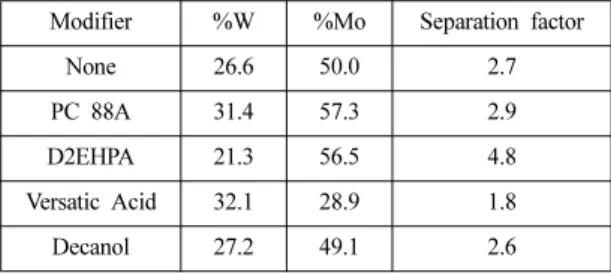
Variation in the extraction percentage and separation factor by the systems is shown in Table 1. It is seen that the presence of PC 88A and D2EHPA in Alamine 336 led to an increase in the separation factor between Mo and W, while an opposite trend was obtained in the case of Versatic Acid and Decanol. The separation efficiency of Mo and W by the mixtures was in the following order: D2EPHA > PC88A > Decanol> Versatic Acid. Since the addition of D2EHPA to Alamine 336 not only prevented the formation of a third phase but
also increased the separation efficiency of Mo and W, the mixture of D2EHPA and Alamine 336 was chosen for further experiments.
The extraction efficiency of Mo and W by the mixture of D2EHPA and Alamine 336 was investigated by varying D2EHPA concentration from 0.05 to 0.3 M in 0.1 M Alamine 336 at initial pH 3. Fig. 3 shows that the extraction percentage of Mo and W was constant within our experimental ranges, indicating that D2EHPA did not take part in the solvent extraction reaction of the two metals.
3.3. Effect of Alamine 336 concentration and O/A ratio
The effect of Alamine 336 concentration on the
Table 1. Effect of acidic extractants and Decanol in Alamine
336 on extraction of Mo and W.
Modifier %W %Mo Separation factor
None 26.6 50.0 2.7
PC 88A 31.4 57.3 2.9
D2EHPA 21.3 56.5 4.8
Versatic Acid 32.1 28.9 1.8
Decanol 27.2 49.1 2.6
Aqueous: Mo-10 g/L, W-1 g/L; Initial pH =3.0; [Alamine 336] = 0.1M; [PC88A/D2EHPA/Versatic Acid/Decanol] = 0.05 M.
Fig. 3. Effect of D2EHPA concentration on extraction of Mo
and W by the mixture of D2EHPA and 0.1 M
Alamine 336. Aqueous: Mo-10 g/L; W-1 g/L; Initial
pH 3.0.
extraction and separation of Mo and W from the synthetic solution containing 10 g/L Mo and 1 g/L W at initial pH 3 was investigated by varying its concentration from 0.1 to 0.5 M. The concentration of D2EHPA in Alamine 336 was fixed at 0.05 M. Fig. 4 shows that the extraction percentage of Mo increased slowly with the increase of Alamine 336 concentration from 0.1 to 0.5 M, while that of W increased rapidly. The increase of Alamine 336 concentration showed a negative effect on the separation efficiency of Mo and W. When Alamine 336 concentration was 0.5 M, the extraction percentage of Mo and W was same and thus it was impossible to separate the two metals.
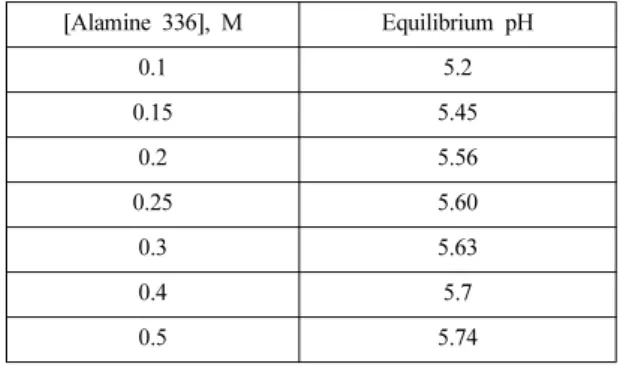
The change in equilibrium pH of the solution with Alamine 336 concentrations is shown in Table 2. The equilibrium pH increased from 5.2 to 5.8 with the increase of Alamine 336 concentration from 0.1 to 0.5.
It has been reported that metal-OH species compete with another species and can be extracted into organic phase.17) According to distribution diagram, Mo-OH species and W12O396- are formed at pH 5.0 and thus the extraction of Mo by 0.1 M Alamine 336 was higher than that of W. Increase in Alamine 336 concentration led to an increase in equilibrium pH where MoO42−
and WO42− are predominant. The charge density of WO42− is smaller than that of MoO42−, resulting in larger solvation interaction between WO42− and Alamine 336.2) This is the reason why the extraction percentage
of W increased rapidly with the increase of Alamine 336 concentration, while that of Mo increased slowly at the same condition. It can be concluded that the control of Alamine 336 concentration is very important in the separation of Mo and W. The optimum concentration of Alamine 336 to selectively extract Mo from the solution with initial pH 3 was 0.1 M.
In order to investigate the effect of the volume ratio of the two phases (O/A ratio) on the extraction and separation of Mo and W using 0.1 M Alamine 336, O/A ratio was varied from 0.2 to 4. In these experiments, the mixture of 0.1 M Alamine 336 and 0.05 M D2EHPA was contacted to the synthetic solution containing 10 g/L Mo and 1 g/L W at initial pH 3. The extraction percentage of Mo and W increased slowly with the increase of O/A ratio from 0.2 to 4 (see Fig. 5). The slow increase in the extraction percentage of Mo may be ascribed to the change in the solution pH with the variation of the O/A ratio.
3.5. Stripping
Fig. 1 indicates that alkaline solution can strip Mo and W from loaded Alamine 336. Therefore, several stripping agents such as NaOH, NH4OH and the mixture of NH4OH and NH4Cl were employed. The loaded organic phase containing 7.5 g/L Mo and 0.86 g/L W was prepared by contacting the synthetic solution containing 10 g/L Mo and 1 g/L W with 0.5 M Alamine 336 + 0.05 M D2EHPA at initial pH 3. It was observed
Fig. 4. Effect of Alamine 336 concentration on extraction of
Mo and W by the mixture of Alamine 336 and 0.05 M D2EHPA. Aqueous: Mo-10 g/L; W-1 g/L; Initial pH 3.0.
Table 2. Equilibrium pH of the solution by varying Alamine 336 concentration in the presence of 0.05 M D2EHPA.
[Alamine 336], M Equilibrium pH
0.1 5.2
0.15 5.45
0.2 5.56
0.25 5.60
0.3 5.63
0.4 5.7
0.5 5.74
Aqueous: Mo-10 g/L; W-1 g/L; Initial pH 3.0.
that the separation of the two phases was difficult when NaOH or NH4OH was used for a stripping agent.
The stripping results by the mixture of NH4OH and NH4Cl are shown in Table 3. The stripping percentage of Mo and W from the loaded mixture of Alamine 336 and D2EHPA by this mixture was only 40%. In order to compare the effect of the nature of a modifier on the stripping, stripping experiments were done from the loaded mixture of Alamine 336 and Decanol. For this purpose, the mixture of 0.5 M Alamine 336 and 0.05 M Decanol was contacted at the same extraction condition. The concentration of Mo and W in the loaded mixture was 6.44 and 0.84 g/L W, respectively. Table 3 also shows that complete stripping of the two metals by the mixture of NH4Cl and NH4OH was obtained
from the loaded mixture of Alamine 336 and Decanol.
The difference in the stripping behaviour of the two metals between the loaded mixture of D2EHPA and Decanol/D2EHPA may be ascribed to the interaction between Alamine 336 and D2EHPA. D2EHPA is acidic, while Alamine 336 is basic. Therefore, acid-base reaction can occur between Alamine 336 and D2EHPA, resulting in the formation of salt.22) Therefore, addition of Decanol to Alamine 336 as a modifier is better on the basis of the stripping performance. Since the stripping behaviour of the Mo and W from the loaded Alamine 336 was similar, it was impossible to separate the two metals by selective stripping.
4. Conclusions
The extraction and separation behaviour of Mo and W from sulfuric acid solution by Alamine 336 was investigated as a function of solution pH and extractant concentration. The extraction behaviour of Mo and W by Alamine 336 depended strongly on solution pH.
Both Mo and W were extracted at initial pH 2 and then extraction percentage of these metals decreased rapidly with the increase of initial pH value from 2 to 6. Selective extraction of Mo over W from sulphuric acid solution by Alamine 336 was obtained in the initial pH range of 3-5. The separation efficiency of Mo and W by the mixture of Alamine 336 and PC88A/Versatic acid/D2EHPA/Decanol was in the order of D2EPHA >
PC88A > Decanol > Versatic acid. However, the formation of a third phase was only prevented in the presence of D2EHPA or Decanol in Alamine 336. In the extraction
Table 3. Stripping behaviour of Mo and W from loaded Alamine 336+D2EHPA/Decanol
Stripping reagent
Alamine 336 + D2EHPA
Alamine 336 + Decanol
% Mo % W % Mo % W
2 M NH
4OH+0.5 M NH
4Cl 37.6 32.6 100 100
3 M NH
4OH+0.5 M NH
4Cl 38.6 32.8 100 100
2 M NH
4OH+1 M NH
4Cl 39.7 32.5 100 100
Aqueous: Mo-10 g/L, W-1 g/L; Initial pH =3.0; Loaded 0.5 M Alamine 336 + 0.05 M D2EHPA: 7.5 g/L Mo and 0.86 g/L W; Loaded 0.5 M Alamine 336 + 0.05 M Decanol: 6.44 g/L Mo and 0.84 g/L W
Fig. 5. Effect of O/A ratio on extraction of Mo and W by the mixture of 0.1 M Alamine 336 and 0.05 M D2EHPA. Aqueous, g/L: Mo- 10; W-1; Initial pH
=3.0; O/A = 0.2-4.
with the mixture of Alamine 336 and D2EHPA, Alamine 336 concentration affected strongly the extraction and separation behaviour of Mo and W, while the effect of D2EHPA concentration was negligible. The stripping results indicated that the stripping efficiency of Mo and W from the mixture of Alamine 336 and D2EHPA was poor, while complete stripping of these metals from the mixture of Alamine 336 and Decanol was obtained by using the mixture of NH4OH and NH4Cl as a stripping reagent.
Acknowledgements
We gratefully thank the Gwangju branch of the Korea Basic Science (KBSI) for ICP data.
References
1. Mahmoud, M.H.H., Nakamura, S., Akiba, K., 1996:
Extraction separation of molybdenum (VI) and tungsten (VI) by α-hydroxy oxim, Solvent Extr. Ion Exc., 14, pp.
203-217.
2. Zhao, Z., Cao, C., Chen, X., 2011: Separation of macro amounts of tungsten and molybdenum by precipitation with ferrous salt, Trans. Nonferrous Met. Soc. China, 21, pp. 2758-2763.
3. Zhao, Z., Cao, C., Chen, X., Huo, G., 2011: Separation of macro amounts of tungsten and molybdenum by selec- tive precipitation, Hydrometallurgy, 108, pp. 229-232.
4. Lu, X., Huo, G., Liao, C., 2014: Separation of macro amounts of tungsten and molybdenum by ion exchange with D309 resin, .Nonferrous Met. Soc. China, 24, pp.
3008-3013.
5. Huo, G., Peng, C., Song, Q., Lu, X., 2014: Tungsten removal from molybdenum solutions using ion exchange, Hydrometallurgy, 147-148, pp. 217-222.
6. Zhang, J., Liu, X., Chen, X., Li, J., Zhao, Z., 2014: Sep- aration of tungsten and molybdenum using macroporous resin: Competitive adsorption kinetics in binary system, Hydrometallurgy, 144-145, pp. 77-85.
7. Moris, M.A., Diez, F.V., CoCa, D.J., 1999: Solvent extraction of molybdenum and tungsten by Alamine 336 and D2EHPA in a rotating disc contactor , Sep. Purif.
Technol., 17, pp. 173 -179.
8. Zheng, Q., Fan, H., 1986: Separation of molybdenum from tungsten by di-2-ethylhexyl phosphoric acid extractant, Hydrometallurgy, 16, pp. 263-270.
9. Saily, A., Khurana, U., Yadav, S.K., Tando, S.N., 1996:
Thiophosphinic acids as selective extrctants for molyb- denum recovery from a low grade ore and spent catalyst, Hydrometallurgy, 41, pp. 99-105.
10. Guan, W., Zhang, G., Gao, C., 2012: Solvent extraction separation of molybdenum and tungsten drom ammo- nium solution by H
2O
2-complextion, Hydrometallurgy, 127-128, pp. 84-90.
11. Gerhardt, N.I., Palant, A.A., Petrova, V.A.,. Tagirov, R.K., 2001: Solvent extraction of molybdenum (VI), tungsten (VI) and rhenium (VII) by diisododecylamine from leach liquors, Hydrometallurgy, 60, pp. 1-5.
12. Ning, P., Cao, H., Zhang, Y., 2009: Selective extraction and deep removal of tungsten from sodium molybdate solution by primary amine N1923, Sep. Purif. Technol., 70, pp. 27-33.
13. Zeng, L., Cheng, C.Y., 2009: A literature review of the recovery of molybdenum and vanadium from spent hydrodesulphurization catalysts. Part II: Separation and purification, Hydrometallurgy, 98, pp. 10-20.
14. Nekovar, P., Schrotterova, D., 2000: Extraction of V(V), Mo(VI) and W(VI) polynuclear species by primene JMT, Chem. Eng. J., 79, pp. 229-233.
15. Earnshaw, A., Greenwood, N., 1997: Chemistry of the Elements, second ed.
16. Nguyen, T.H., Lee, M.S., 2013: Recovery of molyb- denum and vanadium from acidic leaching solution of spent catalyst by solvent extraction, J. of Korean Inst. Of Resources Recycling, 22, pp. 3-11.
17. Nguyen, T.H., Lee, M.S., 2015: Separation of molyb- denum(VI) and tungsten(VI) from sulfate solutions by solvent extraction with LIX 63 and PC 88A , Hydro- metallurgy, 155, pp. 51-55.
18. Nguyen, T.H., Lee, M.S., 2014: Separation of Vanadium and Tungsten from Sodium Molybdate Solution by Sol- vent Extraction, Ind. Eng. Chem. Res., 53, pp. 8608- 8614.
19. Zeng, L., Cheng, C.Y., 2009: A literature review of the recovery of molybdenum and vanadium from spent hydrodesulphurization catalysts. Part I: Metallurgyical process, Hydrometallurgy, 98, pp. 1-9.
20. Srivastava, R.R., Mittal, N.K., Padh, B., Reddy, B.R., 2012: Removal of tungsten and other impurities from spent HDS catalyst leach liquor by an adsorption route, Hydrometallurgy, 127-128, pp. 77-83.
21. Al-Siddique, F.R., Adeler, I., Huwyler, S., 1980: Effect of pH and modifier-concentration on the solvent extraction of molybdenum with an alkyl amine, Wuren- lingen.
22. Liu, Y., Jeon, H.S., Lee, M.S., 2015: Extraction of hydro-
chloric acid with binary mixtures of tertiary amine and
organophosphorus acid and analysis of the interaction between the constituents of these mixtures, Hydrome- tallurgy, 155, pp. 44-50.
23. Liu, Y., Jeon, H.S., Lee, M.S., 2014: Solvent extraction
of Pr and Nd fromchloride solution by themixtures of Cyanex 272 and amine extractants, Hydrometallurgy, 150, pp. 61-67.
응우엔 타이홍
• 깐터대학교(베트남) 물리교육학과 학사
• 깐터대학교 (베트남) 물리학 강사
• 목포대학교 신소재공학과 석사
• 현재 목포대학교 신소재공학과 박사 과정
이만승