≫ 연구논문 ≪
황산용액에서 양이온계 추출제 및 TBP와의 혼합추출제에 의한 지르코늄(IV)과 하프늄(IV)의 용매추출
왕링윈 · 이만승
목포대학교 공과대학 신소재공학과
Solvent Extraction of Zr(IV) and Hf(IV) from Sulfuric Acid Solutions by Acidic Extractants and Their Mixtures with TBP
Ling Yun Wang and Man Seung Lee
Department of Advanced Material Science & Engineering, Institute of Rare Metal, Mokpo National University, Channam 534-729, Korea
요 약
황산용액에서 양이온 추출제인 Versatic acid, LIX 63 및 Cyanex 301을 사용하여 지르코늄(IV)과 하프늄(IV)의 분리실험을 수행 했다. 진한 황산용액에서 Versatic acid와 LIX 63으로 두 금속을 분리할 수 없으나, Cyanex 301에 하프늄(IV)이 선택적으로 추출되 었다. 그러나 Cyanex 301에 의한 두 금속의 추출율은 D2EHPA에 비해 매우 낮았다. TBP를 Cyanex 301과 D2EHPA에 혼합하면 두 금속의 추출과 분리에 역효과를 보였다. 염산, 질산 및 황산용액에서 상기 추출제에 의한 두 금속의 추출반응과 분리효율의 차 이점을 고찰하였다.
주제어 : 지르코늄, 하프늄, 분리, 황산, 양이온계 추출제
Abstract
Separation of Zr(IV) and Hf(IV) from sulfuric acid solutions was investigated by extraction with several acidic extractants such as Versatic acid, LIX 63, and Cyanex 301. From strong sulfuric acid solutions, the separation of Zr(IV) and Hf(IV) by Ver- satic acid and LIX 63 was not possible, while selective extraction of Hf(IV) over Zr(IV) was obtained with Cyanex 301. How- ever, the extraction percentage of the two metals was much lower compared to that by D2EHPA. Mixing of TBP with Cyanex 301 and D2EHPA led to negative effect on the extraction and separation of the two metal ions. The difference in the extraction reaction and separation selectivity between HCl, HNO
3and H
2SO
4media with each extractant was discussed.
Key words : Zirconium, Hafnium, Separation, Sulfuric acid, Acidic extractants
· Received : January 18, 2016 · Revised : February 2, 2016 · Accepted : February 15, 2016 Corresponding Author : Man Seung Lee (E-mail : [email protected])
Department of Advanced Materials Science & Engineering, Mokpo National University, 1666 Yeongsan-ro, Cheonggye-myeon, Muan-gun, Chonnam, 58554, Korea
ⓒThe Korean Institute of Resources Recycling. All rights reserved. This is an open-access article distributed under the terms
of the Creative Commons Attribution Non-Commercial License (http://creativecommons.org/licenses/by-nc/3.0/), which permits
unrestricted non-commercial use, distribution and reproduction in any medium, provided the original work is properly cited.
1. Introduction
Zirconium and hafnium are normally associated together in nature as the minerals, zircon (ZrSiO4) and baddeleyite (ZrO2).1) Although their chemical properties are almost identical, they exhibit opposite nuclear characteristics. In nuclear applications, zirconium has low thermal neutron capture cross-section, while the neutron absorption capacity of hafnium is 640 times stronger than that of zirconium.2) As a nuclear material, zirconium should have a very low content of hafnium less than 100 ppm.3) Therefore the separation of hafnium from zirconium is very important in the manufacture of nuclear grade zirconium. At present, solvent extraction is commercially used to separate the two metals.
Conventionally, two different solvent extraction tech- niques are employed for the separation of Zr(IV) and Hf(IV): (1) MIBK – thiocyanic - hydrochloric acid pro- cess;4,5) and (2) TBP - nitric acid process.6,7) Hf(IV) is preferentially extracted over Zr(IV) as hafnyl thiocyanate in the MIBK process, while TBP has a selectivity for Zr(IV). In developing a separation process, selective extraction of a minor element (Hf(IV)) from major one (Zr(IV)) is more desirable in terms of economics. Up to now, Zr(IV) is selectively extracted into organic phase over Hf(IV) in most of the reported separation systems, except MIBK separation system. Nonetheless, MIBK process has some disadvantages, such as high aqueous solubility and low flash point of the solvent (MIBK) and environmental issues of the cyanide by-products.8) This motivates researchers to develop a new process to selectively extract Hf(IV) over Zr(IV).
The investigation on the separation and extraction behavior of Zr(IV) and Hf(IV) from hydrochloric, nitric and sulfuric acid solutions by using cationic, neutral and amine-based extractants have been investigated in our previous work.8-15) Based on this work, it was demonstrated that Zr(IV) is selectively extracted over Hf(IV) from strong hydrochloric or nitric acid solutions by cationic, neutral and amine extractants.9-13) On the other hand, selective extraction of Hf(IV) over Zr(IV) occurs from only strong sulfuric acid solutions (1- 4 M) by using acidic organophosphorus extractants.8,14)
In this work, solvent extraction experiments were carried out from sulfuric acid solutions by using several acidic extractants, such as Versatic acid, LIX 63, Cyanex 301 and their mixtures with TBP. Moreover, the extraction reactions and separation selectivity between Zr(IV) and Hf(IV) from hydrochloric, nitric and sulphuric acid solutions were also discussed.
2. Experimental
2.1. Materials
The commercial extractants Versatic acid, Cyanex 301 were purchased from Cytec Canada Inc. LIX 63 was purchased from BASF CO., and TBP was supplied by Yakuri pure chemical Co., Ltd. These reagents were used without any further purification. Kerosene (Daejung Chemicals and Metals CO., Ltd., Korea) was used as a diluent and all the other chemicals used were of analytical grade. The mixed feed solutions of Zr(IV) and Hf(IV) was prepared by dissolving the necessary amounts of Zr(SO4)2· 4H2O (Alfa Aesar, Johnson Matthey Company, 98+%) and Hf(SO4)2 (Alfa Aesar, Johnson Matthey Company, 99.9%) in doubly deionized water.
In our experiments, the concentration of Zr(IV) and Hf(IV) in the stock solutions was kept at 0.2 g/L. Reagent H2SO4 was used to adjust the acidity of the solution.
Since the composition of Zr(IV) and Hf(IV) may continuously change owing to hydrolysis and poly- merization reaction,16) freshly prepared solutions of Zr(IV) and Hf(IV) were used in these experiments.
2.2. Methods
The general extraction and stripping experiments were carried out by shaking equal volumes (20 mL) of the aqueous and organic phases for 30 min in a 100 mL screwed cap bottle using a wrist action shaker (Burrell model 75, USA). After equilibrium, the contents were allowed to undergo phase disengagement. All the extraction experiments were carried out at ambient temperature. The concentration of metal in the aqueous phase was measured by ICP-OES (Spectro Arcos). The concentration of metal in the organic phase was obtained by mass balance. The extraction percentage was
calculated as the ratio of the mass of metal extracted into the organic phase to the initial mass of metal in the aqueous phase before extraction.
3. Results and Discussion
3.1. Solvent extraction of Zr(IV) and Hf(IV) by Versatic acid
Experiments were performed to test the extraction and separation behavior of Zr(IV) and Hf(IV) from 0.1 to 3 M sulfuric acid solutions with several acidic extractants, such as Versatic acid, LIX 63 and Cyanex 301. In these experiments, the concentration of Zr(IV) and Hf(IV) in the aqueous solutions was kept at 0.2 g/L. The extraction results by using 0.1 M Versatic acid and LIX 63 are displayed in Table 1. Table 1 indicated that the extraction efficiency of Zr(IV) and Hf(IV) was low with both Versatic acid and LIX 63 in the sulfuric acid concentration ranges employed in this work. For Versatic acid, the extraction percentage of Zr(IV) and
Hf(IV) at 0.1 M sulfuric acid concentration was 12.1 and 17.3%, respectively, and then decreased to nearly nil with the further increase of H2SO4 concentration.
Moreover, it is noticed that the percentage extraction of Hf(IV) seemed to be higher than that of Zr(IV) by Versatic acid. Lee et al. reported17) that Zr(IV) and Hf(IV) could be extracted by Versatic acid following cation exchange extraction mechanism from dilute hydrochloride solutions (pH around 2), as shown in Table 2. The extraction reaction with Versatic acid was suggested to be as:17)
ZrO2+aq + 2(HA)2 org
= ZrOA2·(HA)2 org + 2H+aq (1)
Hf4+aq + 2(HA)2 org = HfA4 org + 4H+aq (2)
where (HA)2 represents dimeric form of Versatic acid.
In previous work,15) poor extraction of Zr(IV) and Hf(IV) by Versatic acid is also observed from 1 to 4 M strong HCl solutions. It might be inferred that the extraction of Zr(IV) and Hf(IV) by Versatic acid follows cation exchange reaction from both chloride and sulfate solutions. In the extraction of metal ions from strong acid solutions, the dissociation of Versatic acid is depressed and thus Zr(IV) and Hf(IV) were not extracted efficiently.
3.2. Solvent extraction of Zr(IV) and Hf(IV) by LIX 63
In the case of chelating extractant - LIX 63, the extraction percentage of both Zr(IV) and Hf(IV) was
Table 1. Extraction of Zr(IV) and Hf(IV) from H
2SO
4solutions with 0.1 M Versatic acid and LIX 63 in kerosene
[H
2SO
4], M 0. 1M Versatic acid 0. 1M LIX 63 Zr-%EX Hf-%EX Zr-%EX Hf-%EX
0.1 12.1 17.3 2.7 3.6
0.5 1.4 3.2 0.9 1.3
1 1.1 0.2 0.1 0
2 0.4 0.1 1.3 0.6
3 0.1 0 0 0
Table 2. Extraction and separation behaviours of Zr(IV) and Hf(IV) from various media with Versatic acid and LIX 63 Extractant Media Acidity Extraction mechanism Selectivity Ref.
Versatic acid
HCl pH=1.4-2.3 Cation exchange - 16
1-4 M Low extraction efficiency 17
HNO
3- - - -
H
2SO
40.1-3 M Cation exchange Hf over Zr This work
LIX 63
HCl 1-4 M Low extraction efficiency 10
HNO
30.5-4 M Solvation Zr over Hf 12
H
2SO
40.1-3 M Low extraction efficiency This work
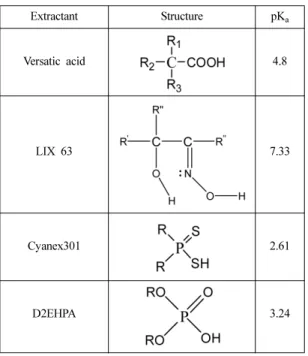
negligible in the sulfuric acid concentration range employed in this work (Table 1). The extraction results obtained from strong H2SO4 solutions are consistent with those from strong HCl solutions.15) Table 2 indicates that the extraction percentage of both Zr(IV) and Hf(IV) from these two acidic solutions was low. The acid dissociation constant (pKa value) of LIX 63 is 7.33 (Table 3). It is the highest value among the listed acidic extractants, indicating that the dissociation of LIX 63 in aqueous phase is more difficult than that of others.
If cation exchange is responsible for the extraction reaction in chloride and sulfate media, the low extraction efficiency obtained from strong H2SO4 and HCl solutions by LIX 63 might be plausible.
However, a different extraction behaviour of Zr(IV) and Hf(IV) by LIX 63 was observed from nitric acid solutions. Wang et al. reported12) that Zr(IV) was selectively extracted over Hf(IV) by LIX 63 from 0.5 to 4 M HNO3 solutions; and solvation reaction is responsible for the extraction. The extraction reaction for Zr(IV) and Hf(IV) by LIX 63 from nitric acid solutions can be represented as:12)
MO(NO3)+aq + NO3-aq + 2LIX 63org
= MO(NO3)2·2LIX 63org (3)
where MO(NO3)+ represents monovalent cationic species of Zr(IV) or Hf(IV) in HNO3 solution.
Since Zr(IV) and Hf(IV) have high charge and small radius, they have a great tendency to form complexes with anions in aqueous solutions. In strong acidic solutions, Zr(IV) and Hf(IV) form diverse complexes with Cl-, NO3- and SO42-, respectively.18,19) The difference in the extraction behaviour with hydrochloric, nitric and sulfuric acid solutions might be ascribed to the difference in the complex formation behaviour of the metal ions with each anion in the aqueous phase.
3.3. Solvent extraction of Zr(IV) and Hf(IV) by Cyanex 301
Cyanex 301 is one kind of dithiophosphinic acid extractant. The effect of H2SO4 concentration on the extraction and separation of Zr(IV) and Hf(IV) using 0.1 M Cyanex 301 is depicted in Fig. 1. As shown in this figure, extraction percentage of both metal ions decreased with the increase of H2SO4 concentrations from 26.4 to 2.9% for Zr(IV) and from 42.6 to 10.7% for Hf(IV), respectively. In terms of separation of Zr(IV) and Hf(IV), Hf(IV) was selectively extracted over Zr(IV) in the sulfuric acid concentration range of 0.3 to 3 M.
But high separation efficiency between Zr(IV) and Hf(IV)
Table 3. Chemical structures and pK
avalues for the acidic
extractants
Extractant Structure pK
aVersatic acid 4.8
LIX 63 7.33
Cyanex301 2.61
D2EHPA 3.24
*R is the alkyl groups.
Fig. 1. Extraction of Zr(IV) and Hf(IV) from H
2SO
4solutions by 0.1 M Cyanex 301 in kerosene
was not attained by using Cyanex 301 in H2SO4 solution.
A comparison of the extraction and separation behaviour from various acidic solutions by using Cyanex 301 is displayed in Table 4. Extraction behavior of Zr(IV) and Hf(IV) with Cyanex 301 from HCl solutions has been investigated.20,21) Cation exchange reaction is responsible for the extraction of Zr(IV) and Hf(IV) by Cyanex 301 from HCl solution:20,21)
MO2+aq + 2HB org = MOB2 org + 2H+aq (4)
where M represents Zr or Hf and HB refers to the monomeric form of Cyanex 301.
In this study, the decrease in the extraction with the increase of the sulfuric acid concentration implied that cation exchange is also responsible for the extraction by Cyanex 301 from strong sulfuric acid medium.
Table 3 shows the chemical structures and the pKa values of several acidic extractants. The pKa values increase in the order of: Cyanex301 < D2EHPA <
Versatic acid < LIX 63, implying that the dissociation of Cyanex 301 and D2EHPA can take place in stronger acidic solutions compared to Versatic acid and LIX 63.
The extraction results obtained from this work and reported work indicate that Zr(IV) and Hf(IV) could be extracted by Cyanex 301 and D2EHPA from strong sulfuric acid solutions, while the extraction by using Versatic acid and LIX 63 is difficult. It is in good agreement with the sequence of pKa values.
The extraction efficiency of D2EHPA for Zr(IV) and Hf(IV) is higher than that of Cyanex 301. The extraction percentage of Zr(IV) and Hf(IV) was around 20% by extraction with 0.1 M Cyanex 301 from 1 M sulfuric acid solution, while quantitative extraction of both metal ions was obtained with 0.05 M D2EHPA under the same condition.8) In terms of the chemical structure,
the functional groups of Cyanex 301 and D2EHPA are in the thiophosphoryl group (-PSSH) and phosphoryl group (-POOH), respectively. They are powerful electron- donating groups. However, oxygen belongs to hard Lewis base, while sulfur is a soft base. On the basis of the HSAB theory, Zr(IV) and Hf(IV) are classified as hard Lewis acids, forming stronger bonds with hard base.
As a result, extraction of Zr(IV) and Hf(IV) by D2EHPA is more effective than that by Cyanex 301, although Cyanex 301 possesses a lower pKa value than D2EHPA.
3.4. Solvent extraction of Zr(IV) and Hf(IV) by mix- tures of Cyanex 301 + TBP and D2EHPA + TBP
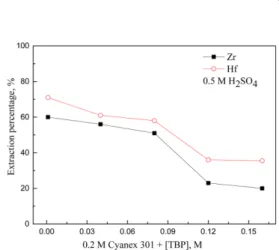
It has been reported that neutral extractants, such as TOPO are used jointly with acidic extractants such as D2EHPA for synergistic extraction of gold or uranium.22-24) Wang et al. reported10) that a mixture of organophosphorous acidic extractants and TOPO has some advantage in the extraction and separation of Zr(IV) and Hf(IV) from HCl solutions. In order to improve the extraction and separation efficiency between Zr(IV) and Hf(IV) from sulphuric acid solution, neutral extractant, TBP, was mixed with Cyanex 301 and D2EHPA, respectively. The effect of TBP concentration on the extraction of Zr(IV) and Hf(IV) in the presence of Cyanex 301 or D2EHPA at 0.5 M H2SO4 was inves- tigated, and the results are presented in Figs. 2 and 3.
The concentration of Cyanex 301 and D2EHPA was fixed at 0.2 and 0.01 M, respectively, while the concentration of TBP in the mixed extractants was varied from 0.01 to 0.2 M.
Figure 2 shows that extraction of Zr(IV) and Hf(IV) metal ions decreased with the increased concentration of TBP in the mixed systems, from 57.2 to 20.0% for Zr(IV) and from 61.7 to 34.7% for Hf(IV). It was
Table 4. Extraction and separation behaviours of Zr(IV) and Hf(IV) from various media with Cyanex 301 Extractant Media Acidity Extraction mechanism Selectivity Ref.
Cyanex 301
HCl 0.005-0.1 M Cation exchange Hf over Zr 20,21
HNO
3- - - -
H
2SO
40.1-3 M Cation exchange Hf over Zr This work
noticed that the percentage extraction of Hf(IV) was higher than that of Zr(IV) by using the mixture of Cyanex 301 and TBP. In terms of separation, significant improvement on the separation of these two metal ions was not observed by the addition of TBP into Cyanex 301. Fig. 3 shows the extraction behavior of Zr(IV) and Hf(IV) in 0.5 M sulfuric acid solutions with the mixture of D2EHPA and TBP. The extraction percentage of Zr(IV) decreased steadily while that of Hf(IV) increased at first and then decreased with the increase of the added TBP concentration in the mixtures. The depression in the extraction of Zr(IV) and Hf(IV) by the mixtures of Cyanex 301 + TBP and D2EHPA + TBP may be related to the mutual interaction in the
organic phase. In terms of separation efficiency, mixing of TBP with D2EHPA led to some negative effect on the separation of the two metal ions compared to single D2EHPA under the same experimental condition.
4. Conclusions
Solvent extraction of Zr(IV) and Hf(IV) was carried out from sulfuric acid solutions by several acidic extractants (Versatic acid/LIX 63/Cyanex 301). Moreover, the extraction and separation of the two metals by cationic extractants from HCl, HNO3 and H2SO4 solutions were discussed on the basis of the complex formation behaviour and the pKa value of the extractant. Zr(IV) and Hf(IV) could be extracted by Versatic and LIX 63 from only weak acid solutions (HCl, HNO3 and H2SO4), due to their relatively high pKa values compared to other kinds of extractants. On the other hand, extraction of Zr(IV) and Hf(IV) with Cyanex 301 took place in strong sulfuric acid solutions, following a cation exchange mechanism. Selective extraction of Hf(IV) over Zr(IV) was attained using single Cyanex 301 and mixtures of Cyanex 301 + TBP, D2EHPA + TBP. Compared to single Cyanex 301/D2EHPA, mixture of TBP with Cyanex 301 or D2EHPA exhibited antagonism on the extraction and separation of Zr(IV) and Hf(IV).
Acknowledgements
We gratefully thank the Gwangju branch of the Korea Basic Science (KBSI) for ICP data.
References
1. Elvers, B., Hawkins, S., Ravenscroft, M., Rounsaville, J.F., Sculz, G., 1989: Ulmann’s Encyclopedia of Indus- trial Chemistry, VCH, Weinhein, Germany.
2. Gallant, S., 2004: Modeling ion-exchange adsorption of proteins in a spherical particle, J. Chromatogr. A, 1028, pp. 189.
3. Xu, L., Xiao, Y., Sandwijk, A.V., Xu, Q., Yang, Y., 2015:
Production of nuclear grade zirconium: A review, J.
Nucl. Mater., 466, pp. 21-28.
4. Fischer, W., Chalybaeus, W., 1947: Die preparative Fig. 2. Extraction of Zr(IV) and Hf(IV) from 0.5 M H
2SO
4solutions by mixture of Cyanex 301 and TBP in kerosene.
Fig. 3. Extraction of Zr(IV) and Hf(IV) from H
2SO
4solutions by mixture of D2EHPA and TBP in
kerosene.
gewinnung reiner hafniumverbindungen durch vertei- lung, Z. Anorg. Allg. Chem., 255, pp. 277-286.
5. Fischer, W., Chalybaeus, W., 1947: Die trennung des haf- nium vom zirconium durch verteilung, Z. Anorg. Allg.
Chem., 255, pp. 79-100.
6. Levitt, A.E., Freund, H., 19556: Solvent extraction of zirconium with tributylphosphate, J. Am. Chem. Soc., 78, pp. 1545-1549.
7. Banerjee, S., Basu, S., 2004: Synergistic effect of neutral donors on the extraction of zirconium(IV) by salicyl- aldoxime in dichloromethane, J. Radioanal. Nucl. Chem., 262, pp. 733-737.
8. Banda, R., Min, S.H., Lee, M.S., 2014: Selective extraction of Hf(IV) over Zr(IV) from aqueous H
2SO
4solutions by solvent extraction with acidic organophos- phorous based extractants, J. Chem. Technol. Biotech- nol., 89, pp. 1712-1719.
9. Banda, R., Lee, H.Y., Lee, M.S., 2012: Separation of Zr from Hf in hydrochloric acid solution using amine-based extractants, Ind. Eng. Chem. Res., 51, pp. 9652-9660.
10. Wang, L.Y., Lee, H.Y., Lee, M.S., 2013: Solvent extraction of zirconium and hafnium from hydrochloric acid solutions using acidic organophosphorous extract- ants and their mixtures with TOPO, Mater. Trans., 54, pp. 1460-1466.
11. Wang, L.Y., Lee, H.Y., Lee, M.S., 2015: Solvent extraction separation of Zr and Hf from nitric acid solu- tions by PC 88A and its mixture with other extractants, Met. Mater. Int., 21, pp. 166-172.
12. Wang, L.Y., Lee, M.S., 2014: Separation of zirconium and hafnium from nitric acid solutions with LIX 63, PC 88A and their mixture by solvent extraction, Hydro- metallurgy, 150, pp. 153-160.
13. Wang, L.Y., Lee, M.S., 2015: Separation of Zr and Hf from sulfuric acid solutions with amine-based extractants by solvent extraction, Sep. Purif. Technol., 142, pp. 83-89.
14. Lee, M.S., Banda, R., Min, S.H., 2015: Separation of Hf(IV)-Zr(IV) in H2SO4 solutions using solvent extraction with D2EHPA or Cyanex272 at different reagent and metal ion concentrations, Hydrometallurgy, 152, pp. 84-90.
15. Wang, L.Y., Lee, H.Y., Lee, M.S., 2015: Solvent extractive separation of zirconium and hafnium from hydrochloric acid solutions by organophosphorous extractants and their mixtures with other types of extract- ants, Chem. Eng. Commun., 202, pp. 1289-1295.
16. Biswas, R.K. Hayat, M.A., 2002: Kinetics of solvent extraction of zirconium from chloride medium by D2EHPA in kerosene using the single drop technique, Hydrometallurgy, 65, pp. 205-216.
17. Lee, H.Y., Kim, S.G., Oh, J.K., 2004: Stoichiometric relation for extraction of zirconium and hafnium from acidic chloride solutions with Versatic Acid 10, Hydro- metallurgy, 73, pp. 91-97.
18. Solovkin, A.S.; Tsvetkova, S.V., 1962: The chemistry of aqueous solutions of zirconium salts (Does the zirconyl ion exist?), Russ. Chem. Rev., 31, pp. 655-669.
19. Ryabchikov, D.I.; Marov, I.N.; Ermakov, A.N.; Bely- aeva, V.K. (1964) Stability of some inorganic and organic complex compound of zirconium and hafnium. J.
Inorg. Nucl. Chem., 26: 965-980.
20. Kumar, J.R., Reddy, B.R., Reddy, K.J., Reddy, A.V., 2007: Liquid-liquid extraction of tetravalent hafnium from acidic chloride solutions using bis(2,4,4-trimeth- ylpentyl) dithiophosphinic acid (Cyanex 301), Sep. Sci.
Technol., 42, pp. 865-877.
21. Reddy, B.R., Kumar, J.R., Reddy, A.V., 2004: Solvent extraction of zirconium(IV) from acidic chloride solu- tions using the thiosubstituted organophosphorus acids Cyanex 301 and 302, J. Chem. Technol. Biotechnol., 79, pp. 1301-1307.
22. Kim, S.G., Lee, H.Y., Oh, J.K., Lee, E.C., 1995: Stoi- chiometric relation for the extraction of the gold-thiourea complex with D2EHPA, Hydrometallurgy, 38, pp. 7-13.
23. Saidi, M., Khalaf, H., 2004: Using microemulsion for recovery of uranium from phosphoric acid of Annaba (Algeria), Hydrometallurgy, 74, pp. 85-91.
24. S.H. Min, M.S. Lee, 2013 : Solvent extraction of Zir- conium and Hafnium from hydrochloric acid solution by LIX 63 and Cyanex 301, J. of Korean Inst. Of Resouces Recycling. 22. Pp. 19-25.
왕링윈
• 연태대학교(중국) 응용화학 학사
• 현재 목포대학교 신소재공학과 박사과정 재학
• 당 학회지 제22권 2호 참조
이만승