Vol. 26, No. 3, 2017, 26-31
≫ 연구논문 ≪
3 M의 염산용액에서 팔라듐(II), 백금(IV), 이리듐(IV) 및 로듐(III)의 분리를 위한 용매추출
응우엔 티홍*,**·§이만승*
*목포대학교 공과대학 신소재공학과
**Can Tho대학교 자연과학대학
Solvent Extraction for the Separation of Pd(II), Pt(IV), Ir(IV) and Rh(III) from 3 M Hydrochloric Acid Solution
Thi Hong Nguyen*
,** and
§Man Seung Lee*
*Department of Advanced Material Science and Engineering, Institute of Rare Metal, Mokpo National University, Chonnam 534-729, Republic of Korea
**College of Natural Sciences, Can Tho University, Can Tho, Viet Nam
요 약
LIX 63 은 6 M의 염산용액에서 백금(IV), 이리듐(IV) 및 로듐(III)에 비해 팔라듐(II)에 대한 선택성이 크다. 또한 염산용액의 농 도는 이리듐과 LIX 63간에 일어나는 산화-환원반응에 큰 영향을 미친다. 따라서 상기 4개의 백금족 금속을 함유한 3 M의 염산용 액에서 LIX 63에 의한 분리성을 검토하였다. 3 M의 염산용액에서 LIX 63은 오직 팔라듐만을 추출했으며, 6 M의 염산용액에 비 해 추출율이 높았다. TBP를 사용하면 팔라듐 추출여액으로부터 백금만을 추출하는 것이 가능하였다. 백금 추출후 NaClO3로 추출 여액에 함유된 이리듐을 산화시킨 다음 Aliquat 336를 접촉시키면 이리듐만이 추출되었다. 각각의 용매추출단계에 대해 최적의 탈 거조건을 구했다. 본 논문의 공정으로 4개의 백금족 금속을 3 M의 염산용액에서 분리하는 것이 가능하였다.
주제어 : 팔라듐, 백금, 이리듐, 로듐, 용매추출
Abstract
LIX 63 showed a selectivity for the extraction of Pd(II) over other PGMs, such as Pt(IV), Ir(IV) and Rh(III) from 6 M HCl solution. Moreover, HCl solution has significant effect on the oxidation-reduction reaction between Ir(IV) and LIX 63. Therefore, the applicability of employing LIX 63 for the separation of the 4 PGMs was investigated from 3 M HCl solution. From 3 M HCl solution, only Pd(II) was selectively extracted by LIX 63 and its extraction percentage was higher than from 6 M HCl solu- tion. Extraction of the Pd(II) free raffinate with TBP led to the selective extraction of Pt(IV). After oxidation of Ir(III) with NaC- lO3 to Ir(IV), extraction of the Pt(IV) free raffinate with Aliquat 336 selectively extracted Ir(IV). For each extraction step, optimum stripping conditions were obtained. By this process, it was possible to separate the 4 PGMs by solvent extraction from 3 M HCl solution.
Key words : Palladium, Platinum, Iridium, Rhodium, Solvent extraction
· Received : January 31, 2017 · Revised : February 24, 2017 · Accepted : February 28, 2017
§Corresponding Author : Man-Seung Lee (E-mail : [email protected])
Department of Advanced Materials Science & Engineering, Mokpo National University, 1666 Yeongsan-ro, Cheonggye-myeon, Muan-gun, Chonnam, 58554, Korea
ⓒThe Korean Institute of Resources Recycling. All rights reserved. This is an open-access article distributed under the terms of the Creative Commons Attribution Non-Commercial License (http://creativecommons.org/licenses/by-nc/3.0/), which permits unrestricted non-commercial use, distribution and reproduction in any medium, provided the original work is properly cited.
1. Introduction
Natural resources for platinum group metals (PGMs), such as platinum (Pt), palladium (Pd), iridium (Ir) and rhodium (Rh) are limited but their demand is increasing.
Therefore, it is important to recover these metals with high purity from secondary resources. After leaching of PGMs from the secondary resources by using strong hydrochloric acid solution in presence of an oxidizing agent, the PGMs are separated from the leaching solution by solvent extraction1-6), ion exchange7) and precipitation8). Especially, many works have been reported on the separation of PGMs by solvent extraction4,9-14). Most of the developed processes are complicated and complete separation from each PGM is difficult. In a previous study, Pt(IV) can be selectively extracted over Pd(II) from 6 M HCl solution using the mixture of Aliquat 336 and TBP and the mixture of thiourea and HCl solution is used for stripping15). The separation of Ir(IV) and Rh(III) from HCl solution is possible by employing the mixture of Aliquat 336 and TBP16). The mixture of thiourea and HCl could strip Ir(IV) and Rh(III) from the loaded organic. However, the co-extraction of Pd(II) or Rh(III) was so high that the separation efficiency of these metals was low.
A new process for the separation of Pd(II), Pt(IV), Ir(IV) and Rh(III) from 6 M HCl solution has been reported by using solvent extraction with LIX 6317). Optimum conditions for the separation of Pd(II), Pt(IV), Ir(IV) and Rh(III) was found and pure solutions of these metals was obtained. According to this study, it was found that some of Ir(IV) was reduced to Ir(III) during the extraction with LIX 63. In general, the Ir(III)- chloro complexes cannot be extracted by amines, which makes the separation of Ir(IV) and Rh(III) complex. Moreover, it has been also reported that HCl concentration has a significant effect on the oxidation-reduction reaction between LIX 63 and Ir(IV)18). Therefore, it is necessary to verify the applicability of the developed separation process using LIX 63 to lower concentration of HCl.
In this work, solvent extraction experiments were per- formed from 3 M HCl solution to verify this process and to investigate the optimum extraction and stripping
conditions. For this purpose, LIX 63-TBP- Aliquat 336 was sequentially contacted to the synthetic solution of 3 M HCl containing Pd(II), Pt(IV), Ir(IV) and Rh(III).
2. Materials and Methods
A sysnthetic solution containing Pd(II), Pt(IV), Ir(IV) and Rh(III) was prepared by dissolving appropriate amounts of PtCl4 (99.9%), PdCl2 (99.9%), H2IrCl6 (99.5%) and RhCl3·xH2O (99.9%) purchased from Alfa- Aesar. The concentration of each metal and HCl in the synthetic solution was fixed at 100 ppm and 3 M, respec- tively. Commercial extractants, such as LIX 63 (BASF Co.), TBP (Yakuri Pure Chemical Co.) and Aliquat 336 (BASF Co.) were used without further purification. Kero- sene (Samchun Pure Chem. Co.) was used as a diluent.
Solvent extraction experiments were performed by mixing equal volume (10 mL) of aqueous and organic phases for 30 min using a wrist action shaker (Burrel, model 75). After equilibrium, the two phases were separated using a separating funnel. All the experiments were performed at room temperature. Metal ion concent- rations in the aqueous phase before and after extraction were determined by inductively coupled plasma-optical emission spectroscopy (ICP-OES; Spectro Arcos). The concentration of metal ions in the loaded organic phase was calculated by mass balance.
3. Results and Discussion
3.1. Selective extraction of Pd(II) by LIX 63 LIX 63 and Aliquat 336 can extract Pt(IV) and Pd(II) from high HCl concentration17). In order to investigate the separation of four PGMs from 3 M HCl concentration by LIX 63 and Aliquat 336, the concentration of these two extractants was varied from 0.02 to 0.1 M. In these experiments, the concentration of Pd(II), Pt(IV), Ir(IV) and Rh(III) was fixed at 100 ppm. The extraction behavior of Pt(IV), Pd(II), Ir(IV) and Rh(III) by Aliquat 336 is shown in Fig. 1. Most of Pt(IV), Pd(II) and Ir(IV) were extracted at any Aliquat 336 concentration range, while the extraction percentage of Rh(III) was negligible at the same condition. Fig. 1 indicates that it is difficult
to separate the PGMs by employing Aliquat 336 from 3 M HCl solution.
Fig. 2 shows LIX 63 can selectively extract Pd(II) over Pt(IV), Ir(IV) and Rh(III). Most Pd(II) was extracted at any LIX 63 concentration range, while the extraction percentage of Pt(IV), Ir(IV) and Rh(III) was negligible.
In the HCl solution, Pd(II), Pt(IV), Ir(IV) and Rh(III) exist as anionic species, such PtCl62−, PdCl42−, IrCl62−
and RhCl63− 19,20). Selective extraction of Pd(II) over other three PGMs is ascribed to the ease of ligand donation
of PdCl42− compared to other anionic species17). Com- pared to the reported results in previous study17), the extraction percentage of Pd(II) from 3 M HCl was higher than that from 6 M HCl at the same LIX 63 concentration.
This agrees well with the extraction reaction of Pd(II) by LIX 63 reported in a previous study17) (see Eq. (1)).
PdCl42−aq + 2HAorg = PdCl2·2HAorg + 2Cl−aq (1) where HA represents LIX 63 and the subscripts aq and org denote the aqueous and organic phase, respectively.
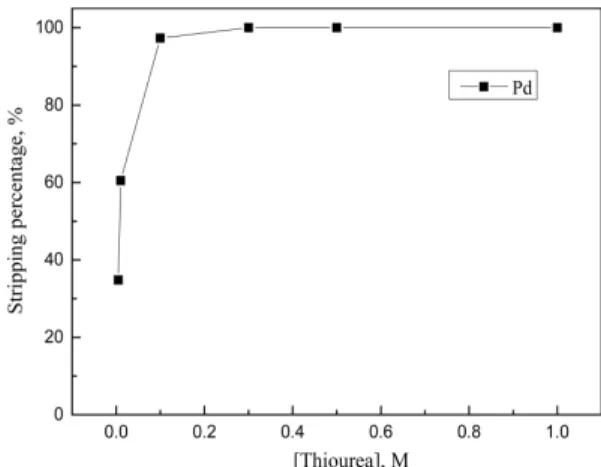
For stripping experiments, the loaded LIX 63 was prepared by extracting the synthetic solution of 3 M HCl with 0.02 M LIX 63. The concentration of Pd(II) in the loaded LIX 63 was 100 ppm, while no other metals were co-extracted in this condition. Thiourea was chosen as a stripping agent and its concentration was varied from 0.05 to 1 M. Fig. 3 shows the variation in stripping percentage of Pd(II) with thiourea concent- ration. The stripping percentage of Pd(II) increased from 35 to 99% as thiourea concentration increased from 0.005 to 0.3 M and then was constant with the further increase of thiourea concentration. From this data, 0.3 M thiourea was chosen as an optimum condition to strip Pd(II) from the loaded LIX 63.
3.2. Selective extraction of Pt(IV) by TBP After separation of Pd(II), the Pd(II) free raffinate Fig. 1. Effect of Aliquat 336 concentration on the extraction
of Pd(II), Pt(IV), Ir(IV) and Rh(III). Aqueous: Pd = Pt = Ir = Rh = 100 ppm, [HCl] = 3 M; [Aliquat 336]
= 0.003-0.1 M.
Fig. 2. Effect of LIX 63 concentration on the extraction of Pd(II), Pt(IV), Ir(IV) and Rh(III). Aqueous: Pd = Pt = Ir = Rh = 100 = ppm, [HCl] = 3 M; [LIX 63] = 0.02- 0.1 M.
Fig. 3. Effect of thiourea concentration on the stripping of Pd(II) from the loaded 0.02 M LIX 63. [Pd(II)]org = 99.5 ppm; [Thiourea] = 0.005-1 M.
contained 100 ppm of Pt(IV), iridium and Rh(III) at 3 M HCl. The raffinate was contacted to TBP (0.5~2 M) to investigate the extraction behaviour of these metals.
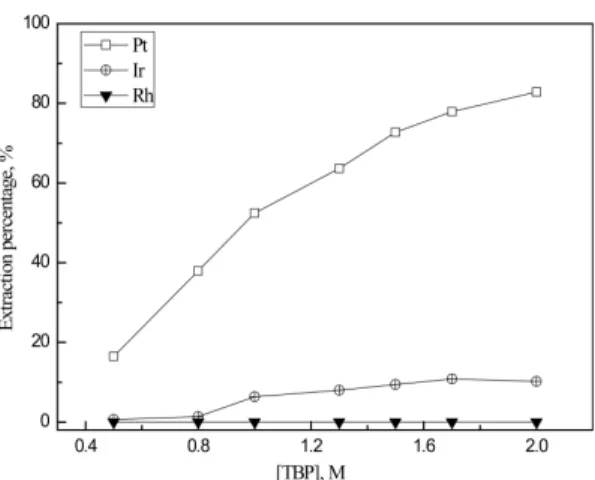
The extraction percentage of Pt(IV) increased steadily from 18 to 80% as TBP concentration increased from 0.5 to 2 M, while the co-extraction of iridium and Rh(III) was negligible (see Fig. 4). The negligible extraction of Rh(III) by TBP in our condition can be ascribed to the formation of RhCl5(H2O)2− which cannot be extracted by TBP16). It has been reported that during extraction with LIX 63, Ir(IV) can be reduced to Ir(III) and this reduced Ir(III) cannot be extracted by TBP17).
In order to find the theoretical number of stages for complete extraction of Pt(IV) from Pd(II) free raffinate containing 100 ppm of Pt(IV), Ir(III) and Rh(III) at 3 M HCl, extraction isotherms for Pt(IV) was obtained by contacting the raffinate with 2 M TBP at different O/A ratios from 1:5 to 5:1. McCabe-Thiele diagram indicates that two theoretical extraction stages are needed to extract most of Pt(IV) at an O/A ratio of 2:1 using 2 M TBP (see Fig. 5). The batch simulation experiments for two stages counter-current extraction were performed with 2 M TBP at an O/A ratio of 2:1. From the batch simulation experiments, it was found that 99.9% of Pt(IV) was extracted from the Pd(II) free raffinate.
Previous work indicates that the Pt(IV) in the loaded TBP can be stripped by using weak HCl solution17). In
order to verify this, HCl concentration was varied from 0.01 to 1 M to strip Pt(IV) from the loaded TBP where the concentration of Pt(IV) was 84 ppm. Fig. 6 shows that the stripping percentage of Pt(IV) from the loaded TBP decreased from 96 to 43.5% as HCl concentration increased from 0.01 to 1 M.
3.3. Selective extraction of Ir(IV) by Aliquat 336 Since some of Ir(IV) is reduced to Ir(III) during the extraction with LIX 63, it was difficult to extract the remaining iridium and Rh(III) after the extraction by LIX 63 and TBP17). Therefore, oxidation of Ir(III) to Ir(IV) is necessary to separate iridium and Rh(III). For this purpose, 8 × 10⁻⁴ M NaClO3 was added as an oxidiz- Fig. 4. Effect of TBP concentration on the extraction of
Pt(IV), iridium and Rh(III). Raffinate: Pt = Ir = Rh = 100 = ppm, [HCl] = 3 M; [TBP] = 0.5-2 M.
Fig. 5. Extraction isotherm of Pt(IV) by 2 M TBP. Raffiante, Pt = Ir = Rh = 100 ppm; [HCl] = 3 M.
Fig. 6. Effect of HCl concentration on the stripping of Pt (IV) from the loaded 2 M TBP. [Pt(IV)]org = 84 ppm;
[HCl] = 0.01-1 M.
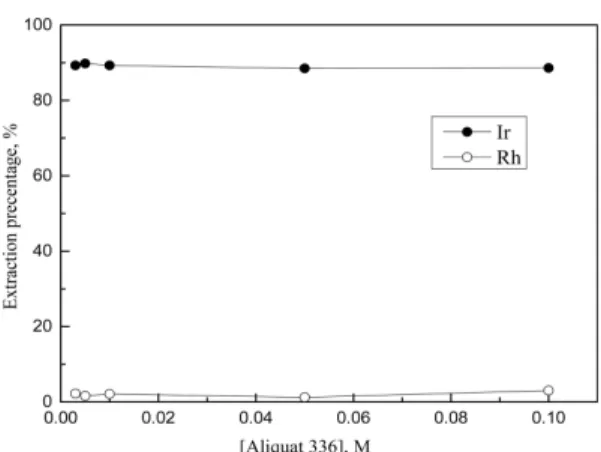
ing agent to the Pd(II) and Pt(IV) free raffinate containing Ir(III) and Rh(III). Aliquat 336 (0.003 to 0.1 M) was contacted to the Pd(II) and Pt(IV) raffinate. Fig. 7 shows that most of the Ir(IV) was extracted at any Aliquat 336 concentration, while the extraction percentage of Rh(III) was negligible. According to the obtained results, 0.01 M Aliquat 336 was chosen for the separation of Ir(IV) and Rh(III) from the raffinate at 3 M HCl.
At the optimum extraction condition for the separation of Ir(IV) from Rh(III), the concentration of Ir(IV) in the loaded 0.01 M Aliquat 336 was 82 ppm Ir(IV).
HClO4 solution was employed as a stripping reagent
and its concentration was varied from 0.1 to 1 M. Fig.
8 shows that the stripping percentage of Ir(IV) increased from 92 to 99.2% as HClO4 concentration increased from 0.1 to 1 M.
4. Conclusions
The possibility of complete separation of 4 PGMs (Pd(II), Pt(IV), Ir(IV) and Rh(III)) was investigated from 3 M HCl solution by solvent extraction. First, only Pd(II) was extracted from the synthetic solution by LIX 63 and thiourea could strip this Pd(II) from the loaded LIX 63. Second, employment of TBP resulted in selective extraction of Pt(IV) from the Pd(II) free raffinate. The Pt(IV) in loaded TBP was completely stripped by weak HCl solution. After adding NaClO3 to the raffinate after Pt(IV) extraction as an oxidizing agent, Ir(IV) was selectively extracted by Aliquat 336 and the Ir(IV) in the loaded Aliquat 336 was completely stripped by HClO4 solution. Our data indicates that sequential extraction with LIX 63-TBP-Aliquat 336 can separate the 4 PGMs from both 3 M and 6 M HCl solution.
Acknowledgements
This work was supported by the Global Excellent Technology Innovation of the Korea Institute of Energy Technology Evaluation and Planning (KETEP), granted financial resource from the Ministry of Trade, Industry
&Energy, Republic of Korea (No. 20165010100890). We express sincere thanks the Korea Basic Science Institute (KBSI), Gwangju branch for providing ICP-OES data.
References
1. Gupta, B., Singh, I. and Mahandra, H., 2014 : Extraction and separation studies on Pt(IV), Ir(III), and Rh(III) using sulphur containing extractant. Separation and Puri- fication Technology, 132, pp. 102-109.
2. Gupta, B. and Singh, I., 2013 : Extraction and separation of platinum, palladium and rhodium using Cyanex 923 and their recovery from real samples. Hydrometallury, 134-135, pp. 11-18.
3. Jha, M. K., Gupta, D., Lee, J. C., Kumar, V., and Jeong, Fig. 7. Effect of Aliquat 336 concentration on the extraction
of Ir(IV) and Rh(III). Raffinate: Ir = 91 ppm; Rh = 100 = ppm, [HCl] = 3 M; Oxidizing agent = 8 × 10⁻⁴ M NaClO3; [Aliquat 336] = 0.003-0.1 M.
Fig. 8. Effect of HClO4 concentration on the stripping of Ir(IV) from the loaded 0.01M Aliquat 336. [Ir(IV)]org
= 82 ppm; [HClO4] = 0.1-1 M.
J., 2014 : Solvent extraction of platinum using amine based extractants in different solutions: A review. Hydro- metallurgy, 142, pp. 60-69.
4. Reddy, B. R., Raju, B., Lee, J. Y., and Park, H. K., 2010 : Process for the separation and recovery of palladium and platinum from spent automobile catalyst leach liquor using LIX 84I and Alamine 336. Journal Hazardous Materials, 180, pp. 253-258.
5). Wei, W., Cho, C. W., Kim, S., Song, M. H., Bediako, J.
K., and Yun, Y. S., 2016 : Selective recovery of Au(III), Pt(IV), and Pd(II) from aqueous solutions by liquid-liq- uid extraction using ionic liquid Aliquat 336. Journal of Molecular Liquid, 216, pp. 18-24.
6. Nguyen, T. H. and Lee, M. S., 2016 : Separation of molybdenum and tungsten from sulfuric acid solution by solvent extraction with Alamine 336, J. of Korean Inst.
of resources recyclying 25, pp. 16-23.
7. Rovira, M., Cortina, J. L., Arnaldos, J., and Sastre, A.
M., 1998 : Recovery and separation of platinum group metals using impregnated resins containing Alamine 336. Solvent Extraction and Ion Exchange, 16, pp. 1279- 1302.
8. Schreier, G. and Edtmaier, C., 2003 : Separation of Ir, Pd and Rh from secondary Pt scrap by precipitation and cal- cination. Hydrometallurgy, 68, pp. 69-75.
9. Pan, L. and Zhang, Z., 2009 : Solvent extraction and sep- aration of palladium(II) and platinum(IV) from hydro- chloric acid medium with dibutyl sulfoxide. Minerals Engineering, 22, pp. 1271-1276.
10. Bandekar, S. V. and Dhadke, P. M., 1998 : Solvent extraction separation of platinum (IV) and palladium (II) by 2 ethylhexyl phosphonic acid mono-2-ethylhexyl ester (PC-88A). Sep. Purif. Technol. 13, pp. 129-135.
11. Swain, B., Jeong, J., Kim, S. K., and Lee, J. C., 2010:
Separation of platinum and palladium from chloride solution by solvent extraction using Alamine 300.
Hydrometallurgy, 104, pp. 1-7.
12. Paiva, A. P., Carvalho, G. I., Costa, M. C., Rosa da Rosta, A. M., and Nogueira, C., 2014 : Recovery of platinum and palladium from chloride solutions by a thiodiglycol- amide derivative. Solvent Extraction and Ion Exchange, 32, pp. 78-94.
13. Rydberg, J., Cox, M., Musikas, C., and Choppin, G. R., 2004 : Solvent Extraction Principles and Practice (Mar- cel Dekker, New York).
14. Foulon, C., Pareau, D., and Durand, G., 1999 : Thermo- dynamic and kinetic studies of palladium (II) extraction by extractant mixtures containing LIX 63: part I. Ther- modynamic study. Hydrometallurgy, 51, pp. 139-153.
15. Nguyen, T. H., Sonu, C. H., and Lee, M. S., 2015 : Sep- aration of platinum(IV) and palladium(II) from concen- trated hydrochloric acid solutions by mixtures of amines with neutral extractants. Journal of Industrial and Engi- neering Chemistry, 32, pp. 238-245.
16. Nguyen, T. H., Sonu, C. H., and Lee, M. S., 2016 : Sep- aration of Ir(IV) and Rh(III) from strong hydrochloric acid solutions by solvent extraction. Journal of Industrial and Engineering Chemistry, 36, pp. 245-250.
17. Nguyen, T. H., Sonu, C. H., and Lee, M. S., 2016 : Sep- aration of Pt(IV), Pd(II), Rh(III) and Ir(IV) from con- centrated hydrochloric acid solutions by solvent extraction.
Hydrometallurgy, 164, pp. 71-77.
18. Nguyen, T. H. and Lee, M. S., 2016 : Effect of HCl con- centration on the oxidation of LIX 63 and the subsequent separation of Pd(II), Pt(IV), Ir(IV) and Rh(III) by solvent extraction, Korean. J. Met. Mater. 54, pp. 768-774.
19. Charlesworth, P., 1981 : Separating the platinum group metals by liquid-liquid extraction. Platinum Metals Review, 25, pp. 106-112.
20. Michael, N. T., 2012 : Computer Simulation of a Chro- matographic Column Used in the Separation of Platinum Group Metal Chlorinated Complexes. OpenUCT. (Thesis sci.: http://hdl.handle.net/11427/11810).
응우엔 티홍
• 목포대학교 신소재공학과 박사
• 현재 Can Tho University, College of Natural Sciences, Associate Professor
이 만 승
• 현재 목포대학교 신소재공학과 교수
• 당 학회지 제11권 1호 참조