Received: March 6, 2012 ; Accepted: March 19, 2012 Corresponding author: Young-baek Hur
Tel: +82 (55) 640-4754 e-mail: [email protected] 1225-3480/24422
굴
Crassostrea gigas
부착기 유생의 부착에 미치는 수온 및 염분의 영향전창영, 허영백, 조기채
국립수산과학원 남동해수산연구소
The Effect of Water Temperature and Salinity on Settlement of Pacific Oyster, Crassostrea gigas Pediveliger Larvae
Chang Young Jeon, Young Baek Hur and Kee Chae Cho Southeast Sea Fisheries Research Institute, NFRDI, Tongyeong 650-943, Korea
ABSTRACT
The combined effects of water temperature and salinity on the settlement rate and density (spats/cm2) of Crassostrea gigas pediveliger larvae were studied under the hatchery conditions. Four water temperatures (20.0, 23.0, 26.0 and 29.0℃) were tested at three salinities (20.0, 30.0 and 40.0). The optimum water temperature by salinity conditions were 29.0℃ and 20.0, 30.0 which significantly (P < 0.05) the highest mean (±S.D) larval settlement rate of 43.1 ± 0.1%, 42.1 ± 0.1%, respectively. But the combination of water temperatures and salinities for settlement density was not effected, but each factor as water temperature (29.0℃), salinity (40.0) was shown significantly high and low settlement density, respectively (P < 0.05). The statistics result of settlement density frequency was appeared: mode (1.2-2.3 spats/cm2), Mean (1.9-2.4 spats/cm2), Range (3.0-5.8 spats/cm2) and the lowest variance was obtained 0.4 at water temperature 20.0℃ by salinity 30.0, but 29.0℃ by 20.0 was the highest (1.1). The best condition at this results for the larvae setting under the artificial seed collection of C. gigas was 29.
0℃ and 20.0-30.0.
Keywords : 부착율, 부착밀도, 부착빈도, 유생, 굴 (settlement rate, settlement density, frequency, larvae, Crassostera gigas, oyster)
서 론
굴 Crassostera gigas 을 포함한 대부분의 해양 고착성 무 척추동물들은 일정기간 부유유생기를 거친 후 성패형태의 치 패가 되기 전에 일련의 부착과 변태 과정을 거치는데, 이러한 해산무척추 동물 유생의 부착과 변태에 영향을 미치는 요인에 대하여 정확하게 밝히는 것은 양식산업, 방오제 기술개발 및 해양생태계 관리기술 개발에 중요한 역할을 한다 (Hadfield and Paul, 2001; Swanson et al., 2006).
해양무척추동물 유생의 부착과 변태를 유도하는 요인은 주 로 서식환경에서 발인되는 자연적인 요인과 생리적인 변화에 따른 생물내적인 요인이 상호복합적으로 작용하여 특이적인 화학작용 신호에 의해서 부착과 변태가 일어나는 것으로 보고 되고 있다 (Crip, 1984, Morse, 1990; Pawlik, 1992;
Tamburri et al., 1996; Qian, 1999; Hadfield and Paul, 2001; Yu et al., 2008; Ganesan et al., 2010). 이러한 부 착행동을 자극하는 신호 물질들은 부착기질 표면의 특성 (Faimali et al., 2004), 부착기질표면의 미생물막 (Maki et al., 1989; Weiner et al., 1989; Leitz and Wagner, 1993;
Keough and Raimondi, 1996), 동일종이 내는 특이물질 (Hadfield, 1978; Jensen et al., 1990; Zimmer-Faust and Tamburri, 1994; Andrews et al., 2001; Zhao and Qian, 2002), 특유한 먹이생물 종 (Hadfield, 1978; Todd, 1985) 등과 같은 부착기질의 특이성과 생물학적인 요인들에서 발원된 특이한 화학물질과 대상생물의 신경계 등에 생화학적
으로 직접적으로 작용하는 각종 합성된 화학물질 (Coon et al., 1985; Bonar et al., 1990; Johnson et al., 1991;
Rodriguez et al., 1993; Martinez et al., 1999; Walch et al., 1999; Doroudi and Southgate, 2002) 등이 부착과 변 태를 유발하는 화학적 신호로 작용하는 것으로 밝혔졌고, 적당 한 화학적 유인물질을 사용하는 것은 이매패류 인공종묘생산 과정에서 유생의 부착율을 높이는데 효과적인 것으로 밝혀졌 다 (Walch et al., 1999). 그럼에도 불구하고 아직까지 유전 적인 요인, 유생의 일령 등과 같은 내적요인 뿐만 아니라, 성 장에 따른 영양공급 상태와 같은 유생사육조건 특히 채묘과정 에 동반되는 사육수의 물리화학적 환경특성 등이 대부분의 이 매패류 유생의 부착에 영향을 미치는 것으로 보고되고 있다 (Hadfield, 1984). 굴 뿐만 아니라, 대부분 이매패류 종의 인 공종묘생산 시 생산성을 높이기 위해서는 성공적인 어미관리, 안정적인 유생사육 등 다양한 요소들이 있지만, 최종단계인 채 묘과정에서 부착기 유생의 부착률을 높이는 것은 전체 종묘생 산량과 채산성을 결정하는 매우 중요한 요소이기 때문에 관련 기술개발이 시급히 요구되어지고, 동시에 이 기술은 가능한 그 효과가 지속적이고 저렴하며 해야하며 무엇보다도 관리적인 측면에서 효율성이 요구된다 (Garcia-Lavandeira et al., 2005; Cann-Moisan et al., 2002). 이러한 의미에서 특히 수서생태학적인 측면에서 매우 중요한 역할을 하는 수온과 염 분은 굴과 같이 기수역 (estuarine) 생물들의 부유유생기 동 안에 생물학적으로 가장 큰 영향을 미치기 때문에 이 두 물리· 화학적 요소가 유생의 부착에 미치는 영향은 매우 높을 수 있 다 (Devakie and Ali, 2000). 또한 이 두 요소는 실내에서 손쉽게 정교하게 조절할 수 있을 뿐만 아니라, 대량으로 처리 하는데 지금까지 밝혀진 다양한 부착 및 변태 유인물질에 비해 매우 저렴하기 때문에 인공종묘배양장에서 활용성이 높다. 참 굴은 우리나라에서 매우 중요한 양식 대상종으로 연간 양식에 필요한 종묘는 약 1,800만연 이상이 소요되고, 이 중 대부분 은 천연종묘생산에 의존하고 있지만, 최근 인공종묘생산기술 이 개발됨에 따라 연간 약 10-15% 정도를 인공종묘로 대체하 고 있다. 그러나 인공종묘는 천연종묘에 비해 생산단가가 높 고, 대량생산에 많은 어려움이 있다. 따라서 단위면적당 생산 량을 높여 생산단가를 낮추는 것은 매우 중요한 일이다. 이와 같은 이유로 지금까지 국내에서 효율적인 유생사육 관리방안 (Min et al., 1995, Hur et al., 2008), 부착기 유생의 밀도 (Min et al., 1999)등에 대해 다수의 보고가 있지만, 효과적 인 채묘관리에 대한 연구는 국내에서는 미미한 상태이다. 현재 국내에서는 40여개의 상업적인 참굴 인공종묘배양장이 운영되 고 있지만, 대부분의 인공종묘 배양장의 채묘률은 20% 미만 으로 전체 생산량을 떨어드리고, 생산단가를 높이는 주요인으 로 작용하고 있다. 따라서 채묘률 개선을 위한 연구개발을 매
우 시급한 실정이다. 이에 본 연구는 참굴 인공종묘생산 시 채 묘률 향상을 위해 적정 수온과 염분 조건을 결정하기 위해 실 시하였다.
재료 및 방법
실험에 이용한 참굴 부착기 유생은 남동해수산연구소 남해 패류센터 패류중간육 성장에서 관리하던 만 1년생 참굴 (평균 각장 63.7 ± 6.4 cm, n = 50) 을 이용하여 채란 후 14일 동 안 수온 26 ± 1℃, 염분 32 ± 2로 조절된 수용적 10 톤 콘 크리트 수조에서 먹이생물로 Isochrysis galbana (KMCC H-2), Cheatoceros gracilis (KMCC B-52), Pavlova lutheri (KMCC H-006), Phaeodactylum tricornutum (KMCC B-14), Nannochloris oculata (KMCC C-31), Tetraselmis tetrathele (KMCC P-002) 를 각각 30% : 20% : 20% : 10% :10% :10%의 비율로 혼합하여 일일 3회 공급하면서 채란 후 14일 동안 사육한 것을 망목 230 μm인 거름망을 이용하여 선별된 부착기 유생 (평균 각장 331.2 ± 13.8 μm, 각고 349.3 ± 13.8 μm, n = 50) 이었다.
채묘시험은 4구간의 수온; 20.0 ± 1℃, 23.0 ± 1℃, 26.0
± ℃, 29.0 ± 1℃에 따라 3구간의 염분; 20.0, 30.0, 40.0 구간으로 설정하여 실시하였다. 염분과 온도구간의 선택은 남 해안 굴 자연채묘 시기인 6월에서 9월의 예년의 평균 수온과 염분범위를 기초로 하여 설정하였다. 염분조절은 1μm 카트 리지 필터와 자외선살균기로 처리한 해수에 증류수와 천일염 을 이용하여 조절하였고, 수온조절은 먼저 수용적 1톤 사각 FRP 수조 4개에 담수를 채우고 온도조절기와 2 kw 티타늄 히터를 이용하여 각각의 온도를 설정한 후 중탕식으로 염분이 각각 조절된 수용적 1 L 원형 PET 용기를 각각 3반복 설치 하여 실시하였다. 채묘시험은 동일한 부착면적을 얻기 위해 굴 패각을 3.0 cm × 3.0 cm 크기로 절단하여 가운데 전기드릴 로 직경 3.0 mm 구멍을 뚫은 다음, 부착 생물부착층 등 이물 질을 제거하기 위하여 pH 2의 염산 수용액에 10분간 침지한 후 담수로 수회 세척한 다음 자연광 조건에서 24시간 건조 후 직경 5.0 mm, 길이 1.0 cm 크기의 플라스틱 간극제를 패각 과 패각 사이에 넣고 10개씩 코팅철사에 조립하여 수하연을 만든 후 각각의 실험 용기에 3연씩 (총 30 패각) 설치한 다음 선별된 부착기 유생을 1마리/mL (1,000마리) 밀도로 투입하 였다. 그리고 부착기 유생의 고른 분포를 유도하기 위하여 미 세하게 공기를 공급하였고, 빛에 의한 영향을 줄이기 위해 빛 을 차단하여 조도를 200 Lux 이하로 유지하면서 48시간 동 안 부착을 유도하였다. 부착실험 기간 동안 먹이공급은 I.
galbana와 C. gracilis를 동일 비율로 혼합하여 1일 2회 3
× 104 cells/mL 공급하였고, 환수는 하지 않았다. 최종 부착 률 조사는 만 48시간 실험 용기에서 채묘 후 수용적 200 L
Fig 1. Mean settlement rate of pediveliger lavae, Crassostrea gigas for combination of four temperatures and three salinities (Values with different superscripts on the bars are statistical different at P < 0.05; F value = 19.285, P value = 0.000).
Setting rate(%) = No. of attached spats x 100 1,000
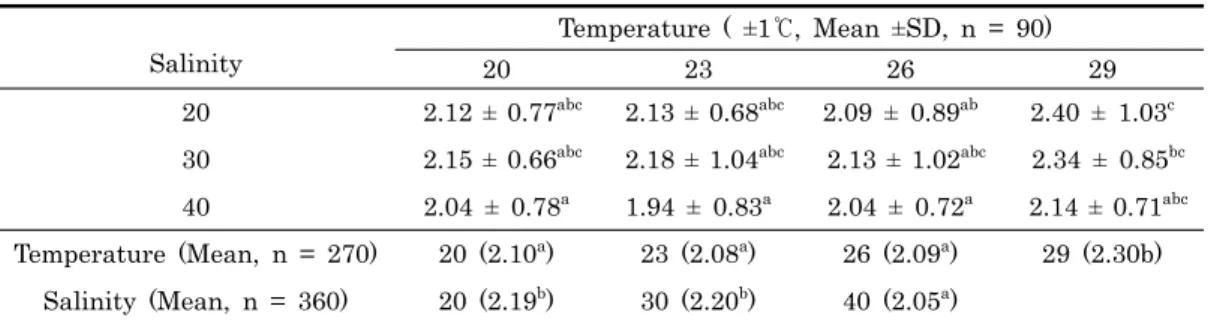
Salinity
Temperature ( ±1℃, Mean ±SD, n = 90)
20 23 26 29
20 2.12 ± 0.77abc 2.13 ± 0.68abc 2.09 ± 0.89ab 2.40 ± 1.03c 30 2.15 ± 0.66abc 2.18 ± 1.04abc 2.13 ± 1.02abc 2.34 ± 0.85bc 40 2.04 ± 0.78a 1.94 ± 0.83a 2.04 ± 0.72a 2.14 ± 0.71abc Temperature (Mean, n = 270) 20 (2.10a) 23 (2.08a) 26 (2.09a) 29 (2.30b)
Salinity (Mean, n = 360) 20 (2.19b) 30 (2.20b) 40 (2.05a)
※Values with different superscripts are statistical different at P < 0.05.
Table 1. Settlement density Crassostera gigas spats per centimeter squares on the effects of four salinities and three temperatures (Alpha = 0.05)
사각 FRP 수조로 채묘기 만 옮겨 수온 25℃에서 채묘 시 공
급된 동일 먹이를 공급하면서 2주간 (부착치패가 명확히 관찰 되는 시기) 유수 사육을 실시한 후 각 부착지질 당 부착마리수 를 육안으로 개수 후 다음 식으로 계산하였다.
(No. of attached spats; sum (n = 30) of number of each substrate attached spats)
한편, 채묘기질 당 부착마리수의 분포변화를 조사하기 위하 여 채묘기질당 부착빈도를 조사하였다. 기질당 부착빈도는 전 체 90개 채묘기 (30개 x 3 시험구) 를 모집단으로 각각의 채 묘기별 부착마리수를 채묘기질 면적으로 나누어 cm2 당 부착 밀도 및 부착빈도를 조사하였다. 이 때 각 빈도별 계급값은 0.2 spat/cm2 간격으로 임의 설정하였다
통계처리
각 채묘 실험구간의 부착율과 부착밀도에 대한 유의차 유무 는 One-way 및 Two-way ANOVA-test 를 실시한 후, Duncan’s test로 평균간의 유의성 (P < 0.05) 을 검정하였고, 부착밀도의 분포를 조사하기 위하여 빈도분석을 실시하였다.
모든 분석은 SPSS 통계 프로그램을 사용하여 분석하였다.
결 과
4구간의 수온구 20.0, 23.0, 26.0, 29.0℃에 염분을 20.0, 30.0, 40.0으로 조절하여 온도와 염분의 혼합구에 대한 참굴 부착기 유생의 채묘시험을 실시한 결과, 각 실험구별 평균 채 묘률 변화는 Fig 1에서 보는 것과 같다. 전체적으로 수온과 염 분 조합구에서 29.0℃에서 염분 20.0으로 조절된 채묘구에서 평균 43.1 ± 0.19%로 동일 수온에서 염분 30.0으로 조절된 채묘구를 제외하고는 다른 채묘구에 비해 유의적 (P < 0.05) 으로 높은 부착율를 보였고, 수온 23.0℃ 염분 40에서 평균
34.9 ± 0.6%로 유의적으로 가장 낮은 부착율을 보였다. 각 온도에 따른 염분별 시험구의 채묘율을 보면, 먼저 20.0℃ 구 간은 평균 부착율이 각각 38.3 ± 0.9%, 38.7 ± 0.9%, 36.7
± 1.4%로 염분 20.0과 30.0 구간이 40.0 구간에 비해 유의 적으로 높은 부착율을 보였지만, 염분 20.0과 30.0 구간간의 부착율에 대한 유의적이 차이는 없었다. 수온 23.0℃ 구간에 서는 각각 38.4 ± 1.1%, 39.2 ± 1.5%, 34.9 ± 0.6%로 염 분 30.0구간이 비교적 높게 나타났지만, 20.0℃ 수온구와 비 슷하게 염분 20.0과 30.0 간에는 유의적이 차이가 없었고, 40.0에 비해서는 유의적으로 높은 채묘율을 보였다. 26.0℃구 간에서는 각각 37.6 ± 0.6%, 38.4 ± 0.9%, 36.8 ± 0.5%로 염분 30.0으로 조절된 채묘구에서 비교적 높은 부착율을 보였 지만, 유의적인 차이는 없었다. 한편, 수온 29.0℃ 구간에서는 각각 43.1 ± 0.1%, 42.1 ± 0.1%, 39.0 ± 0.7%로 다른 수 온구에 비해 염분 20.0에서 비교적 높은 채묘율을 보였다. 그 러나 30.0 시험구간에는 유의적인 차이가 없었고, 염분 40.0 시험구는 20.0과 30.0에 비해 유의적으로 낮은 채묘율을 보였 다. 이상의 결과 전체적으로 비교적 수온이 낮고, 고염분에서 는 부착율이 낮았다.
수온에 따른 염분별 채묘구의 채묘기질 cm2당 부착밀도와
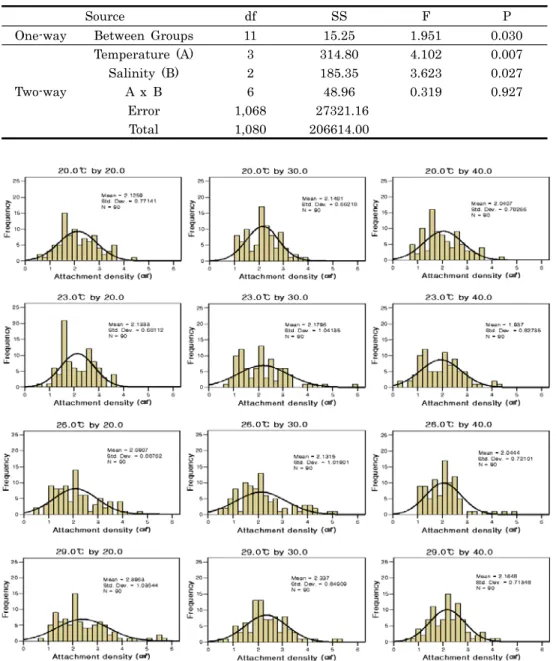
Source df SS F P
One-way Between Groups 11 15.25 1.951 0.030
Two-way
Temperature (A) 3 314.80 4.102 0.007
Salinity (B) 2 185.35 3.623 0.027
A x B 6 48.96 0.319 0.927
Error 1,068 27321.16
Total 1,080 206614.00
Table 2. Analysis of variance of the effects of salinity and temperature on the settlement density of Crassostera gigas spats per centimeter squares (cm2)
Fig. 2. Histogram of the attachment density frequency on the salinity and temperature of Crassostera gigas spats per centimeter squares (cm2).
밀도변화에 따른 통계분석을 실시한 결과는 Table 1와 2에서 보는 것과 같다. 부착밀도는 수온 29.0℃에서 염분 20.0로 조 절된 채묘구에서 2.40 ± 1.03으로 가장 높았지만, 수온 26.
0℃, 염분 20.0과 염분 40.0에서 수온 20.0℃, 23.0℃ 및 26.0℃로 조절된 시험구를 제외하고는 유의적인 차이는 없었 다. 한편, 수온과 염분에 따른 혼합효과를 다변량 분석을 실시 한 결과 혼합효과에 대한 유의적인 차이가 없었다 (P = 0.927). 그러나 수온 (P = 0.007) 과 염분 (P = 0.027) 에
대한 일변량에 대한 효과는 유의적인 차이를 보였는데, 수온는 29.0℃에서 유의적으로 높은 부착밀도를 보였지만, 그 외 수 온에서는 유의적인 차이가 없었다. 염분은 40.0에서 유의적으 로 낮은 부착밀도를 보였지만, 20.0과 30.0 사이에는 유의적 인 차이가 없었다.
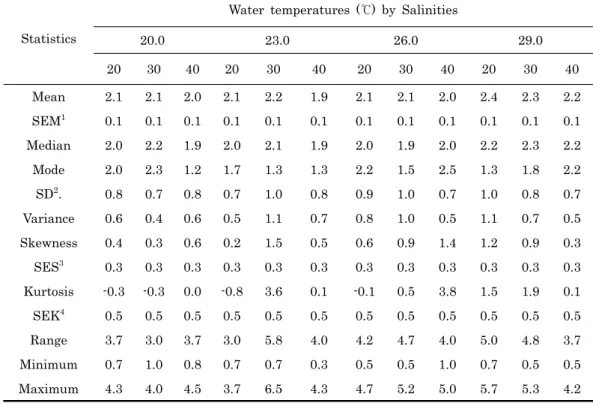
수온에 따른 염분별 채묘구의 채묘기질 cm2당 부착마리의 빈도를 조사한 결과는 Fig 2와 Table 1에서 보는 것과 같다.
전제적으로 가장 많은 부착빈도 값은 1.2-2.3 마리/cm2을 보
Statistics
Water temperatures (℃) by Salinities
20.0 23.0 26.0 29.0
20 30 40 20 30 40 20 30 40 20 30 40
Mean 2.1 2.1 2.0 2.1 2.2 1.9 2.1 2.1 2.0 2.4 2.3 2.2 SEM1 0.1 0.1 0.1 0.1 0.1 0.1 0.1 0.1 0.1 0.1 0.1 0.1 Median 2.0 2.2 1.9 2.0 2.1 1.9 2.0 1.9 2.0 2.2 2.3 2.2 Mode 2.0 2.3 1.2 1.7 1.3 1.3 2.2 1.5 2.5 1.3 1.8 2.2 SD2. 0.8 0.7 0.8 0.7 1.0 0.8 0.9 1.0 0.7 1.0 0.8 0.7 Variance 0.6 0.4 0.6 0.5 1.1 0.7 0.8 1.0 0.5 1.1 0.7 0.5 Skewness 0.4 0.3 0.6 0.2 1.5 0.5 0.6 0.9 1.4 1.2 0.9 0.3 SES3 0.3 0.3 0.3 0.3 0.3 0.3 0.3 0.3 0.3 0.3 0.3 0.3 Kurtosis -0.3 -0.3 0.0 -0.8 3.6 0.1 -0.1 0.5 3.8 1.5 1.9 0.1 SEK4 0.5 0.5 0.5 0.5 0.5 0.5 0.5 0.5 0.5 0.5 0.5 0.5 Range 3.7 3.0 3.7 3.0 5.8 4.0 4.2 4.7 4.0 5.0 4.8 3.7 Minimum 0.7 1.0 0.8 0.7 0.7 0.3 0.5 0.5 1.0 0.7 0.5 0.5 Maximum 4.3 4.0 4.5 3.7 6.5 4.3 4.7 5.2 5.0 5.7 5.3 4.2
1Standard error of mean (SEM), 2standard deviation (SD), 3standard error of skewness (SES),
4standard error of kutosis (SEK). n = 90.
Table 3. Attachment frequency Analysis of Crassostrea giags pediveliger larvae settled at four water temperatures and three salinities.
였다. 20.0℃ 구간에서 염분별 cm2당 부착마리수 (Mean ± S.E) 는 각각 2.1 ± 0.1, 2.1 ± 0.1, 2.0 ± 0.1 이었고, 부 착마리수의 범위는 각각 3.7, 3.0, 3.7마리/cm2 였다. 가장 빈 번한 빈도는 각각 2.0, 2.3, 1.2마리/cm2로 염분 30.0에서 가 장 높은 빈도를 보였다. 왜도와 첨도가 각각 0.3-0.6와 – 0.3-0.0으로 중앙값 1.9-2.2와 비교 했을 때 완만하게 중앙값 에서 음의 분포 를 보였다. 23.0℃ 구간의 평균 부착마리수는 각각 2.1 ± 0.1, 2.2 ± 0.1, 1.9 ± 0.1 이었고, 부착마리수 의 범위는 각각 3.0, 5.8, 4.0마리/cm2 였다. 가장 빈번한 빈 도는 각각 1.7, 1.3, 1.3마리/cm2로 20.0℃ 채묘구와 동일하 게 염분 30.0에서 가장 높은 빈도를 보였다. 왜도와 첨도는 각 각 0.2-1.5와 –0.8-3.6으로 중앙값 1.9-2.1과 비교 했을 때 염 분 30.0은 중앙값에 매우 근접한 값을 보이면서 부착빈도가 좁게 나타났다. 그러나 그 외 구간은 넓은 부착빈도를 보였다.
26.0℃ 구간의 평균 부착마리수는 각각 2.1 ± 0.1, 2.1 ± 0.1, 2.0 ± 0.1 이었고, 부착마리수의 범위는 각각 4.2, 4.7, 4.0마리/cm2 였다. 가장 빈번한 빈도는 각각 2.2, 1.5, 2.5마리 /cm2로 염분 40.0에서 가장 높은 빈도를 보였다. 왜도와 첨도 는 각각 0.6-1.4와 –0.1-3.8으로 중앙값 1.9-2.0과 비교 했을 때 염분 40.0은 중앙값에 매우 근접한 값을 보이면서 부착빈
도가 좁게 나타났지만, 그 외 구간은 넓은 부착빈도를 보였다.
그리고 29.0℃ 구간의 평균 부착마리수는 각각 2.4 ± 0.1, 2.3 ± 0.1, 2.2 ± 0.1 이었고, 부착마리수의 범위는 각각 5.0, 4.8, 3.7마리/cm2 였다. 가장 빈번한 빈도는 각각 1.3, 1.8, 2.2마리/cm2로 염분 40.0에서 가장 높은 빈도를 보였다.
왜도와 첨도는 각각 0.3-1.2와 0.1-1.9으로 중앙값 2.2-2.3과 비교 했을 때 염분 30.0이 중앙값에 매우 근접한 값을 보이면 서 부착빈도가 좁게 나타났다.
고 찰
부착과 변태는 참굴을 포함한 이매패류의 생활사에서 매우 중태한 과정이고, 전체 해양무척추동물의 군집변동에 중요한 영향을 미치고, 특히 효율적인 부착 및 변태 유도는 이매패류 인공종묘 생산과정에서 전체 생산성에 영향을 미치기 때문에 효과적이고, 안정적인 부착과 변태를 유도할 수 있는 방법을 채묘과정에 도입 것은 매우 중요하다 (Laing, 1995).
Crassosstrea과의 굴들은 일반적으로 광염성 (Quayle and Newkirk, 1989) 이고, 온도변화에 매우 잘 적응하는 능력이 있다 (Angell, 1986).
지금까지 자연조건과 실험실적 조건에서 이 종들의 성장과 발달 형태 등에 미치는 수온과 염분의 영향에 대하여 많은 연 구자들이 연구를 수행하였다 (Hidu and Haskin, 1971;
Lund, 1971; Paul, 1980; Tettelbach and Rhodes, 1981;
Henderson, 1983). C. belcheri (Tan, 1993) 와 C.
iredalei와 같은 몇몇 열대성 굴종은 96시간까지 부착과 변태 가 연장되는 경우가 있지만, 본 조사에 이용된 굴 C. gigas은 온도에 따라 조금 다르지만 대부분 48 h 이내에 부착과 변태 가 완료 되는 것으로 보고되고 있다 (Henderson, 1983;
Supan, 1987; Jones and Jones, 1988). 부착과 변태의 성 공률을 높이기 위해서는 비교적 높은 염분과 높은 수온에서 관 리할 필요가 있는 것으로 밝혀졌다 (Lund, 1971;
Henderson, 1983). 본 조사에서도 실험 구간 중 가장 높은 29.0℃ 채묘구에서 유의적으로 높은 부착율과 높은 부착밀도 를 보였다. 그러나 40.0의 고염분에서는 오히려 채묘율이 떨 어지는 현상이 나타났다.
Lund (1971) 과 Henderson (1983) 은 굴 C. gigas 부 착기 유생의 최고 부착률은 각각 수온 30.8℃, 염분 22-34와 30.8℃, 염분 30에서 가장 높은 35-40%의 부착률을 보인다고 보고하였는데, 비록 본 조사에서 30.0℃이상에서는 조사하지 않았지만, 비슷한 수온인 29.0℃와 염분 20-30에서 유의적으 로 가장 높은 42.1-43.1% 가장 높은 부착률를 보여 비슷한 결 과를 보였다.
한편, 국내 인공종묘생산 과정에서 채묘기질로 굴 또는 가리 비 패각을 60-80개씩 간격 없이 연줄에 조립하여 채묘기로 이 용하는데, 채묘기당 적정 부착치패의 마리수는 채묘 후 바로 양성하는 굴 종묘는 채묘기당 30-40마리 (평균 35마리), 단련 을 위해서는 70마리 정도의 부착밀도가 적당하다 (유, 2000).
이 이상 부착된 종묘는 양성 시 성장둔화, 탈락 등에 문제가 있고, 이 보다 적은 종묘는 수하양성을 위해 재조립 시 2-3개 를 포개어 조립해야 하기 때문에 작업효율이 떨어지고, 조립연 의 생산성이 낮아진다. 따라서 종묘생산 시 적정량의 치패를 균등하게 채묘하는 것이 매우 중요하다. 그러나 지금까지 참굴 인공종묘생산과 관련하여 부착기 유생의 온도와 염분에 따른 부착과 변태에 대한 생물학적인 영향에 대하여 앞서 언급한 바 와 같이 많은 보고가 있지만, 채묘기질별 부착빈도에 대하여 보고한 자료는 없어 본 조사와 정확한 비교 고찰은 어렵지만, 굴 종묘 생산용 채묘기로 이용하고 있는 중형 굴 패각의 넓이 는 약 80.0-100 (평균 90) cm2 정도로 35-70 (평균 53) 마리 의 적정치패를 부착시키기 위해서는 약 0.38-0.70 (평균 0.53) 마리/cm2이 적당하고, 채묘 후 30일 정도 중간육성 후 조립연 제작까지 인공종묘 부착치패의 폐사율은 4.8-5.6%
(Min et al., 1999), 동절기 3시간 노출선에서 60일간 단련했 을 경우 생존율은 24.3-37.5% (Hur et al., 2002) 로 보고되
고 있는 점을 감안하면 평균 약 0.40-1.18 마리/cm2 이 적당 할 것으로 유추된다. 그러나 본 실험의 경우 수온 23.0℃, 염 분 40.0의 최소 부착밀도가 0.3마리/cm2을 제외하고는 모든 채묘 시험구에서 0.5마리/cm2 이상의 부착밀도를 보이고, 평 균 1.9-2.4 마리/cm2로 나타나 적정 부착마리수에 비해 비교 적 높은 부착밀도를 보였다. 한편, Min et al., (1995) 은 인 공종묘 생산 시 굴 패각을 이용하여 채묘 할 경우 수온 25.0℃
에서 투입 부착기 유생밀도를 2.5-5.0마리/cm2 (200-400마리/
패각) 으로 하면 채묘기당 부착치패는 평균 0.45-1.27마리 /cm2 (35.6-62.8마리) 의 부착밀도를 얻을 수 있다고 하였는 데, 본 시험에서는 부착기 유생의 투입밀도가 5.5마리/cm2로 투입한 결과가 되어 5.0마리/cm2와 비슷했지만, 평균 부착밀 도는 1.5-1.9배 높게 나타났다. 이와 같은 차이는 유생의 부착 과 변태에 영향을 미치는 유전적인 요인, 유생의 일령 등과 같 은 내적요인 뿐만 아니라, 사육과정에서 수반되는 영양공급 상 태와 같은 유생사육조건 특히 채묘과정에 동반되는 사육수의 물리화학적 환경특성 등이 대부분의 이매패류 유생의 부착에 영향을 미칠 (Hadfield, 1984) 것으로 판단된다. 그러나 수온 과 염분조합에 따른 고른 부착밀도를 찾고자 했지만, 수온 26.0℃, 염분 40에서 첨도가 3.84로 나타났지만, 대부분 완만 한 형태의 빈도분포를 보이면서 비슷한 경향을 보였다. 따라서 향후 고른 부착빈도를 얻기 위해서는 또 다른 다양한 요인을 병행해서 깊이 있는 연구가 수행되어야 할 것으로 본다. 뿐만 아니라, 본 실험에서는 수온과 염분의 조건범위가 비교적 넓기 때문에 최적의 정확한 수온과 염분조건을 설명하는 데는 한계 가 있다. 따라서 향후 보다 세밀한 조건으로 깊이 있는 연구가 진행되어야 할 것이다. 그러나 본 조사의 결과와 지금까지의 연구결과 (Lund, 1971; Henderson, 1983) 로 보아 굴 C.
gigas 인공종묘생산 시 효과적인 채묘관리를 위한 수온조건은 비교적 고수온인 29.0-30.5℃가 좋을 것으로 판단되고, 염분 은 20.0-30.0으로 조절하는 것이 좋을 것으로 판단된다.
요 약
채묘시험은 4구간의 수온구 20.0, 23.0, 26.0, 29.0℃에 염 분을 20.0, 30.0, 40.0으로 조절하여 온도와 염분의 혼합구에 대한 참굴 부착기 유생의 채묘시험을 실시한 결과, 수온 29.
0℃에서 염분 20.0과 30.0으로 조절된 채묘구에서 평균 43.1
± 0.19%와 42.1 ± 0.1%로 유의적으로 가장 높은 채묘율을 보였고, 수온 23.0℃염분 40.0에서 34.9 ± 0.6% 가장 낮은 부착률을 보였다 (P < 0.05). 부착밀도는 수온 29.0℃에서 유의적으로 높았고, 염분 40.0의 고염분에서 유의적으로 낮았 다(P < 0.05). 그러나 수온과 염분의 혼합효과는 유의적인 차 이가 없었다 (P > 0.05). 수온에 따른 염분별 채묘구의 부착 빈도를 조사한 결과 가장 많은 부착빈도는 1.2-2.3 마리/cm2
을 보였고, 평균 부착밀도는 1.9-2.4마리/cm2였다. 전체적으로 채묘율과 평균 부착밀도 그리고 부착빈도를 감안하면 본 실험 결과 효과적인 채묘관리를 위한 수온과 염분조건은 수온 29.
0℃, 염분 20.0-30.0으로 조절하는 것이 좋을 것으로 판단된 다.
감사의 글
본 연구는 국립수산과학원 연구 사업비 (RP-2012-AQ- 018) 지원에 의해 수행된 연구결과입니다.
참고문헌
Andrews, W.R., Targett, N.M. and Epifanio, C.E. (2001) Isolation and characterization of the metamorphic inducer of the common mud crab, Panopeus herbstii.
Journal of Experimental Marine Biology and Ecology, 261: 121–134.
Angell, C.L. (1986) The Biology and Culture of Tropical Oysters. ICLARM Technical Report, No. 13: 42.
Manila, Philippines.
Bonar, D.B., Coon, S.L., Walch, M., Weiner, R.M. and Fitt, W. (1990) Control of oyster settlement and metamorphosis by endogenous and exogenous chemical cues. Bulletin of marine Science, 46: 484–
498.
Cann-Moisan, C., Nicolas, L. and Robert, R. (2002) Ontogenic changes in the contents of dopamine, norepinephrine and serotonin in larvae and postlarvae of the bivalve Pecten maximus. Aquatic Living Resources, 15: 313–318.
Coon, S.L., Bonar, D.B. and Weiner, R.M. (1985) Induction of settlement and metamorphosis of the Pacific oyster, Crassostrea gigas (Thunberg), by L-DOPA and catecholamines. Journal of Experimental Marine Biology and Ecology, 94: 211–
221
Crisp, D.J. (1984) Overview of research on marine invertebrate larvae. In: Grant, P.T. and Mackie, A.M. Eds., Chemoreception in Marine Organisms, vol. 1. 177–265. Academic Press, London.
Devakie, M.N. and Ali, A.B. (2000) Salinity–temperature and nutritional effects on the setting rate of larvae of the tropical oyster, Crassostrea iredalei (Faustino).
Aquaculture, 184: 105-114.
Doroudi, M.S. and Southgate, P.C. (2002) The effect of chemical cues on settlement behaviour of blacklip pearl oyster (Pinctada margaritifera) larvae.
Aquaculture, 209: 117–124.
Faimali, M., Garaventa, F., Terlizzi, A., Chiantore, M.
and Cattaneo-Vietti, R. (2004) The interplay of substrate nature and biofilm formation in regulating Balanus amphitrite Darwin, 1854 larval settlement.
Journal of Experimental Marine Biology and Ecology, 306: 37–50.
Ganesan. A.M., Alfaro A.C., Brooks J.D. and Higgins
C.M. (2010) The role of bacterial biofilms and exudates on the settlement of mussel (Perna canaliculus) larvae. Aquaculture, 306: 388-392.
García-Lavandeira, M., Silva, A., Abad, M., Pazos, A.J., Sánchez, J.L. and Pérez- Parallé, M.L. (2005) Effects of GABA and epinephrine on the settlement and metamorphosis of the larvae of four species of bivalve molluscs. Journal of Experimental Marine Biology and Ecology, 316: 149–156.
Hadfield, M.G., 1978. Metamorphosis in marine molluscan larvae: an analysis of stimulus and response. In: Chia, F.S. and Rice, M.E. Eds, Settlement and Metamorphosis of Marine Invertebrate Larvae. 165–175. Elsevier, New York.
Hadfield, M.G. (1984) Settlement requirement of molluscan larvae: new data on chemical and genetic roles. Aquaculture, 39: 283–298.
Hadfield, M.G. and Paul, V.J. (2001). Natural chemical cues for settlement and metamorphosis of marine-invertebrate larvae. In: McClintock, J.B., Baker, B.J. (Eds.), Marine Chemical Ecology. 431–
461. CRC press, New York.
Henderson, B.A. (1983) Handling and Remote Setting Techniques for the Pacific oyster larvae, Crassostrea gigas. Master’s thesis, Department of Fisheries and Wildlife, 37. Oregon State University. OR
Hidu, H. and Haskin, H. (1971) Setting of the American oyster related to environmental factors and larval behaviour. Proceeding of National Shellfish Association, 61: 35–49.
Hur, Y.B., WI, C.H., KIM, T.I., Chun, C.Y., Hwang, M.S., Kim, Y.O. and Choe, S.W. (2002). Effect of hardening on growth survival of spats of the Pacific oyster, Crassostrea gigas artificially produced in Autumn season. bulletin of National Fisheries Research and Development Agency, 61: 77-84.
Hur, Y.B., Min, K.S., Kim, T.E., Lee, S.J. and Hur, S.B.
(2008) Larvae growth and biochemical composition change of the Pacific oyster Crassostrea gigas, larvae during artificial seed production. Journal of Aquaculture, 21: 203-212.
Jensen, R.A., Morse, D.E., Petty, R.L. and Hooker, N.
(1990) Artificial induction of larval metamorphosis by free fatty acids. Marine Ecological Progress of Service, 67: 55–71.
Johnson, C.R., Muir, D.G. and Reysenbach, A.L. (1991) Characteristic bacteria associated with surfaces of coralline algae: a hypothesis for bacterial induction of marine invertebrate larvae. Marine Ecological Progress of Service, 74: 281–294.
Jones, G.G. and Jones, B.L. (1988) Advances in Remote Setting of Oyster Larvae. 88. Aquaculture Association of BC, Nanaimo, BC.
Keough, M.J. and Raimondi, P.T. (1996) Responses of settling invertebrate larvae to bioorganic films:
Effects of large-scale variation in films. Journal of Experimental Marine Biology and Ecology, 207: 59–
78.
Laing, I. (1995) Effect of food supply on oyster spat fall. Aquaculture, 131: 315–324.
Leitz, T. and Wagner, T. (1993) The marine bacterium Alteromonas espejiana induces metamorphosis of the hydroid Hydractinia echinate. Marine Biology, 115:
173–178.
Lund, D.S. (1971) Laboratory studies on setting of the Pacific Oyster Crassostrea gigas. Master’s thesis, Department of Fisheries and Wildlife, 85. Oregon State University, OR.
Maki, J.S., Rittschof, D., Schmidt, A.R., Snyder, A.G.
and Mitchell, R. (1989) Factors controlling attachment of bryozoan larvae: a comparison of bacterial films and unfilmed surfaces. Biological Bulletin, 177: 295–302.
Martinez, G., Aguilera, C. and Campos, E.O. (1999) Induction of settlement and metamorphosis of the scallop Argopecten purpuratus Lamarck by excess K+ and epinephrine: energetic costs. Journal of Shellfish Research, 18: 41–46.
Min, K.S., Chang, Y.J., Park, D.W., Jung, C.G., Kim, D.H. and Kim, G.H. (1995) Studies on rearing conditions for mass seedling production in Pacific oyster larvae, Crassostrea gigas (Thunberg). bulletin of National Fisheries Research and Development Agency, 49: 91-111.
Min. S.K., Kim, T.I., Hur, S.B., Hur, Y.B., Chun, C.Y.
and Kim, D.H. (1999) Growth and survival of the artificial and natural seeding in the Pacific oyster, Crassostrea gigas (Thunberg). bulletin of National Fisheries Research and Development Agency, 57:
43-53.
Morse, D.E. (1990) Recent progress in larval settlement and metamorphosis: closing the gaps between molecular biology and ecology. Bulletin of marine Science, 46: 465–483.
Paul, J.D. (1980) Salinity–temperature relationship in queen scallop Chlamys opercularis. Marine Biology, 56: 295–300.
Pawlik, J.R. (1992) Chemical ecology of the settlement of benthic marine invertebrate. Oceanogr. Marine Annual Review, 30: 273–335.
Qian, P.Y. (1999) Larval settlement of polychaetes.
Hydrobiologia, 402: 239–253.
Quayle, D.B. and Newkirk, G.F. (1989) Farming Bivalve Molluscs: Methods for Study and Development.
Advances in World Aquaculture, Vol. 1. The World Aquaculture Society In Assoc. with The International Development Research Centre. 294.
The World Aquaculture Society. Baton Rouge, LA.
Rodriguez, S.R., Ojeda, F.P. and Inestrosa, N.C. (1993)
Settlement of benthic marine invertebrates. Marine Ecological Progress of Service, 97: 193– 207.
Supan, J. (1987). Using Remote Setting to produce Seed Oyster in Louisiana and the Gulf Coastal Region.
Louisiana Sea Grant College Program. 47. Louisiana State University, Baton Rouge, LA.
Swanson, R.L., de Nys, R., Huggett, M.J., Green, J.K., Steinberg, P.D. (2006) In situ quantification of a natural settlement cue and recruitment of the Australian sea urchin Holopneustes purpurascens.
Marine Ecological Progress of Services, 314: 1–14.
Tamburri, M.N., Zimmer-Faust, R.K. and Tamplin, M.L.
(1992) Natural sources and properties of chemical inducers mediating settlement of oyster larvae: a re-examination. Biological Bulletin, 183: 327–338.
Tan, S.H. (1993) Aspects on Biology and Larval Development of Tropical Oyster, Crassostrea belcheri (Sowerby). Master’s thesis, School of Biological Sciences University. 221. Sc. Malaysia.
Tettelbach, S.T. and Rhodes, E.W. (1981) Combined effects of temperature and salinity on embryos and larvae of the northern bay scallop, Argopecten irradians irradians. Marine Biology, 63: 249–256.
Todd, C.D. (1985) Settlement-timing hypothesis: reply to Grant and Williamson. Marine Ecological Progress of Services, 23: 197–202.
Walch, M., Weiner, R.M., Colwell, R.R. and Coon, S.L.
(1999) Use of l-DOPA and soluble bacterial products to improve set of Crassostrea virginica (Gmelin, 1791) and C. gigas (Thunberg, 1793). Journal of Shellfish Research, 18: 133–138.
Weiner, R.M., Walch, M., Labare, M.P., Bonar, D.B. and Colwell, R.R. (1989) Effect of biofilms of the marine bacterium Alteromonas colwelliana (LST) on set of the oysters Crassostrea gigas (Thunberg, 1793) and C. virginica (Gmelin, 1791). Journal of Shellfish Research, 8: 117–123.
Yu, X., He, W., Gu, J.D., He, M. and Yan, Y. (2008) The effect of chemical cues on settlement of pearl oyster Pinctada fucata martensii (Dunker) larvae.
Aquaculture, 277: 83-91.
Zhao, B. and Qian, P.Y. (2002) Larval settlement and metamorphosis in the slipper limpet Crepidula onyx (Sowerby) in response to conspecific cues and the cues from biofilm. Journal of Experimental Marine Biology and Ecology, 269: 39–51.
Zimmer-Faust, R.K. and Tamburri, M.N. (1994) Chemical identity and ecological implications of a waterborne, larval settlement cue. Limnology and Oceanography, 39: 1075–1087.
유성규. 2000. 천해양식. p 118-119, 구덕출판사, 부산