≫ 연구논문 ≪
FeCl
3를 함유한 중성추출제의 혼합용매로 약한 염산용액으로부터 리튬(I)의 용매추출
행위동·이세아·§이만승
목포대학교 신소재공학과 희유금속연구소
Solvent Extraction of Li(I) from Weak HCl Solution with the Mixture of Neutral Extractants Containing FeCl
3Weidong Xing, Seah Lee and §Manseung Lee
Department of Advanced Materials Science & Engineering, Institute of Rare Metal, Mokpo National University, Chonnam 534-729, Korea
요 약
염산농도가 낮은 용액에서 TBP/MIBK와 다른 중성추출제(Cyanex 923, TOPO, TOP)의 혼합용매에 의한 리튬(I)의 용매추출실험 을 수행했다. 0.1 M의 FeCl3가 추출된 TBP/MIBK는 염산농도를 1에서 9 M로 변화시켜 준비하였다. 약한 염산용액에서 리튬(I)의 추출은 유기상에서 FeCl3의 안정도와 관계된다. FeCl3가 추출된 TBP를 진한 염산용액에서 제조하는 경우, 추출시 철의 탈거율이 작 아 리튬(I)이 수소이온과의 교환반응에 의해 추출되었다. 혼합용매에서 TBP의 농도도 FeCl3의 안정에 영향을 미쳤다. TBP에 비해 FeCl3는 MIBK로부터 쉽게 탈거되어 리튬(I)을 추출하지 못했다. TBP/MIBK와 혼합용매로 첨가된 중성추출제의 종류는 리튬(I)의 추출과 철의 탈거에 영향을 미치지 않았다.
주제어 : 리튬, 추출, 중성추출제, 약 염산, 염화제2철
Abstract
Solvent extraction of Li(I) from weak HCl solution was investigated by the mixture of TBP/MIBK with other neutral extract- ants such as Cyanex 923, TOPO and TOP. The TBP/MIBK organic phase was loaded with 0.1 M FeCl3 at different HCl con- centrations (1-9 M). Extraction of Li(I) from weak HCl solution is related to the stability of FeCl3 in the organic mixture. As HCl concentration increased in preparing the loaded TBP phase, the stripping percentage of Fe(III) during the extraction of Li(I) became reduced and thus Li(I) could be extracted by ion exchange reaction with hydrogen ion in the organic. The concentration of TBP in the extractant mixture affected the stability of FeCl3. Compared to TBP, Fe(III) was easily stripped from the loaded MIBK and thus no Li(I) was extracted by the mixture with MIBK. The nature of neutral extractant with TBP/MIBK showed little difference in the extraction of Li(I) and stripping of Fe(III).
Key words : Lithium, Extraction, Neutral extractants, Weak hydrochloric acid, FeCl3
· Received : November 15, 2018 · Revised : November 30, 2018 · Accepted : December 7, 2018
§Corresponding Author : Man-Seung Lee (E-mail : [email protected])
Department of Advanced Materials Science & Engineering, Mokpo National University, 1666 Yeongsan-ro, Cheonggye-myeon, Muan-gun, Chonnam 58554, Korea
ⓒThe Korean Institute of Resources Recycling. All rights reserved. This is an open-access article distributed under the terms of the Creative Commons Attribution Non-Commercial License (http://creativecommons.org/licenses/by-nc/3.0/), which permits unrestricted non-commercial use, distribution and reproduction in any medium, provided the original work is properly cited.
solvent extraction7,8), and membrane9). Among these methods, solvent extraction is an efficient and environ- mental-friendly method for the separation and recovery of metals from the aqueous solution.
The extraction efficiency of Li(I) by single extractant from brines is low3,10) and thus several synergistic ex- traction systems have been employed for its separation such as HBTA-TOPO11), LIX 54+TOPO12) and LIX 54+Cyanex 9232). The presence of either TOPO or Cyanex 923 enhances the extraction of Li(I) due to their strong electron donor property2,13) and prevents the formation of a third phase. However, Li(I) extraction by these mixtures can be obtained in the solution pH between 10 and 13. The system of TBP/FeCl3-MIBK plays an efficient role for the extraction of Li(I) when the chloride concentration of strong alkaline solution is high14,15). This might be ascribed to the fact that the hydrogen ion in the loaded TBP containing FeCl3 can be exchanged with Li(I) in chloride solution. In addition, it has been found that MgCl2 as a source of chloride ion has better performance for the extraction of Li(I) than CaCl2 and NH4Cl15) and the high concentration ratio of Fe(III) to Li(I) has a positive influence on the extraction of Li(I)15).
In order to investigate the possibility of extracting Li(I) from dilute HCl solution, several neutral extractant mixtures containing FeCl3 were employed in this work.
For this purpose, the mixtures of TBP/MIBK containing FeCl3 were prepared from different HCl concentrations and these mixtures were employed in the experiments.
The effect of TBP concentration on the extraction of Li(I) was also investigated from weak HCl solution.
purchased from Yakuri Pure Chemical Co. Ltd., Daejung Chemical & Metals Co. Ltd. and Samchun Pure Chemical Co. Ltd., respectively. Kerosene was used as diluent.
Extraction experiments were carried out in the 50 ml bottle with screw cap by mixing equal volume of organic and aqueous phases. The mixture was shaken for 30 min using a wrist action shaker (Burrel, USA) at room temperature. Organic phase containing FeCl3 was pre- pared by mixing neutral extractants and 0.1 M FeCl3 solution with different HCl concentration. The mixtures were separated in the separate funnel and the concent- ration of Li(I) in aqueous phase was measured by ICP- OES (Spectro arcos model). The concentration of Li(I) in the organic phase was calculated by mass balance.
3. Results and Discussion
3.1. Extraction of Li(I) by neutral extractant and its mixture with TBP
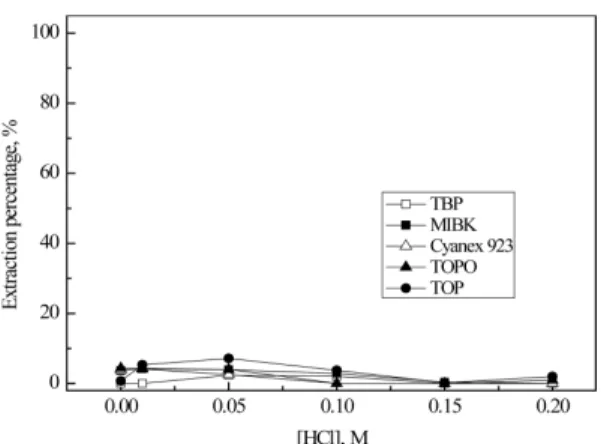
In order to investigate the effect of FeCl3, the extraction of Li(I) by neutral extractants was performed by varying HCl concentration to 0.2 M. When HCl concentration was 0.05 M, 7% of Li(I) was extracted by TOP and about 5% of Li(I) by other extractants (see Fig. 1). The extraction of Li(I) decreased as HCl concentration increased from 0.05 M to 0.2 M. Single neutral extractant could not extract efficiently Li(I) from weak HCl solution.
3.2. Extraction of Li(I) by mixture of neutral ex- tractants and TBP
In this work, Cyanex 923, TOPO and TOP were em- ployed in the solvent extraction experiments. The solvent extraction reaction of FeCl3 by TBP/MIBK depends on
the concentration of chloride ion14-17) and can be re- presented as Eqs. (1) and (2). Eq.(1) occurs when HCl concentration is lower than 6 M, while Eq. (2) occurs in the HCl concentration range from 6 to 9 M. In the course of preparing organic phase containing FeCl3, the solution of 0.1 M FeCl3 with HCl concentration range of 1 M to 9 M was employed for the experiments.
Around 0.1 M FeCl3 was loaded into the organic phase.
The neutral extractant mixtures containing 0.1 M FeCl3 which was prepared at different HCl concentrations were employed in the experiments.
Fe3++ 3Cl−+ 3TBP(o) → FeCl3·3TBP(o) (1) H++ Fe3++ 4Cl−+ 2TBP(o) → HFeCl4·2TBP(o) (2) According to the reported works, Cyanex 923 shows synergistic effect as well as the function of preventing the formation of a third phase2,18). Thus, the mixture of 0.1 M FeCl3 in TBP with 0.1 M Cyanex 923 was investigated. In preparing the TBP containing FeCl3, the concentration of HCl was varied from 1 to 9 M. When HCl concentration was 0.05 M, 80% of Fe(III) loaded in the organic phase came into the aqueous solution and no Li(I) was extracted (see Fig. 2). As HCl concent- ration increased to 9 M, the stripping of Fe(III) into the aqueous phase rapidly decreased to zero at 9 M HCl and about 20% of Li(I) was extracted. When HCl concentration was low, Fe(III) was easily stripped from
the TBP phase but the stability of FeCl3 in TBP increased with HCl concentration. This stability might be due to the change of the extracted species of FeCl3 with HCl concentration. Eqs. (1) and (2) indicate that the species of FeCl3 extracted into TBP changes from FeCl3·3TBP to HFeCl4·2TBP as chloride ion concentration increases19). The species of HFeCl4·nTBP has a strong tendency to form complex with Li(I). The extraction reaction can be represented as Eq. (3)20). Eq. (3) shows that high concentration of hydrogen ion in aqueous solution could suppress the extraction of Li(I).
Li++ HFeCl4·nTBP(o) F LiFeCl4·nTBP(o) + H+ (3) Fig. 1. Effect of HCl on the extraction of Li(I) by single
extractant from weak HCl solution. ([HCl] = 0-0.2 M [extractant] = 0.1 M, O/A =1)
Fig. 2. Effect of HCl concentration on extraction of Li(I) by the mixture of Cyanex 923 and TBP containing 0.1 M FeCl3. ([Cyanex 923] = 0.1 M, [HCl]Li(I) solution = 0.05 M)
Fig. 3. Effect of HCl concentration on extraction of Li(I) by the mixture of TOPO and TBP containing 0.1 M FeCl3. ([TOPO] = 0.1 M, [HCl]Li(I) solution = 0.05 M)
TOPO has a synergistic effect due to its powerful electron donor properties13). Therefore, the effect of TOPO on the extraction of Li(I) with the mixture of TBP with 0.1 M FeCl3 was investigated. Fig. 3 shows that the extraction behavior of Li(I) and the stripping of Fe(III) by the mixture with TOPO was similar to that of Cyanex 923. The same experiments were done with the mixture of 0.1 M TOP with the TBP containing 0.1 M FeCl3. Fig. 4 shows that the extraction and stripping behavior of Li(I) and Fe(III) by the mixture with TOP was similar to that of Cyanex 923 and TOPO.
3.3. Extraction of Li(I) by neutral extractant and its mixture with MIBK
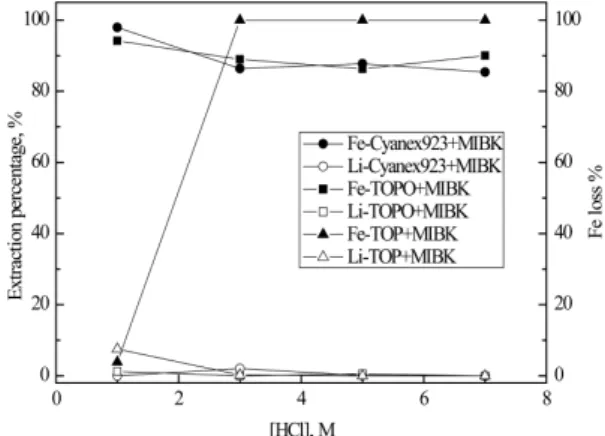
In order to compare the extraction behavior of Li(I) between TBP and MIBK, 0.1 M FeCl3 was extracted into MIBK and this organic was mixed with Cyanex 923, TOPO and TOP. In these experiments, HCl concent- ration was varied from 1 to 9 M. According to Fig. 5, Fe(III) was easily stripped from the MIBK during the extraction of Li(I) from the experimental ranges. There- fore, the organic mixture with MIBK was not effective in extracting Li(I) and thus no Li(I) was extracted.
3.4. Effect of TBP concentration
Based on the reports14), TBP concentration has an important influence on the extraction of Li(I) in the salt lake brine with high concentration ratio of Mg(II) to Li(I). In order to investigate the effect of TBP concent-
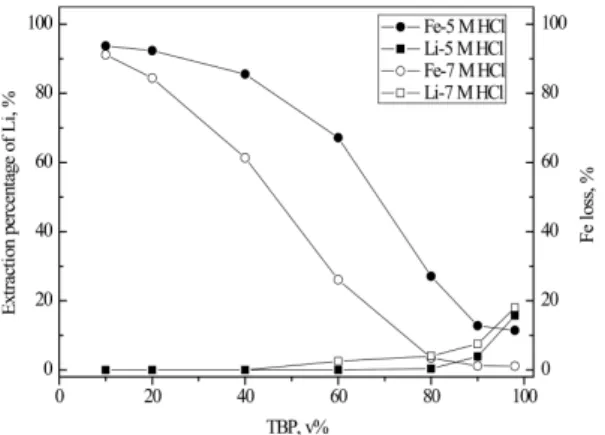
ration on the extraction of Li(I) from the weak HCl solution, the concentration of TBP was varied from 10 to 98%. The organic mixture of TBP containing 0.1 M FeCl3 with neutral extractants was prepared at 5 M and 7 M HCl. Fig. 6 shows that the stripping percentage of Fe(III) decreased rapidly with TBP concentration in the mixture with Cyanex 923. In addition, when the TBP concentration was fixed, stripping percentage of Fe(III) decreased as HCl concentration increased. Com- pared to 5 M HCl, a little more Li(I) was extracted into organic phase prepared at 7 M HCl. Fig. 7 shows the effect of TBP concentration in the mixture of TOPO.
Fig. 4. Effect of HCl concentration on extraction of Li(I) by the mixture of TOP and TBP containing 0.1 M FeCl3. ([TOP] = 0.1 M, [HCl]Li(I) solution = 0.05 M)
Fig. 5. Effect of HCl concentration on extraction of Li(I) by the mixture of MIBK containing 0.1 M FeCl3. ([Cyanex 923]=[TOPO]=[TOP] = 0.1 M, [HCl]Li(I)
solution = 0.05 M)
Fig. 6. Effect of TBP concentration on extraction of Li(I) by the mixture of Cyanex 923 and TBP containing 0.1 M FeCl3. ([Cyanex 923] = 0.1 M, [HCl]FeCl3 solution = 5 M and 7 M, [HCl]Li(I) solution = 0.05 M)
The extraction and stripping behavior of Li(I) and Fe(III) by the mixture with TOPO was similar to that by the mixture with Cyanex 923.
Fig. 8 shows the extraction and stripping behavior of Li(I) and Fe(III) by the mixture with TOP. The stripping percentage of Fe(III) increased rapidly as TBP concent- ration increased from 10 to 40% and then quickly de- creased to 3% at 98% TBP concentration. This data indicates that the FeCl3 in the organic composed of TOP and TBP prepared at high HCl solution is more stable than that from low HCl concentration. Therefore, it can be concluded that Li(I) can be extracted by the mixture
with TBP containing FeCl3 in strong HCl solution with other neutral extractants. In these, the stability of the organic mixture is important to extract Li(I).
4. Conclusions
In current work, the feasibility of extracting Li(I) from weak HCl solution was investigated by neutral extractants like TBP/MIBK mixed with Cyanex 923, TOPO and TOP containing FeCl3. In the course of Li(I) extraction by the mixtures of neutral extractants and TBP containing FeCl3, the stability of FeCl3 in the loaded organic is related to the extraction of Li(I). When the TBP phase containing FeCl3 was prepared at high HCl concentration, the stripping percentage of Fe(III) from the organic mixture was reduced, which resulted in some extraction of Li(I) from 0.05 M HCl solution. The nature of the neutral extractants in the mixture with TBP did not show difference in the extraction behavior of Li(I). TBP concentration in the mixture had a great effect on the stability of FeCl3 in the organic and thus the extraction of Li(I). About 20% of Li(I) was extracted from the 0.05 M HCl solution when the mixture with 98% of TBP containing 0.1 M FeCl3 was prepared from 7 M HCl solution. However, the stability of FeCl3 in MIBK was low and thus Li(I) was hardly extracted by the mixtures containing MIBK.
Acknowledgements
This work was supported by the Global Excellent Technology Innovation of the Korea Institute of Energy Technology Evaluation and Planning (KETEP), granted financial resource from the Ministry of Trade, Industry
&Energy, Republic of Korea (No. 20165010100810).
References
1. Yang, Y., Meng, X., Cao, H., Lin, X., Liu, C., Sun, Y., Zhang, Y. and Sun, Z. 2018 : Selective recovery of lith- ium from spent lithium iron phosphate batteries: A sus- tainable process. Green Chemistry 20(13), pp.3121- 3133.
Fig. 7. Effect of TBP concentration on extraction of Li(I) by the mixture of TOPO and TBP containing 0.1 M FeCl3. ([TOPO] = 0.1 M, [HCl]FeCl3 solution = 5 M and 7 M, [HCl]Li(I) solution = 0.05 M)
Fig. 8. Effect of TBP concentration on extraction of Li(I) by the mixture of TOP and TBP containing 0.1 M FeCl3. ([TOP] = 0.1 M, [HCl]FeCl3 solution = 5 M and 7 M, [HCl]Li(I) solution = 0.05 M)
pp.55-69.
5. An, J. W., Kang, D. J., Tran, K. T., Kim, M. J., Lim, T.
and Tran, T. 2012 : Recovery of lithium from uyuni salar brine. Hydrometallurgy 117-118, pp.64-70.
6. Chitrakar, R., Makita, Y., Ooi, K. and Sonoda, A. 2014 : Lithium recovery from salt lake brine by H2TiO3. Dalton transactions 43(23), pp.8933-8939.
7. Gao, D., Yu, X., Guo, Y., Wang, S., Liu, M., Deng, T., Chen, Y. and Belzile, N. 2015 : Extraction of lithium from salt lake brine with triisobutyl phosphate in ionic liquid and kerosene. Chemical Research in Chinese Uni- versities 31(4), pp.621-626.
8. Harvianto, G. R., Kim, S. H. and Ju, C. S. 2015 : Solvent extraction and stripping of lithium ion from aqueous solution and its application to seawater. Rare Metals 35(12), pp.948-953.
9. Swain, B. 2016 : Separation and purification of lithium by solvent extraction and supported liquid membrane, analysis of their mechanism: A review. Journal of Chem- ical Technology & Biotechnology 91(10), pp.2549-2562.
10. Li, L., Deshmane, V. G., Paranthaman, M. P., Bhave, R., Moyer, B. A. and Harrison, S. 2018 : Lithium recovery from aqueous resources and batteries: A brief review.
Johnson Matthey Technology Review 62(2), pp.161-176.
11. Zhang, L., Li, L., Shi, D., Li, J., Peng, X. and Nie, F.
2017 : Selective extraction of lithium from alkaline brine using hbta-topo synergistic extraction system. Separation and Purification Technology 188, pp.167-173.
12. Kinugasa, T., Nishibara, H., Murao, Y., Kawamura, Y., Watanabe, K. and Takeuchi, H. 1994 : Equilibrium and
and FeCl3. J. Chem. Eng. Data 57(1), pp.82-86.
16. Ji, L., Hu, Y., Li, L., Shi, D., Li, J., Nie, F., Song, F., Zeng, Z., Sun, W. and Liu, Z. 2016 : Lithium extraction with a synergistic system of dioctyl phthalate and tributyl phosphate in kerosene and FeCl3. Hydrometallurgy 162, pp.71-78.
17. Lee, M., Lee, G. and Sohn, K. 2004 : Solvent extraction equilibria of FeCl3 with tbp. Materials Transactions 45(6), pp.1859-1863.
18. Mishra, R. K., Rout, P. C., Sarangi, K. and Nathsarma, K. C. 2010 : A comparative study on extraction of fe(iii) from chloride leach liquor using tbp, cyanex 921 and cyanex 923. Hydrometallurgy 104(2), pp.298-303.
19. Reddy, B. R. and Sarma, P. V. R. B. 1996 : Extraction of iron(iii) at macro-level concentrations using tbp, mibk and their mixtures. Hydrometallurgy 43, pp.299-306.
20. Zhou, Z., Qin, W., Fei, W. and Li, Y. 2012 : A study on stoichiometry of complexes of tributyl phosphate and methyl isobutyl ketone with lithium in the presence of FeCl3. Chinese Journal of Chemical Engineering 20(1), pp.36-39.
행 위 동
• 2014 중국 Kunming Institute of Precious Metals 석사
• 현재 목포대학교 신소재공학과 박사과정
• 당 학회지 제26권 1호 참조
이 세 아
• 목포대학교 신소재공학과 학사
• 현재 목포대학교 신소재공학과 석사과정
이 만 승
• 현재 목포대학교 신소재공학과 교수
• 당 학회지 제11권 1호 참조