• 검색 결과가 없습니다.

The Effect of a Stepwise PNF Pattern Therapy in Weight-Bearing Positions on the Balance and Walking Functions of a Patient with Subacute Stroke -A Single Case Study-

N/A
N/A
Protected

Academic year: 2021

Share "The Effect of a Stepwise PNF Pattern Therapy in Weight-Bearing Positions on the Balance and Walking Functions of a Patient with Subacute Stroke -A Single Case Study-"

Copied!
9
0
0

로드 중.... (전체 텍스트 보기)

전체 글

(1)

Case Study Open Access

아급성기 뇌졸중 환자의 균형 및 보행 기능에 대한 체중지지 자세에서의 단계적 PNF 패턴 치료의 효과

- 단일사례연구 -

김동규⋅이순현⋅오덕원 1†

1)

국립교통재활병원 재활치료부, 1 청주대학교 물리치료학과

The Effect of a Stepwise PNF Pattern Therapy in Weight-Bearing Positions on the Balance and Walking Functions of a Patient with Subacute Stroke

-A Single Case Study-

Dong-Kyu Kim⋅Soon-Hyun Lee⋅Duck-Won Oh 1†

Department of Physical Therapy, National Traffic Injury Rehabilitation Hospital

1 Department of Physical Therapy, College of Health Science, Cheongju University Received: August 7, 2018 / Revised: October 7, 2018 / Accepted: October 8, 2018

ⓒ 2018 Journal of Korea Proprioceptive Neuromuscular Facilitation Association

This is an Open Access article distributed under the terms of the Creative Commons Attribution Non-Commercial License (http://creativecommons.org/licenses/by-nc/3.0) which permits unrestricted non-commercial use, distribution, and reproduction in any medium, provided the original work is properly cited.

| Abstract |

Purpose: The purpose of this study was to demonstrate the effects of a stepwise proprioceptive neuromuscular facilitation (PNF) pattern therapy in weightbearing positions on the balance and walking functions of a patient with subacute stroke.

Methods: The patient was a 78-year-old man with right post-stroke hemiparesis who had decreased balance and gait function.

During the baseline and withdrawal phases, no intervention was applied; however, in the intervention phase, the patient received a stepwise PNF pattern therapy in weight-bearing positions.

Results: During the intervention phase, the LOS improved by 296.51% (from 2482.13 ㎟ to 626 ㎟), and walking speed improved by 18.70% (from 0.75 ㎧ to 0.64 ㎧). The LOS and 10MWT values appeared to be clinically significantly improved after the intervention. In addition, the scores of the BBS and ABC scales improved by 100% (from 36 points to 18 points) and 56.52% (from 720 points to 460 points), respectively.

Conclusion: These findings suggest that a stepwise PNF pattern therapy may be helpful in enhancing the balance and walking function of a patient with subacute stroke. Further studies are required to validate the results of this study.

Key Words: Balance, Stepwise PNF pattern therapy, Stroke, Walking

†Corresponding Author : Duck-Won Oh ([email protected])

(2)

Ⅰ. 서 론

뇌졸중 환자에게 흔히 나타나는 신체 기능 장애는 신경학적 손상에 의한 편측 마비 증상이며, 이로 인한 하체 기능의 손실은 하지 근력의 감소를 가져온다.

이는 보행 능력을 저하시켜 정상적인 보행 속도를 유 지하기 어렵게 하며, 보행을 지속하기 힘들게 한다 (Yang et al., 2006). 뇌졸중 후 대부분의 환자들은 보행 자신감이 감소되어 있으며, 이 때문에 뇌졸중 환자는 낙상의 위험률은 동일 연령의 정상인에 비하여 매우 높은 것으로 보고되고 있다(Geurts et al., 2005). 일반적 으로, 편마비 환자는 균형과 안정성이 부족하여 자세 조절을 스스로 원활하게 수행하기 어려워 체중지지 증감에 대한 수행과 보행을 원활하게 수행할 수 없다 (Lee et al., 2017). 보행 능력의 회복을 위하여 환자 스스로 능동적으로 기능적 활동에 참여할 수 있도록 환경을 조성함으로써 운동 조절 재학습 이론에 근거 하여 운동기능을 학습하게 하는 치료법을 사용하여 뇌졸중 환자들을 치료하는 다양한 방법들이 제시되고 있다(De et al, 2018; Liu et al., 2017; Naidu et al., 2018;

Tisserand et al., 2018).

고유수용성 신경근 촉진법(proprioceptive neuromuscular facilitation, PNF) 은 근육과 힘줄의 고유수용성 감각을 자극하여 그 기능을 향상시키며 근력, 평형성, 유연성 을 증가시킨다(Klein et al., 2002). PNF 운동은 적절한 저항을 가하여 환자의 최대 근력을 이끌어 내며, 환자 의 근력에 따라서 필요 시 도움을 제공하여 운동을 완성하기도 한다. 이러한 방법은 동작의 결함을 가진 뇌졸중 환자들의 운동 수행능력 개선을 위한 대표적 인 치료적 중재로 사용되어 왔다(Oh, 2011). PNF는 신체 위치와 움직임에 대한 정보를 촉진하기 위해 감 각수용기를 자극하는 신경근 재학습의 형태이다 (Adler et al., 2008). 최초 반사 이론(Jette et al., 2005) 에 의해 PNF 개념에 대한 이론이 뒷받침 되었지만, PNF 는 그 이후 현대적인 신경 안정성의 원리를 통합 하도록 발달했다. 중추신경계 환자의 재활에서 중요 하게 생각되는 원리인 신경가소성의 원리는 PNF 개념

에서의 한 부분인 철학(Philosophy)과 밀접한 연관이 있다(Kleim & Jones, 2008).

PNF 치료는 편마비 환자의 기능 장애를 개선시키 기 위하여 환자 개개인의 수준에 맞는 자세를 사용하 고 중력의 영향을 변화시키기 위해 다양한 자세에서 의 패턴을 사용한다. PNF 치료의 이점은 환자의 근력 이나 협응력이 최상인 점에서 운동을 시작하며 운동 의 능동적인 조절이 가능한 지점에서 운동을 시작함 으로써 최대화된다(Alder et al., 2008). 이러한 PNF 접 근법을 사용한 연구에서 즉각적인 보행속도 향상에 영향을 주었다고 보고되었다(Wang, 1994). 다른 연구 에서는 테이핑과 PNF 접근법을 같이 사용하였는데 이같은 접근법은 뇌졸중 환자의 보행속도, 균형능력 까지 향상되었다고 보고되었다(Choi et al, 2013).

운동 적용 시 중력을 적게 받는 자세에서의 연습은 환자가 중력을 보다 많이 받는 자세로 가기 위한 준비 가 될 수 있으며, 환자의 잘못된 움직임을 수정할 수 있다(Alder et al., 2008). 실제로 PNF 치료의 적용 시 신체의 자세선정은 매우 중요하지만, 선행연구에서는 자세를 단계적으로 변화시켜 시행한 PNF 패턴 치료의 프로토콜이 없었으며, 보행 관련 중재의 적용 시 체중 지지 자세를 고려하지 않은 경우도 있다. 본 연구의 목적은 체중지지 자세에서 신체 무게 중심을 단계적 으로 향상시켜 적용한 PNF 패턴 치료가 뇌졸중으로 인한 편마비 환자의 보행 기능과 균형 능력에 어떠한 영향을 미치는지 알아보는 것이었다.

Ⅱ. 연구 방법

1. 연구 대상

본 연구의 대상자는 만 78세 남성으로 왼쪽 중대뇌

동맥(middle cerebral artery infaction) 경색으로 뇌졸중

진단을 받은 환자이었다(Table 1). 10미터걷기검사

(10-m walk test, 10MWT) 는 0.64 ㎧로 제한된 지역사회

보행군으로 분류되었다(Perry, 1995). 그리고 뇌졸중

(3)

Subject

Gender M

Age (yr) 78

Dx cerebral infarction

Post-onset (month) 3

Affected side right

10MWT ( ㎧) 0.64

MMSE-K (score) 28

Table 1. The characteristics of the stroke patient

이외에 다른 특별한 병변은 없었다. 고령에도 불구하고 걸어서 나가고 싶다는 강한 의지가 있었으며, 또한 경제 적 능력도 높은 것으로 파악되었다. 대상자의 한국형 간이 정신 상태 검사(Korean version of mini-mental state examination) 는 28점으로, 인지적으로 치료사의 구두 지 시를 명확히 이해하고 잘 따를 수 있는 수준이었다.

대상자에게 본 연구의 진행 과정과 목적에 대해 충분 히 설명하였으며, 대상자는 연구 참여에 동의하였다.

2. 연구 설계 및 절차

본 연구는 단일 사례 연구 중 A-B-A’ 단계를 가진 반전연구 설계(withdrawal design)를 사용하였다. 초기 평가 시 환자의 인터뷰를 동해 일반적인 사항과 병력, 기능적 활동 수준을 평가하고 목표를 설정하였다. 기 초선 과정, 중재 과정, 추적관찰 과정에서 안정성한계 (limit of stability, LOS)와 10MWT에 대한 측정은 각각 8 회 씩 시행하였으며, 버그 균형 척도(Berg balance scale, BBS) 와 활동 특이적 균형 자신감 척도 (activities-specific balance confidence scale, ABC)의 측 정은 중재 과정의 전과 후에 시행되었다.

3. 평가 도구

1) 균형 능력

본 연구에서 대상자의 동적 균형 능력을 측정하기 위해 사용하는 도구로 균형 평가 시스템(Biorescue,

RM Ingenierie, France) 을 사용하여 선 자세에서 안정성 한계(limit of stability, LOS)를 측정하였다. 동적 균형 능력의 측정을 위해 선 자세에서 화면에 보이는 화살 표(visual cue)에 따라 신체를 기울여 목표지점까지 체 중을 옮길 수 있는 한계를 측정하였고, 각 방향으로의 한계치의 총 면적과 좌우의 면적 비율, 전후의 면적 비율 을 측정하여 모두 더한 값으로 LOS를 측정하였다. 또한 검사 시 안전바를 설치하여 환자의 낙상을 대비하였다.

이 도구의 급간상관계수(intraclass correlation coefficient) 는 0.84이다(Song & Park, 2016).

2) 10미터걷기검사(10-m walk test, 10MWT)

10m 보행평가는 대상자의 이동성 회복을 평가하는 방법이다. 이는 신경학적 손상 환자의 보행속도 평가 에 일반적으로 많이 사용되는 방법으로, 본 연구에서 는 Morice와 Smithies(1982)의 방법을 사용하여, 총 14m 를 편안한 속도로 걷게 한 후 가속과 감속을 감안 해 처음 과 마지막의 2m 구간을 측정에서 제외하였다.

처음 1회 연습과정을 거친 후 3회 반복 측 측정하여 평균값을 선택하였고 단위는 ㎧이다. 1명의 보조자는 안전을 위해 환자의 근처에서 넘어지는 것에 대비했 다. 이 도구의 급간상관계수(intraclass correlation coefficient)는 0.87이다(Green & Young, 2002).

3) 버그 균형 척도(Berg balance scale, BBS)

BBS는 기능적 균형능력을 측정하며, 기능적 과제

의 수행능력을 평가함으로써 균형기능의 손상을 가진

노인들의 균형을 측정하는 도구로서(Berg et al, 1995),

크게 앉기, 서기 자세, 자세변화의 3영역으로 구분할

수 있다. 각 항목 당 최소 0점에서 4점을 적용하여

14 개 항목으로 56점이며 동적 균형 수행능력을 측정

하기 위하여 사용하였고 노인성 질환과 뇌졸중으로

인한 편마비 환자의 이동이나 선자세의 균형능력을

측정하는데 널리 사용되고 있으며, 전체 항목을 수행

하는 데는 약 15분이 소요되며, 이 도구의 급간상관계

수(intraclass correlation coefficient)는 0.95-0.98로 높은

(4)

것으로 보고되었다(Blum et al, 2008). 일반적으로, 0∼

20점은 휠체어 사용, 21∼40점은 보조도구 및 도움이 필요, 41점 이상은 독립적인 보행이 가능한 것으로 분류된다(Berg et al, 1992).

4) 활동-특이적 균형 자신감 척도(activities-specific balance confidence scale, ABC)

뇌졸중 환자의 균형 자신감을 측정하기 위해서 Powell과 Myers(1995)에 의해 개발된 활동 특이적 균 형 자신감 척도를 우리나라의 실정에 맞게 수정·보완 하였다. 이 도구는 총 16개 항목으로 구성되며 구체적 인 일상생활 활동에 대한 균형 자신감을 측정하는데 0%(전혀 자신 없다)에서 100%(완전히 자신 있다)까지 자가 보고식으로 측정하며 각 문항의 점수를 합산하 여 평균을 산출하였다. 가능한 점수는 0점에서 100점 으로 점수가 높을수록 균형에 대한 자신감이 높은 것 을 의미한다. 한국어판 활동 특이적 균형 자신감 척도 의 급간상관계수(intraclass correlation coefficient)는 0.94이다(Marques et al, 2013).

4. 중재 방법

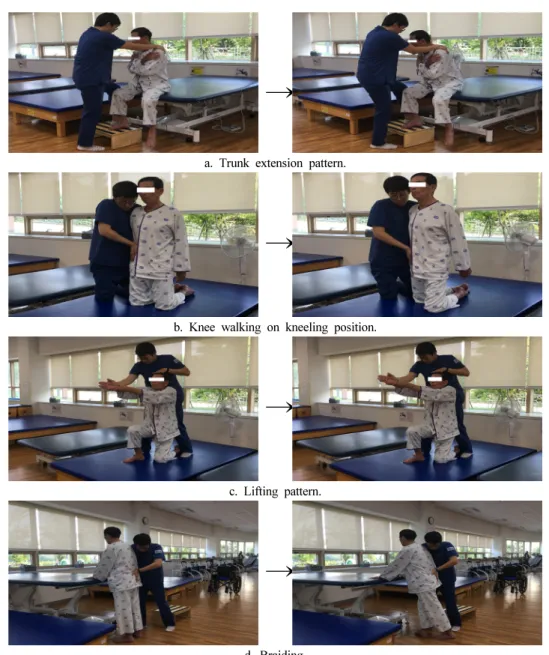
본 연구의 중재는 일반적으로 병원에서 시행되는 물 리치료, 작업치료와 함께 체중지지 자세에서 PNF 패턴 치료를 추가하여 적용하였다. PNF 패턴 치료는 앉은 자세, 무릎 선 자세, 반무릎 선 자세, 선 자세 등 총 4가지 의 체중지지 자세에서의 단계적으로 적용되었다. 각 자 세에서의 패턴 치료는 5회 한 세트로 하여 총 3세트 시행되었다. 세트 간 1분 휴식을 취하였다. 각 자세에서 담당 치료사의 저항과 가이드에 따라 패턴 치료의 난이 도를 높여 나갔다. 총 중재시간은 약 30분 소요되었고, 자세한 중재의 방법은 Fig. 1에 설명되었다.

1) 몸통 폄 패턴(trunk extension pattern)

• 시작 자세 : 팔걸이가 없는 의자에 앉은 자세

(sitting position)

• 적용 방법 : 환측 하지의 보다 많은 체중지지에 대한 감각 입력을 위해 환측 하지에 발판을 제공 하여 건측 하지는 지지를 할 수 없도록 높낮이 조절을 한 후 환측 반대방향으로 몸통 폄 패턴 (trunk extension pattern)을 적용함(Fig 1a).

• 반복 횟수: 5회 반복, 3세트 시행 (각 세트 간 1분 휴식)

2) 무릎 걷기(knee walking on kneeling position)

• 시작 자세 : 무릎 선 자세(kneeling position).

• 적용 방법 : 환측 다리의 장골능(iliac crest)에 손을 올리고 무릎 방향으로 압축(approximation)을 적용, 고정시킨 후 건측 다리의 무릎걷기(앞, 뒤)를 적용 함(Fig. 1b).

• 반복 횟수 : 5회 반복, 3세트 시행 (각 세트 간 1 분 휴식)

3) 들어올리기 (lifting pattern)

• 시작 자세 : 반 무릎 선 자세(half kneeling position)

• 적용 방법 : 건측 하지의 엉덩관절 굴곡 하여 반 무릎 서기 자세(half kneeling position)를 만든 후 환측 하지 방향으로 Lifting pattern을 사용하여 환 측 하지의 체중지지에 대한 감각 입력을 제공함.

환자의 LOM 으로 인해 움직임 가능 범위 내 시행 함(Fig. 1c).

• 반복 횟수 : 5회 반복, 3세트 시행 (각 세트 간 1 분 휴식)

4) 다리 꼬우기 (braiding)

• 시작 자세 : 양 손 지지를 한 선 자세 (standing position with two hands support)

• 적용 방법 : 환측 하지는 지면을 지지 한 후 건측

하지에 다리 꼬기를 시행. 이때 환측 하지의 체중

(5)

a. Trunk extension pattern.

b. Knee walking on kneeling position.

c. Lifting pattern.

d. Braiding.

Fig. 1. Treatment methods.

지지 경험을 촉진하고, 운동 시 안정성을 증진하 기 위해 장골능(iliac crest)에 손을 올리고 환측 지 면 방향으로 압축(approximation)을 적용함. 환자 의 수행 정도에 따라 양 손 지지를 한 손 지지로 변경(Fig. 1d).

• 반복 횟수 : 5회 반복, 3세트 시행(각 세트 간 1분 휴식)

5. 자료 분석

기초선 과정과 중재 과정 및 추적관찰 과정 동안에

수집된 LOS와 10MWT 측정값은 그래프를 사용한 시

각적 분석을 통해 비교되었다. 측정된 데이터의 임상

적 유의성 분석을 위해 2배 표준편차 방법(2-standard

deviation–band method, 2SD)을 사용하였다. 중재 전과

(6)

Base line Follow-up

LOS ( ) 626 2482.13

10MWT ( ) 0.64 0.75

BBS (score) 18 36

ABC (score) 460 720

Table 2. Results of the LOS, 10MWT, BBS and ABC

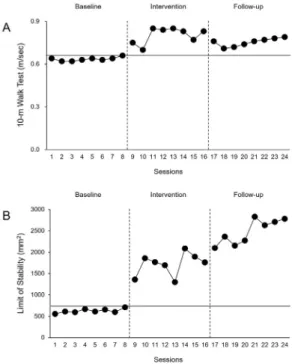
Fig. 2. Comparison of the 10-m walk test (A) and limit of stability (B) values across the baseline, intervention, and follow-up phases. Horizontal line implies thee upper limit of 2SD band of data in the baseline phase.

후의 BBS와 ABC 척도 측정값은 표로 제시하였다.

Ⅲ. 연구 결과

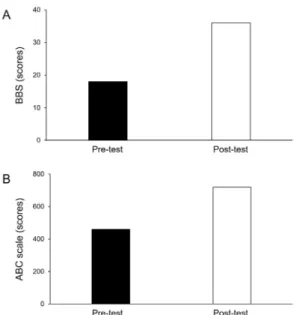
Fig. 2 는 기초선 과정, 중재 과정, 추적관찰 과정에서 의 10MWT와 LOS의 측정값을 설명하는 것이며, Fig.

3는 중재 과정 전과 후의 BBS 및 ABC 척도의 점수를 보여주는 것이다. 중재 결과 LOS는 8회의 초기 측정 평균값 626㎟에서 중재 후 8회 측정 평균값인 2482.13

㎟로 296.51% 향상 된 것을 확인 할 수 있었다. 또한 10MWT는 8회의 초기 측정 평균값 0.64㎧에서 중재 후 8회 측정 평균값인 0.75㎧로 18.70% 향상되었으며, 중재기간에는 지역사회 보행이 가능한 수치인 0.85㎧

를 기록하기도 하였다. 중재 전과 후 한번 씩 기록 된 BBS점수와 ABC 점수도 향상을 보였다. BBS는 100% 향상 된 수치인 18점에서 36점, ABC는 56.52%

향상 된 수치인 460점에서 720점으로 향상이 되었다 (Table. 2). 2SD 방법을 통한 분석에서 LOS와 10MWT 의 측정값은 기초선 과정에 비해 임상적으로 유의한 향상이 있는 것으로 나타났다.

Ⅳ. 고 찰

본 연구는 단계적인 신체 무게 중심 위치를 상승시 킨 체중지지 자세에서 PNF 치료를 적용하는 것이 아 급성기 뇌졸중 환자의 균형 및 보행 기능을 향상시키 는데 도움이 되는 것으로 나타났다.

대부분의 뇌졸중 환자는 비정상적인 근육의 활성, 감각장애 등의 이유 때문에 선 자세에서 환측에 비하여

건측으로 체중을 더 지지하는 특징을 보인다(Bohannon

& Diane, 1991). 대부분의 뇌졸중 환자는 환측을 보상 하여 건측의 보다 많은 체중 부하를 통해 일상생활을 수행할 수 있다(Lamontagne et al., 2005). 그러나 체중 지지의 비대칭성은 건측 하지의 근골격계 손상, 동적

⋅정적 균형 능력 저하, 보행 기능 저하 등을 초래할 수 있는 매우 중요한 증상이기 때문에, 뇌졸중 환자의 여러 기능 향상 프로그램 중 매우 중요한 부분을 차지 한다(Alexander et al., 2009). 이러한 이유로 많은 치료 사들이 환측의 체중 지지 능력을 향상시킴으로서, 균 형 및 보행 기능을 향상시키기 위해 노력하고 있다.

패턴 치료와 같은 PNF 접근법에서는 뇌졸중 후 발

생하는 기능적 제한점을 개선하도록 신체적 수준에

맞는 자세를 사용하는 것을 권장한다. 이를 통해 보다

강한 감각자극을 줌으로써 대뇌 피질수준에서 운동

신경이 동원되는 수를 증가시키며, 관절가동범위와

근력 및 균형 반응이 향상된다(Westwater-Wood et al.,

(7)

Fig. 3. Comparison of the values assessed before and after the intervention phase. (A) Berg balance scale and (B) activity-specific balance confidence scale.

2010). 선행 연구들은 뇌졸중 환자들의 보행 기능에 대한 PNF 접근법의 효과를 지지하고 있다(Akosile et al., 2012; Ribeiro et al., 2013). 본 연구에서는 하지의 체중지지 경험을 위해 다양한 방법으로 PNF 개념을 구현한 PNF 패턴 치료를 적용하였다. 특히, 본 연구에 서는 체간의 안정성을 증가시키며 신체 중심의 높이 의 변화를 주는 동작들이 모두 포함되었다. Miyaka 등(2014)은 체간 훈련이 균형 및 보행 기능을 향상시킬 수 있다고 보고하였는데, 이는 PNF 패턴 치료를 적용 하였던 본 연구의 결과와 유사한 것이었다. Chung 등 (2012) 은 체간 조절 능력은 균형 기능을 증진시키는데 반드시 필요한 요소라고 제시하였다.

본 연구에서 사용된 PNF 패턴 치료는 환자가 쉬운 자세부터 움직임을 시행하는 긍정적인 접근법이며 (positive approach), 전인적 측면(whole person)을 고려 하여 환자가 할 수 있는 움직임부터 보행에 대한 경험 을 제공하는 중재이다. 그 결과, 보행자신감, 보행속 도, 균형능력 등이 모두 향상된 것으로 나타났다. 이러 한 결과는 환자의 근력이나 협응력이 최상인 점에서

운동을 시작하고 운동의 능동적인 조절이 가능한 지 점에서 운동을 시작하며 중력의 영향을 바꾸기 위해 다양하게 환자의 자세를 변화시키며 패턴을 변화시키 는 단계적인 PNF 적용이 뇌졸중 환자에게 긍정적인 역할을 한다는 것을 의미한다(Alder et al., 2008). 본 연구에서처럼, 쉬운 자세에서의 움직임과 중력을 적 게 받는 자세에서의 연습은 환자가 중력을 보다 많이 받는 자세에서의 영향력을 미쳤고, 이는 중재 적용 시 고려되어야 할 것이다.

본 연구의 결과가 아급성기 뇌졸중의 균형과 보행 기능에 도움이 되는 것으로 나타났지만, 본 연구는 결과를 해석하는데 있어서 몇 가지 제한점을 가지고 있다. 첫째, 본 연구가 단일 대상자로 진행하였기 때문 에 본 연구의 결과를 전체 뇌졸중 환자들에게 일반화 시키는 것에 제한이 있다. 둘째, 본 연구의 결과는 본 연구에서 사용된 중재의 장기 효과로 이해되어서는 안 된다. 마지막으로, 본 연구가 보행 분석 변수를 포함 시키지 않았으므로, 본 연구의 결과는 보행 변수의 결과로 이해될 수 없다. 향후에 이와 관련된 연구가 지속적으로 이어져야 할 것이다.

Ⅴ. 결 론

뇌졸중 환자는 자세조절을 스스로 원활하게 수행

하기 어렵고 체중지지 증감에 대한 수행과 보행을 원

활하게 수행할 수 없다. 본 연구는 단계적으로 신체의

무게 중심 위치를 상승시킨 체중지지 자세에서 적용

된 PNF 개념이 아급성기 뇌졸중 환자의 균형과 보행

기능에 어떠한 영향을 미치는지 알아보기 위하여 시

행되었다. 본 연구의 결과는 단계적으로 적용된 PNF

패턴 치료가 편마비 환자의 보행과 낙상에 대한 두려

움 및 균형 능력을 회복하는데 도움이 되는 것으로

나타났다. 향후에는 임상에서 뇌졸중 환자들의 기능

적 수행을 높이고 보행 능력을 향상시킬 수 있도록

보다 체계적인 PNF 치료 프로토콜을 구성하는 연구들

이 지속적으로 이어져야 할 것이다.

(8)

References

Adler S, Beckers D, Buck M. PNF in Practice, 3rd ed. Heidelberg.

Springer-Verlag. 2008.

Alexander LD, Black SE, Patterson KK, et al. Association between gait asymmetry and brain lesion location in stroke patients. Stroke. 2009;40(2):537-544.

Akosile CO, Adegoke BAO, Johnson OE, et al. Effects of proprioceptive neuromuscular facilitation technique on the functional ambulation of stroke survivors.

Journal of Nigeria Society of Physiotherapy. 2012;

18(1-2):22-27.

Berg KO, Maki BE, Williams JI, et al. Clinical and laboratory measures of postural balance in an elderly population.

Archives of physical medicine and rehabilitation.

1992;73(11):1073-1080.

Berg KO, Wood-Dauphinee SL, Williams JI. The balance scale:

reliability assessment with elderly residentand patients with an acute stroke. Scandinavian Journal of Rehabilitation Medicine. 1995;27(1):27-36.

Blum L, Korner-Bitensky N. Usefulness of the Berg balance scale in stroke rehabilitation: a systematic review.

Physical Therapy. 2008;88(5):559-566.

Bohannon RW, Diane TW. Accuracy of weight bearing estimation by stroke versus healthy subjects.

Perceptual and Motor Skills. 1991;72(3):935-941.

Choi YK, Nam CW, Lee JH, et al. The effects of taping prior to PNF treatment on lower extremity proprioception of hemiplegic patients. Journal of Physical Therapy Science. 2013;25(9):1119-1122.

Chung EJ, Lee JS, Kim SS, et al. The relationships among trunk control ability, dynamic balance and gait in stroke patients. Journal of Korean Oriental Medicine.

2012;33(1):148-159.

De Luca A, Vernetti H, Capra C, et al. Recovery and compensation after robotic assisted gait training in chronic stroke survivors. Disability and rehabilitation.

Assistive technology. 2018;1-13.

Green J, Forster A, Young J. Reliability of gait speed measured by a timed walking test in patients one year after stroke. Clinical Rehabilitation. 2002;16(3):306-314.

Kim SJ. Validity and reliability of the Korean version of activities-specific balance confidence scale in individuals with stroke. Yonsei University. Dissertation of Doctorate Degree. 2012.

Klein DA, Stone WJ, Phillips WT, et al. PNF training and physical function in assisted-living older adults.

Journal of aging and physical activity. 2002;10(4):

476-488.

Kleim JA, Jones TA. Principles of experience-dependent neural plasticity:implications for rehabilitation after brain damage. Journal of Speech, Language and Hearing Research. 2008;51(1):S225-239.

Marques AP, Mendes YC, Taddei U, et al. Brazilian-Portuguese translation and cross cultural adaptation of the activities-specific balance confidence (ABC) scale.

Brazilian Journal of Physical Therapy. 2013;17(2);

170-178.

Morice A, Smithies T. Two-, six-, and 12-minute walking test in respiratory disease. British Medical Journal.

1982;285(6337):295.

Lamontagne A, De Serres SJ, Fung J, et al. Stroke affects the coordination and stabilization of head, thorax and pelvis during voluntary horizontal head motions performed in walking. Clinical Neurophysiology.

2005;116(1):101-111.

Liu YC, Yang YR, Tsai YA, et al. Cognitive and motor dual task gait training improve dual task gait performance after stroke - a randomized controlled pilot trial.

Scientific Reports. 2017;7(1):4070.

Lee DK, An DH, Yoo WG, et al. The effect of isolating

the paretic limb on weight-bearing distribution and

EMG activity during squats in hemiplegic and healthy

individuals. Top Stroke Rehabilitation. 2017;24(4):

(9)

223-227.

Miyake Y, Nakamura S, Nakajima M. The effect of trunk coordination exercise on dynamic postural control using a core noodle. Journal of Bodywork and Movement Therapies. 2014;18(4):519-25.

Naidu A, Brown D, Roth E. A challenge-based approach to body weight-supported treadmill training poststroke:

protocol for a randomized controlled trial. JMIR Research Protocols. 2018;7(5):e118.

Oh DK. Effects of elastic band exercise using PNF and CNS-stimulating exercise on functional fitness and EMG in hemiplegic stroke patients. Kyung Hee University. Dissertation of Master's Degree. 2011 Song GB, Park EC. The effects of balance training on balance

pad and sand on balance and gait ability in stroke patients. Journal of the Korean Society of Physical Medicine. 2016;11(1):45-52.

Perry J, Garrett M, Gronley JK, et al. Classification of walking handicap in the stroke population. Stroke. 1995;26(6):

982-989.

Powell LE, Myers AM. The activities-specific balance

confidence (ABC) scale. The journals of gerontology.

Series A, Biological Sciences and Medical Sciences.

1995;50(1):28-34.

Ribeiro T, Britto H, Oliveira D, et al. Effects of treadmill training with partial body weight support and the proprioceptive neuromuscular facilitation method on hemiparetic gait: a randomized controlled study.

European Journal of Physical and Rehabilitation Medicine. 2013;49(4):451-461.

Wang RY. Effect of proprioceptive neuromuscular facilitation on the gait of patients with hemiplegia of long and short duration. Physical Therapy. 1994;74(12):

1108-1115.

Westwater-Wood S, Adams N, Kerry R. The use of proprioceptive neuromuscular facilitation in physiotherapy practice. Physical Therapy Reviews.

2010;15(1):23–28.

Yang YR, Wang RY, Lin KH, et al. Task-oriented progressive resistance strength training improves muscle strength and functional performance in individuals with stroke.

Clinical Rehabilitation. 2006;20(10):860-870.

수치

Table 1. The characteristics of the stroke patient
Fig. 1. Treatment methods.
Table 2. Results of the LOS, 10MWT, BBS and ABC
Fig. 3. Comparison of the values assessed before and  after the intervention phase. (A) Berg balance  scale and (B) activity-specific balance confidence scale.

참조

관련 문서

The aim of this study was to provide a optimal drug therapy which secures effectiveness and safeness in elderly patients by analyzing polypharmacy and the

The purpose of this study was to investigate the effects of a disability awareness program on improving the attitudes of regular elementary school

A Study on the Development of Ship’s Ballast Water A Study on the Development of Ship’s Ballast Water A Study on the Development of Ship’s Ballast Water A Study on the

The purpose of this study is to examine the effects of flow experience through the dance sports media, a dance sports image, and identification on

The purpose of this study was to examine the parents' perceptions on the current status, effects and satisfaction of personal assistant service for students

The purpose of this study was to examine the effects of football on PAPS in sports club activity for 12 weeks in middle school boys.. The following

The purpose of this study was to analyse effect of primer solution on degree of conversion two-step self-etch adhesive with a Fourier transform infrared

In this study, two experiments were conducted to understand the effects of additional charge on the detailed growth mechanism of Alq 3 and to determine the effect of