200
http://www.ecevr.org/CLINICAL
EXPERIMENTAL VACCINE
RESEARCH
Guideline
Infectious diseases are one of the burdens in the beef and dairy production. Therefore, vaccination has been considered as an important component of control and prevent infectious diseases. To maximize the vaccine effects, other factors such as good nutri- tion, adequate ventilation, effective sanitation, and other herd management proce- dures should be properly worked because vaccines help the prevention of infectious diseases. Although several vaccines have been developed and applied to both beef and dairy industries, vaccination programs are variable depending on farm situation without the standardized program.
About 3.5 million of cattle in both beef and dairy cattle are raising in Korea which is indicating the current situation of cattle industry in Korea. Number of cattle was in- creased during the last decade, especially Korean native cattle, Hanwoo. Increase in the number of animals is closely related with the increase of outbreak in infectious diseases. Therefore, several vaccines for cattle have been developed and used in cattle industry. However, vaccination programs are different depending on the situation of countries, regions, farms and farmer’s attitude.
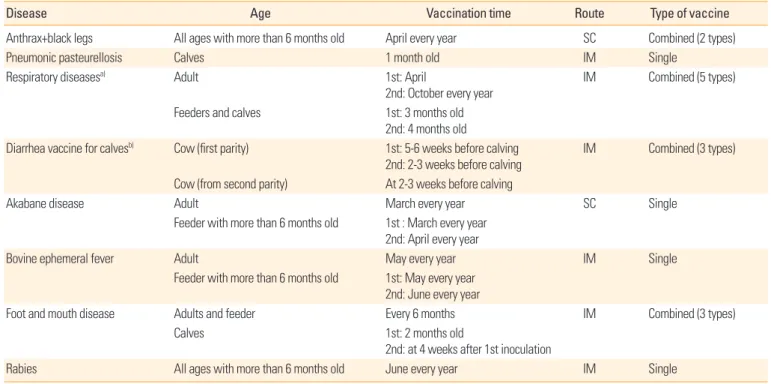
Therefore, vaccination program should be developed in cooperation with the field veterinarian based on individual herd circumstances, including disease history, man- agement, housing, feeding practices, breeding, etc. However, it is not easy to develop the vaccination program with field veterinarians in Korea. Therefore, we would like to suggest generalized vaccination guidelines in our country (Tables 1, 2). But, these guide- lines are adjustable to each farm depending on the current situation of each farm in management and immunological status.
ORCID
Yong Il Cho http://orcid.org/0000-0001-7756-3416 Il-Sun Ryu http://orcid.org/0000-0002-4226-5635 Han Sang Yoo http://orcid.org/0000-0003-0548-0835
© Korean Vaccine Society.
This is an Open Access article distributed under the terms of the Creative Commons Attribution Non-Com- mercial License (http://creativecommons.org/licenses/
by-nc/3.0) which permits unrestricted non-commercial use, distribution, and reproduction in any medium, pro- vided the original work is properly cited.
K O R E A N V A C C I N E S O C I E T Y
K O R E A N V A C C I N E S O C I E T Y
K O R E A NA C C I N E O C I E T Y V
S
Clin Exp Vaccine Res 2015;4:200-201 http://dx.doi.org/10.7774/cevr.2015.4.2.200 pISSN 2287-3651 • eISSN 2287-366X
Yong Il Cho
1, Il-Sun Ryu
2, Han Sang Yoo
3,41Department of Animal Resources Development, National Institute of Animal Science, Rural Development Administration, Cheonan;
2Asia Animal Medicine Institute, Hwaseong;
3Department of Infectious Diseases, College of Veterinary Medicine, Seoul National University, Seoul; 4Institute of Green Bio Science and Technology, Seoul National University, Pyeongchang-gun, Gangwon-do, Korea Received: June 10, 2015
Revised: June 20, 2015 Accepted: June 25, 2015
Corresponding author: Han Sang Yoo, DVM, PhD Department of Infectious Diseases, College of Veterinary Medicine, Seoul National University, 1 Gwanak-ro, Gwanak-gu, Seoul 151-742, Korea Tel: +82-2-880-1263, Fax: +82-2-874-2738 E-mail: [email protected]
No potential conflict of interest relevant to this article was reported.
This study was supported by the Rural Develop- ment Administration (PJ00897001), BK21 PLUS and the Research Institute for Veterinary Science, Seoul National University, South Korea.
There is no published vaccination guideline to cattle even though each vaccine company sug- gested the program based on their products. Also, most of veterinary vaccines are multivalent.
Therefore, it is very difficult to standardize the program. Now, we are suggesting the general vaccine programs based current situations in cattle industry in Korea.
Keywords: Vaccination, Cattle, Korea
Suggested guidelines for
vaccination of cattle in Korea
Yong Il Cho et al • Suggested guidelines for vaccination of cattle in Korea
http://www.ecevr.org/
201
http://dx.doi.org/10.7774/cevr.2015.4.2.200
Table 1. Suggested vaccine programs for diary cattle
Disease Age Vaccination time Route Type of vaccine
Anthrax+black legs All ages with more than 6 months old April every year SC Combined (2 types)
Respiratory diseasesa) Adult 1st: April every year
2nd: October every year IM Combined (5 types)
Feeders and calves 1st: 3 months old
2nd: 4 months old
Diarrhea vaccine for calvesb) Cow (first parity) 1st: 5-6 weeks before calving
2nd: 2-3 weeks before calving IM Combined (3 types) Cow (from second parity) At 2-3 weeks before calving
Akabane disease Adult March every year SC Single
Feeder with more than 6 months old 1st: March every year 2nd: April every year
Bovine ephemeral fever Adult May every year IM Single
Feeder with more than 6 months old 1st: May every year 2nd: June every year
Foot and mouth disease Adults and feeder Every 6 months IM Combined (3 types)
Calves 1st: 2 months old
2nd: at 4 weeks after 1st inoculation
Rabies All ages with 6 months old June every year IM Single
SC, subcutaneous; IM, intramuscular.
a)The combined vaccine contains infectious bovine rhinotracheitis virus, bovine viral diarrhea virus, parainfluenza type-3 virus, bovine respiratory syncytial virus, and Histo
philus somni.
b)The combined vaccine contains bovine rotavirus, bovine coronavirus and Escherichia coli + pilus antigens (K99, F41).
Table 2. Suggested vaccine programs for Korean native cattle (Hanwoo)
Disease Age Vaccination time Route Type of vaccine
Anthrax+black legs All ages with more than 6 months old April every year SC Combined (2 types)
Pneumonic pasteurellosis Calves 1 month old IM Single
Respiratory diseasesa) Adult 1st: April
2nd: October every year IM Combined (5 types)
Feeders and calves 1st: 3 months old
2nd: 4 months old
Diarrhea vaccine for calvesb) Cow (first parity) 1st: 5-6 weeks before calving 2nd: 2-3 weeks before calving
IM Combined (3 types) Cow (from second parity) At 2-3 weeks before calving
Akabane disease Adult March every year SC Single
Feeder with more than 6 months old 1st : March every year 2nd: April every year
Bovine ephemeral fever Adult May every year IM Single
Feeder with more than 6 months old 1st: May every year 2nd: June every year
Foot and mouth disease Adults and feeder Every 6 months IM Combined (3 types)
Calves 1st: 2 months old
2nd: at 4 weeks after 1st inoculation
Rabies All ages with more than 6 months old June every year IM Single
SC, subcutaneous; IM, intramuscular.
a)The combined vaccine contains infectious bovine rhinotracheitis virus, bovine viral diarrhea virus, parainfluenza type-3 virus, bovine respiratory syncytial virus, and Histophilus somni.
b)The combined vaccine contains bovine rotavirus, bovine coronavirus and Escherichia coli + pilus antigens (K99, F41).