60
C A S E REPO RT
pISSN: 2384-3799 eISSN: 2466-1899 Int J Thyroidol 2020 May 13(1): 60-63 https://doi.org/10.11106/ijt.2020.13.1.60
Received April 28, 2020 / Revised May 16, 2020 / Accepted May 18, 2020
Correspondence: Anna See, MD, Department of Otorhinolaryngology Head & Neck Surgery, Singapore General Hospital, Outram Road, Singapore 169608
Tel: 65-6222-3222, Fax: 65-6224-9221, E-mail: [email protected]
Copyright ⓒ the Korean Thyroid Association. All rights reserved.
This is an open-access article distributed under the terms of the Creative Commons Attribution Non-Commercial License (http://creative- commons.org/licenses/by-nc/4.0/), which permits unrestricted non-commercial use, distribution, and reproduction in any medium, provided the original work is properly cited.
Successful Treatment of Cavernous Sinus
Metastasis from Follicular Thyroid Carcinoma with Lenvatinib
Tee Sin Lee
1, Anna See
2, Caleb Lim
3and Xin Yong Huang
1Department of Otorhinolaryngology Head & Neck Surgery, Changi General Hospital1, Department of Otorhinolaryngology Head & Neck Surgery, Singapore General Hospital2, MOH Holdings3, Singapore
Radioiodine-refractory distant metastases in well-differentiated thyroid carcinomas are rare but pose a significant diagnostic and management challenge. Follicular thyroid carcinoma which is a type of well-differentiated carcinoma, is known for its hematogenous spread. Various sites of distant metastasis have been described. We report the first-ever case of radioiodine-refractory metastasis at the cavernous sinus, arising from follicular thyroid carcinoma. The atypical site of metastasis and management complexity of radioiodine-refractory disease is discussed in this article.
Key Words: Follicular thyroid carcinoma, Metastases, Lenvatinib, Cavernous sinus
Introduction
Well-differentiated thyroid carcinoma is regarded as a highly curable cancer, associated with a 10-year survival rate ranging from 80 to 95%.1) However, sur- vival rates decrease by up to 50% if distant metastatic disease is present.2) Distant metastases of differ- entiated thyroid carcinomas (papillary and follicular) can be found either at the time of diagnosis or after thyroidectomy, often through the use of radio- iodine-uptake scans. Non-radioiodine avid distant metastases are rare and post a significant diagnostic and therapeutic challenge to clinicians. Loss of radio- iodine avidity occurs when dedifferentiation occurs and is associated with a poorer outcome.3) We de- scribe an extremely rare case of radioiodine-refractory cavernous sinus metastasis from follicular thyroid car- cinoma which was successfully treated with the ty-
rosine kinase inhibitor Lenvatinib. We explore in detail the complexity of this case which is contributed by i) an atypical site of metastasis and ii) the challenge of a managing a non-radioiodine avid metastasis.
Case Report
A 67-year-old male patient presented with a 7 cm thyroid nodule showing “follicular neoplasm”
(Bethesda IV) on fine needle aspiration cytology. He underwent total thyroidectomy and histology returned as oncocytic variant of follicular thyroid carcinoma, with more than 10 foci of angoinvasion. He received standard adjuvant radioiodine ablation therapy with 106.3 mCi of Iodine-131 (I-131). Concomitant whole-body radioiodine survey revealed no abnormal focal uptake of I-131 elsewhere.
Normal serum thyroglobulin antibody (TgAb) and undetectable thyroglobulin (Tg) levels were recorded
Tee Sin Lee, et al
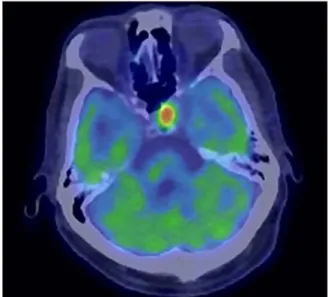
www.ijthyroid.org 61 Fig. 1. (A) PET-CT showing an intensely FDG-avid lesion in the left cavernous sinus extending into the left sphenoid sinus, and the axial (B) and coronal (C) cuts of CT paranasal sinuses showing a soft tissue lesion in left cavernous sinus and bilateral sphenoid sinuses with bony erosion.
after surgery and surveyed every 6 months. He was commenced on high-dose oral levothyroxine for hor- mone replacement and thyroid-stimulating hormone (TSH) suppression. However, on regular surveillance, rising serum Tg values were noted. At 6th month post-surgery, serum Tg was 79 micrograms/liter. At the end of 12 months, serum Tg had risen to 698 mi- crograms/liter (normal, 2.0-70.0). A repeat dose of 30 mCi I-131 was administered under levothyroxine withdrawal which showed no evidence of radio- iodine-avid disease. In view of the rising Tg with neg- ative radioiodine scan, he was investigated with full-body positron emission tomography (PET) scan, administered under 8.6 mCi of F-18 fluorodeox- yglucose (FDG), which showed intensely FDG-avid bi- lateral thyroid beds lesions and multiple metastases at the left scapula, thoracic vertebrae and right sacrum.
In addition, intensely FDG-avid soft tissue lesions in the left cavernous sinus and bilateral sphenoid sinuses were noted (Fig. 1).
Notwithstanding the earlier performed PET scan, a dedicated computed tomography scan of paranasal si- nuses with contrast was undertaken, showing a 2.1 cm irregular mass the left cavernous sinus, abutting the left cavernous internal carotid artery (Fig. 1).
Discussion at multidisciplinary tumor board recom- mended biopsy via the transsphenoidal approach.
Histology returned as metastatic oncocytic follicular thyroid carcinoma, negative for BRAF V600E mutation.
A repeat serum Tg level was markedly elevated at 3112 micrograms/liter. Two weeks later, he developed
acute binocular diplopia, left retroorbital pain and proptosis. Ophthalmological examination showed left third and fourth cranial nerve palsies but negative rela- tive afferent pupillary defect. Left cranial nerves VI, V and II were intact. A diagnosis of left cavernous sinus syndrome was made. Repeat multidisciplinary tumor board recommended urgent palliative radiotherapy and tyrosine kinase inhibitor (TKI) treatment with Lenvatinib.
However, the patient was unable to tolerate radio- therapy and developed vomiting, headache and synco- pal episodes. Neurosurgical intervention was dis- cussed and deemed inappropriate as it conferred a high risk of blindness and cerebrospinal fluid leak. He was then placed on Lenvatinib therapy (14 micrograms once daily) and tolerated the treatment well with no gastrointestinal, cardiovascular, renal or dermatological side effects.
At the end of four weeks, the patient’s left eye def- icits had resolved completely with a corresponding re- markable radiological response on PET scan (Fig. 2).
His osseous metastatic lesions did not show sig- nificant resolution. The serum Tg level was 422 micro- grams/liter. At three years post-treatment, he re- mains visually asymptomatic and is gainfully employed as a private hire car driver.
Discussion
Metastases to the cavernous sinus are rare but have been described in solid carcinomas of the lung, colon, and liver.4,5) Head and neck cancers have also been
Cavernous Sinus Metastasis from FTC
62 Int J Thyroidol, Vol. 13, No. 1, 2020
Fig. 2. Interval PET-CT after treatment with four weeks of Lenvatinib, showing significant reduction in size and FDG-avidity of metastasis.
reported to metastasize to the cavernous sinus.6) Follicular thyroid carcinoma is a form of differentiated thyroid carcinoma with a known propensity for hema- togenous spread and the most common sites of dis- tant metastasis are pulmonary followed by osseous.
When they occur in these sites, distant metastases are usually slow-growing and do not cause much symptoms. Consequently, watchful waiting is fre- quently adopted.
An extensive review of the English Literature on PubMed revealed that this is the first-ever reported case of follicular thyroid carcinoma with metastasis to the cavernous sinus and sphenoid sinus. An atypical location of metastasis to the cavernous sinus with de- bilitating functional deficits, coupled with radioiodine non-avidity, augmented the complexity of this case.
In the surveillance of thyroid carcinoma patients post-thyroidectomy, a combination of clinical exami- nation, biochemistry and imaging are used. A rising serum Tg trend with no evidence of uptake on radio- iodine scans should raise the suspicion of radio- iodine-refractory disease. These are rare and the 10-year survival rate is 10% from the time of de- tection of metastasis.7)
The advent of immunotherapy which targets vas- cular endothelial growth receptor (VEGFR) has ex- panded the therapeutic armamentarium for radio-
iodine-refractory disease. Multitargeted TKIs have been investigated. In 2014, Sorafenib, a TKI that in- hibits VEGFRs 1, 2, and 3, PDGFR β, Raf-1, RET, and BRAF, was approved by the U.S. Food and Drug Administration (FDA) for the treatment of radio- iodine-refractory thyroid cancer based on results of a phase III trial showing a five-month improvement in median progression-free survival.8)
Similar to Sorafenib, Lenvatinib acts on VEGFRs 1 through 3, FGFRs 1 through 4, PDGFR α, RET, and KIT signaling networks.9) A phase III trial (SELECT) was conducted to assess progression-free survival in pa- tients with radioiodine-refractory thyroid cancer who received Lenvatinib versus those who received placebo.10) Results showed that Lenvatinib was asso- ciated with significant improvement in the response rate (64.8% in the Lenvatinib group vs. 1.5% in the placebo group; odds ratio, 28.87; 95% CI, 12.46 to 66.86; p<0.001). However, the authors also observed a significant number of side effects including diarrhea, hypertension, proteinuria and decreased appetite.10) Our patient did not report these.
In conclusion, radioiodine-refractory disease should be promptly suspected in patients with rising serum Tg levels but negative radioiodine scans. While distant metastases in follicular thyroid carcinoma are usually regarded as slow-growing, atypical sites of meta- stases such as the cavernous sinus will require ag- gressive exploration of all available treatment modalities. Multitarget TKIs may prove to be a useful therapy for selected patients.
Conflicts of Interest
No potential conflict of interest relevant to this ar- ticle was reported.
Orcid
Anna See: https://orcid.org/0000-0003-2126-4665
References
1) Gilliland FD, Hunt WC, Morris DM, Key CR. Prognostic
Tee Sin Lee, et al
www.ijthyroid.org 63 factors for thyroid carcinoma. A population-based study of 15,698
cases from the Surveillance, Epidemiology and End Results (SEER) program 1973-1991. Cancer 1997;79(3):564-73.
2) Sampson E, Brierley JD, Le LW, Rotstein L, Tsang RW.
Clinical management and outcome of papillary and follicular (differentiated) thyroid cancer presenting with distant metastasis at diagnosis. Cancer 2007;110(7):1451-6.
3) Riesco-Eizaguirre G, Gutierrez-Martinez P, Garcia-Cabezas MA, Nistal M, Santisteban P. The oncogene BRAF V600E is associated with a high risk of recurrence and less differentiated papillary thyroid carcinoma due to the impairment of Na+/I- targeting to the membrane. Endocr Relat Cancer 2006;13(1):
257-69.
4) Mills RP, Insalaco SJ, Joseph A. Bilateral cavernous sinus metastasis and ophthalmoplegia. Case report. J Neurosurg 1981;
55(3):463-6.
5) Onec B, Oksuzoglu B, Hatipoglu HG, Onec K, Azak A, Zengin N. Cavernous sinus syndrome caused by metastatic colon carcinoma. Clin Colorectal Cancer 2007;6(8):593-6.
6) Zahra M, Tewfik HH, McCabe BF. Metastases to the
cavernous sinus from primary carcinoma of the larynx. J Surg Oncol 1986;31(1):69-70.
7) Durante C, Haddy N, Baudin E, Leboulleux S, Hartl D, Travagli JP, et al. Long-term outcome of 444 patients with distant metastases from papillary and follicular thyroid carcinoma: benefits and limits of radioiodine therapy. J Clin Endocrinol Metab 2006;91(8):2892-9.
8) Brose MS, Nutting CM, Jarzab B, Elisei R, Siena S, Bastholt L, et al. Sorafenib in radioactive iodine-refractory, locally advanced or metastatic differentiated thyroid cancer: a randomised, double-blind, phase 3 trial. Lancet 2014;384(9940):319-28.
9) Matsui J, Yamamoto Y, Funahashi Y, Tsuruoka A, Watanabe T, Wakabayashi T, et al. E7080, a novel inhibitor that targets multiple kinases, has potent antitumor activities against stem cell factor producing human small cell lung cancer H146, based on angiogenesis inhibition. Int J Cancer 2008;122(3):664-71.
10) Schlumberger M, Tahara M, Wirth LJ, Robinson B, Brose MS, Elisei R, et al. Lenvatinib versus placebo in radioiodine- refractory thyroid cancer. N Engl J Med 2015;372(7):621-30.