Advanced POEMS syndrome treated with high-dose melphalan followed by autologous blood stem cell transplantation: a
single-center experience
Il-Young Jang
1#, Dok Hyun Yoon
1,2#, Shin Kim
2, Kyoungmin Lee
2, Kwang-Kuk Kim
3, Young-Min Lim
3, Won-Ki Min
4, Cheolwon Suh
1,21Department of Internal Medicine, 2Department of Oncology, 3Department of Neurology, 4Department of Laboratory Medicine, Asan Medical Center, University of Ulsan College of Medicine, Seoul, Korea
p-ISSN 2287-979X / e-ISSN 2288-0011 http://dx.doi.org/10.5045/br.2014.49.1.42 Blood Res 2014;49:42-8.
Received on November 19, 2013 Revised on January 22, 2014 Accepted on February 19, 2014
#Il-Young Jang and Dok Hyun Yoon contributed equally to this work.
Background
POEMS syndrome is a rare paraneoplastic syndrome associated with plasma cell dyscrasia. High-dose chemotherapy followed by autologous stem cell transplantation has shown encouraging efficacy in the treatment of patients with POEMS syndrome.
However, there are minimal reports on clinical outcomes after autologous stem cell trans- plantation for patients with advanced disease and very poor performance status.
Methods
We retrospectively evaluated 9 advanced POEMS syndrome patients, who had an Eastern Cooperative Oncology Group performance status score of 3 or 4, and were treated with high-dose melphalan therapy followed by autologous stem cell transplantation from 2004 to 2011.
Results
Eight patients achieved initial hematologic response, 4 of whom had complete responses.
At a median follow-up of 44 months (range, 8‒94 months), 7 patients were alive, with 3-year overall survival rate of 77.8%. There were no hematologic relapses in the survivors.
One patient died of disease progression; the other died of pneumonia despite a hemato- logic response 3 months after autologous stem cell transplantation. All survivors achieved improvement in general performance status and in clinical response.
Conclusion
High-dose melphalan followed by autologous stem cell transplantation can be considered a valid treatment option even for patients with advanced POEMS syndrome.
Key Words POEMS syndrome, Stem cell transplantation, Chemotherapy, Severity, Illness index
Correspondence to Cheolwon Suh, M.D., Ph.D.
Department of Oncology, Asan Medical Center, University of Ulsan College of Medicine, 88, Olympic-ro 43-gil, Songpa-gu, Seoul 138-736, Korea Tel: +82-2-3010-3209 Fax: +82-2-3010-6961 E-mail: [email protected]
Ⓒ 2014 Korean Society of Hematology
INTRODUCTION
POEMS syndrome is a rare paraneoplastic syndrome asso- ciated with an underlying plasma cell disorder [1]. The acro- nym POEMS refers to frequently occurring features of the syndrome: polyneuropathy, organomegaly, endocrinopathy, monoclonal protein, and skin changes [2-4]. Other important clinical features include papilledema, extravascular volume overload, elevated vascular endothelial growth factor (VEGF) levels, pulmonary hypertension, platelet dysfunction, a pre-
disposition towards venous thrombosis, as well as multifocal bone lesions and/or diffuse bone marrow plasma cell infiltra- tion [4]. Neuropathy, such as neuropathic pain or hyper- esthesia, is the most predominant characteristic of POEMS syndrome; it afflicts virtually every POEMS patient and se- verely impairs quality of life [5-9].
The treatment for POEMS syndrome should involve elimi- nation of the plasma cell clone. In the case of localized plasmacytomas, this may be achieved with local therapy;
however, in patients with disseminated disease, systemic treatment is required. Owing to its rarity, there have been
no randomized controlled trials of treatment for POEMS syndrome. Several single-center retrospective studies show that high-dose melphalan therapy followed by autologous stem cell transplantation (ASCT) can be an effective treat- ment for progressive POEMS syndrome. However, very few publications report clinical outcomes in patients with ad- vanced POEMS syndrome and poor performance. Further- more, most previous studies of ASCT for POEMS syndrome have focused mainly on hematologic response and survival.
Hence, the aim of the current study was to summarize our experience using ASCT to treat patients with severe POEMS syndrome, focusing on changes in performance status, neuro- pathy, and hematologic outcome.
MATERIALS AND METHODS
Study subjects
This study was a retrospective evaluation of 9 advanced POEMS syndrome patients, who underwent high-dose mel- phalan therapy followed by ASCT from 2004 to 2011 at Asan Medical Center in Seoul, Korea. All 9 patients fulfilled the criteria for diagnosis of POEMS syndrome proposed by Dispenzieri [5]. The diagnosis requires the presence of both major criteria (polyneuropathy and monoclonal plasma pro- liferative disorder) and at least one minor criterion (bone lesion, Castleman’s disease, organomegaly, edema, endocrin- opathy, skin changes, and papilledema). The institutional review board of Asan Medical Center approved this study (IRB No.2013-0863) and waived the requirement for in- formed consent.
Stem cell collection and transplantation
Peripheral blood stem cells were collected from 8 of the 9 patients after mobilization with cyclophosphamide (4 g/m2) and growth factors [10, 11]. Patient number 4 was excluded because of thrombocytopenia. High-dose melphalan (200 mg/m2) was used as the conditioning regimen. All patients received standard supportive care, including prophylactic antibiotics during ASCT [12].
Response assessment
Hematologic responses were defined according to the International Myeloma Working Group criteria [13]. Evalua- tion of performance and neuropathy were based on detailed medical examinations by neurologists and/or oncologists.
After ASCT, the general performance status of all patients was evaluated and monitored according to the Eastern Cooperative Oncology Group (ECOG) performance status scoring system. The following were used to evaluate clinical response: detailed history and physical examination by oncol- ogists and neurologists, and patient-reported outcomes on activities of daily life. Elaborate chart reviews were con- ducted, including chest x-ray, computed tomography (CT), and echocardiography results, and medications prescribed, particularly for peripheral neuropathy or its symptoms. A nerve conduction velocity test was conducted and repeated
whenever peripheral neuropathy developed or worsened be- fore and after ASCT.
Statistical analysis
Overall survival was defined as the time from transplant to death from any cause and analyzed by the Kaplan-Meier method. All statistics were performed using SPSS version 18.0 (IBM Corp., Armonk, NY, USA) and/or Prism 5.01 (GraphPad Software Inc., San Diego, CA, USA).
RESULTS
Patient characteristics
Demographic and clinical features are summarized in Table 1 and Fig. 1. Median age at diagnosis was 48 years (range, 16–56 years). All 9 patients had polyneuropathy, monoclonal plasma cell disorder and organomegaly; 8 of them showed endocrinopathy (abnormality of pituitary, adrenal, thyroid, or gonadal function) and skin changes; none had Castleman’s disease. Extravascular volume overload (e.g., peripheral edema, pleural effusion, or pericardial effusion) was found in 7 patients. As shown in Table 2, 4 patients had a history of prior chemotherapy with vincristine, adria- mycin, and dexamethasone (VAD) with a median of 3 cycles (range, 1–4 cycles). Of the 4, 2 had a very good partial response to chemotherapy, and 2 had stable disease; however, pre-ASCT chemotherapy was discontinued in all 4 patients because of neurotoxicity. The 5 patients with newly diag- nosed POEMS syndrome underwent high-dose melphalan chemotherapy followed by ASCT as first-line treatment without prior chemotherapy.
Hematologic response after ASCT
Initial hematologic responses were observed in all 9 pa- tients around 3 months after ASCT, including 3 complete responses (CR) and 1 stringent CR (sCR). Two patients with an initial CR achieved a sCR at 3 months post-ASCT and 9 months post-ASCT (patient numbers 8 and 1, respectively).
There were no cases of hematologic relapse during the fol- low-up period. All survivors showed more than a partial hematologic response through the last follow-up.
Survival
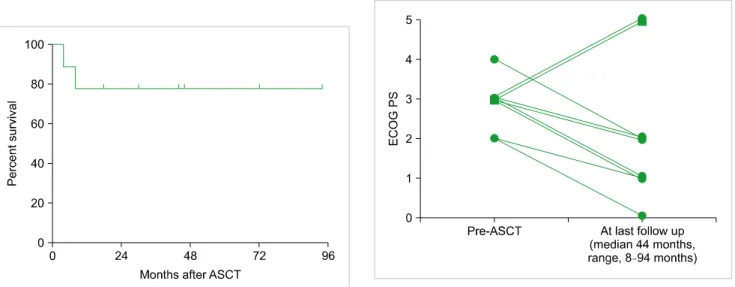
After a median follow-up of 44 months after ASCT (range, 8–94 months), 7 patients were still alive with a 3-year overall survival rate of 77.8% (Fig. 2). One patient died of progressive extravascular overload resulting in intractable pulmonary edema and progressive neuropathy related to POEMS at 8 months after ASCT (patient number 4). Another patient died of pneumonia with respiratory failure despite a hematologic response at 4 months after ASCT (patient number 3) (Table 3).
Details of stem cell collection and transplantation
As shown in Table 2, the median time from symptoms to diagnosis was 10 months (range, 6–43 months), and the
Fig. 1. Clinical features of the 9 patients with POEMS syndrome at diagnosis.
Table 1. Patient characteristics of 9 POEMS patients.
Clinical characteristic Number
(N=9) Median Range
Age at diagnosis 48 16–56
Gender
Male 3
Female 6
Time from symptom to diagnosis 10 6–43 (months)
Previous chemotherapy 4
Neuropathy
Sensory 9
Motor 7
Monoclonal protein
λ 2
IgG-λ 3
IgA-λ 3
IgA-κ, λ 1
M-peak (g/dL) 0.4 0.21–1.50
Serum free light chain ratio 0.73 0.50–1.19 Bone lesion
Osteosclerotic only 1 Mixed sclerotic and lytic 3
Osteolytic only 1
Organomegaly
Lymphadenopathy 8
Splenomegaly 7
Hepatomegaly 8
Extravascular volume overload
Edema 7
Ascites 4
Pleural effusion 5
Endocrinopathy
Adrenal axis abnormality 5
Hypothyroidism 7
Gonadal 3
Hyperprolactinemia 5
Skin changes
Hyperpigmentation 6
Hypertrichosis 7
Thickening 3
Hemangioma 1
Papilledema (N=6) 1
Clubbing 2
Thrombocytosis 3
Systolic pulmonary artery pressure 41 27–49 (mmHg) (N=8)
Table 2. Medical history of each patient before high-dose melphalan followed by ASCT.
Patient
number Age/Gender Time from symptoms
to diagnosis (months) Prior treatment (last hematologic response) Time from diagnosis
to ASCT (months) Follow-up after ASCT (months)
1 36/F 6 VAD C4, Thal/Dex C1 & steroid MP C12 (VGPR)b) 61a) 45
2 16/M 6 VAD C3 (SD)b) 4 94
3 48/F 15 VAD C1 (SD)b) 3 4 (died)
4 47/M 2 VAD C2 (VGPR)b) 3 8 (died)
5 47/F 10 None 2 71
6 49/F 3 None 2 34
7 55/M 13 None 4 30
8 56/F 11 None 2 15
9 49/F 43 None 31 16
a)Delayed for the patient’s financial reasons. b)These patients stopped chemotherapy early due to vincristine-related neuropathy.
Abbreviations: ASCT, Autologous stem cell transplantation; C, cycle; MP, melphalan and prednisolone; SD, stable disease; Thal/Dex, thalidomide and dexamethasone; VAD, vincristine, adriamycin and dexamethasone; VGPR, very good partial response.
median time from diagnosis to ASCT was 3 months (range, 2–61 months). The median number of peripheral blood stem cell mobilizations was 2 (range, 1–5). The median number of CD34-positive hematopoietic stem cells collected was 17.7×10⁶ cells/kg (range, 4.26–66.40×10⁶ cells/kg), and the median number of CD34-positive cells infused was 17.7×10⁶ cells/kg (range, 4.14–48.30×10⁶ cells/kg). The median time for neutrophil recovery to greater than or equal to 500/μL was 10 days (range, 9–13), and median time for platelet recovery to greater than or equal to 50,000/μL was 17 days (range, 13–194). Median duration of hospitalization was 38 days (range, 18–124), and there were no adverse events dur- ing stem cell harvest.
One patient experienced the following complications at day 9 post-ASCT: engraftment syndrome with fever, eryth- rodermatous skin rash on both hands, and mild pulmonary congestion (patient number 8). Patient number 8 recovered within 3 days without corticosteroid treatment. None of
Table 3. Hematologic responses, ECOG performance score, and clinical responses as changes in daily life activities.
Patient number
Hematologic response ECOG PS score
Time from treatment (months): clinical response 3 months
post-ASCT At last
follow-up Pre-ASCT At last follow-up
1 CR sCR 3 2 4: improved skin lesions
5: improved step-walking, decreased requirement for PNP medication 14: resumed work as a hairdresser, but requires pain killer
2 sCR sCR 3 1 3: can walk without assistance
35: student at college of music, playing the marimba
3 PR NA 3 5 4: died of pneumonia with respiratory failure
4 PD NA 3 5 8: progressive neuropathy plus extravascular volume overload;
discharged and not further treated
5 CR VGPR 4 0 2: rapidly recovered from severe peripheral edema without sequelae; no other symptoms
6 VGPR PR 3 1 2: no change in NCV
6: walks without medication or assistance 38: improved state of polyneuropathy
7 VGPR VGPR 3 1 1: decreased ascites and pleural effusion on CT; metabolic lesions disappeared on PET scan; no change in NCV
2: walks without aids; PNP medication stopped; requires hormonal replacement
8 CR sCR 4 2 3: newly developed sensory neuropathy on both upper extremities on
NCV test without patient subjective symptoms
6: can walk with cane; decreased requirement of PNP medication
9 PR PR 3 1 3: can walk without decreased requirement for PNP medication
Abbreviations: ASCT, Autologous stem cell transplantation; CR, complete response; NA, not available; NCV, nerve conduction velocity test; PD, progressive disease; PNP, peripheral neuropathy; PR, partial response; PS, performance status; sCR, stringent complete response; VGPR, very good partial response.
Fig. 2. Kaplan-Meier curve for overall survival. Fig. 3. ECOG performance status at baseline and after ASCT (at last follow-up).
the patients suffered from severe transplantation-related complications (including treatment-related mortality).
Change of performance status and neuropathy
Fig. 3 and Table 3 summarize patient-reported outcomes on activities of daily life as well as the changes in ECOG performance status after ASCT. General performance of all patients at diagnosis was very poor, mainly due to rapidly progressive peripheral neuropathy and extravascular volume overload (peripheral edema, pleural effusion, or ascites).
ECOG performance scores were 3 or 4 in all patients before
ASCT. After ASCT, ECOG performance scores had improved in all survivors to between 0 and 2 at last follow-up. None of the patients showed deterioration of performance status throughout the follow-up period.
A nerve conduction velocity test was performed on 2 patients prior to and after ASCT. One patient (patient number 6) had no change in nerve conduction velocity at 2 months post-ASCT, but showed improvement when tested at 38 months post-ASCT. The other patient (patient number 8)
showed no change in nerve conduction velocity 3 months after ASCT. Although a follow-up nerve conduction velocity test was not performed in patient number 8, the patient needed less medication for neuropathy and could walk with a cane 6 months after ASCT. Daily activity and skin color changes were improved in all patients throughout follow-up.
However, there was some discrepancy between improve- ment in performance or subjective symptoms and changes in peripheral edema or pulmonary edema (Table 3).
DISCUSSION
The efficacy of ASCT in the treatment of advanced POEMS syndrome has been suggested by several studies. In the cur- rent study, 9 patients with very poor performance underwent ASCT and 8 of them achieved a hematologic response, with 4 of the 8 being complete responses.
Since 2001, several case reports and case series have been published showing that ASCT can be an effective treatment for POEMS syndrome. Recently, long-term clinical outcomes have been reported for patients with POEMS syndrome after ASCT [13]. However, few studies have included patients with poor performance status. In one study of 8 patients with POEMS syndrome undergoing ASCT that included just 1 patient with an ECOG performance status >2, the reported overall response rate was 87.5%, with 100% improvement in performance status, and no cases of treatment-related mortality or engraftment syndrome [14]. In another study, only 20% of the 59 patients had an ECOG performance status of 3 [13].
Appropriate patient selection is an important issue regard- ing the risk-benefit ratio associated with ASCT; however, no selection criteria for patients with newly diagnosed POEMS syndrome have been applied thus far. Li and Zhou [15] recently recommended the following exclusion criteria for ASCT: age >65 years, abnormal renal function (serum creatinine >1.326 mg/dL), severe pulmonary hypertension (systolic pulmonary arterial pressure >70 mm Hg), capillary leak syndrome (hypotension and/or refractory ascites), and active infection.
A total of 10 patients have been diagnosed as having POEMS syndrome in our center during the study period.
All patients had very poor performance status (ECOG score 3 or 4) at diagnosis. Among them, 9 patients were treated with ASCT during the study period. Seven of the 9 patients had extravascular volume overload (peripheral edema, as- cites, or pleural effusion) that seemed to be closely associated with peripheral neuropathy. According to the exclusion cri- teria by Li and Zhou [15], 7 patients should not have been treated with ASCT because of their abnormal renal function or capillary leak syndrome. Despite the poor performance status of patients in our study, there was no treatment-related mortality after ASCT, and all survivors showed improvement in performance status and neuropathy.
The reported risk of morbidity and complications asso- ciated with ASCT for POEMS syndrome have changed over
the past decade [15]. In one study, 1 of 30 patients died from treatment-related toxicity, and approximately 50% of patients developed engraftment syndrome. Among those with engraftment syndrome, 10% required temporary dialy- sis, and 17% required intubation [16]. In 2012, a long-term study of ASCT in 59 patients (median follow-up=45 months) reported clinical responses in 92% of patients and 3 deaths [13]. In our study, 2 patients died during follow-up: 1 died of disease progression despite ASCT; the other died of pneu- monia 4 months after ASCT. There was only one case of engraftment syndrome after ASCT. None of the patients suffered from severe transplantation-related complications or treatment-related mortality. Five patients (55.5%) did ex- perience osteosclerotic lesions in this study. If the patients underwent additional positron emission tomography (PET) scans, we might have found more sclerotic lesions.
There is no consensus about optimal dose of melphalan;
however, an ASCT regimen of melphalan 200 mg/m2 has been widely applied [17]. The conditioning chemotherapy for all 9 POEMS patients in our study was melphalan 200 mg/m2. In the previously mentioned study of ASCT in 59 POEMS patients [13], 41 patients received melphalan 200 mg/m2, 17 received melphalan 140 mg/m2, and there were only 2 cases of therapy-related myelodysplastic syndrome.
Further study is needed regarding the optimal dose of melphalan.
With respect to clinical response, there are several sin- gle-center studies showing that high-dose melphalan therapy with subsequent ASCT can effectively control neuropathy in patients with progressive POEMS syndrome [1, 16, 18-27].
In a number of case series, each containing approximately 100 patients, all patients achieved at least some neurologic improvement [16, 18-28]. A 100% neurologic response was reported in 9 patients treated in Japan; the neurologic im- provements were observed 1 to 3 months after treatment [29]. Another study investigated neurologic improvement in 5 patients after their second round of high-dose ASCT therapy using both neurological examination and patients’
subjective assessment of their neurological skills in daily life [17]. However, there are few reports focused on improve- ment of performance and clinical response from Asian centers. In the current study, we were able to assess ECOG performance score before and after ASCT in all patients.
In addition, clinical response was evaluated for each patient by detailed history taking, physical and neurologic examina- tion throughout the study period. In our results, all survivors showed improvement in ECOG performance score from 3 or 4 to between 0 and 2. However, clinical improvement was not apparent until at least 6 months after ASCT (Table 3; Fig. 3). Given the hematologic response and clinical benefit of ASCT, early treatment with ASCT might be considered for patients with poor performance status, especially for those with extravascular volume overload or capillary leakage syndrome.
Limitations in our study include its retrospective design, small sample size, and inadequate evaluation of serum vas- cular endothelial growth factor (VEGF). Since 2011, VEGF
has become one of the major criteria in the revised POEMS criteria, because VEGF is highly correlated with disease activ- ity [1]. Moreover, there was a single domestic center study with 3 POEMS syndrome patients, which showed reduction of serum VEGF levels in all patients after bortezomib fol- lowed by ASCT [30]. Unfortunately, VEGF levels and whole body PET scans were not fully evaluated for patients in this study.
Nevertheless, the clinical benefits observed in this study (improvement in performance status and quality of life, as well as the hematologic response and prolonged survival) suggest that high-dose melphalan followed by ASCT is a valid treatment option even for patients with severe POEMS syndrome.
AuthorsÊ Disclosures of Potential Conflicts of Interest
No potential conflicts of interest relevant to this article were reported.
REFERENCES
1. Dispenzieri A. POEMS syndrome: 2011 update on diagnosis, risk-stratification, and management. Am J Hematol 2011;86:591- 601.
2. Dispenzieri A. POEMS syndrome. Blood Rev 2007;21:285-99.
3. Dispenzieri A, Gertz MA. Treatment of POEMS syndrome. Curr Treat Options Oncol 2004;5:249-57.
4. Kimyagarov S, Klid R, Fleissig Y, Kopel B, Arad M, Adunsky A.
Skeletal muscle mass abnormalities are associated with survival rates of institutionalized elderly nursing home residents. J Nutr Health Aging 2012;16:432-6.
5. Dispenzieri A, Kyle RA, Lacy MQ, et al. POEMS syndrome:
definitions and long-term outcome. Blood 2003;101:2496-506.
6. Dispenzieri A. POEMS syndrome: update on diagnosis, risk- stratification, and management. Am J Hematol 2012;87:804-14.
7. Kelly JJ Jr, Kyle RA, Miles JM, Dyck PJ. Osteosclerotic myeloma and peripheral neuropathy. Neurology 1983;33:202-10.
8. Nasu S, Misawa S, Sekiguchi Y, et al. Different neurological and physiological profiles in POEMS syndrome and chronic inflam- matory demyelinating polyneuropathy. J Neurol Neurosurg Psychiatry 2012;83:476-9.
9. Koike H, Iijima M, Mori K, et al. Neuropathic pain correlates with myelinated fibre loss and cytokine profile in POEMS syndrome.
J Neurol Neurosurg Psychiatry 2008;79:1171-9.
10. Bang SM, Cho EK, Suh C, et al. High dose therapy followed by autologous peripheral blood stem cell transplantation as a first line treatment for multiple myeloma: a Korean Multicenter Study. J Korean Med Sci 2003;18:673-8.
11. Lee JL, Kim SB, Lee GW, et al. The efficacy of high-dose melphalan with autologous peripheral blood stem cell transplantation in patients with multiple myeloma. Yonsei Med J 2003;44:800-10.
12. Sohn BS, Yoon DH, Kim S, et al. The role of prophylactic antimicrobials during autologous stem cell transplantation: a single-center experience. Eur J Clin Microbiol Infect Dis 2012;
31:1653-61.
13. D’Souza A, Lacy M, Gertz M, et al. Long-term outcomes after autologous stem cell transplantation for patients with POEMS syndrome (osteosclerotic myeloma): a single-center experience.
Blood 2012;120:56-62.
14. Jimenez-Zepeda VH, Trudel S, Reece DE, Chen C, Rabea AM, Kukreti V. Cyclophosphamide and prednisone induction followed by cyclophosphamide mobilization effectively decreases the incidence of engraftment syndrome in patients with POEMS syndrome who undergo stem cell transplantation. Am J Hematol 2011;86:873-5.
15. Li J, Zhou DB. New advances in the diagnosis and treatment of POEMS syndrome. Br J Haematol 2013;161:303-15.
16. Dispenzieri A, Lacy MQ, Hayman SR, et al. Peripheral blood stem cell transplant for POEMS syndrome is associated with high rates of engraftment syndrome. Eur J Haematol 2008;80:397-406.
17. Thoennissen GB, Thoennissen NH, Fritz F, et al. POEMS synd- rome treated with melphalan high-dose therapy and autologous blood stem cell transplantation: a single-institution experience.
Ann Hematol 2012;91:1419-25.
18. Dispenzieri A, Moreno-Aspitia A, Suarez GA, et al. Peripheral blood stem cell transplantation in 16 patients with POEMS syndrome, and a review of the literature. Blood 2004;104:3400-7.
19. Rovira M, Carreras E, Blade J, et al. Dramatic improvement of POEMS syndrome following autologous haematopoietic cell transplantation. Br J Haematol 2001;115:373-5.
20. Jaccard A, Royer B, Bordessoule D, Brouet JC, Fermand JP.
High-dose therapy and autologous blood stem cell transplantation in POEMS syndrome. Blood 2002;99:3057-9.
21. Soubrier M, Ruivard M, Dubost JJ, Sauvezie B, Philippe P.
Successful use of autologous bone marrow transplantation in treating a patient with POEMS syndrome. Bone Marrow Transplant 2002;30:61-2.
22. Peggs KS, Paneesha S, Kottaridis PD, et al. Peripheral blood stem cell transplantation for POEMS syndrome. Bone Marrow Transplant 2002;30:401-4.
23. Ganti AK, Pipinos I, Culcea E, Armitage JO, Tarantolo S.
Successful hematopoietic stem-cell transplantation in multicen- tric Castleman disease complicated by POEMS syndrome. Am J Hematol 2005;79:206-10.
24. Kuwabara S, Misawa S, Kanai K, et al. Autologous peripheral blood stem cell transplantation for POEMS syndrome. Neurology 2006;66:105-7.
25. Laurenti L, De Matteis S, Sabatelli M, et al. Early diagnosis followed by front-line autologous peripheral blood stem cell transplantation for patients affected by POEMS syndrome. Leuk Res 2008;32:1309-12.
26. Barete S, Mouawad R, Choquet S, et al. Skin manifestations and vascular endothelial growth factor levels in POEMS syndrome:
impact of autologous hematopoietic stem cell transplantation.
Arch Dermatol 2010;146:615-23.
27. Sanada S, Ookawara S, Karube H, et al. Marked recovery of severe renal lesions in POEMS syndrome with high-dose melphalan therapy supported by autologous blood stem cell transplantation.
Am J Kidney Dis 2006;47:672-9.
28. Giglia F, Chiapparini L, Fariselli L, et al. POEMS syndrome: relapse after successful autologous peripheral blood stem cell transplant-
ation. Neuromuscul Disord 2007;17:980-2.
29. Kuwabara S, Misawa S, Kanai K, et al. Neurologic improvement after peripheral blood stem cell transplantation in POEMS syndrome. Neurology 2008;71:1691-5.
30. Kang SH, Lee JY, Chun SH, et al. Bortezomib therapy followed by autologous stem cell transplantation in POEMS syndrome.
Korean J Hematol 2008;43:145-9.