Received: November 5, 2018 Revised: February 1, 2019 Accepted: April 30, 2019
Correspondence to: Jeong Sil Choi, Gachon University College of Nursing, 191 Hambakmoe-ro, Yeonsu-gu, Incheon 21936, Korea
Tel: 032-820-4201, Fax: 032-820-4200 E-mail: [email protected]
감염관리인력을 확대하는 의료법개정에 따른 감염관리간호사의 핵심역량 조사
최정실
가천대학교 간호대학
Changes of the Core Competency of Infection Control Nurses in Accordance with the New Law Supporting Infection Control Manpower
Jeong Sil Choi
Gachon University College of Nursing, Incheon, Korea
Since the MERS outbreak in Korea in 2015, medical law has been revised to expand infection control manpower in order to strengthen infection control. This has resulted in a surge of infection control nurses (ICNs). The purpose of this study was to investigate the core competencies, job stress, and infection control knowledge of ICNs under the new law enacted in September 2016, while also identifying the factors affecting the core competency. We surveyed 250 ICNs who attended the 2018 Korea Association of Infection Control Nurses conference. Those who had recently become ICNs due to the amendment of the new law was found to have low infection control experience. The core competency was the lowest among ICNs with <2 years of experience who had primarily been recruited due to the new law. Factors affecting the core competencies included infection control knowledge, carrier duration as ICNs, and certification status of ICNs. The explanatory power of these three core competency factors was 55.8%. To improve the core competency of ICNs, education programs improving infection control knowledge and career maintenance support appear essential.
Further, high-quality qualification programs should be provided to ICNs.
Keywords: Competency, Infection control, Nurses
감염관리간호사는 감염관리업무를 담당하는 필 수적인 전문 인력으로 감염관리의 역할을 담당 하는 핵심역량은 의료의 질적인 향상을 위해 중 요한 부분이 되고 있다[1]. 핵심역량은 해당분야 에 필수적인 역할을 효과적으로 수행하는데 요 구 되는 능력을 규명하는 의사결정도구이며, 성 과를 극대화 하는데 필요한 지식, 기술, 태도 및
지적 전략을 포함하는 역량을 의미한다[2,3].
국내에서 감염관리간호사가 전담인력으로 처음 배치된 것은 1991년이며[4], 또한 10개의 전문간 호사 제도를 법제화하였으며 감염관리 간호사도 여기에 포함되게 되었다[5]. 2015년 한국에서는 병 원 및 지역사회에 중동호흡기 증후군(Middle East respiratory syndrome, MERS)이 유행하였고[6], 감 염관리에 대한 사회적 관심과 문제가 제기되면서 국가적 대처의 일환으로 2016년 10월 감염관리 와 관련된 의료법이 개정되었다[7]. 감염관리료 의 신설, 감염관리 업무를 수행하는 전문가의 인 력 및 배치기준이 제정되면서 병원규모에 따른 감염관리 인력 기준이 강화되었고[7], 감염관리 전문 인력이 수적으로 급격히 증가하게 되었다.
우리나라 감염관리간호사의 핵심역량에 대한 조사는 의료법 개정 전 2013년 보고된바 있으나 [8] 의료법 개정 이전 구체적 인력 기준 없이 의 료기관 별 소수의 감염관리 간호사가 감염관리 업무를 수행하던 시기에 조사된 결과였다. 지금 까지 조사된 감염관리간호사의 핵심역량에 영향 을 미치는 요인으로는 연령과 감염관리경력이 높을수록, 직위와 교육수준이 높고, 교육경험이 있으며 전문간호사 인증을 소지한 경우와 같이 개인적인 특성과, 3차 의료기관, 수련병원의 경 우, 전담업무를 하는 조직 특성 등이 꼽힌다 [9-11]. 또한 감염관리에 대한 지식도 핵심역량을 증가시키는 영향요인이었다[12].
이에 본 연구의 목적은 2016년 의료법 개정 후 [7] 새롭게 변화된 의료 환경에서 국내 감염관리 간호사를 대상으로 핵심역량, 감염관리지식 및 직무스트레스 수준을 파악하고 핵심역량에 영향 을 미치는 관련요인을 파악하고자 하였다.
연구 대상자는 감염관리 업무를 수행하고 있 으며 2018년 ‘대한감염관리간호사회’에서 개최한 21회 하계학술대회에 참석한 약 600명의 감염관 리간호사 중 설문에 동의한 250명이었다. 연구원 2명이 설문 조사 하였고, 표본수는 G-Power 3.1.3 을 이용하여 다중 회귀 분석 시 필요한 적정 표 본수에 부합하였다[13]. 250명의 대상자 중 불성 실한 응답 4명과, 소속이 의료기관이 아닌 3명을 제외하고 243명의 자료를 분석하였다. 연구 대상 자는 서면동의를 하고 자발적으로 참여한 경우 로 한정하였다.
핵심역량 도구는 2012년 미국 감염관리자격시 험위원회(Certification Board of Infection Control, CBIC)에서 전문간호사가 되기 위한 역량으로 제 시한 6개 대영역의 핵심역량을 한국 감염관리간 호사를 대상으로 조사한 Kim과 Choi [8]의 도구 49문항을 사용하였다. 5점 척도로 Kim과 Choi [8]
의 선행연구에서 Cronbach’s α는 .96점, 본 연구 에서 Cronbach’s α값은 .98점 이었다. 감염관리 지식도구는 2012년 미국 감염관리자격시험위원 회에서 제시한 전문간호사가 되기 위한 역량으 로 감염성 질병과정의 역학 및 확인, 감염감시 및 역학조사, 감염원인체의 전파예방 및 관리, 직 원건강, 관리와 리더십, 의사소통과 회환, 환자안
전 질관리, 교육과 연구 총 9문항으로 구성되었 다. 5점 척도로 간호학과 교수 2인과 감염관리 전문간호사 2인의 내용 타당도를 검증하여 CVI (Content Validity Index)는 .95였고, Cronbach’s α 값은 .94점 이었다. 직무스트레스는 직무와 관련 된 스트레스 정도로 Parker와 DeCotiis [14]가 일 반인 관리자를 대상으로 개발한 도구로 측정하 였다. 5점 척도로 Cronbach’s α값은 .93점 이었 다. 핵심역량에 영향을 미치는 요인은 핵심역량 차이분석과 상관분석에서 유의한 변수를 투입하 여 회귀분석 하였다.
1. 개인적, 조직적 특성과 핵심역량 차이분석 개인적 특성은 여성이 99.2%로 평균연령은 38.27세였다. 평균임상경력은 14.62년, 감염관리 경력은 3.48년이었다. 감염관리경력의 경우 2년 미만이 35.4%였고, 일반직 간호사가 54.6%, 학사 가 52.7%였다. 감염관리간호사 인정은 보건복지 부에서 인정하는 요건을 갖춘 감염관리 임상전 문간호사 면허 소지자와 대한감염관리간호사회 에서 인정한 감염관리 실무자를 합쳐서 22.6%가 자격 인정을 받았다. 학회나 학술대회는 93.4%가 매년 참가하였다. 조직적 특성은 300-<900병상 이 54.8%, 종합병원이 49.0%로 많았다. 상근근무 는 88.5%, 의료 기관별 평균 감염관리간호사 수 는 5.17명으로 1-3명이 39.5%로 가장 많았으며, 감염관리실 소속이 82.7%로 대부분이었다.
개인적, 조직적 특성에 따른 핵심역량에 유의 한 차이를 보인 경우는 연령이 가장 낮은군에서 핵심역량이 낮았고, 임상경력 및 감염관리경력은 경력이 적을수록 핵심역량이 낮았다. 감염관리 경력의 사후검정결과 2년 미만의 경력자가 다른 경력군 보다 핵심역량이 가장 낮았고 2-<5년은
≥5 경력군 보다 핵심역량이 낮았다. 직위는 관 리자인 경우, 교육수준이 높을수록, 감염관리간 호사 인정 여부 및 사전교육을 이수한 경우 핵심 역량이 높았다(P<.05) (Table 1).
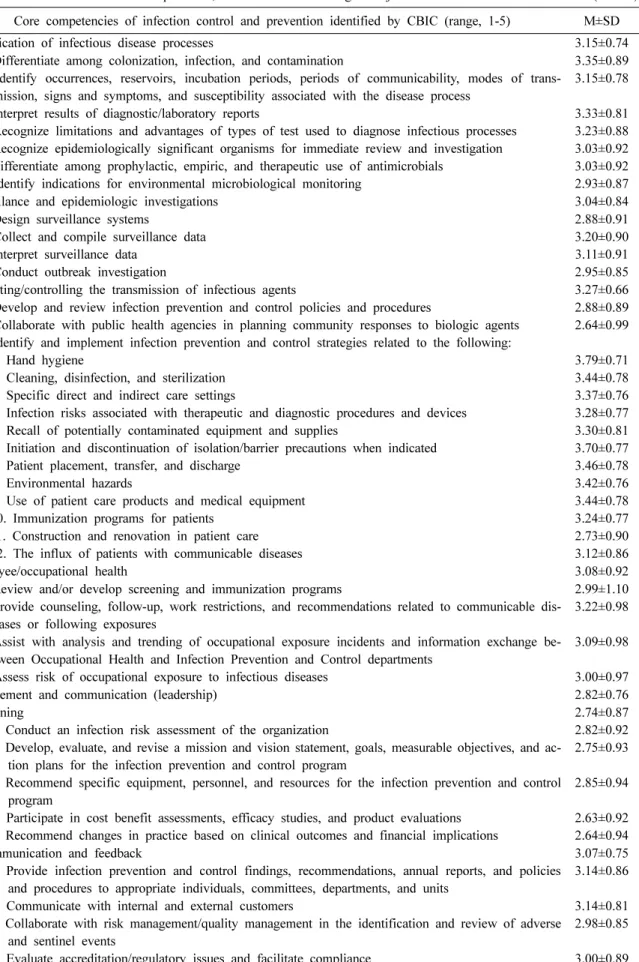
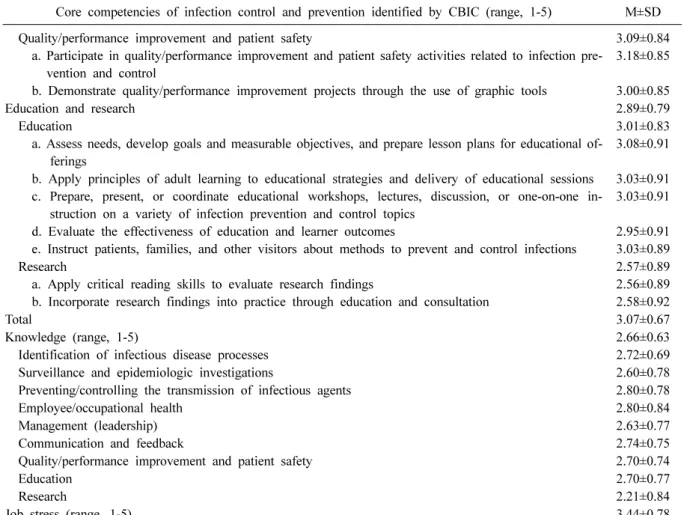
2. 핵심역량, 감염관리 지식, 직무스트레스 특성 핵심역량은 평균 3.07±0.67점(5점 만점)으로 감 염원인체의 전파예방 및 관리 3.27±0.66점으로 가 장 높았고, 교육 및 연구가 2.89±0.79점으로 가장
Table 1. Comparison of core competencies of infection control nurses by individual characteristics and hospital characteristics
Variable Category No. of
ICN % Core competency
M±SD t or F P
†Individual characteristics
Gender Female 241 99.2 3.08±0.67 2.05 .153
Male 2 0.8 2.41±0.45
Age(yrs) 25-29 35 14.4 2.67±0.67 5.61 <.001*
,a30-34 49 20.2 2.98±0.54
35-39 64 26.3 3.11±0.61
40-44 40 16.5 3.20±0.74
≥45 55 22.6 3.29±0.68
38.27±7.83 (23-57) Clinical experience
(yrs)
<5 28 11.5 2.71±0.63 6.60 <.001*
,b5- <10 43 17.7 2.91±0.62
10- <15 61 25.1 3.04±0.58
≥15 111 45.7 3.25±0.69
14.62±8.04 (1-36) Infection control
experience (yrs)
<2 86 35.4 2.76±0.63 42.93 <.001*
,c2- <5 101 41.6 3.03±0.51
≥5 56 23.0 3.67±0.60
3.48±3.61 (0.1-27)
Position Staff nurse 132 54.3 2.95±0.64 6.11 <.003*
,dCharge nurse 30 12.3 3.17±0.70
Manager 81 33.3 3.26±0.67
Degree Diploma 22 9.1 2.85±0.51 9.75 <.001*
,eBachelor’s 128 52.7 2.92±0.62
Master’s 84 34.6 3.37±0.67
Doctoral 9 3.7 3.28±0.82
Accreditation for infection control
Yes 55 22.6 2.93±0.60 49.50 <.001*
No 188 77.4 3.59±0.63
Pre-education Attendance 70 28.8 3.27±0.68 8.35 .004*
Nonattendance 173 71.2 3.00±0.65
Satisfy legal education requirement**
Yes 227 93.4 3.10±0.68 3.02 .084
No 16 6.6 2.80±0.40
Dedication of infection control
Yes 215 88.5 3.10±0.66 1.51 .221
No 28 11.5 2.93±0.73
Hospital characteristics
Hospital location Seoul 85 35.0 3.21±0.65 3.03 .050
Metropolitan city other than Seoul 64 26.3 3.08±0.63
Non-metropolitan city 94 38.7 2.96±0.70
Number of beds <300 53 21.8 3.09±0.67 0.13 .973
300- <600 66 27.2 3.11±0.62
600- <900 67 27.6 3.03±0.74
900- <1200 19 7.8 3.08±0.62
≥1200 38 15.6 3.09±0.65
735.69±546.44 (87-2,706)
Type of hospital Tertiary care hospital 92 37.9 3.07±0.67 0.44 .723
General hospital 119 49.0 3.11±0.70
Hospital 32 13.1 2.95±0.51
No. of infection control nurse
1-3 96 39.5 3.05±0.60 0.48 .696
4-6 90 37.0 3.09±0.76
7-9 33 13.6 3.02±0.60
≥10 24 9.9 3.21±0.67
5.17±3.99 (1-20)
Table 1. Continued
Variable Category No. of
ICN % Core competency
M±SD t or F P
†Working department Infection control 201 82.7 3.09±0.68 1.23 .303
Quality improvement 10 4.1 3.35±0.80
Nursing 23 9.5 2.91±0.22
Medical 4 1.6 2.70±0.22
Others 5 2.1 3.28±0.57
* P<0.05, **16 hours per year,
†scheffe’s test, a; Core competency in age group 25-29 was lower than in the others, b; Core competency in clinical experience group of ≥15 years was higher than in 4 group was highest, c; Core com- petency in infection control experience group of ≥5 years was higher than in group of 2-<5 years and those in 2-<5 years group was higher than in <2 years group, d; Core competency in staff nurse group were lower than in manger group, e; Core competency in diploma degree group was lower than in bachelors group and those in bachelors group was lower than in doctoral degree group.
낮았다. 세부항목에서 가장 높은 항목은 ‘손위생’
이었고(3.79±0.71), 가장 낮은 항목은 ‘연구 결과 를 평가하기 위해 비판적 독해 능력을 적용한다.’
로 2.56±0.89점이었다.
감염관리 지식은 평균 2.66±0.63점(5점 만점)으 로 감염원인체의 전파예방 및 관리 (2.80±0.78)와 직원건강이 (2.80±0.84)가장 높았고, 연구가 2.21±
0.84점으로 가장 낮았다. 직무스트레스는 평균 3.44±0.78점(5점 만점)이었다(Table 2).
3. 핵심역량과 연속변수의 상관관계
핵심역량은 감염관리 지식, 연령, 경력, 감염관 리 경력과 유의한 양의 상관관계가 직무스트레 스와 음의 상관관계가 있었다(P<.05).
4. 핵심역량에 영향을 미치는 요인
핵심역량에 영향을 미치는 요인은 감염관리 지식(β=.606, P<.001), 감염관리 경력(β=.143, P=.010)과 감염관리간호사 인정 여부(β=.111, P=.049)의 순서로 유의한 영향요인이었고, 핵심 역량의 설명력은 55.8%였다.
2016년 의료법 개정 후[7] 감염관리간호사가 급격히 증가되고, 약 2년이 경과한 현재 본 연구 에서 감염관리간호사의 평균 감염관리 경력은 3.48년 이었다. 특히 2년 미만의 경력자가 35.4%
로 전체의 삼분지 일을 차지하였고, 이러한 시점 에 감염관리간호사의 핵심역량을 향상시킬 수 있는 방안을 모색할 필요가 있다. 본 연구에서 감염관리간호사의 핵심역량은 평균 3.07점(5점
만점, 60.2%)이었고, 2016년 의료법이 개정되면 서 새롭게 배치된 2년 미만의 경력자의 핵심역량 이 2.76점으로 다른 경력군에 비하여 유의한 수 준으로 가장 낮았다. 감염관리 간호사의 경력에 따라 핵심역량에 유의한 차이가 있음은 기존 선 행연구와 일한다[8,12]. 본 연구의 조사대상이 학 회에 지속적으로 참여하는 경력자가 많이 포함 되어 국내 감염관리간호사의 경력 분포와는 다 르기 때문에 전반적으로 핵심역량이 높게 나올 가능성이 있다. 그럼에도 불구하고 2년 미만의 신규경력자가 삼분지 일을 차지하고 있음은 새 로운 의료법의 감염관리 인력요건을 충원하기 위해 단기간에 다수의 신규 인력이 유입됨으로 써 전체 감염관리간호사의 핵심역량 지표를 저 하시키고 있음을 알 수 있다. 따라서 감염관리간 호사의 역량을 강화하기 위해서 이들 신규 인력 에 중점을 두어야 한다는 것을 알 수 있다.
본 연구에서 핵심역량은 미국 감염관리자격시 험위원회에서 제시한 영역으로 국내 현실을 완 전히 반영하기는 어려우나, 국제적으로 표준화된 비교를 위하여 필요하다고 생각된다. 가장 높은 수준을 나타낸 영역은 ‘감염원인체의 전파예방 및 관리’로 이 영역은 감염관리 지식에서도 가장 높은 부분이었다. 본 영역은 구체적인 감염예방 및 관리 전략을 알고 적용하는 것으로 손위생, 소독과 멸균, 부서별 감염관리, 격리, 환경관리, 전염성질환 환자 유입관리과 같은 임상에서 실 질적인 감염관리업무를 가장 잘 수행하고 있다 는 것을 나타내고 있다[8,12]. 특히 핵심역량의
Table 2. Characteristics of core competencies, self-evaluated knowledge and job stress in infection control nurses (N=243) Core competencies of infection control and prevention identified by CBIC (range, 1-5) M±SD
Identification of infectious disease processes 3.15±0.74
a. Differentiate among colonization, infection, and contamination
b. Identify occurrences, reservoirs, incubation periods, periods of communicability, modes of trans- mission, signs and symptoms, and susceptibility associated with the disease process
c. Interpret results of diagnostic/laboratory reports
d. Recognize limitations and advantages of types of test used to diagnose infectious processes e. Recognize epidemiologically significant organisms for immediate review and investigation f. Differentiate among prophylactic, empiric, and therapeutic use of antimicrobials
g. Identify indications for environmental microbiological monitoring
3.35±0.89 3.15±0.78
3.33±0.81 3.23±0.88 3.03±0.92 3.03±0.92 2.93±0.87
Surveillance and epidemiologic investigations 3.04±0.84
a. Design surveillance systems
b. Collect and compile surveillance data c. Interpret surveillance data
d. Conduct outbreak investigation
2.88±0.91 3.20±0.90 3.11±0.91 2.95±0.85
Preventing/controlling the transmission of infectious agents 3.27±0.66
a. Develop and review infection prevention and control policies and procedures
b. Collaborate with public health agencies in planning community responses to biologic agents c. Identify and implement infection prevention and control strategies related to the following:
1. Hand hygiene
2. Cleaning, disinfection, and sterilization 3. Specific direct and indirect care settings
4. Infection risks associated with therapeutic and diagnostic procedures and devices 5. Recall of potentially contaminated equipment and supplies
6. Initiation and discontinuation of isolation/barrier precautions when indicated 7. Patient placement, transfer, and discharge
8. Environmental hazards
9. Use of patient care products and medical equipment 10. Immunization programs for patients
11. Construction and renovation in patient care 12. The influx of patients with communicable diseases
2.88±0.89 2.64±0.99
3.79±0.71 3.44±0.78 3.37±0.76 3.28±0.77 3.30±0.81 3.70±0.77 3.46±0.78 3.42±0.76 3.44±0.78 3.24±0.77 2.73±0.90 3.12±0.86
Employee/occupational health 3.08±0.92
a. Review and/or develop screening and immunization programs
b. Provide counseling, follow-up, work restrictions, and recommendations related to communicable dis- eases or following exposures
c. Assist with analysis and trending of occupational exposure incidents and information exchange be- tween Occupational Health and Infection Prevention and Control departments
d. Assess risk of occupational exposure to infectious diseases
2.99±1.10 3.22±0.98
3.09±0.98
3.00±0.97
Management and communication (leadership) 2.82±0.76
Planning
a. Conduct an infection risk assessment of the organization
b. Develop, evaluate, and revise a mission and vision statement, goals, measurable objectives, and ac- tion plans for the infection prevention and control program
c. Recommend specific equipment, personnel, and resources for the infection prevention and control program
d. Participate in cost benefit assessments, efficacy studies, and product evaluations e. Recommend changes in practice based on clinical outcomes and financial implications
2.74±0.87 2.82±0.92 2.75±0.93
2.85±0.94
2.63±0.92 2.64±0.94 Communication and feedback
a. Provide infection prevention and control findings, recommendations, annual reports, and policies and procedures to appropriate individuals, committees, departments, and units
b. Communicate with internal and external customers
c. Collaborate with risk management/quality management in the identification and review of adverse and sentinel events
d. Evaluate accreditation/regulatory issues and facilitate compliance
3.07±0.75 3.14±0.86
3.14±0.81 2.98±0.85
3.00±0.89
Table 2. Continued
Core competencies of infection control and prevention identified by CBIC (range, 1-5) M±SD Quality/performance improvement and patient safety
a. Participate in quality/performance improvement and patient safety activities related to infection pre- vention and control
b. Demonstrate quality/performance improvement projects through the use of graphic tools
3.09±0.84 3.18±0.85
3.00±0.85
Education and research 2.89±0.79
Education
a. Assess needs, develop goals and measurable objectives, and prepare lesson plans for educational of- ferings
b. Apply principles of adult learning to educational strategies and delivery of educational sessions c. Prepare, present, or coordinate educational workshops, lectures, discussion, or one-on-one in-
struction on a variety of infection prevention and control topics d. Evaluate the effectiveness of education and learner outcomes
e. Instruct patients, families, and other visitors about methods to prevent and control infections
3.01±0.83 3.08±0.91
3.03±0.91 3.03±0.91
2.95±0.91 3.03±0.89 Research
a. Apply critical reading skills to evaluate research findings
b. Incorporate research findings into practice through education and consultation
2.57±0.89 2.56±0.89 2.58±0.92
Total 3.07±0.67
Knowledge (range, 1-5) 2.66±0.63
Identification of infectious disease processes 2.72±0.69
Surveillance and epidemiologic investigations 2.60±0.78
Preventing/controlling the transmission of infectious agents 2.80±0.78
Employee/occupational health 2.80±0.84
Management (leadership) 2.63±0.77
Communication and feedback 2.74±0.75
Quality/performance improvement and patient safety 2.70±0.74
Education 2.70±0.77
Research 2.21±0.84
Job stress (range, 1-5) 3.44±0.78
Abbreviation: CBIC, Certification Board of Infection Control and Epidemiology.
세부 항목 중 손위생은 감염관리 간호사들이 가 장 잘 할 수 있다고 응답한 영역이었다. 이는 2013년 전체 감염관리 간호사 중 55%의 응답율 로 조사된 연구와 동일한 결과로[12] 손위생이 감염관리에서 가장 강조되는 영역이면서 병원인 증평가의 주요 항목으로 평가되고 있어, 지속적 인 손위생 모니터링으로 인한 높은 수준의 역량 을 가지고 있는 부분이라고 하겠다. 그러나 비교 적 높은 역량수준에서 요구되는 교육 및 연구부 분이 2.89점(57.8%)으로 가장 점수가 낮았고 지 식에서도 연구가 1.21점으로 가장 낮았다. Jeong 등[15]의 연구에서 감염관리간호사가 수행하는 주요업무 중 연구는 비교적 적게 수행되는 업무 로 보고되었고, 감염관리간호사들이 교육받기 희 망하는 프로그램 중 감염실무와 관련된 통계를 가장 많이 원한 것으로 나타나 본 연구의 결과를 뒷받침하는 것으로 보인다.
본 연구에서 감염관리간호사의 핵심역량에 영 향을 미치는 요인은 감염관리 지식, 감염관리 경 력과 감염관리간호사 인정 여부의 순서로 감염 관리 지식이 가장 큰 영향요인이었다. 특히 본 연구는 지식과 직무스트레스를 포함하여 영향요 인을 분석하였고, 이러한 변수를 모두 포함하여 핵심역량의 영향요인을 탐색하였다는 데 의의가 있다. 기존 선행연구에서는 지식과 직무스트레 스를 모두 포함시키지 못하고 부분적으로 연구 되었으며, 그 결과 지식과 감염관리 경력[12], 감 염관리간호사 자격증과 감염관리 경력이[16] 감 염관리간호사의 핵심역량에 영향을 미치는 요인 이었다.
지식은 핵심역량을 효과적으로 수행하는데 요 구 되는 능력으로[3] 감염관리간호사는 전문지식 의 부족으로 스트레스를 받고 있다고 보고되고 있다[9]. 본 연구의 감염관리 지식수준은 2.66점
(53.2%)으로 도구와 대상자 추출과정이 상이하여 직접적으로 비교하기는 어려우나 2013년 조사된 3.1점(60.2%)보다 다소 낮은 수준이었다[16]. 감 염관리 지식에 대한 평가는 ‘매우 부족하다’에서
‘매우 충분하다’로 본인이 인식하는 지식 정도로 평가되었다는 제한점이 있지만 주관적으로 인식 하는 지식의 정도가 비교적 낮고, 핵심역량에 가 장 큰 영향 요인이었다는 점을 고려해야 한다.
감염관리실 근무 인력의 교육기준에 의하면 감 염관리실 근무 인력은 매년 16시간의 교육을 이 수하도록 의무화하고 있고[7], 감염관리 관련 전 문 학회에서 주관하는 학술대회 또는 워크숍에 매년 참석하도록 하고 있어 감염관리간호사의 적 극적이고 지속적인 참여가 이루어져야 할 것이다.
또한 Her 등[17]의 연구에서 한국의 감염관리 간 호사들이 교육받기를 원하는 프로그램으로 감염 관리실무와 관련된 통계프로그램, 감염감시향상 및 실무연구교육, 유행발생조사의 실제 적용사례 를 보고되고 있어 감염관리간호사의 교육 요구 도를 반영한 교육내용이 고려되어야 할 것이다.
감염관리간호사의 경력이 단절되는 이직의도 는 수입, 직무만족, 새로운 근무선택에 대한 인식 과 조직에 정착하는 정도인 직무착근도에 영향 을 받는 것으로 조사 되었다[16]. 다수의 감염관 리간호사들은 감염관리 업무에 상당한 수준의 스트레스를 느끼고 있고, 전문직 간호사에 대한 역할 갈등, 과다한 업무, 의료기관 평가에 대한 심리적 압박감, 감염관리에 대한 인식부족으로 스트레스를 받고 있다고 보고되고 있다[17]. 이러 한 스트레스 사유들이 결국 이직으로 이어지게 하여 감염관리 경력의 단절을 가져올 수 있으므 로 높은 역량 수준을 지닌 감염관리간호사들이 핵심역량을 잘 수행할 수 있게 하기 위해서는 전 문직으로서의 적절한 보상과 함께 직무만족의 향상과 조직에 잘 적응하기 위한 행정적 지원이 필요하다고 생각된다[16]. 실제 직무스트레스는 개인적, 정신적, 조직적인 다양한 변수에 영향을 받고 있기에 이러한 부분을 고려하여 직무스트 레스에 대한 다차원적인 접근이 필요할 것이다.
감염관리간호사 인정 여부는 선행연구에서와 같이 핵심역량의 영향요인으로[8,12,18] 일정한 자격요건을 갖춘 감염관리간호사를 인정하는 제
도는 전문가적 지식과 핵심역량을 발휘할 수 있 게 하고, 전문가로서의 신뢰를 향상하는 것으로 미국 전문간호사위원회(The American Board of Nursing Specialist, ABNS)의 연구[18]와 일치하는 결과였다. 감염관리간호사 인정 여부는 전문간호 사의 핵심역량을 향상시키는 주요한 요인으로 감염관리전문간호사 석사과정의 확대와 새롭게 변화된 환경에서 실무 요구도를 반영한 교육과 정의 표준화가 필요하다고 본다.
추후 연구에서는 감염관리간호사의 대표성을 확보할 수 있는 연구방법을 적용하고, 감염관리 간호사 이외에 감염관리 의사 및 기타 직종을 포 함한 대상자의 확대 및 직종별 감염관리 핵심역 량에 대한 탐구가 필요하겠다.
Summary
2015년 메르스 유행 이후 2016년 새롭게 개정 된 감염관리 관련 의료법은 감염관리간호사의 양적 증대를 가져왔다. 본 연구의 목적은 의료법 개정 후 감염관리간호사의 핵심역량, 직무스트레 스와 감염관리 지식을 조사하고, 핵심역량에 영 향을 미치는 요인을 파악하고자 하였다. 연구 대 상자는 연구자의 편의에 2018년 감염관리 업무 를 수행하고 있으며, 대한감염관리간호사회에서 개최한 하계 학술대회에 참석한 감염관리간호사 250명으로 의료법 개정으로 새롭게 감염관리간 호사가 된 대상자들은 경력이 낮은 군이었다. 감 염관리간호사의 핵심역량은 의료법이 개정되면 서 새롭게 배치된 2년 미만 경력자가 가장 낮았 다. 핵심역량에 영향을 미치는 요인은 감염관리 지식, 감염관리 경력과 감염관리간호사 인정 여 부로 세 가지 요인에 의한 핵심역량의 설명력은 55.8%였다. 감염관리간호사의 핵심역량을 향상 시키기 위하여 2016년 의료법 개정 이후 새롭게 배치된 인력을 주요 대상자로 인식하여야 한다.
또한 감염관리지식 증진과 감염관리 경력유지 및 감염관리간호사 인정을 확대하기 위한 노력 이 필요하겠다.
Acknowledgements
이 연구는 2018년 대한의료관련감염관리학회 연구비 지원으로 수행된 연구임.
This study was supported by 2018 research grant of Korean Society for Healthcare-associated Infec- tion Control and Prevention.
References
1. Murphy DM, Hanchett M, Olmsted RN, Farber MR, Lee TB, Haas JP, et al. Competency in in- fection prevention: a conceptual approach to guide current and future practice. Am J Infect Control 2012;40:296-303.
2. Benner P. From novice to expert: excellence and power in clinical nursing practice. Melno Park; Addison-Wesley, 1984.
3. McLagan P. Great ideas revisited. Competency models. Creating the future of hrd. Train Dev 1996;50:60-5.
4. Oh HS, Yi SE. National survey on the current status of infection control nurses and their ac- tivities in general hospitals with more than 300 beds. Korean J Nosocomial Infect Control 2005;
10:32-42.
5. Kim KM, Jeong JS, Park HR. Infection control nurse specialist education in Korea. Am J In- fect Control 2010;38:413-5.
6. Choi JS, Kim KM. Crisis prevention and man- agement by infection control nurses during the Middle East respiratory coronavirus outbreak in Korea. Am J Infect Control 2016;44:480-1.
7. Ministry of Health and Welfare. Medical law enforcement rules. http://www.law.go.kr/lsSc.do?
menuId=0&p1=&subMenu=1&nwYn=§ion=
&tabNo=&query=#undefined (Updated on 6 Oc- tober 2016).
8. Kim KM, Choi JS. Factors affecting core com- petencies among infection control nurses in Korea.
Korean J Adult Nurs 2014;26:11-21.
9. Bobay K, Gentile DL, Hagle ME. The relation- ship of nurses’ professional characteristics to lev- els of clinical nursing expertise. Appl Nurs Res 2009;22:48-53.
10. Chang YH, Cho YS, Kwak MJ. A study of fac- tors related nursing competency in nurses. Clin Nurs Res 2006;12:7-19.
11. Murphy CL, McLaws M. Credentialing, diversity, and professional recognition-foundations for an Australian infection control career path. Am J In- fect Control 1999;27:240-6.
12. Choi JS, Kim KM. Factors influencing the self- perceived practice levels of professional stand- ard competency among infection control nurses in Korea. Am J Infect Control 2014;42:980-4.
13. Faul F, Erdfelder E, Lang AG, Buchner A.
G*Power 3: a flexible statistical power analysis program for the social, behavioral, and biome- dical sciences. Behav Res Methods 2007;39:
175-91.
14. Parker DF, DeCotiis TA. Organizational deter- minants of job stress. Organ Behav Hum Per- form 1983;32:160-77.
15. Jeong JS, Yoon SW, Park ES, Kim KM, Yoo SY, Jeong I, et al. The present situation of in- fection control professionals, organization, and activities in Korean acute care general hospitals.
Korean J Nosocomial Infect Control 2006;11:
58-69.
16. Choi JS, Kim KM. Job embeddedness factors as a predictor of turnover intention among in- fection control nurses in Korea. Am J Infect Control 2015;43:1213-7.
17. Her S, Kim KH, Oh HS. A study on work con- dition, stress, role conflict and job satisfaction of infection control nurses working in general hospitals. Korean J Adult Nurs 2012;24:327-38.
18. Goldrick BA. The Certification Board of Infec- tion Control and Epidemiology white paper: the value of certification for infection control pro- fessionals. Am J Infect Control 2007;35:150-6.