INTRODUCTION
1. Background
In Korea, the incidence of breast cancer has increased rapidly since 1995, and it is now the most common among all cancers in women (23,547 cases in 2018, according to Statistics Korea).1) The incidence among women aged 40~50 was 62.6%, and the highest was among women aged 45~49, the most socially and economically active age group, increasing the severity of the breast cancer cases.1) Although the incidence of breast cancer patients is increasing, the 5-year relative sur- vival rate of breast cancer in Korea has also increased, from 79.3% in 1995 to 93.3% in 2018,1) a higher survival rate than other cancers. The low age of onset and high survival rate of breast cancer means that
breast cancer is becoming chronic, and there is thus a need for continu- ous adaptation in diagnosis, treatment, and even after completing treat- ment.2)
The primary treatment for breast cancer patients is mastectomy, fol- lowed by chemotherapy, radiation therapy, and hormone therapy.
Mastectomy patients not only experience side effects such as pain, nausea, and fatigue during treatment, but also are subject to long-term physical effects such as deformation and pain in the surgical site, swell- ing and sensory changes in the arms, decreased grip and muscle strength, and decreased upper extremity function, which leads to sig- nificant reductions in quality of life.3,4) These experiences last for one to two years after surgery, and breast cancer patients also experience physical changes after surgery, which leads to both physical discomfort and psychological pain due to losing a body part that is a symbol of their womanhood.5) For this reason, nursing interventions are needed to reduce the physical, psychological, and social discomfort experienced by post-operative breast cancer patients and help their treatment and rehabilitation.
Of the various nursing interventions, exercise interventions have been applied to cancer patients since the late 1980s. In addition to reducing pain and increasing the shoulder range of motion of breast cancer sur-
The Effects of Exercise Intervention for Post-Operative Breast Cancer Patients in Korea:
A Systemic Review and Meta-Analysis of Randomized Controlled Trials
Lee, Dong-suk1 · Kim, Hyeun-sil2 · Choi, Seung-ok3 · Kim, Eun-mi4
1College of Nursing, Kangwon National University; 2Department of Nursing, Songho University; 3Kangwon National Univ. Hospital; 4Department of Nursing, Songgok University, Chuncheon, Korea Purpose: This study aimed to systematically evaluate literature related to the effects of exercise intervention programs on physical or psychological variables of post-operative breast cancer patients in Korea, and identify the effectiveness of exercise intervention through meta-analysis. Methods: The review question was defined according to PICO-SD (Participants, Intervention, Comparisons, Outcomes, Study Design) to achieve a systematic literature review: “How does exercise intervention affect the physical or psychological outcome in post-operative breast cancer patients compared to the control group?” The subjects were randomized clinical trials (RCTs) studies released in Korea between 2010 and December 2020. Literature searches were conducted using four electronic databases, including Korean Studies Information Service System (KISS), Research Information Sharing Service (RISS), National Assembly Library, and DBpia. The search terms were ‘breast neoplasms’ or ‘breast cancer’ with ‘exercise’ or ‘exercise intervention’ or ‘exercise program.’ A total of 13 RCTs were finally selected. Results: The outcome variables were in the upper extremity range of motion (ROM), shoulder disability, pain and edema. The effect size of exercise intervention on ROM was 0.95(95% CI:0.58, 1.33)( p<.001); shoulder disability was -1.16(95% CI:-1.77, -0.55)(p<.001); pain was -1.24(95% CI:-1.58, -0.89) (p<.001); and edema was -0.03(95% CI:-0.39, 0.33)(p=.858). Conclusion: This result suggests that oncology nurses may apply exercise intervention to improve ROM, shoulder disability, and to alleviate pain in post-op breast cancer patients.
Key Words: Breast neoplasm, Mastectomy, Exercise, Randomized Controlled Trial, Meta-analysis
주요어: 유방암, 유방절제술, 운동, 무작위배정 실험연구, 메타분석
* This study was supported by 2017 Research Grant from Kangwon National University (No. D1001123-01-01).
Address reprint requests to: Kim, Eun-mi Department of Nursing, Songgok University,
34 Songgokdaehak-gil, Namsan-myeon, Chuncheon 24465, Korea Tel: +82-33-260-3689 Fax: +82-33-851-5585 E-mail: [email protected] Received: Mar 24, 2021 Revised: May 07, 2021 Accepted: May 28, 2021
This is an Open Access article distributed under the terms of the Creative Commons Attribution NoDerivs License. (http://creativecommons.org/licenses/by-nd/4.0/) If the original work is properly cited and retained without any modification or reproduction, it can be used and re-distributed in any format and medium.
gery patients, exercise interventions reduce anxiety and depression, ac- celerate return to daily life, strengthen the immune system, and im- prove quality of life.6,7) In particular, the significance of upper limb exer- cise programs to help restore upper limb functions and prevent symp- toms from worsening has been emphasized, because post-op breast cancer patients experience impaired upper limb functions due to the characteristics of breast cancer.8) Exercise interventions used for the treatment and rehabilitation of breast cancer patients consist of stretch- ing, shoulder range of motion exercise, and strength training focusing on upper extremity exercise through various types of exercise such as yoga, aquatic exercise, rehabilitation exercise, Tai Chi, and elastic bands, and are effective in restoring upper limb functions and preventing symptoms from worsening.7,9)
A wide variety of studies have also been conducted in Korea since the 2000s, as exercise interventions have been applied in nursing and other disciplines (rehabilitation therapy, physical therapy, physical education, etc.) from before and after cancer surgery to chemotherapy and throughout the rehabilitation and survival period after treatment.7) With the demand to summarize the results of each study more scientif- ically and objectively, meta-analysis studies have been performed to in- tegrate the results of these studies and present the effect size.10)
In terms of the meta-analysis studies on exercise interventions for breast cancer surgery patients in Korea, Lee et al.11) selected and ana- lyzed 16 studies from 2000 to 2015, and Lee12) selected and analyzed 15 studies by searching only academic papers in the journals of the Na- tional Research Foundation of Korea from 2000 to April 2017 for exer- cise interventions applied to subjects six months after completing breast cancer treatment. However, these studies did not provide enough infor- mation on the systematic literature review and meta-analysis reporting standards, and lack quality assessment. On the other hand, studies by Kim7) and Park & Cho13) were conducted according to systematic litera- ture review and meta-analysis reporting standards. Kim7) selected and analyzed 13 studies published by 2012 without limiting the search pe- riod (year), but did not reflect the results of the studies after 2012. The most recent study by Park & Cho13) does not mention the search period but is presumed to reflect studies up to 2018 as it was published in mid- 2019. It selected and analyzed seven studies by combining four ran- domized controlled trials (RCT) and three non-randomized controlled trials (NRCT), but with regard to extension, internal rotation, grip strength, upper extremity discomfort, and quality of life variables, which were reported as statistically insignificant, the analysis only in-
cluded two to three studies. While the systematic literature review and meta-analysis guidelines of the National Evidence-based Healthcare Collaboration Agency state that it is technically possible to do a meta- analysis of only two studies, the results must be interpreted with cau- tion.14)
Meanwhile, the results of meta-analysis studies conducted in Korea on the effect of exercise interventions for breast cancer surgery patients show that exercise interventions are effective in reducing abdominal fat ratio,7,11) increasing shoulder range of motion (flexion, extension, abduc- tion, external rotation),7,12,13) improving quality of life,7) increasing grip strength,11,12) and increasing upper extremity flexibility,7,12) and that the effects on pain11-13) and edema7,12) were not statistically significant. How- ever, some studies have reported that the effects on flexion,12) grip strength,7,13) and upper extremity flexibility12) were insignificant, high- lighting some differences and inconsistencies between the meta-analysis studies. This means that these themes or topics should be analyzed again by accumulating new research results.
While most foreign meta-analysis studies on the effect of exercise in- terventions on post-op breast cancer patients selected only RCT studies to present their analysis results,6,9,15-17) all four meta-analysis studies con- ducted in Korea were analyzed by mixing the results of randomized controlled trials (RCT) and non-randomized controlled trials (NRCT) in the meta-analysis process. Unlike RCT studies, the intervention ef- fects obtained in NRCT studies are subject to various risks of bias, so the National Evidence-based Healthcare Collaboration Agency14) rec- ommends a separate analysis for cases with different study design char- acteristics; so far, no Korean studies have performed a meta-analysis of RCT studies alone. Therefore, systematic literature reviews and meta- analyses on RCTs need to be conducted instead of mixing study designs with different levels of evidence to compare with foreign meta-analysis studies of RCTs.
Therefore, this study selected RCT studies that applied exercise inter- ventions to post-op breast cancer patients in Korea from 2010 to 2020 and analyzed the effects through a systematic literature review and meta-analysis to identify research trends in Korea and provide the latest valid evidence to compare with foreign RCT research results. In addi- tion, providing evidence of exercise intervention effects on breast cancer patients in Korea will contribute to presenting future research direc- tions for selecting evidence-based decision-making and interventions in oncology nursing practice.
2. Purpose
This study investigated the effects of exercise interventions on post- op breast cancer patients through a systematic literature review and meta-analysis of RCT studies in Korea.
RESEARCH METHOD
1. Design
This study conducted a systematic literature review and meta-analy- sis according to the Preferred Reporting Items for Systematic Reviews and Meta-Analysis (PRISMA) guidelines18) to identify the effects of ex- ercise interventions for post-op breast cancer patients in Korea.
2. Inclusion and exclusion criteria
The criteria for selecting literature consisted of questions according to the research purpose based on Participants, Intervention, Compari- sons, Outcomes, Study Design (PICOS) by the PRISMA group. 1) The participants were those who received breast cancer surgery, 2) interven- tion was exercise interventions that included upper extremity exercises, 3) comparison was a control group that did not receive exercise inter- ventions, 4) outcomes were studies that reported physical, social, and psychological variables, 5) study design was an RCT, and the published languages were limited to English and Korean.
The exclusion criteria included those who were diagnosed with breast cancer but did not receive surgery, studies in which the effect of only exercise interventions could not be confirmed due to the involvement of other interventions, single-group studies without control groups, studies that failed to present or validate the intervention results (cases that only published posters or abstracts, or if the original text was not available), and research types other than RCT (review, meta-analysis study, case study, and qualitative study).
3. Literature search and selection 1) Literature search
The search period was from December 2020 to January 2021 and was limited to studies published from 2010 to December 2020 to reflect the latest research trends. In terms of the academic search engines, this study searched all journal articles, reports, and theses on the Korean studies Information Service System (KISS), Research Information Shar- ing Service (RISS), the National Assembly Digital Library of Korea, and DBpia, which are the key databases presented by the Korea Health In-
formation Service.14) The search terms were searched more than twice by combining ‘Breast Neoplasms,’ ‘Breast Cancer,’ and ‘Exercise,’ ‘Exer- cise intervention,’ ‘Exercise program,’ ‘exercise,’ ‘exercise intervention,’
and ‘exercise program,’ which correspond to P (Participants) and I (In- tervention), using the MeSH (Medical Subject Headings) index. Dupli- cate articles were removed using RefWorks, and then the first round of literature that did not meet the criteria was excluded by checking the ti- tles or abstracts. Inclusion and exclusion were decided by checking the entire original text of the articles that provided insufficient information through the titles or abstracts. In the case of duplicate publications, journal articles were selected over theses. Four researchers formed teams of two. The first team performed the literature search and screen- ing process, and the second team reviewed the results. If any disagree- ment arose, all researchers reviewed the original text according to the inclusion and exclusion criteria until reaching an agreement to select the final studies for the analysis.
2) Literature selection
After excluding 72 duplicate studies using RefWorks from the 340 studies retrieved (n=268), 213 studies with titles and abstracts unrelated to the selection criteria, one study which used interventions other than exercise, and seven studies without controls were also excluded (n= 47).
The first screening process included studies with not enough informa- tion in the titles and abstracts to decide whether to exclude them. After reviewing the full text of the 47 studies that passed the first screening process, 13 final studies were selected for the meta-analysis by excluding 34 studies, including one study on participants who did not receive breast cancer surgery, one study which used interventions other than exercise, two studies which failed to confirm the effects of exercise in- terventions due to performing some exercise interventions on the con- trol group, 11 single-group studies, 15 studies that were not control group pre-test/post-test designs, and four studies for which the original text was not available (Figure 1).
4. Quality assessment
This study consists of a meta-analysis of RCTs, and the quality of the literature was assessed using Version 2.0 of the Cochrane RoB (Risk of bias) tool.19) RoB 2.0 is a recent revision of the widely used RoB tool. The previous version of RoB made assessments based on the outcomes, but some studies using real-world tools raised issues with the tool, such as some areas having low inter-rater reliability, the need to reconsider the
theoretical background in ‘selective outcome reporting’ and the misuse of ‘other areas of risk of bias.’20) To address these issues, RoB 2.0 is struc- tured to assess five domains: bias arising from the randomization pro- cess, bias due to deviations from intended interventions, bias due to missing outcome data, bias in measurement of the outcome, and bias in selection of the reported result.19,20) Each domain has three to seven as- sessment items, which are answered with Yes (Y), Probable Yes (PY), Probable No (PN), No (N), and No Information (NI). Based on the re- sponse, the algorithm programmed in RoB 2.0 calculates the assess- ment results in three stages (low, high, and some concerns of bias). In terms of the 13 RCTs in this study, first, the four researchers assessed the studies and shared the assessment results. Most assessments were consistent, but the ones that did not match each other were reviewed and discussed using the RoB 2.0 manual by Cochrane until an agree-
ment was reached.
5. Data analysis
The effect sizes of 13 exercise interventions were analyzed using R version 4.0.3. These studies were conducted independently, so a ran- dom-effect model was used to estimate the mean of the distribution of effect sizes across different populations, including subjects, periods, and configuration of exercise interventions.21) The effect size was calculated using Hedge’s g by Hedges & Olkin, and the standardized mean differ- ence (SMD) was used to correct the tendency of overestimating the ef- fect size in studies with small samples.22) Based on Cohen’s criteria for effect size,23) values between 0.2~0.5 were considered to be ‘small,’ while 0.5~0.8 represented a ‘medium’ effect size, and 0.8 or higher a ‘large’ ef- fect size. The heterogeneity of the effect sizes between the studies was Figure 1. Flow diagram for study selection.
analyzed with the total variance (Q) and the actual variance (I2) through a forest plot model (I2≤25%: low, 25%<I2≤75%: moderate, I2>75%: high).22) Sensitivity analysis was performed on studies that showed a high heterogeneity to determine if they had a significant in- fluence on the overall effect size and heterogeneity. After confirming the symmetry between the effect size and standard error through a funnel plot, publication bias was assessed through Egger’s regression test if statistical analysis was enabled by the inclusion of 10 or more studies in the analysis. The effect sizes by adjusting publication bias by trim-and-fill analysis were also presented to validate the interpretation and application of the study results.
RESULTS
1. Quality assessment results
First, in the assessment of bias arising from the randomization pro- cess, the result was ‘Low’(18.2%) as only two out of 13 RCT studies re- ported randomization processes through computer random number tables or lottery methods, and the remaining 11 studies had ‘Some con- cerns’(81.8%) because there was no mention of the randomization pro- cesses.
Second, in terms of bias due to deviations from intended interven- tions, there were no specific reports in all 13 articles for the double- blind questions of ‘(1) whether the subjects were aware of their assigned intervention during the trial’ and ‘(2) whether the people delivering the interventions were aware of the interventions assigned to the subjects during the trial,’ among the six sub-questions, so the answers to ques- tions (1) and (2) were No information (NI) and Probable Yes (PY), re- spectively. When responses to the two questions above indicated that double-blinding was not achieved, the third question that follows was
‘(3) whether important non-protocol interventions balanced across the two groups.’ The control and experimental groups were basically treated under the same conditions (e.g., basic physical therapy), and only the experimental group received additional experimental treatment (exer- cise intervention designed in the study). Therefore, the answer was Yes (Y) since there were no exceptional non-protocol interventions. The fourth question was ‘(4) whether this affected the outcome,’ and the an- swer was No (N). The final question, ‘(5) whether the subjects affected the outcome by not complying with the assigned interventions,’ is a question that confirms whether the low compliance rate of the subjects led to dropouts and affected the study results. Each study reported that
the subjects’ compliance rates were checked in person or by phone at the hospitals or homes where exercise interventions were performed, so the answer was No (N). The final assessment of bias due to deviations from intended interventions by the algorithm was ‘Low.’ This domain is attributed to experimental treatment other than protocol, failure of in- tervention, and the dropout of subjects,24) and since there were only a few (one to three people) or no dropouts in the 13 studies for meta- analysis, there was no effect on the overall study results.
Third, in terms of bias due to missing outcome data, all 13 studies answered ‘Yes (Y)’ to the question of ‘whether data for this outcome were available for all, or nearly all, subjects,’ so the assessment was ‘Low’
100%. Although some studies reported that dropouts (one to three peo- ple) were excluded from the final subjects, this was viewed as ‘nearly all’
subjects.
Fourth, in terms of bias in measurement of the outcome, the answer to ‘(1) whether the method of measuring the outcome was inappropri- ate’ was No (N) because structured questionnaires were determined by their reliability and validity, and tools for measuring physical outcome variables, such as protractors, tape measurements, scales, and blood analysis, were considered as appropriate tools. The answer to ‘(2) whether measurement or ascertainment of the outcome was different between intervention groups’ was No (N) because both groups were measured equally. The answer to ‘(3) whether the outcome assessors were aware of the experimental group’ was ‘Probable Yes (PY)’ because the same person treated both groups in some studies. However, the an- swer to the final question of ‘(4) whether the assessors’ awareness of the intervention group affected the assessment of the outcome’ was ‘Low’
100%. Where self-report questionnaires were used, the assessors could not intervene in the assessment; where physical variables were mea- sured, the results were measured by blood tests or machines, and most studies applied a research design to reduce measurement-related errors, such as measuring more than two to three times and using the mean value as the assessment results.
Fifth, in terms of bias in selection of the reported result, the assess- ment was ‘Low’ 100% because all 13 studies reported the results hon- estly. Therefore, as a result of assessing the quality of literature in 13 RCTs, the risk of bias was ‘Low’(Figure 2).
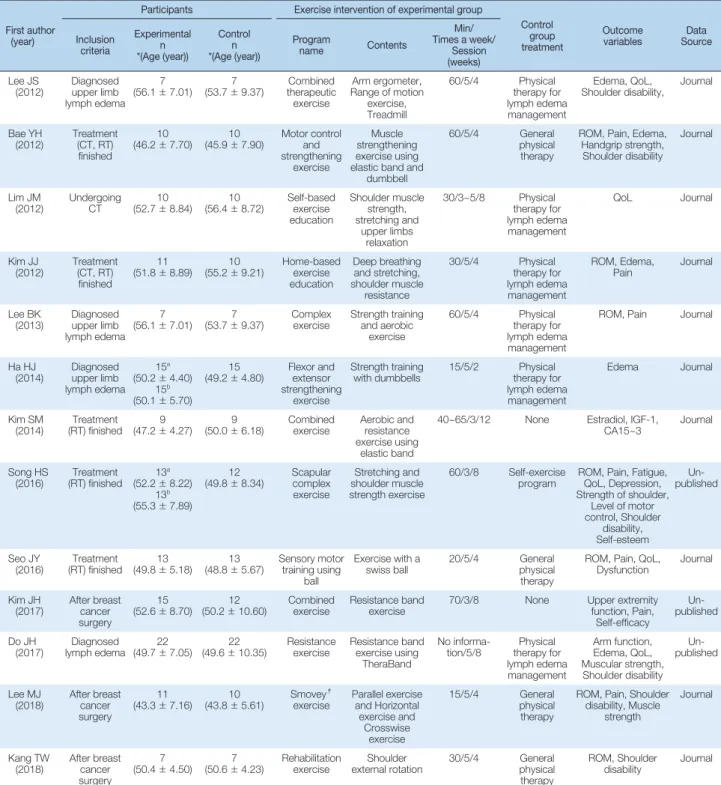
2. General characteristics of the literature for analysis The general characteristics of the final 13 studies in the systematic lit- erature review and meta-analysis on the effects of exercise interventions
on post-op breast cancer patients are presented in Table 1 by analyzing the authors, participants, intervention methods, and outcome variables.
The studies consisted of three theses and 10 journal articles published since 2010, and they reported social and psychological effects and the recovery of physical functions. A total of 322 subjects participated in the individual studies (minimum: 14, maximum: 45, average: 24), consist- ing of post-op breast cancer patients who were diagnosed with lymph- edema, receiving chemotherapy, or survivors who completed radiation therapy and chemotherapy. The exercises mainly consisted of stretch- ing, shoulder range of motion (ROM) exercises, and resistance exercises (using elastic bands and dumbbells) to strengthen upper limb muscle strength for treatment and rehabilitation to reduce lymphedema and improve upper extremity function. In addition, home-based exercise education, rehabilitation exercises, aerobic exercises, treadmill exercises, sensory training exercises using Swiss balls, Smovey (an exercise prod- uct that creates resistance due to vibration swinging effects) exercise, and compound exercises were also used in stages depending on the pa- tient’s condition. The exercise programs were applied for 2 weeks (1), 4 weeks (7), 8 weeks (4), and 12 weeks (1), for an average of three to five times a week for 30~50 minutes per session, for an average of 5.6 weeks.
The main outcome (dependent) variables were physical variables, in- cluding range of motion (ROM), shoulder disability, edema, pain, grip strength, hormones, and upper limb strength/muscle, and some studies also reported psychosocial variables, such as fatigue, depression, self-es- teem, and self-efficacy. Several studies reported quality of life but used
various measurement tools (Functional Assessment Cancer Therapy- Breast, Short-Form Health Survey-36, EORTC QLQ-30, EORTC QLQ- 31, QLQ-BR23). Even if the measurement tools were consistent, it did not lead to meta-analysis because the number of studies was insufficient to derive results by selecting and applying consistent categories, such as reporting only some sub-domains among measurement tools or report- ing only the total score without reporting the sub-domains. Therefore, meta-analysis was performed on ROM, shoulder disability, edema, and pain, which were presented in three or more papers among the physical and psychosocial variables.
In addition, the study by Song (Appendix 1, No. 8) applied exercise interventions for eight weeks on a scapular complex exercise group (a) and general exercise group (b), and the study by Ha (Appendix 1, No. 6) consisted of two experimental groups (flexor exercise group (a) and an extensor exercise group (b)) and one control, so each experimental group was analyzed separately during the meta-analysis.
3. The effects of exercise interventions after breast cancer surgery
1) Shoulder ROM
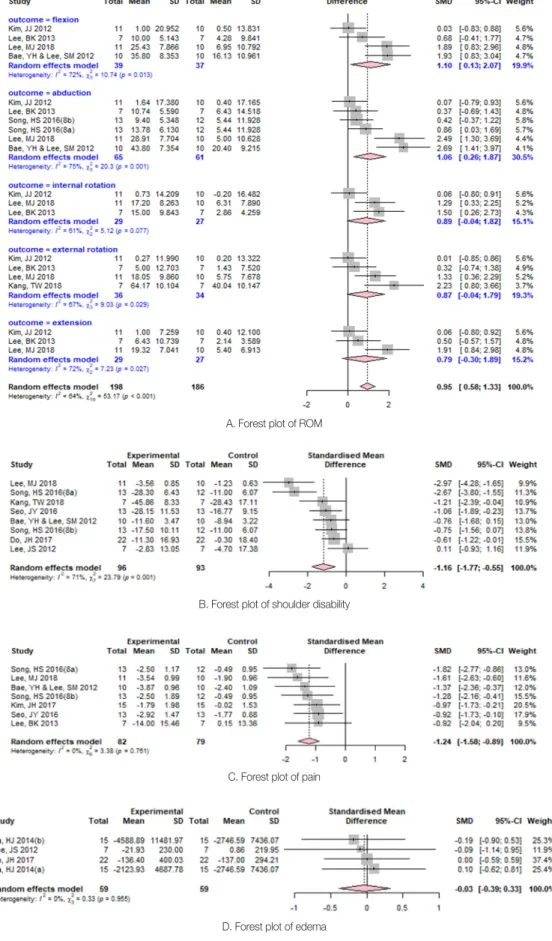
The overall effect size of exercise intervention for shoulder ROM was 0.95(95% CI: 0.58, 1.33), which is statistically significant (Z = 4.99, p <.001), and the I2 was 64%, indicating moderate heterogeneity (Q =53.17, p<.001)(Figure 3-A). In particular, among ROM, flexion showed a large effect size of 1.10(95% CI: 0.13, 2.07), which was statisti- cally significant (Z=2.23, p=.025), and the I2 was 72%, indicating mod- erate heterogeneity (Q=10.74, p=.013). Abduction had a large effect size of 1.06(95% CI: 0.26, 1.87), which was statistically significant (Z =2.60, p=.009), and the I2 was 75%, indicating high heterogeneity (Q =20.30, p =.001). Internal rotation, external rotation, and extension were not statistically significant. Therefore, post-op exercise intervention had a significant effect on flexion and abduction among shoulder ROM.
2) Shoulder disability
Shoulder disability is a structured questionnaire for assessing func- tional upper extremity levels and measures the subjective evaluation score for each item. The measurement tools used in this study were Dis- abilities of Arm, Shoulder, and Hand (DASH) and Shoulder Pain And Disability Index (SPADI), and both tools were consistent and measured the same concept, as the questions in each tool evaluated upper extrem- ity function in terms of pain and discomfort in everyday events (lifting Figure 2. Risk of bias item for each included study.
heavy objects, bathing, etc.). According to the analysis results, the effect size of exercise intervention for shoulder disability was -1.16(95% CI:
-1.77, -0.55), which was a large effect size that decreased pain and dis- comfort of shoulder function by 1.16, and was also statistically signifi- cant (Z =-3.72, p<.001), and the I2 was 71%, indicating moderate het-
erogeneity (Q=23.79, p=.001)(Figure 3-B). Therefore, exercise interven- tion significantly reduced the subjects’ shoulder disability
3) Pain
The effect size of exercise intervention for pain was -1.24(95% CI:
Table 1. Characteristics of Selected Studies (N=13)
First author (year)
Participants Exercise intervention of experimental group
Control group treatment
Outcome
variables Data Source Inclusion
criteria
Experimental n
*(Age (year))
Control n
*(Age (year))
Program
name Contents
Min/
Times a week/
Session (weeks) Lee JS
(2012) Diagnosed upper limb lymph edema
(56.1±77.01) 7
(53.7±9.37) Combined therapeutic
exercise
Arm ergometer, Range of motion
exercise, Treadmill
60/5/4 Physical therapy for lymph edema management
Edema, QoL,
Shoulder disability, Journal
Bae YH
(2012) Treatment (CT, RT) finished
(46.210±7.70) 10
(45.9±7.90) Motor control strengthening and
exercise
Muscle strengthening exercise using elastic band and
dumbbell
60/5/4 General physical therapy
ROM, Pain, Edema, Handgrip strength, Shoulder disability
Journal
Lim JM
(2012) Undergoing
CT 10
(52.7±8.84) 10
(56.4±8.72) Self-based exercise education
Shoulder muscle strength, stretching and
upper limbs relaxation
30/3~5/8 Physical therapy for lymph edema management
QoL Journal
Kim JJ
(2012) Treatment (CT, RT) finished
(51.811±8.89) 10
(55.2±9.21) Home-based exercise education
Deep breathing and stretching, shoulder muscle
resistance
30/5/4 Physical therapy for lymph edema management
ROM, Edema,
Pain Journal
Lee BK
(2013) Diagnosed upper limb lymph edema
(56.1±77.01) 7
(53.7±9.37) Complex
exercise Strength training and aerobic
exercise
60/5/4 Physical therapy for lymph edema management
ROM, Pain Journal
Ha HJ
(2014) Diagnosed upper limb lymph edema
15a (50.2±4.40)
15b (50.1±5.70)
15
(49.2±4.80) Flexor and extensor strengthening
exercise
Strength training
with dumbbells 15/5/2 Physical therapy for lymph edema management
Edema Journal
Kim SM
(2014) Treatment (RT) finished 9
(47.2±4.27) 9
(50.0±6.18) Combined
exercise Aerobic and resistance exercise using
elastic band
40~65/3/12 None Estradiol, IGF-1,
CA15~3 Journal
Song HS
(2016) Treatment (RT) finished 13a
(52.2±8.22) 13b (55.3±7.89)
(49.812±8.34) Scapular complex exercise
Stretching and shoulder muscle strength exercise
60/3/8 Self-exercise
program ROM, Pain, Fatigue, QoL, Depression, Strength of shoulder,
Level of motor control, Shoulder
disability, Self-esteem
publishedUn-
Seo JY
(2016) Treatment (RT) finished 13
(49.8±5.18) 13
(48.8±5.67) Sensory motor training using
ball
Exercise with a
swiss ball 20/5/4 General physical therapy
ROM, Pain, QoL, Dysfunction Journal Kim JH
(2017) After breast cancer surgery
(52.615±8.70) 12
(50.2±10.60) Combined
exercise Resistance band
exercise 70/3/8 None Upper extremity
function, Pain, Self-efficacy
publishedUn-
Do JH
(2017) Diagnosed
lymph edema 22
(49.7±7.05) 22
(49.6±10.35) Resistance
exercise Resistance band exercise using
TheraBand
No informa-
tion/5/8 Physical therapy for lymph edema management
Arm function, Edema, QoL, Muscular strength, Shoulder disability
Un- published
Lee MJ
(2018) After breast cancer surgery
(43.311±7.16) 10
(43.8±5.61) Smovey†
exercise Parallel exercise and Horizontal
exercise and Crosswise
exercise
15/5/4 General physical therapy
ROM, Pain, Shoulder disability, Muscle
strength
Journal
Kang TW
(2018) After breast cancer surgery
(50.4±74.50) 7
(50.6±4.23) Rehabilitation
exercise Shoulder
external rotation 30/5/4 General physical therapy
ROM, Shoulder
disability Journal
*Values are M±SD, †Smovey is a fitness product that provides a dynamic upper body workout. CT=Chemotherapy; RT=Radiation therapy; ROM=Range of motion;
QoL=Quality of life; a=Experimental group 1; b=Experimental group 2; IGF=Insulin-like growth factors.
-1.58, -0.89), which was a large effect size that decreased pain by 1.24, and was also statistically significant (Z =-7.03, p<.001), and the I2 was 0%, indicating no heterogeneity (Q =3.38, p=.761)(Figure 3-C). All of the studies identified used the same measurement method, which was the visual analogue scale (VAS). In other words, post-op exercise inter- ventions significantly reduced pain.
4) Edema
The effect size of exercise intervention for edema was -0.03(95% CI:- 0.39, 0.33), which was not statistically significant (Z =-0.18, p=.858), and the I2 was 0%, indicating no heterogeneity (Q= 0.33, p=.955)(Figure 3-D). In other words, post-op exercise intervention had no effect on re- ducing edema.
4. Publication bias and sensitivity analysis
Sensitivity analysis was performed to identify whether the studies with a high degree of heterogeneity had a significant influence. Pain and edema were considered to be non-heterogeneous, and the I2 for ROM was 64%, indicating moderate heterogeneity. Further sensitivity analysis showed the effect of Bae and Lee’s study (Appendix 1, No. 2) on the overall effect size (reduced from 0.95 to 0.77) and heterogeneity (I2= 64% to 59.8%). In terms of shoulder disability, the study by Song (8a) (Appendix 1, No. 8, complex exercise group a) had an effect on the overall effect size (reduced from -1.16 to -0.85) and heterogeneity (I2=71% to 58.7%).
In terms of publication bias, Egger’s regression test was conducted for statistical verification under the subjective judgment that there were asymmetric funnel plots, and trim-and-fill analysis was also performed if the results showed there was publication bias. Trim-and-fill analysis validates the relationship between the effect size and standard error us- ing regression analysis to detect statistical asymmetries, calculates an adjusted average effect size for asymmetry, and compares it with the original average effect size to evaluate the influence of the errors.21) Trim-and-fill analysis was conducted to determine whether there was publication bias when the results of the published studies did not repre- sent the results of all the selected studies by analyzing and confirming the impact of studies (missing data) that were not included in the meta- analysis because they were not published, but it does not actually change the analyzed mean effect size, and as such caution is required in interpreting such results.25) This study compared the effect size (small, medium, large) and statistical significance before and after trim-and-fill
analysis to determine whether 1) the influence of error was insignifi- cant, 2) the influence of error was not insignificant, but not large enough to affect the outcome, 3) the error was serious enough to ques- tion the study results.21,22)
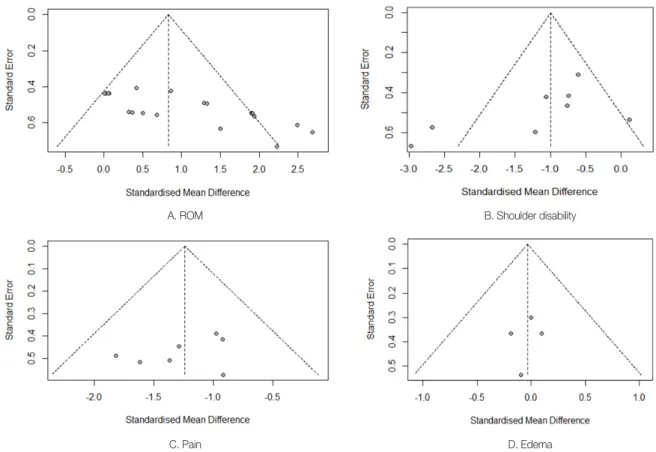
As shown in the funnel plots in Figure 4, pain and edema were gen- erally symmetrical around the mean, and ROM and shoulder disability were generally asymmetrical, with studies with small sample sizes dis- tributed mainly in the lower right corner of the mean. In terms of ROM, statistical analysis was possible due to having more than 10 stud- ies in the analysis, and the result of Egger’s regression test indicated there was publication bias, with bias=7.97(t= 4.88, df=18, p<.001). The effect size corrected for the publication bias in ROM by performing trim-and-fill analysis was still statistically significant (Z=2.74, p=.006) with a medium effect size of 0.58(95% CI:0.16, 1.00). However, the effect size before trim-and-fill was 0.95, so the influence of the error was not insignificant because of the large difference between before and after adjusting for publication bias, but the effect was still above medium and was not statistically significant enough to affect the results.
Although the funnel plot for shoulder disability was asymmetric, Eg- ger’s regression test was not applicable because there were less than 10 studies included in the analysis. According to the results of trim-and-fill analysis, the effect size was -1.16, so the effect of publication bias was in- significant due to showing the same results as before trim-and-fill anal- ysis.
DISCUSSION
This study conducted a systematic literature review and meta-analy- sis by selecting 13 RCTs in Korea that applied exercise interventions, including upper extremity exercises, for post-operative breast cancer patients. All 13 studies showed the latest trends as they were published from 2010 to the present day.
Through assessing the quality of the literature, the risk of bias was determined as ‘Low’ 100% in all domains (bias due to deviations from intended interventions, bias due to missing outcome data, bias in mea- surement of the outcome, and bias in the selection of the reported re- sult) other than bias arising from the randomization process, so the overall quality assessment result was that there was a ‘low’ risk of bias.
The quality assessment tool used in this study was RoB 2.0, the latest version (revised in August 2019) of the widely used RoB tool. Compared to the previous version, RoB 2.0 aims for objectivity through more de-
Figure 3. Forest plots of the effects of exercise intervention for post-op breast cancer patients.
A. Forest plot of ROM
B. Forest plot of shoulder disability
D. Forest plot of edema C. Forest plot of pain
surement of the outcome’ to be ‘low’ due to the use of appropriate tools for the measurement variables, the same measurement and evaluation of experimental and control groups, and applying a study design to minimize bias associated with the assessors’ measurement even if it is affected by physical variables (participants’ self-reported questionnaires, weight, and blood test results) that were not affected by situations where blinding the assessors was not possible. Therefore, the RoB 2.0 tool re- flects all existing risk of bias assessment items while constructing algo- rithms of more specific sub-questions for the risk of bias affecting the outcome, so the quality assessment of the literature does not depend on the subjective judgment of the meta-analysis researchers.
The quality assessment of the study by Park & Cho,13) one of the most recent studies that performed a meta-analysis on a similar topic to this study and used a previous version of the RoB tool, was ‘low,’ and there was no significant difference from the quality assessment results of this study. However, in a foreign study by Furmaniak et al.,17) which also used a previous version of the RoB tool, most of the identified studies were assessed to have a ‘high’ risk of bias in the areas of ‘blinding of participants and researchers’ and ‘blinding of outcome evaluation’ while tailed sub-questions for each assessment domain and helps the assessor’
s judgment by providing algorithmic results for reference. For example, among the six sub-questions for assessing ‘bias due to deviations from intended interventions,’ the answers for ‘(1) whether the subjects were aware of their assigned intervention during the trial’ and ‘(2) whether the people delivering the interventions were aware of the interventions assigned to the subjects during the trial,’ were No information (NI) and Probable Yes (PY), respectively. However, if this had been assessed with the previous version of the RoB tool, the risk of bias would have been
‘uncertain’ or ‘high.’ The RoB 2.0 tool is structured to assess the impact of the risk of bias more specifically by using additional sub-questions rather than assessing the risk of bias to be ‘high’ based solely on the fact that double-blinding was not achieved. The fact that the assessment was
‘low’ in this study is a notable difference from the previous version of the RoB tool because the experimental group and the control group re- ceived the same treatment under the same conditions, the dropouts from the interventions did not affect the results, and due to the subjects’
high compliance rate for exercise interventions. Another difference from previous quality assessments includes assessing the ‘bias in mea-
Figure 4. Funnel plots of effect sizes by standard error.
A. ROM
C. Pain
B. Shoulder disability
D. Edema
most of the other domains were assessed to be ‘low’ or ‘uncertain.’
In the 13 studies identified in this meta-analysis, the overall risk of bias was ‘Low’ in the quality assessment, but they still lack specific in- formation on the randomization method and blinding items. Eleven studies do not provide specific information on the randomization method between the experimental and control groups during the ran- domization process, and none of the 13 studies reported the blinding of study participants and assessors. According to a study by Kyung et al.,26) which evaluated the quality of RCT studies published in domestic med- ical SCI journals based on the CONSORT guidelines, only 1.9% of the studies reported the randomization methods, and more than 50% did not report blinding items. Therefore, to conduct a well-rounded, ran- domized double-blind RCT study, researchers need to improve the quality of their research from the design by referring to standardized research reporting frameworks, such as CONSORT.
In this study, the effects of exercise intervention were found to in- crease ROM, decrease shoulder disability (pain and discomfort), and reduce pain. First, in terms of shoulder ROM, the effect of exercise in- tervention was significant, and the heterogeneity between the selected studies was moderate. In terms of sensitivity analysis, the heterogeneity decreased the most when the study by Bae & Lee was excluded, which showed the largest effect size in flexion among ROM. In addition, the funnel plots and Egger’s regression test showed that there was publica- tion bias. Studies with small sample sizes are more likely not to be pub- lished, but may be published when they have a large effect size, so among the studies included in the meta-analysis, studies with small sample sizes are more likely to have a relatively large effect size, and if there is a significant relationship between the sample size and effect size, this demonstrates the existence of a ‘small-study effect,’ or publica- tion bias.22,27) The studies included in the meta-analysis also consisted of a relatively small population of 24 on average, ranging from a mini- mum of 14 to a maximum of 45. Therefore, the effect of exercise inter- ventions on ROM was large, but caution is required in interpreting the results due to publication bias. However, Ribeiro et al.9) performed a meta-analysis on RCTs that identified the effect of exercise intervention in early rehabilitation treatment within three months after breast cancer surgery, and the results showed that flexion (1.4~2.4) and abduction (1.3~1.9) had large effects and that external rotation was not significant, which was consistent with the findings of this study.
Second, in the case of shoulder disability, shoulder pain and discom- fort were reduced significantly, and the heterogeneity between the se-
lected studies was moderate. Excluding the study by Song (8a) from the sensitivity analysis produced the greatest decrease in heterogeneity. Al- though the funnel plot suggested the possibility of publication bias, Eg- ger’s regression test was not applicable because there were only eight studies that analyzed shoulder disability as a variable. In a trim-and-fill analysis, the effect of publication bias was considered to be insignificant because the effect size was large and showed the same results as before trim-and-fill analysis. Therefore, the effect of exercise intervention for shoulder disability was found to be a significant reduction in shoulder pain and discomfort, and the effect of publication bias was insignifi- cant. A previous study by Park & Cho13) was a meta-analysis on two studies (measured shoulder disability by DASH) and showed a large ef- fect size of 0.81, but was not statistically significant, which differed from the results of this study. In a meta-analysis, the results of studies that analyze only two to three papers must be interpreted with caution,14) and the two studies analyzed by Park & Cho13) found statistically signif- icant and non-significant effect sizes, which eventually influenced the conclusion, which was not statistically significant. Therefore, the results of this study, which analyzed eight articles on shoulder disability, pro- vide more reasonable evidence than the conclusions of previous studies in which the effect of exercise interventions on shoulder disability was not significant.
Third, in terms of pain, all seven RCTs included in the pain analysis measured pain using the same visual analogue scale (VAS), and the ef- fect of reducing pain showed a large effect size with no heterogeneity between the selected studies. The funnel plot also showed that there was no publication bias. This result supports the findings of a previous study28) that reported exercise intervention after surgery has a signifi- cant effect on reducing pain in post-op breast cancer patients. On the other hand, in terms of previous studies in Korea, the meta-analysis by Lee et a.l11) on four studies measuring pain by VAS showed a small ef- fect (0.21) that was not statistically significant, and the meta-analysis by Park & Cho13) on three studies measuring pain by VAS showed a me- dium effect (-0.69) that was not statistically significant, which differed from the results of this study. This is because the studies by Lee et al.11) and Park & Cho13) combined RCTs and NRCTs in the analysis, which influenced the intervention effect of NRCTs that are subject to various risks of bias. Therefore, the results of this study are of great significance due to it being limited to analyzing RCTs as recommended by the Na- tional Evidence-based Healthcare Collaboration Agency.14)
Meanwhile, the effect of exercise intervention on reducing edema
the effects and results.
A limitation of this study is that the analysis consists of the effects of exercise interventions centered around physical variables. Although this study tried to analyze the effects of exercise interventions on psychologi- cal variables, fewer than three studies used the same psychological vari- ables because each of them had various psychological outcome variables, and different and inconsistent tools for measuring even the same vari- ables, so the corresponding variables were excluded from the analysis.
CONCLUSION
This study selected randomized controlled trials from 2010 to 2020 to conduct a systematic literature review and meta-analysis to investi- gate the effects of exercise interventions on post-op breast cancer pa- tients in Korea.
A total of 13 RCT studies were included in the meta-analysis, and the overall risk of bias was ‘Low’ in the quality assessment of the literature, but most studies had insufficient information on the randomization method and blinding items for participants and assessors. There also was a lack of studies reporting the psychological effects, because the ef- fects of exercise intervention were mainly reported in terms of physical variables.
For breast cancer surgery patients, post-op exercise interventions had significant effects in reducing pain and shoulder disability. In terms of shoulder ROM, exercise interventions were particularly effective in flex- ion and abduction. However, there was a publication bias in shoulder ROM, which was not significant, but caution is required in interpreting the results.
In the future, RCT studies that apply exercise interventions on post- op breast cancer patients need to expand the dependent variables to in- clude physical and psychological variables. In addition, sample size ef- fects should be considered to reduce publication bias, and research plans and reports that meet RCT reporting standards, such as CON- SORT, should be made from the design stage.
ORCID
Lee, Dong-suk 0000-0002-7431-4753 Kim, Hyeun-sil 0000-0002-5953-1231 Choi, Seung-ok 0000-0001-5854-691X Kim, Eun-mi 0000-0002-5543-5752 was not significant. The analysis involved four articles, all of which
measured the upper arm circumference (cm) as the edema values, and there was no heterogeneity between the studies (I2= 0%). Some previous studies7,29) also reported that the effect on edema was not significant.
This is because many post-op breast cancer patients experience upper extremity edema during surgery and radiation therapy, so most studies provide physical therapy to reduce edema for both the experimental and control groups (Table 1), and the studies in this meta-analysis re- ported that physical therapy, such as Manual Lymphatic Drainage (MLD) and Complete Decongestive Therapy (CDT), had a significant effect on reducing edema.30) Therefore, there was no significant differ- ence between the two groups because the physical therapy received by both the experimental and control groups was effective in reducing the edema, not because exercise intervention did not contribute to reducing edema.
In summary, exercise interventions for post-op breast cancer patients have a significant effect in improving shoulder ROM, reducing shoulder function discomfort, and reducing pain. However, caution should be used in interpreting the results involving improvement of shoulder ROM due to publication bias.
Meanwhile, the exercise interventions analyzed in this study were ap- plied to subjects diagnosed with lymphedema after breast cancer sur- gery, or survivors receiving adjuvant chemotherapy or those who com- pleted surgery and treatment. The types of exercise were complex exer- cises consisting of stretching, strength exercise, and aerobic exercise to improve upper extremity function, or rehabilitation exercises, such as resistance exercise or strength exercise using elastic bands. According to a study by McNeely et al.,6) there was no uniform standard for exercise intensity, and the wide range of outcome variables and measurement tools indicating various types of exercise and exercise effects made it difficult to compare the effects of exercise interventions. This study has its significance in that it provided evidence for the effectiveness of a sin- gle exercise intervention because the exercise interventions were limited to programs composed of upper extremity exercise, the tools for mea- suring physical variables were consistent among the identified studies, and cases that applied interventions other than exercise were excluded from the analysis. Furthermore, this study is differentiated from previ- ous meta-analysis studies7,11-13) because the studies included in the meta- analysis reflect recent research trends as they were published in the last 10 years, and due to combining only RCTs, the risk of bias was mini- mized, providing more objective and reliable evidence for comparing
cancer patients during and after treatment and at 6 months follow-up:
a meta-analysis. Breast. 2017;33:166-77.
16. Meneses-Echávez JF, González-Jiménez E, Ramírez-Vélez R. Effects of supervised exercise on cancer-related fatigue in breast cancer survivors:
a systematic review and meta-analysis. BMC Cancer. 2015;15:77.
17. Furmaniak AC, Menig M, Markes MH. Exercise for women receiving adjuvant therapy for breast cancer. Cochrane Database Syst Rev.
2016;9:CD005001.
18. Rubin A, Bellamy J. Practitioner’s guide to using research for evidence- based practice. Hoboken, NJ: Wiley; 2012.
19. Sterne JA, Savović J, Page MJ, Elbers RG, Blencowe NS, Boutron I, et al.
RoB 2: a revised tool for assessing risk of bias in randomised trials. BMJ.
2019;366:l4898.
20. Kim SY, Park DA, Seo HJ, Shin SS, Lee SJ, Lee M, et al. Health technol- ogy assessment methodology: systematic review. Seoul: National Evi- dence-based Healthcare Collaborating Agency; 2020.
21. Borenstein M, Hedges L, Higgins J, Rothstein HR. Introduction to meta-analysis. Chichester: Wiley; 2009.
22. Hwang SD. Meta-analysis using R. 2nd ed. Seoul: Hakjisa; 2020.
23. Cohen J. Statistical power analysis for the behavioral science. 2nd ed.
Mahwah, NJ: Lawrence Erlbaum Associates, Inc.; 1988.
24. Risk of bias.info. Web site [Internet]. https://sites.google.com/site/ris- kofbiastool/welcome/rob-2-0-tool/current-version-of-rob-2. Accessed April 10, 2021.
25. Richardson KM, Rothstein HR. Effects of occupational stress manage- ment intervention programs: a meta-analysis. J Occup Health Psychol.
2008;13:69-93.
26. Kyung EJ, Kim HS, Kim EY. The quality of reports on randomized con- trolled trials abstracts from Korean Science Citation Index journal and NEJM: evaluation and comparison of adherence to the CONSORT statement. Korean J Clin Pharm. 2012;22:131-6.
27. Sterne JA, Gavaghan D, Egger M. Publication and related bias in meta- analysis: power of statistical tests and prevalence in the literature. J Clin Epidemiol. 2000;53:1119-29.
28. Boing L, Vieira MC, Moratelli J, Bergmann A, Guimarães AC. Effects of exercise on physical outcomes of breast cancer survivors receiving hormone therapy - a systematic review and meta-analysis. Maturitas.
2020;141:71-81.
29. Kim JJ, Lee SJ, Choi JY, Lim JM. The effects of home-based exercise ed- ucation on shoulder range of motion, lymphedema, and pain for breast cancer resection patients. Korean J Sports Sci. 2012;21:895-903.
30. Smile TD, Tendulkar R, Schwarz G, Arthur D, Grobmyer S, Valente S, et al. A review of treatment for breast cancer-related lymphedema: par- adigms for clinical practice. Am J Clin Oncol. 2018;41:178-90.
REFERENCES
1. Statistics Korea. Web site [Internet]. http://kostat.go.kr.[Accessed March 19, 2021].
2. Hwang SY, Park BW, Lee KS. A psycho-social support program for women with primary breast carcinoma. J Korean Surg Soc. 2001;61:
357-63.
3. Brem S, Kumar NB. Management of treatment-related symptoms in patients with breast cancer. Clin J Oncol Nurs. 2011;15:63-71.
4. Kim YW, Kim MS. The effects of 12 week’s yoga, elastic band exercise and Swiss ball exercise program on physical function improvement for breast cancer survivor. J Sport Leis Stud. 2009;35:1051-60.
5. Jo NH, Shin DS, Park SY. Body image and quality of life by types and time-series of breast surgery. Korean J Womens Health. 2009;10:19-35.
6. McNeely ML, Campbell KL, Rowe BH, Klassen TP, Mackey JR, Cour- neya KS. Effects of exercise on breast cancer patients and survivors: a systematic review and meta-analysis. CMAJ. 2006;175:34-41.
7. Kim EM. Effects of exercise program in breast cancer survivors: a meta- analysis [master’s thesis]. Chuncheon: Kangwon National Univ.;2013.
8. Woo JH, Kim TW. Effectiveness affecting to the shoulder functionality by the health care exercise program for the upper limbs after breast cancer surgery. J Korea Sport Res. 2007;18:567-76.
9. Ribeiro IL, Moreira RF, Ferrari AV, Alburquerque-Sendín F, Camargo PR, Salvini TF. Effectiveness of early rehabilitation on range of motion, muscle strength and arm function after breast cancer surgery: a system- atic review of randomized controlled trials. Clin Rehabil. 2019; 33:
1876-86.
10. Hwang SD, Yang JH. A methodological quality assessment of meta- analysis research papers in social welfare. Soc Welf Policy Pract.
2020;6:5-43.
11. Lee CM, Lee JH, Moon DC. The effect of exercise intervention pro- gram in breast cancer patients: a systematic review and meta-analysis. J Korea Soc Wellness. 2015;10:341-54.
12. Lee JA. Effects of exercise intervention programs on breast cancer sur- vivors. J Korean Assoc Phys Educ Sport Girls Women. 2017;31:169-85.
13. Park SA, Cho MJ. Effects of exercise intervention programs on recovery of functional and quality of life in breast cancer patients: a systematic review and meta analysis. Korean Parent Child Health J. 2019;22:10-21.
14. Kim SY, Park JE, Seo HJ, Lee YJ, Jang BH, Son HS, et al. NECA’s guid- ance for undertaking systematic reviews and meta-analyses for inter- vention. Seoul: National Evidence-based Healthcare Collaborating Agency; 2011.
15. Juvet LK, Thune I, Elvsaas IK, Fors EA, Lundgren S, Bertheussen G, et al. The effect of exercise on fatigue and physical functioning in breast
Appendix 1. Studies Included in Meta-analysis
1. Lee JS, Lee BK, Kim TS. Effects of 4 wks classical decongestive physiotherapy and combined therapeutic exercises on edema, upper limb function and quality of life for middle-aged women with upper lymphedema after breast cancer surgery. J Sport Leis Stud.
2012;50:879-89.
2. Bae YH, Lee SM. The effects of motor control and strengthening exercise on secondary shoulder impingement syndrome at postmas- tectomy. J Korea Acad Ind Coop Soc. 2012;13:2240-50.
3. Lim JM. The effects of home-based exercise education on quality of life index (SF-30) for breast cancer resection patients. Korea J Sports Sci. 2012;21:1139-47.
4. Kim JJ, Lee SJ, Choi JY, Lim JM. The effects of home-based exercise education on shoulder range of motion, lymphedema, and pain for breast cancer resection patients. Korean J Sports Sci. 2012;21:895-903.
5. Lee BK, Lee JS, Kim TS. The influence of 4 wks complex therapeutic exercises on visual analog scale of pain and range of motion for middle-aged women with breast cancer-related lymphedema. J Korean Soc Phys Med. 2013;8:153-61.
6. Ha HJ, Ahn SY, Kim JJ. The effects of flexor and extensor strengthening exercise on upper limb in breast cancer related lymph edema.
Korean J Sports Sci. 2014;23:1057-66.
7. Kim SM, Choi DH. The effects of combined exercise training for breast cancer survivors in estradiol, IGF-I and CA15-3. J Korea Soc Wellness. 2014;9:211-21.
8. Song HS. The effects of shoulder joint mobilization and scapular complex exercise on body function and psycho-social factors in after patient with breast cancer surgery [dissertation]. Daejeon: Daejeon Univ.; 2016.
9. Seo JY, Choi JD. The effects of sensory motor training using ball exercise on shoulder functions and quality of life in breast cancer wom- en after mastectomy. J Korean Soc Phys Med. 2016;11:147-56.
10. Kim JH. Effects of combined exercise on upper extremity function, pain and self-efficacy in survivors with breast cancer after surgery [master’s thesis]. Busan: Silla Univ.; 2017.
11. Do JH. Effects of resistance exercises and complex decongestive therapy on arm function and muscular strength in breast cancer relat- ed lymph edema [dissertation]. Ulsan: Ulsan Univ.; 2017.
12. Lee MJ, Jeong SG, Kim YJ. The Smovey exercise is the effect of range of motion, pain, function, muscle strength of the shoulder with women breast cancer. J Korean Acad Orthop Man Ther. 2018;24:47-55.
13. Kang TW. The effect of proprioceptive neuromuscular facilitation rehabilitation exercise on range of motion, pain, and function of breast cancer patients after surgery. PNF Mov. 2018;16:133-41