Vol. 17, No. 4 pp. 512-520, 2016
여성 유방암 환자의 림프부종 감소와 조절을 위한 운동의 효과:
체계적 고찰과 메타분석
김경희1, 오기영2*
1가천대학교 길병원 진단검사의학과, 2순천향대학교 천안병원 재활의학과
Exercise for reducing and controlling lymphedema in Women with breast cancer: A systematic review and meta-analysis
Kyung-Hee Kim
1, Ki Young Oh
2*1Department of Laboratory medicine. Gachon University Gil Medical Center
2Department of Physical medicine and rehabilitation. Soonchunhyang University Cheonan Hospital
요 약 유방암은 여성에서 가장 흔한 악성종양이며, 림프부종은 가장 흔한 유방암수술 후 합병증 가운데 하나이다. 따라서 림프부종과 같은 치료 후유증의 위험도 감소와 적절한 관리는 유방암 생존 환자와 의사에게 있어서 그 중요성이 점차 커지고 있다. 이러한 림프부종의 발생을 예방하기 위하여 흔히 운동이 처방된다. 그러나 그러한 운동의 시기와 효과에 대해서는 각각 상반된 결과들이 보고되어 왔다. 저자들은 림프부종에 대한 운동 효과를 점검하여 환자 치료에 최선의 근거를 도입하기 위해 최신문헌과 상호 심사된 출판물, 전문 기구의 웹사이트를 체계적으로 고찰하여 림프부종의 예방이나 치료를 위해 시행되는 운동의 효과를 검토하였고, 그 결과 이미 림프부종이 발생해 있는 환자들에서는 임상적인 부종진행의 차이점에 유의성이 없었지만, 발생 전 환자들에서는 운동 혹은 훈련이 이차성 림프부종의 발생을 감소시키고 진행을 변경시키는 양상을 볼 수 있었다. 암치료의 발전, 암과 운동 연구, 림프부종의 관리를 위해서는 현재까지 도출된 근거들에 대한 고찰과 이해가 있어야 임상의사들이 적절한 환자 교육과 전문가의뢰를 시행할 수 있을 것이다.
Abstract Breast cancer is the most common malignancy in women, and lymphedema is one of the most common postoperative complications of breast surgery. Exercises are usually prescribed to prevent this occurrence. On the other hand, conflicting results regarding the effects and timing of such exercises have been reported. This study reviewed systematically the contemporary literature, peer-reviewed publications, and web sites of professional organizations that examined exercise for lymphedema prevention or therapy to determine the effects of exercise on lymphedema providing the best evidence for the treatment of patients. Exercise or training groups have strategies that appear to reduce the development of secondary lymphedema and altering its progression compared to the control group.
Advances in cancer treatment, cancer and exercise research, and lymphedema management require physicians to have a basic understanding of the current evidence to provide the appropriate patient education and specialist referral.
Keywords : Breast cancer, Exercise, Lymphedema
*Corresponding Author : Ki Young Oh(Soonchunhyang University Cheonan Hospital) Tel: +82-10-3347-7882 email: [email protected]
Received February 11, 2016 Accepted April 7, 2016
Revised (1st March 4, 2016, 2nd March 28, 2016) Published April 30, 2016
1. 서론
림프부종은 림프계에서 림프 수송체계의 불균형으로 야기되는 상태이며 이러한 교란의 결과 이환된 신체 부
위의 피하 조직에 단백질이 풍부한 체액이 축적되어 부 종이 발생하게 된다[1].
원발성 림프부종은 선천적이며 매우 드물게 발생하며 림프계의 구조나 기능부전으로 인해 해당 신체 부위에서
필요로 하는 림프량을 제공하지 못하는 것이 특징이다 [2,3].
보다 흔히 진단되는 이차성 림프부종은 주로 종양이 나 종양의 치료로 인한 림프계의 파괴 혹은 압박으로 인 해 야기된다.
이차성 림프부종의 위험 인자로는 유방암의 치료를 위한 액와림프절의 수술적 제거나 액와 방사선 치료가 있으며, 그 결과 팔, 손, 주변 몸통 사분역의 부종이 초래 될 수 있다[4].
유방암연관 림프부종(breast cancer-related lymphedema, BCRL)의 발생률은 대략 수술 후 2년에 약 26%로 추정 된다[4].
따라서 림프부종과 같은 치료 후유증의 위험도 감소 와 적절한 관리는 유방암 생존 환자와 의사에게 있어서 그 중요성이 점차 커지고 있다.
림프부종관리에 유용한 다양한 조치로는 팔 운동, 수 기 림프 배액, 압박의류나 펌프사용 등이 있으며, 이 중 에서 팔 운동(85%)이 가장 흔히 사용된다[5].
지난 20여 년간 암의 예방과 조절에 있어 운동의 중 요성이 대두되어 왔으나[6,7],
액와림프 절제나 방사선 치료를 받은 유방암 생존 환 자에게 있어 상체 운동은 그리 권장되지 않았는데[8], 이 러한 권고는 상체 운동이 상지의 림프부종을 유발하거나 악화시킨다는 근거 없는 믿음에서 기인하였다[9,10].
최근 연구들은 림프부종을 가진 여성이 운동프로그램 에 참여하는 것이 팔 부피나 둘레에 변화를 야기하지 않 음을 보여주었다[11,12]. 그러나 연구설계와 측정 방법의 제한점으로 인하여 운동이 림프계 기능에 미치는 효과에 대하여 아직까지 확고한 결론이 내려지지 않고 있다.
또한 림프부종은 다양한 요인에 기인하는 것으로 여 겨지며 정확한 원인과 병태생리가 완전히 이해되지 않은 상태이다[13].
림프부종의 중증도에 미치는 운동의 효과는 논쟁의 여지가 있고 변화 기전이 복잡하여 환자들에게 혼란을 주고 심리적으로 가라앉게 하여, 결과적으로 일상적인 운동처방의 순응도에 영향을 미치게 된다.
따라서 저자들은 림프부종에 대한 운동 효과를 시급 히 점검하여 환자 치료에 최선의 근거를 도입하여야 할 필요성을 절실히 느껴 그 간의 연구들을 수집하고 분류 하여 문헌연구를 수행하게 되었다.
2. 연구 방법
2.1 연구 설계
각 연구의 중재들의 정량적 효과 검토를 수행하였고, 방법론의 수준을 위해 모든 관련된 연구를 평가하였다.
무작위대조시험(randomized controlled trials, RCTs) 의 내용과 질에 관련된 요소 보고는 Preferred Reporting Items for Systematic Reviews and Meta-Analyses (PRISMA) statement를 토대로 하였다.
2.2 문헌검색 방법
문헌 검색은 영어 출판 논문으로 데이터베이스 검색 은 Cumulative Index to Medline (1966-2014), EMBASE (1974-2014), Cochrane Central Register of Controlled Trials, Cochrane Database of Systematic Reviews (CDSR) 와 Google scholar를 이용하였다.
검색엔진에 사용한 일반용어의 예는 다음과 같다.
1. Lymphedema/ or elephantiasis/
2. Lymphedema or elephantiasis 3. 1 or 2
4. exp Exercise/
5. training/
6. physical activity/
7. exercise therapy/
8. exp Sports/
9. physical therapy 10. fitness/
11. kinesiotherapy/
12. exp Rehabilitation
13. 4 or 5 or 6 or 7 or 8 or 9 or 10 or 11 or 12 14. 3 and 13
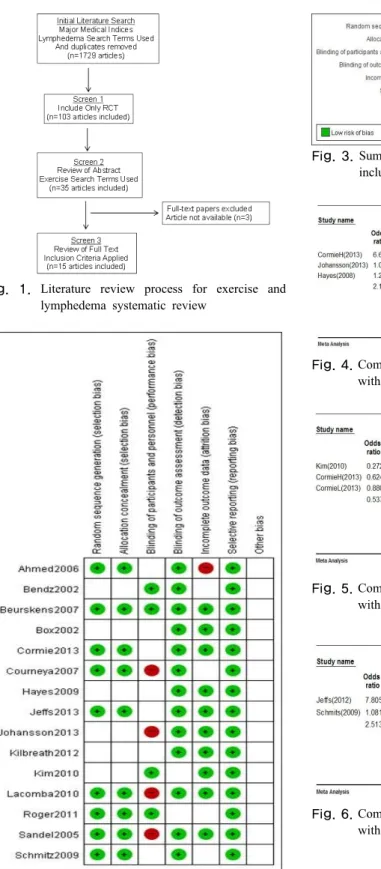
데이터베이스 검색 후 처음에 잠재적으로 관련된 연 구 1729개가 확인되었으며 중복된 것을 삭제하고 RCT 연구만을 포함시킨 후 남은 103개의 논문에 대해 추가 적인 고찰을 시행하였다.
제목과 초록을 검토한 결과 35개의 연구가 포함기준 을 만족하였고 이들 논문을 상세히 검사하였고 15개의 연구 논문이 포함기준을 충족하여 최종 검토 대상으로 하였다.
검토과정의 흐름도는 [Fig. 1]에 제시하였다.
2.3 Inclusion criteria
임상적 효과에 대한 가장 강력한 근거를 제공하기 위 하여 출판된 RCT 논문만을 검토 대상으로 포함하였다.
다른 포함기준으로는 이 고찰의 목적을 근거로 하여, 유방암치료로 액와림프절제술을 받고 수술 후 운동프로 그램 요법(웨이트 트레이닝, 유산소 강화운동, 스트레칭 과 관절가동범위 운동)을 시행한 후 연구결과 평가를 위 해 다음 중 한 가지 이상의 검사를 시행한 여성으로 하 였다. 검사로는 팔둘레와 팔부피, 림프부종 발생률, 혹은 생체정기저항 분광학검사(bioimpedance spectroscopy, BIS)가 있다.
2.4 Exclusion criteria
남성을 대상으로 한 연구는 제외하였다.
수기 림프 배액, 압박옷이나 피부치료를 통해 단지 울 혈제거요법만을 다룬 연구는 이번 고찰의 초점인 운동과 림프부종의 연관성이라는 목적에 적합하지 않으므로 제 외하였다.
질평가와 자료추출 과정에서 검토자간의 의견불일치 가 있을 경우에는 상호 동의에 의해 해결하였다.
2.5 자료추출 및 질평가
자료추출 도구로 Endnote 7Ⓡ을 사용하였다.
모든 연구는 Cochrane Collaboration group이 개발한 the standard critical appraisal instrument for randomized studies를 이용하여, 두 명의 독립적인 검토자가 면밀하 게 평가하였다.
2.6 자료분석
충분한 자료가 확보된 경우에는 메타분석을 시행하였다.
무작위대조시험 RCT 들을 결합하는 데는 Comprehensive Meta Analysis (CMA, Version 2.2) 소 프트웨어를 사용하였다.
발생률과 같은 이분척도 자료에는 교차비 (odds ratio, OR)를 95% 신뢰구간(confidence intervals, CI)과 함께 표기하여 치료 영향을 나타내었다.
부피, 둘레와 같은 동일한 측정법으로 얻어진 연속자 료에는 weighted mean difference (WMD)를 계산하여 그 결과를 통계프로그램(CMA)을 이용하여 교차비(OR) 로 전환시켰다. 모든 포인트 추정값은 연관된 95% CI와 함께 보고하였다.
비교대상이 되는 RCT 결과들은 비균질성을 위한 random effects estimates, 95% CI, 카이제곱검정 (Chi2test)기법과 I2통계를 이용하여 그 결과들을 혼합 분 석하였다.
3. 결과
3.1 대상연구들의 요약
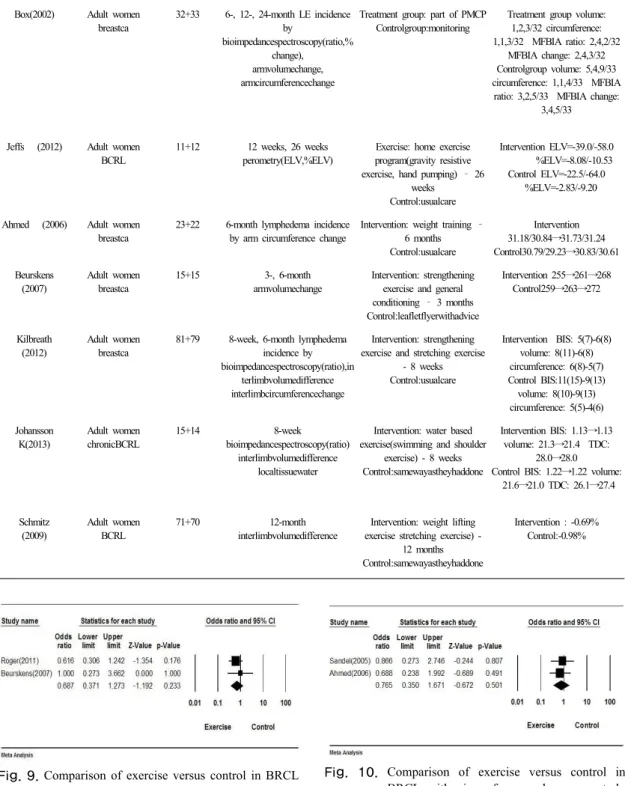
분석한 15개의 연구와 각 연구의 자세한 사항은 표에 나열하였다(Table 1).
모든 연구는 액와림프 절제술을 포함한 유방암수술을 받은 환자를 대상으로 한 RCT로서 2002년에서 2013년 사이에 출판되었다.
모든 연구에서 연구 참가자들은 개입(중재)군이나 대 조군에 무작위로 할당되었고 각 군의 수는 거의 동일하 였으며, 기초적 특성은 중재군과 대조군 사이에 잘 일치 되었다.
3.2 Risk of bias in included studies 바이어스 위험도는 두 명의 저자가 독립적으로 판단 하였다. 요약과 바이어스 위험도표는 [Fig. 2]와 [Fig. 3]
에 나타내었다.
3.3 림프부종 중증도 감소에 대한 운동의 효과 림프부종이 이미 발생한 환자들에서 운동군과 대조군 사이에 차이가 있음을 보고한 연구들이 있다.
예로써, Heyes 2008, Johansson 2013, Cormie 2013 는 BIS 비율을 검사하였고, Kim 2010 과 Cormie 2013 는 이환부 부피의 변화를, Schmits 2009와 Jeff 2012는 부피의 차이를 지수(index)로 하여 운동 효과를 조사하 였다.
이런 모든 연구들은 운동 선호 경향을 보였으나 결과 에 통계학적 유의성은 결여되어 있었다[Fig. 4, 5, and 6].
3.4 림프부종 발생률 감소에 대한 운동의 효과 유방암관련 림프부종 발생률의 차이는 세 개의 연구 에 보고되어 있었다(Box 2002; Lacomba 2010; Kilbreath 2012).
합산된 자료는 운동치료군에 비교하여 대조군에서 통 계적으로 유의하게 높은 림프부종 발생률을 보여주고 있
다(OR: 0.260; 95% CI: 0.118 ~ 0.574) [Fig. 7].
그 외에 림프부종의 발생률과 비슷한 지수들을 이용 하여 보고한 연구가 여섯 개 있었다.
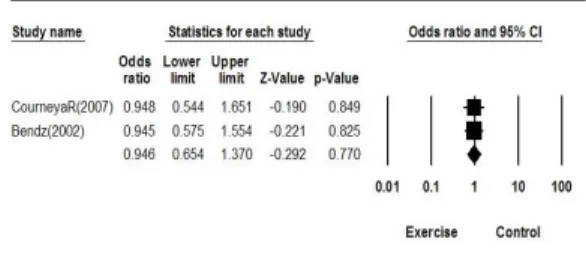
Bendz 2002와 Courneya 2007는 이환부의 부피 차이 를 검사하였고, Beurskens 2007와 Roger 2011는 부피 변화를 보고하였으며, Sandel 2005와 Ahmed 2006는 이 환부의 둘레 변화를 밝혀냈다.
이 연구들의 자료는 운동 선호 경향을 보였으나 결과 에 여전히 통계적 유의성은 보이지 않았다[Fig. 8, 9, 10].
4. 고찰
유방암연관 림프부종은 많은 생존자들에게 계속 큰 문제거리로 남아 있다.
이번의 체계적 검토를 통해, 유방암 환자군에 있어서 운동 연구의 대부분은 지속적으로 림프부종 발생의 위험 도를 다루어 오고 있음을 확인하였다.
림프부종이 발생할 위험성은 유방암 생존자의 여생을 통하여 지속되며, 발생률의 범위는 유방암 진단 후 2년 에 13% [14], 10-40 개월에 17% [15], 18 개월에 30%
[16], 2-6년에 17% [17] 등으로 보고되고 있다.
유방암 외에는 림프부종을 동반하거나 발생 위험을 가진 다른 환자군에서의 운동 중재에 관한 문헌은 제한 적이다.
4.1 암 진단 후 운동의 유익
암생존자에 대한 운동의 다양한 이득이 보고되어 있다.
암 생존자에 대한 운동 지침인 The 2010 American College of Sports Medicine (ACSM) Exercise Guidelines for Cancer Survivors에서는 “암생존자들이 당면하는 심리적 그리고 생리적 시험의 일부는 운동을 통하여 예방, 약화, 치료 또는 재활할 수 있다”고 명시하 였다[18].
이러한 운동의 이득에는 유연성 증가, 피로 감소, 강 도 힘 세기의 증가, 신체상과 삶의 질향상, 신체조성 개 선 그리고 불안 감소가 포함된다. 더욱이 ACSM 지침은 운동이 암의 재발이나 이차암 발생 위험성을 감소시키는 것과도 연관된다고 인용하고 있다.
암치료 과정에서의 운동 효과에 대한 추가적인 두 개 의 문헌 고찰 역시 운동이 생리적, 심리적 이득을 제시하
는 것으로 결론내렸다[19, 20].
림프부종의 위험이 있거나 이전에 림프부종으로 진단 되었던 경험이 있는 환자에서 운동의 효과는 최근까지도 논쟁의 여지가 있다.
하지만 운동은 근골격계의 펌프기전의 활성화로 정맥 혈과 림프액의 환류를 증가시키는 등 실제적으로 림프부 종의 위험성에 있어서 팔다리에 생리적 이점을 많이 부 여해준다[21, 22]. 게다가 상체운동은 림프관에 대한 교 감신경계의 구동을 재설정함으로써 장기적으로 림프부 종의 관리에 보조적 역할을 수행할 수 있는 것으로 가정 된다[22].
4.2 운동의 림프부종 예방 효과
이번 체계적 검토에서는 유방암 후 림프부종 발생율 을 보고한 연구들에서, 운동치료군은 대조군에 비교하여 발병률이 낮은 것으로 드러났으며, 발병률과 유사한 다 른 지표들을 이용한 비슷한 연구들 역시 비록 통계적 유 의성은 없었으나 운동치료가 선호되는 경향을 보였 다.[23-25]
4.3 기존의 림프부종을 가진 환자에 대한 운 동의 효과
이미 림프부종이 발생해 있는 환자에서 진행의 차이 점을 보고한 연구들에서는 주로 BIS ratio, 이환부 팔의 부피 변화, 혹은 양팔의 부피 차이를 관찰함으로써 운동 의 효과를 조사하였었는데, 예방 효과와는 달리 운동을 시행한 군은 림프부종의 진행이 덜한 것처럼 보이기는 하였지만 메타분석 결과로는 통계적 유의성은 없었 다.[26-31]
4.4 제한점
본 체계적 고찰은 1966년에서 2014년까지 영어로 출 판된 상호 심사 논문만을 대상으로 한 한계가 있다.
게다가 많은 연구가 각 연구 방법과 결과의 이질성과 다양성으로 인해 메타분석에서 결합되지 못하였다.
Fig. 1. Literature review process for exercise and lymphedema systematic review
Fig. 2. Summary of the study authors' review on the sources of bias for each included study
Fig. 3. Summary of the sources of bias for the studies included in this review
Fig. 4. Comparison of exercise versus control in BCRL with BIS ratio as the study outcome.
Fig. 5. Comparison of exercise versus control in BCRL with volume change as the study outcome.
Fig. 6. Comparison of exercise versus control in BCRL with volume difference as the study outcome.
Author Participants Sample size (Intervention+Co
ntrol)
Outcomes Intervention Results
Roger T(2011)
Adult women stageI~IIIbreastca
52+52 18-month
armvolume change
Exercise: aerobic warm up, walking, resistance exercise,
stretching (RESTOREprogram)-6months
Control:usualcare
Intervention: 33.5 ml Control:60.4ml(p=0.56)
Sandel(2005) Adult women breastca
19+19 13-and 26-week
armcircumferencechange
Exercise: aerobic warm up, core exercise, dance movement
wrapup–12weeks Control:usualcare
Intervention: 120.1 cm→120.1 cm Control:112.8cm→113.6cm
Kim(2010) Adult women BCRL
20+20 8-week
armvolumechange
Exercise: Remedial exercise + resistive exercise – 8 weeks
Control:Remedialexercise
Intervention: 4987 cc→4012 cc Control:4744cc→4036cc
Lacomba(2010) Adult women breastca
59+57 12-month
lymphedemaincidence changeinvolumeratio maximumcircumferencechange
Exercise: Resistive exercise + stretching exercise + PNF
exercise – 9 weeks Control:onlyeducation
Intervention: volume increase 1.6% /0.68 cm Control: volume increase 5.1%
/1.15 cm incidenceOR=0.22 Courneya(2007) Adult women
stageI~IIIA undergoingadjuva
ntchemotherapy
78+82+82 Median 17-week
LEincidence;
Armvolumedifference
Resistive exercise: 60~70% of 1RM
Aerobicexercise:60%ofVO2max Control:noexercise(median17week)
Resistive exercise: -9 mL, 3/82 (3.7%)
Aerobicexercise:-4mL,7/78(9.0%) Control:-5mL6/82(7.3%)
Bendz(2002) Adult women breastca
101+104 6-month, 2-year
LEincidence;
Armvolumedifference
Early exercise: start at pod 1 Delayedexercise:startatpod14
Early exercise: 102.3 mL/103.7 mL, 5%/13%
Delayedexercise:103.0mL/104.5mL, 4%/12%
Hayes(2008) Adult women BCRL
16+16 12-week, 24-week
bioimpedancespectroscopy(ratio) perometry(volumedifference)
Exercise: aerobic exercise + resistive exercise – 12 weeks
Control:usualcare
Intervention BIS=-0.01/0.02 volume=13/2 ControlBIS=0.00/0.01volume=43/19 Cormie(2013) Adult women
BCRL
22+21+19 3-month
bioimpedancespectroscopy(ratio) armvolumechange armcircumferencechange
High load resistive exercise:
75-85% of 1RM Lowloadresistiveexercise:55-65%
of1RM
Control:noexercise (3 months)
High load resistive exercise BIS: -0.2 volume: -53.5
circumference: -0.9 Lowloadresistiveexercise BIS: -1.6
volume: 98.5 circumference: 0.3 Control BIS: -0.9 volume: 1.6
circumference: -1.7 Table 1. Summary of the RCTs included in the review
Fig. 7. Comparison of exercise versus control in BCRL
with lymphedema incidence as study outcome. Fig. 8. Comparison of exercise versus control in BRCL with volume change as the study outcome.
Box(2002) Adult women breastca
32+33 6-, 12-, 24-month LE incidence by
bioimpedancespectroscopy(ratio,%
change), armvolumechange, armcircumferencechange
Treatment group: part of PMCP Controlgroup:monitoring
Treatment group volume:
1,2,3/32 circumference:
1,1,3/32 MFBIA ratio: 2,4,2/32 MFBIA change: 2,4,3/32 Controlgroup volume: 5,4,9/33 circumference: 1,1,4/33 MFBIA ratio: 3,2,5/33 MFBIA change:
3,4,5/33
Jeffs (2012) Adult women BCRL
11+12 12 weeks, 26 weeks perometry(ELV,%ELV)
Exercise: home exercise program(gravity resistive exercise, hand pumping) – 26
weeks Control:usualcare
Intervention ELV=-39.0/-58.0 %ELV=-8.08/-10.53
Control ELV=-22.5/-64.0 %ELV=-2.83/-9.20
Ahmed (2006) Adult women breastca
23+22 6-month lymphedema incidence by arm circumference change
Intervention: weight training – 6 months Control:usualcare
Intervention 31.18/30.84→31.73/31.24 Control30.79/29.23→30.83/30.61 Beurskens
(2007)
Adult women breastca
15+15 3-, 6-month
armvolumechange
Intervention: strengthening exercise and general conditioning – 3 months Control:leafletflyerwithadvice
Intervention 255→261→268 Control259→263→272
Kilbreath (2012)
Adult women breastca
81+79 8-week, 6-month lymphedema incidence by bioimpedancespectroscopy(ratio),in
terlimbvolumedifference interlimbcircumferencechange
Intervention: strengthening exercise and stretching exercise
- 8 weeks Control:usualcare
Intervention BIS: 5(7)-6(8) volume: 8(11)-6(8) circumference: 6(8)-5(7) Control BIS:11(15)-9(13)
volume: 8(10)-9(13) circumference: 5(5)-4(6) Johansson
K(2013)
Adult women chronicBCRL
15+14 8-week
bioimpedancespectroscopy(ratio) interlimbvolumedifference
localtissuewater
Intervention: water based exercise(swimming and shoulder
exercise) - 8 weeks Control:samewayastheyhaddone
Intervention BIS: 1.13→1.13 volume: 21.3→21.4 TDC:
28.0→28.0 Control BIS: 1.22→1.22 volume:
21.6→21.0 TDC: 26.1→27.4
Schmitz (2009)
Adult women BCRL
71+70 12-month
interlimbvolumedifference
Intervention: weight lifting exercise stretching exercise) -
12 months Control:samewayastheyhaddone
Intervention : -0.69%
Control:-0.98%
Fig. 9. Comparison of exercise versus control in BRCL with lymphedema incidence as study outcome.
Fig. 10. Comparison of exercise versus control in BRCL with circumference change as study outcome.
5. 결론
이번의 림프 부종 예방 및 치료에 대한 운동의 효과에 대한 근거를 알아보고자 했던 문헌고찰에서 유방암 후 림프부종 발생율을 보면, 운동치료군은 대조군에 비교하 여 발병률이 낮은 것으로 드러났으며, 이미 림프부종이 발생해 있는 환자들에서 진행의 차이점을 보면 통계적 유의성은 없었지만 운동치료군은 림프부종의 진행이 덜 한 양상을 보였다.
많은 연구들이 있었지만, 각 연구 방법과 결과의 이질 성과 다양성으로 인해 메타분석에서 결합되지 못하는 등 한계점이 나타나 편향을 좀 더 최소화하고 최적의 치료 법을 찾아낼 수 있는 연구디자인을 갖춘 림프부종의 관 리에 관한 추가적인 연구가 필요한 실정이며, 림프부종 관리에 대한 운동 처방 평가를 위해 운동 빈도, 기간, 방 식, 강도, 진행전략 등 포괄적인 정보가 필요할 것이다.
향후의 연구는 림프배액에 가장 큰 효과를 줄 수 있는 운동을 찾아내고, 암치료의 각 단계마다에서 효능을 평가 할 수 있어야 할 것이고, 그렇게 함으로써, 이차성 림프부 종의 예방, 회복, 관리에 대한 운동의 기여뿐만 아니라 암 생존자들의 건강과 웰빙에 대한 운동의 장기적인 효과를 조사하는 전향적 연구에 도움이 되리라 생각된다.
References
[1] J. M. Armer, “The problem of post-breast cancer lymphedema: impact and measurement issues”, Cancer Invest, Vol.23, pp.76–83, 2005.
DOI: http://dx.doi.org/10.1081/CNV-48707
[2] C. A. Harwood, P. S. Mortimer, “Causes and clinical manifestations of lymphatic failure”, Clin Dermatol, Vol.13, pp.459–471, 1995.
DOI: http://dx.doi.org/10.1016/0738-081X(95)00096-X [3] P. S. Mortimer, “The pathophysiology of lymphedema.
Cancer”, Vol.83(12 Suppl American), pp.2798–2802, 1998.
[4] V. S. Erickson, M. L. Pearson, P. A. Ganz, J. AdamsJ, K. L. Kahn, “Arm edema in breast cancer patients”, J Natl Cancer Inst, Vol.93, pp.96–111, 2001.
DOI: http://dx.doi.org/10.1093/jnci/93.2.96
[5] Y. M. Lee, S. S. Mak, S. M. Tse, S. J. Chan,
“Lymphoedema care of breast cancer patients in a breast care clinic: a survey of knowledge and health practice”, Support Care Cancer, Vol.9, pp.634–641, 2001.
DOI: http://dx.doi.org/10.1007/s005200100270
[6] C. Doyl, L. H. Kushi, T. Byers, K. S. Courneya, W. D.
Wahnefried, B. Grant, et al, “Nutrition and physical
activity during and after cancer treatment: an American Cancer Society guide for informed choices”, CA Cancer J Clin, Vol.56, pp.323–353, 2006.
DOI: http://dx.doi.org/10.3322/canjclin.56.6.323
[7] World Cancer Research Fund/American Institute for Cancer Research. Food, Nutrition, Physical Activity, and the Prevention of Cancer: a Global Perspective.
Washington DC, AICR, 2007.
[8] B. Cheema, C. A. Gaul, K. Lane, M. A. Fiatarone Singh.
“Progressive resistance training in breast cancer: a systematic review of clinical trials”, Breast Cancer Res Treat, Vol.109, pp.9–26, 2008.
DOI: http://dx.doi.org/10.1007/s10549-007-9638-0 [9] P. A. Ganz, “The quality of life after breast cancer—
solving the problem of lymphedema”, N Engl J Med, Vol.340, pp.383–385. 1999.
DOI: http://dx.doi.org/10.1056/NEJM199902043400511 [10] S. G. Rockson, “Precipitating factors in lymphedema:
myths and realities”, Cancer, Vol.83(12 Suppl American), pp.2814–2816, 1998.
[11] D. C. McKenzie, “Abreast in a boat – a race against breast cancer”, CMAJ, Vol.159, pp.376–378, 1998.
[12] S. R. Harris, S. L. Niesen-Vertommen, “Challenging the myth of exercise-induced lymphoedema following breast cancer: a series of case report”, J Surg Oncol, Vol.74, pp.95–99, 2001.
DOI:http://dx.doi.org/10.1002/1096-9098(200006)74:2<
95:: AID-JSO3>3.0.CO;2-Q
[13] K. Lane, D. Worsley, D. McKenzie, “Exercise and the lymphatic system: implication for breast-cancer survivors”, Sports Med, Vol.35, pp.461–471, 2005.
DOI: http://dx.doi.org/10.2165/00007256-200535060-00001 [14] A. Sagen, R. Karesen, M. A. Risberg, “Physical activity
for the affected limb and arm lymphedema after breast cancer surgery: A prospective, randomized controlled trial with two years follow-up”, Acta Oncol, Vol.48, pp.1102–1110, 2009.
DOI: http://dx.doi.org/10.3109/02841860903061683 [15] R. L. Ahmed, W. Thomas, D. Yee, K. H. Schmitz,
“Randomized controlled trial of weight training and lymphedema in breast cancer survivors”, J Clin Oncol.
Vol.24, pp.2765–2772, 2006.
DOI: http://dx.doi.org/10.1200/JCO.2005.03.6749 [16] S. C. Hayes, H. R. Hirche, J. Turner, “Exercise and
secondary lymphedema: safety, potential benefits, and research issues”, Med Sci Sports Exerc, Vol.41, pp.483 –489, 2009.
DOI: http://dx.doi.org/10.1249/MSS.0b013e31818b98fb [17] K. H. Schmitz, R. L. Ahmed, A. B. Troxel, A. Cheville,
L. L. Grant, R. Smith, et al, “Weight lifting for women at risk for breast cancerrelated lymphedema: a randomized trial”, JAMA, Vol.304, pp.2699–2705, 2010.
DOI: http://dx.doi.org/10.1001/jama.2010.1837
[18] K. H. Schmitz, K. S. Courneya, C. Matthews, W. D.
Wahnefried, D. A. Galvao, B. M. Pinto, et al, “American College of Sports Medicine roundtable on exercise guidelines for cancer survivors”, Med Sci Sports Exerc, Vol.42, pp.1409–1426, 2010.
DOI: http://dx.doi.org/10.1249/MSS.0b013e3181e0c112
[19] S. Y. McCaughan, S. M. Arzola, “Exercise intervention research for patients with cancer on treatment”, Semin Oncol Nurs, Vol.23, pp.264–274, 2007.
DOI: http://dx.doi.org/10.1016/j.soncn.2007.08.004 [20] M. Markes, T. Brockow, K. L. Resch, “Exercise for
women receiving adjuvant therapy for breast cancer”, Cochrane Database Syst Rev, CD005001, 2006 DOI: http://dx.doi.org/10.1002/14651858.cd005001.pub2 [21] A. P. Sander, “A safe and effective upper extremity
resistive exercise program for woman post breast cancer treatment”, Rehabil Oncol, Vol.26, pp.3–10, 2008.
[22] D. Bicego, K. Brown, M. Ruddick, D. Storey, C. Wong, S. R. Harris, “Exercise for women with or at risk for breast cancer-related lymphedema”, Phys Ther, Vol.86, pp.1398–1405, 2006.
DOI: http://dx.doi.org/10.2522/ptj.20050328
[23] M. T. Lacomba, M. J. Y. Sanchez, A. Z. Goni, D. P.
Merino, E. S. Tellez, E. M. Mogollon, “Effectiveness of early physiotherapy to prevent lymphedema after surgery for breast cancer”, BMJ, Jan 12, 340:b5396, 2010.
DOI: http://dx.doi.org/10.1136/bmj.b5396
[24] R. C. Box, H. M. Reul-Hirche, J. E. Bullock-Saxton, C.
M. Furnival, “Physiotherapy after breasr cancer surgery:
result of a randomised controlled study to minimise lymphedema” Brest Cancer Research and Treatment, Vol.75, pp51-64, 2002
DOI: http://dx.doi.org/10.1023/A:1016571204924 [25] S. L. Kilbreath, K. M. Refshauge, J. M. Beith, J. C.
Ward, M. Lee, J. M. Simpson, R. Hansen, “Upper limb progressive resistance training and stretching exercises following surgery for early breast cancer: a randomized controlled trial”, Breast Cancer Res Treat, Vol.133(2), pp.667-676, 2012.
DOI: http://dx.doi.org/10.1007/s10549-012-1964-1 [26] D. S. Kim, Y. J. SimJ, H. J. Jeong, G. C. Kim, “Effect
of active resistive exercise on breast cancer-related lymphedema: a randomized controlled trial”, Arch Phys Med Rehabil, vol.91(12), pp.1844-1848, 2010.
DOI: http://dx.doi.org/10.1016/j.apmr.2010.09.008 [27] S. C. Hayes, H. Reul-Hirche, J. Turner, “Exercise and
secondary lymphedema: safety, potential benefits, and research issues”, Med Sci Sports Exerc, vol.41(3), pp.483-489, 2009.
DOI: http://dx.doi.org/10.1249/MSS.0b013e31818b98fb [28] P. Cormie, K. Pumpa, D. A. Galvão, E. Turner, N. Spry,
C. Saunders, Y. Zissiadi, R. U. Newton, “Is it safe and efficacious for women with lymphedema secondary to breast cancer to lift heavy weights during exercise: a randomised controlled trial”, J Cancer Surviv, vol.7(3), pp.413-424, 2013.
DOI: http://dx.doi.org/10.1007/s11764-013-0284-8 [29] E. Jeffs, T. Wiseman, “Randomised controlled trial to
determine the benefit of daily home-based exercise in addition to self-care in the management of breast cancer- related lymphoedema: a feasibility study”, Support Care Cancer. vol.21(4), pp.1013-1023, 2012.
DOI: http://dx.doi.org/10.1007/s00520-012-1621-6 [30] K. Johansson, S. Hayes, R. M. Speck, K. H. Schmitz,
“Water-based exercise for patients with chronic arm lymphedema: a randomized controlled pilot trial”, Am J Phys Med Rehabil. vol.92(4), pp.312-319, 2013.
DOI: http://dx.doi.org/10.1097/PHM.0b013e318278b0e8 [31] K. H. Schmitz, R. L. Ahmed, A. Troxel, A. Cheville, R.
Smith, L. Lewis-Grant, C. J. Bryan, C. T. Williams- Smith, Q. P. Greene, “Weight lifting in women with breast-cancer-related lymphedema”, N Engl J Med.
vol.361(7), pp.664-673, 2009.
DOI: http://dx.doi.org/10.1056/NEJMoa0810118
김 경 희(Kim Kyoung Hee) [정회원]
• 2000년 2월 : 고려대학교 의과대 학 의학과 (의학사)
• 2004년 2월 : 고려대학교 대학원 의학과 (의학석사)
• 2008년 2월 : 고려대학교 대학원 의학과 (의학박사)
• 2007년 10월 ~ 현재 : 가천의대 길병원 교수
<관심분야>
유전, 면역
오 기 영(Ki Young Oh) [정회원]
• 1996년 2월 : 한양대학교 의과대 학 의학과 (의학사)
• 2006년 2월 : 강원대학교 대학원 의학과 (의학석사)
• 2010년 8월 : 한양대학교 대학원 의학과 (의학박사)
• 2005년 9월 ~ 현재 : 순천향대학 교 의학과 교수
<관심분야>
운동치료, 재활