http://dx.doi.org/10.5468/ogs.2016.59.5.367 pISSN 2287-8572 · eISSN 2287-8580
Introduction
The polycystic ovary syndrome (PCOS) is the most common endocrine disturbance [1], affecting 5% to 8% of women of reproductive age [2]. PCOS is defined as a multi-system disorder [3]. Obesity, hypertension, diabetes mellitus type 2, dyslipidemia and cancer commonly are coexisted in women with PCOS [4]. Women with PCOS are more likely to suffer complications of pregnancy than women with normal ovaries and these include increased risk of miscarriage, gestational diabetes and pre-eclampsia [5]. A meta-analysis in 2009 has reported the significantly association between women with PCOS and endometrial cancer (odds ratio [OR], 2.70; 95%
confidence interval [CI], 1.00 to 7.29) [6].
Breast cancer is the second most frequent type of cancer in the world and the most common among women in the devel- oped and the developing countries [7,8]. The relationship be- tween PCOS and breast cancer is complicated by the fact that PCOS is associated with factors that both increase (later age at
first pregnancy) and reduce (later age at menarche, anovulatory cycles) the risk of breast cancer. Also, obesity is a major risk fac- tor for breast cancer and is often linked with PCOS [9].
Several epidemiological studies investigated the associa- tion between PCOS and the breast cancer, but the results are inconsistent [10-13]. In a meta-analysis of three comparative
The association between polycystic ovary syndrome and breast cancer: a meta-analysis
Fatemeh Shobeiri, Ensiyeh Jenabi
Mother and Child Care Research Center, Hamadan University of Medical Sciences, Hamadan, Iran
Objective
The results of epidemiological studies investigated the association between polycystic ovary syndrome (PCOS) and the breast cancer are inconsistent. This meta-analysis was conducted to estimate the association between PCOS and the breast cancer risk. We searched PubMed, Web of Science, and Scopus for observational studies until June 2015. Data were independently extracted and analyzed using 95% odds ratio, and confidence intervals (CIs) based on the random- effects models.
Methods
We identified 970 references and conducted eight studies with 45,470 participants and 243,064 person- year.
Results
The association between PCOS and the breast cancer risk in case-control studies 0.87 (95% CI, 0.44 to 1.31) and that of cohort studies was estimated 1.18 (95% CI, 0.93 to 1.43).
Conclusion
This meta-analysis demonstrated that PCOS no does increase the risk of breast cancer. Further prospective cohort studies are needed to provide convincing evidence in order to PCOS can increase or not effect on the risk of the breast cancer.
Keywords: Breast neoplasms; Case-control studies; Cohort studies; Meta-analysis; Polycystic ovary syndrome
Articles published in Obstet Gynecol Sci are open-access, distributed under the terms of the Creative Commons Attribution Non-Commercial License (http://creativecommons.
org/licenses/by-nc/3.0/) which permits unrestricted non-commercial use, distribution, and reproduction in any medium, provided the original work is properly cited.
Copyright © 2016 Korean Society of Obstetrics and Gynecology Received: 2016.2.11. Revised: 2016.3.27. Accepted: 2016.4.4.
Corresponding author: Ensiyeh Jenabi
Mother and Child Care Research Center, Hamadan University of Medical Sciences, Shahid Fahmideh Avenue, Hamadan 6517838695, Iran Tel: +98-81-38380090 Fax: +98-81-38380509
E-mail: [email protected]
http://orcid.org/0000-0002-4536-0814
studies, Barry et al. [3] showed that the risk of breast cancer was not significantly increased in women with PCOS. They searched Embase and Medline databases. The present meta- analysis conducted to estimate the overall effect PCOS on the breast cancer in women of reproductive age based on the current evidence.
Materials and methods
1. Criteria for including studies
The outcome of interest was breast cancer. The exposure of interest was PCOS. Epidemiological studies, including Cohort, case-control, and cross-sectional studies were included so as to address the relationship between PCOS and breast cancer, irrespective of age, race, publication date and language.
2. Search methods
The key words used were “carcinoma or cancer or tumor or malignancy” and “polycystic ovar or polycystic ovary syn- drome” and “breast”. Major electronic databases including PubMed, Web of Science, and Scopus were searched until June 2015. In order to find additional references, the refer- ence lists of the included studies were screened. In addition,
we contacted the authors of the studies for more potentially eligible studies. Furthermore, the conference databases were searched.
3. Data collection and analysis
Two authors independently made the decision on which stud- ies met the inclusion criteria for the objective of this meta- analysis. Any disagreement was resolved after a discussion by the authors. Two authors extracted the data from the includ- ed studies. The variables extracted for analysis contained the first author’s name, the year and the country where the study was conducted, study design, age mean/range (year), sample size, the effect measure and its 95% CI.
We assessed the risk of bias among the included studies us- ing Grades of Recommendation, Assessment, Development, and Evaluation (GRADE) considering the following key ele- ments: limitation, consistency, directness, precision, reporting bias, strength, gradient, and confounding [14].
4. Heterogeneity and publication bias
The statistical heterogeneity was explored applying the Q- test. The I
2statistic was used for assessing inconsistency in the results [15]. The potential for publication bias was examined by the Egger’s [16] and Begg’s [17] tests and was visualized
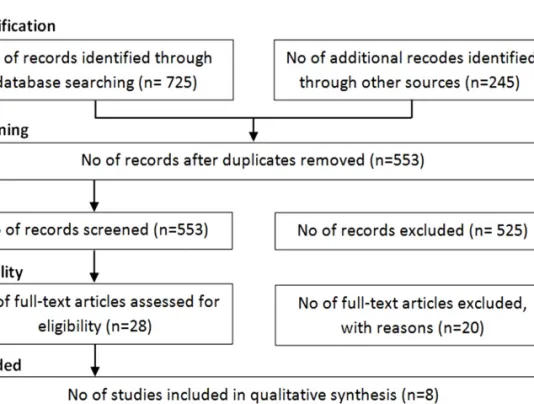
Fig. 1. Flow of information
through the different phases of the
meta-analysis.
using a funnel plot. The OR and its associated 95% CI were mentioned as a measure of the association between PCOS and the breast cancer risk. Wherever reported, we employed the full adjusted forms of OR controlled for at least one or more of the potential confounding factors such as age, in- come, oral contraceptive, Body mass index, family history of breast carcinoma and menopause status. Data were analyzed and the results were employed for using of a random-effects model [18]. Since the results and the number of the included studies were respectively homogenous and limited, no sub- group analysis was performed. All statistical analyses were performed at a significance level of 0.05 using the Stata ver.
11 (StataCorp, College Station, TX, USA).
Results
We identified 970 references, 725 references through search- ing electronic database and 245 references after checking ref- erence lists. No reference was found through searching con- ference databases. Four hundred and seventeen duplicates and 525 irrelevant references were excluded after reading titles and abstracts, while 20 were excluded after reviewing full texts (Fig. 1). Eight studies remained for the final meta- analysis, which included 45,470 participants and 243,064 person-year: five cohort [11-13,19,20], and three case-control studies [10,21,22] (Table 1).
The relationship between PCOS and breast cancer is shown Table 1. Summary of studies results
Author (year) Country Design Age (yr) Measure Adjustment Sample size
a)Shen et al. (2015) [13] Taiwan Cohort 27.05 Related risk Unadjusted 17,830
Gottschau et al. (2015) [12] Denmark Cohort 24–34 Related risk Adjusted 12,070
Talamini et al. (1997) [21] Italy Case-control 55 Odds ratio Unadjusted 5,157
Ghasemi et al. (2010) [10] Iran Case-control 44.2 Odds ratio Adjusted 332
Coulam et al. (1983) [20] USA Cohort No data Related risk Adjusted 14,510
Anderson et al. (1997) [11] USA Cohort 55–69 Related risk Unadjusted 228,554
Baron et al. (2001) [22] USA Case-control 64.7 Odds ratio Unadjusted 9,295
Wild et al. (2000) [19] UK Cohort 56.7 Odds ratio Adjusted 786
a)
Year or person year.
Fig. 2. Forest plot of the associa-
tion between polycystic ovary syn-
drome and breast cancer.
in Fig. 2. Based on OR estimates obtained from case-control studies and related risk from cohort studies, there was no significantly association between PCOS and the breast cancer
(0.87; 95% CI, 0.44 to 1.31) and (1.18; 95% CI, 0.93 to 1.43), respectively.
The I
2statistics and Cochran homogeneity test revealed no evidence of heterogeneity among the included studies address- ing the association between PCOS and breast cancer in case- control studies (5.2%, P=0.348) and in cohort studies (0%, P=0.721). Publication bias was employed using Begg’s and Egger’s tests and was visualized employing a funnel plot. The Egger regression test and Begg’s test revealed no evidence of publication bias among the included studies that addressed addressing the association between PCOS and the breast can- cer risk (P=0.716 and P=0.621), respectively. No evidence of publication bias was observed in the funnel plots (Fig. 3). Table 2 indicates the quality of the studies assessed using GRADE. As is seen, four studies were moderate in quality while four the other studies had low qualities [10-13,19-22].
Table 2. Quality assessment of studies addressing the association between polycystic ovary syndrome and breast cancer risk Author (year) Design
a)Limita-
tion
b)Consis-
tency
c)Direct-
ness
d)Preci-
sion
e)Report-
ing bias
f)Strength
g)Gradi-
ent
h)Confound-
ing
i)Quality
j)Shen et al.
(2015) [13] Cohort 0 0 0 0 0 0 0 +1 Moderate
Gottschau et al.
(2015) [12]
Cohort -1 0 0 0 0 0 0 0 Low
Talamini et al.
(1997) [21]
Case- control
0 0 0 0 0 0 0 +1 Moderate
Ghasemi et al.
(2010) [10]
Case- control
-1 0 0 -1 0 0 0 0 Low
Coulam et al.
(1983) [20] Cohort -1 0 0 -1 0 0 0 0 Low
Anderson (1997)
et al. [11] Cohort 0 0 0 0 0 0 0 +1 Moderate
Baron (2001) et al. [22]
Wild et al.
(2000) [19]
Case- control
0 0 0 0 0 0 0 +1 Moderate
Shen et al.
(2015) [13]
Gottschau et al.
(2015) [12] Cohort 0 0 0 -1 0 0 0 +1 Low
a)
Randomized trial, cohort study, case-control study, cross-sectional study;
b)(a) Incomparability of the groups, (b) different measurement meth- ods, (c) unmatched or unadjusted, (d) short follow-up (in cohort studies), 1 limitation=-1, ≥2 limitation=-2;
c)Inverse point estimate compared to overall estimate | no overlap overestimate=-1;
d)Interested intervention/exposure, interested outcome, interested population; some (-1) or major (-2) uncertainty about directness;
e)If sample size <2,000 and confidence interval includes 1.0=-1, otherwise=0;
f)Possibility of selective outcome reporting=-1, otherwise=0;
g)RR >2 | <0.5=+1, RR >5 | <0.2)=+2, otherwise=0;
h)≥2 levels of exposure=+1, 1 level of exposure=0;
i)Adjusted/matched=+1, otherwise=0;
j)High: if having no negative score with all positive scores, moderate: if having no negative score with at least one positive score, low: if otherwise.
Fig. 3. Funnel plot of included studies addressing the association between polycystic ovary syndrome and breast cancer. OR, odds ratio.
Begg's of funnel plot with pseudo 95% confidence limits
Standard error of: log[OR]
0 0.1 0.2 0.3 0.4 1
0.5
0
-0.5
log[OR]