The Study of Corrosion Behavior
of Active Screen Plasma Nitrided Stainless Steels
L.H. Chiu†, C.A. Chang, S.H. Yeh, F.S. Chen, and Heng Chang1
Department of Materials Engineering, Tatung University, 40 Chunshan North Road, 3rd Sec., Taipei 10451, Taiwan
1Department of Mechanical Engineering, Chinese Culture University, 55 Hwa Kang Road, Yang Ming Sang, Taipei 11192, Taiwan
Plasma nitriding is a surface treatment process which is increasingly used to improve wear, fatigue and corrosion resistance of industrial parts. Active screen plasma nitriding (ASPN) has both the advantages of the classic cold wall and the hot wall conventional dc plasma nitriding (DCPN) method and the parts to be nitrided are no longer directly exposed to the plasma. In this study, AS plasma nitriding has been used to nitride the UNS S31803 duplex stainless steel, AISI 304 and AISI 316 austenitic stainless steel, and AISI 420 martensitic stainless steel. Treated specimenswere characterized by means of microstructural analysis, microhardness measurements and electrochemical tests in NaCl aerated solutions. Hardness of the nitride cases of AISI 420 stainless steel by Knoop test can get up to 1300 HK0.1. From polarization tests, the corrosion current densities of AISI 420 and UNS S31803specimens ASPN at 420 °C were generally lower than those of their untreated substrates. The corrosion resistance of UNS S31803 duplex stainless steel can be enhanced by plasma nitriding at 420 °C Cowing to the formation of the S-phase.
Keywords: Stainless steel, UNS S31803, Active screen plasma nitriding, Corrosion.
†Corresponding author: [email protected]
1. Introduction
Active screen plasma nitriding is a thermochemical proc- ess to improve surface properties, such as the metallurgical, mechanical, and tribological properties, of various en- gineering materials. The "Active Screen" or cage is in- stalled inside the plasma processing chamber constituted the hot wall of the vessel, and surrounds all parts to be nitrided. Enclosing inside the screen, the workload is heat- ed up by radiation, analogous to cold wall vacuum furnace heating methods, providing a very uniform temperature throughout the entire load. Moreover, the "Active Screen"
produces all necessary active and neutral particles neces- sary to nitride steels, titanium and its alloys.
Plasma nitriding involves the addition of nitrogen into the surface of a treated component. With typically treat- ment temperature between 450 °C and 590 °C, plasma ni- triding is a ferritic treatment and as such produces virtually no distortion to treated components. After plasma nitriding on the stainless steels, the improvement of the wear re- sistances is accompanied with the reduction of its corrosion
resistances, due to chromium nitrides precipitation and de- pletion of chromium in the substrate.1-3 It has been ob- served that plasma nitriding at low temperature on auste- nitic stainless steel produces a hard layer with good corro- sion resistance. This layer contains a super saturated solid solution of nitrogen (N) in austenite, which is formed as the expanded austenite called S-phase or γN.3-6
During active screen (AS) plasma nitriding, the work table and the parts to be treated are placed in a floating potential without sputtering on the sample surface. Active screen plasma nitriding under similar operating parameters has resulted in identical microstructure, case hardness and case depth as conventional dc plasma nitriding.7,8 Howev- er, the surface morphologies of the AS plasma nitrided specimens have been observed to be significantly different from those of the dc plasma nitrided specimens9.
Increasing interest in microstructure and wear resistance of plasma nitrided stainless steels has been shown in recent literatuer.10-11 However, the corrosion behavior of the ni- trided layers is not yet available. In this study, the effect of the processing temperature on the microstructure and corrosion characteristics of the plasma nitrided layers pro- duced on the stainless steels has been investigated in detail.
Table 1. Chemical composition (wt%)
Material C Si Mn Cr Ni Mo
UNS S31803 0.029 0.50 1.52 22.88 5.75 2.99
AISI 316 0.049 0.13 1.95 17.58 11.89 2.53
AISI 304 0.037 0.55 1.36 17.78 8.00 0.04
AISI 420 0.22 0.65 0.93 12.30 0.33 0.02
to 1500-grit, and ultrasonically cleaning in an acetone solution.
Active screen plasma nitriding was carried out in a dc nitriding furnace as shown in Fig. 1. The nitriding process was conducted at 420 °C and 450 °C for 10hrs and 25 hrs in the glow discharge of the plasma. The vacuum chamber was pumped down to 6 Pa and back filled with treatment atmosphere of 50%N2+50%H2 at a pressure of 560 Pa. The cross-sectional microstructures of the speci- mens were observed by optical microscopy (OM) and scanning electron microscopy. The phase of the nitrided layer on the specimen surfaces was characterized by an X-ray diffractometer using Cu-Kα radiation. Microhard- ness measurement was performed by using a Vickers mi- crohardness tester. Potentiodynamic polarization measure-
Fig. 1. Schematic diagram of ASPN facility
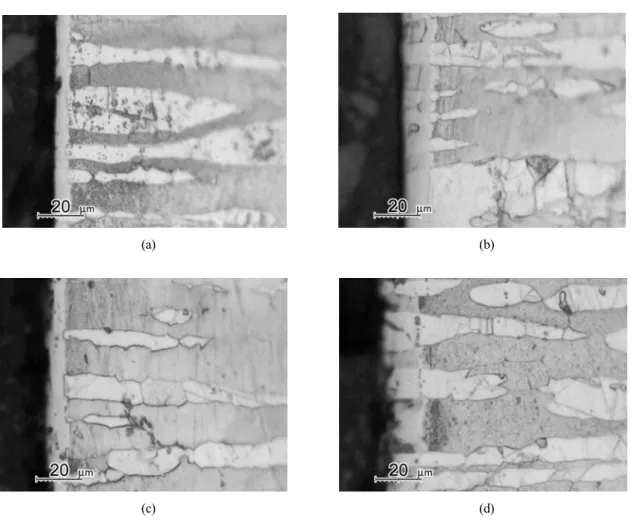
layers produced on UNS S31803 duplex stainless steel by the ASPN treatment. It can be observed that increasing in treatment temperature and time resulted in increment in the nitriding layer thickness from 7 μm to 18 μm. As can be seen in these figs., the α and γ phase can be easily identified. For the specimens treated at 420 °C for 10hrs, the nitrided layers were observed as a single phase formation. However, as the specimens treated for 25 hrs, it can be seen that the layers influenced by the substrates transformed to compound phases.
Fig. 3 compares the nitrided layer thickness of various AS plasma nitrided materials at 420 °C and 450 °C for 10 hrs and 25 hrs. The thickness increase of the nitrided zone was depended on the microstructure of the substrate, the nitriding time, the nitriding temperature, and the Cr content. The nitrided layer thickness of AISI 420 marten- sitic stainless steel specimen has achieved to 40 μm when nitriding treatment was carried out at 450 °C for 25 hrs.
3.2 XRD examinations
Fig. 4 shows the X-ray diffraction patterns of the ASPN AISI 316 stainless steel specimens. In agreement to Li et al.,3 the result demonstrated that the S phase was de- tected on the specimens nitrided at 420 °C but absent at 450 °C.
Fig. 5 shows the X-ray diffraction patterns of the ASPN UNS S31803 duplex stainless steel specimens. The phases of the specimen nitrided at 420 °C for 10hrs were identi- fied to be γN with small amounts of Fe3N on the surface.
The amount of the precipitates increases with increasing
(a) (b)
(c) (d)
Fig. 2. Micrographs of nitrided layer of UNS S31803 specimens by plasma nitriding at various processing conditions, (a) 420°C, 10h, (b) 420°C, 25h, (c) 450°C, 10h and (d) 450°C, 25h
UNS S31803 AISI 316 AISI 304 AISI 420
0 5 10 15 20 25 30 35
40 4500C25h
4500C10h 4200C25h 4200C10h
Depth(um)
Fig. 3. Thickness of the nitrided layer in dependence on the various stainless steels and nitriding conditions
treatment time and temperature. CrN precipitates were ob- served on the specimen nitrided at 450 °C for 25 hrs. It is believed that CrN precipitate has a serious effect on the corrosion resistance of the nitrided specimens.
2θ
Intensity
Fig. 4. X-ray diffraction patterns of ASPN AISI 316 stainless steel specimens
3.3 EPMA measurements
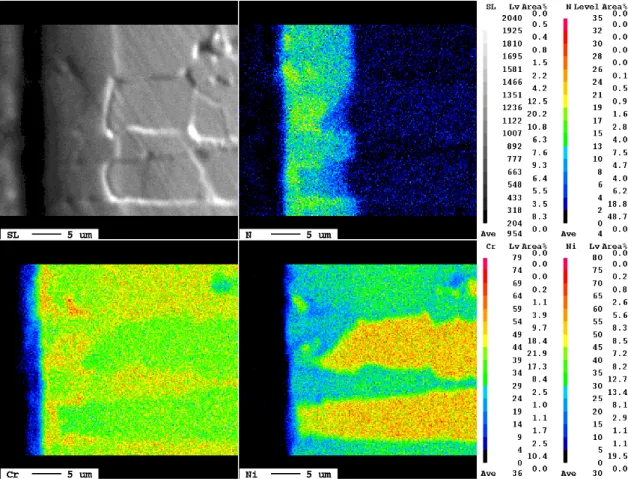
Fig. 6 shows the electron probe microanalysis (EPMA) image of the nitrided layer on the UNS S31803 specimen
Fig. 6. EPMA image of nitrided UNS S31803 duplex stainless steel at 420°C, 25h 2θ
Fig. 5. X-ray diffraction patterns of ASPN UNS S31803 duplex stainless steel specimens
treated at 420 °C for 25 hrs. The amount of nitride precip- itates in the ferrite phase was higher than that in the austen- ite phase. It is due to the nitrogen has rapid diffusion rate in ferrite (BCC) structure than austenite (FCC) structure.
This can be ascribed to the nitrogen diffusion length during
25 hrs. The hardness increases with increasing treatment time and temperature, as the amount of the precipitates increases. The hardness achieved above 1000 HK0.1 for specimens nitrided at 450 °C for 25 hrs. The highest hard- ness was measured to 1300 HK0.1 on AISI 420 martensitic stainless steel specimen.
3.5 Corrosion Behavior
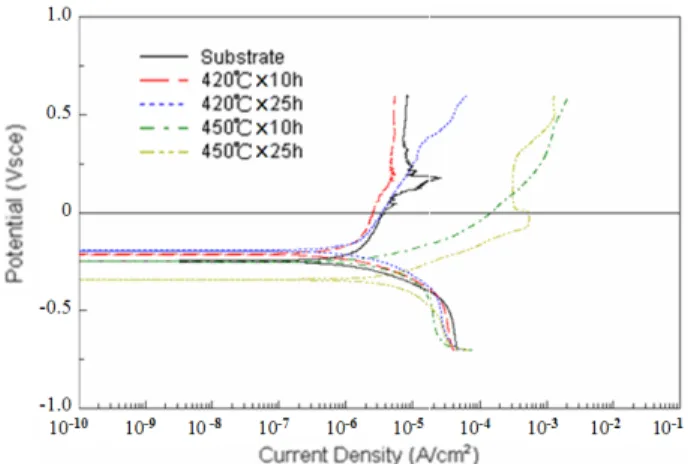
Fig. 9 shows the polarization curves of ASPN UNS S31803 duplex stainless steel specimens at 420 °C and 450 °C for 10 hrs and 25 hrs. According to polarization
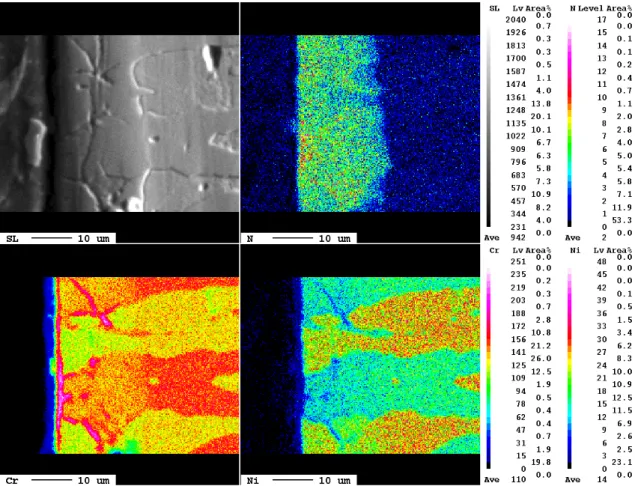
Fig. 7. EPMA image of nitrided UNS S31803 duplex stainless steel at 450°C, 25h
UNS S31803 AISI 316 AISI 304 AISI 420 0
200 400 600 800 1000 1200
1400 4500C25h 4200C25h 4500C10h 4200C10h Substrate
Hardness(HK)
Fig. 8. Microhardness of the nitrided layer in dependence on the various stainless steels and nitriding conditions
data, corrosion potential (Ecorr) was slightly shifted to a noble direction in specimens treated at 420 °C. Corrosion current density (icorr) is slightly lower than, but close to, that for the untreated substrate. As the nitrided treatments were carried out at 450 °C, corrosion potential (Ecorr) was
shifted to a less noble direction. According to Fig. 2 and 7, chromium and iron nitride precipitates dispersed along the grain boundary, pores and surface, and the amount increased with the increase treatment time. Due to the mi- gration of Cr from solid solution to form CrN precipitates, corrosion resistance of the specimens was deteriorated, as observed by other authors.12,13 On the other hand, the plas- ma nitriding at 420 ºC improves corrosion resistance of UNS S31803 specimens. This can be attributed to for- mation of γN phase in specimens treated at 420 ºC.
Fig. 10 shows the polarization curves of nitrided AISI 420 martensitic stainless steel specimens at 420 °C and 450 °C for 10 hrs and 25 hrs. It can be seen that corrosion potential (Ecorr) was generally shifted to a less noble direction. Corrosion current densities (icorr) of the speci- mens nitrided at 420 °C were slightly lower than that of the untreated substrates. The result demonstrated that the specimens nitrided at 420 °C revealed a slight improve- ment of the corrosion behavior over the untreated sub- strates. However, the corrosion resistance of AISI 420 stainless steel specimens nitrided at 450 °C was de- teriorated.
Fig. 9. Polarization curves of nitrided UNS S31803 duplex stain- less steel at 420°C and 450°C for 10h and 25h
Fig. 10. Polarization curves of nitrided AISI 420 stainless steel at 420°C and 450°C for 10h and 25h
4. Conclusions
The experimental results demonstrated that the layer thickness increased with increasing treatment temperature and time. The main phase produced at 420 °C on the ni- trided AISI 316 and AISI 304 stainless steel specimens were identified to be S-phase. The value of surface hard- ness achieved above 1000 HK0.1 for specimens nitrided
Acknowledgments
Financial support of this research by Tatung University, under Contract B95-T11-082 is gratefully acknowledged.
References
1. J. Flis, A. Gajek, Journal of Electroanalytical Chemi- stry, 515, 82 (2001).
2. P. Corengia, G. Ybarra, C. Moina, A.Cabo, E. Broit- man, Surface and Coatings Technology, 187, 63 (2004).
3. C.X. Li, T. Bell, Corrosion Science, 46, 1527 (2004).
4. E. Menthe, A. Bulak, J. Olfe, A. Zimmermann, K.‐T.
Rie, Surface and Coatings Technology, 133‐134, 259 (2000).
5. L. Wang, B. Xu, Z. Yu, Y. Shi, Surface and Coa- tings Technology, 130, 304 (2000).
6. E. Menthe, K‐T. Rie, J.W. Schultze, S. Simson, Sur- face and Coatings Technology, 74‐75, 412 (2000).
7. C.X. Li, T. Bell, Heat Treatment of Metals, 30, 1 (2003).
8. C.X. Li, J. Georges, X.Y. Li, Surface Engineering, 18, 453 (2002).
9. C.X. Li, T. Bell, H. Dong, Surface Engineering, 18, 174 (2002).
10. M. Pohl, A.M. Kliauga, W. Reick, Surface Engineer- ing, 9, 193 (1993).
11. A.M. Kliauga, M. Polhl,, Surface and Coatings Tech- nology, 98, 1205 (1998).
12. F. Borgioli, A. Fossati, E. Galvanetto, T. Bacci, Sur- face and Coatings Technology, 200, 2474 (2005).
13. L. Wang, Applied surface science, 211, 308 (2003).