Nursing Management Minimum Data Sets (NMMDS) 연구의 최신 동향
정면숙
1·박정인
2·Connie W. Delaney
2·Bonnie L. Westra
2경상대학교 간호대학 ․ 건강과학 연구원1, 미국 미네소타 주립대학교 간호대학2
A Review of Practical Use and Research Trends on Nursing Management Minimum Data Sets (NMMDS)
Jung, Myun Sook1 · Park, Jung In2 · Connie W. Delaney2 · Bonnie L. Westra2
1College of Nursing, Institute of Health Sciences, Gyeongsang National University
2School of Nursing, University of Minnesota, Minneapolis, MN, USA
Purpose: The purpose of this study was to review articles on Nursing Management Minimum Data Sets (NMMDS) and to suggest strategies to improve practical use of NMMDS in nursing management. Methods: A systematic search for articles published until 2013 was undertaken using the following biomedical databases: CINAHL, PubMed, and Google scholar. Seventeen articles were fully reviewed. Results: The results showed that studies were related to updating NMMDS reflecting current EHR use, mapping NMMDS to standardized national databases, and validating, translating and evaluating NMMDS for international uses. NMMDS has three dimensions and was developed reflect- ing the needs of nurse managers. Conclusion: The study findings provide a summary of recent trends in NMMDS.
These results can serve as basic information to promote practical use of NMMDS in the healthcare organization to provide nursing management data for nurse managers.
Key Words: Nursing management minimum data sets (NMMDS), Nursing informatics
주요어: Nursing Management Minimum Data Set (NMMDS), 간호정보 Corresponding author: Park, Jung In
School of Nursing, University of Minnesota, 5-160 Weaver-Densford Hall, 308 Harvard Street SE, Minneapolis, MN, 55455, USA.
Tel: +1-612-803-6411, E-mail: [email protected]
- 이 연구는 2011년도 경상대학교 연구년제 연구교수 연구지원비에 의해 수행되었음.
- This work was supported by the Gyeongsang National University Fund for professors on sabbatical leave, 2011.
Received: May 9, 2014 | Revised: Sep 1, 2014 | Accepted: Sep 16, 2014
This is an open access article distributed under the terms of the Creative Commons Attribution Non-Commercial License (http://creativecommons.org/licenses/
by-nc/3.0), which permits unrestricted non-commercial use, distribution, and reproduction in any medium, provided the original work is properly cited.
서 론
1. 연구의 필요성
최근 우리 사회는 정보과학의 발전과 함께 생성되고 있는 양 질의 빅 데이터에 대한 효과적인 활용과 이를 통한 새로운 지식 구축에 대한 관심이 증대되고 있으며, 이는 보건의료 분야에서 도 예외가 아니다. 효과적인 정보의 활용이 이루어지기 위해서 는 우선 유용한 데이터의 축적이 기본이 되어야 한다. 보건의료
분야에서 의사결정의 질은 가치 있는 정보와 지식으로 전환될 수 있는 양질의 데이터에 의해 영향을 받기 때문이다. 특히 간호 정보 측면에서 볼 때 정보가 보건의료체계 내에서 유용한 정보 로서 기여하기 위해서는 보건의료인의 의사결정 지원이나 정책 결정에 필요한 핵심적인 요소들을 포함하고 있어야 하며, 다른 정보와의 호환과 접근이 편리하고 유익해야 한다. 오늘날 간호 정보학에 대한 관심과 필요성은 1970년대 초반부터 시작되어 서 국제적인 관심과 주목을 받으며 확산되었다[1]. 1992년 미국 간호협회 American Nurses Association (ANA)는 간호정보
학을 간호실무의 한 전문분야로 인정하고, ‘간호정보학이란 데 이터와 정보, 지식, 지식, 그리고 간호 실무에서의 지혜를 관리 하고 의사소통하기 위해 간호와 컴퓨터, 그리고 정보과학을 통 합하는 전문 분야’로 정의하였으며[2], 다양한 간호현장에서 정 보학을 활용한 실무와 연구, 교육의 발전으로 이어지면서 간호 전문직 발전의 견인차 역할을 하게 되었다. 이 시기에 이루어진 간호정보학 분야의 활동으로는 간호용어 분류체계 개발, 컴퓨 터 기반의 간호실무 표준, 데이터 표준, 간호최소자료세트 개발 등이 있다.간호사들이 활동하는 보건의료 기관에서 체계적 자 료수집과 정보관리, 그리고 지식구축을 촉진하는 데이터세트 는 간호관리자들이 행정적 의사결정을 지원하는데 매우 필요 한 요소이므로[3-6], 이를 보다 체계적으로 수집, 표준화 하고 기관별 비교 및 다양한 연구를 위해서는 국가적 차원의 데이터 베이스 구축이 요구된다[7]. 그 동안 개발된 표준화된 보건의료 데이터베이스로는 Uniform Hospital Discharge Data Set (UHDDS), Uniform Ambulatory Care Data Set (UACDS), Minimum Data Set for Long Term Care (MDS), Minimum Data Set -Post Acute Care (MDS-PAC) 등이 있다[8]. 간호계 에서는 질 높은 간호를 제공하기 위해서 정보 활용의 필요성 이 어느 전문직보다 강조되어 왔으며, 간호가 제공되는 현장 이나 영역을 넘어서 일관된 정의와 표준화된 데이터 요소들이 필요함에 따라 최소자료세트(Minimum Data Set)가 개발되 었다. 미국 간호협회가 2004년 인준한 13개의 분류체계와 데 이터셋은 North American Nursing Diagnosis Association (NANDA), Nursing Interventions Classification (NIC), Omaha Classification System (OCS), Critical Care Classifi- cation (CCC), Nursing Management Minimum Data Set (NMMDS), Patient Care Data Set (PCDS), Perioperative Nursing Data Set (PNDS), SNOMED CT, Nursing Minimum Data Set (NMDS), International Classification for Nursing Practice (ICNP), ABC codes, 그리고 Logical Observation Identifiers Name and Code (LOINC) 등이다 [7]. 간호계에서 개발된 분류체계와 데이터셋은 나름대로 개별적인 특수 목적을 가지고 개발이 이루어진 것이 많으며. 그 예로 간호행정가를 위 한 Nursing Management Minimum Data Sets (NMMDS), 수술장 간호사들을 위한 Perioperative Nursing Data Set (PNDS)[9], Nursing Minimum Data Set for School Nursing (NDSSN)[10], 조산간호 사업을 위한 Midwifery Nursing Health Data Set[11], 등의 간호의 분야별 데이터세트를 들 수 있다. 이중 Nursing Minimum Data Set (NMDS)은 1985년 개발이 되었으며, 임상의사결정을 지원하는데 필요한 기본적
인 데이터 수집과, 간호를 제공받는 대상자 관련 자료수집의 틀 을 제공한다[12,13]. 또한 임상현장이나 지리적 차이를 넘어서 간호사가 수행하는 모든 현장에서 활용 가능하며, 간호업무의 서술에 필요한 기본적이고 핵심적인 간호데이터 수집을 표준화 하기 위해 이루어진 간호계 최초의 시도로서, 간호요소(nurs- ing care), 인구통계학적 요소(client demographics), 그리고 서비스 요소(service elements)의 세 영역(category)으로 나 뉘고, 여기에는 다시 16개의 요소(elements)가 포함된다. 이중 간호영역에는 간호진단, 간호중재, 간호결과와 간호의 강도가 포함된다[14]. 하지만 이에 대한 지식 및 이해 부족으로 그 활용 은 아직까지 원활하지 못하며[15-17], 국제적인 사용을 위한 i-NMDS 개발도 국제간호협의회(International Council of Nurses, ICN) 및 국제의료정보학회 산하 간호정보학 그룹(In- ternational Medical Informatics Association Nursing Infor- matics Special Interest Group) 지원하에 이루어지고는 있으 나 더딘 실정이다[18]. 또한 간호 행정가들의 관리적 의사결정 을 지원할만한 자료가 부족하다는 약점이 있어, 1989년 간호 관리자의 입장을 반영한 간호관리 최소데이터세트(NMMDS) 가 개발되었다[19-21].
이처럼 체계적인 데이터 수집 및 관리를 가능하게 하고 간호 관리자의 의사결정 지원에 필요함에도 불구하고 NMMDS는 상 대적으로 잘 알려져 있지 않으며 그 활용도 많지 않다. 이에 본 고에서는 NMMDS의 활용을 촉진하고 우리나라 간호현장에서 도 간호관리용 데이터세트의 적용가능성을 알아보기 위해서 NMMDS의 특징 및 구성요소, 연구 동향 및 활용을 중심으로 심도 있게 고찰하고자 한다.
연 구 방 법
1. 연구설계본 연구는 1989년 NMMDS가 개발된 이후부터 2013년까 지 NMMDS와 관련된 연구들을 전수 검색해서 분석 정리하 고, 아직은 우리나라 간호학계에 상대적으로 덜 알려져 있는 상황을 감안해서 지금까지 개발되어온 NMMDS의 특징 및 구 성요소를 간략하게 제시한 문헌고찰 연구이다.
2. 연구대상 및 분석
CINAHL, PubMed 그리고 Google scholar 를 통해 2013 년까지 “Nursing Management Minimum Data Set”과
“NMMDS”로 검색하여 나온 연구자료들을 연구자들이 전문 읽고 분석하였다. 언어는 모두 영어로 이루어졌고 1편의 한글 연구가 있었으며, 결과로서 NMMDS의 연구 동향, 연구방법, 연구결과 및 활용 등을 분석하였다.
연 구 결 과
1. Nursing Management Data Sets의 특징 및 구성요소
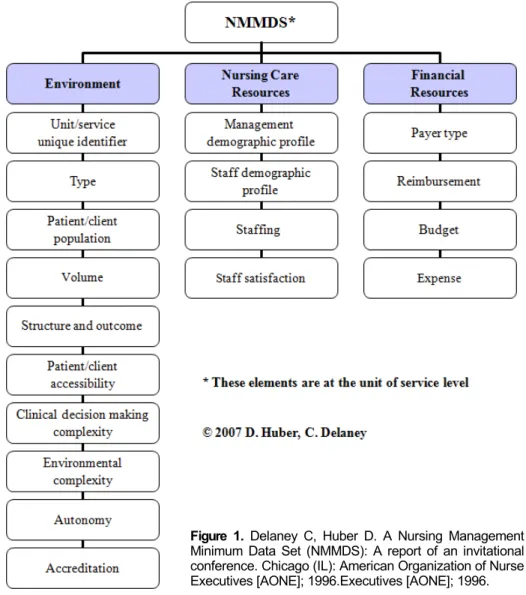
앞서 제시한 NMDS는 환자간호 기록을 좀 더 완전하고 정 확하게 수집할 수 있으며, 간호실무의 서술, 결과연구, 질 모 니터링, 국가 데이터베이스와의 링크를 통한 연구 등 실무와 연구측면의 활용 폭이 넓다. 또한 의사결정과 간호의 질 향상 등을 지원하기 위한 최소간호데이터에의 접근 등이 포함되므 로 보건의료 정책에 활용가능하며 보건의료조직의 내 외부를 비교하기 위한 데이터의 결집을 원활하게 한다[22]. 이러한 기 반 위에서 Huber와 Delaney는 지금까지 간호학계에서 개발 된 NMDS나 기타 다른 여러 데이터셋에서는 간호관리자의 업 무수행에 필요한 간호관리 관련 자료의 확보가 부족하므로 이 러한 변수들이 결집될 수 있는 데이터셋이 필요하다는 인식하 에 NMMDS를 개발하고, 개별 데이터에 대한 임상정보와 간 호관리/ 행정/측면의 데이터세트 간의 갭을 찾아내기 위한 노 력을 기울였다[20]. 즉, NMMDS는 “연구기반의 관리적 데이 터셋(management data set)으로서 간호 관리자의 의사결정 을 위해서 정확하고 신뢰할만한 데이터를 수집할 수 있는 간 호관리 데이터셋이 필요하다는 간호행정가들의 요구에 부응 해서 만들어졌다”[21]. 이러한 NMMDS는 표준화된 정의를 기반으로, 측정 가능하며 모든 보건의료 제공 현장에 적용 가 능하다는 장점을 가지고 있다[19,23]. 개발 당시, NMMDS의 개념적 기반으로는 Donabedian의 구조, 과정, 결과적 기틀과 Iowa Model of Nursing Administration, 그리고 USA Nurs- ing Minimum Data set이 활용되었다. 그 후, NMMDS의 데 이터 요소와 정의에 대한 타당도 검증을 위한 연구가 미국간 호경영자협회 American Organization of Nurse Executives (AONE)로부터 지원을 받아서 이루어졌으며, 초기에는 급성 기 환자 간호기관, 만성관리 기관, 외래 클리닉, 지역사회 셋 팅 등에서 타당도 검증이 이루어졌다 [21]. 1999년, ANA 인정 두 번째 간호용어체계가 된 이후 NMMDS는 현재까지 업데이 트 작업이 지속적으로 이루어지고 있다[24]. NMMDS의 구조 는 크게 환경, 간호 자원, 재정적 자원의 3개 영역(category) 과 18개의 요소들로 이루어져있다(Figure 1) [19]. 이들 각각
의 구조를 살펴보면 다음과 같다.
1) 환경
간호 관리자는 안전하고 질 높은 환자간호를 제공할 수 있 는 환경을 만들기 위해 지속적으로 환경을 관찰하고 평가할 필요가 있다. NMMDS의 3개 영역 중 하나인 환경 영역은 “간 호관리자가 사정하고 조정하며 이끌고 관리하는 간호를 제공 하는 환경측면”을 의미하며[21], 여기에는 10개의 변수가 포 함되어 있다. 이들 변수는 (1) 간호단위/ 서비스의 특성, (2) 간호제공유형, (3) 환자/대상자특성, (4) 제공되는 간호서비스 양, (5) 간호 제공 구조와 결과, (6) 환자/대상자 접근성, (7) 임상의사결정의 복잡성, (8) 환경적 복잡성, (9) 자율성, (10) 간호서비스 제공에 대한 인가 등으로 구성되어 있다.
이들을 좀 더 상세히 살펴보면 (1) 간호단위/ 서비스의 특 성은 고유 기관 식별명, 고유서비스 식별명, 서비스 이름, 고 유 간호단위 식별명, 고유 간호단위명칭, Medicare 지불 영 역, 기관의 위치, 우편번호 등이 포함된다. (2) 간호제공유형 은 가장 정확하게 간호의 수준을 설명하는 서비스의 유형을 제시하는 것으로서 37개 항목이 제시된다. (3) 환자/ 대상자 특성은 간호가 제공되는 대상자의 특성을 말하며 여기에는 간 호나 치료를 받는 분야, 발달단계, 상호작용, 인구학적 특성 등이 포함된다. (4) 제공되는 간호서비스의 양이란 환자, 가 족, 그룹과 지역사회에 제공되거나 가능한 서비스의 양을 기 록한다. (5) 간호제공 구조와 경과요소는 제공된 간호의 형태, 전문적 간호 결과, 그리고 임상적 환자결과 등이 포함된다.
(6) 환자/ 대상자의 접근성은 간호를 제공하기 위해 소요되는 시간과 거리를 의미한다. (7) 임상의사결정의 복잡성은 규칙 성, 획일성, 예측가능성, 전문가적 지식 수준, 환자간호에 관 여되는 정보화 등의 정도에 따라 측정이 된다. (8) 환경적 복 잡성은 환자/ 대상자의 회전율, 환자/대상자 믹스의 다양성, 안정적인가 변동이 많은가를 의미하는 환경 분위기 등을 의미 한다. (9) 자율성은 의사결정 수준, 임상적 자율성, 전문적 자 율성, 간호실무에 대한 통제력, 자신의 지식에 근거해서 활동 하는 자유, 행정적 억압으로부터의 자유, 의사결정에서의 책 임과 참여 기회 등에 따라 차이를 둔다. (10) 간호서비스 제공 에 대한 인가는 간호서비스의 인증이나 자격상태에 따라 기록 한다[19]. 이상의 NMMDS-환경적 요소를 중심으로 살펴보면 이러한 환경적 요소 부분은 간호서비스를 구성하는 환경을 기 반으로 하는 간호기록 작성이 이루어 않고 있는 우리나라의 경우는 사실상 변화되기가 쉽지 않다. 그러나 이러한 간호기 록이 이루어질 때 병원이나 보건의료 기관의 주요 생산요소로
Figure 1. Delaney C, Huber D. A Nursing Management Minimum Data Set (NMMDS): A report of an invitational conference. Chicago (IL): American Organization of Nurse Executives [AONE]; 1996.Executives [AONE]; 1996.
서의 간호서비스가 인정받는 계기가 될 것이다.
2) 간호자원
NMMDS에서 간호자원의 영역은 4개의 기본적인 변수를 포함하며 간호를 제공하는 인적자원 측면을 설명한다. 즉, (1) 관리자의 인구 통계학적 특성, (2) 스텝의 인구통계학적 특성, (3) 인적구성, (4) 직무만족도가 포함된다. 먼저, 관리자의 인 구통계학적 변수는 교육적 배경, 자격증, 성별, 경험, 고유면 허번호, 면허증 타이틀 등이 포함된다. 스텝은 직접 환자간호 를 담당하며 이들의 인구통계학적 변수는 교육, 자격증, 전문 적 조직 멤버십, 평균연령, 책임을 지는 의존적인 사람의 수, 직접 간접 간호제공이 가능한 사람의 수, 서비스 제공 연도 등 이 포함된다. 인적 구성 영역은 직원의 수, 이직, 유지 등의 정보 가 포함된다. 직무만족은 지위(position)와 맥락(context)측면 에서 직접 환자간호를 담당하는 스텝과 관리자 및 지원 스텝
을 나누어서 최근 업무에 대한 긍정적 또는 부정적 감정을 보 고하는 사람의 비율로 측정을 한다[19].
이러한 간호자원 정보는 수집된 자료의 활용을 통해 효과적 인 인적자원관리전략과 중재방안의 계획이 가능해진다. 특히 간호인력의 인적자원관리를 위한 기본적인 데이터의 도출이 가능해서 간호계의 중요 현안 과제인 높은 이직률을 방지하고 직무만족을 높일 수 있는 전략을 도출하는데 유용하게 활용이 가능할 것으로 판단된다.
3) 재정적 자원
NMMDS의 재정적 자원 영역은 4가지 요소로서 (1) 지불유 형, (2) 상환, (3) 간호제공 단위 또는 서비스(unit or service) 별 예산, 그리고 (4) 지출 등이 있다. 지불유형은 "간호제공 단 위나 서비스에서 제공하는 간호나 치료에 대한 지불 유형"으 로 정의되며, 단위 또는 서비스 별로 제공된 서비스(시간, 일
수, 방문, procedures, 상담, 접촉, 프로그램, 혹은 교육 등)의 양에 따라 측정된다. 상환은 “서비스를 제공한 간호 단위나 서 비스에 대한 분배방식/지불금”으로 정의되며, 행위별수가제 나 포괄수가제등과 같은 지불금액의 분배비율에 따라 측정된 다. 간호제공 단위나 서비스의 예산은 “간호제공 단위나 서비 스에 대한 기관의 전체 연간 항목별 예산의 비율”로 정의되며, 주별 임금, 연간 봉급, 복지, 감가상각, 공급, 활동 비용, 기타 수익과 같은 비용을 통해 측정 한다. 비용은 “연간 간호제공 단위나 서비스별 직접비용, 직접 재료 비용, 간접비용”으로 정의된다[19]. 직접 비용은 노동비용의 총합으로 계산되고, 직 접 재료비용은 환자 보급품을 비롯한 재료들의 총합으로 계산 되며, 간접비용은 장비, 행정 관리, 임상 프로그램 개발, 또는 향후 개발 등의 연간 비용을 포함한다[23]. 그러나환자 대상의 간호요소간호와 관련된 데이터는 포함되지 않으며 간호의 효 과성을 결정할 데이터를 제공하지 않는다 [7,25,26].
2. NMMDS의 활용과 연구 동향
CINAHL, PubMed, 그리고 Google Scholar를 통해 2013 년까지 ‘Nursing Management Minimum Data Set’과
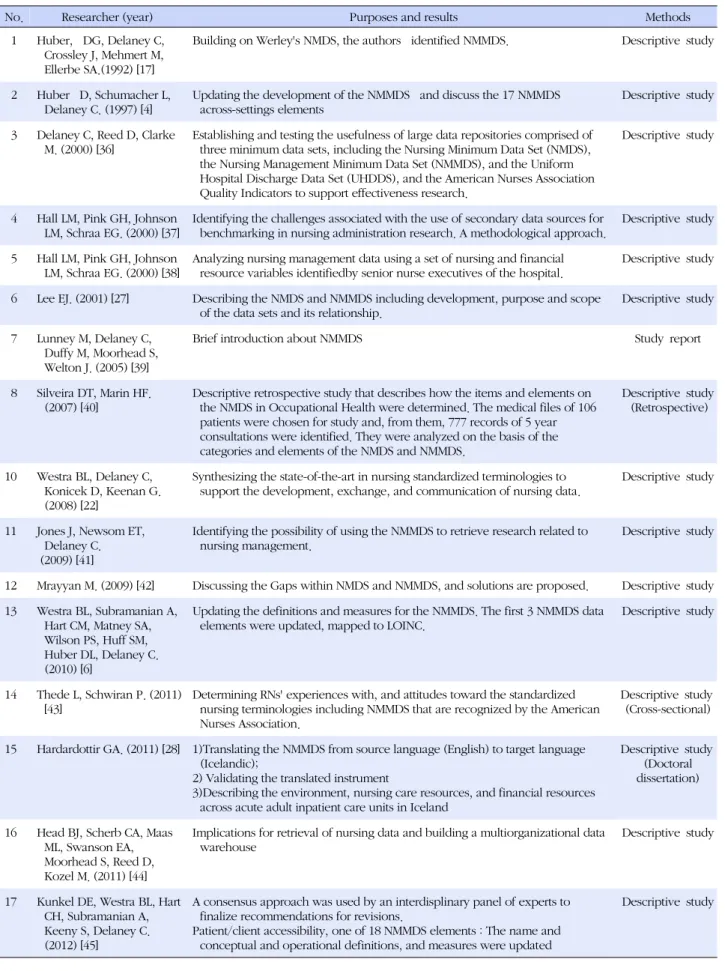
‘NMMDS’로 검색을 한 결과 개발 이후 NMMDS 관련 연구 (프로시딩북 발표 포함)는 17편이었고, 이중 1편의 박사학위 논문이 포함되어 있었으며, 한국에서도 1편의 연구가 수행되 었다[27](Table 1). 주요 연구주제는 NMMDS의 타당도 검증 과 함께 시대적 변화에 따른 변수의 개정작업 및 유관 데이터 셋과의 통합작업을 포함한 업데이트와 조정 등이 10편(59%) 이었으며 이중 1편의 박사학위 논문에서는 NMMDS의 국제 적 적용을 위한 번역 및 타당도 검증 연구가 아이슬랜드에서 이루어졌다[28]. 이밖에 NMMDS를 소개하고 비교하는 종설 형식의 연구가 4편(24%), 그리고 기타 3편(18%)의 발표가 있 었다.
타당도 검증 연구의 경우, NMMDS 개발이 전문가 집단의 논의와 많은 양의 문헌 고찰, 전국 단위 설문 조사, 구성 타당 도 및 내용 타당도를 위한 관련 학회 개최, 그리고 실무 반영을 통하여 이루어졌음을 들어 타당도가 높다고 보았다. 변수 개 정 작업에 관한 문헌에서는 (1) 간호단위/ 서비스의 특성, (2) 간호제공유형, (3) 환자/대상자 특성, 그리고 (6) 환자/대상자 접근성 변수들이 전문가 토론 및 문헌 고찰을 통하여 최근의 경향을 반영하도록 개정되었다는 점과 이를 국가적 데이터 표 준에 맵핑한 결과를 보고 하였다. 이들을 좀 더 상세히 살펴보 면 18개의 NMMDS 요소들에 대한 업데이트 및 다른 데이터
셋과의 호환성을 증진시키기 위한 맵핑 작업이 최근 미국 미 네소타 대학교 간호대학을 중심으로 개발자와 연구자들을 중 심으로 활발하게 이루어지고 있으며, 특히 Logical Observa- tion Identifier Names and Codes terminology (LOINC)에 NMMDS를 결합시키는 작업이 개발자들에 의해 최근 지속적 으로 이루어져서 이 LOINC와의 맵핑 결과가 연구와 포스터 를 통해 각각 1편씩 발표가 되었다 [6,29]. LOINC는 국가적 데이터 표준으로 선택된 것으로서 대중에게 무료로 공개된 데 이터베이스이며, 일련의 유니버설한 이름과 코드를 제공한다.
또한 LOINC는 다양한 셋팅에서 전자의무기록(Electronic Health Records, EHR) 데이터의 전송을 용이하게 하기 위해 미국 국내는 물론이고 국제적으로도 쓰이는 구조를 제공하므 로 매우 중요한 의미를 지닌다[6].
NMMDS가 갖는 장점은 간호자원과 돌봄 측면의 자료가 환 자안전과 기타 간호결과에 어떻게 영향을 미치는지를 더 잘 이해하도록 청구서(billing)와 임상 데이터가 결합될 수 있는 간호관리 변수들을 규명해 낸다는 점이다. 또한 NMMDS는 근무의 특수성과 care의 셋팅에 따라서 전문지식 수준과 양적 측면의 간호 인력 수요에 대한 이해를 증가시킬 수 있다. 그러 나 아직까지 NMMDS가 데이터 웨어하우스에 포함되어 다양 한 셋팅의 간호관리 데이터의 비교를 위해서 활용되지는 못하 였고, 질 향상활동이나 연구를 지원하기 위한 접근도 부족한 현실이며 이 부분은 시작단계라고 할 수 있다[30]. 하지만 간 호 관리 관련 변수들을 사용한 성과 연구들이 이미 많이 이루 어지고 있고[31-35], 이는 NMMDS가 모두 포괄하고 있는 변 수들이므로 향후 NMMDS의 활용도가 높아진다면 그 유용성 에 대한 기대를 할 수가 있다.
이 밖에도 많은 NMMDS 변수들이 Magnet Recognition Program, National Database of Nursing Quality Indica- tors, National Quality Forum, Joint Commission quality indicators 등에 포함이 되어서 현장에서 활용이 되고 있다 [27]. 이처럼 NMMDS는 어느 현장에서나 활용이 가능하도록 되어 있어서 넓은 범위로 활용이 가능하다는 장점이 있다. 그 러나 이러한 노력들은 우선적으로 급성기 환자간호현장에 초 점을 맞추고 있으므로 확대 적용을 위한 지속적인 노력이 이 루어져야 할 것으로 본다.
최근 사회가 변화하고 수요자들의 요구 및 컴퓨터 환경이 바 뀌면서 NMMDS에 대한 개정의 필요성이 증가되었다. 즉, 개 발 당시의 NMMDS는 종이를 기반으로 한 설문지를 활용하였 으나 최근 정보의 발달로 EHR 데이터를 활용한 질 향상 요구 가 증가하면서 EHR 데이터를 체계적으로 보완하기 위해 표준
Table 1. Analysis of Researches using NMMDS
No. Researcher (year) Purposes and results Methods
1 Huber, DG, Delaney C, Crossley J, Mehmert M, Ellerbe SA.(1992) [17]
Building on Werley's NMDS, the authors identified NMMDS. Descriptive study
2 Huber D, Schumacher L, Delaney C. (1997) [4]
Updating the development of the NMMDS and discuss the 17 NMMDS across-settings elements
Descriptive study
3 Delaney C, Reed D, Clarke M. (2000) [36]
Establishing and testing the usefulness of large data repositories comprised of three minimum data sets, including the Nursing Minimum Data Set (NMDS), the Nursing Management Minimum Data Set (NMMDS), and the Uniform Hospital Discharge Data Set (UHDDS), and the American Nurses Association Quality Indicators to support effectiveness research.
Descriptive study
4 Hall LM, Pink GH, Johnson LM, Schraa EG. (2000) [37]
Identifying the challenges associated with the use of secondary data sources for benchmarking in nursing administration research. A methodological approach.
Descriptive study
5 Hall LM, Pink GH, Johnson LM, Schraa EG. (2000) [38]
Analyzing nursing management data using a set of nursing and financial resource variables identifiedby senior nurse executives of the hospital.
Descriptive study
6 Lee EJ. (2001) [27] Describing the NMDS and NMMDS including development, purpose and scope of the data sets and its relationship.
Descriptive study
7 Lunney M, Delaney C, Duffy M, Moorhead S, Welton J. (2005) [39]
Brief introduction about NMMDS Study report
8 Silveira DT, Marin HF.
(2007) [40]
Descriptive retrospective study that describes how the items and elements on the NMDS in Occupational Health were determined. The medical files of 106 patients were chosen for study and, from them, 777 records of 5 year consultations were identified. They were analyzed on the basis of the categories and elements of the NMDS and NMMDS.
Descriptive study (Retrospective)
10 Westra BL, Delaney C, Konicek D, Keenan G.
(2008) [22]
Synthesizing the state-of-the-art in nursing standardized terminologies to support the development, exchange, and communication of nursing data.
Descriptive study
11 Jones J, Newsom ET, Delaney C.
(2009) [41]
Identifying the possibility of using the NMMDS to retrieve research related to nursing management.
Descriptive study
12 Mrayyan M. (2009) [42] Discussing the Gaps within NMDS and NMMDS, and solutions are proposed. Descriptive study 13 Westra BL, Subramanian A,
Hart CM, Matney SA, Wilson PS, Huff SM, Huber DL, Delaney C.
(2010) [6]
Updating the definitions and measures for the NMMDS. The first 3 NMMDS data elements were updated, mapped to LOINC.
Descriptive study
14 Thede L, Schwiran P. (2011) [43]
Determining RNs' experiences with, and attitudes toward the standardized nursing terminologies including NMMDS that are recognized by the American Nurses Association.
Descriptive study (Cross-sectional)
15 Hardardottir GA. (2011) [28] 1)Translating the NMMDS from source language (English) to target language (Icelandic);
2) Validating the translated instrument
3)Describing the environment, nursing care resources, and financial resources across acute adult inpatient care units in Iceland
Descriptive study (Doctoral dissertation)
16 Head BJ, Scherb CA, Maas ML, Swanson EA, Moorhead S, Reed D, Kozel M. (2011) [44]
Implications for retrieval of nursing data and building a multiorganizational data warehouse
Descriptive study
17 Kunkel DE, Westra BL, Hart CH, Subramanian A, Keeny S, Delaney C.
(2012) [45]
A consensus approach was used by an interdisplinary panel of experts to finalize recommendations for revisions.
Patient/client accessibility, one of 18 NMMDS elements : The name and conceptual and operational definitions, and measures were updated
Descriptive study
화된 NMMDS 데이터의 요소, 정의, 측정, 그리고 코드를 업데 이트하고 대중에게 배포하는 일이 매우 중요해졌다. 이에 따라 NMMDS 연구팀은 지속적으로 각 변수에 대한 개정 작업을 하 고 있으며, 임상에서의 컴퓨터 사용환경이 바뀜에 따라 EHR 관련 변수를 추가 하는 등 현장을 반영하려는 노력을 하고 있 다. 또한 국가적 데이터 표준과의 맵핑을 통해 기관별, 지역별 간호 관련 데이터 호환 및 비교 연구가 가능한 환경을 만들고 있다. NMMDS의 확대 보급이 잘 이루어지려면 무엇보다도 국 가 차원에서 수용되어서 대중에게 공개가 되는 국가차원의 용 어에 연계되어 사용하도록 하는 일이 중요하다. 우리나라도 향 후 앞서 제시한 국가적 내지는 국제적 호환이 가능한 데이터와 의 연계 작업이 지속적으로 이루어져야 한다고 판단된다.
논 의 및 결 론
현대사회가 정보화 사회로 발전하면서 기존의 의료 및 간 호정보의 활용면에서도 많은 변화가 있어왔다. 간호정보학의 발전은 간호학의 교육, 실무, 연구면에서 엄청난 발전을 가져 왔고, 축적되는 데이터는 정보로 이어지고, 새로운 지식체의 생성을 가능하게 하고 있다. 간호관리자를 위한 간호정보 데 이터의 축적을 위해 Huber와 Delaney[20]에 의해 개발된 NMMDS는 시대적 변화에 맞춰서 지속적으로 업데이트되고 타당도를 높이기 위한 작업을 계속해 왔다. 간호관리 데이터 는 간호의 질을 설명하는 중요한 변수가 된다. 따라서 간호관 리에 필요한 데이터 확보를 통해 질 개선과 직원들의 이직률 감소 등 실무 현장에서 간호관리자가 활용할 수 있도록 NMMDS의 활용을 촉진할 필요가 있다. 그리하여 관리자의 행정적 짐을 줄이는 것은 물론이고, 간호 관련 데이터를 활용 해서 간호성과를 향상시키고 보건의료 조직에서 질 향상과 연 구를 촉진할 수 있을 것이다.
본 연구에서는 NMMDS의 활용을 촉진하고 우리나라 간호 현장에서도 쓰일 수 있는 간호관리용 데이터 세트의 적용 가 능성을 알아보기 위해 NMMDS의 특징 및 구성 요소, 연구 동 향 및 활용을 알아보았다. 17편의 연구를 통해 NMMDS가 현 장 및 간호 관리자의 입장을 반영하여 개발되었고, 시대적 변 화에 따른 개정 작업과 국가적으로 표준화된 데이터 베이스와 의 연계, 국제적 적용을 위한 번역 및 타당도 검증 연구가 진행 되고 있음을 확인하였다. 하지만 전체적으로 연구 편수가 아 직은 17편에 국한되고, 연구방법론 측면에서도 실제 NMMDS 를 활용하여 실무에 적용시킨 연구 보다는 주로 그 개발과 데 이터베이스 구축에 관련된 연구에 국한되어서 포괄적인 고찰
에 한계가 있었다. 이처럼 NMMDS가 아직까지는 실무에서 널리 활용되지 못하고 있으며 연구도 활발하게 이루어지고 있 지 않은 것이 현실이다. 그러나 현재 NMMDS 개발팀 주도하 에 진행되고 있는 LOINC와의 맵핑 작업이나 국제적 활용 촉 진을 위한 번역 및 실무 적용 활동을 통해서 보다 활발한 연구 나 실무적용이 확대 되어 갈 것으로 기대가 된다. NMMDS의 세가지 영역인 환경측면, 간호자원 측면, 재정 측면의 변수들 은 간호서비스의 성과와 밀접한 관련을 가지며, 이는 전체적 인 의료서비스의 질 향상에 기여하는 주요 변수이므로 효율적 인 간호관리를 위해서는 보다 활발한 NMMDS 활용 전략을 도출할 필요가 있다고 본다. 간호관리 고유의 데이터에 대한 중요성이 간과되고 있는 우리나라 현실에서도 NMMDS의 활 용방안에 대한 노력이 이루어져야 할 것으로 생각된다.
REFERENCES
1. Saba VK. Nursing informatics: Yesterday, today and tomor- row. International Nursing Review. 2001;48(3):177-187.
2. American Nurses Association (ANA). Nursing informatics:
Scope and standards of practice. Silver Spring, MD: American Nurses Association; 2008.
3. Clark J, Lang N. Nursing's next advance: An internal classi- fication for nursing practice. International Nursing Review.
1992;39(4):109-111, 128.
4. Huber D, Schumacher L, Delaney C. Nursing management minimum data set (NMMDS). The Journal of Nursing Admin- istration. 1997;27(4):42-48.
5. Maas ML, Delaney C. Nursing process outcome linkage re- search: Issues, current status, and health policy implications.
Medical Care. 2004;42(2 Suppl):II40-48.
http://dx.doi.org/10.1097/01.mlr.0000109291.44014.cb 6. Westra BL, Subramanian A, Hart CM, Matney SA, Wilson PS,
Huff SM, et al. Achieving "meaningful use" of electronic health records through the integration of the nursing management minimum data set. Journal of Nursing Administration. 2010;
40(7-8):336-343.
http://dx.doi.org/10.1097/Nna.0b013e3181e93994 7. Park H-A. Nursing informatics. Seoul: Hyunmoonsa; 2012.
8. Charters KG. Nursing informatics, outcomes, and quality im- provement. AACN Clinical Issues. 2003;14(3):282-294.
9. Beyea SC. Perioperative data elements: Interventions and out- comes. AORN Journal. 2000;71(2):344-352.
10. Fahrenkrug MA. Development of a nursing data set for school nursing. The Journal of School Nursing. 2003;19(4):238-248.
11. Rukanuddin RJ. Development of standardized midwifery nurs- ing reproductive health data set (MN-RHDs) for Pakistan. Stu- dies in Health Technology and Informatics. 2006;122:461-464.
12. Coenen A, Weis DM, Schank MJ, Matheus R. Describing par- ish nurse practice using the nursing minimum data set. Public Health Nursing. 1999;16(6):412-416.
13. Delaney C. Significance of the nursing minimum dataset for decision support in acute care. In: Mills MEC, Romano CA, Heller BR, editors. Information management in nursing and health care. Springhouse, PA: Springhouse; 1996. p. 32-38.
14. Werley HH, Devine EC, Zorn CR, Ryan P, Westra BL. The nursing minimum data set: Abstraction tool for standardized, comparable, essential data. American Journal of Public Health.
1991;81(4):421-426. http://dx.doi.org/10.2105/Ajph.81.4.421 15. Sermeus W, Delesie L, Van den Heede K, Diya L, Lesaffre E.
Measuring the intensity of nursing care: Making use of the Belgian nursing minimum data set. International Journal of Nursing Studies. 200845(7):1011-1021.
http://dx.doi.org/10.1016/j.ijnurstu.2007.05.006
16. Van den Heede K, Michiels D, Thonon O, Sermeus W. Using nursing interventions classification as a framework to revise the Belgian nursing minimum data set. International Journal of Nursing Terminologies and Classifications. 2009;20(3):122- 131. http://dx.doi.org/10.1111/j.1744-618X.2009.01124.x 17. Karpiuk KL, Delaney CW, Ryan P. South Dakota statewide
nursing minimum data set project. Journal of Professional Nursing. 1997;13(2):76-83.
18. Goossen WF, Delaney C, Hovenga E, Marin H, Saba V. Les- sons learned from the international nursing minimum data set (i-NMDS). In: Oud N, Sermeus W, Ehnfors M, Association of Common European Nursing Diagnoses Intervention, and Outcomes. European Conference, editors. ACENDIO 2005:
Proceedings of the fifth biennial European Conference of the Association for Common European Nursing Diagnoses, Inter- ventions and Outcomes held in Bled, Slovenia: Documenting nursing care-- enhancing patient care through nursing doc- umentation: New directions for novices and experts. Bern:
Verlag Hans Huber; 2005. p. 31-34.
19. Delaney CW, Huber D, University of Iowa Nursing Manage- ment Minimum Data Set Research Team, American Organiza- tion of Nurse Executives. A nursing management minimum data set (NMMDS): A report of an invitational conference. Chi- cago, IL American Organization of Nurse Executives; 1996.
20. Huber DG, Delaney C, Crossley J, Mehmert M, Ellerbe S. A nursing management minimum data set. Significance and de- velopment. The Journal of Nursing Administration. 1992;22 (7-8):35-40.
21. Huber D, Delaney C. Capturing the context of health care re- form: Clinical testing of the nursing management minimum data set(NMMDS). Paper presented at: The Seventh National Conference on Nursing Administration Research; 1997;
Kansas City, MI.
22. Westra BL, Delaney CW, Konicek D, Keenan G. Nursing stan-
dards to support the electronic health record. Nursing Out- look. 2008;56(5):258-266 e251.
http://dx.doi.org/10.1016/j.outlook.2008.06.005
23. Huber D, Delaney C. Nursing management data for nursing information systems. In: Moorhead S, Delaney CW, editors.
Information systems innovations for nursing: New visions and ventures. Thousand Oaks, CA: Sage; 1998. p. 15-29.
24. American Nurses Association (ANA). ANA recognized termi- nologies that support nursing practice [Internet]. 2012 [cited 2014 April 10]. Available from:
http://www.nursingworld.org/MainMenuCategories/Tools/
Recognized-Nursing-Practice-Terminologies.pdf
25. Coenen A, Schoneman D. The nursing minimum data set:
Use in the quality process. Journal of Nursing Care Quality.
1995;10(1):9-15.
26. Ryan P, Delaney C. Nursing minimum data set. Annual Re- view of Nursing Research. 1995;13:169-194.
27. Lee E. The nursing minimum data set (NMDS) and its rela- tionship with the nursing management minimum data set (NMMDS): Significance, development, and future of nursing profession. Journal of Korean Academy of Nursing. 2001;31 (3):401-416.
28. Hardardottir GA. Translation and national clinical validation of the nursing management minimum data set (NMMDS) in hospitals in the country of Iceland [dissertation]. Iowa City, IA: University of Iowa; 2011.
29. Subramanian A, Westra B, Matney S, Wilson PS, Delaney CW, Huff S, et al. Integrating the nursing management minimum data set into the logical observation identifier names and co- des system. AMIA Annual Symposium Proceedings. 2008:
1148.
30. Junttila K, Meretoja R, Seppala A, Tolppanen EM, Ala-Nikkola T, Silvennoinen L. Data warehouse approach to nursing ma- nagement. Journal of Nursing Management. 2007;15(2):155- 161. http://dx.doi.org/10.1111/j.1365-2834.2007.00690.x 31. Titler M, Dochterman J, Kim T, Kanak M, Shever L, Picone
DM, et al. Cost of care for seniors hospitalized for hip fracture and related procedures. Nursing Outlook. 2007;55(1):5-14.
http://dx.doi.org/10.1016/j.outlook.2006.06.006
32. O'Brien-Pallas L, Duffield C, Hayes L. Do we really under- stand how to retain nurses? Journal of Nursing Management.
2006;14(4):262-270.
http://dx.doi.org/10.1111/j.1365-2934.2006.00611.x 33. Fogarty GJ, McKeon CM. Patient safety during medication ad-
ministration: The influence of organizational and individual variables on unsafe work practices and medication errors.
Ergonomics. 2006;49(5-6):444-456.
http://dx.doi.org/10.1080/00140130600568410
34. Aiken LH, Clarke SP, Sloane DM, Lake ET, Cheney T. Effects of hospital care environment on patient mortality and nurse
outcomes. The Journal of Nursing Administration. 2008;38 (5):223-229.
http://dx.doi.org/10.1097/01.NNA.0000312773.42352.d7 35. Tourangeau AE, Doran DM, McGillis Hall L, O'Brien Pallas L,
Pringle D, Tu JV, et al. Impact of hospital nursing care on 30-day mortality for acute medical patients. Journal of Advanced Nursing. 2007;57(1):32-44.
http://dx.doi.org/10.1111/j.1365-2648.2006.04084.x
36. Delaney C, Reed D, Clarke M. Describing patient problems &
nursing treatment patterns using nursing minimum data sets (NMDS & NMMDS) & UHDDS repositories. Proceedings of the AMIA Symposium. 2000:176-179.
37. Hall LM, Pink GH, Johnson LM, Schraa EG. Developing a nursing management practice atlas: Part 1, Methodological approaches to ensure data consistency. The Journal of Nurs- ing Administration. 2000;30(7-8):364-372.
38. Hall LM, Pink GH, Johnson LM, Schraa EG. Development of anursing management practice atlas. Part 2, Variation in use of nursing and financial resources. The Journal of Nursing Administration. 2000;30(9):440-448.
39. Lunney M, Delaney C, Duffy M, Moorhead S, Welton J. Advo- cating for standardized nursing languages in electronic health records. The Journal of Nursing Administration. 2005;35(1):
1-3.
40. Silveira DT, Marin HdF. A nursing minimum data set in occu- pational health: Items and elements for professional practice.
In: Kuhn KA, James R Warren, Leong T-Y, editors. Medinfo 2007: Proceedings of the 12th world congress on health(med- ical) informatics: Building sustainable health systems. Amster- dam: IOS; 2007.
41. Jones J, Newsom ET, Delaney C. Use of nursing management minimum data set (NMMDS) for a focused information retrie- val. In: Kurosu M, editor. Human centered design. San Diego, CA: Springer; 2009. p. 972-978.
42. Mrayyan M. Nurse autonomy, nurse job satisfaction and client satisfaction with nursing care: their place in nursing data sets.
Nursing Leadership (Toronto, Ont.). 2003;16(2):74-82.
43. Schwiran PM, Thede LQ. Informatics: the standardized nurs- ing terminologies: A national survey of nurses' experiences and attitudes. Online Journal of Issues in Nursing. 2011;16(2):
12.
44. Head BJ, Scherb CA, Maas ML, Swanson EA, Moorhead S, Reed D, et al. Nursing clinical documentation data retrieval for hospitalized older adults with heart failure: Part 2. Interna- tional Journal of Nursing Terminologies and Classifications.
2011;22(2):68-76.
http://dx.doi.org/10.1111/j.1744-618X.2010.01177.x 45. Kunkel DE, Westra BL, Hart CM, Subramanian A, Kenny S,
Delaney CW. Updating and normalization of the Nursing Management Minimum Data Set element 6: Patient/client ac- cessibility. Computers, Informatics, Nursing: CIN. 2012;30(3):
134-141. http://dx.doi.org/10.1097/NCN.0b013e31823eb913