2017, Vol. 61, No. 5
Printed in the Republic of Korea
https://doi.org/10.5012/jkcs.2017.61.5.291
Notes
Synthesis of New Pyrazoline Derivatives and Its Antimicrobial and Antioxidant Activities
Hemant Hegde†, Chuljin Ahn‡, Shwetha, D.†, Santosh L. Gaonkar†, and Nitinkumar S. Shetty†,*
†Department of Chemistry, Manipal Institute of Technology, Manipal, Karnataka, India-576104.
*E-mail: [email protected]
‡Department of Chemistry, Changwon National University, Changwon 51140, Korea (Received June 30, 2017; Accepted August 3, 2017)
Key words: Pyrazolines, Aryloxy quinolines, Antioxidants, Antibacterials
INTRODUCTION
Resistance gained by microorganism to conventional antimicrobial agents has lead to the development of new antimicrobial agents against pathogenic microbes. Chalcones and their derivatives proved to be an important molecular scaffold for the search of new pharmaceutically active mole- cules. Among the various derivatives of chalcones, synthesis of pyrazolines has gained major attention due to their prom- ising biological activities such as anticancer, antimicrobial, antidepressant, immunosuppressive, anti-inflammatory, etc.1−8 Many studies revealed that incorporation of pyrazole moiety into various heterocyclic ring systems gives worthwhile molecules from the biological point of view.9−11 Several marketed drugs such ascelecoxib12 and rimonabant13 con- tains pyrazole as their core molecular unit.14,15
On the other hand, quinolines represent a prominent class of heterocyclic compounds exhibiting wide spectrum of pharmaceutical application.16−20 Prompted by the potential biological activities of pyrazolines and quinolines, we designed new hybrid molecule having the synergistic effect of these heterocyclic moieties in single nucleus that would help in the development of new therapeutic lead molecules.
Furthermore, the newly synthesized compounds were tested for their in vitro antimicrobial activities against gram-pos- itive, gram-negative bacteria and antioxidant activity.
EXPERIMENTAL
General
Chemicals were procured from commercial vendors and used as such without any purification. Reaction progress was monitored using thin layer chromatographic technique (TLC) on pre-coated aluminum sheets alichrosep silica gel-60/UV254 with I2 and UV light as detecting agents.
Melting point was measured using Thiele’s tube in an open capillary tube and was uncorrected. IR spectra were recorded on Shimadzu FTIR spectrometer-8400s with KBr as back- ground using press pellet technique. NMR analysis was done with Bruker NMR-400 MHz using TMS as an inter- nal standard.
General procedure for the synthesis of chalcone deriva- tives 3(a-j)
2-Acetyl thiophene (20 mmol) was dissolved in mini- mum quantity of sodium hydroxide solutions (10%). To this added aromatic aldehyde (20 mmol) previously dis- solved in ethanol (2 mL) and reaction mixture stirred to obtain a homogeneous mixture. Stirring was continued at room temperature for 8-10 h. On completion of reaction (checked by thin layer chromatography), reaction mixture was then poured into the beaker containing crushed ice and neutralized using dil. HCl. Precipitate formed was then filtered and washed with distilled water.
Procedure for the synthesis of quinoline hydrazide deriv- ative (4)21
2-(4-Chloro-quinolin-8-yloxy) acetohydrazide (4) was prepared by reacting ethyl [(5-chloroquinolin-8-yl)oxy]ace- tate (1 mmol) and hydrazine hydrate, 99% (1.5 mmol) in ethanol (2 mL). Solid thus formed was filtered, dried and used directly for the next step.
2-[(5-Chloroquinolin-8-yl)oxy]acetohydrazide (4): Yield, 95%, m.p. 118−120oC; IR spectrum (γ-max cm−1): 3041 (Ar-H), 2936 (CH2), 1678 (C=O), 1589 (C=N), 1441 (C=C), 545 (Ar-C-Cl). 1H NMR (400 MHz, DMSO-d6) δ 10.4 (s, 1H, N-H), 8.87 (d, 1H, J = 3.4 Hz, quinoline ring-H), 8.14 (d, 1H, J = 8.4 Hz, quinoline ring-H), 7.84−7.68 (dd, 1H, quinoline ring-H), 7.42−7.44 (d, 1H, J = 8 Hz, quinoline ring-H), 7.25−7.27 (d, 1H, J = 8 Hz, quinoline ring-H),
5.68 (s, 2H, NH2), 5.36 (s, 2H, OCH2).13C NMR (100 MHz, DMSO-d6) δ 62.6, 112.0, 121.1, 122.3, 123.5, 123.7, 128.7, 129.8, 132.6, 132.9, 164.3. Elemental analysis, Anal. calcd.
for C11H10ClN3O2:C, 52.47; H, 3.96; N, 16.74. Found: C, 52.50; H, 4.01; N, 16.70%.
General procedure for the synthesis of pyrazoline deriva- tives 5(a-j)
A mixture of the chalcones 3(a-j) (1 mmol), 5-chloro-2- (quinolin-8-yloxy) acetohydrazide 2 (1 mmol) and NaOH (5 mmol) was refluxed in PEG-400 (5 mL) for 8-10 h. The contents were cooled, and poured onto crushed ice and stirred for 1 h. The resulting precipitate was filtered and recrystalised using ethanol: DMF (10:1) to yield 5(a-j) in pure form.
2-[(5-Chloroquinolin-8-yl)oxy]-1-[5-phenyl-3-(thiophen- 2-yl)-4,5-dihydro-1H-pyrazol-1-yl]ethan-1-one (5a): Yield, 79.1%, m.p. 108−110oC; IR spectrum (γ-max cm−1): 3035 (Ar-H), 2928 (CH2), 1683 (C=O), 1592 (C=N), 1446 (C=C), 546 (Ar-C-Cl). 1H NMR (400 MHz, DMSO-d6) δ 8.92 (d, 1H, J = 4.2 Hz quinoline ring-H), 8.10 (d, 1H, J = 8.2 Hz, quinoline ring-H), 7.84-7.86 (d, 1H, J = 8.2 Hz, thiophene- H), 7.64−6.80 (m, 10H, Ar-H), 5.63(dd, 1H, J = 5.2,11.5 Hz, pyrazoline-CH), 5.40 (s, 2H, OCH2), 3.75 (dd, 1H, J
=11.6, 17.8 Hz, pyrazoline-CH2), 3.21 (dd, 1H, J = 3.8, 17.4 Hz, pyrazoline-CH2).13C NMR (100 MHz, DMSO- d6) δ 13.4, 14.1, 66.4, 68.6, 115.5, 121.1, 122.3, 123.5, 126.7, 127.3, 128.2, 128.4, 129.3, 132.6, 132.9, 140.6, 140.7, 149.1, 150.2, 150.7, 153.7, 154.0, 164.3, 169.5. Ele- mental analysis, Anal. calcd. for C24H18ClN3O2S:C, 64.35; H, 4.05; N, 9.38. Found: C, 64.39; H, 4.07; N, 9.43%.
1-[5-(4-Chlorophenyl)-3-(thiophen-2-yl)-4,5-dihydro- 1H-pyrazol-1-yl]-2-[(5-chloroquinolin-8-yl)oxy]ethan-1- one (5b): Yield, 83.2%, m.p. 96−98oC; IR spectrum (γ-max cm−1): 3056 (Ar-H), 2931 (C-H),1656 (C=O), 1446 (C=C), 544 (Ar-C-Cl). 1H NMR (400 MHz, DMSO-d6) δ 8.92 (d, 1H, J = 3.8 Hz, quinoline ring-H), 8.11 (d, 1H, J = 8.4 Hz, quinoline ring-H), 7.65−6.97 (m, 10H, Ar-H), 5.66 (dd, 1H, J = 4.1,12.3 Hz, pyrazoline-CH), 5.43 (s, 2H, OCH2), 3.81 (dd, 1H, J = 12.2,18.1 Hz, pyrazoline-CH2), 3.24 (dd, 1H, J = 4.7, 17.5 Hz, pyrazoline-CH2).13C NMR (100 MHz, DMSO-d6) δ 13.1, 14.6, 66.7, 69.2, 110.6, 112.5, 115.7, 121.5, 122.7, 123.8, 126.9, 127.3, 128.2, 128.4, 129.6, 132.8, 140.6, 149.1, 150.2, 153.9, 154.4, 159.3, 164.3, 169.5.
Elemental analysis, Anal. calcd. for C24H17Cl2N3O2S: C, 59.76; H, 3.55; N, 8.71. Found: C, 59.79; H, 3.56; N, 8.67%.
2-[(5-Chloroquinolin-8-yl)oxy]-1-[5-(4-fluorophenyl)- 3-(thiophen-2-yl)-4,5-dihydro-1H-pyrazol-1-yl]ethan-
1-one (5c): Yield, 83.7%, m.p. 102−104oC; IR spectrum (γ-max cm−1): 3051 (Ar-H), 2922 (C-H), 1629 (C=O), 1599 (C=N), 1458 (Ar C=C), 548 (Ar-C-Cl). 1H NMR (400 MHz, DMSO-d6) δ 8.92 (d, 1H, J = 4.4 Hz, quinoline ring-H), 8.10 (d, 1H, J = 7.8 Hz, quinoline ring-H), 7.71−6.80 (m, 10H, Ar-H), 5.61 (dd, 1H, J = 5.1, 11.4 Hz, pyrazoline-CH), 5.46 (s, 2H, OCH2), 3.78 (dd, 1H, J = 12.3, 17.7 Hz, pyrazoline- CH2), 3.22 (dd, 1H, J = 4.6, 17.8 Hz, pyrazoline-CH2). 13C NMR (100 MHz, DMSO-d6) δ 12.9, 13.8, 66.5, 69.4, 110.9, 112.7, 116.1, 121.7, 122.9, 127.3, 127.7, 128.5, 129.8, 133.1, 133.6, 141.5, 148.7, 149.1, 150.2, 153.8, 154.6, 156.4, 163.9, 169.6. Elemental analysis, Anal. Calcd. for C24H17ClFN3O2S:
C, 61.87; H, 3.68; N, 9.02. Found: C, 61.89; H, 3.69; N, 9.05%.
2-[(5-Chloroquinolin-8-yl)oxy]-1-[5-(4-hydroxyphenyl)-3- (thiophen-2-yl)-4,5-dihydro-1H-pyrazol-1-yl]ethan-1- one (5d): Yield, 82.15%, m.p. 112−114 °C; IR spectrum (γ- max cm−1): 3340 (Ar O–H), 3097, 3055 (Ar–H), 2953, 2922 (C-H), 1600, 1573, 545 (Ar-C-Cl). 1H NMR (400 MHz, DMSO-d6) δ 10.42 (s, 1H, Ar-OH), 8.93 (d, 1H, J = 4.1 Hz, quinoline ring-H), 8.11 (d, 1H, J = 7.8 Hz, quinoline ring-H), 7.79−6.96 (m, 10H, Ar-H), 5.62 (dd,1H, J = 5.1, 12.3 Hz, pyrazoline-CH), 5.43 (s, 2H, OCH2), 3.85 (dd, 1H, J = 11.8, 17.6 Hz, pyrazoline-CH2), 3.24 (dd, 1H, J = 5.3, 17.7 Hz, pyrazoline-CH2). 13C NMR (100 MHz, DMSO-d6) δ 13.3, 13.9, 66.8, 70.2, 111.3, 112.7, 116.1, 121.7, 122.9, 124.1, 123.9, 127.3, 127.7, 128.5, 130.2, 133.1, 140.3, 141.5, 148.7, 149.1, 150.2, 153.8, 159.8, 163.9, 169.6. Elemental analysis, Anal. calcd. for C24H18ClN3O3S: C, 62.13; H, 3.91; N, 9.06. Found: C, 62.15; H, 3.96; N, 9.07.
2-[(5-Chloroquinolin-8-yl)oxy]-1-[5-(4-nitrophenyl)- 3-(thiophen-2-yl)-4,5-dihydro-1H-pyrazol-1-yl]ethan- 1-one (5e): Yield, 82.15%, m.p. 106−108oC; IR spectrum (γ-max cm−1): 3082, 3057 (Ar–H), 2960, 2924, 2852 (C- H), 1566, 1512, 1456 (Ar-C=C), 550 (Ar-C-Cl).1H NMR (400 MHz, DMSO-d6) δ 8.92 (d, 1H, J = 3.6 Hz, quino- line ring-H), 8.10 (d, 1H, J = 8.1 Hz, quinoline ring-H), 7.71−6.97 (m, 10H, Ar-H), 5.62 (dd, 1H, J = 4.1,12.2 Hz, pyrazoline-CH), 5.42 (s, 2H, OCH2), 3.78 (dd, 1H, J = 11.7, 18.2 Hz, pyrazoline-CH2), 3.21 (dd, 1H, J = 4.1, 17.8 Hz, pyrazoline-CH2). 13C NMR (100 MHz, DMSO-d6) δ 13.9, 14.3, 67.1, 70.3, 111.7, 112.9, 116.2, 121.8, 123.4, 124.2, 127.5, 128.9, 130.2, 133.7, 140.8, 141.7, 148.8, 149.3, 150.5, 154.7, 156.4, 160.4, 163.9, 169.9. Elemental analysis, Anal.
calcd. for C24H17ClN4O4S: C, 58.48; H, 3.48; N, 11.37.
Found: C, 58.51; H, 3.49; N, 11.40%.
2-[(5-Chloroquinolin-8-yl)oxy]-1-[5-(2,4-dichlorophenyl)- 3-(thiophen-2-yl)-4,5-dihydro-1H-pyrazol-1-yl]ethan-1- one (5f): Yield, 72.15%, m.p. 114−116oC; IR spectrum
(γ-max, cm−1): 3042 (Ar-H), 2928 (CH2), 1684 (C=O), 1595 (C=N), 1434 (C=C), 548 (Ar-C-Cl). 1H NMR (400 MHz, DMSO-d6) δ 8.93 (d, 1H, J = 3.9 Hz, quinoline-H), 8.10 (d, 1H, J = 8.1 Hz, quinoline ring-H), 7.79−6.98 (m, 9H, Ar-H), 5.62 (dd, 1H, J = 4.5, 11.7 Hz, pyrazoline-CH), 5.44 (s, 2H, OCH2), 3.82 (dd, 1H, J = 11.7, 18.2 Hz, pyrazo- line-CH2), 3.26 (dd, 1H, J = 4.8, 18.2 Hz, pyrazoline-CH2).
13C NMR (100 MHz, DMSO-d6) δ 13.4, 14.2, 66.8, 70.4, 111.9, 113.1, 115.8, 122.2, 123.6, 124.8, 127.4, 128.2, 128.7, 128.9, 129.3, 130.3, 133.5, 141.8, 149.4, 150.5, 154.5, 156.6, 160.5, 164.5, 170.1. Elemental analysis, Anal. calcd. for C24H16Cl3N3O2S: C, 55.78; H, 3.16; 8.11. Found: C, 55.77;
H, 3.12; 8.13%.
2-[(5-Chloroquinolin-8-yl)oxy]-1-[5-(pyridin-4-yl)-3- (thiophen-2-yl)-4,5-dihydro-1H-pyrazol-1-yl]ethan-1- one (5g): Yield, 72.05%, m.p. 104−106oC; IR spectrum (γ-max, cm−1): 3340 (Ar O-H); 2924 (C-H); 1597, 1575, 1512, 1487 (Ar-C=C), 547 (Ar-C-Cl). 1H NMR (400 MHz, DMSO-d6) δ 8.92 (d, 1H, J = 4.2 Hz, quinoline ring-H), 8.10 (d, 1H, J = 8.4 Hz, quinoline ring-H), 7.79−6.99 (m, 10H, Ar-H), 5.68 (dd, 1H, J = 4.8, 11.6 Hz, pyrazoline-CH), 5.43 (s, 2H, OCH2), 3.84 (dd, 1H, J = 12.1, 17.7 Hz, pyrazoline- CH2), 3.28 (dd, 1H, J = 5.1, 17.4 Hz, pyrazoline-CH2).13C NMR (100 MHz, DMSO-d6) δ 14.1, 14.5, 67.2, 70.6, 111.9, 113.4, 116.5, 123.7, 124.5, 127.3, 127.9, 128.4, 129.6, 130.3, 133.9, 141.7, 148.9, 149.4, 150.7, 154.9, 156.6, 160.7, 164.4, 168.6. Elemental analysis, Anal. calcd. for C23H17ClN4O2S : C, 61.54; H, 3.82; N, 12.48. Found: C, 61.57; H, 3.78; N, 12.50%.
2-[(5-Chloroquinolin-8-yl)oxy]-1-[5-(pyridin-3-yl)-3- (thiophen-2-yl)-4,5-dihydro-1H-pyrazol-1-yl]ethan-1- one (5h): Yield, 87.18%, m.p. 108−110oC; IR spectrum (γ-max cm−1): 3038 (Ar-H), 2926 (CH2), 1674 (C=O), 1593 (C=N), 1441 (C=C), 548 (Ar-C-Cl). 1H NMR (400 MHz, DMSO-d6) δ 8.93 (d,1H, J = 4.2 Hz, Ar-H), 8.12 (d,1H, J = 7.8 Hz, Ar-H), 7.79−7.06 (m, 10H, Ar-H), 5.66 (dd, 1H, J = 4.9, 11.5 HZ, pyrazoline-CH), 5.42 (s, 2H, OCH2), 3.83 (dd, 1H, J = 11.8,18.4 Hz, pyrazoline-CH2), 3.26 (dd, 1H, J = 5.1, 18.2 Hz, pyrazoline-CH2).13C NMR (100 MHz, DMSO-d6) δ 13.4, 13.9, 66.8, 70.1, 111.5, 113.5, 116.5, 122.3, 123.5, 124.8, 127.6, 128.5, 130.3, 133.9, 134.2, 140.9, 141.5, 149.7, 154.8, 156.7, 160.7, 164.4, 170.3.
Elemental analysis, Anal. calcd. for C23H17ClN4O2S : C, 61.57; H, 3.85; N, 12.53. Found: C, 61.54; H, 3.82; N, 12.48%.
2-[(5-Chloroquinolin-8-yl)oxy]-1-[5-(furan-2-yl)-3-(thio- phen-2-yl)-4,5-dihydro-1H-pyrazol-1-yl]ethan-1-one (5i):
Yield, 78.05%, m.p. 104−106oC; IR spectrum (γ-max cm−1):
3043 (Ar-H), 2927 (CH2), 1682 (C=O), 1594 (C=N), 1440
(C=C), 545 (Ar-C-Cl). 1H NMR (400 MHz, DMSO-d6) δ 8.93 (d, 1H, J = 4.1 Hz, quinoline ring-H), 8.11 (d, 1H, J = 8.2 Hz, quinoline ring-H), 7.77−7.07 (m, 8H, Ar-H), 5.62 (dd, 1H, J = 4.9, 11.7 Hz, pyrazoline-CH), 5.49 (s, 2H, OCH2), 3.88 (dd, 1H, J = 11.8, 17.7 Hz, pyrazoline-CH2), 3.16 (dd, 1H, J = 5.1, 18.2 Hz, pyrazoline-CH2).13C NMR (100 MHz, DMSO-d6) δ 14.1, 14.7, 67.2, 70.3, 111.9, 113.5, 116.7, 122.3, 123.5, 124.6, 127.7, 128.2, 128.9, 130.4, 133.9, 140.6, 141.5, 149.5, 150.6, 154.4, 156.6, 160.5, 164.5, 168.9.
Elemental analysis, Anal. calcd. for C23H17ClN4O2S: C, 61.54; H, 3.82; N, 12.48. Found: C, 61.59; H, 3.79; N, 12.50%.
2-[(5-Chloroquinolin-8-yl)oxy]-1-[5-(2-methoxy-1-naph- thyl)-3-(thiophen-2-yl)-4,5-dihydro-1H-pyrazol-1-yl]ethan- 1-one (5j): Yield, 83.5%, m.p. 118−120oC; IR spectrum (γ-max cm−1): 3068 (Ar-H), 2913 (CH3), 1683 (C=O), 1596 (C=N),1466 (C=C), 547 (Ar-C-Cl). 1H NMR (400 MHz, DMSO-d6) δ 8.94 (d,1H, J = 3.8 Hz, quinolinering-H), 8.10 (d, 1H, J = 8.1 Hz, quinoline ring-H), 7.79−7.01 (m, 9H, Ar-H), 5.62 (dd, 1H, J = 4.5, 11.7 Hz, pyrazoline-CH), 5.44 (s, 2H, OCH2), 3.85 (dd, 1H, J = 12, 18 Hz, pyrazo- line-CH2), 3.25 (dd, 1H, J = 4.8, 17.7 Hz, pyrazoline-CH2) 3.72 (s, 3H, OCH3). 13C NMR (100 MHz, DMSO-d6) δ 14.3, 14.7, 62.5, 67.3, 70.5, 111.9, 112.5, 116.3,.122.3, 123.6, 124.4, 127.7, 128.6, 128.9, 129.5, 130.4, 133.7, 134.1, 141.2, 141.9, 149.3, 150.1, 150.5, 154.2, 154.8, 156.3, 160.6, 164.2, 169.5. Elemental analysis, Anal. calcd. for C29H22-
ClN3O3S: C, 65.97; H, 4.20; N, 7.96. Found: C, 66.02; H, 4.24; N, 7.95%.
RESULTS AND DISCUSSION
A reaction sequence for the preparation of pyrazolines 5(a–j) is outlined in Scheme 1-3. The required chalcones were prepared by reacting 2-acetyl thiophene with appro- priate aldehyde in presence of base by conventional Claisen-
Scheme 1. Synthesis of chalcone derivatives.
Compound Ar Compound Ar
3a Ph 3f 2,4-Dichloro-Ph
3b 4-Cl-Ph 3g 4-Pyridinyl
3c 4-F-Ph 3h 3-Pyridinyl
3d 4-OH-Ph 3i Furan-2-yl
3e 4-NO2-Ph 3j 2-OMe-1-Naphthyl
Schmidt condensation (Scheme 2). Reaction between chalcone with 5-chloro-quinolynyl hydrazide in PEG-400 in the presence of NaOH (reaction time varies from 8 to 10 h) afforded titled pyrazolines 5(a–j) in 70–82% yield.
The purity of the compounds was checked by thin layer chromatography and elemental analyses. Spectral data (1H &
13C NMR, IR) of all the synthesized compounds were in full agreement with the proposed structures. In general, Infrared spectra (IR) shown C=O, C=N and C-N peak in the region of 1640−1630, 1590−1585 and 1320−1290 cm−1, respectively. 1H NMR signals of the respective protons of all the compounds were assigned based on their chemical shifts, multiplicities and coupling constants. The spectra showed doublet of doublet in the range of δ 3.7−3.2 cor- responding to methylene proton of pyrazoline ring (geminal protons); singlet in the range of δ 5.6−5.2 corresponding to -OCH2 group; and multiplet at δ 8.5−8.2 for quinolinyl proton. The elemental analysis results were within ±0.4%
of the theoretical values.
Antibacterial Activities
The synthesized pyrazoline derivatives 5(a–j) were eval- uated in vitro for their antibacterial activity against Gram- positive S. aureus, B. subtilis and Gram-negative E. coli by using agar diffusion method as recommended by the National Committee for Clinical Laboratory Standards, (NCCLS)22 using ciprofloxacin as reference standard, Dimethyl
sulphoxide (1%, DMSO) as control.
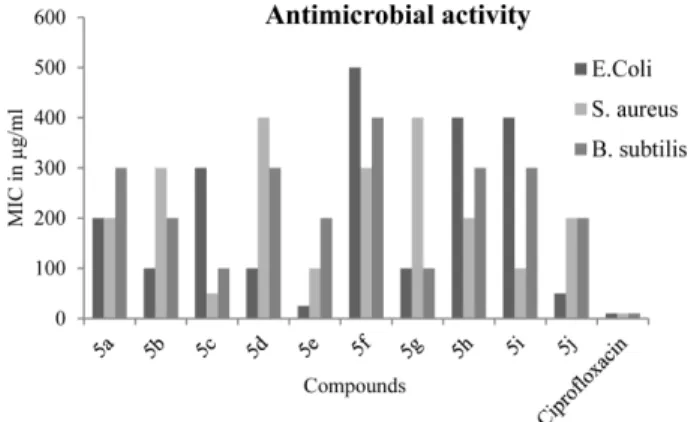
The culture strains of bacteria were maintained on nutri- ent agar slant at 37oC for 24 h. The antibacterial activity was evaluated using nutrient agar plate seeded with 0.1 mL of respective bacterial culture strain suspension prepared in sterile saline (0.85%) of 105 CFU/mL dilutions (by com- paring with Mcfarland standard solution). The wells of 6 mm diameter were filled with 0.1 mL of target compound dilution ranging from 25 to 250 µg/mL separately for each bacterial strain. All the plates were incubated at 37oC for 24 h. Zone of inhibition and minimum inhibitory concen- trations (MICs) were noted. The results of antibacterial studies are given in Fig. 1.
The compounds 5e and 5j were found to be the most effective antibacterial agents having MIC values 50 and 75 μg/mL, respectively against E. coli. The antibacterial activity value of these compounds approaches the anti- bacterial potential of the standard drug ciprofloxacin. In case of S. aureus, compounds 5c and 5e have shown marked antibacterial potential at MIC values less than 100 μg/mL.
For antibacterial activity against B. subtilis compounds 5c and 5g had shown better antibacterial activity with MIC values of 75 µg/mL, respectively.
The compounds were also found to be more active against Gram-negative E. coli as compared to Gram-positive B.
subtilis and S. aureus.
Antioxidant Activity: 1,1-Diphenyl-2-picryl Hydrazyl (DPPH) Assay
Antioxidant activity was studied using DPPH assay.
The assay was carried out in a 96 well microtiter plate. To 100 µl of DPPH solution, 100 µl of each of the test sample or the standard drug was added separately in wells of the microtiter plate. The plates were incubated at 37oC for 20 minute and the absorbance of each solution was measured Scheme 3. Synthesis of pyrazoline derivatives.
Compound Ar Compound Ar
5a Ph 5f 2,4-Dichloro-Ph
5b 4-Cl-Ph 5g 4-Pyridinyl
5c 4-F-Ph 5h 3-Pyridinyl
5d 4-OH-Ph 5i Furan-2-yl
5e 4-NO2-Ph 5j 2-OMe-1-Naphthyl
Scheme 2. Synthesis of 5-chloro-quinoline hydrazide derivatives.
Figure 1. Antimicrobial activity of compounds 5(a−j).
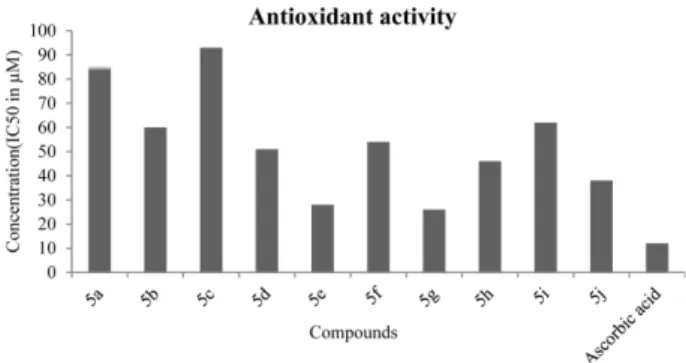
at 540 nm, using ELISA microtiter plate reader. The experi- ment was performed in triplicate and% scavenging activity was calculated using the formula given below. IC50 (Inhib- itory concentration) is the concentration of the sample required to scavenge 50% of DPPH free radicals and it was cal- culated from the graph, % scavenging vs. concentration.
% DPPH radical scavenging =
×100
Compounds 5e and 5g have shown good radical scav- enging activity with the values IC50 28 and 26 µM respec- tively and are comparable with that of standard (i.e. Ascorbic acid) which is shown IC50 value of 12 µM (Fig. 2).
CONCLUSION
A series of quinoline substituted pyrazolines 5(a−j) was synthesized successfully from chalcones under basic con- dition in presence of PEG-400 as a reaction medium. All the compounds were subjected to antibacterial and anti- oxidant studies where, most of the compound showed promising activities. The compound 5e found to be the potent molecule being showed both antibacterial and anti- oxidant properties. Hence, the target compounds appear to be of greater potential for further exploration of various other activities.
Acknowledgment. This work is financially supported by Changwon National University in 2017-2018.
REFERENCES
1. Bano, S.; Javed, K.; Ahmad, S.; Rathish, L.G.; Singh, S.;
Alam, M. S. Eur. J. Med. Chem. 2011, 46, 5763.
2. Bai, X.; Shi, W. Q.; Chen, H. F.; Zhang, P.; Li, Y.; Yin, S. F. Chem. Nat. Compd. 2012, 48, 60.
3. Lee, M.; Brockway, O.; Dandavati, A.; Tzou, S.; Sjoholm, R.; Satam, V.; Westbrook, C.; Mooberry, S. L.; Zeller, M.;
Babu, B.; Lee, M. Eur. J. Med. Chem. 2011, 46, 3099.
4. Patel, N. B.; Patel, H. R. Arkivoc 2009, 12, 302.
5. Taj, T.; Kamble, R. R.; Gireesh, T. M.; Hunnur, R. K.; Mar- gankop, S. B. Eur. J. Med. Chem. 2011, 46, 4366.
6. Corradi, A.; Leonelli, C.; Rizzuti, A.; Rosa, R.; Veronesi, P.;
Grandi, R.; Baldassari, S.; Villa, C. Molecules 2007, 12, 1482.
7. Aggarwal, R.; Kumar, V.; Kumar, R.; Singh, S. P. Beilstein J. Org. Chem. 2011, 7, 179.
8. Anwara, H. F.; Elnagdic, M. H. Arkivoc 2009, 1, 198.
9. Tandon, V. K.; Yadav, D. B.; Chaturvedi, A. K.; Shukla, P. K. Bioorg. Med. Chem. Lett. 2005, 15, 3288.
10. Akbas, E.; Berber, I. Eur. J. Med. Chem. 2005, 40, 401.
11. Bekhit, A. A.; Ashour, H. M. A.; Ghany, Y. S. A.; Bekhit, A. E. A.; Baraka, A. Eur. J. Med. Chem. 2008, 43, 456.
12. Penning, T. D.; Talley, J. J.; Bertenshaw, S. R.; Carter, J.
S.; Collins, P. W.; Docter, S.; Graneto, M. J.; Lee, L. F.;
Malecha, J. W.; Miyashiro, J. M.; Rogers, R. S.; Rogier, D. J.; Yu, S. S.; Anderson, G. D.; Burton, E. G.; Cogburn, J. N.; Gregory, S. A.; Koboldt, C. M.; Perkins, W. E.; Seib- ert, K.; Veenhuizen, A. W.; Zhang, Y. Y.; Isakson, P. C. J.
Med. Chem.1997, 40, 1347.
13. Deng, X.; Mani, N. S. Org. Lett. 2008, 10, 1307.
14. Katritzky, A. R.; Wang, M.; Zhang, S.; Voronkov, M. V.
J. Org. Chem. 2001, 66, 6787.
15. Deng, X.; Mani, N. S. Org. Lett. 2006, 8, 3505.
16. Eswaran, S.; Adhikari, A. V.; Chowdhury, I. H.; Pal, N. K.;
Thomas, K. D. Eur. J. Med. Chem. 2010, 45, 3374.
17. Kumar, S.; Bawa, S.; Gupta, H. Mini Rev. Med. Chem. 2009, 9, 1648.
18. Eswaran, S.; Adhikari, A. V.; Shetty, N. S. Eur. J. Med.
Chem. 2009, 44, 4637.
19. Nasveld, P.; Kitchener, S. Trans. R. Soc. Trop. Med. Hyg.
2005, 99, 2.
20. Upadhayaya, R. S.; Vandavasi, J. K.; Kardile, R. A.;
Lahore, S. V.; Dixit, S. S.; Deokar, H. S.; Shinde, P. D.;
Sarmah, M. P.; Chattopadhyaya, J. Eur. J. Med. Chem. 2010, 45, 1854.
21. Hayat, F.; Salahuddin, A.; Umar, S.; Azam, A. Eur. J. Med.
Chem. 2010, 45, 4669.
22. Heifets, L. B.; Flory, M. A.; Lindholm-Levy, P. J. Anti- microb. Agents Chemother. 1989, 33, 1252.
Absorbance of control - Absorbance of test sample Absorbance of test sample
Figure 2. Antioxidant activity of compounds 5(a−j).