ABSTRACT
Background: A national immunization program (NIP) to prevent disease and reduce mortality from vaccine preventable diseases (VPD) is very important.
Methods: We analyzed only the anaphylaxis cases that occurred between 2001 and 2016 that Korea Centers for Disease Control and Prevention (KCDC) determined had a definite causal relationship with a vaccine. The clinical symptoms were assessed according to the Brighton Collaboration case definition (BCCD) level.
Results: During the period, there were 13 cases of vaccine-related anaphylaxis. The median age was 9 years (range, 1 month to 59 years). The incidence of anaphylaxis per million doses was 0.090 in 2005, 0.079 in 2012, 0.071 in 2013, 0.188 in 2015, and 0.036 in 2016. Of those cases, 23.1% were influenza vaccines, and 76.9% were BCCD level 2. Epinephrine was used in 46.2%.
Conclusion: Vaccine-related anaphylaxis seems to have been very rare in the past, but health care professionals must always be aware of anaphylaxis.
Keywords: Vaccine; Anaphylaxis; Adverse Reaction; Vaccine Preventable Diseases
INTRODUCTION
Immunization can protect the public against various infectious diseases, and is the most effective way to reduce mortality. Because there are many vaccine-preventable-diseases (VPD), especially in childhood and adolescents, immunization is the safest way to prevent severe disease. There are various national immunization programs (NIPs), which are somewhat different depending on the disease prevalence, epidemiological condition and economic state of each country.1-5 Most vaccines are likely to cause anaphylaxis, but severe anaphylaxis occurs extremely rarely. There are few reports about post-vaccination anaphylaxis in Korea.
The World Allergy Organization (WAO) proposed to define anaphylaxis as a severe, life- threatening, generalized or systemic hypersensitive reaction.6 WAO defines anaphylaxis widely, while Brighton Collaboration has categorized three levels of certainty that include at least two organ systems based on a combination of major and/or minor criteria.7
Original Article
Received: Mar 24, 2020 Accepted: Aug 4, 2020 Address for Correspondence:
Eun Hee Chung, MD, PhD
Department of Pediatrics, Chungnam National University, College of Medicine, 282 Munhwa- ro, Jung-gu, Daejeon 35015, Republic of Korea.
E-mail: [email protected]
* Eui Jeong Roh and Mi-Hee Lee contributed equally to this work.
† Present address: Department of Pediatrics, Chungnam National University Hospital, Daejeon, Korea
© 2020 The Korean Academy of Medical Sciences.
This is an Open Access article distributed under the terms of the Creative Commons Attribution Non-Commercial License (https://
creativecommons.org/licenses/by-nc/4.0/) which permits unrestricted non-commercial use, distribution, and reproduction in any medium, provided the original work is properly cited.
ORCID iDs Eui jeong Roh
https://orcid.org/0000-0001-5431-5866 Mi-Hee Lee
https://orcid.org/0000-0002-8012-3347 Kun-Baek Song
https://orcid.org/0000-0001-6981-6292 Yeon Kyeong Lee
https://orcid.org/0000-0003-4411-0941 Min-Kyung Kim
https://orcid.org/0000-0003-0473-2797 Tae Eun Kim
https://orcid.org/0000-0002-0326-3506
Eui jeong Roh ,1*† Mi-Hee Lee ,2* Kun-Baek Song ,3 Yeon Kyeong Lee ,4 Min-Kyung Kim ,4 Tae Eun Kim ,4 and Eun Hee Chung 3
1Department of Pediatrics, Sun General Hospital, Daejeon, Korea
2Department of Pediatrics, Incheon Medical Center, Incheon, Korea
3Department of Pediatrics, Chungnam National University, College of Medicine, Daejeon, Korea
4 Division of Vaccine-Preventable Disease Control and National Immunization Program, Korea Centers for Disease Control and Prevention, Cheongju, Korea
Vaccine-related Anaphylaxis Cases Confirmed by KCDC from 2001–2016
Pediatrics
Eun Hee Chung
https://orcid.org/0000-0001-9380-0151 Funding
This work was supported by research fund Chungnam National University (2018).
Disclosure
The authors have no potential conflicts of interest to disclose.
Author Contributions
Conceptualization: Lee MH, Chung E. Data curation: Lee MH, Lee YK, Kim MK, Kim TE.
Formal analysis: Song KB. Writing - original draft: Roh EJ, Lee MH. Writing - review &
editing: Roh EJ, Lee MH, Chung E.
The purpose of this study was to elaborate on predisposing factors, and management of anaphylaxis by the Brighton Collaboration case definition (BCCD) reported to Korea Centers for Disease Control & Prevention (KCDC).7 All of these cases have been confirmed as vaccine- related anaphylaxis with definite causality by the KCDC.
METHODS
We reviewed the cases confirmed by the Korea Advisory Committee on Vaccine Injury Compensation (KACVIC) under the KCDC with vaccine anaphylaxis from 2001 to 2016 and used the National Vaccine and Injury Investigation Team's reports.
Data collected included demographic information and medical history from medical records.
We investigated whether there were any adverse reactions from recipients who had been vaccinated with the same lot number. We evaluated vaccine management states, such as vaccine refrigerator operation, temperature measurement methods, vaccination records, national test reports, biological product shipping certificates, and performance certificates.
Each case was retrospectively reviewed by applying the BCCD level (Supplementary Tables 1 and 2).7
Ethics statement
Institutional Review Board of Incheon Medical Center reviewed the study and exempted it from deliberation (115288-201805-HR-028-01).
RESULTS
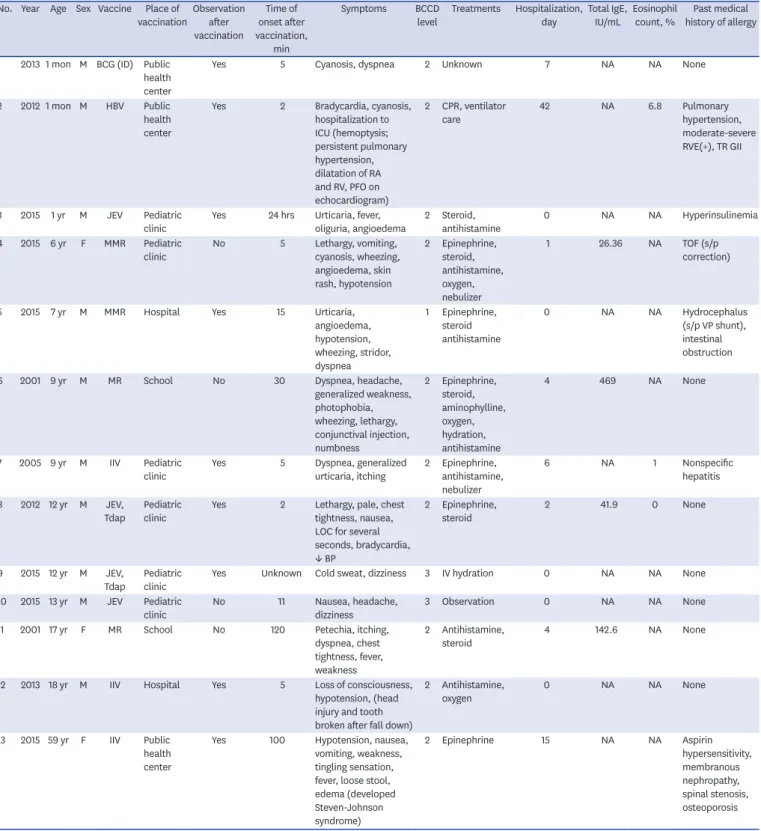
During the period, there were 13 cases of vaccine-related anaphylaxis and no deaths (Table 1).
The median age was 9 years (range, 1 month to 59 years), and males represented 10 (76.8%) cases. They were all fully recovered. The incidence of anaphylaxis per million doses was 0.090 in 2005, 0.079 in 2012, 0.071 in 2013, 0.188 in 2015, and 0.036 in 2016. The incidence for 2001 was not calculated because the denominator and dose for each vaccine were unknown.
Most immunization places were in pediatric outpatient clinics (8 cases), followed by public health centers (3 cases) and schools (2 cases). Anaphylaxis that occurred after vaccination was most frequent within 30 minutes (76.9%), followed by 30 minutes to 2 hours (15.4%), and after 2 hours (7.7%). The median time of symptom onset was 11 minutes. They all had no history of anaphylaxis or allergic reaction.
Reported vaccines were influenza (3/13, 23.1%), measles-mumps-rubella vaccine (MMR; 2/13, 15.4%), measles-rubella vaccine (MR; 2/13, 15.4%), inactivated Japanese encephalitis vaccine (JEV) alone (2/13, 15.4%), JEV and tetanus-diphtheria-acellular pertussis vaccine (Tdap) together (2/13, 15.4%), Bacille Calmette-Guérin vaccine (BCG) intradermal type (1 case, 7.7%) and hepatitis B vaccine (HBV; 1 case, 7.7%). Two cases were MR vaccinated at school by the
‘Catch-up Campaign’ program when there was a measles epidemic in Korea in 2000–2001. In 2015, there were 2 cases of JEV single injection, 1 JEV and Tdap simultaneous injection, and 2 MMR. These were identified as different lot numbers.
Table 1. Clinical findings of 13 vaccine-related anaphylaxis cases, confirmed by KCDC during 2001–2016 No. Year Age Sex Vaccine Place of
vaccinationObservation after vaccination
Time of onset after vaccination,
min
Symptoms BCCD
level Treatments Hospitalization, day Total IgE,
IU/mL Eosinophil
count, % Past medical history of allergy
1 2013 1 mon M BCG (ID) Public health center
Yes 5 Cyanosis, dyspnea 2 Unknown 7 NA NA None
2 2012 1 mon M HBV Public health center
Yes 2 Bradycardia, cyanosis, hospitalization to ICU (hemoptysis;
persistent pulmonary hypertension, dilatation of RA and RV, PFO on echocardiogram)
2 CPR, ventilator
care 42 NA 6.8 Pulmonary
hypertension, moderate-severe RVE(+), TR GII
3 2015 1 yr M JEV Pediatric
clinic Yes 24 hrs Urticaria, fever,
oliguria, angioedema 2 Steroid,
antihistamine 0 NA NA Hyperinsulinemia
4 2015 6 yr F MMR Pediatric
clinic No 5 Lethargy, vomiting,
cyanosis, wheezing, angioedema, skin rash, hypotension
2 Epinephrine, steroid, antihistamine, oxygen, nebulizer
1 26.36 NA TOF (s/p
correction)
5 2015 7 yr M MMR Hospital Yes 15 Urticaria,
angioedema, hypotension, wheezing, stridor, dyspnea
1 Epinephrine, steroid antihistamine
0 NA NA Hydrocephalus
(s/p VP shunt), intestinal obstruction
6 2001 9 yr M MR School No 30 Dyspnea, headache,
generalized weakness, photophobia, wheezing, lethargy, conjunctival injection, numbness
2 Epinephrine, steroid, aminophylline, oxygen, hydration, antihistamine
4 469 NA None
7 2005 9 yr M IIV Pediatric
clinic Yes 5 Dyspnea, generalized
urticaria, itching 2 Epinephrine, antihistamine, nebulizer
6 NA 1 Nonspecific
hepatitis 8 2012 12 yr M JEV,
Tdap Pediatric
clinic Yes 2 Lethargy, pale, chest
tightness, nausea, LOC for several seconds, bradycardia,
↓ BP
2 Epinephrine,
steroid 2 41.9 0 None
9 2015 12 yr M JEV,
Tdap Pediatric
clinic Yes Unknown Cold sweat, dizziness 3 IV hydration 0 NA NA None
10 2015 13 yr M JEV Pediatric
clinic No 11 Nausea, headache,
dizziness 3 Observation 0 NA NA None
11 2001 17 yr F MR School No 120 Petechia, itching,
dyspnea, chest tightness, fever, weakness
2 Antihistamine,
steroid 4 142.6 NA None
12 2013 18 yr M IIV Hospital Yes 5 Loss of consciousness,
hypotension, (head injury and tooth broken after fall down)
2 Antihistamine,
oxygen 0 NA NA None
13 2015 59 yr F IIV Public health center
Yes 100 Hypotension, nausea, vomiting, weakness, tingling sensation, fever, loose stool, edema (developed Steven-Johnson syndrome)
2 Epinephrine 15 NA NA Aspirin
hypersensitivity, membranous nephropathy, spinal stenosis, osteoporosis MR = measles-rubella vaccine, IIV = inactivated influenza vaccine, JEV = inactivated Japanese encephalitis vaccine, Tdap = tetanus-diphtheria-acellular pertussis vaccine, HBV = hepatitis B vaccine, BCG (ID) = Bacille Calmette-Guérin vaccine (intradermal type), MMR = measles-mumps-rubella vaccine, LOC = loss of consciousness, BP = blood pressure, ICU = intensive care unit, CPR = cardiopulmonary resuscitation, IM = intramuscular, RVE = right ventricle enlargement, TR = tricuspid regurgitation, TOF = tetralogy of Fallot, VP = ventriculoperitoneal, ARB = angiotensin receptor blocker, BCCD = Brighton Collaboration case definitions, NA = not available.
Most of the patients manifested cardiovascular symptoms (84.6%). Respiratory (61.5%), dermatologic (46.2%) and gastrointestinal system (38.5%) symptoms were also prevalent.
The results of the BCCD level according to the Adverse Event Following Immunization (AEFI) reporting checklist were 10/13 (76.9%) for level 2, 2/13 (15.4%) for level 3, 1/13 was level 1 (7.7%).
Six cases (46.2%) were treated with epinephrine, six cases (46.2%) were treated with corticosteroid, and seven cases (53.8%) were treated with anti-histamine medication.
Cardiopulmonary resuscitation was performed on one patient who was one month of age. He was diagnosed with congenital heart disease.
The rate of hospitalization was 61.3% (8/13), and the median duration was 10 days (1–42 days).
Five cases (38.5%) had improved without hospitalization and counsel regarding future vaccinations. Nine people were monitored for sufficient time after vaccination at the
immunization place. Four cases had not been observed for enough time after the immunization and one of them fell from the anaphylactic shock and sustained a head and tooth injury.
DISCUSSION
By implementing NIP, the world has controlled VPD, achieving herd immunity as well as immunization of those who are vaccinated.8 In Korea, an advisory committee on immunization was formed in 1992 to compensate victims of vaccination.3 In 1994, there had been four cases of death after the JEV inoculation, then the AEFI Surveillance System and the National Vaccine Injury Composition Program were subsequently established.3 Immunization rates in Korea averaged 97.2% in 2018, higher than in the United States (86.9%), Australia (94.3%), and the United Kingdom (93.9%).9
In the US, vaccine-induced anaphylaxis was rare at 1.31 per million doses across all ages during 2009–2011.10 Also in Germany, except for the influenza A virus subtype (H1N1) pandemic influenza vaccination, it was estimated at 6.8 cases per year.11 In the previous study 2009–2013 in Korea, vaccines had been reported being responsible for 1.0 percent of the cases.12 However, this was limited in identifying the frequency of vaccine anaphylaxis because it was a report by a small number of medical institutions and the result was a code analysis using the International Classification of Diseases, 10th Revision (ICD-10), but not a BCCD based analysis. In reporting to AEFI, BCCD helps to determine a causal relationship between anaphylaxis and vaccines and is used as a standard checklist in analyzing the surveillance data.1 An important finding in our study is that it included anaphylactic cases in which KCDC determined there was a definite causal relationship with a vaccine by using BCCD.
As part of NIP in Korea, the KCDC has been operating the national immunization safety management system; securing high-quality vaccines, monitoring adverse reactions, conducting epidemiological investigations of serious adverse reactions, and managing a vaccine injury compensation system.2
Vaccine components include immunizing antigens such as toxoids and viral proteins, egg or yeast as culture media, antibiotics, thimerosal preservatives as additives, gelatin or albumin stabilizers, and aluminum salts. These are all potential allergens, and even latex on the vaccine lid can trigger an allergic reaction during the handling process.13-15 In the production
of recombinant HBV, Saccharomyces cerevisiae is used during the cell culture process. Among hosts with yeast allergy, anaphylaxis may rarely occur.16
In the US, anaphylaxis by inactivated trivalent influenza vaccine and monovalent were 1.35 and 1.83 per million doses, respectively, and in Germany, anaphylaxis was most common after the immunization of the pandemic H1N1 influenza vaccine.10,11 One study found that seven out of 10 cases of vaccine anaphylaxis were caused by influenza vaccines in Korea.12 The influenza vaccine was the most common cause of adverse reactions in 2008-2012 in Korea.13 In particular, 12 million monovalent influenza vaccines had been given during pandemic H1N1 in 2009, of which 23 had been suspected of anaphylaxis, which was 0.18 cases per 100,000 population.5,13 Influenza vaccines were also the most common cause of anaphylaxis (23.1%) in our study, which confirmed the causal relationship with vaccines.
A 59-year-old woman with a history of aspirin-exacerbated respiratory disease developed Steven Johnson syndrome (SJS) five days after influenza vaccination. There is no convincing data the influenza vaccine caused SJS. The possibility of other causes could not be ruled out, such as drugs during hospitalization or taken before vaccination. But in a case report in Japan in 2016, a 75-year-old man developed the SJS two days after the flu vaccine.17
It should be remembered that some of the risk factors for severe anaphylaxis include old age, comorbid medical conditions, and asthma.10,18-20
Epinephrine is a drug that is used in the treatment of severe anaphylaxis, but health care workers hesitate to use it. In our findings, epinephrine had been administered in six cases (46.2%). In Australia, 72% of anaphylaxis patients were treated with adrenaline, whereas in Korea, 36.9% of adults and 24% of children were administered epinephrine.21,22
There was one person who collapsed after immunization, causing tooth and head injury.
Usually children should be observed for 20 to 30 minutes after vaccination, but children at high-risk of anaphylaxis should be observed for 60 minutes and restricted from strenuous exercise for one day.23
A limitation of our research is that detailed medical information and circumstances were not available in some cases. As the frequency of vaccine-related anaphylaxis itself was very small, the risk factors for anaphylaxis could not be determined. The incidence from these results was calculated only in cases where the vaccine was identified as vaccine anaphylaxis and rewarded. Therefore, vaccine-related anaphylaxis cases may be under-reported and may be higher than the results reported in this study.
The AEFI surveillance system was introduced in 1994, but the computerization of the Electronic Document Interchange (EDI) system began in 2000.4 The frequency of some years could not be calculated because the total number of vaccination corresponding to the denominator was unknown.
The prospective analysis and continuous monitoring of AEFI are required.
We suggest that to prevent severe vaccine anaphylaxis, 1) a careful history of anaphylaxis or
and 3) differential diagnosis of anaphylaxis, and preparation of epinephrine for an emergency are needed.
In conclusion, the incidence of vaccine-related anaphylaxis was very low in Korea. The anaphylaxis cases had been classified according to BCCD levels, and these results can be used as national representative data for vaccine-anaphylaxis in Korea.
Vaccination of the NIP is very safe and has contributed to disease prevention by increasing the vaccination coverage rate. Nevertheless, physicians should always be aware of the potential for fatal adverse reactions after vaccination, be prepared for emergencies, and actively treat anaphylaxis.
The risks and precautions should be evaluated before immunization to prevent vaccine- related anaphylaxis. Whenever new vaccines are introduced, vaccine-related side effects and the frequency of anaphylaxis should be always monitored.
ACKNOWLEDGMENTS
We appreciate to Korea Advisory Committee on Vaccine Injury Compensation and Vaccine Injury Investigation Team for reviewing all cases.
SUPPLEMENTARY MATERIALS
Supplementary Table 1
Brighton Collaboration case definitions Click here to view
Supplementary Table 2
Major and minor criteria used in the case definition of anaphylaxis Click here to view
REFERENCES
1. Gold MS, Gidudu J, Erlewyn-Lajeunesse M, Law B; Brighton Collaboration Working Group on Anaphylaxis. Can the Brighton Collaboration case definitions be used to improve the quality of Adverse Event Following Immunization (AEFI) reporting? Anaphylaxis as a case study. Vaccine 2010;28(28):4487-98.
PUBMED | CROSSREF
2. Lee JK, Choi WS. Immunization policy in Korea. Infect Chemother 2008;40(1):14-23.
CROSSREF
3. Kwon YH, Park YJ. The national immunization safety management system in Korea. Public Health Wkly Rep 2013;6(25):485-91.
4. Ministry of Health and Welfare, Korea Center for Disease Control & Prevention. Guidelines for Managing Adverse Reactions after Vaccination. Cheongju: Korea Center for Disease Control and Prevention; 2011, 11-9.
5. Lee DH, Shin SS, Jun BY, Lee JK. National level response to pandemic (H1N1) 2009. J Prev Med Public Health 2010;43(2):99-104.
PUBMED | CROSSREF
6. Johansson SG, Bieber T, Dahl R, Friedmann PS, Lanier BQ, Lockey RF, et al. Revised nomenclature for allergy for global use: report of the Nomenclature Review Committee of the World Allergy Organization, October 2003. J Allergy Clin Immunol 2004;113(5):832-6.
PUBMED | CROSSREF
7. Rüggeberg JU, Gold MS, Bayas JM, Blum MD, Bonhoeffer J, Friedlander S, et al. Anaphylaxis: case definition and guidelines for data collection, analysis, and presentation of immunization safety data.
Vaccine 2007;25(31):5675-84.
PUBMED | CROSSREF
8. Mallory ML, Lindesmith LC, Baric RS. Vaccination-induced herd immunity: successes and challenges. J Allergy Clin Immunol 2018;142(1):64-6.
PUBMED | CROSSREF
9. Lee J, Jeong H, Kim S, Yu J, Kim G. National childhood vaccination coverage among children aged 1–3 and 6 years in Korea, 2018. Public Health Wkly Rep 2019;12(39):1548-58.
10. McNeil MM, Weintraub ES, Duffy J, Sukumaran L, Jacobsen SJ, Klein NP, et al. Risk of anaphylaxis after vaccination in children and adults. J Allergy Clin Immunol 2016;137(3):868-78.
PUBMED | CROSSREF
11. Oberle D, Pavel J, Rieck T, Weichert S, Schroten H, Keller-Stanislawski B, et al. Anaphylaxis after immunization of children and adolescents in Germany. Pediatr Infect Dis J 2016;35(5):535-41.
PUBMED | CROSSREF
12. Lee SY, Ahn K, Kim J, Jang GC, Min TK, Yang HJ, et al. A multicenter retrospective case study of anaphylaxis triggers by age in Korean children. Allergy Asthma Immunol Res 2016;8(6):535-40.
PUBMED | CROSSREF
13. Yang HJ. Allergic reactions to vaccine components. Allergy Asthma Respir Dis 2014;2(3):157-64.
CROSSREF
14. Erlewyn-Lajeunesse M, Hunt LP, Heath PT, Finn A. Anaphylaxis as an adverse event following immunisation in the UK and Ireland. Arch Dis Child 2012;97(6):487-90.
PUBMED | CROSSREF
15. Chung EH. Vaccine allergies. Clin Exp Vaccine Res 2014;3(1):50-7.
PUBMED | CROSSREF
16. DiMiceli L, Pool V, Kelso JM, Shadomy SV, Iskander J; V.A.E.R.S. Team. Vaccination of yeast sensitive individuals: review of safety data in the US vaccine adverse event reporting system (VAERS). Vaccine 2006;24(6):703-7.
PUBMED | CROSSREF
17. Oda T, Sawada Y, Okada E, Yamaguchi T, Ohmori S, Haruyama S, et al. Stevens-Johnson syndrome after influenza vaccine injection. J Investig Allergol Clin Immunol 2017;27(4):274-5.
PUBMED | CROSSREF
18. González-Pérez A, Aponte Z, Vidaurre CF, Rodríguez LA. Anaphylaxis epidemiology in patients with and patients without asthma: a United Kingdom database review. J Allergy Clin Immunol 2010;125(5):1098-1104.e1.
PUBMED | CROSSREF
19. Clark S, Wei W, Rudders SA, Camargo CA Jr. Risk factors for severe anaphylaxis in patients receiving anaphylaxis treatment in US emergency departments and hospitals. J Allergy Clin Immunol 2014;134(5):1125-30.
PUBMED | CROSSREF
20. Iribarren C, Tolstykh IV, Miller MK, Eisner MD. Asthma and the prospective risk of anaphylactic shock and other allergy diagnoses in a large integrated health care delivery system. Ann Allergy Asthma Immunol 2010;104(5):371-7.
PUBMED | CROSSREF
21. Cheng DR, Perrett KP, Choo S, Danchin M, Buttery JP, Crawford NW. Pediatric anaphylactic adverse events following immunization in Victoria, Australia from 2007 to 2013. Vaccine 2015;33(13):1602-7.
PUBMED | CROSSREF
22. Choi YJ, Kim J, Jung JY, Kwon H, Park JW. Underuse of epinephrine for pediatric anaphylaxis victims in the emergency department: a population-based study. Allergy Asthma Immunol Res 2019;11(4):529-37.
PUBMED | CROSSREF
23. Erlewyn-Lajeunesse M, Brathwaite N, Lucas JS, Warner JO. Recommendations for the administration of influenza vaccine in children allergic to egg. BMJ 2009;339:b3680.
PUBMED | CROSSREF