http://dx.doi.org/10.7570/kjo.2014.23.3.141 pISSN 1226-4407 eISSN 2234-7631
INTRODUCTION
The prevalence of childhood obesity has been steadily increasing during the past few decades worldwide.
1,2According to the current report by World Health Organization (WHO), the worldwide preva- lence of childhood obesity has increased by 2.5% from 1990 to 2010.
1Although the specific causes of the rapid increase in childhood obe- sity have not been fully understood, increased sedentary lifestyles (e.g., television viewing, internet use and, playing video games) and decreased physical activity are considered as the major culprits.
3,4Furthermore, increased energy consumption from high-fat or high- calorie foods (e.g., fast foods or sweet beverages) is strongly associat- ed with the rapid increase in childhood obesity.
5The obesity epidemic in youth is an important public health con- cern since it is strongly associated with many health risks such as cardiovascular disease (CVD)
6, type 2 diabetes mellitus (T2DM)
7, low level of quality of life
8as well as mental disorders.
9In addition, previous studies also reported that childhood obesity tracks well into
adult obesity
10, suggesting that effective strategies to combat obesity should be implemented in childhood to prevent increasing risk of chronic disease in adulthood.
11Previous literatures
12,13have reported beneficial effects of regular physical activity as a primary treatment strategy for obesity preven- tion or reduction in children and adolescents. Aerobic exercise train- ing has been traditionally employed as an effective intervention tool to combat obesity epidemic in adults
14,15and youth.
16Racette et al.
15reported that 12 weeks of aerobic exercise (60 to 65% of maximal ox- ygen consumption intensity, 45 minutes, 3 times/week) reduces fat mass in women, and similar positive change in body composition was found in adolescents after 12 weeks of aerobic exercise (2 times/
week, 20 to 30 minutes).
16Recently, emerging evidence also suggest that resistance exercise training is an alternative and an effective tool for obesity treatment for both adults
17-19and children.
20-28It is well established that resis- tance exercise training provides positive effects on body composi- tion
19, and is also known to improve psychological well-being (en-
Effects of Resistance Exercise Training on Childhood Obesity
Minsuk Oh
1, YoonMyung Kim
2, Sang-Hoon Suh
3, Justin Y. Jeon
1,*
Department of Sport and Leisure Studies
1, Yonsei University, Seoul; University College
2, Yonsei University, Seoul; Department of Physical Education
3, Yonsei University, Seoul, Korea
The prevalence of childhood obesity has been steadily increasing worldwide. Low level of physical activity, poor cardiorespiratory fitness, sed- entary lifestyle, and increased energy intake are recognized as major culprits in the childhood obesity epidemic. Childhood obesity is closely associated with many chronic comorbidities such as type 2 diabetes mellitus (T2DM), cardiovascular disease (CVD), cancer, and psychological disorders. Studies have suggested that regular exercise is an effective tool for obesity treatment in youth. Aerobic exercise format (either exercise alone or combined with calorie restriction) has been widely and traditionally applied for reducing childhood obesity. A growing body of evi- dence suggests that resistance exercise training is beneficial in improving body composition, thereby is an alternative tool for the treatment of childhood obesity. However, the effects of resistance exercise training alone in childhood obesity are relatively limited in youth. Thus, the pur- pose of this review was to provide an update on current findings associated with resistance exercise training as an effective treatment and pre- vention strategy for childhood obesity reduction.
Key words: Obesity, Childhood, Resistance training
Corresponding author Justin Y. Jeon
Department of Sport and Leisure Studies, Yonsei University, 50 Yonsei-ro, Seodaemun-gu, Seoul 120-749, Korea
Tel +82-2-2123-6197 Fax +82-2-2123-8648 E-mail [email protected] Received May 8, 2014 Reviewed Jul. 18, 2014 Accepted Aug. 14, 2014
Copyright © 2014 Korean Society for the Study of Obesity
This is an Open Access article distributed under the terms of the Creative Commons Attribution
Non-Commercial License (http://creativecommons.org/licenses/by-nc/3.0/) which permits
unrestricted non-commercial use, distribution, and reproduction in any medium, provided the
original work is properly cited.
hance quality of life, decrease level of depression, or anxiety)
29,30, and prevents risks of injury from sports activity.
31Although the benefi- cial effects of resistance exercise training have been investigated in adults, its effects on childhood obesity was not fully understood.
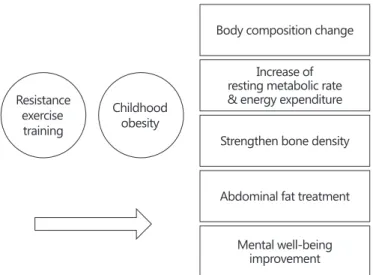
Therefore, the purpose of the review was to summarize and provide an update on current findings associated with resistance exercise training, which is gaining recognition as an effective treatment and prevention strategy for childhood obesity. Intervention studies con- cerning the effects of resistance exercise training in obese children are summarized in Table 1. The studies only covered children who were either overweight or obese.
RESISTANCE EXERISE TRAINING AND BODY COMPOSITION IN CHILDHOOD OBESITY
In obese adults, it is well established that resistance exercise train- ing alone, without calorie restriction, positively alters body weight, waist circumference, and body fat mass.
32,33Similar to such observa- tions in adults, several studies with youth reported positive changes in body composition after resistance exercise training.
21,22,25,34The summary of findings in youth is shown in Table 2. McGuigan et al.
22conducted an 8 week (3 times/week) program of whole body resis- tance exercise training in overweight and obese youth aged 7-12 years. After the intervention, they reported that there was a signifi- cant increase in lean body mass (5.3%, P<0.05), and decrease in per- cent body fat (2.6%, P<0.01), whereas weight and fat mass were not significantly changed. The results were consistent with the findings from adult population studies, and it proved that resistance exercise training is an effective treatment for modifying body composition.
Moreover, Shaibi et al.
25also showed a significant reduction in per- cent body fat (2.5%, P<0.05) after 16 weeks (2 times/week,≤60 min/
session) of resistance exercise training intervention in obese adoles- cents. Most studies have reported that resistance exercise training intervention in youth obesity increases lean body mass, and positive- ly modifies percent body fat accordingly. Meanwhile, Sgro et al.
27re- ported that fat mass decreased by 8.1% after 24 weeks of resistance exercise training intervention period in overweight or obese children (P<0.05). This was the only study that provided evidence for fat mass reduction after 24 weeks of resistance exercise training.
27Since most interventions were set for 8 or 16 weeks of resistance exercise
training while the 24 weeks of intervention was used in the study of Sgro et al.
27, the duration of the training intervention may be the fac- tor causing a different outcome in the study of Sgro et al.
27compared with the other studies.
22,24,25It would be safe to conclude that resis- tance exercise training for at least over 16 weeks would be effective in fat mass reduction among youth. Long term resistance exercise is suggested to treat childhood obesity.
Additionally, weight gain was also found after 12 weeks of resistance exercise training in obese adolescents aged 15.5 years.
21The weight gain is influenced by the increase of lean body mass after resistance exercise. However, the most noteworthy thing is that normal growth in youth may also cause weight gain during the research intervention period. Resistance exercise training affects lean body mass and per- cent body fat rather than body weight reduction or fat mass reduction in childhood obesity, and this may be attributed to normal growth in children. To conclude, normal growth and resistance exercise train- ing may simultaneously affect body composition. Further study on the effect of minimal time period of resistance exercise training on body composition is needed to exclude the impact of normal growth.
RESISTANCE EXERCISE TRAINING AND ABDOMINAL FAT ON
CHILDHOOD OBESITY
Abdominal obesity, especially visceral abdominal fat is one of the leading cause of T2DM
35, and incidence of CVD.
36A number of stud- ies in adult population have investigated exercise treatment for ab- dominal obesity.
37,38Intervention studies in adult population showed that 16 weeks of progressive resistance exercise training program (2 times/week) reduced visceral (10.3%, P<0.01) and subcutaneous (11.2%, P<0.01) abdominal fat in seniors of average age of 66.6 years.
39Treuth et al.
40reported that intra abdominal adipose tissue signifi- cantly decreased (13.9 cm
2, P<0.05) even though body weight re- mained the same after 16 weeks of progressive resistance exercise training intervention in older women. According to the collected data of the adult population, it may be suggested that participating in resis- tance exercise training for over 16 weeks reduces visceral abdominal fat in adults. To date, very limited study was found on the effect of re- sistance exercise training alone on abdominal obesity in children.
Meanwhile, a randomized trial study
41involving non-obese children
(mean age: 12.2 years) reported that high-intensity progressive resis-
Table 1. Intervention studies of resistance exercise training effects on childhood obesity (overweight or obese youth only) Reference Design Participant (No.), Sex (M, F), Cohort
Age (mean ±SD or range) Duration
Control or comparison condition
Training program & intervention
Training Intervention-frequency (F), intensity (I), time (T)
Outcome Measurement T raining equipment
Van Der Heijden et al. (2010)
21
NRCT N =12 (M =5, F =10)
obese Hispanic, (BMI
≥95th percentile), Tanner 4-5
15.5 (± 12 weeks No W -up/C-down+ST : Hand-held weights Flys, Push- 0.5) yr Ups, Chest Press, Seated Row , Overhead Press, Triceps Extension with hand-held weights, Hand- held weights Curls, Cable Curls, Lateral Raises, Hand-held weights Press, Leg Extension, Static Lunges, Squats with and without weights, Dead Lifts with and without weights, Leg Curl with and without weights, Calf Raises, Bridges on Physio - ball, Curl Ups
F: 2 times/week I: light to moderate week 1-2: 2-3 set, 8-12 reps (~50% of 3RM); week 3-8: increased gradually according to each individual’
s ability; week 9-12: 3 sets,
15-20 reps (~80-85% of 3 RM) T: 60 min (10 min W
-up, 40 min ST , 10 min cool-down)
Body composition (weight, BMI, % body fat, lean body mass, fat mass, ab - dominal fat, hepatic and intramyocellu - lar fat, bone mineral density), peripheral insulin sensitivity , glucose production rate (GPR)
Free weights
McGuigan et al. (2008)
22
NRCT N =48 (M =22, F =26),
overweight (BMI
≥85th percentile)
7-12 yr 8 weeks No
Progressive resistance training (PRT) Day 1: Squat, Bench Press, Lunges, Rows, Shoulder Press, Push- Ups, Sit-Ups, Arm Curl, T riceps Dips, Abdominal Day 2: Squats, Straight leg dead-lifts, Flys, Front raises, Rows, Heal raises, T riceps extensions, Bi -
cep curls, Abdominal Day 3: W
eight squat jumps, CMJs, Explosive hang
pulls, Bench press, Rows, Shoulder presses, Sit- ups, Abdominal F: 3 times/week I: 1st day: 3 sets, 8-10 reps, controlled tempo, 90 sec between sets; 2nd day: 3 sets, 10-12 reps, controlled tempo, 60 sec between sets; 3rd day: 3 sets, 3-5 reps, fast tempo, 3 min between sets
Body composition (% body fat, lean body mass, height, weight, BMI, total fat mss, bone mineral contents)
Machines, free-weight
Lau et al. (2010)
23
NRCT N =18 (M =13, F =5), Obese Chinese
12.45 (± 6 weeks No Circuit-based RT (w-up, C-down, 10 RT stations 1.77) yr (Chest Press, Lat Pull Down, Shoulder Press, Leg Press, Leg Extension, Leg Curl, Heel Raise, Biceps Curl, T riceps Extension, Adjusted Push-Ups) F: 3 times/week I: 70-85% of 1 RM with full motion T: 60 min, 3-5 min rest between sets
Body composition (body fat mass and lean body mass, bone mineral con - tents), muscle strength, leptin, insulin and glucose
Free weights
Treuth et al. (1998)
28
NRCT N =22 Control group (F =11) T reatment group (F =11) obese (BMI ≥95th percentile), Tanner 1-2
7-10 yr 5 months wait-list control Circuit T rai ning: 6 Upper -body exercises (Ben ch Press, Military Press, Biceps Curl, Latissimus Pull Do w n, Tri ce ps Ex te ns ion , a nd S it- Up s) an d 1 Lo w er - body exercise (Leg Press) F: 3 times/week I: upper
→ 2 sets of 12 reps, leg press → 2 sets of 15 reps T: 20 min
Body composition (weight, % body fat, fat free mass), muscle strength, fitness (VO2max),
resting metabolic rate and total energy expenditure
Machines
Lau et al. (2004)
24
RCT N =37 T reatment group (M =14, F =7)
Control group (M =11, F =5), obese
10-17 yr 6 weeks
Diet education and behavior modification program only Exercise: Circuit-based RT (W -up, C-down, 10 RT stations (machines) F: 3 times/week I: 70-85% 1 RM, at least 5 lifts with
full motion T: 60 min 3 set circuit, 3-5 min rest between sets
Body composition (height, weight, BMI, lean mass, fat mass, % body fat, bone mineral contents), lipids, insulin and gl uc os e, b lo od p re ss ur e, c ho le st er ol level
Machines
Shaibi et al. (2006)
25
RCT N =22 T reatment group (M =11) Control group (M =11), Latino,
overweight (BMI
≥85th percentile), Tanner ≥3
Control: 15.6 (
±0.5)
yr Treatment: 15.1 (
±0.5) yr
16 weeks W ait-list control Progressive resistance training (PRT) Day 1: 5 min W -up/C-down: stretches, abdominal exercises Two compound lower -body exercises, three isolat - ed upper -body exercises Da y 2 : 5 m in W -u p/ C- do w n: s tre tc he s, a bd om in al exercises Two compound upper
-body exercises, three isolat - ed lower -body exercises
F: 2 times/week I: moderate intensity
, higher volume
week 1-4: 1 set, 10-15 reps; week 5-10: 2 sets, 13-15 reps; week 11-16: 3 sets, 8-12 reps T: ≤ 60 min 3 set circuit, 1-2 min rest between sets/exercises
Body composition (fat mass and lean body mass), muscle strength, Leptin, in - sulin and glucose
Machines stacked weights
Davis et al. (2009)
26
RCT N =41 Control group (F =7) Nutrition only (N) (F =10),
N+ST (strength training) (F =9) N+CAST (aerobic+ST) (F =15),
Latino girl, overweight (BMI
≥85th percentile)
15.2 ( ±1.1) yr 16 weeks W ait-list control or Diet education program only Progressive resistance training (PRT) Day 1: 5 min W -up/C-down: stretches, abdominal exercises Two compound lower -body exercises, three isolat - ed upper -body exercises Da y 2 : 5 m in W -u p/ C- do w n: s tre tc he s, a bd om in al exercises Two compound upper
-body exercises, three isolat - ed lower -body exercises
F: 2 times/week I: moderate intensity
, higher volume
week 1-4: 1 set, 10-15 reps; week 5-10: 2 sets, 13-15 reps; week 11-16: 3 sets, 8-12 reps T: ≤ 60 min, 3 set circuit, 1-2 min rest between sets/exercises
Body composition (BMI, fat mass, lean body mass), muscle strength, insulin and glucose
Machines, free-weight
Sgro et al. (2009)
27