• 검색 결과가 없습니다.

Repair of Tetralogy of Fallot in Infancy via the Atrioventricular Approach

N/A
N/A
Protected

Academic year: 2021

Share "Repair of Tetralogy of Fallot in Infancy via the Atrioventricular Approach"

Copied!
6
0
0

로드 중.... (전체 텍스트 보기)

전체 글

(1)

ISSN: 2233-601X (Print) ISSN: 2093-6516 (Online)

1

Department of Cardiovascular Surgery, School of Medicine, Isfahan University of Medical Science,

2

Department of Cardiovascular Surgery, Chamran Heart Center, Isfahan University of Medical Science

†This study was carried out in Chamran Heart Center which is one of the largest centers in Iran.

Received: July 8, 2015, Revised: October 1, 2015, Accepted: October 2, 2015, Published online: February 5, 2016

Corresponding author: Hamid Bigdelian, Department of Cardiovascular Surgery, School of Medicine, Isfahan University of Medical Science, Isfahan, 81746-73461, Iran

(Tel) 98-3132600901 (Fax) 98-313260090 (E-mail) [email protected]

C

The Korean Society for Thoracic and Cardiovascular Surgery. 2016. All right reserved.

CC

This is an open access article distributed under the terms of the Creative Commons Attribution Non-Commercial License (http://creative- commons.org/licenses/by-nc/4.0) which permits unrestricted non-commercial use, distribution, and reproduction in any medium, provided the original work is properly cited.

Repair of Tetralogy of Fallot in Infancy via the Atrioventricular Approach

Hamid Bigdelian, M.D.

1

, Mohsen Sedighi, Ph.D.

2

Background: Tetralogy of Fallot (TOF) is a well-recognized congenital heart disease. Despite improvements in the outcomes of surgical repair, the optimal timing of surgery and type of surgical management of patients with TOF remains controversial. The purpose of this study was to assess outcomes following the repair of TOF in infants depending on the surgical procedure used. Methods: This study involved the retrospective review of 120 patients who underwent TOF repair between 2010 and 2013. Patients were divided into three groups depending on the surgical procedure that they underwent. Corrective surgery was done via the transventricular approach (n=40), the transatrial approach (n=40), or a combined atrioventricular approach (n=40). Demographic data and the outcomes of the surgical procedures were compared among the groups. Results: In the atrioventricular group, the incidence of the following complications was found to be significantly lower than in the other groups: complete heart block (p=0.034), right ventricular failure (p=0.027) and mediastinal bleeding (p=0.007). Patients in the atrioventricular group had a better postoperative right ventricular ejection fraction (p=0.001). No statistically significant differences were ob- served among the three surgical groups in the occurrence of tachycardia, renal failure, and tricuspid incompetence.

The one-year survival rates in the three groups were 95%, 90%, and 97.5%, respectively (p=0.395). Conclusion:

Combined atrioventricular repair of TOF in infancy can be safely performed, with acceptable surgical risk, a low in- cidence of reoperation, good ventricular function outcomes, and an excellent survival rate.

Key words: 1. Tetralogy of Fallot 2. Cardiopulmonary bypass 3. Congenital abnormalities

INTRODUCTION

Tetralogy of Fallot (TOF) is a well-recognized congenital heart disease involving the combination of ventricular septal defects (VSDs), pulmonary stenosis, and hypertrophy of the right ventricle (RV) [1]. Previous research has suggested that repairing TOF in infancy promotes the normal growth and development of the heart and other organs, the elimination of

hypoxemia and cyanosis, the prevention of right ventricular hypertrophy, the preservation of left ventricular function, and the decreased incidence of late arrhythmias [2]. Earlier studies have reported that the use of traditional ventriculotomy for VSD closure and relief of right ventricular outflow tract (RVOT) obstructions leads to an increased incidence of late RV failure, ventricular arrhythmias, and sudden death. Curr- ently, the right atrial (RA) approach via the tricuspid valve is

http://dx.doi.org/10.5090/kjtcs.2016.49.1.9

(2)

used in the majority of infants undergoing repair of TOF.

Atriotomy provides excellent exposure, but is associated with an increased risk of complete heart block (CHB) and tricus- pid incompetence (TI) [3]. The purpose of this study was to describe our experiences with the repair of TOF using three techniques to close VSDs, with particular emphasis on the surgical procedure used.

METHODS 1) Patients

Between 2010 and 2013, 135 consecutive children with TOF underwent classic TOF repair in our center. Our study was approved by our local ethics committee and informed consent was obtained from the parents, because the patients were not of the legal age to provide consent. Fifteen patients with pul- monary atresia, coronary anomalies, or who underwent emer- gency operations were excluded from the study. Therefore, our study population constricted of a total of 120 eligible patients. All patients were diagnosed using two-dimensional and Doppler echocardiography. All patients were operated on by one surgeon, and their demographic and clinical character- istics were obtained retrospectively from their medical records.

During aforementioned time, in our center, the atrial and ventricular approaches were exclusively used for TOF repair according to the surgeon’s preference (based on cardiac ana- tomical characteristics and VSD location). In the present study, the patients were divided into three groups depending on the procedure they underwent: the RA group included pa- tients who underwent TOF repair via atriotomy (n=40), the RV group included patients who underwent TOF repair via ventriculotomy (n=40), and the right atrioventricular valve (RAV) group included patients who underwent TOF repair via a combined atrioventricular technique (n=40). The pa- tients’ medical records in the hospital database, including clinical follow-up information, were retrospectively reviewed in the current study.

2) Surgical technique

Standard cardiopulmonary bypass (CPB) with a single in- jection of cold crystalloid cardioplegia and hypothermia (24

o

C–

28

o

C) was employed in all patients. The aorta was cannulated with a 12–18-F plastic guided flexible arterial cannula. The superior vena cava was cannulated using a straight venous cannula and the inferior vena cava cannula was inserted through a stab wound at the cavoatrial junction. After estab- lishing CPB, the aorta was cross-clamped with a right-angle cross-clamp and cold crystalloid cardioplegic solution was in- fused into the aortic root until cardiac arrest. The repair tech- nique used in each patient was chosen based on both the ana- tomical location of the VSD and the operating surgeon’s preference. In the RA group, the VSD was closed using a polytetrafluoroethylene (PTFE) patch via a standard transatrial incision following the relief of the RVOT obstruction. In the RV group, VSD closure was performed using a PTFE patch following the relief of the RVOT obstruction via a longitu- dinal transventricular incision measuring approximately 2–3 cm.

In the third group, after the relief of RVOT obstruction, the anterior portion of the VSD was closed by a PTFE patch via a short atriotomy and minimal retraction of the tricuspid valve.

Subsequently, the inferior part of the VSD was closed through a ventriculotomy (limited to 1.5 cm) and minimal manipu- lation of the RV. In order to verify the full competence of the tricuspid valve, saline solution was injected into the right ventricle. After complete closure of the VSD, pericardium was closed and mediastinal and pleural drainage tubes were placed.

3) Statistical analysis

All statistical analyses were carried out using IBM SPSS

ver. 22.0 (IBM Co., Armonk, NY, USA). Continuous varia-

bles are presented as mean±standard deviation. One-way anal-

ysis of variance (ANOVA) was used to identify statistically

significant differences among these data points. Categorical

variables are presented as frequency (percentage), and were

analyzed using the chi-square test or Fisher’s exact test, as

appropriate. In order to generate survival curves, we used

Kaplan–Meier survival estimates. All p-values <0.05 were

considered to indicate statistical significance in all tests.

(3)

Table 1. Demographic and clinical data of patients

Variable Atriotomy (n=40) Ventriculotomy (n=40) Atrioventriculotomy (n=40) p-value

Age (mo) 8.65±2.2 8.48±2.1 8.35±2.5 0.843

Gender

Female 23 (57.5) 22 (55.0) 28 (70.0) 0.338

Male 17 (42.5) 18 (45.0) 12 (30.0)

Weight (kg) 7.22±1.9 7.38±1.9 7.67±2.1 0.597

Body surface area (m

2

) 0.34±0.91 0.34±0.90 0.34±0.10 0.982

Cardiopulmonary bypass time (min) 126±34 128±32 125±30 0.670

Aortic cross-clamp time (min) 89.32±20.7 91.20±20.6 86.52±19.2 0.584

Intubation time (hr) 23.12±2.6 26.08±2.1 20.75±1.8 0.001

Intensive care unit stay (day) 4.68±0.27 5.78±0.32 3.87±0.16 0.001

Values are presented as mean±standard deviation or number (%). Continuous data are analyzed using one way analysis of variance.

Categorical data are analyzed using chi-square test and Fisher’s exact test.

RESULTS

1) Demographic and clinical characteristics of the patients

The study participants included 47 males (39%) and 73 fe- males (61%), ranging in age from six to 12 months. Patients who were less than six months of age or underwent initial palliation with a Blalock-Taussig shunt before corrective sur- gery were excluded from the study. All characteristics of the patients are summarized in Table 1. The mean age of the pa- tients in the RA, RV, and RAV groups was 8.65±2.2 months, 8.48±2.1 months, and 8.35±2.5 months, respectively. The mean weight of the patients at the time of repair in the RA, RV, and RAV groups was 7.22±1.9 kg, 7.38±1.9 kg and 7.67±2.1 kg, respectively. As Table 1 shows, no statistically significant differences were found among the groups with re- gard to these variables.

The mean aortic cross-clamp time in the RA group was 89.32±20.7 minutes, compared to 91.20±20.6 minutes in the RV group and 86.52±19.2 minutes in the RAV group. The mean duration of CPB was 126±34 minutes in the RA group, versus 128±32 minutes in the RV group and 125±30 minutes in the RAV group. No intraoperative deaths or severe compli- cations involving exposure, cannulation, or bleeding were ob- served in any of the three groups. The mean duration of in- tubation was 23.12±2.6 hours in the RA group, 26.08±2.1 hours in the RV group, and 20.75±1.8 hours in the RAV group. The mean length of the stay in the intensive care unit

(ICU) in the RA and RV groups was 4.68±0.27 and 5.78±

0.32 days, respectively, in contrast to 3.87±0.16 days in the RAV group. As presented in Table 1, ANOVA showed sig- nificant differences in intubation time and ICU stay duration (p=0.001).

2) Postoperative morbidity and mortality

A total of 86 patients (71.6%) experienced early postopera- tive complications. In the RA group, the complications were transient CHB (n=12), supraventricular tachycardia (n=3), RV failure (n=3), mediastinal bleeding requiring reoperation (n=5), tricuspid incompetence (n=5), and renal failure due to low cardiac output syndrome requiring peritoneal dialysis (n=4).

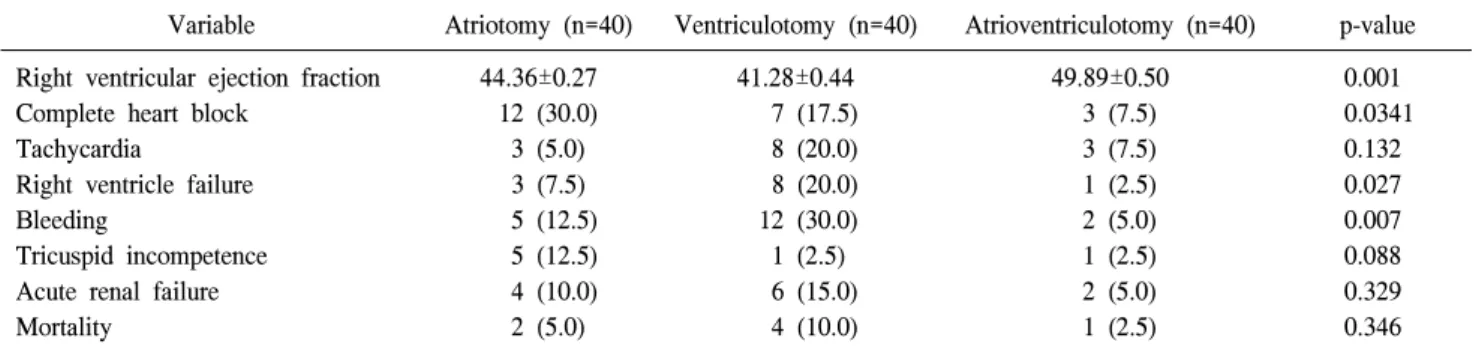
The complications in the RV group were transient CHB (n=7), supraventricular tachycardia (8), RV failure (n=8), me- diastinal bleeding requiring reoperation (n=12), tricuspid in- competence (n=1), and renal failure due to low cardiac output syndrome (n=6). The postoperative complications in the RAV group were transient CHB (n=3), supraventricular tachycardia (n=3), RV failure (n=1), mediastinal bleeding requiring reop- eration (n=2), tricuspid incompetence (n=1), and renal failure due to low cardiac output syndrome (n=2). As Table 2 shows, a significant difference was observed in the incidence of tran- sient CHB, RV failure, and mediastinal bleeding (p≤0.05).

Twelve (30%) events of transient CHB occurred in the RA

group versus seven (17.5%) in the RV group, whereas three

patients (7.5%) in the RAV group experienced transient CHB

(p=0.034). Moreover, RV failure took place in three patients

(4)

Table 2. Comparison of morbidity and mortality of patients after tetralogy of Fallot repair among tree groups

Variable Atriotomy (n=40) Ventriculotomy (n=40) Atrioventriculotomy (n=40) p-value

Right ventricular ejection fraction 44.36±0.27 41.28±0.44 49.89±0.50 0.001

Complete heart block 12 (30.0) 7 (17.5) 3 (7.5) 0.0341

Tachycardia 3 (5.0) 8 (20.0) 3 (7.5) 0.132

Right ventricle failure 3 (7.5) 8 (20.0) 1 (2.5) 0.027

Bleeding 5 (12.5) 12 (30.0) 2 (5.0) 0.007

Tricuspid incompetence 5 (12.5) 1 (2.5) 1 (2.5) 0.088

Acute renal failure 4 (10.0) 6 (15.0) 2 (5.0) 0.329

Mortality 2 (5.0) 4 (10.0) 1 (2.5) 0.346

Values are presented as mean±standard deviation or number (%). Continuous data are analyzed using one way analysis of variance.

Categorical data are analyzed using chi-square test and Fisher’s exact test, if applicable.

Fig. 1. Kaplan–Meier curves for one-year survival in tree groups.

All p-values analyzed by log-rank test. RAV, right atrioventricular valve; RA, right atrial; RV, right ventricle.

(7.5%) patients in the RA group, as compared to eight (20%) in the RV group, whereas only one patient (2.5%) experi- enced RV failure in the RAV group (p=0.027). Significantly less mediastinal bleeding was observed in the RAV group (5%) than in the RA (12.5%) and RV (30%) groups (p=0.007).

Although not significant, other variables showed a trend to be lower in the RAV group compared to the RA and RV groups.

Transthoracic Doppler echocardiography demonstrated sig- nificantly better RV function in the RAV group. As Table 2 shows, the mean RV ejection fraction (RVEF) in the RAV group was 49.89%±0.50%. The RVEF in the RA and RV groups was 44.36%±0.27% and 41.28%±0.44%, respectively (p=0.001). The postoperative RV/left ventricle systolic pres- sure ratio in patients was less than 0.7. As presented in Table 2, two mortality events (5%) took place in the RA group, in

contrast to four events (10%) in the RV group, whereas one mortality event (2.5%) took place in the RAV group. The earliest death in the RAV group was attributed to low cardiac output syndrome (LCOS) on the second postoperative day.

Two deaths occurred in the RA group, due to acute respira- tory distress syndrome and arrhythmia on the first and second postoperative day, respectively. Four early hospital deaths in the RV group took place, due to RV failure, supraventricular tachycardia, and LCOS in the ICU. The Kaplan-Meier surviv- al curve is presented in Fig. 1. The one-year survival rates in the RA, RV, and RAV groups were 95.0%, 90.0%, and 97.5%, respectively (p=0.395).

DISCUSSION

Despite improvements in the outcomes of surgical repair of

TOF over the last decades, certain issues remain under de-

bate, such as the optimal timing of surgery and the use of a

transatrial or a transventricular approach for the closure of the

VSD [4]. The location of the defects, clinical symptoms, and

the coexistence of cardiac malformations affect the timing of

corrective surgery. Hence, the morbidity and mortality asso-

ciated with the complete repair of TOF depend on the ex-

istence of major cardiac lesions and the complexity of the

cardiac deficit. The primary clinical sign of children with

TOF depends on the degree of RVOT obstruction. Generally,

cyanosis is moderate at birth and slowly progresses with

growth. However, some children have a remarkable degree

cyanosis and RVOT obstruction at or shortly after birth, as a

result of the hypoplastic pulmonary valve annulus with or

(5)

without severe right ventricular infundibular obstruction or hypoplasia [5,6].

Numerous studies have demonstrated the advantages of ear- ly TOF repair, including the promotion of normal growth and organ development, the relief of cyanosis, a decreased occur- rence of dysrhythmias, the need for little or no extensive right ventricular muscle excision, and improved left ventricular function [2,4,7]. Seliem et al. [8] demonstrated that, among patients who underwent TOF repair before six months of age, both right ventricular wall thickness and right ventricular he- modynamic function decreased significantly. In opposition, in- fants who underwent TOF repair after six months of age showed no significant changes in these parameters. It was clear that long-standing right ventricular hypertension in older patients resulted in hypertrophy of the ventricular septum [8].

Thus, more extensive incision in the right ventricle was re- quired due to difficult exposure, which may have adversely affected postoperative ventricular function. Nonetheless, some concerns have been raised regarding the safety of primary re- pair in infancy [9].

The present study is a descriptive report of the survival and clinical outcomes of 120 patients who underwent TOF repair. Better surgical outcomes were demonstrated after TOF repair using an atrioventricular approach in comparison to routine atriotomy and ventriculotomy, in terms of mortality and morbidity. Transatrial and transventricular approaches have been previously investigated at several institutions. The transatrial repair of TOF can be performed at any age, even in infants [3]. Dietl et al. [10] described the advantages of right atriotomy for intracardiac repair, including the preserva- tion of long-term function of the right ventricle, minimal in- juries to the ventricular branch of the right coronary artery, and a decreased incidence of life-threatening arrhythmias.

Moreover, the severity of pulmonary regurgitation after trans- annular patching is less than that observed when the ventri- cular approach is used [10,11]. However, atrial incisions are associated with the disadvantages of CHB and TI. The tradi- tional approach of ventriculotomy provides superior exposure through a right ventricular incision for the closure of the VSD and relief of the RVOT obstruction. Nevertheless, right ventricular hypertrophy and fibrosis are concerns, since these conditions may increase the occurrence of arrhythmias and

sudden death. Importantly, pathophysiologically, the impair- ment of right ventricular function due to RV wall rupture and disruption of the RV geometry is associated with extensive incisions on the body of the RV in ventriculotomy [12].

In our study, we repaired cardiac malformations via a com- bined atrioventricular incision, which was limited to less than 20% of the length of the RA and RV. The mortality rate was low (2.5%), which was similar to that reported in other stud- ies assessing the outcomes of transventricular and/or trans- atrial repair in neonates and infants [3]. One early death oc- curred related to LCOS following surgery. This surgical ap- proach enabled the optimal closure of VSDs was achieved with no late residual VSDs. The low occurrence of late ar- rhythmias and the absence of sudden cardiac death in our study correspond to the results of previous investigations re- porting no late arrhythmias or sudden deaths following atriot- omy or ventriculotomy incisions for TOF repair in infancy [10]. Nevertheless, three patients (7.5%) showed transient CHB that returned to a sinus rhythm after 48 hours. Posto- perative RV function assessment by regular echocardiography demonstrated a trend toward improvement of RV hemody- namic function in the RAV group.

The present study had some limitations. This retrospective study included a small number of patients who underwent surgical repair of TOF in a single center. Hence, the stat- istical analyses may not have sufficient power to support any definitive conclusions. Similarly to previous studies, a longer follow-up duration would be also warranted.

In conclusion, the combined atrioventricular approach to

the repair of TOF in children seems to be a superior proce-

dure, yielding acceptable results with low mortality and

morbidity. This approach can be safely performed with a low

operative risk, a low incidence of late arrhythmias, better

preservation of RV function, and excellent survival. Moreover,

the occurrence of RV disruption, TR, and CHB was low due

to the minimal retraction and manipulation of the RA and

RV. Therefore, we believe that the atrioventricular approach

yields acceptable results and successful repair of TOF in

infants.

(6)

CONFLICT OF INTEREST

No potential conflict of interest relevant to this article was reported.

ACKNOWLEDGMENTS

The authors would like to thank all the patients and all the individuals who gave us the chance to carry out this study.

They are also grateful for support and participation of their colleagues and the nurses of the intensive care units of Chamran Heart Center. No financial disclosure is necessary.

REFERENCES

1. Van Straten A, Vliegen HW, Hazekamp MG, et al. Right ventricular function after pulmonary valve replacement in patients with tetralogy of Fallot. Radiology 2004;233:824-9.

2. Bove EL. Transatrial repair of tetralogy of Fallot. Oper Tech Thorac Cardiovasc Surg 2005;10:54-62.

3. Alexiou C, Chen Q, Galogavrou M, et al. Repair of tetral- ogy of Fallot in infancy with a transventricular or a trans- atrial approach. Eur J Cardiothorac Surg 2002;22:174-83.

4. Lee JR, Kim JS, Lim HG, et al. Complete repair of tetral- ogy of Fallot in infancy. Interact Cardiovasc Thorac Surg 2004;3:470-4.

5. Hirsch JC, Mosca RS, Bove EL. Complete repair of tetral- ogy of Fallot in the neonate: results in the modern era. Ann Surg 2000;232:508-14.

6. Hennein HA, Mosca RS, Urcelay G, Crowley DC, Bove EL.

Intermediate results after complete repair of tetralogy of Fallot in neonates. J Thorac Cardiovasc Surg 1995;109:332-42, 344.

7. Caspi J, Zalstein E, Zucker N, et al. Surgical management of tetralogy of Fallot in the first year of life. Ann Thorac Surg 1999;68:1344-8.

8. Seliem MA, Wu YT, Glenwright K. Relation between age at surgery and regression of right ventricular hypertrophy in tetralogy of Fallot. Pediatr Cardiol 1995;16:53-5.

9. Turley K, Mavroudis C, Ebert PA. Repair of congenital car- diac lesions during the first week of life. Circulation 1982;

66(2 Pt 2):I214-9.

10. Dietl CA, Cazzaniga ME, Dubner SJ, Perez-Balino NA, Torres AR, Favaloro RG. Life-threatening arrhythmias and RV dysfunction after surgical repair of tetralogy of Fallot:

comparison between transventricular and transatrial approaches.

Circulation 1994;90(5 Pt 2):II7-12.

11. Stellin G, Milanesi O, Rubino M, et al. Repair of tetralogy of Fallot in the first six months of life: transatrial versus transventricular approach. Ann Thorac Surg 1995;60(6 Suppl):

S588-91.

12. Miura T, Nakano S, Shimazaki Y, et al. Evaluation of right

ventricular function by regional wall motion analysis in pa-

tients after correction of tetralogy of Fallot: comparison of

transventricular and nontransventricular repairs. J Thorac

Cardiovasc Surg 1992;104:917-23.

수치

Table 1. Demographic and clinical data of patients
Table 2. Comparison of morbidity and mortality of patients after tetralogy of Fallot repair among tree groups

참조

관련 문서