Blood Loss and Related Laboratory Changes after Single-Event Multilevel Surgery and Hip Reconstructive Surgery in Patients with Cerebral Palsy
Jae Jung Min, MD, Soon-Sun Kwon, PhD*, Kyu Tae Kim, MD, Ki Hyuk Sung, MD, Kyoung Min Lee, MD, Young Choi, MD
†, Moon Seok Park, MD
Department of Orthopaedic Surgery, Seoul National University Bundang Hospital, Seongnam,
*Department of Mathematics, College of Natural Sciences, Ajou University, Suwon,
†Department of Orthopaedic Surgery, Kosin University Gospel Hospital, Busan, Korea
Background: Single-event multilevel surgery (SEMLS) and hip reconstructive surgery (HRS) often cause intraoperative bleeding, consequently increasing the probability of transfusion and postoperative laboratory changes. Therefore, it is important to assess risk factors to predict the amount of blood loss. This study aimed to evaluate blood loss, its influencing factors, and the related laboratory changes during SEMLS and HRS in patients with cerebral palsy (CP).
Methods: We retrospectively examined consecutive CP patients who underwent SEMLS and HRS. Surrogate markers of blood loss, including preoperative and postoperative hemoglobin (Hb), hematocrit, and changes in Hb concentration, were assessed.
Albumin, aspartate aminotransferase (AST), alanine aminotransferase (ALT), and creatine levels were also analyzed for related laboratory changes. Risk factors were analyzed using multiple regression and logistic regression models.
Results: The overall cohort comprised 1,188 patients. Of them, 1,007 and 181 underwent SEMLS and HRS, respectively. Fur- thermore, 72 of 181 patients underwent a concomitant Dega osteotomy. The regression model showed that low preoperative Hb concentration (p < 0.001), high albumin level (p = 0.007), low body mass index (BMI) (p = 0.002), and bilateral HRS (p < 0.001) were significant risk factors of postoperative anemia. Valproate medication was associated with Hb drop, and the risk factors for Hb level < 8 g/dL on postoperative day 2 were bilateral HRS and Dega osteotomy in the HRS subgroup. In total, 21.6% had elevated AST levels on postoperative day 2, and bilateral HRS (p < 0.001), Gross Motor Function Classification System (GMFCS) level V (p = 0.041), Dega osteotomy (p < 0.001), and high preoperative AST level (p < 0.001) increased the risk of AST elevation.
Conclusions: We have summarized the estimated blood loss and related laboratory changes after SEMLS and HRS in patients with CP and identified the risk factors. Clinical guidelines should be accordingly developed to include assessment of these risk fac- tors and their impact in the outcomes of CP patients undergoing SEMLS and HRS.
Keywords: Cerebral palsy, Hip reconstructive surgery, Single event multilevel surgery, Blood loss
Copyright © 2021 by The Korean Orthopaedic Association
This is an Open Access article distributed under the terms of the Creative Commons Attribution Non-Commercial License (http://creativecommons.org/licenses/by-nc/4.0) which permits unrestricted non-commercial use, distribution, and reproduction in any medium, provided the original work is properly cited.
Clinics in Orthopedic Surgery • pISSN 2005-291X eISSN 2005-4408 Received August 18, 2020; Revised December 22, 2020; Accepted December 22, 2020
Correspondence to: Moon Seok Park, MD
Department of Orthopaedic Surgery, Seoul National University Bundang Hospital, 82 Gumi-ro 173beon-gil, Bundang-gu, Seongnam 13620, Korea Tel: +82-31-787-7203, Fax: +82-31-787-4056, E-mail: [email protected]
Co-Correspondence to: Young Choi, MD
Department of Orthopaedic Surgery, Kosin University Gospel Hospital, 262 Gamcheon-ro, Seo-gu, Busan 49267, Korea Tel: +82-51-990-6130, Fax: +82-51-243-0181, E-mail: [email protected]
Jae Jung Min and Soon-Sun Kwon contributed equally to this work as first authors.
Cerebral palsy (CP) is a permanent disorder affecting movement and posture, causing activity limitations due to non-progressive disturbances that occurred in the fetal or immature infant brain.1) The incidence of CP ranges from 2.7 to 3.2 per 1,000 live births.2,3) Two major orthopedic procedures in the lower extremity are single-event multi- level surgery (SEMLS) to improve gait for ambulatory pa- tients (Gross Motor Function Classification System [GM- FCS] levels I–III) and hip reconstructive surgery (HRS) to reduce pain and facilitate caregiving (mainly for GMFCS levels IV–V). However, lower limb procedures for CP of- ten cause intraoperative bleeding, which in turn increases the probability of transfusion and postoperative laboratory changes. Therefore, it is important to assess risk factors and predict the probability of perioperative bleeding.
CP is a major risk factor for malnutrition and iron deficiency anemia.4,5) Further, blood loss and transfusion rate have been shown to be higher in combined femoral and acetabular osteotomy in patients with neuromuscular disease.6) In addition, CP patients often have seizure disor- ders that are usually treated with the anticonvulsant valpro- ate, which has been reported to increase the risk of periop- erative bleeding during orthopedic surgery by interfering with coagulation factors and liver function.7-11) However, few studies have investigated the perioperative hematologic changes in CP patients undergoing SEMLS or HRS. Con- sequently, the purpose of this study was to evaluate blood loss and its influencing factors and to investigate related laboratory changes during SEMLS and HRS in patients with CP.
METHODS
Patients and Study Design
This retrospective study was approved by the Institutional Review Board of Seoul National University Bundang Hos- pital (IRB No. B-1901-514-110), which is a tertiary referral center for CP. Informed consent was waived due to retro- spective nature of this study.
We evaluated CP patients who underwent SEMLS and HRS in our hospital between May 2003 and Novem- ber 2018. Those who underwent procedures other than SEMLS and HRS were excluded. We reviewed the medi- cal records via the clinical data warehouse (CDW) in our hospital (Healthcare Information and Management Sys- tems Society, stage 7). For statistical independence, only data from each patient’s first surgery were included in the study.12) Research assistants collected the data from CDW, and two of the authors (JJM and MSP) validated patients’
demographic characteristics and risk factors.
Consensus Building
Related articles on PubMed were retrieved using the fol- lowing search terms and reviewed: “cerebral palsy,” “bleed- ing tendency,” “risk,” and “transfusion.” Five authors (JJM, KHS, KML, MSP [orthopedic surgeons with 2, 16, 17, and 19 years of experience, respectively], and SSK [a statisti- cian]) met for consensus, and the candidate risk factors of postoperative anemia, albumin drop, and liver enzyme and creatinine elevation were chosen as follows: patient age at the index surgery, GMFCS level, body mass index (BMI), preoperative anemia, valproate medication, and type of surgery.
1,356 CP Patients screened Underwent orthopedic surgery between May 2003 and Nov 2018
1,188 Patients included
168 Patients who underwent surgery other than SEMLS and
HRS excluded
Demographic findings Laboratory findings
1,184 Preoperative
Hemoglobin Hematocrit
1,183 Preoperative
Platelet
1,172 Preoperative
BUN GOT GPT Albumin
1,171 Preoperative
Creatinine
1,113 POD 2 Hemoglobin
Hematocrit Platelet
1,104 POD 2
BUN Creatinine
GOT GPT 755 POD 2 Albumin
Patient selection
Available data 1,129
BMI
1,183 GMFCS 1,188
Sex Age at surgery Type of surgery
AED Hx Transfusion Hx
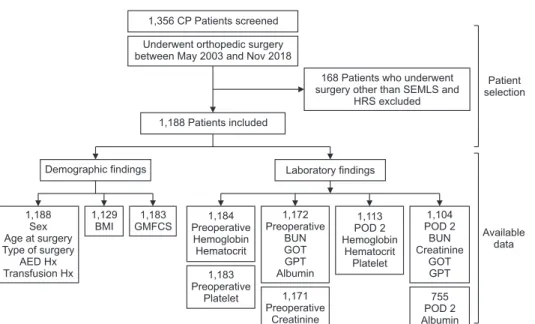
Fig. 1. Flow diagram of patient selection and patients with available data. CP:
cerebral palsy, SEMLS: single-event multi- level surgery, HRS: hip reconstructive surgery, AED: anti-epileptic drug, Hx:
history, BMI: body mass index, GMFCS:
Gross Motor Function Classification System, BUN: blood urea nitrogen, GOT: glutamic- oxaloacetic transaminase, GPT: glutamic- pyruvic transaminase, POD: postoperative day.
GMFCS is a known major risk factor for postopera- tive complication,6,13,14) and thus we assessed the medical record of each patient’s GMFCS level. Further, given that patients diagnosed with tetraplegia had a 3.5 times higher risk of malnutrition than those with diplegia or hemiple- gia,4,5) we also collected data on the patients’ weight, height, and BMI.
Meanwhile, we searched records of preoperative consult to the pediatric neurology department regarding the patients’ history of seizure and anti-epileptic drugs.
The patients were grouped into those who took valproate perioperatively and those who did not.
Type of Surgery
In general, SEMLS was mainly performed to improve gait in GMFCS level I–III. Preoperative three-dimensional gait analy- sis was used to plan procedures, and the indications for indi- vidual procedures were consistent with medical understand- ing at the time of treatment. Surgical procedures including tendon lengthening/transfer and osteotomy were performed based on considerations of both clinical and gait analysis findings.15-17)
HRS was performed in CP patients with hip dis- placement (migration percentage > 33%). The goals of the intervention were a painless, stable hip and prevention of recurrence of hip displacement. All patients underwent a femoral varus derotational osteotomy.18) The medial soft-tissue release consists of the release of the adductor longus tendon; if the abduction angle obtained was < 30°, an additional soft-tissue release involving the adductor brevis, gracilis, and semitendinosus or semimembrano- sus was performed. After the femoral varus derotational osteotomy, open reduction was additionally performed if a concentric reduction was not seen in intraoperative fluo- roscopic examination. A modified Dega osteotomy was performed based on either a preoperative radiographic finding of acetabular defects or an intraoperative finding of insufficient coverage (migration percentage) of the fem- oral head after the femoral varus derotational osteotomy and open reduction.19)
SEMLS and HRS were further categorized into four groups: SEMLS (soft), SEMLS (bone), unilateral HRS, and bilateral HRS. SEMLS (soft) was defined as an SEMLS comprising tendon lengthening and tendon transfer, ex- cluding bony procedure. Soft-tissue procedures in GMFCS level IV–V patients for facilitating therapeutic standing and wheelchair sitting or for preventing hip displacement were also included in the SEMLS (soft) group. Meanwhile, SEMLS (bone) was defined as an SEMLS that includes bony procedures such as the femoral derotational oste-
otomy, tibial derotational osteotomy, and foot osteotomy.
Unilateral HRS was defined as HRS performed in only one limb. In our institute, HRS is performed bilaterally.20) How- ever, staged operations during single hospitalization were performed according to the attending clinician’s discre- tion. Therefore, unilateral HRS in this study was defined as the first surgery in staged operation. We only included
Table 1. Summary of Patient Data
Variable Value (n = 1,188)
Patient information
Sex (male : female) 735 : 453
BMI (kg/m2) 18.2 ± 4.8
GMFCS level (I : II : III : IV : V) 436 : 315 : 180 : 148 : 104
Age at surgery (yr) 12.4 ± 7.9
Type of surgery
SEMLS (soft : bone) 1,007 (696 : 311) HRS (unilateral : bilateral) 181 (68 : 113)
Dega pelvic osteotomy 72
AED medication 139 (12)
Valproate 44 (4)
Laboratory finding Hemoglobin
Preoperative 13.7 ± 1.3
POD 2 12.2 ± 2.1
Hemoglobin drop 1.9 ± 1.7 (14)
Hematocrit
Preoperative 40.6 ± 3.5
POD 2 34.9 ± 5.7
Hematocrit drop 5.7 ± 5.3 (14)
Albumin
Preoperative 4.5 ± 0.3
POD 2 3.7 ± 0.4
Albumin drop 0.8 ± 0.4 (18)
Transfusion after surgery 70 (6)
Values are presented as mean ± standard deviation, number (%), or mean
± standard deviation (%).
BMI: body mass index, GMFCS: Gross Motor Function Classification System, SEMLS: single-event multilevel surgery, HRS: hip reconstructive surgery, AED: anti-epileptic drug, POD: postoperative day.
the first surgery to warrant statistical independence.12) Bilateral HRS in this study was defined as simultaneous bilateral hip reconstruction.
Data Collection
Data on patient’s age, sex, BMI derived from weight and height during the time of surgery, type of surgery, GMFCS level, perioperative hemoglobin (Hb), hematocrit, albu- min, and other coagulation factors (aspartate aminotrans- ferase [AST], alanine aminotransferase [ALT], blood urea nitrogen, and creatinine), past medical history of valproate administration, and postoperative transfusion were col- lected from medical records.
Laboratory values of Hb, hematocrit, albumin, AST/
ALT, and creatinine on postoperative day 2 were also col- lected. Hb levels on postoperative day 2 were further as- sessed according to raw Hb level, Hb level < 8 mg/dL, and difference in Hb from preoperative Hb level. AST and ALT levels were further dichotomized at a cutoff of 40 IU/L, with elevated AST defined as levels above 40 IU/L. The cre- atinine level was also dichotomized at a cutoff of 0.8 g/dL, with elevated creatinine defined as levels above 0.8 g/dL.
Statistical Analysis
The Kolmogorov-Smirnov test was used to verify the nor- mality of the distribution of continuous variables. Descrip- tive statistics used include mean, standard deviation, and
frequency. The effects of age at surgery, type of surgery, GMFCS, BMI, valproate medication use, and preopera- tive laboratory findings were investigated using multiple regression analysis, where the dependent variables were postoperative Hb level, Hb drop, and albumin drop.21) A logistic regression analysis was conducted to investigate the trend between binary categories of each dependent variable and each risk factor.22) The multiple linear models were accepted as valid for an estimation of the responses using the adjusted R2. A larger adjusted R2 was preferred in terms of model selection. The significance of the logistic regression models could be tested using likelihood test or Wald’s test, and validity of models for estimating the responses was assessed using the Akaike information cri- terion (AIC) and the Bayesian information criterion (BIC).
A smaller AIC or BIC value is preferred in terms of model selection. All statistical analyses were performed using the SAS ver. 9.4 (SAS Institute, Cary, NC, USA). All p-values were two-tailed, and p < 0.05 was considered statistically significant.
RESULTS
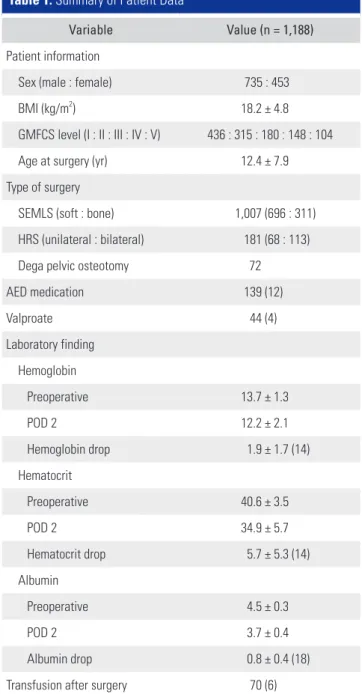
A total of 1,188 patients were evaluated in this study (Fig. 1). Of these, 1,007 (85%) and 181 (15%) underwent SEMLS and HRS, respectively. Further, 72 of 181 (40%) patients in the HRS group underwent a concomitant Dega
Table 2. Hemoglobin Drop and Transfusion in Major Category of Patients GMFCS Type of
surgery No. of
patients Preop Hb POD 2 Hb POD 2 Hb
< 8 g/dL Hb drop Transfusion after surgery
I SEMLS (soft) 335 13.7 ± 1.3 12.8 ± 1.3 0 0.9 ± 0.9 (6) 0
SEMLS (bone) 100 13.5 ± 1.2 11.2 ± 1.8 4 (4) 2.3 ± 1.7 (17) 1 (1)
II SEMLS (soft) 188 13.8 ± 1.3 12.7 ± 1.3 0 1.1 ± 1.0 (8) 1 (1)
SEMLS (bone) 122 13.6 ± 1.3 11.1 ± 1.6 2 (2) 2.5 ± 1.5 (18) 2 (2)
III SEMLS (soft) 98 13.9 ± 1.2 12.6 ± 1.2 0 1.3 ± 0.9 (9) 0
SEMLS (bone) 68 13.7 ± 1.4 10.6 ± 1.9 5 (7) 3.2 ± 1.7 (23) 0
HRS (unilateral) 2 12.8 ± 0.9 10.6 ± 1.7 0 2.2 ± 0.8 (17) 0
HRS (bilateral) 13 13.7 ± 1.0 9.2 ± 1.4 2 (15) 4.5 ± 1.7 (33) 4 (31)
IV HRS (unilateral) 29 13.7 ± 1.5 10.2 ± 1.3 0 3.5 ± 1.9 (26) 4 (14)
HRS (bilateral) 50 13.4 ± 1.3 9.0 ± 1.7 14 (28) 4.4 ± 1.8 (33) 15 (30)
V HRS (unilateral) 33 13.5 ± 1.1 10.2 ± 1.6 2 (6) 3.2 ± 1.9 (24) 9 (27)
HRS (bilateral) 46 13.5 ± 1.3 9.3 ±1.4 8 (17) 4.1 ± 1.9 (31) 19 (41)
Values are presented as mean ± standard deviation, number (%), or mean ± standard deviation (%).
GMFCS: Gross Motor Function Classification System, Hb: hemoglobin, Preop: preoperative, POD: postoperative day, SEMLS: single-event multilevel surgery, HRS: hip reconstructive surgery.
pelvic osteotomy. Forty-four patients were using valproate at the time of the surgery, and 70 received blood transfu- sion after surgery (Table 1).
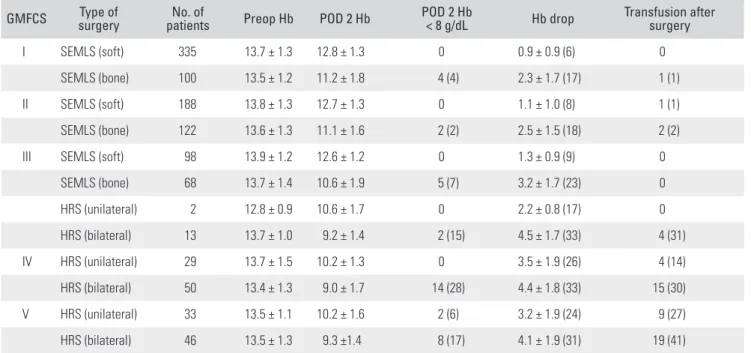
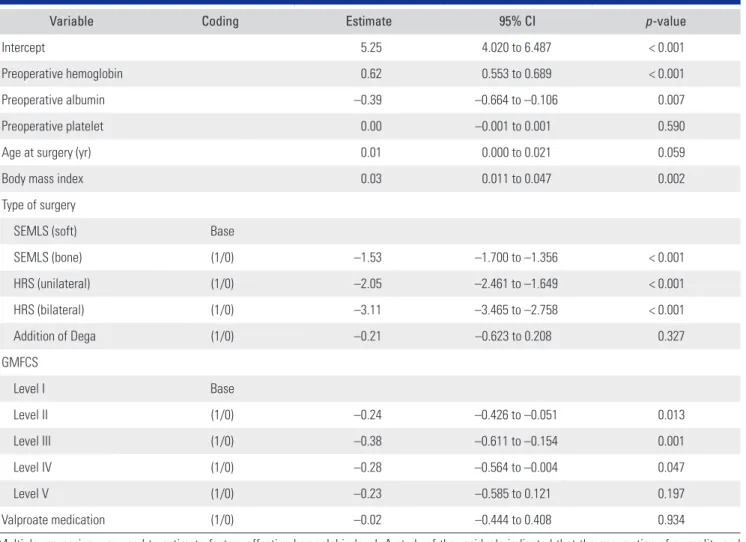
Among patients with GMFCS level V who under- went bilateral HRS, 41% of those who received transfusion had an average Hb drop of 4.1 ± 1.9 (Table 2). In our re- gression model, the major risk factors that affected Hb lev- els on postoperative day 2 were preoperative anemia (p <
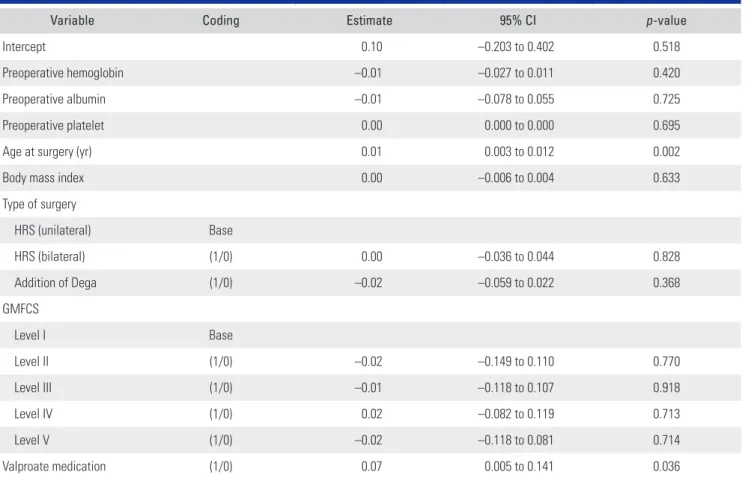
0.001), preoperative albumin (p = 0.007), BMI (p = 0.002), and type of surgery (p < 0.001). Further, GMFCS level was also associated with Hb level on postoperative day 2 (Table 3). The risk factors of Hb drop on postoperative day 2 were the type of surgery (p = 0.024) and preoperative Hb (p = 0.030). In subgroup analysis in the HRS group, the risk fac- tors were age at the time of operation (p = 0.002) and val- proate medication (p = 0.036) (Table 4). Meanwhile, only bilateral HRS (p = 0.008) was a risk factor for Hb level < 8 mg/dL on postoperative day 2. In subgroup analysis in the
HRS group, risk factors included bilateral HRS (p = 0.012) and Dega osteotomy (p = 0.004) (Table 5). The risk factors of albumin drop on postoperative day 2 were bilateral HRS (p < 0.001), Dega osteotomy (p < 0.001), and preoperative albumin (p < 0.001). GMFCS level was also associated with a decreased albumin level.
Of the 1,104 patients with available postoperative AST and ALT data, 239 (21.6%) had elevated AST. The risk factors for AST elevation on postoperative day 2 were bilat- eral HRS (p < 0.001), GMFCS level V (p = 0.041), Dega os- teotomy (p < 0.001), and preoperative AST level (p < 0.001).
Further, 46 of 1,104 (4.2%) patients had elevated ALT.
The risk factors for ALT elevation on postoperative day 2 were BMI (p = 0.037) and preoperative ALT (p < 0.001).
There were 44 of 1,104 (4.0%) patients with an elevated creatinine level. The risk factors for creatinine elevation on postoperative day 2 were age at the time of operation (p <
0.001) and preoperative Hb (p < 0.001).
Table 3. Factors Affecting Hemoglobin Level on Postoperative Day 2
Variable Coding Estimate 95% CI p-value
Intercept 5.25 4.020 to 6.487 < 0.001
Preoperative hemoglobin 0.62 0.553 to 0.689 < 0.001
Preoperative albumin –0.39 –0.664 to –0.106 0.007
Preoperative platelet 0.00 –0.001 to 0.001 0.590
Age at surgery (yr) 0.01 0.000 to 0.021 0.059
Body mass index 0.03 0.011 to 0.047 0.002
Type of surgery
SEMLS (soft) Base
SEMLS (bone) (1/0) –1.53 –1.700 to –1.356 < 0.001
HRS (unilateral) (1/0) –2.05 –2.461 to –1.649 < 0.001
HRS (bilateral) (1/0) –3.11 –3.465 to –2.758 < 0.001
Addition of Dega (1/0) –0.21 –0.623 to 0.208 0.327
GMFCS
Level I Base
Level II (1/0) –0.24 –0.426 to –0.051 0.013
Level III (1/0) –0.38 –0.611 to –0.154 0.001
Level IV (1/0) –0.28 –0.564 to –0.004 0.047
Level V (1/0) –0.23 –0.585 to 0.121 0.197
Valproate medication (1/0) –0.02 –0.444 to 0.408 0.934
Multiple regression was used to estimate factors affecting hemoglobin level. A study of the residuals indicated that the assumption of normality and homogeneity of variance was satisfied. Adjusted R2 was 0.582.
CI: confidence interval, SEMLS: single-event multilevel surgery, HRS: hip reconstructive surgery, GMFCS: Gross Motor Function Classification System.
DISCUSSION
In this study, we have identified several risk factors af- fecting blood loss after SEMLS and HRS in CP patients.
In our regression model, preoperative low Hb concentra- tion, high albumin level, low BMI, and bilateral HRS were found to be significant risk factors, and the GMFCS level was also associated with postoperative anemia. In bilateral HRS, the rate of Hb drop after surgery was over 30%, and valproate medication was associated with Hb drop. The risk factors for Hb level < 8 g/dL on postoperative day 2 were bilateral HRS and Dega pelvic osteotomy.
Before discussing the clinical implications of the present study, it is crucial to address its limitations. First, the study is retrospective by design. Our institute does not have a standard protocol or threshold for transfusion, and transfusion has been performed according to the surgeon’s or anesthesiologist’s discretion. However, we have not used tranexamic acid, cell saver, or other additive agents, and thus we believe that the population is suitable for the
observational study. Second, valproate medication was di- chotomized and considered as a binary variable. The blood level of valproate is believed to affect coagulation function.
However, the blood level of valproate was not available in our study. Also, the effect of drugs other than valproic acid has not been discussed.
It is reasonable to consider that preoperative anemia is associated with postoperative anemia.4) However, high preoperative albumin was also associated with postopera- tive anemia in our study. Albumin is generally accepted as a surrogate marker of preoperative nutritional status, and it is believed that nutritional status is associated with coagulation function. However, several studies have re- ported that albumin affects coagulation competence and perioperative bleeding, although these studies focused on albumin replacement and cardiac surgery.23,24) Some stud- ies have also reported that albumin may reduce platelet activation and the release of inflammatory mediators.25,26) Further studies are needed to clarify whether albumin does influence coagulation function.
Table 4. Factors Affecting Hemoglobin Drop on Postoperative Day 2 in the HRS Group
Variable Coding Estimate 95% CI p-value
Intercept 0.10 –0.203 to 0.402 0.518
Preoperative hemoglobin –0.01 –0.027 to 0.011 0.420
Preoperative albumin –0.01 –0.078 to 0.055 0.725
Preoperative platelet 0.00 0.000 to 0.000 0.695
Age at surgery (yr) 0.01 0.003 to 0.012 0.002
Body mass index 0.00 –0.006 to 0.004 0.633
Type of surgery
HRS (unilateral) Base
HRS (bilateral) (1/0) 0.00 –0.036 to 0.044 0.828
Addition of Dega (1/0) –0.02 –0.059 to 0.022 0.368
GMFCS
Level I Base
Level II (1/0) –0.02 –0.149 to 0.110 0.770
Level III (1/0) –0.01 –0.118 to 0.107 0.918
Level IV (1/0) 0.02 –0.082 to 0.119 0.713
Level V (1/0) –0.02 –0.118 to 0.081 0.714
Valproate medication (1/0) 0.07 0.005 to 0.141 0.036
Multiple regression was used to estimate factors affecting hemoglobin drop. A study of the residuals indicated that the assumption of normality and homogeneity of variance was satisfied. Adjusted R2 was 0.137.
HRS: hip reconstructive surgery, CI: confidence interval, GMFCS: Gross Motor Function Classification System.
Low BMI is considered to indicate poor nutritional status, which affects coagulation competence. Particularly, malnutrition is common in patients with CP due to vari- ous reasons such as spasticity, aspiration, and feeding dif- ficulty.5) However, it is challenging to measure the height and weight to calculate the BMI in patients with GMFCS level IV or V due to flexion contractures, lack of weight- bearing and head control, hip displacement, and scoliosis.
Furthermore, HRS is generally performed in patients with GMFCS level IV-V. Other practical methods for assessing nutritional status in patients with CP will be needed.
Predictably, the rate of Hb drop on postoperative day 2 was higher among those who underwent bilateral HRS and those with additional periacetabular pelvic oste- otomies than those who underwent soft-tissue procedures alone.13,14) A previous study reported that longer duration of surgery is an independent risk factor for transfusion,6) which is consistent with our findings. The operation time for bilateral HRS tends to be longer, and the procedure exposes more surfaces and cancellous bone for bleeding.
Also, while a pneumatic tourniquet can be used in other bony procedures of the lower extremities, it cannot be used in femoral and acetabular osteotomies, leaving pa- tients more vulnerable to intraoperative blood loss.
There has been little consensus on the threshold for
postoperative red blood cell transfusion in patients with CP, with thresholds ranging from Hb concentrations of 6 to 10 g/dL, depending on the physician’s discretion.27) In the United States, the CRIT study on 284 intensive care units in 213 U.S. hospitals showed that the Hb concentra- tion before a transfusion in adult surgical patients was 8.8
± 1.8 g/dL.28) In our study, we assumed that Hb < 8 g/dL would be the threshold for transfusion.
CP patients with higher GMFCS levels tend to have more severe epilepsy events and thus in more need of anti- epileptic medications including valproate. The effect of val- proate on blood loss has been controversial. Valproate and its byproducts are known to be hepatotoxic and may cause thrombocytopenia.29) However, while some argued that it has minimal disruptive effect on coagulation homeostasis,9) one study reported that valproate administration substan- tially increased intraoperative bleeding.30) In the subgroup analysis in the HRS group, one of the risk factors for Hb drop was valproate medication (p = 0.034). Our cohort was quite large, and the effect size of valproate medication was small (0.073 g/dL), and thus it is uncertain whether valpro- ate has a clinically meaningful difference. We believe that the small effect size resulted in the controversy about the effect of valproate on perioperative bleeding.
Of the 1,104 patients with available postoperative Table 5. Risk Factors for Hemoglobin < 8 g/dL on Postoperative Day 2 in the HRS Group
Variable Coding Odds ratio (95% CI)
Preoperative hemoglobin 1.35 (0.74 to 2.44)
Preoperative albumin 0.54 (0.06 to 4.98)
Preoperative platelet 1.00 (0.99 to 1.01)
Age at surgery (yr) 0.92 (0.78 to 1.09)
Body mass index 1.01 (0.84 to 1.20)
Type of surgery
HRS (bilateral) (1/0) 8.78 (1.62 to 47.45)
Addition of Dega (1/0) 5.82 (1.76 to 19.21)
GMFCS
Level II (1/0) > 999.99 (< 0.01 to > 999.99)
Level III (1/0) > 999.99 (< 0.01 to > 999.99)
Level IV (1/0) > 999.99 (< 0.01 to > 999.99)
Level V (1/0) > 999.99 (< 0.01 to > 999.99)
Valproate medication (1/0) 3.70 (0.62 to 21.93)
Logistic regression was used to investigate the risk factors for hemoglobin < 8 g/dL on postoperative day 2 in the HRS group. The AIC was 122.3.
HRS: hip reconstructive surgery, CI: confidence interval, GMFCS: Gross Motor Function Classification System, AIC: Akaike information criterion.
AST and ALT data, the AST level increased in 21.6%, while only 4.2% of patients had elevated ALT. While the risk factors for AST elevation were mostly procedure- related (e.g., bilateral HRS, Dega osteotomy, GMFCS level V, and preoperative AST), the risk factors for ALT eleva- tion were unrelated to the operation. Further, while both AST and ALT reflect liver function, AST is also related to muscular damage.31) Therefore, it can be inferred that pa- tients undergoing more intensive surgical procedures are at higher risk of AST elevation.
We have summarized the estimated blood loss and related laboratory changes after SEMLS and HRS in pa- tients with CP and identified the risk factors. Preoperative low Hb, high albumin level, low BMI, bilateral HRS, and concomitant Dega pelvic osteotomy were found to be sig- nificant risk factors, and within the bilateral HRS group, valproate intake was statistically significant. The findings of our study may not be new, as many of the factors are equally applied to any typically developing children un- dergoing orthopedic procedures. However, an equivalent
study on CP patients with large series has not been done yet. Clinical guidelines should be accordingly developed to include assessment of these risk factors and their impact on the outcomes of CP patients undergoing SEMLS and HRS.
CONFLICT OF INTEREST
No potential conflict of interest relevant to this article was reported.
ORCID
Jae Jung Min https://orcid.org/0000-0003-1416-2898 Soon-Sun Kwon https://orcid.org/0000-0002-3344-1609 Kyu Tae Kim https://orcid.org/0000-0003-2979-4054 Ki Hyuk Sung https://orcid.org/0000-0002-5007-2403 Kyoung Min Lee https://orcid.org/0000-0002-2372-7339 Young Choi https://orcid.org/0000-0003-3929-6315 Moon Seok Park https://orcid.org/0000-0002-2856-7522
REFERENCES
1. Bax M, Goldstein M, Rosenbaum P, et al. Proposed defini- tion and classification of cerebral palsy, April 2005. Dev Med Child Neurol. 2005;47(8):571-6.
2. Park MS, Kim SJ, Chung CY, Kwon DG, Choi IH, Lee KM.
Prevalence and lifetime healthcare cost of cerebral palsy in South Korea. Health Policy. 2011;100(2-3):234-8.
3. Rosen MG, Dickinson JC. The incidence of cerebral palsy.
Am J Obstet Gynecol. 1992;167(2):417-23.
4. Papadopoulos A, Ntaios G, Kaiafa G, et al. Increased inci- dence of iron deficiency anemia secondary to inadequate iron intake in institutionalized, young patients with cerebral palsy. Int J Hematol. 2008;88(5):495-7.
5. Perenc L, Przysada G, Trzeciak J. Cerebral palsy in chil- dren as a risk factor for malnutrition. Ann Nutr Metab.
2015;66(4):224-32.
6. Sherrod BA, Baker DK, Gilbert SR. Blood transfusion inci- dence, risk factors, and associated complications in surgical treatment of hip dysplasia. J Pediatr Orthop. 2018;38(4):208- 16.
7. Winter SL, Kriel RL, Novacheck TF, Luxenberg MG, Leutgeb VJ, Erickson PA. Perioperative blood loss: the effect of valproate. Pediatr Neurol. 1996;15(1):19-22.
8. Carney BT, Minter CL. Is operative blood loss associated with valproic acid? Analysis of bilateral femoral osteotomy in children with total involvement cerebral palsy. J Pediatr
Orthop. 2005;25(3):283-5.
9. Zighetti ML, Fontana G, Lussana F, et al. Effects of chronic administration of valproic acid to epileptic patients on coagulation tests and primary hemostasis. Epilepsia.
2015;56(5):e49-52.
10. Loiseau P. Sodium valproate, platelet dysfunction, and bleeding. Epilepsia. 1981;22(2):141-6.
11. Serdaroglu G, Tutuncuoglu S, Kavakli K, Tekgul H. Coagu- lation abnormalities and acquired von Willebrand's disease type 1 in children receiving valproic acid. J Child Neurol.
2002;17(1):41-3.
12. Park MS, Kim SJ, Chung CY, Choi IH, Lee SH, Lee KM.
Statistical consideration for bilateral cases in orthopaedic research. J Bone Joint Surg Am. 2010;92(8):1732-7.
13. Lee SY, Sohn HM, Chung CY, et al. Perioperative complica- tions of orthopedic surgery for lower extremity in patients with cerebral palsy. J Korean Med Sci. 2015;30(4):489-94.
14. Pulido LF, Babis GC, Trousdale RT. Rate and risk factors for blood transfusion in patients undergoing periacetabular osteotomy. J Surg Orthop Adv. 2008;17(3):185-7.
15. Lee SH, Chung CY, Park MS, et al. Parental satisfaction after single-event multilevel surgery in ambulatory children with cerebral palsy. J Pediatr Orthop. 2009;29(4):398-401.
16. Sung KH, Chung CY, Lee KM, et al. Long term outcome of
single event multilevel surgery in spastic diplegia with flexed knee gait. Gait Posture. 2013;37(4):536-41.
17. Sung KH, Kwon SS, Chung CY, Lee KM, Cho GH, Park MS.
Long-term outcomes over 10 years after femoral derotation osteotomy in ambulatory children with cerebral palsy. Gait Posture. 2018;64:119-25.
18. Bayusentono S, Choi Y, Chung CY, Kwon SS, Lee KM, Park MS. Recurrence of hip instability after reconstructive sur- gery in patients with cerebral palsy. J Bone Joint Surg Am.
2014;96(18):1527-34.
19. Chung CY, Choi IH, Cho TJ, Yoo WJ, Lee SH, Park MS.
Morphometric changes in the acetabulum after Dega oste- otomy in patients with cerebral palsy. J Bone Joint Surg Br.
2008;90(1):88-91.
20. Park MS, Chung CY, Kwon DG, Sung KH, Choi IH, Lee KM. Prophylactic femoral varization osteotomy for contra- lateral stable hips in non-ambulant individuals with cerebral palsy undergoing hip surgery: decision analysis. Dev Med Child Neurol. 2012;54(3):231-9.
21. Senm A, Srivastava M. Regression analysis: theory, meth- ods, and applications: New York: Springer-Verlag; 1990. 28- 49.
22. Dobson AJ, Barnett AG. Introduction to generalized linear models. 3rd ed. Boca Raton: Chapman and Hall; 2008. 120- 29.
23. Rasmussen KC, Hojskov M, Johansson PI, et al. Impact of albumin on coagulation competence and hemorrhage dur- ing major surgery: a randomized controlled trial. Medicine (Baltimore). 2016;95(9):e2720.
24. Jacob M, Fellahi JL, Chappell D, Kurz A. The impact of hy- droxyethyl starches in cardiac surgery: a meta-analysis. Crit Care. 2014;18(6):656.
25. Russell JA, Navickis RJ, Wilkes MM. Albumin versus crystalloid for pump priming in cardiac surgery: meta- analysis of controlled trials. J Cardiothorac Vasc Anesth.
2004;18(4):429-37.
26. Adrian K, Mellgren K, Skogby M, Friberg LG, Mellgren G, Wadenvik H. The effect of albumin priming solution on platelet activation during experimental long-term perfusion.
Perfusion. 1998;13(3):187-91.
27. Rouette J, Trottier H, Ducruet T, et al. Red blood cell transfu- sion threshold in postsurgical pediatric intensive care pa- tients: a randomized clinical trial. Ann Surg. 2010;251(3):421- 7.
28. Corwin HL, Gettinger A, Pearl RG, et al. The CRIT Study:
anemia and blood transfusion in the critically ill: cur- rent clinical practice in the United States. Crit Care Med.
2004;32(1):39-52.
29. Levy RH, Rettenmeier AW, Anderson GD, et al. Effects of polytherapy with phenytoin, carbamazepine, and stiripentol on formation of 4-ene-valproate, a hepatotoxic metabolite of valproic acid. Clin Pharmacol Ther. 1990;48(3):225-35.
30. Chambers HG, Weinstein CH, Mubarak SJ, Wenger DR, Silva PD. The effect of valproic acid on blood loss in patients with cerebral palsy. J Pediatr Orthop. 1999;19(6):792-5.
31. Pettersson J, Hindorf U, Persson P, et al. Muscular exercise can cause highly pathological liver function tests in healthy men. Br J Clin Pharmacol. 2008;65(2):253-9.