133
Correspondence to: Yong Suk Cho, Department of General Surgery, Hangang Sacred Heart Hospital, Hallym University Medical Center, 94-200, Yeongdeungpo-dong 7-ga, Yeongdeungpo-gu, Seoul 150- 719, Korea. Tel: 02-2639-5442, Fax: 02-2678-4386, E-mail: maru- [email protected]
Received October 5, 2009, Accepted December 18, 2009
A Clinical Study of Stevens-Johnson Syndrome and Toxic Epidermal Necrolysis: Efficacy of Treatment in Burn Intensive Care Unit
Departments of Surgery and 1Plastic Surgery, Burn Center, Hangang Sacred Heart Hospital, College of Medicine, Hallym University, 2Department of Dermatology and Cutaneous Biology Research Institute,
Yonsei University College of Medicine, Seoul, Korea
Haejun Yim, M.D., Jin Mo Park, M.D.
2, Yong Suk Cho, M.D., Dohern Kim, M.D., Jun Hur, M.D., Wook Chun, M.D., Jong Hyun Kim, M.D., Dong Kook Seo, M.D.
1Purpose: Stevens-Johnson syndrome (SJS) and toxic epidermal necrolysis (TEN), potentially life-threatening skin
diseases with organ failures caused by drugs, require specialized intensive care. However, SJS and TEN have usually been managed in general wards and intensive care units by most doctors. This study describes the efficacy of treatment in the burn intensive care unit (BICU) compared to previous general treatments.Methods: To investigate the clinical features, outcomes and benefits of 11 patients with SJS and TEN treated
in our burn intensive care unit. Data on 11 patients who were treated between January 2004 and December 2008 were collected via a retrospective chart review. Also, the data were reviewed with previous literatures on SJS and TEN treatments.Results: Patients were classified with overlap SJS/TEN (n=4, 36.36%) or TEN (n=7, 63.64%). Nonsteroidal
anti-inflammatory drugs (NSAIDs) were the most common causative agents. Hepatitis was the most common organ involvement in both overlap SJS/TEN (n=1, 9.1%) and TEN (n=4, 36.36%). Renal dysfunction (n=4, 36.36%) and respiratory disorders (n=3, 27.27%) were seen in some cases. Mean time of total reepithelization was 9 days and mean hospital day was 14.66 days. Two patients with TEN died from sepsis with multi-organ failure, and the mortality rate was 18.18%.Conclusion: Adequate treatment of SJS and TEN in the BICU supports efficacy with a low mortality rate, short
healing time, short hospitalization and fewer complications. (J Korean Surg Soc 2010;78:133-139)Key Words: Burn intensive care unit, Stevens-Johnson syndrome, Toxic epidermal necrolysis
INTRODUCTION
Stevens-Johnson syndrome (SJS) and toxic epidermal ne- crolysis (TEN) are characterized by widespread epidermal necrosis and mucosal involvement secondary to keratino- cyte apoptosis mostly by drugs with high mortality. Though the pathophysiology has not yet been fully elucidated, both disorders are considered to be within the same spectrum,
except the involved body areas.(1-4) Several treatments with advanced dressing material and drug therapy were intro- duced. Some authors not by dermatologist but by surgeons suggested some advantages of burn intensive care unit (BICU) treatment in SJS and TEN. There were some reports of clinical studies of SJS and TEN in Korean dermatologic literature, however, only limited number of reports included treatment in the burn intensive care unit.(5-7) However, the BICU supports the patients with proper thermoregulations, intensive fluid replacement with electrolyte balance, enteral nutrition, infection control and wound management with specialized nursing. Those spe- cialized treatments of BICU provide the efficacy with a low mortality rate, short healing time, short hospitalization and
fewer complications. Therefore, the aim of the present study is to present the efficacy of the burn intensive care unit treatment with necessity in SJS and TEN.
Herein, we report our interesting retrospective study in treating SJS and TEN in the burn intensive care unit with literature reviews.
METHODS 1) Patients
A retrospective review was performed on all 11 patients who visited our hospital burn center for SJS/TEN from January 2004 to December 2008. All of them were ad- mitted to the burn intensive care unit.
2) Diagnostic criteria
Diagnoses were made by dermatologists with histopa- thological confirmation. The patients were divided into three groups according to the following criteria of Bas- tuji-Garin et al.(8,9). Bullous erythema multiforme (EM):
epidermal detachment involving <10% of the body sur- face, coupled with localized typical targets or raised atypical targets. SJS: epidermal detachment of <10% of the body surface in association with widespread erythematous or purpuric macules or flat atypical targets. SJS/TEN overlap:
epidermal detachment of 10% to 30% of the body surface plus widespread purpuric macules or flat atypical targets.
TEN with spots: epidermal detachment of >30% of the body surface coupled with wide spread purpuric macules or flat atypical targets. TEN without spots: large sheets of epidermal detachment involving >10% of the body surface without purpuric macules or target lesions.
3) Evaluations
Data regarding demographics, causative agents, pattern of involvement, underlying diseases, complications, mortali- ty, and morbidity were obtained. As it is difficult to con- firm which drugs are responsible for SJS/TEN, we checked all drugs used within 3 weeks of onset.(5) Severity of illness score for toxic epidermal necrolysis (SCORTEN) was eva- luated during the first 24 hours of admission. From the
SCORTEN score, expected mortality and expected death case were calculated. SCORTEN includes seven clinical variables: 1) age above 40 years, 2) presence of malignancy, 3) tachycardia above 120/min, 4) involvement of >10%
of body surface area, 5) serum urea >28 mg/dl, 6) serum glucose >252 mg/dl and 7) bicarbonate <20 mEq/L.(10)
4) Treatment
All patients received proper fluid and electrolyte resusci- tation, pain management, nutritional support, wound care, surgical debridement of dead tissue by intensive care unit specialist. For the wound management, moisture retentive dressings such as MedifoamⓇ (Hydrophilic polyurethane foam dressing; Il Dong & Biopol, Korea), AQUACELⓇ (ConvaTec, UK) or ActicoatTM (Smith & nephew, Canada) were applied. Sulfonamide-containing topical agents were avoided. Antibiotics were applied only to treat systemic infections depending on the wound, urine, and blood cultures, which were checked twice a week. Steroids were prohibited and any steroid agents used prior to admission were discontinued. Ten patients in the burn intensive care unit were treated with intravenous immunoglobulin (IVIG) at a dose of 1 g/kg/day for 3 to 7 days (mean 4.3 days).
RESULTS 1) Demographics
A total of 11 patients (9 males and 2 females, mean age 31.81 years, range 5∼83 years) were included in this study.
According to the criteria of Bastuji-Garin et al.,(8,9) four patients were diagnosed with SJS/TEN (n=4, 36.36%) and seven with TEN (n=7, 63.64%). Six (54.55%) of the pa- tients had underlying diseases, including hypertension, con- gestive heart failure, gout, nephritic syndrome, epilepsy, and glaucoma (Table 1).
2) Medication history
The most common causative drugs were NSAIDs (6 of 11 patients, 54.55%) for upper respiratory infections. Two patients (18.18%) took allopurinol for gout. Two others had taken prednisolone for nephrotic syndrome. One (9.1%)
Table 1. The clinical profiles related with medication of 11 patients with SJS/TEN overlap and TEN Patient No. Criteria Age/Sex Onset*
(days)
TBSA†
(%) Underlying preexisting disease Previous
drug allergy Offending drugs
1 SJS/TEN 41/M 5 18 Upper respiratory infection − NSAIDs‡
2 SJS/TEN 6/F 5 27 Acute pharyngeal tonsillitis, mycoplasma pneumonia − NSAIDs
3 SJS/TEN 83/F 3 27 Upper respiratory infection − NSAIDs
4 SJS/TEN 5/M 3 27 Acute pharyngeal tonsillitis − NSAIDs
5 TEN 48/M 21 36 Hypertension, congestive heart failure, gout − Allopurinol
6 TEN 79/M 5 40 Hypertension, congestive heart failure, gout − Allopurinol
7 TEN 7/M 5 60 Upper respiratory infection − NSAIDs
8 TEN 8/M 9 60 Epilepsy − Carbamazepine
9 TEN 15/M 3 90 Nephrotic syndrome − Prednisolone
10 TEN 45/M 5 95 Upper respiratory infection, glaucoma − NSAIDs
11 TEN 13/M 35 100 Nephrotic syndrome − Prednisolone
*Time of onset clinical disease following the institution of a new drug regimen; †TBSA = total body surface area; ‡NSAIDs = nonsteroidal anti-inflammatory drugs.
patient had taken the antiepileptic drug carbamazepine for epilepsy. The average period between taking the relevant drug to the appearance of symptoms was 9 days. Both overlap SJS/TEN (100%) and TEN (71.4%) showed symp- toms within 2 weeks. The mean percentage total body surface area (TBSA) of skin involvement was 24.75% (18∼
30%) in overlap SJS/TEN and 68.7% (31∼100%) in TEN (Table 1).
3) Clinical courses
The time from appearance of the first skin lesions to the initiation of therapy varied from 1 to 10 days (mean 4.27 days). The mean period of hospital care to complete skin healing time was 9 days (8∼12 days). The mean period of hospitalization was 14.66 days (7∼22 days). All patients showed involvement of the mucous membranes, including the buccal, conjunctival, and genital mucosae.
4) Complications
During admission, coagulase negative staphylococcus, P.
aeruginosa, A. baumannii, and methicillin-resistant staphylo- coccus aureus were cultured. On laboratory examination, neutropenia was found in three cases and normocytic anemia in six cases. The most common complication was hepatitis, which was seen in one case in the overlap SJS/TEN group and four cases in the TEN group. Acute renal failure occurred in four cases in the TEN group.
Continuous renal replacement therapy (CRRT) was applied in two patients. Two patients developed sepsis and three patients had disseminated intravascular coagulation (DIC).
Conjunctivitis developed in six patients.
5) Mortality and SCORTEN evaluation
Two of eleven patients died of septic complications with DIC due to TEN, resulting in a mortality rate of 18.18%
(Table 2). In two patients, acute renal failure and pneu- monia were accompanied with a SCORTEN score of 5.
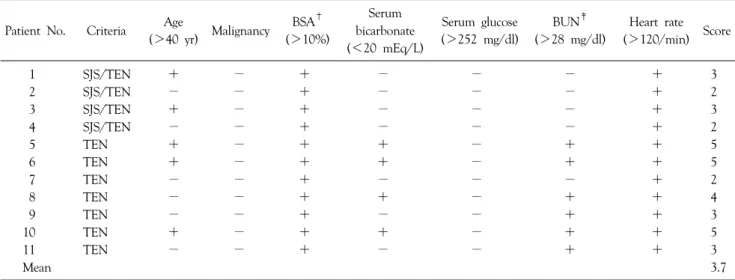
The mean SCORTEN score were 2.5 in the overlap SJS/
TEN group and 3.85 in the TEN group. Three patients had a score of 5. One patient had a score of 4. Four patients had as score of 3 and three patients had a score of 2 (Table 3). The number of expected deaths was 5.058, but the actual number of deaths was 2 (Table 4).
DISCUSSION
Drugs cause adverse reactions to the skin which can occasionally be life threatening, such as SJS and TEN.
Although most adverse reactions are transient, SJS and TEN can be persistent and are often accompanied with multi-organ failure.(10) Cases with skin surface involve- ment of <10% TBSA are diagnosed as SJS, while those showing involvement of >30% TBSA are called TEN.
Epidermal detachment between 10% and 30% is classified
as SJS/TEN overlap. SJS occurs predominantly in children and adolescents, whereas TEN occurs in all ages regardless of sex and race.(11) The incidence rates of SJS and TEN are approximately 1∼7 cases and 0.4∼1.2 cases per 1 million people, respectively, per year.(11-15) The inciden- ces of TEN and drug reactions are generally higher among patients with HIV infection, SLE, and bone marrow trans- plantation.(16) The most frequently implicated drugs are sulfonamide antibiotics, aromatic anticonvulsants such as phenytoin, phenobarbital, and carbamazepine, beta-lactam antibiotics, nevirapine, abacavir, NSAIDs, allopurinol, la- motrigine, tetracyclines, and quinolones.(17) Other causes of SJS and TEN include herpes simplex virus, Mycoplasma pneumoniae, Mycobacterium tuberculosis, group A streptococci, hepatitis B virus, Epstein-Barr virus, Francisella tularensis, Yersinia spp., enterovirus, Histoplasma spp., Coccidioides spp., and HIV.(18) In our series, NSAIDs (6 cases, 54.55%) were the most common causative agents, followed by allopurinol, prednisolone and carbamazepine. One girl was positive for anti-mycoplasma antibodies, suggesting that the disease may have been due to mycoplasma infection. Patients with over- lap SJS/TEN and TEN showed prodromal symptoms with fever, chills, myalgia, and sore throat for several days. The mean period of incubation was 9 days. Careful attention to medical history and clinical suspicion are essential to distinguish prodromal symptoms from symptoms of other diseases.(19)
Although many treatment options for TEN have been proposed, no satisfactory treatment guidelines have yet been developed. The mortality rate associated with TEN is known as ranging from 20% to 75%.(7-10) In the present series, 11 patients had an extensive mean body surface area involvement of 52.73% (18∼100%) with mortality rate of 18.18%.
Since the first report of clinical studies of SJS and TEN by Kim et al.(7) in 1991, there were few more reports by some authors in Korean dermatologic literature.(5,6) However, as shown in articles, those studies did not in- clude the burn intensive care unit but in the general ward.
Compared to those previous studies, the burn intensive care unit treatment presents some positive points (Table 5).
Table 2. The clinical course and outcome of 11 patients Patient No.CriteriaTime to treat* (days)Time to heal† (days) Length of hospital stay (days)
Mucosal involvementOrganism growth‡Sepsis/ DIC§Other organ involvementResidual complicationOutcome 1 2 3 4 5 6 7 8 9 10 11 Mean
SJS/TEN SJS/TEN SJS/TEN SJS/TEN TEN TEN TEN TEN TEN TEN TEN
2 2 7 1 2 3 4 2 10 7 7 4.27
8 11 14 8 13 − 11 14 8 − 12 9
10 11 20 10 13 12 11 20 15 7 22 14.66
+ + + + + + + + + + +
No growth No growth CNS∥ No growth CNS MRSA¶ , CNS MRSA P. aeruginosa, A.baumannii P. aeruginosa, A.baumannii A. baumannii P. aeruginosa, A.baumannii
−/− −/− −/− −/− −/− +/+ −/− −/+ −/− +/+ −/−
− Pneumonia − − Hepatic failure, acute renal failure Acute renal failure, pneumonia − Hepatic failure, acute renal failure − Acute renal failure, pneumonia, pleural effusion −
− Conjunctivitis − Conjunctivitis Conjunctivitis Conjunctivitis − Conjunctivitis − Conjunctivitis −
Recovered Recovered Recovered Recovered Recovered Dead Recovered Recovered Recovered Dead Recovered *Time from appearance of first skin lesions to the initiation of therapy;† Time from start of hospital treatment to complete skin healing or reepithelization;‡ Organism cultured from blood during treatment; § DIC = disseminated intravascular coagulation;∥ CNS = coagulase negative Staphylococcus; ¶ MRSA = methicillin-resistant Staphylococcus auresus.
Table 4. Mortality assessed by SCORTEN data in SJS/TEN overlap and TEN patients
SCORTEN*
score
No. of patients
Expected mortality rate (%)
No. of expected death case
No. of actual death case
0∼1 0 3.2 0 0
2 3 12.1 0.363 0
3 4 35.3 1.412 0
4 1 58.3 0.583 0
>5 3 90 2.700 2
Total 12 − 5.058 2
*SCORTEN = score for toxic epidermal necrolysis.
Table 3. SCORTEN* data in SJS/TEN overlap and TEN patients Patient No. Criteria Age
(>40 yr) Malignancy BSA† (>10%)
Serum bicarbonate (<20 mEq/L)
Serum glucose (>252 mg/dl)
BUN‡ (>28 mg/dl)
Heart rate (>120/min) Score
1 SJS/TEN + − + − − − + 3
2 SJS/TEN − − + − − − + 2
3 SJS/TEN + − + − − − + 3
4 SJS/TEN − − + − − − + 2
5 TEN + − + + − + + 5
6 TEN + − + + − + + 5
7 TEN − − + − − − + 2
8 TEN − − + + − + + 4
9 TEN − − + − − + + 3
10 TEN + − + + − + + 5
11 TEN − − + − − + + 3
Mean 3.7
*SCORTEN = score for toxic epidermal necrolysis; †BSA = body surface area; ‡BUN = blood urea nitrogen.
First, the burn intensive care unit treatment shortened the time of complete reepithelization. By Kim et al.(5), they studied 5 patients of SJS and 10 patients of TEN, mean time to total reepithelization time was 14.1 days. However, our study showed 9 days for total reepithelization. Second, the burn intensive care unit treatment shortened the length of hospital days. In our study the mean length of hos- pitalization was 14.66 days, but in other studies it was much longer as 16.9 days by Kim et al.(6), 19.7 days by Kim et al.(7) and 20.6 days by Kim et al.(5). Third, the patients received treatment in the burn intensive care unit showed relatively well controlled vital signs without fluc- tuation hemodynamic changes also reduced the chance of eye complications (54.54%) and respiratory distress (27.27
%). The mortality rate (n=2, 18.18%) in our study is
relatively lower than other studies.(7-10) In 2002 reported by Kim et al.,(11) 10 patients of TEN received IVIG and 4 of them died of sepsis and complications. In case of mortality, both of them died of sepsis and those patients had poor underlying conditions which easily enable to develop into sepsis. One patient was 79 years-old man with past history of hypertension, congestive heart failure and gout involving 40% of TBSA and the other patient was 45 years-old man with involving 95% of TBSA.
There are a few suggestive reasons for strong points of the burn intensive care unit treatments. First, similar to other burn centers, treatment at our burn unit focused on providing thermoregulation, fluids and electrolyte therapy, enteral nutrition (if possible), wound management, and infection control. Such supportive treatments could short- en both the reepithelization and hospitalization period.
Also with proper antibiotics, respiratory distress including pneumonia was reduced. Second, we did not administer steroids to any patients. Instead of using steroids, in- travenous immunoglobulin (IVIG, 1 g/kg/day) was ad- ministered in 10 cases for a mean of 4.3 days. The therapeutic effects of immunoglobulin are likely to involve inhibition of Fas-mediated keratinocyte death by naturally occurring Fas-blocking antibodies contained within human immunoglobulin preparations acting directly on the Fas-Fas ligand system at the keratinocyte surface.(20,21) Using oral
steroids in SJS and TEN is still in debate. Kim et al.(22) and Halebian et al.(23) reported 60% and 30% higher mortality rates, respectively, in patients treated with me- dium-to high-dose steroids. Also we did not apply any topical antimicrobial agents such as sulfa-containing pro- ducts, as they might be causative agents and have the risk of systemic sensitization.(17) Third, we used aseptic and highly qualified materials. As TEN occurs at the der- mal-epidermal junction, wounds are essentially the same as superficial partial-thickness burn wounds. Therefore, if these wounds can be kept clean without any complications, they can heal within 10 to 14 days. Based on this principle, after cleaning with normal saline and removing all loose skin and blisters, the wounds were dressed with mois- ture-retentive dressing, such as MedifoamⓇ, AQUACELⓇ or ActicoatTM. These moisture retentive dressings are ef- fective in the management of partial-thickness burns be- cause they provide an environment suitable for wound healing, minimize evaporative water loss, and reduce pain.
Since these products also require relatively few changes, they are convenient for nursing care, including hydro- therapy, and reduction of overall cost.(23,24)
In conclusion, no specific treatment regimen has been unequivocally shown to be effective in treating SJS and TEN, and palliative care remains the cornerstone of TEN treatments. Therefore, burn units are considered ideal for the management of TEN patients because of their wide experience in managing burn wounds and their ability to provide infection control and basic life support. We expect the collaborate therapy with a burn intensive care unit in treating severe TEN and SJS patients will reduce the mor- bidity and mortality rates.
REFERENCES
1) Lee JY, Oh MJ, Lee BJ, Choi DC. Comparison of clinical characteristics according to infection in Stevens-Johnson syn- drome and toxic epidermal necrolysis. J Asthma Allergy Clin Immunol 2006;26:277-81.
2) Revuz J, Penso D, Roujeau JC, Guillaume JC, Payne CR, Wechsler J, et al. Toxic epidermal necrolysis. Clinical findings and prognosis factors in 87 patients. Arch Dermatol 1987;
Table 5. A comparison of the previous studies on SJS and TEN treatment in general wards to BICU treatment Report No. of patients Involvement of skin area (TBSA*, %)SCORTEN† (mean)Re-epithelization time (days) Length of hospital stays (days)Mortality rate (%) SJSOverlapTEN SJSOverlapTENSJSOverlapTENMean SJSOverlapTENMeanSJSOverlapTENMean Kim et al.(5) 58 2 − −−3.510∼1411∼1814∼30 14.1 12∼2120∼3014∼3020.600 506.7 Kim et al.(6)153149.119.867.3−−−−− 3∼38 3∼38 3∼38 16.900 14.36.25 Kim et al.(7) 8012− −−−−−−− 7∼300 3∼90 19.700 4225 Our case 04 7 0 24.7568.73.70 8∼14 8∼149 010∼20 7∼22 14.6600 2918.18 *TBSA = total body surface area;† SCORTEN = score for toxic epidermal necrolysis.
123:1160-5.
3) McGee T, Munster A. Toxic epidermal necrolysis syndrome:
mortality rate reduced with early referral to regional burn center. Plast Reconstr Surg 1998;102:1018-22.
4) Ruiz-Maldonado R. Acute disseminated epidermal necrosis types 1, 2, and 3: study of sixty cases. J Am Acad Dermatol 1985;13:623-35.
5) Kim JW, Kim ST, Song DH. A clinical observation of the patients with Stevens-Johnson syndrome and toxic epidermal necrolysis in Jeju island. Korean J Dermatol 2004;42:579-91.
6) Kim EJ, Lee JB, Kwon YH, Yun SJ, Kim SJ, Lee SC, et al. A clinical study of Stevens-Johnson syndrome and toxic epidermal necrolysis over the last five-year period in the Gwangju-Chon- nam area. Korean J Dermatol 2006;44:574-8.
7) Kim YG, Cho KH, Chung JH. A comparative clinical study of toxic epidermal necrolysis and Stevens-Johnson syndrome. Kor- ean J Dermatol 1991;29:602-9.
8) Halebian P, Corder V, Herndon D, Shires GT. Clinical ma- nagement: a burn center experience with toxic epidermal ne- crolysis. J Burn Care Rehabil 1983;4:176-83.
9) Bastuji-Garin S, Rzany B, Stern RS, Shear NH, Naldi L, Roujeau JC. Clinical classification of cases of toxic epidermal necrolysis, Stevens-Johnson syndrome, and erythema multi- forme. Arch Dermatol 1993;129:92-6.
10) Pereira FA, Mudgil AV, Rosmarin DM. Toxic epidermal ne- crolysis. J Am Acad Dermatol 2007;56:181-200.
11) Kim KJ, Jee MS, Han MH, Choi JH, Sung KJ, Moon KC, et al. The effect of high-dose intravenous immunoglobulin for the treatment of toxic epidermal necrolysis. Korean J Dermatol 2002;40:766-71.
12) Wolkenstein P, Latarjet J, Roujeau JC, Duguet JC, Boudeau S, Vaillant L, et al. Randomised comparison of thalidomide versus placebo in toxic epidermal necrolysis. Lancet 1998;352:1586-9.
13) Lohmeier K, Megahed M, Schulte KW, Stannigel H, Mayatepek E, Schroten H. Toxic epidermal necrolysis in a premature infant of 27 weeks’ gestational age. Br J Dermatol 2005;152:150-1.
14) Chan HL, Stern RS, Arndt KA, Langlois J, Jick SS, Jick H, et al. The incidence of erythema multiforme, Stevens-Johnson syndrome, and toxic epidermal necrolysis. A population-based study with particular reference to reactions caused by drugs
among outpatients. Arch Dermatol 1990;126:43-7.
15) Roujeau JC, Guillaume JC, Fabre JP, Penso D, Flechet ML, Girre JP. Toxic epidermal necrolysis (Lyell syndrome). Incidence and drug etiology in France, 1981-1985. Arch Dermatol 1990;
126:37-42.
16) Strom BL, Carson JL, Halpern AC, Schinnar R, Snyder ES, Shaw M, et al. A population-based study of Stevens-Johnson syndrome. Incidence and antecedent drug exposures. Arch Dermatol 1991;127:831-8.
17) McKenna JK, Leiferman KM. Dermatologic drug reactions.
Immunol Allergy Clin North Am 2004;24:399-423, vi.
18) Roujeau JC, Kelly JP, Naldi L, Rzany B, Stern RS, Anderson T, et al. Medication use and the risk of Stevens-Johnson syndrome or toxic epidermal necrolysis. N Engl J Med 1995;
333:1600-7.
19) Fritsch PO, Ruiz-Maldonado R. Erythema multiforme, Stevens- Johnson syndrome and toxic epidermal necrolysis. In: Freedberg IM, Eisen AZ, Wolff K, Austen KF, Goldsmith LA, Katz SI, editors. Fitzpatrick’s Dermatology in General Medicine. 6th ed.
New York: McGraw-Hill; 2003:543-57.
20) Schopf E, Stuhmer A, Rzany B, Victor N, Zentgraf R, Kapp JF.
Toxic epidermal necrolysis and Stevens-Johnson syndrome. An epidemiologic study from West Germany. Arch Dermatol 1991;
127:839-42.
21) Viard I, Wehrli P, Bullani R, Schneider P, Holler N, Salomon D, et al. Inhibition of toxic epidermal necrolysis by blockade of CD95 with human intravenous immunoglobulin. Science 1998;282:490-3.
22) Kim PS, Goldfarb IW, Gaisford JC, Slater H. Burn rounds:
Stevens-Johnson syndrome and toxic epidermal necrolysis: a pathophysiologic review with recommendations for a treatment protocol. J Burn Care Rehabil 1983;4:91-100.
23) Halebian PH, Corder VJ, Madden MR, Finklestein JL, Shires GT. Improved burn center survival of patients with toxic epi- dermal necrolysis managed without corticosteroids. Ann Surg 1986;204:503-12.
24) Choi SW, Suh MS, Park SJ, Lim YK. Burn care of toxic epidermal necrolysis using allevynⓇ: a report of two cases. J Korean Burn Soc 2006;9:74-8.