INTRODUCTION
Metachromatic leukodystrophy (MLD; MIM 250100) is a severe neurodegenerative disorder caused by decreased activity of arylsulfatase A (ARSA; EC 3.1.6.8), a lysoso- mal enzyme involved in the catabolism of cerebroside sulfatide [1, 2]. MLD is inherited as an autosomal reces- sive trait [1]. The accumulation of sulfatide leads to demyelination in the central and peripheral nervous sys- tems, resulting in a variety of neurological symptoms [1].
The worldwide prevalence of MLD is very low (1:40,000 live births), and its prevalence among Koreans is unknown [3]. MLD is usually subdivided into 3 clinical subtypes, on the basis of the age at onset: a late-infantile form (50-
516 516
Identification of a Novel Splicing Mutation in the ARSA Gene in a Patient with Late-infantile Form of Metachromatic Leukodystrophy
Dong-Hee Kang, M.D.
1,*, Dong Hwan Lee, M.D.
2,*, Yong-Hee Hong, M.D.
2, Seung-Tae Lee, M.D.
3, Byung Ryul Jeon, M.D.
1, You Kyoung Lee, M.D.
1, Chang-Seok Ki, M.D.
3, and Yong-Wha Lee, M.D.
1Department of Laboratory Medicine and Genetics1, Soonchunhyang University Bucheon Hospital, Soonchunhyang University College of Medicine, Bucheon; Department of Pediatrics2, Soonchunhyang University Hospital and Soonchunhyang University College of Medicine, Seoul; Department of Laboratory Medicine and Genetics3, Samsung Medical Center, Sungkyunkwan University School of Medicine, Seoul, Korea
516 516
Metachromatic leukodystrophy (MLD; MIM 250100), a severe neurodegenerative disorder inher- ited as an autosomal recessive trait, is caused by mutations in the arylsulfatase A (ARSA) gene.
Although several germ line ARSA mutations have been identified in patients with MLD of various ethnic backgrounds elsewhere in the world, no genetically confirmed cases of MLD have been reported in Korea. Recently, we identified a mutation in the ARSA gene of a Korean male with MLD.
A male infant with late-infantile form of MLD had been admitted to our hospital for further examina- tion. His neuromuscular symptoms, which included inability to walk at the age of 12 months, gradu- ally worsened, even after allograft bone marrow transplantation; he died at the age of 9 yr. His elder brother had also been diagnosed with MLD. To confirm the presence of a genetic abnormality, all the coding exons of the ARSA gene and the flanking introns were amplified by PCR. A molecular analysis of the ARSA gene revealed both a novel heterozygous splicing mutation (c.1101+1G>T) in intron 6 and a heterozygous missense mutation in exon 2 (c.296G>A; Gly99Asp). The patient’s elder brother who had MLD is believed to have had the same mutation, which may be correlated with a rapidly deteriorating clinical course. This study identified a novel mutation in the ARSA gene, related to a late-infantile form of MLD with a lethal clinical course and suggested that molecular diag- nosis of patients may be useful in early diagnosis and for deciding intervention measures for their family members. (Korean J Lab Med 2010;30:516-20)
Key Words : Metachromatic leukodystrophy, ARSA, Novel mutation, Korean
Received :April 19, 2010 Manuscript No :KJLM10-070 Revision received :July 13, 2010
Accepted :August 17, 2010
Corresponding authors :Yong-Wha Lee, M.D.
Department of Laboratory Medicine and Genetics, Soonchunhyang University Bucheon Hospital and Soonchunhyang University College of Medicine, 1174 Jung-dong, Wonmi-gu, Bucheon 420-767, Korea
Tel : +82-32-621-5943, Fax : +82-32-621-5944 E-mail : [email protected]
Chang-Seok Ki, M.D.
Department of Laboratory Medicine & Genetics, Samsung Medical Center, Sungkyunkwan University School of Medicine, 50 Irwon-dong, Gangnam-gu, Seoul 135-710, Korea Tel : +82-2-3410-2709, Fax : +82-2-3410-2710 E-mail : [email protected]
*These authors contributed equally to this study.
ISSN 1598-6535 The Korean Society for Laboratory Medicine
60% of cases), in which the first symptoms develop at around 2 yr of age; a juvenile form (20-30% of cases), in which patients present with the symptoms between 3 and 16 yr of age; and an adult-onset form (15-20% of cases), with manifestations appearing after 16 yr of age [4].
The late-infantile form is the most common type of MLD. Onset is characterized by ataxia and loss of acquired motor skills. Weakness and hypotonia are present in most patients, and disease progression is accompanied by men- tal deterioration until patients are no longer able to estab- lish any contact with their surroundings. This form of MLD has a short course, and death generally occurs within 7 yr after onset [5].
Some Korean cases of MLD have been reported, includ- ing 2 cases of the late-infantile form (one in a 2-yr-old girl, and another in a 4-yr-old girl), which showed typ- ically clinical, neurologic, pathologic, and laboratory findings [6-8].
The human ARSAgene maps to the long arm of chro- mosome 22, in the region of q13, and contains 8 exons that encode a 1521-nucleotide-long mRNA [3, 9]. More than 110 different mutations causing MLD have been iden- tified in the ARSAgene in patients with various ethnic backgrounds worldwide [4]. However, thus far, no case of genetically confirmed MLD has been reported in Korea.
Here, we describe a Korean case of late-infantile MLD, with a novel ARSAsplicing mutation as a causative factor.
CASE REPORT
A Korean male infant was one of the 2 children born to non-consanguineous parents. Pregnancy and labor pro- gressed without complications. At the age of 3 months, the patient was tested for ARSA because of a family history of MLD. The patient’s fibroblast ARSA level was 0.082 nmol/min/mg protein (reference value: 0.5-1.5 nmol/min/mg protein), which was consistent with infan- tile-onset MLD. He showed normal development until 12 months but was never able to walk independently. At 17 months, he developed spastic lower limbs. At 20 months, he was no longer able to sit, and by 2 yr, he was unable
to turn his face down or grasp items. At 2 yr of age, he received allograft bone marrow transplantation (BMT).
Although his ARSA level slightly increased at 1 month after the transplantation, it never reached normal val- ues. At the age of 3 yr, he developed seizures.
After being in a bed-ridden state due to progressive quadriparesis with spastic and flaccid characteristics, the patient died at the age of 9 yr.
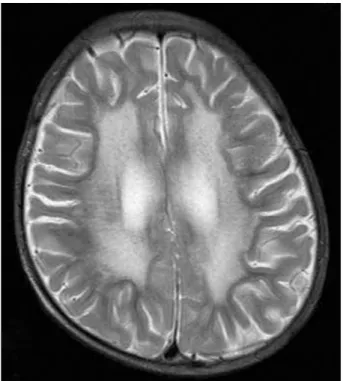
Brain magnetic resonance imaging showed bilateral, diffuse hyperintensities in the periventricular white matter and cerebral atrophy, consistent with a demyeli- nating disease (Fig. 1).
For 3 generations, no definite MLD history was estab- lished in the patient’s family, excluding his elder broth- er. The patient’s elder brother was tested for ARSA at the age of 23 months because of generalized weakness and spasticity of the lower limbs. His enzyme level was 0.049 nmol/min/mg protein (reference value: 0.5-1.5 nmol/min/mg protein), and he was diagnosed with late- infantile MLD. He eventually reached a vegetative state and died at the age of 5 yr.
Fig. 1. Brain magnetic resonance image. Axial T2-weighted image shows bilateral, diffuse confluent hyperintensities in the periven- tricular white matter and cerebral atrophy.
After obtaining informed consent from the parents, we obtained blood samples from the patient and his par- ents. The genomic DNA was isolated from peripheral blood leukocytes using the Wizard Genomic DNA Purifi- cation kit (Promega, Madison, WI, USA), according to manufacturer’s instruction. All the coding exons and the flanking intronic regions of the ARSAgene were ampli- fied using primer sets designed by the authors (sequences available upon request). PCR was performed using a thermal cycler (Model 9700; Applied Biosystems, Foster City, CA, USA). Direct sequencing was performed on an ABI Prism 3100 Genetic Analyzer (Applied Biosystems, Foster City, CA, USA) using the Big-Dye Terminator Cycle Sequencing Ready Reaction kit (Applied Biosys- tems, Foster City, CA, USA). Potential mutations were defined by exclusion from the Human Gene Mutation Database (http://www.hgmd.cf.ac.uk) and the previously reported mutations on PubMed (http://www.ncbi.nlm.nih.
gov/PubMed/). All novel mutations were confirmed by sequencing 100 control chromosomes.
Direct sequencing of the ARSAgene revealed a novel heterozygous mutation affecting the consensus splicing donor site in intron 6 (c.1101+1G>T) and a heterozygous mutation altering the coding sequence of exon 2 (c.296G>A;
Gly99Asp) (Fig. 2). Screening of the ARSAgene in 50
normal control subjects revealed no mutant alleles in 100 screened chromosomes. Further genetic analysis of the patient’s parents showed that the ARSAgenes of his father and mother had c.296G>A and c.1101+1G>T, respective- ly. The result of ARSAgene analysis of his parents sug- gested an autosomal recessive inheritance pattern.
The genomic sequence spanning an interval of 50 nucleotides up- and downstream of the mutation at the splicing site in intron 6 was evaluated by information analysis of the splice donor and acceptor sites [10]. The individual information content of each natural and vari- ant primary and secondary splice site was analyzed by measuring their Ri values expressed in bits of informa- tion using the Scan program (from the Laboratory of Computational and Experimental Biology at the National Institutes of Health). The effect of nucleotide substitu- tion on splicing information was predicted on the basis of the Ri values.
The c.1101+1G>T variation weakened the natural splic- ing donor site of intron 6 [initial information content score (Ri), 8.6 bit; final Ri, 0.8 bit] and strengthened a site 5 nucleotides downstream, a preexisting cryptic donor site of exon 6 (4.7 bit).
DISCUSSION
MLD is a lysosomal storage disease caused by a defi- ciency in ARSA. It is characterized by the accumulation of sulfatide-the ARSA substrate-in the white matter of the central nervous system and in the peripheral nerves [11]. A pathological hallmark of the disease is demyeli- nation, causing various ultimately lethal neurological symptoms [4].
Patients homozygous for alleles that do not allow syn- thesis of functional ARSA always develop the most severe late-infantile form of the disease, whereas those homozy- gous for alleles allowing the expression of residual enzyme activity are associated with the later-onset juvenile or adult forms [4, 12, 13]. In this study, we report a com- pound heterozygous mutation in the ARSA gene in a patient with late-infantile onset MLD, with lethal clini- Fig. 2. Mutation analysis of the arylsulfatase A (ARSA) gene in a
Korean patient with metachromatic leukodystrophy. Direct sequencing of the ARSA gene shows overlapped peaks (solid arrow) at the nucleotide position 296 due to a heterozygous G-to- A transition (c.296G>A; Gly99Asp) (A) and overlapped peaks (open arrow) at the consensus splicing donor site in the intron 6 due to a heterozygous G-to-T transversion (c.1101+1G>T) (B).
T G
Exon 6 Intron 6
G G
Exon 2
T C C C G G G G G G R C C T G C C C C T
T A C A G G C A A G K T A G G G C C G G
B A
cal characteristics. An amino acid substitution of Asp for 99Gly resulted from a G-to-A transition in exon 2.
Because the substitution was from a neutral amino acid to an acidic one, the structure of the ARSA protein was thought to be possibly altered. In fact, a transient expres- sion study by Kondo et al. [11] confirmed that such a mutation abolishes ARSA activity.
In addition, a mutation affecting the donor consensus splice site of intron 6, which was identified in this study, is a novel alteration in this gene. The most common ARSAmutations in patients with MLD differ depending upon ethnicity. Four mutations, including c.459+1G>A, p.Pro426Leu, c.1204+1G>A, and p.Ile179Ser, are com- mon in European populations, whereas 3 other muta- tions, p.Gly99Asp, p.Gly245Arg, and p.Thr409Ile, are common in Japanese populations [14]. These mutations are thought to have spread by the founder effect.
Splice-site mutations involving introns 1-7, but not intron 6, have already been identified. The c.1101+1G>T mutation identified in this study results in an altered splice-recognition sequence between exon 6 and the subsequent intron 6, which may be responsible for the diminished function of ARSA. Thus, the combination of the 2 mutations found in the present case led to the most severe late-onset form of MLD.
Because ethnic differences exist in the type and fre- quency of mutations in the ARSAgene, novel genetic changes may be identified in the Korean population. In the present case, while disease progression was slowed to some extent after BMT, the patient died at the age of 9 yr. MLD cannot be treated effectively by BMT if neu- ropsychologic and/or neurologic signs are advanced, or if MLD is in its late-infantile form [15, 16]. In this study, BMT was performed after the onset of symptoms. Best outcomes are noted in MLD patients who undergo BMT before the symptoms occur, slowing disease progression, although BMT does not seem to alleviate peripheral ner- vous system manifestations [14]. Therefore, identifica- tion of the disease-causing mutation can enable estab- lishing a genotypic diagnosis of MLD, providing impor- tant information to both families and physicians.
This study identified a novel splicing mutation of the ARSAgene that was found to be related to late-infantile onset MLD with a lethal clinical course. Molecular diag- nosis may be beneficial in the early diagnosis of MLD patients and for deciding intervention measures for their family members.
REFERENCES
1. Lugowska A, Szyman@ska K, Kmiec T, Tarczyn@ska I, Czartoryska B, Tylki-Szyman@ska A, et al. Homozygote for mutation c.1204+1G>A of the ARSA gene presents with a late-infantile form of metachro- matic leukodystrophy and a rare MRI white matter lesion type. J Appl Genet 2005;46:337-9.
2. Coulter-Mackie MB, Gagnier L, Beis MJ, Applegarth DA, Cole DE, Gordon K, et al. Metachromatic leucodystrophy in three families from Nova Scotia, Canada: a recurring mutation in the arylsulphatase A gene. J Med Genet 1997;34:493-8.
3. Zlotogora J, Furman-Shaharabani Y, Harris A, Barth ML, von Figu- ra K, Gieselmann V. A single origin for the most frequent mutation causing late infantile metachromatic leucodystrophy. J Med Genet 1994;31:672-4.
4. Gieselmann V. Metachromatic leukodystrophy: genetics, patho- genesis and therapeutic options. Acta Paediatr Suppl 2008;97:15-21.
5. Barth ML, Fensom A, Harris A. The arylsulphatase A gene and molecular genetics of metachromatic leucodystrophy. J Med Genet 1994;31:663-6.
6. Roh MR, Lee KW, Lee DW, Lee SJ, Lee DW, Kang DY, et al. Two cases of late infantile metachromatic leukodystrophy. J Korean Pedi- atr Soc 1984;27:1033-9.
7. Lee HJ, Shin YJ, Hwang YS, Moon HR, Seo JS. Late infantile metachro- matic leukodystrophy-arylsulfatase A assay in 24h urine. J Korean Pediatr Soc 1989;32:978-83.
8. Kim YJ, Chae KY, Choi JE, Kim KJ, Hwang YS, Kim IO. Clinical and neurologic features of metachromatic leukodystrophy. J Korean Child Neurol Soc 1995;3:31-42.
9. Kreysing J, von Figura K, Gieselmann V. Structure of the arylsulfa- tase A gene. Eur J Biochem 1990;191:627-31.
10. Rogan PK, Faux BM, Schneider TD. Information analysis of human splice site mutations. Hum Mutat 1998;12:153-71.
11. Kondo R, Wakamatsu N, Yoshino H, Fukuhara N, Miyatake T, Tsuji
S. Identification of a mutation in the arylsulfatase A gene of a patient with adult-type metachromatic leukodystrophy. Am J Hum Genet 1991;48:971-8.
12. Polten A, Fluharty AL, Fluharty CB, Kappler J, von Figura K, Giesel- mann V. Molecular basis of different forms of metachromatic leukodystrophy. N Engl J Med 1991;324:18-22.
13. Conzelmann E and Sandhoff K. Partial enzyme deficiencies: resid- ual activities and the development of neurological disorders. Dev Neurosci 1983;6:58-71.
14. Fluharty AL. Arylsulfatase A deficiency. In: Pagon RA, Bird TC, et al. eds. GeneReviews. http://www.ncbi.nlm.nih.gov/bookshelf/
br.fcgi?book=gene &part=mld[ME4] (Updated on Sep 2008).
15. Peters C and Steward CG. Hematopoietic cell transplantation for inherited metabolic diseases: an overview of outcomes and practice guidelines. Bone Marrow Transplant 2003;31:229-39.
16. Peters C. Hematopoietic cell transplantation for storage diseases. In:
Blunme K, Forman S, et al. eds. Thomas hematopoietic cell trans- plantation. London: Blackwell Scientific, 2003.