Background and Purpose The risk of vitamin D deficiency varies with the season. The fre- quency of vitamin D deficiency in migraine patients and its association with migraine are un- clear.
Methods We retrospectively evaluated first-visit migraine patients between January 2016 and May 2017, and investigated the demographics, season, migraine subtypes, frequency, severity, and impact of migraine, psychological and sleep variables, climate factors, and vitamin D lev- els. The nonfasting serum 25-hydroxyvitamin D concentration was measured to determine the vitamin D level, with deficiency of vitamin D defined as a concentration of <20 ng/mL.
Results In total, 157 patients with migraine aged 37.0±8.6 years (mean±standard deviation) were analyzed. Their serum level of vitamin D was 15.9±7.4 ng/mL. Vitamin D deficiency was present in 77.1% of the patients, and occurred more frequently in spring and winter than in summer and autumn (89.1%, 85.7%, 72.4%, and 61.7%, respectively; p=0.008). In multivariate Poisson regression analysis, monthly headache was 1.203 times (95% confidence interval=
1.046–1.383, p=0.009) more frequent in patients with vitamin D deficiency than in those with- out deficiency after adjusting for demographics, season, migraine subtype, depression, anxiety, and sleep quality. These associations were consistently noted in subgroup analysis of episodic migraine (odds ratio=1.266, p=0.033) and chronic migraine (odds ratio=1.390, p=0.041).
Conclusions Our study found that a larger number of monthly days with headache was related to vitamin D deficiency among migraineurs. Future studies should attempt to confirm the causal relationship between vitamin D deficiency and migraine.
Key Words migraine, vitamin D, seasonal variation, summer, winter.
Effect of Vitamin D Deficiency on the Frequency of Headaches in Migraine
INTRODUCTION
Vitamin D deficiency is associated with chronic pain disorder, depression, and several neu- rological disorders.1-6 The brain has an abundance of vitamin D receptors and there is evi- dence of a nonskeletal role of vitamin D in inflammation, immunity, and the metabolism of neurotransmitters.6-8 In addition, vitamin D has been associated with severe headache and is considered a potential prophylactic agent or adjuvant in the management of migraine.9-11
The serum level of vitamin D is related to sun exposure (as determined by latitude, out- door physical activity, and sun-seeking or avoidance behavior), dietary intake, and genetic components.6,12 Migraineurs tend to avoid sunlight due to photophobia during an attack, and low physical activity and long working hours reportedly increase the risk of headache or migraine.13,14 The risks of both vitamin D deficiency and migraine have been shown to vary with latitude, suggesting the need to investigate the association of vitamin D deficien- cy with migraine frequency.15
Previous studies investigating vitamin D deficiency in migraine had limitations such as Tae-Jin Songa
Min-Kyung Chub Jong-Hee Sohnc Hong-Yup Ahnd Sun Hwa Leee Soo-Jin Choe
a Department of Neurology, College of Medicine,
Ewha Womans University, Seoul, Korea
b Department of Neurology, Kangnam Sacred Heart Hospital, Hallym University College of Medicine, Seoul, Korea
c Department of Neurology, Chuncheon Sacred Heart Hospital, Hallym University College of Medicine, Chuncheon, Korea
d Department of Statistics, Dongguk University, Seoul, Korea
e Department of Neurology, Dongtan Sacred Heart Hospital, Hallym University College of Medicine, Hwaseong, Korea
pISSN 1738-6586 / eISSN 2005-5013 / J Clin Neurol 2018;14(3):366-373 / https://doi.org/10.3988/jcn.2018.14.3.366
Received January 15, 2018 Revised March 19, 2018 Accepted March 22, 2018 Correspondence Soo-Jin Cho, MD, PhD Department of Neurology, Dongtan Sacred Heart Hospital, Hallym University College of Medicine, 7 Keunjaebong-gil, Hwaseong 18450, Korea
Tel +82-31-8086-2310 Fax +82-31-8086-2317 E-mail [email protected]
cc This is an Open Access article distributed under the terms of the Creative Commons Attribution Non-Com- mercial License (http://creativecommons.org/licenses/by-nc/4.0) which permits unrestricted non-commercial use, distribution, and reproduction in any medium, provided the original work is properly cited.
JCN
Open Access ORIGINAL ARTICLESong TJ et al.
JCN
lack of adjustment for seasonal variation, climate, or other variables, and the absence of appropriate headache param- eters.16-18 A cross-sectional study suggested that the vitamin D level is lower in migraine patients than in nonheadache controls among nonsmokers, but it did not evaluate the as- sociation of vitamin D levels with the severity of headache.19 Therefore, the association of vitamin D and migraine needs to be investigated using comprehensive headache parameters, seasonal consideration, and psychological comorbidities.
The present study investigated the frequency of vitamin D deficiency in migraine patients and the relationship between vitamin D deficiency and headache parameters.
METHODS
Subjects
This study was conducted in the Department of Neurology at the University Hospital of Hwaseong, Korea, in an urban setting at latitude 37° N. The study performed a retrospective review of prospective headache registry records of patients who presented for the first time with complaints of head- ache between January 2016 and May 2017. The inclusion criteria were as follows: 1) migraine with aura, migraine without aura, chronic migraine, and probable migraine di- agnosed according to the third edition of the International Classification of Headache Disorders (ICHD-3),20 2) aged 19–65 years, 3) detailed information available about the headache and psychological status obtained a self-adminis- tered questionnaire, and 4) measurement of the vitamin D level. The exclusion criteria were 1) the presence of second- ary headaches due to causes other than medication overuse, 2) incomplete questionnaire data, 3) use of preventive medi- cation for migraine, or 4) duration of more than 1 month between the vitamin D measurement and assessment of the migraine status.
The study protocol was reviewed and approved by the Dongtan Sacred Heart Hospital Institutional Review Board/
Ethic Committee (IRB No. 2016-10-439) and conducted in accordance with the Declaration of Helsinki and Good Clin- ical Practice guidelines. All participants were kept fully in- formed during the clinical procedures. The Institutional Re- view Board waived the need to obtain informed consent due to this being a post-hoc analysis of collected clinical data and the guarantee of anonymity of personal data.
Demographics data and questionnaire
Migraine was diagnosed by an investigator based on clinical history, a neurological examination, and laboratory or imag- ing data, as appropriate. Migraine with aura, migraine without aura, and probable migraine were classified into episodic mi-
graine. Demographics data including age and sex, monthly frequency of attacks, headache duration in hours, monthly days of taking abortive medication use, and the severity of pain [assessed using a Visual Analog Scale (VAS) ranging from 0 to 10] were collected and assessed. The applied ques- tionnaires included Headache Impact Test-6 (HIT-6) to mea- sure headache-related impact, Patient Health Questionnare-9 (PHQ-9) to assess depression, Generalized Anxiety Disor- der-7 (GAD-7) to assess anxiety, and the Pittsburgh Sleep Quality Index (PSQI) to measure the quality of sleep.21-24
Climate factors
Detailed climate data for the catchment area of our study population were acquired from the Korea Meteorological Administration (www.kma.go.kr). In brief, monthly temper- atures were defined as the air temperatures at 1.5 m above ground level in Korea. The monthly relative humidity refers to the ratio of the amount of water vapor in the air to the amount of water vapor at saturation at that temperature during the corresponding month. Precipitation was defined by the depth of water in the measuring equipment installed at the Korea Meteorological Administration. Total sunshine hours refer to sunlight shining on the ground without being obscured by clouds or fog.
Measurement and analysis of vitamin D
The serum 25-hydroxyvitamin D [25(OH)D] concentration is used to assess the vitamin D status. Nonfasting levels of se- rum 25(OH)D were measured using a chemiluminescence immunoassay (ARCHITECT i4000SR, Abbott Diagnostics, Abbott Park, IL, USA). The intra- and interassay coefficients of variation were 1.7–2.8% and 2.7–4.1%, respectively. The assay was standardized against NIST Standard Reference Material 2972 (NIST, Gaithersburg, MD, USA) and certified by the Centers for Diseases Control and Prevention Vitamin D Standardization Program.25 Vitamin D deficiency, insufficien- cy, and sufficiency were defined as <20, ≥20 and <30, and
≥30 ng/mL 25(OH)D, respectively.6,26 The month and year were recorded for when the vitamin D test was performed.
Statistical analysis
A descriptive analysis of vitamin D deficiency and insufficien- cy was carried out in absolute terms and according to season.
The independent-samples t test was applied to continuous variables, and the chi-square test was used for categorical vari- ables. The association of vitamin D deficiency with monthly headache frequency was analyzed using Poisson regression analysis after adjusting for demographics, migraine subtype, depression, anxiety, and sleep quality. A p value of <0.05 was considered statistically significant. All analyses were performed
Vitamin D Deficiency in Migraine
JCN
using the Statistical Package for the Social Sciences (Windows version 22.0, IBM Corp., Armonk, NY, USA).
RESULTS
Patients and clinical demographics
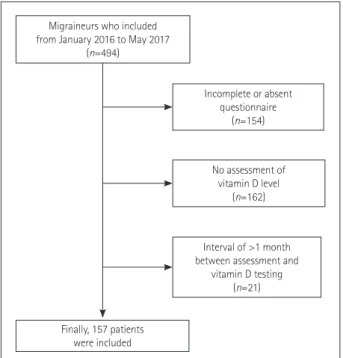
There were 494 adult patients with migraine who were regis- tered in the headache records between January 2016 to May 2017, of which 154 had an incomplete response or absent questionnaire, 162 had no assessment of the vitamin D level, and 21 had an interval between the assessment and vitamin D testing of longer than 1 month, and so were excluded, re- sulting in 157 migraineurs being included in this study (Fig.
1). The sex distribution, number of days of migraine attacks per month, VAS score, and season distribution did not dif- fer between the included and excluded patients, but the fre- quency of chronic migraine was higher and that of probable migraine was lower in the included patients (Supplementary Table 1 in the online-only Data Supplement).
The 157 included patients were aged 37.0±8.6 years (mean±
standard deviation), and 75.2% (118/157) of them were fe- male. They were classified into migraine without aura (n=114), migraine with aura (n=8), chronic migraine (n=31), and probable migraine (n=4) according to the ICHD-3 classifica- tion. The vitamin D level was 15.9±7.4 ng/mL. The frequency of vitamin D deficiency was observed in 121 migraineurs (77.0%), and was more common in spring and winter than in summer and autumn (89.1%, 85.7%, 72.4%, and 61.7%, re- spectively; p=0.008). Based on a <30 ng/mL cutoff for serum
vitamin D, 149 (94.9%) migraineurs were considered to have vitamin D insufficiency.
Comparison of demographics and clinical factors according to presence of vitamin D deficiency
The demographics, headache characteristics, and accompa- nying problems (HIT-6 score, PHQ-9 score, GAD-7 score, and PSQI) did not differ significantly between migraineurs with and without vitamin D deficiency, with the exception of the seasonal distribution. The number of monthly days with headache tended to be higher in patients with vitamin D deficiency than in those without deficiency (p=0.073) (Ta- ble 1). The temperature, relative humidity, and total sun- shine hours of the months in which the vitamin D concen- tration was measured were lower in those with vitamin D deficiency than in those without deficiency (Table 1). When dichotomizing seasons into summer/autumn and winter/spring, the serum vitamin D level was negatively correlated with the HIT-6 score in summer/autumn (ρ=–0.239, p=0.037) but not in winter/spring (ρ=0.094, p=0.405).
Factors associated with monthly headache frequency
In multivariate Poisson regression analysis, monthly head- ache was 1.203 times [95% confidence interval (CI)=1.046–1.383, p=0.009] more frequent in patients with vitamin D deficiency than in those without deficiency after adjusting for age, sex, and variables with p<0.1 in the univariate analy- sis [season (winter/spring vs. summer/autumn), migraine subtype (chronic vs. episodic), depression (PHQ-9 score), anxiety (GAD-7 score), and sleep quality (PSQI)]. Chronic migraine was more strongly associated than episodic migraine with the number of monthly days with headache [odds ratio (OR)=2.562, 95% CI=2.292–2.864, p<0.001] (Table 2).
Comparison of demographics and clinical data according to sex and chronicity
Vitamin D deficiency was observed more frequently in fe- males (79.7%) than in males (69.2%), although the difference was not statistically significant (p=0.179). In subgroup anal- ysis, males with vitamin D deficiency tended to have higher VAS and PSQI scores than those without deficiency (Table 3). In subgroup multivariate analysis after adjusting for age, season (winter/spring vs. summer/autumn), and migraine subtype (chronic vs. episodic), vitamin D deficiency was in- dependently associated with more monthly days with head- ache in females (OR=1.220, 95% CI=1.026–1.451, p=0.024) but not in males (OR=1.123, 95% CI=0.866–1.456, p=0.383).
In chronic migraine patients, the number of monthly days with headache was higher in migraineurs with vitamin D de- ficiency than in those without deficiency (19.3±7.0 days vs.
Migraineurs who included from January 2016 to May 2017
(n=494)
Incomplete or absent questionnaire
(n=154)
No assessment of vitamin D level
(n=162)
Interval of >1 month between assessment and
vitamin D testing (n=21)
Finally, 157 patients were included
Fig. 1. Flowchart outlining patient inclusion.
Song TJ et al.
JCN
13.3±4.0 days, p=0.058). None of the other variables differed significantly with vitamin D deficiency in either episodic mi- graineurs or chronic migraineurs (Table 4). In subgroup multivariate analysis after adjusting for age, sex, and season (winter/spring vs. summer/autumn), vitamin D deficiency was independently associated with more monthly days with head- ache in both episodic migraine patients (OR=1.266, 95% CI=
1.019–1.573, p=0.033) and chronic migraine patients (OR=
1.390, 95% CI= 1.013–1.905, p=0.041).
DISCUSSION
We found that proportion of migraineurs with vitamin D deficiency varied from 61.7% in autumn to 89.1% in spring.
Vitamin D deficiency was independently associated with an increased frequency of monthly headache among migraineu- rs even after adjusting for season, depression, anxiety, and sleep Table 2. Analysis of contributing factors related to the monthly fre-
quency of headache in patients with migraine
Factor Exponential (B)
(95% CI) p*
Age 1.001 (0.995–1.007) 0.774
Sex, female 0.960 (0.851–1.084) 0.511
Season, winter/spring† 1.078 (0.966–1.204) 0.181 Chronic migraine‡ 2.562 (2.292–2.864) <0.001
PHQ-9 score 1.005 (0.988–1.023) 0.561
GAD-7 score 1.001 (0.986–1.017) 0.886
PSQI 1.011 (0.993–1.029) 0.236
Vitamin D <20 ng/mL 1.203 (1.046–1.383) 0.009 The goodness of fit of our model in the Poisson regression analysis was confirmed by a p value of 0.001 in the Omnibus test.
*Results of multivariate Poisson regression analysis of monthly head- ache frequency as the dependent variable, †Summer/autumn as refer- ence, ‡Episodic migraine as reference.
GAD-7: Generalized Anxiety Disorder-7, PHQ-9: Patient Health Ques- tionnaire-9, PSQI: Pittsburgh Sleep Quality Index.
Table 1. Comparison of demographics and clinical factors based on the presence or absence of vitamin D deficiency
Characteristic Total
(n=157)
Migraineurs with vitamin D deficiency (n=121)*
Migraineurs without
vitamin D deficiency (n=36) p Demographics
Age, years 36.9±8.6 36.8±0.1 37.6±7.5 0.593
Females 118 (75.2) 94 (79.7) 24 (66.7) 0.179
Season 0.008
Spring 46 (29.3) 41 (33.9) 5 (13.9)
Summer 29 (18.5) 21 (17.4) 8 (22.2)
Autumn 47 (29.9) 29 (24.0) 18 (50.0)
Winter 35 (22.3) 30 (24.8) 5 (13.9)
ICHD-3 classification 0.406
Migraine without aura 114 (72.6) 89 (73.6) 25 (69.4)
Migraine with aura 8 (5.1) 5 (4.1) 3 (8.3)
Chronic migraine 31 (19.7) 25 (20.7) 6 (16.7)
Probable migraine 4 (2.5) 2 (1.7) 2 (5.6)
Headache characteristics
Monthly days with headache 9.0±7.4 9.5±7.8 7.3±5.9 0.073
Attack duration, hours 39.5±49.3 40.9±53.1 34.6±33.3 0.753
Medication, days/month 4.6±6.3 5.0±6.9 3.5±3.3 0.712
VAS score 7.0±1.7 7.1±1.8 6.8±1.7 0.242
Accompanying problems
HIT-6 score 61.2±7.3 61.5±7.6 60.6±6.8 0.554
PHQ-9 score 7.2±5.1 7.4±5.2 6.7±4.7 0.552
GAD-7 score 6.1±5.1 6.4±5.3 5.1±4.6 0.270
PSQI 8.7±3.8 9.0±3.8 8.1±4.3 0.224
Climate factors, monthly
Temperature, °C 13.6±9.7 12.4±9.6 17.6±9.2 0.006
Relative humidity, % 67.8±6.9 66.7±6.6 71.6±6.3 0.001
Precipitation, mm 78.0±76.1 72.7±72.6 95.7±85.7 0.113
Total sunshine hours 189.8±36.4 187.0±35.1 199.3±39.6 0.075
Data are mean±standard deviation or n (%) values.
*Vitamin D deficiency: serum total 25-hydroxyvitamin D <20 ng/mL.
GAD-7: Generalized Anxiety Disorder-7, HIT-6: Headache Impact Test-6, ICHD-3: third edition of the International Classification of Headache Disor- ders, PHQ-9: Patient Health Questionnaire-9, PSQI: Pittsburgh Sleep Quality Index, VAS: Visual Analog Scale.
Vitamin D Deficiency in Migraine
JCN
quality.
The reported prevalence rates of vitamin D insufficiency and deficiency in patients with migraine have varied from 40% to 68% and from 13% to 80%, respectively.16,17,19,27,28 These dif- ferences are presumably due to differences in race, research design, and residence area.15 The incidence rates of vitamin D deficiency or insufficiency in our study were similar to previous data from Korea, with the prevalence of vitamin D deficiency reportedly being 68.5% in males and 83.1% in fe- males.29 Although previous studies have found vitamin D deficiency to be more common in nonmigraine headaches or
chronic tension-type headaches, the relative prevalence rates of vitamin deficiency in migraineurs versus nonheadache controls have not been established.19,30
Our study found that the number of monthly days with headache was associated with serum vitamin D deficiency.
Despite of the limitation of small samples in the subgroup analysis, this association was consistently noted among fe- males, episodic migraine patients, and chronic migraine patients. Previous studies found that the frequency of head- ache attack tended to increase in winter and decrease in summer, which is consistent with the seasonal variation of Table 3. Comparison of demographics and clinical factors according to vitamin D deficiency in males and females
Characteristic
Males (n=39) Females (n=118)
Migraineurs with vitamin D deficiency
(n=27)
Migraineurs without vitamin D deficiency
(n=12)
Migraineurs with vitamin D deficiency
(n=94)
Migraineurs without vitamin D deficiency
(n=24) Demographics
Age, years 37.4±8.7 35.0±7.7 36.6±9.0 38.9±7.1
Season
Spring 12 (44.4) 4 (33.3) 29 (30.9) 1 (25.4)*
Summer 4 (14.8) 3 (25.0) 17 (18.1) 5 (20.8)*
Autumn 6 (22.2) 5 (41.7) 23 (24.5) 13 (54.2)*
Winter 5 (18.5) 0 (0.0) 25 (26.6) 5 (20.8)*
ICHD-3 classification
Migraine without aura 21 (77.8) 7 (58.3) 68 (72.3) 18 (75.0)
Migraine with aura 0 (0.0) 1 (8.3) 5 (5.3) 2 (8.3)
Chronic migraine 6 (22.2) 3 (25.0) 19 (20.2) 3 (12.5)
Probable migraine 0 (0.0) 1 (8.3) 2 (2.1) 1 (4.2)
Headache characteristics
Monthly days with headache 10.1±8.1 8.2±5.6 9.3±7.7 6.8±6.1
Attack duration, hours 30.5±24.2 34.3±25.5 43.9±58.6 34.8±37.1
Medication, days/month 6.7±8.8 4.1±4.1 4.4±6.2 3.2±2.9
VAS score 7.4±1.7 6.3±1.4† 7.0±1.8 6.9±1.7
Accompanying problems
HIT-6 score 62.1±7.4 61.3±6.5 61.3±7.6 60.2±6.9
PHQ-9 score 7.3±6.0 6.6±4.2 7.3±5.0 6.7±5.1
GAD-7 score 6.6±5.9 4.6±3.7 6.3±5.1 5.3±4.9
PSQI 9.8±3.4 7.4±3.7† 8.7±3.8 8.5±4.5
Climate factors, monthly
Temperature, °C 14.1±8.9 19.3±7.5† 12.0±9.8 16.7±10.0*
Relative humidity, % 66.4±6.3 69.3±5.7 66.8±6.7 72.8±6.4*
Precipitation, mm 73.5±63.0 78.3±44.2 72.5±75.4 104.4±100.0
Total sunshine hours 205.8±47.9 223.6±41.4† 181.6±28.5 181.6±24.2
Data are mean±standard deviation or n (%) values.
*p<0.05, †p<0.1.
GAD-7: Generalized Anxiety Disorder-7, HIT-6: Headache Impact Test-6, ICHD-3: third edition of the International Classification of Headache Disor- ders, PHQ-9: Patient Health Questionnaire-9, PSQI: Pittsburgh Sleep Quality Index, VAS: Visual Analog Scale.
Song TJ et al.
JCN
serum vitamin D levels.15 Combination therapy with simv- astatin and vitamin D was found to exert migraine-preven- tive effects in a previous randomized clinical trial,10 but vita- min D had been prescribed for its anti-inflammatory effect against cytokines or the alleviation of muscle pain.11 Further- more, there are few reports on the association of vitamin D and headache frequency in females and chronic migraine patients, and so our study provides new information on this research topic.
The severity of migraine was found to not be related to vi- tamin D level among migraineurs in middle East Asian coun- tries.16 Studies have also shown no significant relationship between serum vitamin D and migraine severity.17 Our re- sults are in line with these previous findings because the VAS scores did not differ with vitamin D deficiency. However, considering the effect of season, our study demonstrated that the HIT-6 score was negatively correlated with vitamin D lev- el during summer/autumn only. It is possible that the effect of HIT-6 was not clear due to low individual differences in
normal vitamin D concentrations during spring and winter.
The mechanisms underlying the associations of migraine and migraine frequency with vitamin D remain to be eluci- dated. However, a few hypotheses are as follows: First, the vitamin D receptors 1-hydroxylase (the enzyme responsible for the formation of the active form of vitamin D) and vita- min-D-binding protein are located in the brain. Vitamin D facilitates the differentiation of brain cells, regulates axonal growth, and regulates calcium signaling directly in the brain, modulates the production of brain-derived reactive oxygen species, and stimulates the production of neurotrophic fac- tors. These roles of vitamin D elicit peripheral and central sensitization of neurons in the periosteum during bone swell- ing, resulting in headache.7,17 Second, although this was not evaluated in our study, magnesium is the second-most-plen- tiful intracellular cation and an important component of bone mineralization that plays a crucial role in the synthesis and metabolism of vitamin D. Lower levels of vitamin D are gen- erally associated with lower serum magnesium levels.31 A Table 4. Comparison of demographics and clinical factors according to vitamin D deficiency in episodic migraine and chronic migraine
Characteristic
Episodic migraine (n=126) Chronic migraine (n=31) Migraineurs with
vitamin D deficiency (n=96)
Migraineurs without vitamin D deficiency
(n=30)
Migraineurs with vitamin D deficiency
(n=25)
Migraineurs without vitamin D deficiency
(n=6) Demographics
Age, years 35.9±8.6 36.8±6.2 40.2±9.4 41.3±12.0
Season
Spring 34 (35.4) 4 (13.3)* 7 (28.0) 1 (16.7)
Summer 17 (17.7) 6 (20.0)* 4 (16.0) 2 (33.3)
Autumn 24 (25.0) 16 (53.3)* 5 (20.0) 2 (33.3)
Winter 21 (21.9) 4 (13.3)* 9 (36.0) 1 (16.7)
Headache characteristics
Monthly days with headache 7.0±5.7 6.1±5.5 19.3±7.0 13.3±4.0†
Attack duration, hours 37.7±34.6 33.5±29.6 53.2±95.8 40.5±51.3
Medication, days/month 3.9±5.0 2.5±2.1 8.6±10.9 8.3±4.2
VAS score 7.1±1.6 6.8±1.6 6.9±2.2 6.3±1.9
Accompanying problems
HIT-6 score 61.4±7.5 60.8±5.9 61.6±7.8 59.5±10.6
PHQ-9 score 7.0±5.0 6.7±4.5 8.6±5.9 6.5±6.2
GAD-7 score 6.2±5.0 4.7±3.6 7.2±6.1 6.8±8.1
PSQI 8.7±3.6 7.8±4.1 9.7±4.0 9.5±5.0
Climate factors, monthly
Temperature, °C 13.0±9.4 17.9±8.9* 10.4±10.5 16.0±11.7
Relative humidity, % 67.1±6.8 71.8±6.0* 65.4±6.1 71.0±8.6†
Precipitation, mm 77.1±74.1 95.3±81.6 55.9±65.2 97.6±113.0
Total sunshine hours 186.8±35.4 198.1±41.2 187.8±34.3 205.2±32.4
Data are mean±standard deviation or n (%) values.
*p<0.05, †p<0.1.
GAD-7: Generalized Anxiety Disorder-7, HIT-6: Headache Impact Test-6, ICHD-3: third edition of the International Classification of Headache Disor- ders, PHQ-9: Patient Health Questionnaire-9, PSQI: Pittsburgh Sleep Quality Index, VAS: Visual Analog Scale.
Vitamin D Deficiency in Migraine
JCN
previous study found that the serum levels of magnesium were lower during migraine attacks than in healthy individ- uals.32 Third, neurological diseases such as depression and fibromyalgia, which are associated with vitamin D, are also closely related to migraine itself. It is therefore possible that our findings are attributed to accompanying health condi- tions.7,33
Our study had several limitations. First, a retrospective analysis was performed based on headache clinic data and a relatively small sample. Moreover, although the clinical features were similar in the included and excluded patients, the frequency of vitamin D deficiency in this study was lim- ited to the entire population because of differences in the rates of chronic migraine. However, the purpose of this study was to determine the relationship between vitamin D defi- ciency and headache variables. Furthermore, the relationship between vitamin D deficiency and monthly days with head- ache was statistically significant in both episodic and chron- ic migraineurs. Second, the number of monthly days with headache was based on recall rather than being assessed us- ing a headache diary. Third, vitamin D replacement by diet, medication, or fortification was not assessed.
Notwithstanding these limitations, our study has the fol- lowing strengths. First, it was conducted in Asia at relatively high latitudes without prominent sun-seeking behaviors. The geographic and cultural characteristics provide novel in- sights into the association of vitamin D with migraine in an area with a high risk of vitamin D deficiency. Second, our study systematically considered depression, anxiety, and sleep qual- ity, which are closely related to the characteristics of migraine.
Third, our study made adjustments for seasonal variation and climate factors that influence serum vitamin D levels.
In conclusion, our study found that a larger number of monthly days with headache is related to vitamin D deficien- cy among migraineurs. The vitamin D level may also be asso- ciated with the occurrence or impact of headache among mi- graineurs. Future studies should attempt to confirm the causal relationship between vitamin D deficiency and migraine.
Supplementary Materials
The online-only Data Supplement is available with this arti- cle at https://doi.org/10.3988/jcn.2018.14.3.366.
Conflicts of Interest
The authors have no financial conflicts of interest.
Acknowledgements
This study was supported by Hallym University Research Fund (HURF- 2016-54). This study was supported by a grant from Basic Science Research Program through the National Research Foundation of Korea (NRF) funded by the Ministry of Education (2015R1D1A1A01057934). No other financial relationships relevant to this publication were disclosed.
REFERENCES
1. Atherton K, Berry DJ, Parsons T, Macfarlane GJ, Power C, Hypponen E. Vitamin D and chronic widespread pain in a white middle-aged British population: evidence from a cross-sectional population sur- vey. Ann Rheum Dis 2009;68:817-822.
2. Parker GB, Brotchie H, Graham RK. Vitamin D and depression. J Affect Disord 2017;208:56-61.
3. Milaneschi Y, Hoogendijk W, Lips P, Heijboer AC, Schoevers R, van Hemert AM, et al. The association between low vitamin D and depres- sive disorders. Mol Psychiatry 2014;19:444-451.
4. Littlejohns TJ, Henley WE, Lang IA, Annweiler C, Beauchet O, Chaves PH, et al. Vitamin D and the risk of dementia and Alzheimer disease.
Neurology 2014;83:920-928.
5. Munger KL, Hongell K, Åivo J, Soilu-Hänninen M, Surcel HM, Ascherio A. 25-hydroxyvitamin D deficiency and risk of MS among women in the Finnish Maternity Cohort. Neurology 2017;89:1578- 1583.
6. Holick MF. The vitamin D deficiency pandemic: approaches for diag- nosis, treatment and prevention. Rev Endocr Metab Disord 2017;18:
153-165.
7. Eyles DW, Burne TH, McGrath JJ. Vitamin D, effects on brain devel- opment, adult brain function and the links between low levels of vita- min D and neuropsychiatric disease. Front Neuroendocrinol 2013;
34:47-64.
8. Garcion E, Nataf S, Berod A, Darcy F, Brachet P. 1,25-dihydroxyvita- min D3 inhibits the expression of inducible nitric oxide synthase in rat central nervous system during experimental allergic encephalomyeli- tis. Brain Res Mol Brain Res 1997;45:255-267.
9. Thys-Jacobs S. Vitamin D and calcium in menstrual migraine. Head- ache 1994;34:544-546.
10. Buettner C, Nir RR, Bertisch SM, Bernstein C, Schain A, Mittleman MA, et al. Simvastatin and vitamin D for migraine prevention: a ran- domized, controlled trial. Ann Neurol 2015;78:970-981.
11. Buettner C, Burstein R. Association of statin use and risk for severe headache or migraine by serum vitamin D status: a cross-sectional pop- ulation-based study. Cephalalgia 2015;35:757-766.
12. Wang TJ, Zhang F, Richards JB, Kestenbaum B, van Meurs JB, Berry D, et al. Common genetic determinants of vitamin D insufficiency: a ge- nome-wide association study. Lancet 2010;376:180-188.
13. Sato K, Hayashino Y, Yamazaki S, Takegami M, Ono R, Otani K, et al.
Headache prevalence and long working hours: the role of physical in- activity. Public Health 2012;126:587-593.
14. Varkey E, Hagen K, Zwart JA, Linde M. Physical activity and head- ache: results from the Nord-Trondelag Health Study (HUNT). Cepha- lalgia 2008;28:1292-1297.
15. Prakash S, Mehta NC, Dabhi AS, Lakhani O, Khilari M, Shah ND. The prevalence of headache may be related with the latitude: a possible role of Vitamin D insufficiency? J Headache Pain 2010;11:301-307.
16. Zandifar A, Masjedi SS, Banihashemi M, Asgari F, Manouchehri N, Ebrahimi H, et al. Vitamin D status in migraine patients: a case-con- trol study. Biomed Res Int 2014;2014:514782.
17. Mottaghi T, Khorvash F, Askari G, Maracy MR, Ghiasvand R, Magh- soudi Z, et al. The relationship between serum levels of vitamin D and migraine. J Res Med Sci 2013;18(Suppl 1):S66-S70.
18. Lippi G, Cervellin G, Mattiuzzi C. No evidence for an association of vitamin D deficiency and migraine: a systematic review of the litera- ture. Biomed Res Int 2014;2014:827635.
19. Kjaergaard M, Eggen AE, Mathiesen EB, Jorde R. Association be- tween headache and serum 25-hydroxyvitamin D: the Tromsø Study:
Tromsø 6. Headache 2012;52:1499-1505.
20. No authors listed. Headache Classification Committee of the Inter- national Headache Society (IHS) The International Classification of Headache Disorders, 3rd edition. Cephalalgia 2018;38:1-211.
21. Chu MK, Im HJ, Ju YS, Yu KH, Ma HI, Lee BC. [Validity and reliabil-
Song TJ et al.
JCN
ity assessment of Korean Headache Impact Test-6 (HIT-6)]. J Korean Neurol Assoc 2009;27:1-6.
22. Seo JG, Park SP. Validation of the Patient Health Questionnaire-9 (PHQ-9) and PHQ-2 in patients with migraine. J Headache Pain 2015;
16:65.
23. Seo JG, Park SP. Validation of the Generalized Anxiety Disorder-7 (GAD-7) and GAD-2 in patients with migraine. J Headache Pain 2015;
16:97.
24. Buysse DJ, Reynolds CF 3rd, Monk TH, Berman SR, Kupfer DJ. The Pittsburgh Sleep Quality Index: a new instrument for psychiatric prac- tice and research. Psychiatry Res 1989;28:193-213.
25. Centers for Disease Control and Prevention (US). CDC Vitamin D Standardization-Certification Program (VDSCP)-total 25 hydroxy vi- tamin D certified procedures [Internet]. Atlanta (GA): Centers for Disease Control and Prevention; 2017 [cited 2017 Dec 8]. Available from: https://www.cdc.gov/labstandards/pdf/hs/CDC_Certified_Vita- min_D_Procedures.pdf.
26. Holick MF, Binkley NC, Bischoff-Ferrari HA, Gordon CM, Hanley DA, Heaney RP, et al. Evaluation, treatment, and prevention of vitamin D deficiency: an Endocrine Society clinical practice guideline. J Clin Endocrinol Metab 2011;96:1911-1930.
27. Wheeler SD. Vitamin D deficiency in chronic migraine. Headache 2008;48(S1):S52-S53.
28. Khorvash F, Mottaghi T, Askari G, Maracy MR, Ghiasvand R, Magh- soudi Z, et al. The association between serum vitamin D levels with general and abdominal obesity among patients with migraine. Int J Prev Med 2013;4(Suppl 2):S313-S317.
29. Jeong H, Hong S, Heo Y, Chun H, Kim D, Park J, et al. Vitamin D sta- tus and associated occupational factors in Korean wage workers: data from the 5th Korea National Health and Nutrition Examination Sur- vey (KNHANES 2010–2012). Ann Occup Environ Med 2014;26:28.
30. Prakash S, Rathore C, Makwana P, Dave A, Joshi H, Parekh H. Defi- ciency in patients with chronic tension-type headache: a case-control study. Headache 2017;57:1096-1108.
31. Deng X, Song Y, Manson JE, Signorello LB, Zhang SM, Shrubsole MJ, et al. Magnesium, vitamin D status and mortality: results from US National Health and Nutrition Examination Survey (NHANES) 2001 to 2006 and NHANES III. BMC Med 2013;11:187.
32. Assarzadegan F, Asgarzadeh S, Hatamabadi HR, Shahrami A, Tabata- baey A, Asgarzadeh M. Serum concentration of magnesium as an in- dependent risk factor in migraine attacks: a matched case-control study and review of the literature. Int Clin Psychopharmacol 2016;31:287-292.
33. Makrani AH, Afshari M, Ghajar M, Forooghi Z, Moosazadeh M. Vita- min D and fibromyalgia: a meta-analysis. Korean J Pain 2017;30:250- 257.