Copyrights © 2015 by The Korean Gastric Cancer Association www.jgc-online.org This is an open-access article distributed under the terms of the Creative Commons Attribution Non-Commercial License (http://creativecommons.org/
licenses/by-nc/4.0) which permits unrestricted noncommercial use, distribution, and reproduction in any medium, provided the original work is properly cited.
Introduction
For the treatment of gastric cancer, minimally invasive gas- trectomy (MIG) is technically feasible and safe, especially for early gastric cancer.1,2 Recently, excellent postoperative short- term outcomes of laparoscopic gastrectomy and robotic gastrec- tomy have been reported in prospective, multicenter studies. In
addition, acceptable oncologic outcomes of laparoscopic gas- trectomy for gastric cancer in a retrospective, multicenter study have been confirmed.3,4 Thus, MIG (laparoscopic or robotic) is now regarded as one of the standard treatments for early gastric cancer,5-8 and is being performed in more institutions.
Laparoscopic gastrectomy has a steep learning curve. While the procedure can be performed successfully in the early learn- ing period, it is known that robotic gastrectomy can more easily be learned by surgeons with experience in laparoscopic gastrec- tomy.9 However, these were well-trained gastric surgeons who were thoroughly familiar with open gastrectomy. To date, there has been no report of surgical outcomes of MIG performed by surgeons with minimal open counterpart experience as an op- erator. Although some urologic surgeons reported that previous Correspondence to: Yoo Min Kim
Department of Surgery, CHA Bundang Medical Center, CHA University, 59 Yatap-ro, Bundang-gu, Seongnam 13496, Korea
Tel: +82-31-780-1870, Fax: +82-31-780-5259 E-mail: [email protected]
Received November 2, 2015 Revised December 15, 2015 Accepted December 15, 2015
Beginner Surgeon’s Initial Experience with
Distal Subtotal Gastrectomy for Gastric Cancer Using a Minimally Invasive Approach
Yung Hun You, Yoo Min Kim, and Dae Ho Ahn
Department of Surgery, CHA Bundang Medical Center, CHA University, Seongnam, Korea
Purpose: Minimally invasive gastrectomy (MIG), including laparoscopic distal subtotal gastrectomy (LDG) and robotic distal subtotal gas- trectomy (RDG), is performed for gastric cancer, and requires a learning period. However, there are few reports regarding MIG by a be- ginner surgeon trained in MIG for gastric cancer during surgical residency and fellowship. The aim of this study was to report our initial experience with MIG, LDG, and RDG by a trained beginner surgeon.
Materials and Methods: Between January 2014 and February 2015, a total of 36 patients (20 LDGs and 16 RDGs) underwent MIG by a beginner surgeon during the learning period, and 13 underwent open distal subtotal gastrectomy (ODG) by an experienced surgeon in Bundang CHA Medical Center. Demographic characteristics, operative findings, and short-term outcomes were evaluated for the groups.
Results: MIG was safely performed without open conversion in all patients and there was no mortality in either group. There was no significant difference between the groups in demographic factors except for body mass index. There were significant differences in extent of lymph node dissection (LND) (D2 LND: ODG 8.3% vs. MIG 55.6%, P=0.004) and mean operative time (ODG 178.8 minutes vs.
MIG 254.7 minutes, P<0.001). The serial changes in postoperative hemoglobin level (P=0.464) and white blood cell count (P=0.644) did not show significant differences between the groups. There were no significant differences in morbidity.
Conclusions: This study showed that the operative and short-term outcomes of MIG for gastric cancer by a trained beginner surgeon were comparable with those of ODG performed by an experienced surgeon.
Key Words: Minimally invasive surgical procedures; Stomach neoplasms; Laparoscopy; Robotics; Beginner surgeon
experience with open surgery had little effect on the perfor- mance of minimally invasive surgical procedures,10 there has been no report on the effect of experience with open gastrec- tomy on performing MIG.
Therefore, we present our initial experience with minimally invasive, laparoscopic, or robotic distal subtotal gastrectomy (RDG) by a single, trained beginner surgeon, report the results of the evaluation of the short-term outcomes, compared with those for open distal subtotal gastrectomy (ODG) by an experienced surgeon.
Materials and Methods
1. Patients
We retrospectively reviewed a database of gastric cancer patients treated since January 2014 at CHA Bundang Medi- cal Center, CHA University, Gyeonggi-do, Korea. Robotic or laparoscopic distal gastrectomy was offered to patients with histologically proven gastric adenocarcinoma not involving the serosal layer or extraperigastric lymph nodes on preoperative evaluation. All tumors were staged with preoperative endos- copy, endoscopic ultrasound, and abdominopelvic computed tomography (CT). Laparoscopic and robotic gastrectomies were first performed in April 2014; a total of 36 patients underwent laparoscopic or RDG in Bundang CHA Medical Center between April 2014 and February 2015 by a beginner surgeon in the early learning period. Of the 36 cases, 20 laparoscopic distal subtotal gastrectomies (LDGs) and 16 RDGs were performed. An expe- rienced surgeon performed 13 ODGs in CHA Bundang Medical Center for the same indications as for MIG from January 2014 to February 2015. During a training period of 3 years, the begin- ner surgeon had experienced more than 200 ODGs, 200 LDGs, and 100 RDGs as a first assistant. The experienced surgeon has performed more than a thousand ODGs for gastric cancer over 20 years. We compared demographic characteristics, operative findings, and postoperative short-term outcomes of 20 LDGs and 16 RDGs by the beginner surgeon with those of 13 ODGs by the experienced surgeon. After receiving a detailed explana- tion, all patients selected the type of surgery by themselves and all gave proper informed consent before surgery. Because this was a retrospective analysis, signed informed consent for the study was waived by the institutional review board.
2. Variables
The demographic characteristics and operative findings, in- cluding age, sex, American Society of Anesthesiologists (ASA) score, body mass index (BMI), previous abdominal surgery, ex- tent of lymph node dissection (LND), presence of combined re- section, operative time, and tumor classification, were evaluated.
Variables associated with postoperative short-term outcomes, such as postoperative changes in hemoglobin, white blood cell (WBC) count, length of hospital stay, time to first soft diet, and postoperative complications were reviewed. The participants in this study had undergone gastrectomy for gastric cancer; thus, we evaluated the number of retrieved lymph nodes, with more than 15 for early gastric cancer and 25 for advanced gastric cancer, to assess the oncologic quality of lymphadenectomy by the beginner surgeon. We serially evaluated the level of serum hemoglobin (Hb) in the perioperative period to estimate intra- operative blood loss, because the methods for measuring intra- operative blood loss differed between ODG and MIG groups in our institution. The serial WBC counts in the postoperative period were reviewed as inflammatory markers. The level of serum Hb and the WBC count were checked preoperatively, immediate postoperatively, and on postoperative day (POD) #1, POD #3, and POD #5. Postoperative complications according to the Clavien-Dindo classification were also evaluated to compare short-term outcomes.11
3. Surgical methods
The extent of gastric wall resection (total or distal subtotal gastrectomy) was determined according to the location of the tumor and the extent of LND; D1+ or D2 was performed ac- cording to the Japanese gastric cancer treatment guidelines.5 The surgical techniques for the robotic and laparoscopic gastrecto- mies with LND are similar in detail, as previously reported.12-15 Reconstructions were performed with gastroduodenostomy, gastrojejunostomy with or without Braun anastomosis, or Roux- en-Y gastrojejunostomy, based on the tumor location for distal subtotal gastrectomy. The da Vinci Si System (Intuitive Surgical Inc., Sunnyvale, CA, USA) was used in all robotic gastrectomies.
1) Laparoscopic distal subtotal gastrectomy
The patient was placed in reverse Trendelenburg position and 5 ports (3, 12-mm and 2, 5-mm ports) were inserted into the upper abdomen. After trocar insertions, liver traction was per- formed using the sling method with gauze and Prolene 2-0.16
After mobilization of the stomach and dissection of lymph nodes, distal gastrectomy was performed by applying 2, 60- mm Endo linear staplers through the 12-mm port in the left abdomen, and reconstruction was done intracorporeally with Endo linear staplers. Intracorporeal gastroduodenostomy was performed, similar to so-called delta-shaped anastomosis, as reported by Kanaya et al.17 When the last 45-mm stapler was fired to close the common entry hole, the previously stapled duodenal stump was also included and removed to secure the blood supply to the duodenum. Intracorporeal gastrojejunostomy was performed in a side-to-side, anisoperistaltic, and antecolic fashion, using Endo linear staplers. The common entry hole was closed intracorporeally by a hand-sewn method, with 2 layers of continuous running suture and absorbable barbed suture. Full- thickness running suture was used for the first layer and sero- muscular running suture was used from the opposite start point using the same suture material without tying. For intracorporeal Roux-en-Y gastrojejunostomy, the proximal jejunum was di- vided 25 cm from the ligament of Treitz using a 45-mm Endo linear stapler. Intracorporeal gastrojejunostomy was performed in a side-to-side, isoperistaltic, and antecolic fashion using 60- mm Endo linear staplers 7 cm distal from the jejunal transection line. A side-to-side jejunostomy was performed 25 to 30 cm distal from the gastrojejunostomy site using a 45-mm Endo lin- ear stapler. The common holes were closed intracorporeally by a hand-sewn method as described above. In all cases, Petersen’s
defect was repaired with a purse-string suture.
2) Robotic distal subtotal gastrectomy
After port insertion (2, 12-mm and 3, 8-mm ports), the sur- gical cart can be docked on the patient. The instrumentation and settings consist of a 30o down endoscope, Maryland bipolar forceps in the 1st arm, ultrasonic shears in the 2nd arm, and Cadiere forceps in the 3rd arm. The surgery begins with liver retraction; detailed procedures and intracorporeal reconstruction are the same as described above for LDG, except for gastrojeju- nostomy. When performing gastrojejunostomy, the 8-mm port for the 2nd robotic arm is changed to a 12-mm port for stapling.
After gastrojejunostomy, an 8-mm robotic cannula is inserted into the 12-mm port, trocar-in-trocar fashion, to proceed after gastrojejunostomy.
4. Statistical analysis
All statistical analyses were conducted with the IBM SPSS software ver. 20 (IBM Co., Armonk, NY, USA). The variables compared among operations were tested with Student’s t-test or analysis of variance for continuous variables and the chi-square test or Fisher’s exact test for categorical variables as appropriate.
The Mann-Whitney U-test was used for continuous variables, unless the data satisfied the normality criteria. For longitudinal outcomes, such as WBC counts, a linear mixed model was ap- plied, and the outcomes at each time point were compared by
Table 1. Demographic characteristics
Characteristic ODG (n=12) LDG (n=20) RDG (n=16) P-value* MIG (n=36) P-value†
Age (yr) 61.8±10.4 (39~79) 67.1±12.2 (37~80) 57.7±10.5 (39~72) <0.001 62.9±12.3 (37~80) 0.780
Sex 0.570 1.000
Male 8 (66.7) 14 (70.0) 10 (62.5) 24 (66.7)
Female 4 (33.3) 6 (30.0) 6 (37.5) 12 (33.3)
Body mass index (kg/m2) 25.4±3.9 (19.8~33.2) 22.8±3.9 (16.3~28.4) 23.0±3.1 (18.7~29.3) <0.001 23.0±3.3 (16.3~29.3) 0.043
Previous abdominal surgery 0.827 0.517
No 10 (83.3) 15 (72.5) 13 (81.3) 28 (77.8)
Yes 2 (16.7) 5 (27.5) 3 (18.7) 8 (22.2)
ASA score 0.023 0.498
1 3 (25.0) 7 (35.0) 8 (50.0) 15 (41.7)
2 6 (50.0) 10 (50.0) 6 (37.5) 16 (44.4)
3 3 (25.0) 3 (15.0) 2 (12.5) 5 (13.9)
Values are presented as mean±standard deviation (range) or number (%). ODG = open distal subtotal gastrectomy; LDG = laparoscopic distal subtotal gastrectomy; RDG = robotic distal subtotal gastrectomy; MIG = minimally invasive gastrectomy; ASA = American Society of Anesthesiologists. *P-value among three groups (ODG, LDG, RDG); †P-value between ODG and MIG.
independent t-tests. The accepted level of statistical significance was a P-value less than 0.05.
Results
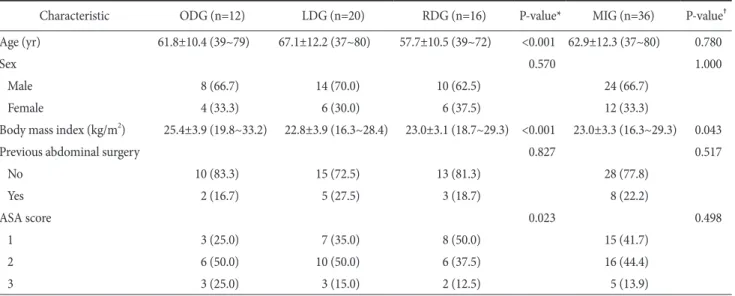
The demographic characteristics of the enrolled patients in ODG and MIG groups are summarized in Table 1. Although LDG and RDG groups were significantly older or younger than the ODG group (67.1±12.2, 57.7±10.5 vs. 61.8±10.4, respec- tively, P<0.001), the mean age of the MIG group was not sig- nificantly different from the ODG group (P=0.780). The ODG group had a higher BMI (P=0.043); there were no differences in gender and previous abdominal operations between the ODG and MIG groups. The proportion of ASA scores in the ODG group was not different from the MIG group (P=0.498), but there
were significantly more patients without a comorbidity (ASA=1) in the RDG group than in the ODG and LDG groups (P=0.023).
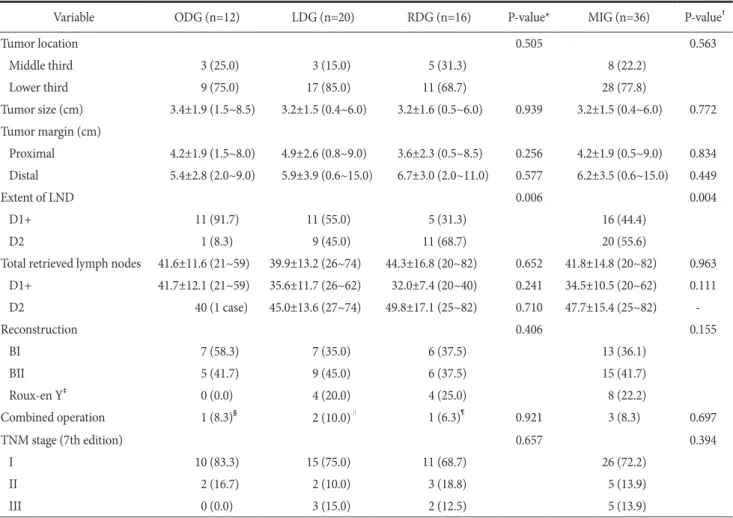
The operative findings and the pathologic results are sum- marized in Table 2. There was no significant difference between ODG and MIG groups for tumor location, tumor size, and re- section margin. The mean of total retrieved lymph nodes was 41.6 in ODG and 41.8 in MIG and was not significantly different between the groups (P=0.963), even though the MIG group had a higher proportion of D2 LND than the ODG group (P=0.004).
For patients who underwent D1+ LND, total retrieved lymph nodes in MIG were 34.5 on average, and more than 15 lymph nodes were retrieved in all MIG patients. For patients who un- derwent D2 LND, total retrieved lymph nodes in MIG were 47.7 on average, and more than 25 lymph nodes were retrieved in all MIG patients. There were no differences in reconstruction after
Table 2. Operative findings and pathologic outcomes
Variable ODG (n=12) LDG (n=20) RDG (n=16) P-value* MIG (n=36) P-value†
Tumor location 0.505 0.563
Middle third 3 (25.0) 3 (15.0) 5 (31.3) 8 (22.2)
Lower third 9 (75.0) 17 (85.0) 11 (68.7) 28 (77.8)
Tumor size (cm) 3.4±1.9 (1.5~8.5) 3.2±1.5 (0.4~6.0) 3.2±1.6 (0.5~6.0) 0.939 3.2±1.5 (0.4~6.0) 0.772 Tumor margin (cm)
Proximal 4.2±1.9 (1.5~8.0) 4.9±2.6 (0.8~9.0) 3.6±2.3 (0.5~8.5) 0.256 4.2±1.9 (0.5~9.0) 0.834 Distal 5.4±2.8 (2.0~9.0) 5.9±3.9 (0.6~15.0) 6.7±3.0 (2.0~11.0) 0.577 6.2±3.5 (0.6~15.0) 0.449
Extent of LND 0.006 0.004
D1+ 11 (91.7) 11 (55.0) 5 (31.3) 16 (44.4)
D2 1 (8.3) 9 (45.0) 11 (68.7) 20 (55.6)
Total retrieved lymph nodes 41.6±11.6 (21~59) 39.9±13.2 (26~74) 44.3±16.8 (20~82) 0.652 41.8±14.8 (20~82) 0.963 D1+ 41.7±12.1 (21~59) 35.6±11.7 (26~62) 32.0±7.4 (20~40) 0.241 34.5±10.5 (20~62) 0.111
D2 40 (1 case) 45.0±13.6 (27~74) 49.8±17.1 (25~82) 0.710 47.7±15.4 (25~82) -
Reconstruction 0.406 0.155
BI 7 (58.3) 7 (35.0) 6 (37.5) 13 (36.1)
BII 5 (41.7) 9 (45.0) 6 (37.5) 15 (41.7)
Roux-en Y‡ 0 (0.0) 4 (20.0) 4 (25.0) 8 (22.2)
Combined operation 1 (8.3)§ 2 (10.0)∥ 1 (6.3)¶ 0.921 3 (8.3) 0.697
TNM stage (7th edition) 0.657 0.394
I 10 (83.3) 15 (75.0) 11 (68.7) 26 (72.2)
II 2 (16.7) 2 (10.0) 3 (18.8) 5 (13.9)
III 0 (0.0) 3 (15.0) 2 (12.5) 5 (13.9)
Values are presented as number (%) or mean±standard deviation (range). ODG = open distal subtotal gastrectomy; LDG = laparoscopic distal subtotal gastrectomy; RDG = robotic distal subtotal gastrectomy; MIG = minimally invasive gastrectomy; LND = lymph node dissection. *P-value among three groups (ODG, LDG, RDG); †P-value between ODG and MIG; ‡Roux-en-Y gastrojejunostomy; §Transperitoneal hernia repair;
∥Laparoscopic cholecystectomy; ¶Robotic segmentectomy of S2, liver.
distal gastrectomy, combined operations, and TNM stage be- tween the groups. Combined operations were performed in one patient (transperitoneal hernia repair) in ODG, 2 patients (cho- lecystectomy for asymptomatic multiple gallbladder stones) in LDG, and one patient (robotic segmentectomy of S2 of the liver for hepatocellular adenoma) in RDG.
The operative short-term outcomes are summarized in Table 3. The mean operative time for MIG was about one and one half hours longer than that for ODG (254.7±51.5 minutes vs. 178.8
±52.7 minutes, P<0.001), and the difference was statistically significant. There were 3 cases in the MIG group that took over 300 min, including 2 LDGs and 1 RDG. One case was an RDG
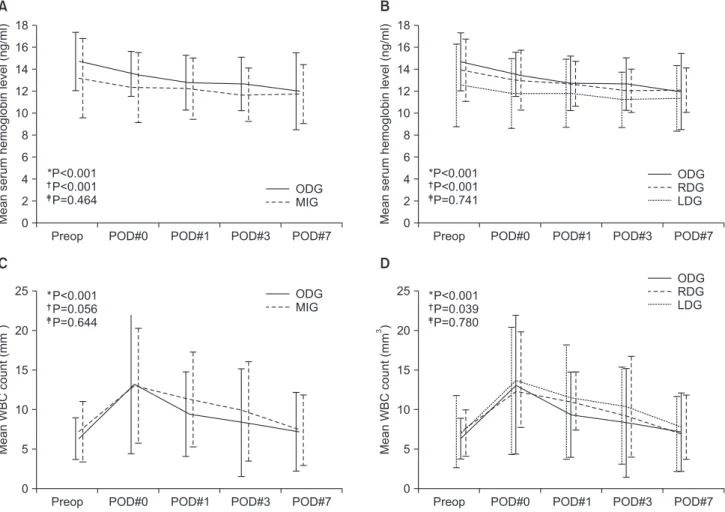
with full robotic segmentectomy of the liver for hepatocellular adenoma and another was an LDG with previous abdominal surgical history and combined cholecystectomy for asymptom- atic gallbladder stones. The other case was an LDG with active intestinal tuberculosis and there were several nodules on the omentum fixed to the mesentery in the ileocecal area. In this case, we took biopsies, evaluated the frozen results, and per- formed a total omentectomy. There was no intraoperative or postoperative transfusion in either group. The postoperative Hb levels were significantly different over time for individual pa- tients as well as between groups. As shown in Fig. 1, the curves for Hb level in ODG and MIG are almost parallel and do not Table 3. Postoperative short-term outcomes
Variable ODG (n=12) LDG (n=20) RDG (n=16) P-value* MIG (n=36) P-value†
Operative time (min) 178.8±52.7 (120~280) 241.0±50.7 (185~355) 271.9±48.6 (200~360) 0.939 254.7±51.5 (185~360) <0.001
Serum Hemoglobin (ng/ml) 0.741‡ 0.464‡
Preoperative 14.6±1.3 12.5±1.9 13.9±1.4 0.002 13.1±1.8 0.010
Immediate postoperative 13.5±1.0 11.8±1.5 13.0±1.4 0.003 12.3±1.6 0.004
POD#1 12.7±1.2 11.8±1.5 12.7±1.0 0.075 12.2±1.4 0.246
POD#3 12.6±1.2 11.2±1.3 12.0±1.0 0.008 11.6±1.2 0.017
POD#7 11.9±1.7 11.3±1.5 12.1±1.0 0.272 11.7±1.3 0.617
Serum white blood cell (×103) 0.780* 0.644*
Preoperative 6.3±1.3 7.3±2.3 7.1±1.5 0.347 7.2±1.3 0.152
Immediate postoperative 13.2±4.4 12.4±4.0 13.8±3.0 0.561 13.1±3.6 0.915
POD#1 9.4±2.7 11.0±3.6 11.6±2.0 0.153 11.3±3.0 0.061
POD#3 8.4±3.4 9.3±3.1 10.4±8.0 0.261 9.8±3.1 0.204
POD#7 7.2±2.5 7.0±2.4 7.9±2.0 0.538 7.4±2.2 0.800
Soft diet start (d) 6 (4~8) 5 (4~8) 5 (4~7) 0.225 5 (4~8) 0.325
Postoperative hospital stay (d) 11.8±1.8 9.7±3.0 11.4±5.7 0.285 10.4±4.4 0.330
12.0 (9~15) 8.5 (7~20) 9.5 (7~28) 10.0 (7~28)
Complication 1 (8.3) 3 (15.0) 2 (12.5) 0.859 5 (13.9) 0.527
Clavien-Dindo grade I/II‡ 1 3 2 5
Clavien-Dindo grade III/IV‡ 0 0 0 0
Wound infection 0 1 1 2
Anastomotic leakage 0 0 0 0
Bleeding 0 0 0 0
Intraabdominal abscess 0 0 0 0
Delayed gastric emptying§ 0 1 1 2
Pulmonary complication 1 1 0 1
Values are presented as mean±standard deviation (range), mean±standard deviation only, median (range), number (%), or number only. ODG = open distal subtotal gastrectomy, LDG = laparoscopic distal subtotal gastrectomy; RDG = robotic distal subtotal gastrectomy; MIG = minimally invasive gastrectomy; POD = postoperative day. *P-value among three groups (ODG, LDG, RDG); †P-value between ODG and MIG; ‡P-value estimated by Linear mixed model; ‡Clavien-Dindo classification of surgical complications; §Delayed gastric emptying and stasis.
cross; there was no statistical difference over time for individual patients or between groups (P=0.464). This finding was also ob- served in comparisons of ODG, LDG, and RDG groups (P=0.741).
The postoperative WBC counts were significantly different over time for individual patients (P<0.001, Fig 1.). However, the curves for both groups were similar and did not cross; thus, the changes in WBC counts in the perioperative period were not statistically significant between groups (P=0.644) over time, compared with the changes in individual patients, as shown in Fig. 1. The changes in WBC counts over time in the periopera- tive period were not significantly different in comparisons of ODG, LDG, and RDG groups (P=0.780). There was no signifi- cant difference in time to soft diet and hospital stay between the groups. Postoperative complications greater than grade III did not developed in either group; there was no significant differ- ence between ODG and MIG groups (P=0.527), and there was no postoperative mortality within 30 days after surgery in either
group. Two LDG patients were readmitted within 6 months after surgery due to delayed gastric emptying and dumping syndrome with severe postprandial diarrhea.
Discussion
In our study, we simultaneously started performing laparo- scopic gastrectomy and robotic gastrectomy for gastric cancer;
these were performed successfully in terms of operative time, total retrieved lymph nodes, postoperative changes in Hb level and WBC counts, and postoperative morbidity.
Complete LND of the perigastric and extraperigastric area during gastrectomy for gastric cancer must be meticulous around the major vessels, which is stressful in a conventional laparo- scopic environment. Thus, it has been suggested that perfor- mance of at least 50 cases is needed to overcome the learning curve for laparoscopic gastrectomy with only limited LND;
A
Meanserumhemoglobinlevel(ng/ml)
ODG MIG
Preop POD#0 POD#1 POD#3
18 16 14 12 10 8 6 4 2
POD#7 0
*P<0.001 P<0.001 P=0.464
Meanserumhemoglobinlevel(ng/ml)
Preop POD#0 POD#1 POD#3
18 16 14 12 10 8 6 4 2
POD#7 0
ODG LDG RDG
MeanWBCcount(mm)3
ODG MIG
Preop POD#0 POD#1 POD#3
25
20
15
10
5
POD#7 0
MeanWBCcount(mm)3
Preop POD#0 POD#1 POD#3 POD#7
0
ODG LDG 25 RDG
20
15
10
5
B
C D
*P<0.001 P=0.056 P=0.644
* <0.001P P<0.001 P=0.741
*P<0.001 P=0.039 P=0.780
Fig. 1. Mean hemoglobin level (A, B) and white blood cell count (C, D) after gastrectomy. Preop = preoperative; POD = postoperative day; ODG
= open distal subtotal gastrectomy; MIG = minimally invasive gastrectomy; LDG = laparoscopic distal subtotal gastrectomy; RDG = robotic distal subtotal gastrectomy; WBC = white blood cell. *P-value for over time within subject; †P-value between or among the groups; ‡P-value between or among the groups considering time effect within the patients.
surgeons must acquire experience from far more than 50 cases to be proficient in performing laparoscopic gastrectomy with D2 LND.18 Accordingly, surgeons at low-volume hospitals, where gastric cancer surgery is not frequently performed, may have difficulty in becoming proficient in laparoscopic gastrectomy.
Meanwhile, robotic surgical systems provide ambidextrous tremor-filtered bidirectional dissection around complex vascular structures that is more thorough and precise, reducing the pos- sibility of injury to vessels or the pancreas.12 Moreover, the use of wristed instruments via robotic arms aids in the approach to and traction of the stomach and pancreas, as well as proper and stable exposure of the peripancreatic area; in addition, these procedures are performed on a stable camera platform. Thus, robotic gastrectomy exhibits a shorter learning curve than that for laparoscopic gastrectomy,19 and with its mechanical superior- ity has been adopted as an alternative approach for gastrectomy in gastric cancer. However, robotic gastrectomy is expensive and the robot is not always available, unlike laparoscopic equipment, especially at low-volume centers. Some investigators showed that experience with laparoscopic surgery could affect the learn- ing process for robotic gastrectomy; an experienced laparoscopic surgeon requires fewer cases of robotic gastrectomy to reach a steady state.9
In our institution, 60 to 80 cases of gastrectomy for gastric cancer are performed annually; these were insufficient to over- come the learning curves of MIG including LDG and RDG, even though our institution is not a low-volume center by definition.
In our initial experience, LDG and RDG can be performed safe- ly for gastric cancer, although cases in each group in our study were too few to evaluate the learning curve; in addition, the follow-up period was insufficient to estimate long-term results.
Even though the number of cases was small, surgical outcomes after robotic gastrectomy were acceptable in the initial period compared to laparoscopic gastrectomy. In order to overcome the learning curve in a shorter time, a surgeon should be trained by surgical teams and review videos of surgical procedures. A sur- geon should also have experience as a first assistant in more than 100 cases of laparoscopic and robotic gastrectomy, even though the experience was not as an operator.20,21 With these measures, we successfully performed MIG; we retrieved a mean number of 39.9 lymph nodes in LDG and 44.3 in RDG, similar to the 39.9 retrieved in open gastrectomy, and the more than 31.5 retrieved in laparoscopic gastrectomy in a large-scale, case-control and case-matched Korean multicenter study.3 In a meta-analysis of
laparoscopic distal gastrectomies with D2 LND, a mean total of 28 to 49 lymph nodes were reportedly retrieved,22 which was comparable with our results, because our study included D1+
and D2 LND.
We observed no Clavien-Dindo grade III and IV postopera- tive complications after LDG and RDG. Although we should be aware of biases regarding the clinicopathological differences between this study and published data, our complication rates (15.0% in LDG and 12.5% in RDG) were acceptable when com- pared with published data.3,22 However, the most notable finding of this study was the operative time for the MIG group, which was about one and one half hours longer on average. In spite of this, there was no significant difference in intraoperative blood loss, postoperative decrease in the level of Hb, or postoperative inflammatory response as shown by changes in WBC counts.
Moreover, postoperative progress assessed by days to diet start, hospital stay, and complications was not significantly different between the groups; thus, a longer operative time for MIG is within acceptable limits.
In conclusion, we report our initial experience with MIG for gastric cancer compared with operations by an experienced surgeon in the same institution. The operative and short-term outcomes with MIG performed by a beginner surgeon were ac- ceptable during the early learning period.
Conflicts of Interest
No potential conflict of interest relevant to this article was reported.
References
1. Kitano S, Shiraishi N, Uyama I, Sugihara K, Tanigawa N; Japa- nese Laparoscopic Surgery Study Group. A multicenter study on oncologic outcome of laparoscopic gastrectomy for early cancer in Japan. Ann Surg 2007;245:68-72.
2. Kim HH, Hyung WJ, Cho GS, Kim MC, Han SU, Kim W, et al. Morbidity and mortality of laparoscopic gastrectomy versus open gastrectomy for gastric cancer: an interim report: a phase III multicenter, prospective, randomized Trial (KLASS Trial).
Ann Surg 2010;251:417-420.
3. Kim HH, Han SU, Kim MC, Hyung WJ, Kim W, Lee HJ, et al. Long-term results of laparoscopic gastrectomy for gastric cancer: a large-scale case-control and case-matched Korean
multicenter study. J Clin Oncol 2014;32:627-633.
4. Park do J, Han SU, Hyung WJ, Kim MC, Kim W, Ryu SY, et al;
Korean Laparoscopic Gastrointestinal Surgery Study (KLASS) Group. Long-term outcomes after laparoscopy-assisted gas- trectomy for advanced gastric cancer: a large-scale multicenter retrospective study. Surg Endosc 2012;26:1548-1553.
5. Japanese Gastric Cancer Association. Japanese gastric cancer treatment guidelines 2010 (ver. 3). Gastric Cancer 2011;14:113- 123.
6. Okines A, Verheij M, Allum W, Cunningham D, Cervantes A; ESMO Guidelines Working Group. Gastric cancer: ESMO Clinical Practice Guidelines for diagnosis, treatment and follow-up. Ann Oncol 2010;21 Suppl 5:v50-v54.
7. Ajani JA, Bentrem DJ, Besh S, D'Amico TA, Das P, Denlinger C, et al; National Comprehensive Cancer Network. Gastric can- cer, version 2.2013: featured updates to the NCCN Guidelines.
J Natl Compr Canc Netw 2013;11:531-546.
8. Lee JH, Kim JG, Jung HK, Kim JH, Jeong WK, Jeon TJ, et al.
Clinical practice guidelines for gastric cancer in Korea: an evidence-based approach. Gastric Cancer 2014;14:87-104.
9. Kim HI, Park MS, Song KJ, Woo Y, Hyung WJ. Rapid and safe learning of robotic gastrectomy for gastric cancer: multidimen- sional analysis in a comparison with laparoscopic gastrectomy.
Eur J Surg Oncol 2014;40:1346-1354.
10. Stolzenburg JU, Rabenalt R, Do M, Horn LC, Liatsikos EN.
Modular training for residents with no prior experience with open pelvic surgery in endoscopic extraperitoneal radical pros- tatectomy. Eur Urol 2006;49:491-498.
11. Dindo D, Demartines N, Clavien PA. Classification of surgical complications: a new proposal with evaluation in a cohort of 6336 patients and results of a survey. Ann Surg 2004;240:205- 213.
12. Song J, Kang WH, Oh SJ, Hyung WJ, Choi SH, Noh SH. Role of robotic gastrectomy using da Vinci system compared with laparoscopic gastrectomy: initial experience of 20 consecutive cases. Surg Endosc 2009;23:1204-1211.
13. Woo Y, Hyung WJ, Pak KH, Inaba K, Obama K, Choi SH, et al.
Robotic gastrectomy as an oncologically sound alternative to laparoscopic resections for the treatment of early-stage gastric cancers. Arch Surg 2011;146:1086-1092.
14. Hyung WJ, Lim JS, Song J, Choi SH, Noh SH. Laparoscopic spleen-preserving splenic hilar lymph node dissection dur- ing total gastrectomy for gastric cancer. J Am Coll Surg 2008;207:e6-e11.
15. Hyung WJ, Song C, Cheong JH, Choi SH, Noh SH. Factors influencing operation time of laparoscopy-assisted distal sub- total gastrectomy: analysis of consecutive 100 initial cases. Eur J Surg Oncol 2007;33:314-319.
16. Woo Y, Hyung WJ, Kim HI, Obama K, Son T, Noh SH. Mini- mizing hepatic trauma with a novel liver retraction method:
a simple liver suspension using gauze suture. Surg Endosc 2011;25:3939-3945.
17. Kanaya S, Gomi T, Momoi H, Tamaki N, Isobe H, Katayama T, et al. Delta-shaped anastomosis in totally laparoscopic Billroth I gastrectomy: new technique of intraabdominal gastroduode- nostomy. J Am Coll Surg 2002;195:284-287.
18. Kim MC, Jung GJ, Kim HH. Learning curve of laparoscopy- assisted distal gastrectomy with systemic lymphadenectomy for early gastric cancer. World J Gastroenterol 2005;11:7508- 7511.
19. Park SS, Kim MC, Park MS, Hyung WJ. Rapid adaptation of robotic gastrectomy for gastric cancer by experienced laparo- scopic surgeons. Surg Endosc 2012;26:60-67.
20. Yang SJ, Ahn EJ, Park SH, Kim JH, Park JM. The early experi- ence of laparoscopy-assisted gastrectomy for gastric cancer at a low-volume center. J Gastric Cancer 2010;10:241-246.
21. Kim MG, Kwon SJ. Comparison of the outcomes for laparo- scopic gastrectomy performed by the same surgeon between a low-volume hospital and a high-volume center. Surg Endosc 2014;28:1563-1570.
22. Ding J, Liao GQ, Liu HL, Liu S, Tang J. Meta-analysis of laparoscopy-assisted distal gastrectomy with D2 lymph node dissection for gastric cancer. J Surg Oncol 2012;105:297-303.