INTRODUCTION
Colon cancer is one of the most common malignancies in many regions of the world (1). Also in Japan, the numbers of cases of colorectal cancer are increasing with the spread of Western dietary habits (2). The idea that this cancer might be a candidate for chemoprevention stems from epidemio- logical evidence that some factors in the diet may play impor- tant roles in its development, whereas others may reduce the risk (3, 4). In animal studies, repeated treatment with a car- cinogen, 1,2-dimethylhydrazine (DMH), produces colon tumors in rodents (5, 6). Colon carcinogenesis models using DMH or the related azoxymethane, with putative preneo- plastic aberrant crypt foci (ACF) as end-point marker lesions, have been used to assess the influence of modulatory factors (7, 8).
ACF are readily discernible morphological changes with- in the colonic mucosa of rodents that may contribute to the stepwise progression to colon cancer (9-11). Pretlow and co- workers (12) showed that these lesions are also present in the colonic mucosa of patients with colon cancers and suggested that they are putative precursor lesions from which adenomas and carcinomas may develop. The formation and growth of ACF are associated with induction of colon tumors in rats and are influenced by exposure to chemopreventive agents (13, 14). Natural compounds that inhibit ACF induced by
colon carcinogens have proved to be protective against colon cancer in rodents (13, 15).
Ginseng is believed to have been used in medicinal prepa- rations for about 2000 yr in Oriental countries. Several pharmacological activities have been reported for ginseng extracts or ginseng dammarance saponins (16-19). Each type of ginseng can be ingested in various forms, for exam- ple, as fresh slices, juice, extract (tincture or boiled extract), powder, tea, tablet, or capsule (20). Preventive effects of ginseng against cancer development have been observed for many of these, including fresh ginseng extract, white gin- seng extract, white ginseng powder, and red ginseng prod- ucts, but not fresh ginseng slices, fresh ginseng juice, and white ginseng tea (20).
Antitumor effects of ginseng have also been supported by animal studies (21-26). For example, a medium-term (8) model system revealed anti-carcinogenic activity of ginseng regarding pulmonary adenoma induction by benzo[a]pyrene in newborn mice (27). In humans, anticancer influence of ginseng has been documented (20, 28). Although ginseng was found in one study to have a non-organ-specific preven- tive effect against cancer (29), there are weak negative asso- ciations between ginseng intake and cancers of the female breast, uterine cervix, urinary bladder, and thyroid gland. It is also associated with decreased odds ratios for cancers of the lip, oral cavity, pharynx, esophagus, stomach, colorec- Shoji Fukushima*, Hideki Wanibuchi, Wei Li
Department of Pathology, Osaka City University Medical School, Osaka, Japan
Address for correspondence Shoji Fukushima, M.D.
To whom requests for reprints should be addressed, at the Department of Pathology*, Osaka City University Medical School, 1-4-3 Asahi-machi, Abeno-ku, Osaka 545-8585, Japan Tel : +81.6-6645-3735, Fax : +81.6-6646-3093 E-mail : [email protected]
*The contents of the study was published in Nutrition and Cancer 2000; 36: 66-73.
S75
Inhibition by Ginseng of Colon Carcinogenesis in Rats
The inhibitory effects of ginseng on the development of 1,2-dimethylhydrazine (DMH)-induced aberrant crypt foci (ACF) in the colon were investigated in rats.
Male, 6-week-old rats were injected with DMH once a week for 4 weeks. Rats in Groups 1 and 2 were fed diets containing red and white ginseng, rerspectively, at a dose of 1% for 5 weeks, starting one week before the first treatment of DMH. Animals in Groups 3 and 4 received red or white ginseng for 8 weeks starting after DMH treatment. Group 5 served as a carcinogen control group.
Numbers of ACF with at least four crypts were significantly reduced in the colon of Group 2 treated with red ginseng combined with DMH. Moreover, rats were injected with DMH 4 times at one-week intervals. They were also fed diets con- taining 1% red or white ginseng or the control diet throughout 30 days of the experiment. Treatment with red ginseng resulted in a significant decrease of 5- bromo-2′-deoxyuridine labeling indices in colonic crypts comprising ACF. These findings suggest that dietary administration of red ginseng in combination with DMH suppresses colon carcinogenesis in rats, and the inhibition may be associ- ated, in part, with inhibition of cell proliferation, acting on ACF in the colonic mucosa.
Key Words : Ginseng; 1,2-Dimethylhydrazine; Rat Colon Carcinogenesis; Aberrant Crypt Foci
tum, liver, pancreas, larynx, lung, and ovary (20).
In the present study, inhibitory effects of ginseng in a DMH- induced colon carcinogenesis model in rats were assessed, with attention concentrated on quantitative values for pre- neoplastic ACF and cellular proliferative status in terms of 5-bromo-2′-deoxyuridine (BrdU) labeling (30).
MATERIALS AND METHODS Animals
A total of 125 male five-week-old F-344 rats (Charles River, Hino, Shiga, Japan) were housed five per plastic cage with wood chips for bedding in an animal room under standard conditions. Body weight and food intake were measured weekly during the experiment. Diet and water were avail- able ad libitum.
Chemicals
DMH was purchased from Wako Pure Chemical Indus- tries (Osaka, Japan). White ginseng and red ginseng pow- ders were obtained from Wakunaga Pharmaceutical Co. Ltd.
(Hiroshima, Japan), and each was administered at a concen- tration of 1% in CE-2 basal diet (Clea Japan, Osaka, Japan).
Ginseng powders were from the roots of Panax ginseng C.A.
Meyer cultivated in China.
Experimental protocols
In Experiment 1, 65 five-week-old rats were divided into eight groups. Animals in Groups 1-5 (10 rats in each group) were given DMH (20 mg/kg body weight, subcutaneous) once a week for 4 weeks. Rats in Groups 6-8 (5 rats each group) were subcutaneously injected with 0.9% saline (vehi- cle) at the same time. Groups 1 and 2 also received diets containing red and white ginseng, respectively, for 5 weeks, starting one week before the first DMH or saline treatment.
Groups 3 and 4 were similarly fed diets containing red and white ginseng after DMH treatment (Weeks 5-12 ). Group 5 served as a carcinogen-treated control. The animals of Groups 6 and 7 were fed a diet containing red and white
ginseng without DMH, and Group 8 (the vehicle control) received the basal diet alone throughout the experiment period.
In Experiment 2, 60 five-week-old rats were divided into 6 groups of 10 rats each and injected with DMH at 20 mg/kg body wt, sc (Groups 1-3) or saline alone (Groups 4-6) 4 times at one-week intervals (Weeks 1-4). The rats were fed diets containing red ginseng (Groups 1 and 4) and white ginseng (Groups 2 and 5) or the control diet (Groups 3 and 6), respec- tively, for 30 days, starting one week before the first DMH or saline treatment.
Animals were sacrificed under ether anesthesia at week 12 (Experiment 1) and the second day after the last injection of DMH (Experiment 2), respectively. All 60 rats in Experiment 2 received a single injection of BrdU (Sigma Chemical, St.
Louis, MO; 100 mg/kg body wt, ip) one hour before sacri- fice. After the colon was stained with 0.2% methylene blue as described previously (30), ACF were examined under a stereomicroscope. After they were counted, the colons were examined for BrdU immunohistochemistry, as described earlier (31).
Statistical Analysis
Statistical analyses were completed with Stat-View soft- ware on a Macintosh computer. The significance of differ- ences between average values for groups was analyzed using Cochran’s two-tailed Student’s t-test.
RESULTS Experiment 1
All rats survived to the final sacrifice. The body weights of animals given DMH and red or white ginseng were small- er than those treated with DMH alone, and final average body weights of rats in Groups 1-3 were significantly lower than those in the control groups. Among the vehicle-treat- ed animals, the relative liver weights in Group 7 were sig- nificantly lower than those in Group 8. Food consumption on a rat-per-cage basis was comparable among the groups.
Animals administered saline (vehicle) and fed the control
Total No. of ACF Treatment
Group No.
No. of
rats 1 crypt 2 crypts 3 crypts ≥4 crypts
1 10 DMH+WG 282.1±58.5 97.7±34.9 89.3±21.7 55.1±15.0 37.9±24.8
2 10 DMH+RG 177.5±92.3* 56.2±28.2* 70.4±36.5 32.9±24.1* 18.2±10.0*
3 10 DMH→WG 222.7±45.4* 81.6±33.5 76.7±14.6 39.4±8.3** 25.0±11.2
4 10 DMH→RG 292.3±83.6 89.8±24.5 93.2±27.5 64.3±42.7 45.8±31.3
5 10 DMH 305.5±56.0 115.5±42.9 91.1±20.8 61.7±13.2 37.2±13.8
Table 1.Effects of Ginseng on DMH-Induced ACF Formation in the Colons of rats: Experiment 1a,b
DMH,1,2-dimethylhydrazine; WG, white ginseng; RG, red ginseng; ACF, aberrant crypt foci. a: Values are means±SD; n: number of rats, b: Statistical significance is as follows: *, p�0.01; **, p�0.001 vs. Group 5.
No. of Foci Containing
and experimental diets containing red or white ginseng lacked any ACF in the colon (data not shown). Table 1 sum- marizes data for DMH-induced ACF in the colons of rats fed the control and experimental diets (Groups 1-5). Admin- istration of red or white ginseng in the diet (Groups 2 and 3) significantly suppressed the total number of ACF per colon compared with the control diet (Group 5). Particular- ly in animals fed red ginseng during initiation (Group 2), there was a significant reduction in the number of large ACF containing at least four crypts per focus, which have been reported to be more likely to develop into tumors (14). Num- bers of foci containing three crypts were also significantly decreased by feeding white ginseng after DMH administra- tion (Group 3). The distribution and frequency of ACF in Groups 1-5 were predominantly observed in the distal colon.
Group 2 demonstrated a significantly lowered occurrence of ACF in all regions of the colon.
Experiment 2
Exposure to red ginseng (Group 2) relative to the control (Group 3) significantly reduced the formation of ACF (Table
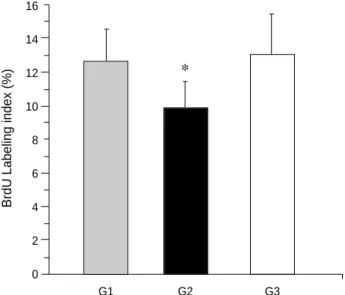
2). Rats administered saline (Groups 4-6) had no ACF in the colon (date not shown). Crypts containing ACF had more BrdU-labeled cells than normal-appearing crypts. Crypts containing ACF in animals fed red ginseng had fewer BrdU- labeled cells than those of animals fed the basal diet. As shown in Fig. 1, the BrdU labeling index was significantly suppressed within ACF in the animals (Group 2) fed the diet with red ginseng. The inhibition was evident along the length of the colon.
DISCUSSION
The present study was undertaken to evaluate red or white ginseng for potential inhibition of ACF formation in the colon, putative preneoplastic lesions (10-12). The results indicate that dietary red ginseng powder exposure during the initiation phase exerts significant inhibition potential.
The colon tumor incidence in rats correlates best with num- bers of large ACF (�4 crypts/focus), which are more likely to persist, increase in size through multiplication (9, 11), and develop into tumors (14). Large ACF are also linked with colon cancer development from the viewpoint of dysplastic change (10, 11), altered proliferative pattern (11), K-ras mutations (32), and DNA adduct formation (33). There- fore, the finding of significant reduction of large ACF (�4 crypts/focus) might point to an effect on tumor yield. Al- though this requires confirmation in a long-term experi- ment, the results provide support for human intervention trials of red ginseng as a cancer-chemopreventive agent.
Ginseng has potent cancer-chemopreventive effects in humans (20, 23, 24, 28). Epidemiological studies have shown that the odds ratios of ginseng consumers are decreased with all kinds of cancers in case-control studies (20, 28). Recent- ly, a prospective study to evaluate the preventive effect of ginseng against lung cancer in humans also revealed a reduced risk with ginseng intake, adjusted for smoking, with no cancer death among 24 red ginseng consumers (29). In the present study, significant decrease of the number of large ACF was not observed in animals given white ginseng pow- der, although total colonic ACF were reduced (Experiment 1). Therefore, the present study indicated that white gin- seng is not as effective as red ginseng at inhibiting DMH- induction of ACF development in the rat colon.
Concerning the effects of red ginseng, Yun and co-workers
Total No. of ACF Treatment
Group No.
No. of
rats 1 crypt 2 crypts 3 crypts ≥4 crypts
1 DMH+WG 10 111.0±22.9 101.4±23.1 8.2±4.4 0.3±0.5 0.1±0.3
2 DMH+RG 10 63.2±19.3* 56.7±16.3* 6.0±4.2* 0.6±0.7 0
3 DMH 10 169.6±80.2 149.5±75.2 13±5.5 0.5±0.7 0.1±0.3
Table 2.Effects of Ginseng on DMH-Induced ACF Formation in the Colons of Rats: Experiment 2a,b
DMH,1,2-dimethylhydrazine; WG, white ginseng; RG, red ginseng; ACF, aberrant crypt foci. a: Values are means±SD; b: Statistical significance is as follows; *, p�0.01 vs. Group 3.
No. of Foci Containing
BrdU Labeling index (%)
16 14 12 10 8 6 4 2
0
G1 G2 G3
Fig. 1. 5-Bromo-2’-deoxyuridine labeling indices in colonic mucos- al crypts within aberrant crypt foci (ACF) in rats fed ginseng or basal diet (Experiment 2) , DMH+white ginseng (Group 1);
, DMH+red ginseng (Group 2); , DMH (Group 3); *, p<0.05 vs. Group 3.
*
(21) carried out extensive animal experiments to investigate whether ginseng inhibited carcinogenesis. They reported that oral administration of red ginseng extract inhibited the incidence and the proliferation of lung tumours induced by various chemical carcinogens in mice. It was considered that the anticarcinogenic mechanism partly involved elevation of natural killer cell activity (34, 35). Matsuda and colleagues (36, 37) reported that red ginseng inhibited formation of pulmonary metastases after infusion of tumor cells into rats and that combined with mitomycin C showed a stronger antitumor effect, with enhanced in vitro cytotoxicity, than the same combination with white ginseng. Moreover, it has been reported that the ability of red ginseng saponins to inhibit lung metastasis of tumor cells in mice is related to inhibition of adhesion and invasion of tumor cells and also to antiangiogenesis (23). In terms of the effect of ginseng on body weight of rats, Table 1 shows no toxic effect of red or white ginseng in the control Groups 6 or 7 compared with Group 8 in Experiments 1 and 2. However, a significant decrease in body weight was noted in Groups 1-3 in Exper- iment 1 and Group 2 in Experiment 2. The decrease in body weight was seen only in groups treated with DMH simultaneously with or before ginseng administration. A possible synergistic effect of ginseng with DMH metabo- lites could affect body weight; therefore, the body weight loss in the present experiment could be a DMH- specific phenomenon.
Ginseng is classified into three types depending on how it is processed: fresh ginseng, white ginseng, and red ginseng.
White ginseng is four to six yr old and dried after peeling;
red ginseng is harvested when it is six yr old and then steamed and dried. The major active components of ginseng are 20 (s)-protopanaxadiol and 20(s)-protopanaxatrial saponins. The specific properties of saponin components of white and red ginseng preparations have been reported (23, 38, 39). Con- sidered to be the major active components (40), saponins have been reported to have antimutagenic activity, inhibit tumor angiogenesis and metastasis (23, 41), reduce growth of several tumor cell lines (42) and human ovarian cancers in nude mice (25, 26), and exert immunomodulating poten- tial (43, 44). The chemical proporties and biological effects of triterpenoid saponin components (ginsenosides) have been widely studied (23, 39, 45, 46). Although red ginseng con- tains other tumor growth-inhibitory substances (47), many investigators have shown that ginsenosides suppress tumor growth and inhibit tumor metastasis (23, 24, 48). Karikura and associates (49, 50) described five and six decomposition products of ginsenoside Rb1 and ginsenoside Rb2, respec- tively, in the rat large intestine after oral administration. It is not known, however, which component of red ginseng has the most profound effect on cancer, and clearly studies focused on this question are of high priority.
Modulation of cell proliferation in ACF and colon epithe- lial cells has been proposed as a mechanism whereby agents
impact on colon cancer (51, 52). BrdU is a good parameter for evaluating cell proliferation, because only S phase cells are labeled, although care in its use is necessary, since BrdU has been classified as a potential carcinogen (53). It should be stressed that the inhibition of cell proliferation, as moni- tored by BrdU LIs, clearly correlates with suppression of ACF development by several chemopreventive agents (54, 55). In the present study, red ginseng reduced the BrdU labeling index of crypt cells. Whether this is the only mech- anism underlying red ginseng actions in our model, how- ever, remains to be determined.
It is noteworthy in this context that red ginseng was effec- tive for inhibition of ACF development during the initiation, but not the promotion, phase. Reduction of ACF number and multiplicity, as well as the relation of cancer chemopre- vention in general to the initiation phase of carcinogenesis, has been discussed in detail (14, 56). Belleli and others (57) showed a 50% decrease in the number of colon tumors in rats receiving 1, 25-(OH)2 vitamin D3before carcinogen admin- istration but found that the same treatment during the ini- tiation or postinitiation phase did not change the tumor inci- dence. Previously, Wattenberg (58) classified carcinogenesis inhibitors according to the phase in which they show inhibito- ry effects in animal models of carcinogenesis: 1) inhibitors of the formation of the active carcinogen itself, 2) blocking agents, which block the carcinogen at the initiation phase, preventing it from reaching or reacting with target sites, and 3) suppressing agents, which suppress the formation of neo- plasia when administered in the postinitiation phase. In our model the formation of ACF was inhibited in rats receiving red ginseng before carcinogen administration and in the ini- tiation phase, suggesting that the agent might influence the formation of active DMH itself and act as a blocking agent.
Metabolic studies are necessary to assess whether this is indeed the case.
ACKNOWLEDGEMENTS AND NOTES
The authors thank Wakunaga Pharmaceutical Co. Ltd., Hiroshima, Japan for supply and advice concerning ginseng.
This work was supported by a grant-in-aid for cancer research from the Ministry of Health and Welfare of Japan.
REFERENCES
1. Shike M, Winawer SJ, Greenwald PH, Bloch A, Hill MJ, Swaroop SV. Primary prevention of colorectal cancer: the WHO Collaborat- ing Centre for Prevention of Colorectal Cancer. Bull World Hlth Org 1990; 68: 377-85.
2. Tajima K, Hirose K, Nakagawa N, Kuroishi T, Tominaga S. Urban- rural difference in the trend of colorectal cancer mortality with spe- cial reference to the subsites of colon cancer in Japan. Jpn J Cancer
Res 1985; 76: 717-28.
3. Potter JD, McMichael AJ. Diet and cancer of the colon and rectum:
a case-control study. J Natl Cancer Inst 1986; 76: 557-69.
4. Mukhtar H, Athor M. Dietary anticarcinogens and cancer preven- tion. Clevel Clin J Med 1988; 55: 507-8.
5. Pozharisski KM, Likhachev AJ, Klimashevski VF, Shaposhnikov JD.
Experimental intestinal cancer research with special reference to human pathology. Adv Cancer Res 1979; 30: 165-237.
6. Druckrey E. Organ-specific carcinogenesis in the digestive tract.
In: Topics in Chemical Carcinogenesis, Nakahara W, Takayama S, Sugimura T, Odashima S, editors, Baltimore Maryland: University Park Press, 1972; 73-101.
7. Bird RP. Role of ACF in understanding the pathogenesis of colon cancer. Cancer Lett 1995; 93: 55-71.
8. McLellan EA, Bird RP. Aberrant crypts: potential preneoplastic lesions in the murine colon. Cancer Res 1988; 48: 6187-92.
9. McLellan EA, Medline A, Bird RP. Dose response and proliferative characteristics of aberrant crypt foci: putative preneoplastic lesions in rat colon. Carcinogenesis 1991; 12: 2093-8.
10. McLellan EA, Bird RP. Aberrant crypts: potential preneoplastic lesions in the murine colon. Cancer Res 1988; 48: 6187-92.
11. McLellan EA, Medline A, Bird RP. Sequential analyses of the growth and morphological characteristics of aberrant crypt foci: putative preneoplastic lesions. Cancer Res 1991; 51: 5270-4.
12. Pretlow TP, O’Riordan MA, Pretlow TG, Stellato TA. Aberrant crypts in human colonic mucosa: putative preneoplastic lesions. J Cell Biochem 1992; 16G (Suppl): 55-62.
13. Pereira MA, Barnes LH, Rassman VL, Kolloff GV, Steele VE. Use of azoxymethane-induced foci of aberrant crypts in rat colon to identify potential cancer chemopreventive agents. Carcinogenesis 1994; 15: 1049-54.
14. Pretlow TP, O’Riordan MA, Somich GA, Amini SB, Pretlow TG.
Aberrant crypts correlate with tumor incidence in F344 rats treated with azoxymethane and phytate. Carcinogenesis 1992; 13: 1509-12.
15. Tanaka T, Mori H. Inhibition of colon carcinogenesis by non-nutri- tive constituents in foods. J Toxicol Pathol 1996; 9: 139-49.
16. Tanaka O, Kasai R. Saponins of ginseng and related plants. In:
Progress in the Chemistry of Organic Natural Products, Herz W, Griesebach H, Kirby GW, Tamm C, editors, New York: Springer- Verlag 46, 1984; 1-76.
17. Shibata S, Tanaka O, Shoji J, Saito H. Chemistry and pharmacolo- gy of panax. In: Economic and Medicinal Plant Research, Wagner H, Hikino H, Farnsworth NR, editors, Tokyo: Academic Press, 1985;
218-84.
18. Tanaka O. Saponin composition of Panax species. In: Recent Advances in Ginseng Studies, Shibata S, Ohtsuka T, Saito H, editors, Tokyo:
Hirokawa Publishing Co., 1990; 43-8.
19. Bhattacharya, SK, Mitra SK. Anxiolytic activity of Panax ginseng roots: an experimental study. J Ethnopharmacol 1991: 34: 87-92.
20. Yun TK, Choi SY. Preventive effect of ginseng intake against vari- ous human cancers: a case-control study on 1987 pairs. Cancer Epidemiol Biomarkers & Prev 1995; 4: 401-8.
21. Yun TK, Yun YS, Han IW. Anticarcinogenic effect of long-term oral administration of red ginseng on newborn mice exposed to var-
ious chemical carcinogens. Cancer Detect Prev 1983; 6: 515-25.
22. Xiaoguang C, Hongyan L, Xiaohong L, Zhaodi F, Yan L, Lihua T, Rui H. Cancer chemopreventive and therapeutic activities of red ginseng. J Ethnopharmacol 1998; 60: 71-8.
23. Mochizuki M, Yoo YC, Matsuzawa K, Sato K, Saiki I, Tono-Oka S, Samukawa K, Azuma I. Inhibitory effects on tumor metastasis in mice by saponins, ginsenoside-Rb2, 20(R)-and 20(S)-ginsenoside- Rg3. of red ginseng. Biol Pharm Bull 1995; 18: 1197-202.
24. Sato K, Mochizuki M, Saiki I, Yoo YC, Samukawa K, Azuma I.
Inhibition of tumor angiogenesis and metastasis by a saponin of panax ginseng, ginsenoside-Rb2. Biol Pharm Bull 1994; 17: 635-9.
25. Tode T, Kikuchi Y, Kita T, Hirata J, Imaizumi E, Nagata I. Inhibito- ry effects by oral administration of ginsenoside Rh2 on the growth of human ovarian cancer cells in nude mice. J Cancer Res Clin Oncol 1993; 120: 24-6.
26. Nakata H, Kikuchi Y, Tote T, Hirata J, Kita T, Ishii K, Kudoh K, Nagata I, Shinomiya N. Inhibitory effects of ginsenoside Rh2 on tumor growth in nude mice bearing human ovarian cancer cells.
Jpn J Cancer Res 1998; 89: 733-40.
27. Yun TK, Kim SH, Lee YS. Trial of a new medium-term model using benzo(a)pyrene induced lung tumor in newborn mice. Anticancer Res 1995; 15: 839-45.
28. Yun TK, Choi SY. A case-control study of ginseng intake and can- cer. Int J Epidemiol 1990; 19: 871-6.
29. Yun TK, Choi SY. Non-organ specific cancer prevention of ginseng:
a prospective study in Korea. Int J Epidemiol 1998; 27: 359-64.
30. Li W, Wanibuchi H, Salim EI, Wei M, Yamamoto S, Nishino H, Fukushima S. Inhibition by ginseng of 1,2-dimethylhydrazine induc- tion of aberrant crypt foci in the rat colon. Nutr Cancer 2000; 36:
66-73.
31. Hsu SM, Raine L, Fager H. Use of avidin-biotin-peroxidase complex (ABC) in immunoperoxidase techniques: a comparison between ABC and unlabeled antibody (PAP) procedures. J Histochem Cytochem 1981; 29: 577-80.
32. Shivapurkar N, Tang Z, Ferreira A, Nasim S, Garett C, Alabaster O.
Sequential analysis of K-ras mutations in aberrant crypt foci and colonic tumors induced by azoxymethane in F344 rats on high-risk diet. Carcinogenesis 1994; 15: 775-8.
33. Qin X, Zarkovic M, Nakatsuru Y, Arai M, Oda H, Ishikawa T. DNA adduct formation and assessment of aberrant crypt foci in vivo in the rat colon mucosa after treatment with N-methyl-N-nitrosourea.
Carcinogenesis 1994; 15: 851-5.
34. Yun TK, Kim SH. Inhibition of development of benzo(a)pyrene- induced mouse pulmonary adenoma by several natural products in a medium-term bioassay system. J Korean Cancer Assoc 1988; 20:
133-42.
35. Yun YS, Moon HS, Oh YR, Jo SK, Kim YG, Yun TK. Effect of red ginseng on natural killer cell activity in mice with lung adenoma induced by urethan and benzo(a)pyrene. Cancer Detect Prev 1987;
1(suppl): 301-9.
36. Matsuda H, Tong CN, Kubo M. Pharmacological study on Panax ginseng C.A. MEYER. XIV. Effect of 70% methanolic extract from red ginseng on the cytocidal effect of mitomycin C against rat ascites hepatoma AH 130. Yakugaku Zasshi (Jap) 1992; 112: 846-55.
37. Tong CN, Matsuda H, Kubo M. Pharmacological study on Panax ginseng C.A. MEYER. XIV. Effect of 70% methanolic extract from red and white ginseng on the antitumor activity of mitomycin C.
Yakugaku Zasshi (Jap) 1992; 112: 856-65.
38. Kitagawa I, Yoshihara M, Yoshihara M, Hayashi T, Taniyama T.
Chemical studies of crude drugs (1). Constituents of Ginseng radix rubra. Yakugaku Zasshi (Jap) 1983; 103: 612-22.
39. Liu CX, Xiao PG. Recent advances on ginseng in China. J Ethnophar- macol 1992; 36: 27-38.
40. Ota T, Maeda M, Odashima S. Mechanism of action of ginsenoside Rh 2: uptake and metabolism of ginsenoside Rh 2 by cultured B16 melanoma cells. J Pharm Sci 1991; 80: 1141-6.
41. Umnova NV, Michurina TL, Smirnova NI, Aleksandrova IV, Poroshenko GG. Study of antimutugenic properties of Bio-ginseng in mammalian cells in vitro and vivo. Bull Exp Biol Med 1991; 111:
507-9.
42. Matsunaga H, Katano M, Yamamoto H, Mori M, Takat K. Studies on the panaxttriol of Panax ginseng C.A. Meyer. isolation, determi- nation and antitumor activity. Chem Pharm Bull 1989; 37: 1279- 81.
43. Kenarova B, Neychev H, Hadjiivanova C, Petkov VP. Immunomod- ulating activity of ginsenoside Rg1 from Panax ginseng. Jpn J Phar- macol 1990; 54: 447-54.
44. Kim JY, Germolec DR, Luster MI. Panax ginseng as a potential immunomodulator: studies in mice. Immunopharmacol Immunotox- icol 1990; 12: 257-76.
45. Jeong TC, Kim HJ, Park JI, Ha CS, Park JD, Kim SI, Roh JK. Pro- tective effects of red ginseng saponins against carbon tetrachloride- induced hepatotoxicity in Sprague Dawley rats. Planta Med 1997;
63: 136-40.
46. Ota T, Fujikawa-Yamamoto K, Zong ZP, Yamazaki M, Odashima S, Kitagawa I, Abe H, Arichi S. Plant-glycoside modulation of cell surface related to control of differentiation in cultured B16 melanoma cells. Cancer Res 1987; 47: 3863-7.
47. Matsunaga H, Katano M, Yamamoto H, Mori M, Takata K. Deter- mination of panaxytriol, a new type of tumour growth inhibitor from Panax ginseng, by capillary gas chromatography. J Chromatogr 1989; 481: 368-72.
48. Kikuchi Y, Sasa H, Kita T, Hirata T, Tode T, Nagata I. Inhibition of human ovarian cancer cell proliferation in vitro by ginsenoside Rh 2 and adjuvant effects to cisplatin in vivo. Anti-cancer Drugs 1991; 2:
63-7.
49. Karikura M, Miyase T, Tanizawa H, Takino Y, Taniyama T, Hayashi T. Studies on absorption, distribution, excretion and metabolism of ginseng saponins. V. The decomposition products of ginsenoside Rb 2 in the large intestine of rats. Chem Pharm Bull Tokyo 1990; 38:
2859-61.
50. Karikura M, Miyase T, Tanizawa H, Taniyama T, Takino Y. Stud- ies on absorption, distribution, excretion and metabolism of ginseng saponins. VII. Comparison of the decomposition modes of ginseno- side-Rb 1 and -Rb 2 in the digestive tract of rats. Chem Pharm Bull Tokyo 1991; 39: 2357-61.
51. Tanaka T, Kawabata K, Kakumoto M, Makita H, Hara A, Mori H, Satoh K, Hara A, Murakami A, Kuki W, Takahashi Y, Yonei H, Koshimizu K, Ohigashi H. Citrus auraptene inhibits chemically induced colonic aberrant crypt foci in male F344 rats. Carcinogen- esis 1997; 18: 2155-61.
52. Barsoum GH, Hendrickse C, Winslet MC, Youngs D, Donovan IA, Neoptolemos JP, Keighley MR. Reduction of mucosal crypt cell proliferation in patients with colorectal adenomatous polyps by dietary calcium supplementation. Br J Surg 1992; 79: 581-3.
53. Coltrera MD, Gown AM. PCNA/cyclin expression and BrdU uptake define different subpopulations in different cell lines. J Histochem Cytochem 1991; 39: 23-30.
54. Kawamori T, Tanaka T, Ohnishi M, Hirose Y, Nakamura Y, Satoh K, Hara A, Mori H. Chemoprevention of azoxymethane-induced colon carcinogenesis by dietary feeding of S-methyl methane thio- sulfonate in male F344 rats. Cancer Res 1995; 55: 4053-8.
55. Tanaka T, Kawamori T, Ohnishi M, Makita H, Mori H, Satoh K, Hara A. Suppression of azoxymethane-induced rat colon carcino- genesis by dietary administration of naturally occurring xanthophylls astaxanthin and canthaxanthin during the postinitiation phase. Car- cinogenesis 1995; 16: 2957-63.
56. Kawamori T, Tanaka T, Suzuki M, Okamoto K, Tamai Y, Torihara M, Yamahara J, Mori H. Chemoprevention of azoxymethane-induced intestinal carcinogenesis by a novel synthesized retinoidal buteno- lide, 5-hydroxy-4-(2-phenyl-(E)-ethenyl)-2 (5H)-furanone, in the rat. Carcinogenesis 1995; 16: 795-800.
57. Belleli A, Shany S, Levy J, Guberman R, Lamprecht SA. A protec- tive role of 1, 25-dihydroxyvitamin D3 in chemically induced rat colon carcinogenesis. Carcinogenesis 1992; 13: 2293-8.
58. Wattenberg LW. Chemoprevention of cancer. Cancer Res 1985;
45: 1-8.