INTRODUCTION
Fibromyalgia (FM) is a chronic pain condition of unknown etiology, with an estimated prevalence rate of 2% (1). It is characterized by diffuse pain, fatigue, disturbed sleep, the presence of tender points, and functional impairment (2).
The assessment of health status and physical functioning is essential in patients with rheumatic disease and has become an important approach in evaluating outcomes (3, 4). Health status instruments, such as the Health Assessment Question- naire (HAQ) (5), the Arthritis Impact Measurement Scale (AIMS) (6), and their various modifications, as well as the Fibromyalgia Impact Questionnaire (FIQ) (7) are widely accepted forms for evaluating the clinical severity of disease (8) and the efficacy of different interventions in patients with FM (9).
The FIQ was developed by Burckhardt et al. (7) to assess the current health status of women with FM. The FIQ is a 10-item self-administered instrument that measures physical functioning, work status, depression, anxiety, sleep, pain, stiffness, fatigue, and well-being. The FIQ has been trans- lated into many languages, and these versions have shown metric properties, reliability, and validity that are comparable to the original version (10-13).
The aim of this study was to translate the FIQ into Korean
and to evaluate its reliability and validity for use with Korean- speaking patients with FM.
MATERIALS AND METHODS Subjects
Included in this study were 55 patients of the Department of Internal Medicine at Chonnam National University Hos- pital, Gwangju, Korea, who had FM and satisfied The Ameri- can College of Rheumatology 1990 Criteria for the Classifi- cation of Fibromyalgia (2). Demographic and clinical char- acteristics, including age, marital status, education level, and duration of symptoms of FM were documented.
Clinical severity
Visual analog scales (VAS) were used by each patient to evaluate current levels of pain, morning stiffness, fatigue, depression, anxiety, global well-being, impact on life, and disease severity. The items were scored from 0 to 10, with 10 denoting the worst possible condition. Tender-point exami- nation was carried out by applying a uniform amount of manual finger pressure, until the fingernail bed blanched, on
Yun-A Kim, Shin-Seok Lee, Kyeongsoo Park*
Department of Internal Medicine, Chonnam National University Medical School, Gwangju; Research Information Center for Health*, Chonnam National University, Gwangju, Korea
Address for correspondence Shin-Seok Lee, M.D.
Division of Rheumatology, Department of Internal Medicine, Chonnam National University Medical School, 8 Hak-dong, Dong-gu, Gwangju 501-757, Korea
Tel : +82.62-220-6591, Fax : +82.62-225-8578 E-mail : [email protected]
220
Validation of a Korean Version of the Fibromyalgia Impact Questionnaire
The aim of this study was to translate the Fibromyalgia Impact Questionnaire (FIQ) into Korean and to evaluate its reliability and validity for use with Korean- speaking patients with fibromyalgia (FM). After translating the FIQ into Korean, we administered it to 55 patients with FM (28 patients filled out the questionnaire again 7 days later) together with a Korean version of the Health Assessment Questionnaire (HAQ) and the Symptom Checklist-90-Revision (SCL-90-R). The tender-point count (TPC) was calculated from tender points identified by thumb palpation. In addition to sociodemographic characteristics, the severity of relevant current clinical symptoms, e.g., pain intensity, fatigue, and morning stiffness, were assessed by 10-cm visual analog scales (VAS). The test-retest reliability was between 0.466 and 0.780 (total 0.778). Cronbach's alpha was 0.800 for FIQ1 (the first assessment) and 0.857 for FIQ2 (the second assessment), indicating acceptable levels of internal consistency for both assessments. Significant cor- relations were obtained between the FIQ items, the HAQ, the severity of clinical symptoms, and the subscales of the SCL-90-R. In conclusion, the Korean ver- sion of the FIQ is a reliable and valid instrument for measuring health status and physical functioning in Korean patients with FM.
Key Words : Fibromyalgia; Questionnaires; Validity
Received : 2 January 2002 Accepted : 28 January 2002
each of nine paired anatomical locations. Definite tenderness at any point was considered present if some involuntary ver- bal or facial expression of pain was noted or if a wince or with- drawal was observed. The tender-point count (TPC) was cal- culated by summing the number of these tender points.
Translation of the FIQ
The original FIQ contains 19 questions grouped into 10 items. The first item contains 10 sub-items and focuses on the patient's ability to perform daily tasks involving large muscles (i.e., cooking, cleaning, walking, shopping, home- making, socializing, mobility, etc.). The responses are scaled in a Likert format, from “0=always able to perform", to “3=
never able to perform". The ten sub-items are added together and divided by the number of valid scores to yield one physi- cal-functioning score. In the subsequent two FIQ items, the patient is asked to circle the number of days in the past week that they felt good and how often they missed work. The last seven items - the ability of patients to do their job, pain, fatigue, morning tiredness, stiffness, anxiety, and depression - are all measured by 100-mm anchored horizontal visual analogue scales (VAS). Each item is standardized on a scale ranging from 0 to 10, with 10 indicating greater impairment.
The FIQ was translated into Korean by three translators, in- cluding one of the authors, and back-translated by three dif- ferent translators. Four questions were changed because of cultural differences. In the physical functioning ability score, the phrase “make a bed" was changed to “prepare a mattress", since beds are not popular in Korea. “Walk several blocks"
was changed to “walk more than one kilometer". We use the metric system and chose kilometer since it is commonly understood, even though it is one block longer. “Do yard work" was changed to “work in the fields", since people in Korea usually live in houses without gardens. “Drive a car"
was changed to “drive a car or a bicycle", since the number of women who drive cars is lower in Korea than in western countries. During the translation process, the questionnaire was tested on a large number of FM patients, but the results are not presented in this study.
The retest was performed one week after the original test.
The first assessment was done by patients while they visited
the clinic, and the second FIQ was done by mail one week after the visit. During that week, no intervention was given.
Health Assessment Questionnaire (HAQ)
Patient-reported assessments of current functional limita- tions were collected with the HAQ. The HAQ is a self-admin- istered disability instrument developed for patients with rheumatoid arthritis, and it is used to compare the disabili- ties of patients with different rheumatic diseases and FM.
The HAQ has been translated into numerous languages, in- cluding a valid and reliable Korean-language version (14).
Symptom Checklist-90-Revision (SCL-90-R)
This scale includes 90 items that measure 9 clinical sub- scales and was developed as a measure of general psychiatric symptom severity and as a descriptive measure of psycho- pathology (15). On a 5-point Likert scale, subjects report the degree to which they have been distressed by symptoms in the past month. The scale has been extensively used and vali- dated in Korean (16).
Statistical analysis
Test-retest reliability was assessed using Spearman correla- tions, and internal consistency was evaluated with Cronbach’s alpha coefficient of reliability. Construct validity was evalu- ated by correlating the FIQ items with the severity of clini- cal symptoms (VAS), the TPC, the HAQ, and the subscales of the SCL-90-R. Statistical analysis was performed using SPSS for Windows (Version 10.0; SPSS, Chicago, IL, U.S.A.).
RESULTS
Descriptive analyses of the demographic and clinical charac-
Age (yr) 44.2±12.9 40.0±11.4
Education (yr) 10.2±4.7 11.8±4.1
Symptom duration (yr) 7.5±7.1 6.3±5.5 Disease duration (yr) 0.6±0.9 0.6±0.6 Income (×10,000 won per month) 136.2±85.6 144.6±84.5
Total (n=55) Retest (n=28) Table 1. Descriptive analysis of demographic and clinical parameters
Data are presented as mean±SD.
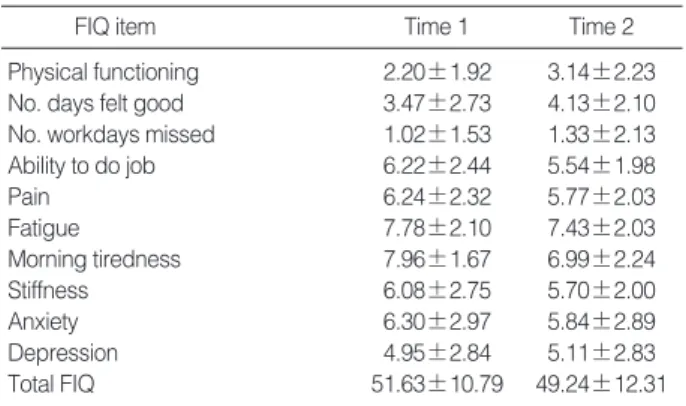
Physical functioning 2.20±1.92 3.14±2.23 No. days felt good 3.47±2.73 4.13±2.10 No. workdays missed 1.02±1.53 1.33±2.13 Ability to do job 6.22±2.44 5.54±1.98
Pain 6.24±2.32 5.77±2.03
Fatigue 7.78±2.10 7.43±2.03
Morning tiredness 7.96±1.67 6.99±2.24
Stiffness 6.08±2.75 5.70±2.00
Anxiety 6.30±2.97 5.84±2.89
Depression 4.95±2.84 5.11±2.83
Total FIQ 51.63±10.79 49.24±12.31
Time 1
FIQ item Time 2
Data are presented as mean±SD.
Table 2. Mean score and standard deviation of each Korean FIQ item (scale 0-10) and the total Korean FIQ score
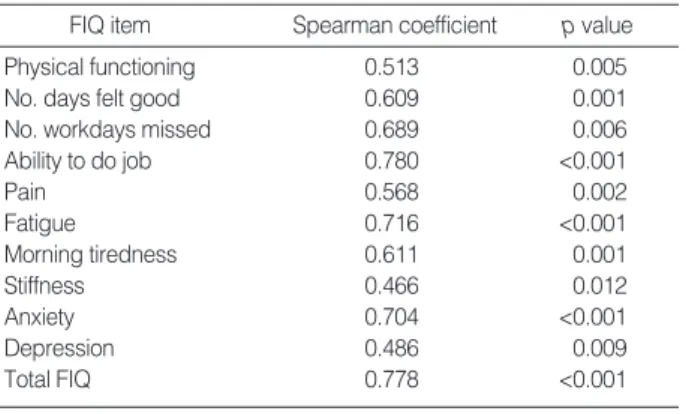
teristics of the patients are shown in Table 1. The mean age of the 55 patients was 44.2 yr (range, 16-62 yr) and the mean disease duration was 0.6 yr (range, 0-2 yr). Twenty-eight pa- tients answered the FIQ again one week after the first admin- istration. Mean values (SD) for FIQ1 (the first assessment) and FIQ2 (the second assessment) were 51.63 (10.79) and 49.24 (12.31), respectively (Table 2). The test-retest relia- bility was between 0.466 and 0.780 (total, 0.778) for the physical functioning component as well as for the total FIQ and the other components (Table 3). Cronbach's alpha was 0.800 for FIQ1 and 0.857 for FIQ2, indicating acceptable levels of internal consistency for both assessments.
The correlations between FIQ items and the HAQ, the TPC, and the anxiety and depression subscales of the SCL- 90-R are summarized in Table 4. There were statistically significant correlations between the total HAQ score and scores on the physical functioning component of the FIQ and total FIQ. Substantial correlations (p<0.01) were obtained between the anxiety and depression subscales of the SCL- 90-R and the anxiety and depression items on the FIQ, with correlation coefficients of 0.432 and 0.373, respectively. Cor- relations between the TPC and the FIQ items and the total
FIQ were rather low, ranging from -0.043 to 0.486. Only the items that addressed the ability of patients to do their job (0.331), fatigue (0.486), morning tiredness (0.294), and the total FIQ (0.433) reached statistical significance (p< 0.05).
Correlations between the FIQ items and the severity of cur- rent FM symptoms (VAS) are summarized in Table 5. Most of the items were moderately correlated with almost all cur- rent FM symptoms.
DISCUSSION
Physicians have been urged to do more research on FM pathophysiology and treatment. We need a valid and reliable instrument to communicate in the same terms while measur- ing the status, progress, and outcome of patients with FM, and to compare the results of different trials. In this study, a Korean version of the FIQ was found to be valid and reliable when used in clinical care and research. The translation of an instrument from one language to another usually presents problems, especially if the culture and socioeconomic char-
Physical functioning 0.513 0.005
No. days felt good 0.609 0.001
No. workdays missed 0.689 0.006
Ability to do job 0.780 <0.001
Pain 0.568 0.002
Fatigue 0.716 <0.001
Morning tiredness 0.611 0.001
Stiffness 0.466 0.012
Anxiety 0.704 <0.001
Depression 0.486 0.009
Total FIQ 0.778 <0.001
Spearman coefficient
FIQ item p value
Table 3. Test-retest reliability coefficients (Spearman) for the Korean FIQ
Physical functioning -0.020 0.497� No. days felt good 0.265 0.345� No. workdays missed -0.043 0.427� Ability to do job 0.331* 0.552�
Pain 0.211 0.558�
Fatigue 0.486� 0.210
Morning tiredness 0.294* 0.019
Stiffness 0.200 0.259
Anxiety 0.168 0.037 0.432�
Depression 0.241 0.150 0.373�
Total FIQ 0.433� 0.390�
TPC HAQ
FIQ item SCL-90-R
Table 4. Test of the validity of the FIQ (n=55): Spearman cor- relation coefficients between scores for the FIQ items and for the HAQ, the TPC, and the subscales of the SCL-90-R
*p<0.05, �p<0.01.
Physical functioning 0.006 0.216 0.140 0.224 0.170 0.119 0.198 0.111 0.195
No. days felt good 0.458� 0.353� 0.375� 0.498� 0.338* 0.401� 0.386� 0.346� 0.548�
No. workdays missed 0.018 0.232 0.107 0.213 0.066 0.262 0.048 0.129 0.124
Ability to do job 0.473� 0.451� 0.398� 0.438� 0.413� 0.480� 0.602� 0.597� 0.585�
Pain 0.616� 0.664� 0.226* 0.318* 0.337* 0.544� 0.672� 0.592� 0.610�
Fatigue 0.438� 0.398� 0.704� 0.598� 0.380� 0.525� 0.373� 0.391� 0.640�
Morning tiredness 0.049 0.319* 0.461� 0.237 0.132 0.219 0.312* 0.294* 0.297*
Stiffness 0.391� 0.668� 0.325* 0.355� 0.414� 0.580� 0.583� 0.618� 0.620�
Anxiety 0.183 0.180 0.373� 0.558� 0.767� 0.364� 0.258 0.353� 0.535�
Depression 0.140 0.313* 0.393� 0.714� 0.692� 0.335* 0.195 0.309* 0.544�
Total FIQ 0.515� 0.664� 0.628� 0.779� 0.702� 0.672� 0.635� 0.662� 0.874�
FIQ item Pain Morning Fatigue Depression Anxiety Total VAS
stiffness
Global well-being
Impact on life
Disease severity
Table 5. Test of the validity of the FIQ (n=55): Spearman correlation coefficient between the FIQ items and current FM symptoms
*p<0.05, �p<0.01. VAS: visual analog scales.
acteristics of the populations differ. To adapt the FIQ to Kore- an culture, we modified several questions. In this study, the mean of the total FIQ score was 51.63 for the initial assess- ment and 49.24 for the second assessment. These scores were somewhat higher than those reported by Burckhardt et al. (7), whose total score was 48.1, and Offenbaecher et al. (12), whose total score was 46.1. The sub-scores obtained for “fatigue”
and “morning tiredness”were high in our trial. These ele- vated sub-scores might have increased the total score.
The test-retest reliabilities for items on the physical func- tioning component and for the overall FIQ score were 0.513 and 0.778, respectively. In cross-cultural adaptations of the FIQ for Swedish, Hebrew, German, and Turkish populations (10-13), test-retest correlations for the FIQ of 0.62 to 1.00 have been reported. Our test-retest reliability was somewhat less than that of others, but was still respectable. Internal consistency was found to be high for both assessments (0.800 for FIQ1 and 0.857 for FIQ2). This level of consistency is similar to that reported by Sarmer et al. (13), who reported internal consistencies of 0.72 and 0.73, and Buskila et al. (11), who reported internal consistencies of 0.93 and 0.86. Thus, this scale is a coherent, additive instrument, in which an aver- age score for the individual items in each subscale has mean- ing.
Construct validity was evaluated by correlating the FIQ items with the severity of clinical symptoms (VAS), the TPC, the HAQ, and the subscales of the SCL-90-R. Using the HAQ as the gold standard for evaluating the disability of patients with rheumatic diseases, we found substantial cor- relations between the total HAQ score and scores on the physi- cal functioning component, as well as the total FIQ. How- ever, the items for fatigue, morning tiredness, stiffness, anx- iety, and depression did not correlate with the HAQ. For the original FIQ, Burckhardt et al. (7) found a higher correlation between the FIQ and the AIMS. The AIMS has more specif- ic subscales, including pain, depression, and anxiety, where- as the HAQ assesses difficulties and disabilities in basic activi- ties of daily life and does not deal with those areas. There- fore, the HAQ may not be a valid indicator of health status in patients with FM. The anxiety and depression items of the FIQ correlated significantly with the anxiety and depression subscale of the SCL-90-R, demonstrating satisfactory con- struct validity in the psychological components of the trans- lated FIQ. The correlation between clinical severity parame- ters, such as pain intensity, morning stiffness and fatigue, and the FIQ was found to be moderate to high, supporting the construct validity of the Korean version of the FIQ. Similar results have been reported by other authors for translations of the FIQ into other languages (10-13). The relationship between the TPC and the FIQ items was lower than for other clinical parameters. In the Hebrew validation study (11), the correlations between the TPC and the FIQ items ranged from 0.24 to 0.57, and the correlations between the FIQ
items and dolorimetry measurements were even higher than with the TPC, ranging from 0.25 to 0.65. Our findings might have been related to low correlations between “subjective”
and “objective”parameters. In addition, this difference might be related to the fact that the mean on the TPC for our pa- tients was 11.40, and our patients might not have been as severely affected as the Hebrew-speaking patients.
In conclusion, the Korean version of the FIQ is a reliable and valid instrument for measuring health status and physi- cal functioning in Korean patients with FM.
REFERENCES
1. Wolfe F, Ross K, Anderson J, Russell IJ, Hebert L. The prevalence and characteristics of fibromyalgia in the general population. Arthri- tis Rheum 1995; 38: 19-28.
2. Wolfe F, Smythe HA, Yunus MB, Bennett RM, Bombardier C, Goldenberg DL, Tugwell P, Campbell SM, Abeles M, Clark P, Fam AG, Farber SJ, Fiechtner JJ, Franklin CM, Gatter RA, Hamaty D, Lessard J, Lichtbroun AS, Masi AT, McCain GA, Reynolds WJ, Romano TJ, Russell IJ, Sheon RP. The American College of Rheuma- tology 1990 Criteria for the Classification of Fibromyalgia. Report of the Multicenter Criteria Committee. Arthritis Rheum 1990; 33:
160-72.
3. Bell MJ, Bombardier C, Tugwell P. Measurement of functional sta- tus, quality of life, and utility in rheumatoid arthritis. Arthritis Rheum 1990; 33: 591-601.
4. Meenan RF, Pincus T. The status of patient status measures. J Rheu- matol 1987; 14: 411-4.
5. Fries JF, Spitz P, Kraines RG, Holman HR. Measurement of patient outcome in arthritis. Arthritis Rheum 1980; 23: 137-45.
6. Meenan RF, Gertman PM, Mason JH. Measuring health status in arthritis. The arthritis impact measurement scales. Arthritis Rheum 1980; 23: 146-52.
7. Burckhardt CS, Clark SR, Bennett RM. The fibromyalgia impact questionnaire: development and validation. J Rheumatol 1991; 18:
728-33.
8. Hawley DJ, Wolfe F. Pain, disability, and pain/disability relation- ships in seven rheumatic disorders: a study of 1,522 patients. J Rheu- matol 1991; 18: 1552-7.
9. Burckhardt CS, Mannerkorpi K, Hedenberg L, Bjelle A. A random- ized, controlled clinical trial of education and physical training for women with fibromyalgia. J Rheumatol 1994; 21: 714-20.
10. Hedin PJ, Hamne M, Burckhardt CS, Engstrom-Laurent A. The Fibromyalgia Impact Questionnaire, a Swedish translation of a new tool for evaluation of the fibromyalgia patient. Scand J Rheumatol 1995; 24: 69-75.
11. Buskila D, Neumann L. Assessing functional disability and health status of women with fibromyalgia: validation of a Hebrew version of the Fibromyalgia Impact Questionnaire. J Rheumatol 1996; 23:
903-6.
12. Offenbaecher M, Waltz M, Schoeps P. Validation of a German ver-
APPENDIX The Korean version of the FIQ sion of the Fibromyalgia Impact Questionnaire (FIQ-G). J Rheuma- tol 2000; 27: 1984-8.
13. Sarmer S, Ergin S, Yavuzer G. The validity and reliability of the Turkish version of the Fibromyalgia Impact Questionnaire. Rheuma- tol Int 2000; 20: 9-12.
14. Bae SC, Cook EF, Kim SY. Psychometric evaluation of a Korean Health Assessment Questionnaire for clinical research. J Rheuma-
tol 1998; 25: 1975-9.
15. Derogatis LR, Rickels K, Rock. The SCL-90 and the MMPI: a step in the validation of a new self-report scale. Br J Psychiatry 1976;
128: 280-9.
16. Kim KI, Kim JH, Won HT. Korean Manual of Symptom Checklist- 90-revision, Seoul, Chung Ang Aptitude Publishing Co., 1984.
1. 다음을 할 수 있습니까?
항상 대부분 가끔 절대못함
1) 장보기 _0 _1 _2 _3
2) 세탁기로 빨래하기 _0 _1 _2 _3
3) 식사준비하기 _0 _1 _2 _3
4) 설거지 _0 _1 _2 _3
5) 진공청소기로 청소하기 _0 _1 _2 _3
6) 잠자리 준비하기 _0 _1 _2 _3
7) 1km정도 걷기 _0 _1 _2 _3
8) 친구 또는 친척 방문하기 _0 _1 _2 _3
9) 들일하기 _0 _1 _2 _3
10) 자동차나 자전거 운전하기 _0 _1 _2 _3
2. 지난 일주일동안 좋게 느껴진 날이 며칠인가요?
0 1 2 3 4 5 6 7
3. 지난 일주일동안 섬유조직염 때문에 일을 못나간 것은 며칠이었 습니까? (밖에서 하는 직업이 없으면 답하지 마시오.)
0 1 2 3 4 5 6 7
4. 일을 할 때 섬유조직염으로 인한 통증 또는 다른 증상으로 일에 얼마나 지장이 있었습니까?
아무 문제없음 대단히 힘들었음
5. 통증은 얼마나 심했습니까?
통증 없음 매우 심한 통증
6. 얼마나 피곤했습니까?
피곤함이 없었다 매우 피곤했다
7. 아침에 일어날 때 기분이 어떠했습니까?
상쾌했다 매우 피곤했다
8. 뻣뻣함이 얼마나 심했습니까?
없었다 매우 뻣뻣했다
9. 긴장되거나, 신경이 예민해지거나 또는 불안해 하는 것을 얼마 나 느꼈습니까?
없었다 매우 긴장되었다
10. 우울하거나 기분이 언짢은 것은 얼마나 느꼈습니까?
없었다 매우 우울했다