INTRODUCTION
Republic of Korea does not yet have a universal criterion for disability evaluation. In order to develop a single reason- able and consistent criterion that could be widely accepted across the nation, eleven committees for each medical special- ty were recruited under the supervision of Korean Academy of Medical Sciences (KAMS): cardiopulmonary, digestive, en- docrine, extremities, genitourinary, nervous system, pediatric development, psychiatric, skin & appearance, special sense, and spine. Each committee consisted of about ten specialists.
Since both disability and developing disability evaluation are social processes in the sense that they are formed and changed by social norms and values, the steering committee developed a series of strategies from the very beginning that would help the evaluation criterion to be accepted as legitimate by major- ity of society. Unfortunately due to the lack of time and bud- get, however, the strategies could not be fully exercised. We plan to apply our strategies more fully in the next year with more money and time available. This paper introduces this series of strategies in order to share Korean experience.
Disability and disability evaluation as social processes
As widely acknowledged, in order for a certain impairment to be recognized as a disability, it must constrain a person in a way that substantially limits the activity, especially in rela- tion to employment or education. In other words, a person with same impairment could be disabled or non-disabled, de- pending on time and space where he or she lives in. For exam- ple, substantial leg impairment could be fatal in a pre-mod- ern society, but it is now much less critical in modern society where a variety of transportation tools are available. Also un- der the strong emphasis of the social value on facial appear- ance, some big permanent scars on face could lead to disabil- ity. Disability is the combined product of impairment and di- verse social environments, including technology, social norms, and cultural values. Because of this social process of disabili- ty, we need to consider and even incorporate social norms and values of the current society when we evaluate disability.
Furthermore, social environment where impairment is em- bedded is not a single constant entity. Social values are con- stantly changing and also vary across societies or even groups
S242
Yoosik Youm1, Mi-Jin Lee2, and Sun-Chul Hwang3
Department of Sociology1, Yonsei University, Seoul;
Graduate Program in Medical Law and Ethics2, Yonsei University, Seoul; Department of Neurosurgery3, College of Medicine, Soonchunhyang University, Bucheon, Korea
Address for correspondence Yoosik Youm, M.D.
Department of Sociology, Yonsei University, 262 Seongsan-ro, Seodaemun-gu, Seoul 120-749, Korea Tel : +82.2-2123-2431, Fax : +82.2-2123-2420 E-mail : [email protected]
*This work has been supported by the department of sociology, Yonsei University Institute of “Social Subsumption and Exclusion”, a Brain Korea 21 program, Korea.
DOI: 10.3346/jkms.2009.24.S2.S242
Consensus Making Process in the Korean Academy of Medical Sciences Guideline for Physical Impairment: Evaluation as a Social Process
The steering committee of the Korean Academy of Medical Sciences Guideline for Physical Impairment was fully aware of the social processes of disability evaluation from the beginning and thus, developed a series of strategies to examine and incor- porate social property of the evaluation into the evaluation guide. Although those strategies could not be implemented to full extent because of lack of budget and time, we believe it worthwhile to share those in this paper as an example of gener- al framework for developing disability evaluation. A series of strategies will be intro- duced and discussed that views the evaluation process as social per se, and pro- pose a scheme that is designed to obtain growing legitimacy starting from core ex- perts to expanded experts to general public. Also preliminary analyses on surveys of public attitude and experts’ opinion with regard to the relative importance of each possible disability revealed the following three facts: 1) Public had difficulty weighing relative importance of many impairments. 2) Regarding some impairments includ- ing complex regional pain syndrome many doctors had varied opinions. 3) Public attitude did not always consistent with doctor’s opinion. All these findings strongly suggest the need for developing strategies to draw consensus for legitimate and effective evaluation.
Key Words : Disability Evaluation; Social Process; Consensus
Received : 6 April 2009 Accepted : 30 April 2009
within one society. Thus, social surroundings of impairment must be recognized as an entity with fractured and diverse aspects rather than one simple universe. Considering this so- cial characteristic of disability, the best strategy would be to incorporate diverse and even conflicting values and pressures from the beginning of the evaluation rather than treat them as a separate entity from the evaluation. The KAMS guide tried to adopt a series of strategies based on this viewpoint.
Before we introduce those strategies, however, let me con- tinue the debate on the social process of the evaluation pro- cedure itself.
Disability evaluation in practice consists of a series of eval- uations and re-evaluations. First, it should start from a small number of specialists. KAMS started with about ten people in each specialty. Let’s call this group of medical specialist as core experts. But in many cases, this first step alone is not en- ough for successful evaluation procedure for two reasons. For any specialty field, there usually exist some vague grey areas that call for judgment call. Thus, the best approach might be to bring those unresolved issues to a bigger number of spe- cialists: expanded experts. Also, expanded experts are necessary to obtain stronger legitimacy. Even if core experts could pro- duce objective and scientific criteria to the full extent, as we discussed above, criteria themselves are social product, and thus, they need to be shared as many social members as pos- sible to gain strong legitimacy and widely adopted by many experts later.
Second step would be, as we discussed above, to form a team of expanded experts. Depending on the magnitude of unre- solved grey areas among core experts, the size of expanded experts should be determined. However, more critical issue here is how to recruit the members of expanded experts. The goal of forming core experts is not to obtain a representative sample of experts, but to recruit top experts to build up eval- uation criterion. However, the reason we need expanded ex- perts is different. We need a representative sample of experts as much as possible, because unresolved issues among core ex- perts are not of technique but of social value or customs in many cases. Especially, considering legitimacy issue that could be critical once the evaluation criteria announced, the repre- sentativeness of the expanded experts is essential. Usually, there is no simple universal way of obtaining representative sample of medical experts and we will discuss this more later.
The last step could be to probe and incorporate public opin- ions in various active ways. Since this last step usually is not considered as a part of evaluation process, we will discuss this later in detail.
MATERIALS AND METHODS Consensus among core experts
The important issue regarding core experts is not the recruit-
ment. Usually, it could be done by recommendation of top experts or appointment by an official national medical asso- ciation. Once recruited, however, the consensus is the key to the successful evaluation procedure. Because of the nature of the evaluation, if possible, consensus instead of majority rule would be much more desirable.
Reaching a consensus poses two difficult challenges. First, it usually requires a moderator. However, it is hard to find a perfect moderator who can balance between every different or even conflicting views. Especially, expert committees like this also need an expert of the same field as a moderator, which makes him or her uneasy to act in a neutral way. Second, reach- ing a consensus needs more time and efforts than majority voting. Although consensus usually gives more satisfaction among participants, we sometimes have to rely on voting due to the lack of time.
If time permits, small number of experts like ten or so could reach a consensus. But, we do not usually have enough time for consensus regarding every issue. Here we suggest a way as an example to reach a consensus with the minimum activ- ity of moderator in a relatively short time. It is called Mul- tiperson Decision Making Problem (MDMP) model (1-5).
This consists of the following six steps. 1) Opinion Expres- sion: each expert expresses his or her own preference on the issue. Based on each opinion, the magnitude of consensus is measured. There exist several alternatives for this measure in- cluding variance that was used in Economics (5-8). Whatev- er measure we use, if it exceeds some pre-determined criteri- on, we can claim that we reach a consensus and all the follow- ing procedures are unnecessary. 2) Proximity measure: If the amount of consensus is not satisfactory, we measure proxim- ity of each opinion from the whole opinion. This in principle measures how far each opinion is away from the whole com- mittee. 3) Feedback: based on proximity measure, people with proximity score that are furthest from the collective score are recommended to change their opinion so that their opinions become closer to the collective one. 4) Changing the opinions:
based on the feedback, some people change their opinion. 5) Now, new consensus score is calculated, and it is compared to the criterion. 6) If it exceeds the criterion, satisfactory level of consensus is reached and no more action is needed. If not, we will repeat from step 2) again until we will have satisfac- tory amount of consensus.
Consensus among expanded experts
As we discussed above, the critical issue here is to obtain a representative sample of experts in specific medical field to resolve legitimacy issue. The most widely used method was a snow-ball sampling based on core experts as seeds. We ask core experts to enumerate other experts in the same field. Once we contact those additional experts, we ask the same favor: to enumerate other experts. We repeat this snowballing until we hit the desired number of expanded experts. Although this
recruitment strategy is convenient and natural way to collect a small number of target people, it usually ends up with stro- ngly biased sample. For example, if we start with male experts, the resultant sample would be male-biased.
Another popular strategy is to use a membership directo- ry. Usually, medical experts must be registered and Korea is not an exception. If we can contact experts in a random way from the directory and do a survey with them, it would be a perfect representative sample. However, medical experts, espe- cially in Korea, are busiest men due to tight schedule of car- ing patients. Thus, the response rate for survey is usually ex- tremely low, and as result, the resultant final sample is also strongly biased.
One possible alternative which we plan to implement is to adopt a respondent driven sampling (RDS) method that ad- justs biasedness introduced during snowball sampling (9-11).
This method is handy in the sense that it is really similar to traditional snowball sampling except we collect some net- work information of respondents so that we can adjust biased- ness of each respondent later. This method is widely adopt- ed since its debut in the 1990s, especially among the stud- ies that targeted for hidden small population such as jazz sin- gers, drug users, men who have sex with men (MSM), etc.
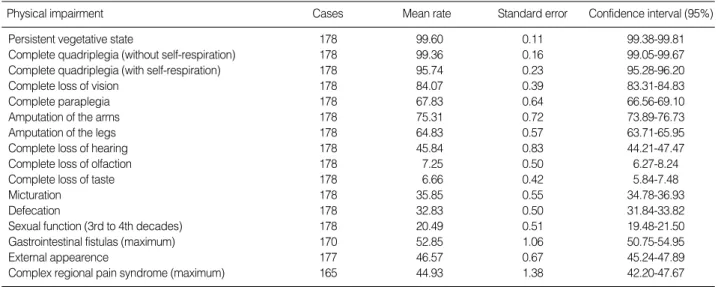
We conducted a new survey of 400 experts (doctors) on their opinion on physical impairment rate for 16 different impair- ments via faxes and obtained 195 completed cases (48.8%
response rate) form September 2008 to January 2009. The Table 1 summarized the result. Although in general experts showed very consistent opinions, some impairments such as
‘gastrointestinal fistulas’ and ‘complex regional pain syndrome’
exposed substantial variance (or standard errors) among expert opinions. For example, response rate for ‘complex regional pain syndrome’ ranges from 0% to 70% and also inter-quar- tile range is 30%, which is relatively large. This finding stron- gly suggests the necessity of developing strategies for success- ful consensus making among experts since simple mean could
be ineffective and even illegitimate when there exist wide vari- ations of opinions.
Public opinion
We need to examine opinion of the public beyond expert group for two reasons. First, we need to weigh impairments across field. For example, we need to decide relative impor- tance of eyes vs. legs. In this case, it is not recommendable to ask opinions of experts only. We need to examine public opinion when our decision requires more than one medical special field. Second, we also need to examine public opinion to gain stronger legitimacy. Even if the evaluation criteria and procedure are scientific and objective, the legitimacy of the criteria could be weak unless they are accepted by the pub- lic. Especially, considering sharp conflicts between interest groups with regard to disability evaluation, it could be crit- ical to secure public legitimacy.
There could be two alternatives to probe public opinion.
The first one is to conduct a survey of a representative sample of the public. The second alternative is to combine MDEMP model with a traditional survey. The first approach is most widely used. Also if we obtain a majority preference from this survey, it is the best strategy available. But what if we confirm the existence of sharp division, for example 52% vs. 48%? It would be hard to draw conclusions from this type of neck to neck competing and sometimes even conflicting opinions.
This is actually what we found from a public opinion survey.
This survey is conducted in February 2009 on a 840 represen- tative sample of Korean adults through mobile phone text messaging. A survey research company named MBIZONE keeps the list of more than one million people who registered and agreed to be respondents for the surveys conducted by the company in the exchange of small amount of money.
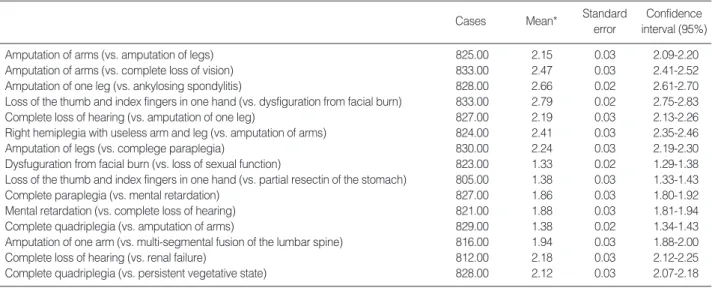
MBIZONE selected 840 representative adults out of regis- tered one million people for this study. Table 2 summarized
Physical impairment Cases Mean rate Standard error Confidence interval (95%)
Persistent vegetative state 178 99.60 0.11 99.38-99.81
Complete quadriplegia (without self-respiration) 178 99.36 0.16 99.05-99.67
Complete quadriplegia (with self-respiration) 178 95.74 0.23 95.28-96.20
Complete loss of vision 178 84.07 0.39 83.31-84.83
Complete paraplegia 178 67.83 0.64 66.56-69.10
Amputation of the arms 178 75.31 0.72 73.89-76.73
Amputation of the legs 178 64.83 0.57 63.71-65.95
Complete loss of hearing 178 45.84 0.83 44.21-47.47
Complete loss of olfaction 178 7.25 0.50 6.27-8.24
Complete loss of taste 178 6.66 0.42 5.84-7.48
Micturation 178 35.85 0.55 34.78-36.93
Defecation 178 32.83 0.50 31.84-33.82
Sexual function (3rd to 4th decades) 178 20.49 0.51 19.48-21.50
Gastrointestinal fistulas (maximum) 170 52.85 1.06 50.75-54.95
External appearence 177 46.57 0.67 45.24-47.89
Complex regional pain syndrome (maximum) 165 44.93 1.38 42.20-47.67
Table 1. Summary of experts’ opinion on physical impairment rates
the result. The table summarized a series of questions to com- pare two impairments. For example, the first question reads,
“Who is more disabled in Korea, ‘person who lost both arms’
or ‘person who lost both legs’?” We coded 1 if a respondent chose the first one and coded 3 if he or she chose the latter one. We coded 2 if a respondent said, ‘almost identical’.
We obtained two important implications from Table 2. Fir- st, we can find some impairments had the mean value around 2. The closest one is 1.94 for the comparison between ‘ampu- tation of one arm’ and ‘multi-segmental fusion of the lumbar spine’. Public survey produced little information about the relative importance of this type of impairments. Second, pub- lic opinion does not always consistent with experts’ view. For example, Table 1 clearly showed that Korean experts believed amputation of arms was more critical than amputation of legs (95% confidence intervals are ‘73.89-76.73’ vs. ‘63.71-65.95’).
Additional table (not shown) revealed that only 4.5% of ex- perts believed that amputation of legs was more critical while 70% believed that amputation of arms was more critical.
However the order is reversed in public opinion. In Table 2, the mean value of ‘amputation of arms’ vs. ‘amputation of legs’
was 2.15, which means that public believed that amputation of legs was more critical. According to additional analysis (not shown), the proportion of people who believed that amputa- tion of legs was more critical was 44% while 30% of the res- pondent believed that amputation of arms was more serious.
Both findings robustly implicated the need of developing efficient and legitimate procedure of consensus formation.
The second alternative to investigate public opinion is to integrate MDMP model with public survey. Because MDMP model includes feedback and changing opinions, it is not po- ssible to apply this to huge number of people in person. Ins- tead, it is possible to apply this to about one thousand people via mobile phone. Once we select a representative sample from
MBIZONE, we can give feedbacks and obtain new changing opinions through its system. Considering the fact that mobile phone survey only takes about one day for about 1,000 people, this is a plausible strategy in the future.
DISCUSSION
The KAMS realized that disability evaluation itself is a so- cial product, therefore, tried to incorporate social property of evaluation into evaluation process from the beginning. Due to the lack of budget and time, we could not implement all the strategies we planned. We just finished the first draft of the evaluation guide from core experts. We plan to apply stra- tegy 1, 2, or 3 as time permits, since we now enter into the second year period of our project. Evaluation guide must ch- ange across societies and times but we believe that our set of strategies could be an example of a general framework where opinions of experts and public are systematically examined and thus legitimacy could strongly be held.
REFERENCES
1. Bordogna G, Fedrizzi M, Pasi G. A linguistic modeling of consensus in group decision making based on OWA operators. IEEE Trans Syst Man Cybern A Syst Hum 1997; 27: 126-32.
2. Bryson N. Group decision-making and the analytic hierarchy process:
Exploring the consensus-relevant information content. Comput Oper Res 1996; 23: 27-35.
3. Carlsson C, Ehrenberg D, Eklund P, Fedrizzi M, Gustafsson P, Lind- holm P, Merkuryeva G, Riissanen T, Ventre AG. Consensus in dis- tributed soft environments. Eur J Oper Res 1992; 61: 165-85.
4. Chiclana F, Herrera F, Herrera-Viedma E. Integrating three represen-
Cases Mean* Standard Confidence
error interval (95%)
Amputation of arms (vs. amputation of legs) 825.00 2.15 0.03 2.09-2.20
Amputation of arms (vs. complete loss of vision) 833.00 2.47 0.03 2.41-2.52
Amputation of one leg (vs. ankylosing spondylitis) 828.00 2.66 0.02 2.61-2.70
Loss of the thumb and index fingers in one hand (vs. dysfiguration from facial burn) 833.00 2.79 0.02 2.75-2.83
Complete loss of hearing (vs. amputation of one leg) 827.00 2.19 0.03 2.13-2.26
Right hemiplegia with useless arm and leg (vs. amputation of arms) 824.00 2.41 0.03 2.35-2.46
Amputation of legs (vs. complege paraplegia) 830.00 2.24 0.03 2.19-2.30
Dysfuguration from facial burn (vs. loss of sexual function) 823.00 1.33 0.02 1.29-1.38
Loss of the thumb and index fingers in one hand (vs. partial resectin of the stomach) 805.00 1.38 0.03 1.33-1.43
Complete paraplegia (vs. mental retardation) 827.00 1.86 0.03 1.80-1.92
Mental retardation (vs. complete loss of hearing) 821.00 1.88 0.03 1.81-1.94
Complete quadriplegia (vs. amputation of arms) 829.00 1.38 0.02 1.34-1.43
Amputation of one arm (vs. multi-segmental fusion of the lumbar spine) 816.00 1.94 0.03 1.88-2.00
Complete loss of hearing (vs. renal failure) 812.00 2.18 0.03 2.12-2.25
Complete quadriplegia (vs. persistent vegetative state) 828.00 2.12 0.03 2.07-2.18
Table 2. Summary of public opinion survey
*, 1 means the former one is more critical, 3 means the latter is more critical, and 2 means two are almost identical.
tation models in fuzzy multipurpose decision making based on fuzzy preference relations. Fuzzy Sets Syst 1998; 97: 33-48.
5. Herrera-Viedma E, Herrera F, Chiclana F. A consensus model for mul- tiperson decision making with different preference structures. IEEE Trans Syst Man Cybern 2002; 32: 394-402.
6. Alston RM, Kearl JR, Vaughan MB. Is there a consensus among eco- nomists in the 1990s? American Economic Review, Papers and Pro- ceedings 1992; 82: 203-9.
7. Fuller D, Geide-Stevenson D. Consensus among economists: revis- ited. J Econ Educ 2003; 369-87.
8. Kearl JR, Pope CL, Whiting GC, Wimmer LT. A confusion of econo-
mists. American Economic Review, Papers and Proceedings 1979;
69: 28-37.
9. Heckathorn DD. Respondent driven sampling: a new approach to the study of hidden populations. Social Problems 1997; 44: 174-99.
10. Heckathorn DD. Respondent driven sampling II: deriving statistical- ly valid population estimates from chain-referral samples of hidden populations. Social Problems 2002; 49: 11-34.
11. Heckathorn DD, Semaan S, Robert S, Broadhead RS, Hughes J. Ex- tensions of respondent-driven sampling: a new approach to the study of injection drug users aged 18-25. AIDS Behav 2002; 6: 55-67.