INTRODUCTION
Arteriosclerotic change of radial artery in hemodialysis (HD) patients is known as an important risk factor of vascu- lar access failure (1, 2). We have reported that intimal hyper- plasia (IH), which is the main pathologic change of radial artery, is associated with early failure of radiocephalic arteri- ovenous fistula (AVF) in HD patients (3). But, there is no noninvasive method to predict IH of radial artery before the vascular access operation.
Ultrasonography is considered as a fundamental technique to investigate the vascular system, especially carotid artery (4-6). The intima-media thickness (IMT), which represents whole thickness of arterial wall, can be measured by ultra- sonography. However, the intima thickness is exceptional.
We have reported that radial arterial IMT measured by ultra- sonographic examination was correlated well by histological examination (7). This study was performed to evaluate the impact of IMT on the early failure of AVF in HD patients by histologic examination.
MATERIALS AND METHODS Patient population
One hundred twenty-six uremic patients underwent radio- cephalic AVF operation for the first time at our hospital bet- ween January 2000 and December 2003. We selected radio- cephalic AVF as the first choice of vascular access type. How- ever, when the cephalic vein was too small to create a radio- cephalic AVF or collapsed because of recent multiple punc- tures, we placed other vascular accesses (upper arm AVF, AV graft, central catheter). Of these patients having radiocephalic AVF, this study included the patients who underwent radial artery biopsy during the surgery. To avoid vessel injury before the operation as a cause of early AVF failure, we excluded patients who had a history of central venous cannulation or arterial puncture ipsilateral to the AVF surgical site. As a result, total 90 patients who were fit with these criteria and included in this study. This study was approved by the Insti- tutional Review Board of Uijongbu St. Mary’s Hospital.
Young Ok Kim, Yeong Jin Choi*, Ji Il Kim�, Young Soo Kim, Byung Soo Kim, Chul Whee Park, Ho Cheol Song, Sun Ae Yoon, Yoon Sik Chang, Byung Kee Bang
Department of Internal Medicine, Clinical Pathology*, General Surgery�, College of Medicine, The Catholic University of Korea, Seoul, Korea
Address for correspondence Sun Ae Yoon, M.D.
Department of Internal Medicine, Uijongbu St. Mary’s Hospital, The Catholic University of Korea, 65-1 Kumoh-dong, Uijongbu 480-130, Korea Tel : +82.31-820-3347, Fax : +82.31-820-2719 E-mail : [email protected]
*The part of this study was presented at the Annual Meeting of the American Society of Nephrology, San Antonio, MO, 2004. The authors wish to acknowledge to the financial support of the Department of Internal Medicine, The Catholic University of Korea and this work was supported in part by Gambro Korea Grant from the Korean Society of Nephrology.
284
The Impact of Intima-media Thickness of Radial Artery on Early Failure of Radiocephalic Arteriovenous Fistula in Hemodialysis Patients
This study was performed to investigate the impact of intima-media thickness (IMT) of radial artery on early failure of radiocephalic arteriovenous fistula (AVF) in hemo- dialysis (HD) patients. Ninety uremic patients undergoing radiocephalic AVF oper- ation were included in this study. During the operation, 10-mm long partial arterial walls were removed with elliptical form for microscopic analysis. Specimens were stained with trichrome and examined by a pathologist blinded to the clinical data.
And then AVF patency was followed up for 1 yr after the operation. Of the total 90 patients, 31 patients (34%) had AVF failure within 1 yr after the operation. Mean IMT was thicker in failed group (n=31) than in patent group (n=59) (486±130 m vs. 398±130 m, p=0.004). The AVF patency rate within 1 yr after the operation was lower in patients with IMT ≥500 m (n=26) than in patients with IMT <500 m (n=64) (p=0.017). Age was an independent risk factor of IMT. Diabetes mellitus tended to be independent risk factor but not statistically significant. Our data suggest that increased radial artery IMT is closely associated with early failure of radiocephalic AVF in HD patients.
Key Words : Uremia; Renal Dialysis; Arteriovenous Fistula; Radial Artery
Received : 3 August 2005 Accepted : 22 September 2005
Measurement of wall thickness of radial artery
A radiocephalic AVF was constructed in an end vein-to- side artery fashion at the wrist by a single vascular surgeon.
During the operation, 10-mm long partial arterial walls were removed from the incision sites of the radial arteries with elliptical form for microscopic analysis. Specimens were cut into 5- m sections and stained with hematoxylin and eosin and trichrome. Slides were examined by a pathologist blind- ed to the clinical data. The each wall thickness of radial artery (intima, media, and intima-media thickness) was measured using light microscopy respectively and atherosclerotic lesion was investigated. An atherosclerotic lesion was defined as the presence of cholesterol clefts or aggregation of foamy macro- phages. The IMT was defined as sum of intima thickness and media thickness and IH was defined as the presence of cells and fibrous tissues between the endothelium and inter- nal elastic lamina as our previous study (3).
Follow-up of AVF patency
Before the operation, we investigated hypertension, smok- ing history, hemoglobin, hematocrit, serum cholesterol, total protein, and albumin level. AVF patency was prospectively followed up for 1 yr after the operation. First cannulation through the AVF for hemodialysis was individualized accord- ing to the state of venous maturation at least 4 weeks after the operation. If hemodiaysis treatment had been needed before venous maturation, the catheter for hemodialysis was inserted at the central vein contralateral to the AVF site and hemodialysis was performed. We investigated early AVF failure within 1 yr after the operation. Early AVF failure was defined as complete obstruction or low blood flow insufficient to support a dialysis flow rate of at least 200 mL/min and require radiologic intervention or surgical correction within 1 yr after the operation as our previous study (8). Of the AVF failures that occurred in this study, nonthrombotic events such as those caused by infection or external compression were excluded. AVF failure caused by external compression was defined as cessation of blood flow just after prolonged compression of the needling sites of AVF. We compared clin- ical factors and each wall thickness of radial artery between failed and patent group. And we also evaluated relationship between the AVF failure and radial artery IMT or IH.
Statistical analyses
A comparison of mean value of the clinical factors and each wall thickness according to the radial artery IMT values or AVF patency was made by using unpaired Student t test.
For comparison of AVF patency between patients with IMT
<500 m and ≥500 m and between patients with and without IH according to the time course survival analysis using Kaplan-Meier method with log rank test was performed.
To decide independent risk factors of IMT and early AVF failure out of the clinical factors, multiple regression analysis and Cox regression analysis were used, respectively. When comprising groups, p less than 0.05 is considered to be sig- nificant.
RESULTS Clinical characteristics
Mean age of the patients was 56±13 yr and the number of female was 44 (48.9%). Primary renal diseases consisted of diabetic nephropathy (52 cases), chronic glomerulonephri- tis (19 cases), hypertensive nephropathy (11 cases), polycys- tic kidney disease (3 case), Goodpasture’s disease (1 case), and unknown (4 cases). The percentage of hypertension and smoking history was 75% (n=68), 40% (n=36), respectively.
Mean hemoglobin level and hematocrit were 8.8±1.2 g/dL, 26.0±3.9%, respectively. Serum albumin and total choles- terol levels were 3.1±0.5 g/dL, 178±52 mg/dL, respec- tively.
Each wall thickness of radial artery and incidence of IH and atherosclerotic lesion
Mean intima thickness was 57±42 m (13-225 m) and mean media thickness was 376±120 m (120-700 m).
Mean IMT, which is sum of intima thickness and media thick- ness, was 430±132 m (133-760 m). Of the total 90 pati- ents, 8 patients had normal range of IMT (less than 250 m) and 82 patients had increased IMT (more than 250 m). Of the 82 patients with increased IMT, 56 patients had IMT more than 250 m and less than 500 m and 26 patients had IMT more than 500 m. IH was observed in 67 of the total 90 patients (74%) and atherosclerotic lesion was found in only two patients.
Comparison of each wall thickness of radial artery between patent and failed groups
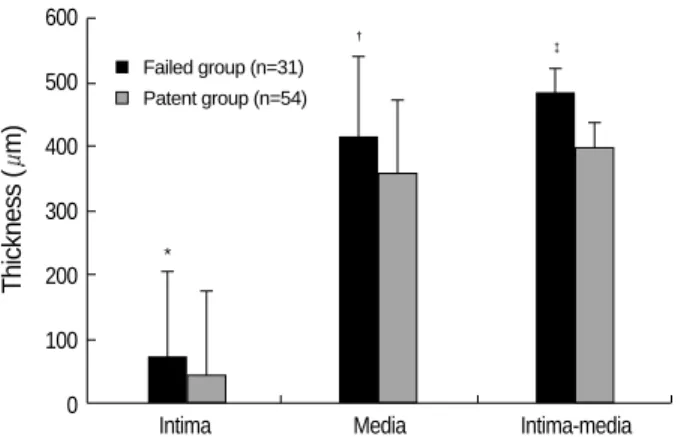
During follow up for 1 yr after the operation, there was no any follow-up loss. Four patients died with AVF failure and 5 patients died with patent AVF before the end point of this study. In comparison of each wall thickness of radial artery, we excluded 5 patients who died with patent AVF before the end point of this study. Of the total 90 patients, 31 patients (34%) had AVF failure within 1 yr after the oper- ation. Eighteen of the 31 AVF failures occurred within 4 months after the operation. Except 5 patients who died with patent AVF, we compared each wall thickness of radial artery between patent group (n=54) and failed group (n=31). Mean intima thickness, media thickness, and IMT were thicker in failed group than in patents group, respectively (intima thick-
ness; 75±34 m vs. 45±38 m, p=0.001, media thickness;
413±126 m vs. 355±116 m, p=0.042, IMT; 486±130 m vs. 398±130 m, p=0.004) (Fig. 1).
Comparison of age, and incidence of diabetes mellitus and hypertension between patent and failed groups
We compared age, incidences of diabetes mellitus and hyper- tension between patent and failed groups. Of the total pati- ents, we also excluded 5 patients who died with patent AVF before the end point of this study. Mean age in the failed group was older than that in the patent group (61±10 yr vs. 53± 15 yr, p=0.011). The incidence of diabetes mellitus in the failed group tended to be higher than that in the patent group but the difference was not significant (43% vs. 27%, p=
0.154). There was no difference in the incidence of hyper- tension between the 2 groups (35% vs. 37%, p=0.876).
Cox regression analysis for the independent clinical factors affecting early AVF failure
To evaluate the independent risk factors of early AVF fail- ure, we analyzed age, diabetes mellitus, and IMT value using Cox regression analysis. Expired cases were dealt with cen- sored data. Of these clinical factors, only IMT was indepen- dent risk factor of early AVF (Table 1).
Comparison of AVF patency according to radial artery IMT and IH
Using a threshold of 500 m of IMT, AVF patency rate was compared between these two groups using Kaplan-Meier method with log rank test. Expired cases were dealt with censored data. The AVF patency rate within 1 yr after the operation was lower in patients with IMT ≥500 m (n=
26) than in patients with IMT <500 m (n=64) (p=0.017, Fig. 2). The AVF patency rate in patients with IH (n=67) was also lower than in patients without IH (n=23) (p=0.041).
Thickness (m)
600
500
400
300
200
100
0 Intima Media Intima-media
*
�
�
Fig. 1.Comparison of intima, media, and intima-media thickness (IMT) between failed (n=31) and patent groups (n=54). Of the total 90 patients, 5 patients who died with patent AVF before the study end point were excluded. *, p<0.001; �, p=0.042; �, p=0.004 ver- sus patients with patent group by Student’s t test.
Failed group (n=31) Patent group (n=54)
AVF patency rate (%)
1.0 0.9 0.8 0.7 0.6 0.5 0.4 0.3 0.2 0.1 0.0
0 2 4 6 8 10 12
Duration (month)
Fig. 2.Comparison of AVF patency rate between patients with IMT
≥500 m (n=26) and <500 m (n=64). Five patients who died with patent AVF before the study end point were included as cen- sored data. p=0.017 versus patients with patent group by Kaplan- Meier method with Log Rank test.
Patients with IMT ≥500 m (n=26) Patients with IMT <500 m
(n=64)
Exp (B) CI Significance
Age 0.016 1.016 0.982-1.051 0.356
Diabetes mellitus -0.159 0.853 0.399-1.823 0.682 Radial artery IMT 0.004 1.004 1.001-1.007 0.013 Table 1.Results of Cox regression analysis for the determinants of the independent factors affecting the early AVF failure
R=0.415, p=0.026 p value
Age 0.243 0.037
Sex 0.018 0.880
Diabetes mellitus 0.226 0.053
Hypertension 0.013 0.897
Smoking 0.093 0.433
Total cholesterol 0.057 0.616
Serum albumin 0.080 0.440
Table 3.Results of multiple regression analysis for the determi- nants of the independent factors affecting radial artery IMT
IMT ( m)
≥500 (n=26) <500 (n=64) p
Age (yr) 62±9 54±14 0.006
Diabetes mellitus (%) 77 50 0.019
Hypertension (%) 73 76 0.727
Smoking (%) 46 37 0.448
Total cholesterol (mg/dL) 182±43 176±56 0.676 Albumin (g/dL) 3.2±0.7 3.1±0.5 0.344 Table 2.Comparison of clinical factors between the patients with IMT ≥500 m and <500 m
Comparison of clinical factors between the patients with IMT ≥≥500 m and <500 m
The patients with IMT ≥500 m was older and had higher incidence of diabetes mellitus, compared to the patients with IMT <500 m (Age; 62±9 vs. 54±14 yr, p=0.006, inci- dence of diabetes mellitus; 77% vs. 50%, p=0.019). But there was no difference in sex, smoking, hypertension, hemo- globin, hematocrit, serum total cholesterol and total protein, and albumin levels between the two groups (Table 2).
Multiple regression analysis for the independent clinical factors affecting IMT
To evaluate the independent risk factor of IMT, we analyzed the clinical factors, age, sex, diabletes mellitus, hypertension, smoking history, serum cholesterol, and albumin level, using multiple regression analysis. Of these clinical factors, only age was independent risk factor of IMT. Diabetes mellitus tended to be independent risk factor but not statistically sig- nificant (Table 3).
DISCUSSION
This study first demonstrated the association between the radial artery IMT measured by histologic examination and early failure of radiocephalic AVF in HD patients. The causes of early failure of radiocephalic AVF are often unknown al- though the quality of the radial artery is thought to play an important role. The IMT represents whole thickness of arte- rial wall, which can be measured by high-resolution ultra- sonography (4-6). We previously reported that ultrasonog- raphy is accurate in measuring radial artery IMT, compared to histologic examination (7). Although radial artery IMT, which represents actual wall of the radial artery, is considered to play an important role of early failure of radiocephalic AVF, the impact of the radial artery IMT on the early failure of radiocephalic AVF is not reported yet.
We previously reported that preexisting IH of the radial artery is associated with early failure of radiocephalic AVF in hemodialysis patients (3). However, IH can be detected only by histologic examination during the operation and there was no available noninvasive method to measure it directly. It cannot be helpful for the surgeon to decide which the radial artery is an adequate for the radiocephalic AVF or not. Carotid artery IMT can be easily measured by high-res- olution ultrasonography and increased carotid artery IMT is known to be an independent risk factor of cardiovascular morbidity and mortality (4-6). Mackay et al. (9) reported that radial artery IMT in patients with severe coronary artery atherosclerosis awaiting coronary artery bypass grafting was thicker than that in healthy persons. We also reported that radial artery IMT in uremic patients was thicker than that
in both uncomplicated hypertensive patients and healthy persons (7). Based on these findings, we hypothesized that radial artery IMT would be associated with early failure of the radiocephalic AVF and retrospectively evaluated radial artery IMT by using histologic examination in uremic patients who received radiocephalic AVF operation and investigated early failure of the radiocephalic AVF within 1 yr after the operation. Patients with IMT ≥500 m had lower patency rate within 1 yr after the operation than patients with IMT
<500 m (p<0.001). Our findings suggest that increased radial artery IMT may be one of the factors of early failure of radiocephalic AVF in HD patients. Therefore, we recom- mend that ultrsonography should be performed in pre-dialy- sis uremic patients having poor vascularity prior to the radio- cephalic AVF creation. In patients with radial artery IMT
≥500 m, the radiocephalic AVF operation should be avoid- ed and other types of vascular access such as brachiocephalic AVF or graft should be considered.
Because it is clinically difficult to obtain the radial artery specimens, there are few data about histologic study of the radial artery. The main pathologic derangement of the radial artery is IH and role of atherosclerosis is strictly restricted, in contrast to carotid and coronary arteries in which athero- sclerosis commonly occur (3, 10-12). Ejerblad et al. (10) found that IH in the radial artery was observed in all uremic patients and healthy controls, but intima of uremic arteries was sig- nificantly thicker than that of controls. Ruengsakulrach et al. (13) reported that incidence of IH in the radial artery of 150 patients with advanced coronary artery disease was 94%, but that of atherosclerosis was only 5%. In this study, IH were observed in 74%, of 90 uremic patients, and atheroscle- rosis only in 2.2%. Although upper normal limit of radial artery in healthy persons measured by ultrasonographic exami- nation is reported to 250 m, there is no study demonstrat- ing it by histologic examination. In this study, mean IMT in uremic patients was 430±132 m (133-760 m). Of the total 90 patients, 82 patients (91%) had increased IMT (more than 250 m).
In this study, early AVF failure within 1 yr after the oper- ation occurred in 31 (34%) of the total 90 patients. This incidence was similar to other reports (14-16). Mean radial artery IMT was thicker in failed group than in patents group (486±130 m vs. 398±130 m, p=0.004). The incidence of IH in the failed group was also higher than that in the patent group (43% vs. 9%, p=0.002). In order to evaluate the impact of IMT on the early AVF failure, we divided the total patients into two groups using threshold of 500 m of IMT. Upper normal limit of the radial artery IMT in gener- al population is known to be less than 250 m (9, 17). Our study showed that 91% of uremic patients had IMT more than upper normal limit and mean IMT in total 90 patients was 430±132 m. So we decided to cut off value 500 m of IMT, which represents both double folds of upper normal limit and near level of sum of mean value of IMT and 1 stan-
dard deviation in the total patients. The AVF failure within 1 yr after the operation in the patients with IMT ≥500 m was higher than that in the patients with <500 m (72% vs.
50%, p=0.017).
There is no well-defined mechanism to explain how incre- ased radial artery IMT causes early AVF failure. We suggest some possible mechanisms. First, increased IMT causes lumi- nal narrowing and loss of vascular elasticity, which increases arterial stiffness. These two factors prevent to increase AVF blood flow. Second, increased IMT may include IH. It may directly extend to venous site and cause venous stenosis near the anastomosis site (3). Venous stenosis decreases AVF blood flow and directly induces AVF failure. In this study, patients with IMT ≥500 m had higher incidence of IH, compared to patients with IMT <500 m (92% vs. 32%). Low blood flow and small internal diameter of the radial artery is known to be risk factors of early failure of radiocephalic AVF. In pre- vious study and this study, we investigate partial arterial speci- men obtained from the incision site of AVF operation. So we focused only on arterial alteration such as IH and IMT and we did not evaluate arterial blood flow or internal diameter of the radial artery. Vein abnormalities such as small internal diameter or recent vein injury can cause early AVF failure (1, 18). In our hospital, when the cephalic vein was too small to create a radiocephalic AVF or it was collapsed because of recent multiple punctures, we did not place radiocephalic AVF. And in order to minimize the impact of vein injury, this study excluded the patients who had a history of central venous cannulation ipsilateral to the AVF surgical site.
Can radial artery biopsy performed during the operation influence on AVF patency? There is no data available to ex- plain it at this moment. In this study, 10-mm long partial arterial walls were obtained from the incision sites of the radial arteries with elliptical form during the operation. There was no any complication of the biopsy. We previously reported that the early failure of the radiocephalic AVF operation with- out arterial biopsy occurred in 12 of the 58 patients (21%) within 4 months after the operation (8). In this study, the AVF failure developed in 18 of the 90 patients (20%) within the same period. So we do not think that the arterial biopsy influences on the AVF patency.
In this study, only age was an independent risk factor for increased radial artery IMT. Incidence of diabetes mellitus in the patients with IMT ≥500 m was higher than that in the patients with IMT <500 m. With multivariate anal- ysis, diabetes mellitus tended to be a risk factor but it was not statistically significant. Our previous study and other studies showed that diabetes mellitus is an independent risk factor of IH (3, 13, 19, 20). But which diabetes mellitus is an independent risk factor of IMT or not has been reported yet. Future study is needed to evaluate the impact of diabetes mellitus on radial artery IMT.
In conclusion, our findings suggest that increased radial artery IMT is closely associated with early failure of radio-
cephalic AVF in HD patients. Therefore, if we can detect radial artery IMT in pre-dialysis uremic patients who will receive the AVF operation, it will be helpful for the surgeon to decide which the radial artery is adequate or not for the AVF operation. In contrast to IH, radial artery IMT can be easily measured by high-resolution ultrasonography before the operation. We recommend that ultrasonography should be performed in uremic patients, especially elderly and dia- betic patients before the AVF operation and radiocephalic AVF operation should be avoided in patients with increased radial artery IMT.
ACKNOWLEDGEMENT
We thank Tae Wook Choi, Gambro Korea for excellent assistance in the preparation of the manuscript.
REFERENCES
1. Wong V, Ward R, Taylor J, Selvakumar S, How TV, Bakran A. Fac- tors associated with early failure of arteriovenous fistulae for haemo- dialysis access. Eur J Vasc Endovasc Surg 1996; 12: 207-13.
2. Haimov M. Vascular access for hemodialysis. Surg Gynecol Obstet 1975; 141: 619-25.
3. Kim YO, Song HC, Yoon SA, Yang CW, Kim NI, Choi YJ, Lee EJ, Kim WY, Chang YS, Bang BK. Preexisting intimal hyperplasia of radial artery is associated with early failure of radiocephalic arterio- venous fistula in hemodialysis patients. Am J Kidney Dis 2003; 41:
422-8.
4. Simon A, Gariepy J, Chironi G, Megnien JL, Levenson J. Intima- media thickness: a new tool for diagnosis and treatment of cardio- vascular risk. J Hypertens 2002; 20: 159-69.
5. Allan PL, Mowbray PI, Lee AJ, Fowkes FG. Relationship between carotid intima-media thickness and symptomatic and asymptomatic peripheral arterial disease. The Edinburgh Artery Study. Stroke 1997;
28: 348-53.
6. Benedetto FA, Mallamaci F, Tripepi G, Zoccali C. Prognostic value of ultrasonographic measurement of carotid intima media thickness in dialysis patients. J Am Soc Nephrol 2001; 12: 2458-64.
7. Ku YM, Kim YO, Kim JI, Choi YJ, Yoon SA, Kim YS, Song SW, Yang CW, Kim YS, Chang YS, Bang BK. Ultrasonographic mea- surement of intima-media thickness of radial artery in pre-dialysis uraemic patients: comparison with histological examination. Nephrol Dial Transplant 2006; 21: 715-20.
8. Kim YO, Yang CW, Yoon SA, Chun KA, Kim NI, Park JS, Kim BS, Kim YS, Chang YS, Bang BK. Access blood flow as a predic- tor of early failures of native arteriovenous fistulas in hemodialysis patients. Am J Nephrol 2001; 21: 221-5.
9. MacKay AJ, Hamilton CA, McArthur K, Berg G, Tropeano AI, Bou- touyrie P, Reid JL, Dominiczak. Radial artery hypertrophy occurs in coronary atherosclerosis and is independent of blood pressure.
Clin Sci 2001; 100: 509-16.
10. Ejerblad S, Ericsson JLE, Eriksson I. Arterial lesions of the radial artery in uraemic patients. Acta Chir Scand 1979; 145: 415-28.
11. Stary HC, Chandler AB, Dinsmore RE, Fuster V, Glagov S, Insull W jr, Rosenfeld ME, Schwartz CJ, Wagner WD, Wissler RW. A defi- nition of advanced types of atherosclerotic lesions and a histological classification of atherosclerosis. A report from the Committee on Vascular Lesions of the Council on Arteriosclerosis, American Heart Association. Circulation 1995; 92: 1355-74.
12. Ross R. The pathogenesis of atherosclerosis: a perspective for the 1990s. Nature 1993; 362: 801-9.
13. Ruengsakulrach P, Sinclair R, Komeda M, Roman J, Gordon I, Bux- ton B. Comparative histopathology of radial artery versus internal thoracic artery and risk factors for development of intimal hyperpla- sia and atherosclerosis. Circulation 1999; 100: 139-44.
14. Palder SB, Kirkman RL, Whittemore AD, Hakim RM, Lazarus JM, Tilney NL. Vascular access for hemodialysis. Patency rates and
results of revision. Ann Surg 1985; 202: 235-9.
15. Windus DW. Permanent vascular access: a nephrologist's view. Am J Kidney Dis 1993; 21: 457-71.
16. Fan PY, Schwab SJ. Vascular access: concepts for the 1990s. J Am Soc Nephrol 1992; 3: 1-11.
17. Safar ME, Girerd X, Laurent S. Structural changes of large conduit arteries in hypertension. J Hypertens 1996; 14: 545-55.
18. Brimble KS, Rabbat CG, Schiff D, Ingram AJ. The clinical utility of Doppler ultrasound prior to arteriovenous fistula creation. Semin Dial 2001; 14: 314-7.
19. Kay HR, Korns ME, Flemma RJ, Tector AJ, Lepley D Jr. Atheroscle- rosis of the internal mammary artery. Ann Thorac Surg 1976; 21:
504-7.
20. Kaufer E, Factor SM, Frame R, Brodman RF. Pathology of the radial and internal thoracic arteries used as coronary artery bypass grafts.
Ann Thorac Surg 1997; 63: 1118-22.