Incidence of Metabolic Syndrome and Relative Importance of Five Components as a Predictor of Metabolic Syndrome: 5-Year Follow-up Study in Korea
The aim of this study was to describe the incidence of metabolic syndrome and to identify five components as metabolic syndrome predictors. The final study included 1,095 subjects enrolled in a rural part of Daegu Metropolitan City, Korea for a cohort study in 2003. Of these, 762 (69.6%) subjects had participated in the repeat survey. During the five-year follow-up, incidence density was significantly higher for women than for men (men, 30.0/1,000 person-years; women, 46.4/1,000 person-years). In both men and women, incidence of metabolic syndrome showed a significant increase with increasing number of metabolic syndrome components at baseline. Compared with individuals presenting none of components at baseline, relative risks were increased 1.22 (men; 95% CI, 0.43-3.51), 2.21 (women; 95% CI, 0.98-4.97) times more for individuals with one component of metabolic syndrome and 5.30 (men; 95% CI, 2.31-12.13), 5.53 (women; 95% CI, 2.78- 11.01) times more for those who had two components. In multivariate analysis, the most powerful risk factor for metabolic syndrome was abdominal obesity in men and low HDL- cholesterol in women (adjusted relative risk, 3.28, 2.53, respectively). Consequently, finding a high risk group for metabolic syndrome according to gender and prevention of metabolic syndrome through lifestyle modification are essential.
Key Words: Cohort Studies; Incidence; Metabolic Syndrome; Risk Factors Jun Hyun Hwang,1 Sin Kam,2
Ji-yeon Shin,3 Jong-Yeon Kim,1 Kyung-Eun Lee,2 Gi-Hong Kwon,4 Byung-Yeol Chun,2 Shung Chull Chae,5 Dong Heon Yang,5 Hun Sik Park5 and Tae-Yoon Hwang6
1Department of Preventive Medicine, Catholic University of Daegu School of Medicine, Daegu;
2Department of Preventive Medicine, Kyungpook National University School of Medicine, Daegu;
3National Cancer Control Institute, National Cancer Center, Goyang; 4Division of Health and Science, Yeungnam College of Science and Technology, Daegu; 5Department of Internal Medicine, Kyungpook National University Hospital, Daegu;
6Department of Preventive Medicine & Public Health, Yeungnam University College of Medicine, Daegu, Korea
Received: 19 July 2013 Accepted: 8 October 2013 Address for Correspondence:
Tae-Yoon Hwang, MD
Department of Preventive Medicine & Public Health, Yeungnam University College of Medicine, 170 Hyeonchung-ro, Nam-gu, Daegu 705-717, Korea
Tel: +82.53-620-4374, Fax: +82.53-653-2061 E-mail: [email protected]
This sudy was supported in part by a grant from Daegu Metropolitan City (2008, 200807340000).
http://dx.doi.org/10.3346/jkms.2013.28.12.1768 • J Korean Med Sci 2013; 28: 1768-1773 Endocrinology, Nutrition & Metabolism
INTRODUCTION
Metabolic syndrome (MetS), clustering of glucose intolerance, obesity, hypertension, and dyslipidemia, is showing a rapid in- crease worldwide (1). This increase is associated with the global epidemic of obesity and diabetes (2). Each component of MetS is a well-known risk factor for cardiovascular disease (3). These components do not occur independently by chance, but co-oc- cur in an individual. When these components occur simultane- ously in a person, they are synergistically associated with in- creased risk of cardiovascular disease (4, 5).
Several previous cross-sectional studies have suggested an increase in the prevalence of MetS. In the United States, the pre- valence of MetS showed a marked increase over the period from 1988 to 2006 (27.9% in the Third National Health and Nutrition Examination Survey [1988-1994 NHANES] and 34.1% in the
1999-2006 NHANES) (6). In Korea, the prevalence of MetS also showed a marked increase over the period from 1998 to 2007 (24.9% in the 1998 Korea National Health and Nutrition Exami- nation Survey [1998 KNHANES] and 31.3% in the 2007 KNHANES) (7). Although several cross-sectional studies in the general pop- ulation like the one described above have been reported, there were no longitudinal data in general population, especially in Korea.
Therefore, the purposes of the this study were 1) to estimate the incidence of MetS in a rural area of Korea and 2) to evaluate five components as a predictor of MetS.
MATERIALS AND METHODS Study population
Dalseong-gun is a rural part located near Daegu Metropolitan
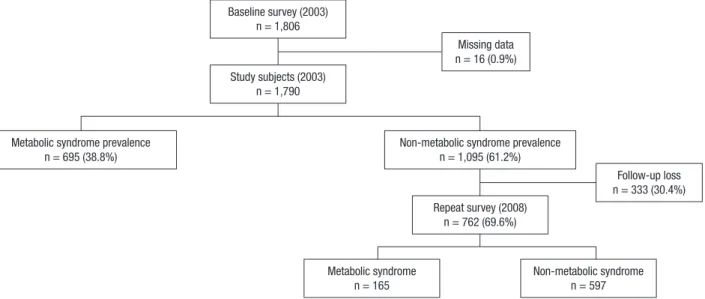
City in Korea. A baseline survey using a cluster sampling meth- od was conducted in Dalseong-gun in August 2003. We select- ed nine primary health posts of community (basic healthcare unit in rural area). In each territory of nine posts, two or three villages were randomly selected so that a total of 26 villages was chosen as a survey unit. All voluntary subjects over the age of 20 yr in each sampled village were enrolled. At the time of the baseline survey, a total of 1,806 people was recruited. Of these, 16 (0.9%) subjects were excluded because of missing data. Of the 1,790 remaining subjects, 695 (38.8%) were identified as having MetS at the baseline survey. The MetS-free cohort, com- prised of 1,095 (61.2%) subjects, was reexamined in August 2008.
Meanwhile, 333 (30.4%) of the 1,095 subjects did not participate in the repeat survey; thus, the follow-up rate was 69.6% (Fig. 1).
Subjects who were lost to follow-up were regarded as censored cases when statistical analysis was performed.
Methods
Medical history taking, physical examination, anthropometric measurement, a questionnaire survey on health-related behav- ior, and biochemical measurements were included in the health examination. Blood pressure was taken twice in a seating posi- tion by trained nurses using a standard mercury sphygmoma- nometer. The first and fifth Korotkoff sounds were used for esti- mation of systolic and diastolic blood pressure. Body weight was obtained with the participant dressed in light clothing and barefoot. Waist circumference was measured midway between the lower limit of the rib cage and the iliac crest. The question- naire asked about alcohol intake (non-, ex-, or current drinker), smoking habits (non-, ex-, or current smoker), and regular phys- ical exercise (no, yes). Blood samples were collected from an antecubital vein after 12 hr of fasting. The levels of fasting blood sugar, total cholesterol, triglyceride, and high-density lipopro-
tein cholesterol (HDL-cholesterol) were measured using an au- tomatic analyzer (Dimension AR, Dade Behring, Deerfield, IL, USA). The definition of MetS was based on the the Third Report of the National Cholesterol Education Program Adult Treatment Panel III (NCEP-ATP III) criteria; however, only the criteria for central obesity were based on the International Diabetes Fed- eration (IDF) definition of South Asian cut-points (8-10). When at least three of the following characteristics were observed, we considered the presence of MetS: waist circumference ≥ 90 cm in men and ≥ 80 cm in women; blood pressure ≥ 130/85 mmHg or antihypertensive drug medication; triglyceride ≥ 150 mg/
dL; HDL-cholesterol < 40 mg/dL in men and < 50 mg/dL in women; and fasting glucose ≥ 100 mg/dL or antidiabetic drug medication.
Statistical analysis
Descriptive summary statistics from the study sample were ge- nerated using mean and standard deviation for continuous vari- ables and proportions for categorical variables. In this study, age, health-related behavior, and each component of MetS were considered possible risk factors. Analysis of differences in inde- pendent variables between subjects who were lost to follow-up and repeated subjects was performed using t-test and chi-square test. As there are differences in diagnostic criteria for MetS and general characteristics between men and women, incidence and risk factors of MetS were analyzed separately by gender. In- cidence density and 95% confidence intervals (CI) were calcu- lated by dividing the number of cases by person-years at risk.
Time at risk was considered as the number of years between the first and repeat survey in those who did not develop MetS.
In individuals who developed MetS or were lost to follow-up, time at risk was estimated as the mid-point of the period be- tween the two surveys (11). Cumulative incidence rate was pre-
Fig. 1. Frame of the study design and numbers of subjects.
Baseline survey (2003) n = 1,806
Study subjects (2003) n = 1,790
Metabolic syndrome prevalence n = 695 (38.8%)
Missing data n = 16 (0.9%)
Non-metabolic syndrome prevalence n = 1,095 (61.2%)
Repeat survey (2008) n = 762 (69.6%)
Metabolic syndrome
n = 165 Non-metabolic syndrome
n = 597
Follow-up loss n = 333 (30.4%)
sented additionally in order to help in better understanding of the incidence of MetS. Cox proportional hazards model was used to assess the risk factors for MetS so that crude and adjust- ed relative risks were calculated. Available risk factors included age, each component of MetS, alcohol intake, smoking habits, and regular physical activity. The five components of MetS were divided into two categories according to the diagnostic criteria for MetS. Statistical significance was defined as a P value of less than 0.05. Statistical analysis was performed using SAS (9.1 ver- sion, Cary, NC, USA).
Ethics statement
The study protocol was approved by the institutional review board of Kyungpook National University Hospital (IRB No. KN- UHBIO_08-1004). Written informed consent was obtained from all participants.
RESULTS
Baseline characteristics after stratification according to follow- up status are shown in Table 1. Repeated subjects were signifi- cantly older than the subjects who were lost to follow-up. How- ever, no significant differences were observed in blood pres- sure, fasting glucose, waist circumference, triglyceride, HDL- cholesterol, the proportion of gender, alcohol intake, smoking, and regular physical exercise.
During the five-year follow-up period, 13.9% of men and 20.8%
of women were newly diagnosed as MetS. When the annual probability of progression to MetS was calculated based on the assumption of the constant risks, the annual incidence rate was 2.8% (men) and 4.2% (women) (Table 2).
As shown in Table 3, incidence density of MetS in women was significantly higher than in men (men, 30.0/1,000 person- years; women, 46.4/1,000 person-years). In addition, a differ- ence in the incidence density was observed between men and women according to age. Incidence of MetS showed a signifi- cant increase with age in women, while it tended to show a non- Table 1. Comparison of baseline characteristics between follow-up loss and repeated
subjects
Characteristics Follow-up loss
subjects (n = 333) Repeated subjects (n = 762) P value Sex
Male Female
154 (46.3%) 179 (53.7%)
332 (43.6%) 430 (56.4%)
0.41
Age (yr) 55.9 ± 14.5 58.0 ± 11.4 0.01
Systolic blood pressure (mmHg) 125.8 ± 17.1 126.6 ± 17.1 0.50 Diastolic blood pressure (mmHg) 79.5 ± 10.1 79.7 ± 10.2 0.79 Fasting glucose (mg/dL) 90.0 ± 11.4 91.5 ± 13.5 0.05 Waist circumference (cm) 79.3 ± 8.9 79.9 ± 8.4 0.32 Triglyceride (mg/dL) 122.1 ± 83.3 115.6 ± 56.9 0.19 HDL-cholesterol(mg/dL) 55.7 ± 13.5 55.9 ± 13.0 0.85 Alcohol intake*
Current drinkers Ex-drinkers Non-drinkers
114 (36.4%) 29 (9.3%) 170 (54.3%)
239 (33.1%) 52 (7.2%) 431 (59.7%)
0.23
Smoking*
Current smokers Ex-smokers Non-smokers
105 (33.6%) 41 (13.1%) 167 (53.3%)
192 (26.6%) 101 (14.0%) 429 (59.4%)
0.07
Regular physical exercise*
No Yes
228 (72.8%) 85 (27.2%)
563 (78.0%) 159 (22.0%)
0.07
*Only 313 follow-up loss subjects and 722 repeated subjects had information on al- cohol intake, smoking, and regular physical exercise, respectively.
Table 2. Cumulative incidence rate of metabolic syndrome
Sex No. of
persons
No. of follow-up
loss
No. of cases
5-yr cumulative incidence rate
(%)
Annual incidence rate (%)*
Men 486 154 57 13.9 2.8
Women 609 179 108 20.8 4.2
*Annual incidence rate was calculated based on assumption that annual probability of progression to metabolic syndrome had constant risks.
Table 3. Incidence density of metabolic syndrome according to age and the number of baseline metabolic syndrome components
Sex No. of persons Person-year No. of cases Incidence density (95% CI)* Crude relative risk
Men Age
No. of MetS components
≤ 49 50-59 60-69
≥ 70 0 1 2
486 112 107 151 116 107 194 185
1,902.5 405 430 615 452.5 437.5 787.5 677.5
57 15 13 17 12 5 11 41
30.0 (27.9-32.0) 37.0 (32.3-41.7) 30.2 (25.9-34.6) 27.6 (24.1-31.2) 26.5 (22.5-30.6) 11.4 (8.4-14.4) 14.0 (11.5-16.4) 60.5 (56.8-64.2)
Reference 0.82 (0.39-1.71) 0.75 (0.37-1.49) 0.72 (0.34-1.52)
Reference 1.22 (0.43-3.51) 5.30 (2.31-12.13) Women
Age
No. of MetS component
≤ 49 50-59 60-69
≥ 70 0 1 2
609 205 137 181 86 121 225 263
2,327.5 790 520 702.5 325 500 872.5 955
108 23 28 45 12 7 27 74
46.4 (44.4-48.4) 29.1 (25.9-32.3) 53.8 (49.6-58.1) 64.1 (60.5-67.6) 36.9 (31.7-42.2) 14.0 (11.0-17.0) 30.9 (27.9-34.0) 77.5 (74.8-80.1)
Reference 1.85 (1.07-3.18) 2.20 (1.35-3.59) 1.27 (0.63-2.54)
Reference 2.21 (0.98-4.97) 5.53 (2.78-11.01)
*Per 1,000 person-years.
significant decrease with age in men. In both men and women, incidence of MetS showed a significant increase with increas- ing number of MetS components at baseline. Compared with individuals presenting none of the components of metabolic syndrome at baseline, relative risks were increased 1.22 (men;
95% CI, 0.43-3.51), 2.21 (women; 95% CI, 0.98-4.97) times more for individuals who had one metabolic component, and 5.30 (men; 95% CI, 2.31-12.13), 5.53 (women; 95% CI, 2.78-11.01) times more for those who had two components.
Table 4 shows relative risks for MetS by each component of MetS. In men, components of abdominal obesity and hypertri- glycemia showed a significant association with incidence of MetS. After adjustment for potential risk factors for MetS, com- ponents of hypertension and diabetes were added for risk fac- tors, and abdominal obesity was the most powerful risk factor for MetS (adjusted relative risk, 3.28). On the other hand, com- ponents of abdominal obesity and low HDL-cholesterol showed a significant association with incidence of MetS in women. How- ever, after adjustment for covariates, incidence of MetS showed a significant association with low HDL-cholesterol, abdominal obesity, diabetes, and hypertension, except hypertriglycemia (adjusted relative risk, 2.53, 2.51, 2.47, and 1.92, respectively).
DISCUSSION
Several previous epidemiological studies have evaluated the in- cidence rate or incidence density of MetS. In this cohort study, the incidence density of MetS was 30.0/1,000 person-years in men and 46.4/1,000 person-years in women. In a study con- ducted in Portugal, incidence density of MetS (47.2/1,000 per- son-year) was similar to that of our study (12). In addition, the annual cumulative incidence rate in the current study was 2.8%
in men and 4.2% in women, similar to that of the French study (men, 3.5%; women, 2.7% ) (13). Although our results were high- er than that of the Coronary Artery Risk Development in Young Adults (CARDIA) study (10/1,000 person-year), this might be explained by age distribution of the study population (popula- tion in the CARDIA study, 18-30 yr) (14). Some differences be- tween these results could be explained by differences of the study population, methodologies, and the definition of MetS
among studies. In other words, incidence of MetS in the rural Korean population is similar to that of western countries. This tendency has been explained by increasing prevalence of life- related disease (e.g., hypertension) in developing countries, contrary to stable or decreasing prevalence of those in devel- oped countries (15). In addition, high economic development, westernization in lifestyle and diet, and an increase in the prev- alence of obesity may explain a similar trend in incidence of MetS between Korea and western countries.
In this study, incidence of MetS showed an increase with age in women, except for a slight decline in the incidence density of subjects over the age of 70. On the other hand, the group of men under age 50 had the highest incidence density. The incidence of MetS in women was lower than that of men until age 50; how- ever, incidence of MetS in their 50’s, period of menopausal tran- sition in women, showed crossover between that of men and women. These associations were also presented in previous cross-sectional studies (16, 17). The causes of the crossover can be explained as follows. First, abdominal obesity plays a major role in development of MetS. The pattern of lipid accumulation differs in men and women. Women mainly develop peripheral adiposity with gluteal fat accumulation, whereas men are more prone to development of central or android obesity. However, concentrations of lipoproteins as well as body fat distribution in women shift to a male pattern after menopause (18, 19). There- fore, men have higher incidence of MetS than women at a youn- ger age, but have lower incidence than women after menopause, like the current study. Second, according to the fourth Korea National Health and Nutrition Examination Survey, there are gender differences in the components of MetS. Components of MetS, such as hypertriglycemia, abdominal obesity, and lower HDL-cholesterol tend to show a sharp increase with age in wo- men. Otherwise, the rate of increase for central obesity and low- er HDL-cholesterol with age of men is lower than that of wom- en. In addition, hypertriglycemia decreases with age in men (20). In our study, unlike women, abdominal obesity and hy- pertriglycemia, the two most powerful risk factors, also showed a decrease with age in men (data not shown). Therefore, it was considered that the incidence of MetS differed between men and women. These differences in incidence between men and Table 4. Relative risks (95% confidence interval) of metabolic syndrome according to baseline components
Risk factors
Men Women
Crude relative
risk Adjusted relative risk
(Model I*) Adjusted relative risk
(Model II†) Crude relative
risk Adjusted relative risk
(Model I*) Adjusted relative risk (Model II†) Hypertension component 1.42 (0.84-2.41) 2.34 (1.23-4.44) 2.15 (1.12-4.12) 1.33 (0.91-1.95) 1.90 (1.18-3.04) 1.92 (1.19-3.10) Diabetes component 1.47 (0.82-2.65) 2.59 (1.32-5.09) 2.51 (1.23-5.02) 1.56 (0.92-2.66) 2.48 (1.36-4.49) 2.47 (1.36-4.48) Abdominal obesity component 2.36 (1.31-4.25) 3.37 (1.76-6.48) 3.28 (1.70-6.34) 2.22 (1.51-3.26) 2.63 (1.72-4.03) 2.51 (1.63-3.86) Hypertriglycemia component 1.98 (1.16-3.38) 2.97 (1.60-5.50) 2.74 (1.45-5.20) 0.85 (0.45-1.58) 1.36 (0.69-2.68) 1.19 (0.59-2.40) Low HDL-cholesterol component 1.56 (0.71-3.44) 2.25 (0.93-5.42) 2.18 (0.87-5.44) 1.54 (1.04-2.28) 2.45 (1.52-3.94) 2.53 (1.56-4.10)
*Adjusted for age and five components of metabolic syndrome; †Only 465 male and 570 female had information on alcohol intake, smoking, and regular physical exercise, re- spectively. Adjusted for alcohol intake, smoking, and regular physical regular exercise adding to Model I variables.
women according to age were supported by findings of a previ- ous study. In a study conducted in Taiwan, the mean age of MetS in men (51.3 yr) was earlier than that in women (56.2 yr) by 4.9 yr (21). In addition, the period from the appearance of any isolated component to MetS was 12.8 yr in women and 5.7 yr in men, regardless of which component was presenting as a case of MetS. In other words, MetS occurs earlier and more rap- idly in men than in women.
MetS is a heterogenous cluster of five components in men and women, and the exact mechanism of interaction between components is not well-known. Therefore, it is difficult to clarify which component is the most powerful predictor of MetS. In men, results of this study showing that abdominal obesity was the most powerful predictor among five components were con- sistent with previous findings (12, 22, 23). In the study conduct- ed in Portugal, the strength of association was remarkably simi- lar to that of our study, in the following order: abdominal obesi- ty, hypertriglycemia, diabetes, and hypertension (12). In addi- tion, low HDL-cholesterol component was not statistically sig- nificant. In contrast with men, low HDL-cholesterol compo- nent was the most powerful predictor in women, although the differences in the strength of association among three compo- nents except hypertension and hypertriglycemia were small. In addition, hypertriglycemia, which was the second most impor- tant predictor of MetS in men did not show a significant associ- ation with incidence of MetS in women. These gender differ- ences of components as predictors of MetS were observed in other studies. In a Hong Kong Chinese study using same crite- ria for MetS with our study, for example, central obesity was the most powerful predictor in both men and women; other signifi- cant components included hypertriglycemia and hyperglyce- mia in men and low HDL-cholesterol in women (23). A previ- ous study of a non-diabetes population also revealed that ab- dominal obesity was the best predictor of MetS in both men and women; however, the second predictor of MetS was glu- cose intolerance and HDL-cholesterol, respectively (22). Ac- cording to previous studies, obesity and insulin resistance are closely linked, and obesity may precede development of insulin resistance (22, 24, 25). Insulin resistance subsequently leads to elevation in triglyceride, glucose level and blood pressure, and reduction of HDL-cholesterol levels (26, 27). However, tempo- ral relationship of five components were not well-known and there were gender differences in components of MetS (19). These studies supported our results indicating that there might be dif- ferences in the mechanism and pathogenesis of five components as a predictor of MetS between men and women.
Due to the small sample size, we did not determine incidence of MetS according to the combination of five components; how- ever, incidence of MetS showed a significant increase with in- creasing number of MetS components. Regardless of the type of combination of components in previous studies, the more
the number of components increased, the greater the increase in incidence of MetS (12, 23, 28). Therefore, those who have two components are in a higher risk group for MetS than those who have none or one component, thus, more intensive lifestyle mo- dification was needed in the higher risk group.
There are several limitations in the current study. First, in this study, loss to follow-up can be a source of bias. Of the partici- pants in the baseline survey, 30.4% were not examined in re- peat survey. This may have some impact on the results. Howev- er, in comparison between subjects who were lost to follow-up and repeated subjects, we observed no significant differences, except age. Accordingly, it could be suggested that there was lit- tle impact on our findings due to the loss to follow-up. Second, we could not include some important confounding variables in this study, such as dietary habits, C-reactive protein, and γ-glu- tamyltranspeptidase (28, 29). Therefore, these risk factors should be included in future study. Finally, study population of the cur- rent study was confined to residents in a rural part of Daegu City; therefore, our results may be applied to other research or polices with caution. Despite these limitations, the major stren- gth of our study includes prospective cohort study designed with general population in a Korean rural area. To our knowledge, this study describes incidence of MetS and relationship between five components in Korean general population for the first time.
In conclusion, this study provides information on incidence of MetS in a rural area of Korea as 30.0/1,000 person-years in men and 46.4/1,000 person-years in women, and relative im- portance of five components as a predictor of MetS. Differences in the incidence rate of MetS are observed according to age and gender. In addition, differences in components as a predictor of MetS, such as abdominal obesity in men and low HDL-choles- terol in women, are observed according to gender. Moreover, those who have two components belong to a particularly high risk group for MetS. Accordingly, finding a high risk group for MetS and prevention of MetS through lifestyle modification is essential.
ACKNOWLEDGMENTS
We would like to thank the study investigators of the Hyperten- sion-Diabetes Daegu Initiative (HYDDI).
HYDDI Study Investigators: Moon-Young An, MD, Ji-Yong Choi, MD, Sung-Woo Ha, MD, Nam-Soo Hong, MD, Seung-Ho Hur, MD, Soo-Hee Jin, PhD, Eui-Dal Jung, MD, Bo-Wan Kim, MD, Hye-Soon Kim, MD, Jung-Guk Kim, MD, Keon-Yeop Kim, MD, Ki-Su Kim, MD, Duk-Hee Lee, MD, Hyoung Woo Lee, MD, In-Kyu Lee, MD, Jung-Jeung Lee, MD, Mi-Young Lee, MD, Sang- Hee Lee, MD, Bu-Dol Lim, MD, Ji-Seun Lim, MD, Chang-Wook Nam, MD, Keun-Gyu Park, MD, Sun-Kyun Park, MD, Jae Kean Ryu, MD, Dong-Gu Shin, MD, Ho-Sang Shon, MD, Hyo-Kyung Son, MD, Kyu Chang Won, MD, Jin-Hoon Yang, MD, Gyeong-
Im Yu, PhD. Jang Hoon Lee, MD, Yongkeun Cho, MD, Jae Eun Jun, MD, Wee Hyun Park, MD, Dong Hoon Shin, MD, Kyeong Soo Lee, MD, Kee-Sik Kim, MD, Kwon-Bae Kim, MD, Young Jo Kim, MD
DISCLOSURE
Authors of this paper have no conflicts of interest to disclose.
REFERENCES
1. Eckel RH, Grundy SM, Zimmet PZ. The metabolic syndrome. Lancet 2005; 365: 1415-28.
2. Zimmet P, Alberti KG, Shaw J. Global and societal implications of the di- abetes epidemic. Nature 2001; 414: 782-7.
3. Lee MG, Jeong MH, Ahn Y, Chae SC, Hur SH, Hong TJ, Kim YJ, Seong IW, Chae JK, Rhew JY, et al. Impact of the metabolic syndrome on the clinical outcome of patients with acute ST-elevation myocardial infarc- tion. J Korean Med Sci 2010; 25: 1456-61.
4. Isomaa B, Almgren P, Tuomi T, Forsén B, Lahti K, Nissén M, Taskinen MR, Groop L. Cardiovascular morbidity and mortality associated with the metabolic syndrome. Diabetes Care 2001; 24: 683-9.
5. Lakka HM, Laaksonen DE, Lakka TA, Niskanen LK, Kumpusalo E, Tu- omilehto J, Salonen JT. The metabolic syndrome and total and cardio- vascular disease mortality in middle-aged men. JAMA 2002; 288: 2709- 16.
6. Mozumdar A, Liguori G. Persistent increase of prevalence of metabolic syndrome among U.S. adults: NHANES III to NHANES 1999-2006. Dia- betes Care 2011; 34: 216-9.
7. Lim S, Shin H, Song JH, Kwak SH, Kang SM, Won Yoon J, Choi SH, Cho SI, Park KS, Lee HK, et al. Increasing prevalence of metabolic syndrome in Korea: the Korean National Health and Nutrition Examination Sur- vey for 1998-2007. Diabetes Care 2011; 34: 1323-8.
8. Expert Panel on Detection, Evaluation, and Treatment of High Blood Cholesterol in Adults. Executive summary of the third report of the Na- tional Cholesterol Education Program (NCEP) Expert Panel on detec- tion, evaluation, and treatment of high blood cholesterol in adults (Adult Treatment Panel III). JAMA 2001; 285: 2486-97.
9. International Diabetes Federation. The IDF consensus worldwide defi- nition of the metabolic syndrome. Available at http://www.idf.org/web- data/docs/Metac_syndrome_def.pdf [accessed on 29 November 2012].
10. Alberti KG, Zimmet P, Shaw J. Metabolic syndrome: a new world-wide definition: a Consensus Statement from the International Diabetes Fed- eration. Diabet Med 2006; 23: 469-80.
11. Szklo M, Nieto FJ. Epidemiology beyond the basics. 2nd ed. Sudbury:
Jones & Bartlett Pub, 2005, p68-70.
12. Santos AC, Severo M, Barros H. Incidence and risk factors for the meta- bolic syndrome in an urban South European population. Prev Med 2010;
50: 99-105.
13. Balkau B, Vernay M, Mhamdi L, Novak M, Arondel D, Vol S, Tichet J, Eschwège E ; D.E.S.I.R. Study Group. The incidence and persistence of the NCEP (National Cholesterol Education Program) metabolic syn- drome: the French D.E.S.I.R. Study. Diabetes Metab 2003; 29: 526-32.
14. Carnethon MR, Loria CM, Hill JO, Sidney S, Savage PJ, Liu K; Coronary
Artery Risk Development in Young Adults Study. Risk factors for the me- tabolic syndrome: the Coronary Artery Risk Development in Young Adults (CARDIA) Study, 1985-2001. Diabetes Care 2004; 27: 2707-15.
15. Kearney PM, Whelton M, Reynolds K, Whelton PK, He J. Worldwide prevalence of hypertension: a systematic review. J Hypertens 2004; 22:
11-9.
16. Bener A, Mohammad AG, Ismail AN, Zirie M, Abdullatef WK, Al-Ham- aq AO. Gender and age-related differences in patients with the metabolic syndrome in a highly endogamous population. Bosn J Basic Med Sci 2010;
10: 210-7.
17. Weng C, Yuan H, Tang X, Huang Z, Yang K, Chen W, Yang P, Chen Z, Chen F. Age- and gender dependent association between components of metabolic syndrome and subclinical arterial stiffness in a Chinese popu- lation. Int J Med Sci 2012; 9: 730-7.
18. Williams CM. Lipid metabolism in women. Proc Nutr Soc 2004; 63: 153- 60.
19. Regitz-Zagrosek V, Lehmkuhl E, Weickert MO. Gender differences in the metabolic syndrome and their role for cardiovascular disease. Clin Res Cardiol 2006; 95: 136-47.
20. Korea National Health and Nutrition Examination Survey. KNHANES statistical information. Available at http://knhanes.cdc.go.kr [accessed on 29 November 2012].
21. Hwang LC, Bai CH, Chen CJ, Chien KL. Gender difference on the devel- opment of metabolic syndrome: a population-based study in Taiwan.
Eur J Epidemiol 2007; 22: 899-906.
22. Palaniappan L, Carnethon MR, Wang Y, Hanley AJ, Fortmann SP, Haff- ner SM, Wagenknecht L; Insulin Resistance Atherosclerosis Study. Pre- dictors of the incident metabolic syndrome in adults: the Insulin Resis- tance Atherosclerosis Study. Diabetes Care 2004; 27: 788-93.
23. Cheung BM, Wat NM, Tam S, Thomas GN, Leung GM, Cheng CH, Woo J, Janus ED, Lau CP, Lam TH, et al. Components of the metabolic syn- drome predictive of its development: a 6-year longitudinal study in Hong Kong Chinese. Clin Endocrinol (Oxf) 2008; 68: 730-7.
24. DeFronzo RA, Ferrannini E. Insulin resistance: a multifaceted syndrome responsible for NIDDM, obesity, hypertension, dyslipidemia, and ath- erosclerotic cardiovascular disease. Diabetes Care 1991; 14: 173-94.
25. Anderson PJ, Critchley JA, Chan JC, Cockram CS, Lee ZS, Thomas GN, Tomlinson B. Factor analysis of the metabolic syndrome: obesity vs insu- lin resistance as the central abnormality. Int J Obes Relat Metab Disord 2001; 25: 1782-8.
26. Goff DC Jr, Zaccaro DJ, Haffner SM, Saad MF; Insulin Resistance Ath- erosclerosis Study. Insulin sensitivity and the risk of incident hyperten- sion: insights from the Insulin Resistance Atherosclerosis Study. Diabetes Care 2003; 26: 805-9.
27. Haffner SM, Valdez RA, Hazuda HP, Mitchell BD, Morales PA, Stern MP.
Prospective analysis of the insulin-resistance syndrome (syndrome X).
Diabetes 1992; 41: 715-22.
28. Ryu S, Song J, Choi BY, Lee SJ, Kim WS, Chang Y, Kim DI, Suh BS, Sung KC. Incidence and risk factors for metabolic syndrome in Korean male workers, ages 30 to 39. Ann Epidemiol 2007; 17: 245-52.
29. Grundy SM, Cleeman JI, Daniels SR, Donato KA, Eckel RH, Franklin BA, Gordon DJ, Krauss RM, Savage PJ, Smith SC Jr, et al. Diagnosis and management of the metabolic syndrome: an American Heart Associa- tion/National Heart, Lung, and Blood Institute scientific statement: ex- ecutive summary. Crit Pathw Cardiol 2005; 4: 198-203.