Long Term Outcomes of Pediatric Liver Transplantation According to Age
Liver transplantation (LT) has been the key therapy for end stage liver diseases. However, LT in infancy is still understudied. From 1992 to 2010, 152 children had undergone LT in Seoul National University Hospital. Operations were performed on 43 patients aged less than 12 months (Group A) and 109 patients aged over 12 months (Group B). The mean age of the recipients was 7 months in Group A and 74 months in Group B. The patients’ survival rates and post-LT complications were analyzed. The mean Pediatric End-stage Liver Disease score was higher in Group A (21.8) than in Group B (13.4) (P = 0.049). Fulminant hepatitis was less common in Group A (4.8%) than in Group B (13.8%) (P = 0.021). The post-transplant lymphoproliferative disorder and portal vein complication were more common in Group A (14.0%, 18.6%) than in Group B (1.8%, 3.7%) (P = 0.005). However, the 1, 5, and 10 yr patient survival rates were 93%, 93%, and 93%, in Group A and 92%, 90%, and 88% in Group B (P = 0.212). The survival outcome of pediatric LT is excellent and similar regardless of age. LTs in infancy are not riskier than those of children.
Keywords: Pediatrics; Liver Transplantation; Survival Rate; Fulminant Hepatitis; Living Donors; Liver Transplantation
Jeik Byun,1 Nam-Joon Yi,1 Jeong-Moo Lee,1 Suk-won Suh,1 Tae Yoo,1 YoungRok Choi,1 Jae-Sung Ko,2 Jeong-Kee Seo,2 Hyeyoung Kim,1 Hae Won Lee,1 Hyun-Young Kim,1 Kwang-Woong Lee,1 Sung-Eun Jung,1 Seong-Cheol Lee,1 Kwi-Won Park,1 and Kyung-Suk Suh1
Departments of 1Surgery, and 2Pediatrics, Seoul National University College of Medicine, Seoul, Korea
Received: 23 September 2013 Accepted: 16 December 2013 Address for Correspondence:
Nam-Joon Yi, MD
Department of Surgery, Seoul National University College of Medicine, 101 Daehak-ro, Jongno-gu, Seoul 110-744, Korea Tel: +82.2-2072-2990, Fax: +82.2-766-3975
E-mail: [email protected]
http://dx.doi.org/10.3346/jkms.2014.29.3.320 • J Korean Med Sci 2014; 29: 320-327
INTRODUCTION
Liver transplantation (LT) has been a key therapy for end stage liver diseases in children for over 40 yr. In 1988, a successful de- ceased donor whole LT was performed for the first time in Ko- rea at the Seoul National University Hospital on a 14-yr old girl who was suffering from Wilson’s disease (1). Last year, we per- formed a total of 1,000 cases of LT including 700 cases of living donor LT (LDLT). The recent outcome of LT in our institution was improved according to the experience of the centers’ prac- titioners (2).
Several large scale studies for the outcome of pediatric LT have been published in other countries (2-6). For these studies, the disease categories and outcome of LT as well as the physio- logic changes of the children significantly differed according to the age at the time of the transplant. Children < 12 months have been known to have a higher risk than older children. Several data have been analyzed on prognostic factors of pediatric LT according to the different age groups. However, these were based on deceased donor liver transplantation (DDLT).
The aim of this study was to evaluate survival outcomes of the pediatric LTs according to different age groups, and to re- veal the associated prognostic factors.
MATERIALS AND METHODS Data collection
Between 1992 and 2010, 152 pediatric recipients who had un- dergone their first ABO compatible LT in Seoul National Uni- versity Hospital were retrospectively reviewed. Identification of 152 children (boys = 75, girls = 77) under 18 yr of age at LT was undertaken from medical records and electronic databases (Table 1). The mean body weight of the recipients was 17.9 ± 14.4 kg and 5 (3.3%) patients had a body weight of less than 6 kg.
The mean height of all recipients was 104 cm. The most com- mon underlying liver disease was biliary atresia (BA) (n = 94, 59.9%). The mean age of the recipients at the time of LT was 55 months (range, 0-210). The most common graft type was LDLT (n = 118, 75.2%) and left lateral section graft (n = 52, 33.1%).
Mean graft versus weight ratio (GRWR) was 2.33%. A mainte- nance immunosuppressants 145 (95.4%) and 7 (5.6%) used ta- crolimus and cyclosporine respectively. The mean postopera- tive hospital stay was 34.9 ± 21.6 days. We divided patients into two groups according to the age at the time of transplantation;
Group A, age under 12 months (infant group, n = 43) and Group B, over 12 months (children group, n = 109).
Cell Therapy & Organ Transplantation
Assessment of variables
We assessed pre-operative and peri-operative characteristics that are known to be related to survival outcomes of LT. The characteristics include the age, gender, and body weight of the recipients. Pre-operative conditions underlying liver disease in- clude the Child-Turcott-Pugh (CTP) score, Pediatric End-stage Liver Disease (PELD) score, and Korean Organ Network for Or-
gan Sharing (KONOS) status. Peri-operative characteristics in- clude year of transplant, donor source, and graft type. Post-op- erative complications include acute and chronic rejection, bac- terial, fungal, and viral infection. Surgical complications were included. The PELD and CTP scores were calculated with the latest laboratory data before the surgery. KONOS status is the regulation for organ sharing in Korea, for which United Network Table 1. Patient characteristics
Pre-operative characteristics Total
(n = 152) Age < 12 mo
(n = 43) Age ≥ 12 mo
(n = 109) P value
Age (mean ± SD, months) 56.0 ± 60.2 7.7 ± 2.8 74.4 ± 61.7
Gender Boys
Girls 75 (49.3%)
77 (50.7%) 22 (51.2%)
21 (48.8%) 53 (48.6%)
56 (51.4%)
0.858
Height (mean ± SD, cm) 104 ± 36.7 69.8 ± 6.2 116 ± 35.3
Body weight (mean ± SD, kg)
< 6
≥ 6
17.9 ± 14.4 5 (3.3%) 147 (96.7%)
7.8 ± 1.4 3 (7.0%) 40 (93.0%)
21.7 ± 15.3 2 (1.8%) 107 (98.2%) Year of transplant
Before 2005 After 2005
102 (67.1%) 50 (32.9%)
27 (62.8%) 16 (37.2%)
75 (68.8%) 34 (31.2%)
0.566
Underlying liver disease Biliary atresia Fulminant hepatic failure Others
92 (60.5%) 17 (11.2%) 43 (28.3%)
33 (76.7%) 2 (4.7%) 8 (18.6%)
59 (54.1%) 15 (13.8%) 35 (32.1%)
0.021
KONOS status 1
2A, 2B, 3 17 (11.2%)
135 (98.8%) 2 (4.7%)
41 (95.3%) 15 (13.8%)
94 (86.2%)
0.111
PELD score (mean ± SD)
< 20
≥ 20
16.4 ± 11.9 103 (67.8%)
49 (32.2%)
22.4 ± 10.9 23 (53.5%) 20 (46.5%)
13.4 ± 11.6 80 (73.4%) 29 (26.6%)
0.049
CTP score
< 7
≥ 7 34 (22.4%)
118 (77.6%) 2 (4.7%)
41 (95.3%) 32 (29.4%)
77 (70.6%)
0.001
Graft options Graft type
Left side Right side Whole Others GRWR (mean, %)
128 (84.2%) 2 (1.3%) 19 (12.5%)
3 (2.0%) 2.3 ± 1.1
39 (90.7%) 0 (0.0%) 4 (9.3%) 0 (0.0%) 3.33 ± 1.0
89 (81.7%) 2 (1.8%) 15 (13.8%)
3 (2.8%) 1.8 ± 0.7
0.231
Donor Living
Deceased 118 (77.6%)
34 (22.4%) 36 (83.7%)
7 (16.3%) 82 (75.2%)
27 (24.8%)
0.181
Donor age 29.8 ± 11.6 29.3 ± 9.0 30.1 ± 12.3
Relationship between a donor and a recipient Deceased donor
Mother Father Brothers/Sisters Other family members Unrelated living
34 (22.4%) 47 (30.9%) 54 (35.5%) 3 (2.0%) 9 (5.9%) 5 (3.3%)
7 (16.3%) 18 (41.9%) 15 (34.9%) 0 (0.0%) 2 (4.7%) 1 (2.3%)
27 (24.8%) 29 (26.6%) 39 (35.8%) 3 (2.8%) 7 (6.4%) 4 (3.7%)
0.289
Total number of LT 1
2
146 (96.1%) 6 (3.9%)
42 (97.7%) 1 (2.3%)
104 (95.4%) 5 (4.6%)
1.000
Ischemic time (mean ± SD, min) Living
Deceased
91.4 88.0 ± 44.2 106.9 ± 46.2
98.1 93.9 ± 60.8 125.0 ± 56.6
88.0 84.6 ± 32.6 100.8 ± 46.7 Immunosupression
Cyclosporine
Tarolimus 7 (4.6%)
145 (95.4%) 0 (0.0%)
43 (100.0%) 7 (6.4%)
102 (93.6%)
CTP, Child-Turcotte-Pugh; PELD, pediatric end-stage liver disease; KONOS, Korean Organ Network for Organ Sharing; GRWR, graft recipient weight ratio; LT, liver transplantation.
for Organ Sharing (UNOS) criteria was a model: Status 1, inten- sive care unit-bound with expected survival less than 7 days;
Status 2, continuously hospitalized; and Status 3, at home, but requiring continuous medical care (7). Graft rejections were identified with histopathological diagnosis of graft biopsy via Baff-score. Post-transplant lymphoproliferative disease (PTLD) was confirmed by immunohistologic staining of tissue biopsy.
Surgical complications were diagnosed with imaging modali- ties of computed tomography and Doppler ultrasound.
Statistical analysis
Statistical analyses were performed using the SPSS 19.0 statisti- cal software program for Window. Descriptive data are reported using parameters such as frequency, mean, mode, and standard deviation. The cumulative survival rates and graphs were calcu- lated using the Kaplan-Meier method and compared using a log-rank test. Continuous data are presented as mean with stan- dard deviation and categorical data are presented as a number with percentage. The hazard ratios and multivariate analysis were performed with Cox’s proportional hazards model. The level of significance was set at 0.05.
Ethics statement
This study protocol was reviewed and approved by the institu- tional review board of the Seoul National University Hospital (H-1208-030-121). Informed consent was waived by the board.
RESULTS
Post-operative complications
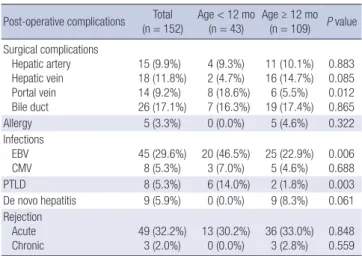
Post-operative complications of the recipients are summarized in Table 2. The post-operative complication rate was 72.4%. The most common complication was acute cellular rejection in 49 cases (32.2%). Bile duct complication was most common in surgical aspect (17.1%). Epstein-Barr virus (EBV) infection was diagnosed in 45 cases (29.6%), and cytomegalovirus (CMV) in- fection was diagnosed in 8 cases (5.3%). PTLD was diagnosed in 8 cases (5.3%).
Within 15 hepatic arterial complication cases, 8 had re-oper- ations, 1 had angio-intervention, and 6 had conservative man- agements. Within 18 hepatic vein complication cases, 4 had re- operations, 4 had stent insertions, 7 had balloon dilatations, and 3 had conservative managements. Within 14 portal vein complication cases, 3 had re-operations, 4 had stent insertions, 3 had balloon dilatations, and 4 had conservative managements.
Within 26 bile duct complication cases, 5 had re-operations, 15 had percutaneous transhepatic biliary drainage (PTBD) inser- tions, 3 had endoscopic retrograde biliary drainage (ERBD) in- sertions, and 2 had both PTBD and ERBD insertions.
There were 27 (17.8%) cases of immediate post-operative complications that needed operative interventions under gen-
eral anesthesia. The most common cause of grade IIIb compli- cation was post-operative bleeding which was in 9 (5.9%) cases.
Other causes of grade IIIb complications were 6 (3.9%) bile duct complications, 3 (2.0%) portal vein complications, 2 (1.3%) he- patic arterial thrombosis, 2 (1.3%) hepatic arterial stenosis, 2 (1.3%) hepatic vein complications, and 1 (0.7%) graft liver tor- sion, ileal perforation, adhesive ileus. There were 2 cases (1.3%) of re-operation cases for post-transplant lymphomas.
Post-operative complications according to graft types are pre- sented in Table 2B. There were no statistical differences of sur- gical complication within left lateral section graft and other grafts.
Survival outcome
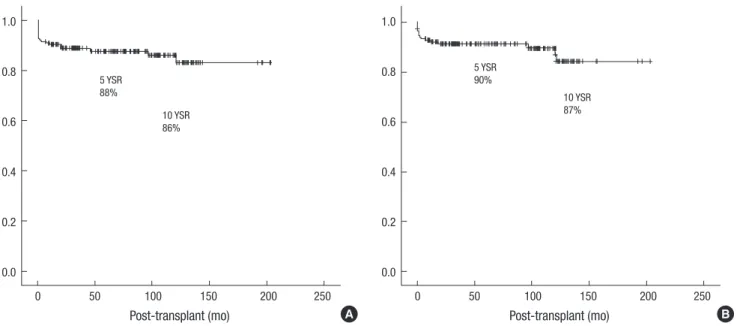
The patient survival rate and the graft survival rate were calcu- lated using the Kaplan-Meier method (Fig. 1). Six cases (3.9%) of re-LTs were performed. Three were re-transplanted due to acute rejection. Others were owing to hepatic artery thrombo- sis, hepatic vein stenosis, and recurred Allagile syndrome. The overall mean graft survival was 177 months and mean patient survival was 179 months. The 1, 5, and 10 yr graft survival rates were 92%, 88%, and 86%, respectively; and the 1, 5, and 10 yr patient survival rates were 93%, 90%, and 87%, respectively.
Patient characteristics between the two age groups; Group A and B
We analyzed the characteristics of the two groups as shown in Table 2A. Post-operative complications
Post-operative complications Total
(n = 152) Age < 12 mo
(n = 43) Age ≥ 12 mo (n = 109) P value Surgical complications
Hepatic artery Hepatic vein Portal vein Bile duct
15 (9.9%) 18 (11.8%) 14 (9.2%) 26 (17.1%)
4 (9.3%) 2 (4.7%) 8 (18.6%) 7 (16.3%)
11 (10.1%) 16 (14.7%) 6 (5.5%) 19 (17.4%)
0.883 0.085 0.012 0.865
Allergy 5 (3.3%) 0 (0.0%) 5 (4.6%) 0.322
Infections EBV
CMV 45 (29.6%)
8 (5.3%) 20 (46.5%)
3 (7.0%) 25 (22.9%) 5 (4.6%) 0.006
0.688
PTLD 8 (5.3%) 6 (14.0%) 2 (1.8%) 0.003
De novo hepatitis 9 (5.9%) 0 (0.0%) 9 (8.3%) 0.061 Rejection
Acute Chronic
49 (32.2%) 3 (2.0%)
13 (30.2%) 0 (0.0%)
36 (33.0%) 3 (2.8%)
0.848 0.559 EBV, Epstein-Barr virus; CMV, cytomegalovirus; PTLD, post-transplant lympho-prolif- erative disease.
Table 2B. Post-operative complications according to graft types Post-operative complications Total
(n = 152) LLS
(n = 52) Others (n = 100) P value Surgical complications
Hepatic artery Hepatic vein Portal vein Bile duct
14 (9.2%) 18 (11.8%) 14 (9.2%) 26 (17.1%)
4 (7.7%) 4 (7.7%) 3 (5.8%) 9 (17.3%)
10 (10.0%) 14 (14.0%) 11 (11.0%) 17 (17.0%)
0.602 0.229 0.267 0.973 LLS, Left lateral section.
Table 1. The gender proportion was almost equal in the two groups (boys/girls 51.2%/48.8% in Group A, and 48.6%/51.4%
in Group B). BA was more common in Group A (76.7%) than in Group B (54.1%) (P = 0.021). Fulminant hepatitis (FH) was 4.7%
in Group A and 13.8% in Group B (P = 0.021) which was signifi- cantly different. The percentage of recipients with a body weight under 6 kg was 7.0% in group A and 1.8% in group B (P = 0.128).
The year of LT did not significantly differ. The percentage of re- cipients with a CTP score of over 7 was 95.1% in Group A and 71.7% in Group B (P = 0.001). The percentage of recipients with a PELD score of over 20 was 46.5% in Group A and 26.6% in Group B. The mean PELD score was higher in Group A (22.4 ± 10.9) than in Group B (13.4 ± 11.6) (P = 0.049). This indicates that the worse pre-operative condition of patients was that of Group A.
The proportion of deceased donors was 16.3% in Group A and 24.8% in Group B (P = 0.181). The donor type of the left lateral section was 47.6% in Group A and 29.9% in Group B (P = 0.231).
In post-operative condition, the acute rejection rate was 30.2%
in Group A and 33.0% in Group B (P = 0.848). Chronic rejection was not found in Group A but 2.8% was found in Group B (P = 0.559). Hepatic artery complication was 9.3% in Group A and 8.3% in Group B (P = 1.000). Hepatic vein complication was 4.7% in Group A and 11.9% in Group B (P = 0.235). Portal vein complication was 18.6% in Group A and 3.7% in Group B, with a statistical difference (P = 0.005). Bile duct complication was 34.9% in Group A and 22.9% in Group B (P = 0.154). The re-tran- splantation rate was 2.3% in Group A and 4.6% in Group B (P = 1.000). Portal vein complications were more common in Group A than in Group B, but others were not significant.
Survival outcomes between the two age groups
Fig. 2A shows the patient and graft survival outcomes of the two
groups using the Kaplan-Meier method. The 1, 5, and 10 yr graft survival rates were 93%, 89%, and 89% in Group A and 91%, 89%, and 87% in Group B (P = 0.555). The 1, 5, and 10 yr patient sur- vival rates were 93%, 93%, and 93%, in Group A and 92%, 90%, and 88% in Group B (P = 0.212).
Analysis of prognostic factors affecting patient and graft survival according to age
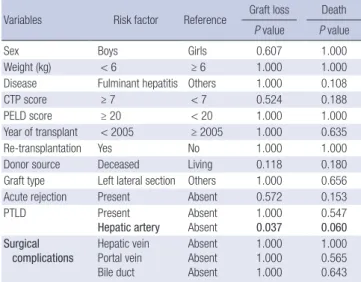
On univariate risk analysis for patient and graft survival of Group A (Table 3), hepatic artery complication was the only significant prognostic factor (P = 0.037) for graft survival, and there was no significant factor for patient survival. In multivariate analysis of Group A, there was no statistically significant factor for either patient or graft survival.
On univariate risk analysis for graft survival of Group B (Table 4), FH (P = 0.003), re-transplantation (P = 0.014), and deceased donor (P = 0.044) were significant prognostic factors; and on pa- tient survival, FH (P < 0.001), and re-transplantation (P = 0.018) were significant prognostic factors. On multivariate analysis for graft and patient survival of Group B, FH (P = 0.001 for graft, ha- zard ratio = 0.12, and P < 0.001 for patient, hazard ratio = 0.10), and re-transplantation (P = 0.021 for graft, hazard ratio = 0.13, and P = 0.025 for patient, hazard ratio = 0.14) were significant prognostic factors.
DISCUSSION
Although LT has been a key therapy for end stage liver diseases in children, the LT of infants has conventionally been avoided due to technical difficulties and poor survival outcome (8-12).
This study describes a single center, long term data analysis of LT recipients under the age of one year old. Several articles have Fig. 1. Overall survival outcome of pediatric liver transplantation. (A) Graft survival rate. (B) Patient survival rate. YSR, year survival rate.
Post-transplant (mo)
0 50 100 150 200 250
1.0
0.8
0.6
0.4
0.2
0.0
5 YSR 88%
10 YSR 86%
Post-transplant (mo)
0 50 100 150 200 250
1.0
0.8
0.6
0.4
0.2
0.0
5 YSR 90%
10 YSR 87%
A B
been published analyzing recipients in this age group; however, most of the previous data were obtained from DDLT based cen- ters of western countries. Since our center’s data has more than 75% of LDLT dominancy, the purpose of this study was to eval- uate our data in detail, and to compare the outcome of recipi- ents under 12 months of age and associated factors with other age groups in a LDLT based study group.
The acceptable outcome of long term graft survival rates for children less than 12 months have been reported to be as low as 50%-69% and patient survival rates have been reported to be 74%-80% (13-16). Recently, Venick et al. (17) reported that the 1, 5, and 10 yr graft survival rates under 12 months of age were
75%, 72%, and the patient survival rates 68% and 79%, 77%, and 75%, respectively. Their report concluded that, compared to older recipients, small infants showed poorer survival outcome.
Infants historically had the highest wait-list mortality owing to lack of small size donors in DDLT dominant societies (22, 23).
Compared to older children, infants tend to have a greater sur- vival with LDLT grafts because of the shorter waiting time and shorter ischemic time compared to DDLT graft (24). A number of reports have been published showing equal survival outcome for small infants, but the study size were small to get a clinical significances (18, 19).
The option of LDLT for infant recipients allowed for a reduc- Fig. 2. The patient and graft survival outcomes of the two groups according to the age; less (infant) and more (children) than 12 months. (A) Graft survival rate. (B) Patient sur- vival rate.
Survival A
0 50 100 150 200 250 1.0
0.8
0.6
0.4
0.2
0.0
Graft
Children (n = 109) Infant (n = 43)
P > 0.05
Patient
Children (n = 109) Infant (n = 43)
P > 0.05
Survival
0 50 100 150 200 250
1.0
0.8
0.6
0.4
0.2
0.0
Survival B
0 50 100 150 200 250 1.0
0.8
0.6
0.4
0.2
0.0
Graft
12 mo < (n = 109)
≤ 6 mo (n = 8)
6 mo <, ≤ 12 mo (n = 35)
P = 0.502
Patient
12 mo < (n = 109)
≤ 6 mo (n = 8) 6 mo <, ≤ 12 mo (n = 35)
P > 0.05
Survival
0 50 100 150 200 250
1.0
0.8
0.6
0.4
0.2
0.0
Table 3. Factors affecting survival outcome on univariate analysis in Group A (infant)
Variables Risk factor Reference Graft loss Death P value P value
Sex Boys Girls 0.607 1.000
Weight (kg) < 6 ≥ 6 1.000 1.000
Disease Fulminant hepatitis Others 1.000 0.108
CTP score ≥ 7 < 7 0.524 0.188
PELD score ≥ 20 < 20 1.000 1.000
Year of transplant < 2005 ≥ 2005 1.000 0.635
Re-transplantation Yes No 1.000 1.000
Donor source Deceased Living 0.118 0.180
Graft type Left lateral section Others 1.000 0.656
Acute rejection Present Absent 0.572 0.153
PTLD Present
Hepatic artery
Absent Absent
1.000 0.037
0.547 0.060 Surgical
complications Hepatic vein Portal vein Bile duct
Absent Absent Absent
1.000 1.000 1.000
1.000 0.565 0.643 CTP, Child-Turcotte-Pugh; PELD, pediatric end-stage liver disease; PTLD, post-trans- plant lympho-proliferative disease.
Table 4. Factors affecting survival outcome in Group B (children)
Variables Risk factor Reference
Univariate analysis Multivariate analysis
Graft loss Death Graft loss Death
P value P value HR 95% CI P value HR 95% CI P value
Sex Boys Girls 0.256 0.166
Weight (kg) < 6 ≥ 6 0.229 0.246
Disease Fulminant hepatitis Others 0.003 0.000 0.12 0.03-0.43 0.001 0.10 0.03-0.37 0.000
CTP score ≥ 7 < 7 0.502 0.755
PELD score ≥ 20 < 20 0.087 0.181
LT era < 2005 ≥ 2005 0.759 1.000
Re-transplantation Yes No 0.014 0.018 0.13 0.002-0.73 0.021 0.14 0.03-0.78 0.025
Donor source Deceased Living 0.044 0.057 1.62 0.42-6.33 0.487 1.41 0.37-5.36 0.613
Graft type Left lateral section Others 0.199 0.346
Acute rejection Present Absent 1.000 1.000
Chronic rejection Present Absent 0.319 0.341
PTLD Present Absent 0.225 0.241
Surgical complications Hepatic artery Hepatic vein Portal vein Bile duct
Absent Absent Absent Absent
1.000 0.358 0.403 0.490
0.325 0.212 0.428 0.734
CTP, Child-Turcotte-Pugh; PELD, pediatric end-stage liver disease; LT, liver transplantation; PTLD, post-transplant lymphoproliferative disease; HR, hazard ratio; CI, confidence interval.
ed wait-list mortality with minimal ischemia time (17). Even though a few reports have been presented that did not show survival advantages with LDLT (20, 21), other large single cen- ter long term analysis reported better survival outcome. The Japanese Liver Transplantation Society (28) recently reported the 20 yr survival outcomes of 2,200 cases of pediatric LT; the 1-, 5-, 10- and 20-yr patient survival rates were 88.3%, 85.4%, 82.8%, and 79.6%, respectively. The recipient ages of less than 6 months (n = 106, 4.8%) and over 10 yr (n = 396, 17.8%) showed lower survival outcomes. The Korean multicenter studies of pe- diatric LT (29) recently showed the survival outcome; 1-, 5-, and 10-yr patient survival rates were 87.8%, 82.2%, and 78.1%, re-
spectively. The survival outcome did not differ according to the recipient age of less than 12 months (n = 187, 35.0%). However these reports did not show the associated prognostic factors ac- cording to the age group. Analyzing factors according to age has relevance because the general conditions and underlying liver disease differed somewhat according to the age at the time of the transplant.
In the present study, the number of recipients less than 6 mon- ths was small (n = 8, 5.3%), which may lead to type II errors. There- fore, we merely divided the patient group according to infants and children within 12 months of age. Furthermore to ensure that small infants do not have inferior survival rate, we addition- ally evaluated survival outcome of recipients less than 6 months as well in Fig. 2B. Although no significant survival difference was observed, we analyzed the factors associated with survival outcome according to the age group. The overall survival out- comes of our study including both age groups were acceptable compared to other previously reported papers (4-6); the 1, 5, and 10 yr graft survival rates were 92%, 88%, and 86%, and the patient survival rates were 93%, 90%, and 87%, respectively.
The infants (Group A) had poorer pre-operative conditions i.e., higher PELD and higher CTP score and had worse post-op- erative complications. Since our center has 76% of LDLT domi- nancy, the waitlist mortality rates were relatively low. Similar findings have also been documented in other studies (17, 25).
Due to the small size of vessels, small infants are known to be related with higher vascular complication rates (10, 26). In our data, the portal vein complications in Group A were statistically higher than in Group B. In Group A, a total of 8 cases of portal vein stenosis were treated with stent insertion, and none of these
directly affected patient survivals. Hepatic artery thrombosis is also known to occur frequently in small children, but in our anal- ysis, it was not. This was also noticed in other previous studies using surgical microscopes (18, 19, 27).
It has been reported that there are relatively high incidence of PTLD in younger recipients (30, 31). In our study, PTLD was also significantly higher in the infant group. Six patients were diagnosed with PTLD in the infant group and two died of lym- phoma. Since four infants are still on conservative management, the PTLD was not a significant prognostic factor for survival out- come.
There were 6 re-transplantation cases. Only one of Group A had a second LT due to portal vein complications. In addition, similar to other previous studies, re-transplantation in older chil- dren seems to carry an increased risk of death (17). The rates of acute and chronic rejection did not differ significantly. Because the two age groups significantly differed in pre-operative char- acteristics and post-operative complications, it is important to evaluate the prognostic factors differently for the different age groups in order to manage the patient properly and determine whether or not to perform LT. In the infant group, only hepatic artery complication was a significant prognostic factor in uni- variate analysis. On multivariate analysis, no factor proved to be significant in the infant group. In the children group, FH and retransplantation was a significant prognostic factor in multi- variate analysis.
The limitation of our study is that it was retrospectively re- viewed. Long term growth and development of the recipients were not analyzed in our study. However, since our study was detailed, long-term, and a LDLT dominant single center study, it may aid clinicians and surgeons in their medical decisions.
Survival outcome was not inferior in infants (≤ 12 months) com- pared to children, although the pre-transplant medical condi- tion was more critical and post-transplant complication was more common in the infants. Age alone should not be regarded as a contraindication for LT. LT in small infant is a safe proce- dure. Careful treatment is recommended over fulminant hepa- titis patients, which is the only preoperative prognostic factor on the survival outcome, especially for children (> 12 months).
ACKNOWLEDGMENT
This article won the young investigator award at the 64th Annu- al Congress of the Korean Surgical Society.
DISCLOSURE
None of the authors of this study has any financial interest or conflict with industries or parties.
ORCID
Jeik Byun http://orcid.org/0000-0002-3405-5945 Jeong-Moo Lee http://orcid.org/0000-0001-7806-8759 Suk-won Suh http://orcid.org/0000-0001-6111-9601 YoungRok Choi http://orcid.org/0000-0003-2408-7086 Jae-Sung Ko http://orcid.org/0000-0002-3064-2974 Hyeyoung Kim http://orcid.org/0000-0002-3157-8214 Hae Won Lee http://orcid.org/0000-0002-3312-9295 Hyun-Young Kim http://orcid.org/0000-0003-0106-9969 Kwang-Woong Lee http://orcid.org/0000-0001-6412-1926 Kwi-Won Park http://orcid.org/0000-0002-9857-3709 REFERENCES
1. Kim ST, Kim SJ, Park KW, Suh KS, Jung SE, Ha J, Kim YH, Yun IJ, Lee KU.
Early experience of liver transplantation at Seoul National University Hospital. Transplant Proc 1996; 28: 1695-6.
2. Kim JS, Grotelüschen R, Mueller T, Ganschow R, Bicak T, Wilms C, Mue- ller L, Helmke K, Burdelski M, Rogiers X, et al. Pediatric transplantation:
the Hamburg experience. Transplantation 2005; 79: 1206-9.
3. Duffy JP, Kao K, Ko CY, Farmer DG, McDiarmid SV, Hong JC, Venick RS, Feist S, Goldstein L, Saab S, et al. Long-term patient outcome and quali- ty of life after liver transplantation: analysis of 20-year survivors. Ann Surg 2010; 252: 652-61.
4. Ueda M, Oike F, Ogura Y, Uryuhara K, Fujimoto Y, Kasahara M, Ogawa K, Kozaki K, Haga H, Tanaka K. Long-term outcomes of 600 living donor liver transplants for pediatric patients at a single center. Liver Transpl 2006; 12: 1326-36.
5. Jain A, Mazariegos G, Kashyap R, Kosmach-Park B, Starzl TE, Fung J, Reyes J. Pediatric liver transplantation: a single center experience span- ning 20 years. Transplantation 2002; 73: 941-7.
6. Oh SH, Kim KM, Kim DY, Lee YJ, Rhee KW, Jang JY, Chang SH, Lee SY, Kim JS, Choi BH, et al. Long-term outcomes of pediatric living donor liv- er transplantation at a single institution. Pediatr Transplant 2010; 14:
870-8.
7. Korean Network for Organ Sharing. KONOS status system. Available at http://www.konos.go.kr/konosis [accessed on 17 July 2013].
8. Sokal EM, Veyckemans F, de Ville de Goyet J, Moulin D, Van Hoorebeeck N, Alberti D, Buts JP, Rahier J, Van Obbergh L, Clapuyt P. Liver transplan- tation in children less than 1 year of age. J Pediatr 1990; 117: 205-10.
9. Esquivel CO, Koneru B, Karrer F, Todo S, Iwatsuki S, Gordon RD, Ma- kowka L, Marsh WJ Jr, Starzl TE. Liver transplantation before 1 year of age. J Pediatr 1987; 110: 545-8.
10. Busuttil RW, Seu P, Millis JM, Olthoff KM, Hiatt JR, Milewicz A, Nuesse B, el-Khoury G, Raybould D, Nyerges A, Liver transplantation in chil- dren. Ann Surg 1991; 213: 48-57.
11. Cox KL, Berquist WE, Castillo RO. Paediatric liver transplantation: in- dications, timing and medical complications. J Gastroenterol Hepatol 1999; 14: S61-6.
12. Colombani PM, Dunn SP, Harmon WE, Magee JC, McDiarmid SV, Spray TL. Pediatric transplantation. Am J Transplant 2003: 3: 53-63.
13. Cacciarelli TV, Esquivel CO, Moore DH, Cox KL, Berquist WE, Concep-
cion W, Hammer GB, So SK. Factors affecting survival after orthotopic liver transplantation in infants. Transplantation 1997; 64: 242-8.
14. Woodle ES, Millis JM, So SK, McDiarmid SV, Busuttil RW, Esquivel CO, Whitington PF, Thistlethwaite JR. Liver transplantation in the first three months of life. Transplantation 1998; 66: 606-9.
15. Noujaim HM, Mayer DA, Buckles JA, Beath SV, Kelly DA, McKiernan PJ, Mirza DF, de Ville De Goyet J. Techniques for and outcome of liver transplantation in neonates and infants weighing up to 5 kilograms. J Pediatr Surg 2002; 37: 159-64.
16. Colombani PM, Cigarroa FG, Schwarz K, Wise B, Maley WE, Klein AS.
Liver transplantation in infants younger than 1 year of age. Ann Surg 1996; 223: 658-62.
17. Venick RS, Farmer DG, McDiarmid SV, Duffy JP, Gordon SA, Yersiz H, Hong JC, Vargas JH, Ament ME, Busuttil RW. Predictors of survival fol- lowing liver transplantation in infants: a single-center analysis of more than 200 cases. Transplantation 2010; 89: 600-5.
18. Chan KL, Fan ST, Saing H, Wei W, Lo CM, Ng I, Tsoi NS, Chan J, Tso WK, Yuen KY, et al. Liver transplantation is not contraindicated in infancy.
Transplant Proc 2000; 32: 2142-3.
19. Van der Werf WJ, D’Alessandro AM, Knechtle SJ, Pilli G, Hoffmann RM, Judd RH, Odorico JS, Kirk AD, Rayhill SC, Sollinger HW, et al. Infant pe- diatric liver transplantation results equal those for older pediatric pa- tients. J Pediatr Surg 1998; 33: 20-3.
20. Deshpande RR, Bowles MJ, Vilca-Melendez H, Srinivasan P, Girlanda R, Dhawan A, Mieli-Vergani G, Muiesan P, Heaton ND, Rela M. Results of split liver transplantation in children. Ann Surg 2002; 236: 248-53.
21. Wallot MA, Mathot M, Janssen M, Hölter T, Paul K, Buts JP, Reding R, Otte JB, Sokal EM. Long-term survival and late graft loss in pediatric liv- er transplant recipients: a 15-year single-center experience. Liver Transpl 2002; 8: 615-22.
22. Horslen S, Barr ML, Christensen LL, Ettenger R, Magee JC. Pediatric transplantation in the United States, 1996-2005. Am J Transplant 2007;
7: 1339-58.
23. Magee JC, Krishnan SM, Benfield MR, Hsu DT, Shneider BL. Pediatric transplantation in the United States, 1997-2006. Am J Transplant 2008;
8: 935-45
24. McDiarmid SV, Anand R, Lindblad AS; SPLIT Research Group. Studies of Pediatric Liver Transplantation: 2002 update: an overview of demo- graphics, indications, timing, and immunosuppressive practices in pedi- atric liver transplantation in the United States and Canada. Pediatr Trans- plant 2004; 8: 284-94.
25. Fouquet V, Alves A, Branchereau S, Grabar S, Debray D, Jacquemin E, Devictor D, Durand P, Baujard C, Fabre M, et al. Long-term outcome of pediatric liver transplantation for biliary atresia: a 10-year follow-up in a single center. Liver Transpl 2005; 11: 152-60.
26. Farmer DG, Venick RS, McDiarmid SV, Ghobrial RM, Gordon SA, Yer- siz H, Hong J, Candell L, Cholakians A, Wozniak L, et al. Predictors of outcomes after pediatric liver transplantation: an analysis of more than 800 cases performed at a single institution. J Am Coll Surg 2007; 204: 904- 14.
27. Mekeel KL, Langham MR Jr, Gonzalez-Peralta RP, Hemming AW. Liver transplantation in very small infants. Pediatr Transplant 2007; 11: 66- 72.
28. Kasahara M, Umeshita K, Inomata Y, Uemoto S; Japanese Liver Trans- plantation Society. Long-term outcomes of pediatric living donor liver transplantation in Japan: an analysis of more than 2200 cases listed in the registry of the Japanese Liver Transplantation Society. Am J Trans- plant 2013; 13: 1830-9.
29. Kim JM, Kim KM, Yi NJ, Choe YH, Kim MS, Suh KS, Kim SI, Lee SK, Lee SG. Pediatric liver transplantation outcomes in Korea. J Korean Med Sci 2013; 28: 42-7.
30. Guthery SL, Heubi JE, Bucuvalas JC, Gross TG, Ryckman FC, Alonso MH, Balistreri WF, Hornung RW. Determination of risk factors for Ep- stein-Barr virus-associated posttransplant lymphoproliferative disorder in pediatric liver transplant recipients using objective case ascertainment.
Transplantation 2003; 75: 987-93.
31. Narkewicz MR, Green M, Dunn S, Millis M, McDiarmid S, Mazariegos G, Anand R, Yin W; Studies of Pediatric Liver Transplantation Research Group. Decreasing incidence of symptomatic Epstein-Barr virus disease and posttransplant lymphoproliferative disorder in pediatric liver trans- plant recipients: report of the studies of pediatric liver transplantation experience. Liver Transpl 2013; 19: 730-40.