from Zeolitic Imidazolate Framework-7
Ji Won Yoon1, Rui Wang1, Joon-Shik Park2, and Jong-Heun Lee1,+
Abstract
Highly uniform and well-dispersed Zeolitic Imidazolate Framework-7 (ZIF-7) particles were prepared by the precipitation of Zn
2+using benzimidazole, which were converted into ZnO nanoparticles by heat treatment at 500 °C for 24 h. The ZIF-7 derived ZnO nanoparticles showed abundant mesopores, high surface area, and good dispersion. The gas sensing characteristics toward 5 ppm ace- tone, ethanol, trimethylamine, ammonia, p-xylene, toluene, benzene, and carbon monoxide and carbon dioxide were investigated at 350 – 450
oC. ZIF-7 derived ZnO nanoparticles exhibited high response to 5 ppm acetone (R
a/R
g=57.6; R
a: resistance under exposure to the air, R
g: resistance under exposure to the gas) at 450
oC and negligible cross-responses to other interference gases (trimethylamine, ammo- nia, p-xylene, toluene, benzene, carbon monoxide, carbon dioxide) and relatively low responses to ethanol. ZIF derived synthesis of metal oxide nanoparticles can be used to design high performance acetone sensors.
Keywords: Zeolitic Imidazolate Framework-7, ZnO, Gas sensor, Oxide semiconductor
1. 서 론
산화물 반도체형 가스 센서는 감응 물질의 표면과 피검가스 의 반응을 통해 발생하는 저항 변화로 가스를 검출한다 [1]. n- 형 산화물 반도체 가스 감응 물질로는 SnO
2[2,3], ZnO [4,5], In
2O
3[6], TiO
2[7], WO
3[8], Fe
2O
3[9] 등이 있다. 200~400
oC 에 서 n-형 산화물 반도체의 표면에 산소가 흡착되면 반도체 표면 으로부터 전자를 받아 음으로 (O
-또는 O
2-) 대전되고, 전자 공 핍층이 표면 부근에 형성되어 센서의 저항이 증가한다. 이때 환 원성 가스가 산화물 반도체 표면에 존재하는 음으로 대전된 표 면산소와 반응하여 산화될 경우, 반응에서 남은 전자가 반도체 형 가스센서에 주입되어 가스 농도에 비례하는 저항 감소를 센
서 신호로 얻을 수 있다.
가스 감응 특성을 향상시키기 위해서는 비표면적이 크면서 가 스의 확산이 용이한 다공성 나노구조가 유리하다 [10]. 분무열 분해 [11], 수열합성 [12], 전기 방사법 [13], 용액합성 [14]과 같 은 방법으로 가스 감응소재가 합성된 바 있지만, 다공성 나노구 조 산화물 합성을 위해 보다 단순한 공정이 필요하다.
Zeolitic Imidazolate Framework(ZIF) 는 단순한 용액 공정으 로 다공성 나노구조를 합성할 수 있어, 가스분리막과 가스센 서 분야에서 응용 가능성이 높다 [15]. ZIF는 Metal Organic Framework의 한 종류로 금속 이온과 유기 리간드의 조합을 통해 수 Å에서 수 nm에 이르는 다양한 기공을 형성하는 금 속유기구조체이다 [16]. 그 중에서 ZIF-7은 Zn
2+이 유기 리간 드 benzimidazole과 3D tetrahedral 구조를 형성한 구조체이 다. 기공의 크기는 약 3 Å으로 알려져 있으며 고온에서는 리 간드가 분해되고, 금속이 산화되어 다공성 산화물이 합성된다 [17]. 투명전극의 제작에도 사용되는 ZnO [18]는 아세톤, 에 탄올 등을 검지하는 가스 센서에서도 활용되고 있는 물질이므 로, ZIF의 열분해를 이용하여 제조한 ZnO의 아세톤 감응특성 은 우수할 것으로 판단된다. 본 연구에서는 ZIF-7을 ZnO로 산화하여 mesopore를 지닌 나노 구조체를 합성하여 아세톤 가 스 감응 특성을 평가하였다.
1고려대학교 신소재공학부 (Department of Materials Science and Engineering, Korea University)
145 Anam-ro, Seongbuk-gu, Seoul 20841, Korea
2전자부품연구원 스마트센서연구센터(Smart Sensor Research Center, Korea Electronics Technology Institute)
25 Saenari-ro Bundang Seongnam Gyeonggi, 13509, Korea
+Corresponding author: [email protected]
(Received: May. 15, 2017, Revised: May. 24, 2017, Accepted: May. 26, 2017)
This is an Open Access article distributed under the terms of the Creative Commons Attribution Non-Commercial License(http://creativecommons.org/
licenses/bync/3.0) which permits unrestricted non-commercial use, distribution, and reproduction in any medium, provided the original work is properly cited.
2. 실험방법
2.1 ZIF-7 derived ZnO 나노입자 합성
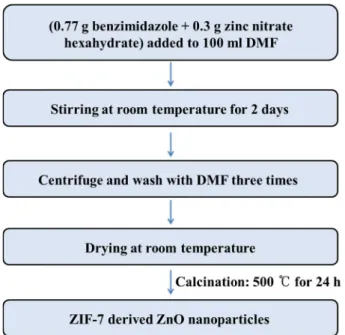
ZIF-7 derived ZnO 나노 입자는 Cai et al. 의 실험 방법을 따 라 합성했다 [17]. Benzimidazole (0.77 g, 98%, Sigma-Aldrich Co., Ltd., USA)와 zinc nitrate hexahydrate (Zn(NO
3)
2· 6H
2O, 0.3 g, 98%, Sigma-Aldrich Co., Ltd., USA) 를 DMF (N,N- Dimethylformamide, 100 ml, 99.5%, Samchun Co., Ltd. Korea) 에 첨가하여 2일간 상온에서 교반시켰다. 이후, 생성된 ZIF-7 나노 입자를 수득하기 위해 원심분리(10,000 rpm; 10분)를 한 뒤, DMF 로 세 번 세척했다. ZIF-7 나노 입자는 상온에서 건조한 뒤 500
o
C에서 24 시간 동안 열처리하여 다공성 ZnO 나노 입자로 변 환시켰다. 합성된 나노 입자의 특성을 분석하기 위하여 Field- Emission 주사현미경 (FE-SEM, S-4300 Hitachi Co., Ltd., Japan) 과 X-선 회절기 (XRD, Rigaku Model/MAX-2500, Source:
CuKa), 투과전자현미경 (HR-TEM, Talos F200 X, Hillsboro, OR, USA) 과 Brunauer-Emmet-Teller 측정기(BET, Micromeritics Co., USA) 가 사용되었다.
2.2 센서 소자 제작 및 측정
ZnO 나노입자와 증류수를 교반하여 slurry 형태로 만든 후, Au 전극(폭: 100 mm, 간격: 100 mm) (Fig. 2a)이 패터닝 된 알루미 나 기판 위에 도포하였다. 상기의 감응 소자 (Fig. 2b)를 기판 후 면에 설치된 히터를 통해 500
oC에서 2 시간 열처리하여 잔류 수 분을 제거하였다. 가스 감응 특성을 평가하기 이전에 각각의 동 작 온도 구간에서 센서를 안정화하였으며, 가스의 유속은 500 cm
3/
min 으로 설정하였다. 측정한 가스 (acetone, ethanol, trimethylamine, ammonia, p-xylene, toluene, benzene, carbon monoxide, carbon dioxide)의 농도는 모두 5 ppm이며, 동작 온도는 350 - 450
oC이다.
3. 결과 및 고찰
3.1 X-선 회절 분석
Benzimidazole 과 zinc nitrate와의 반응에서 Zn
2+와 benzimidazole Fig 1. Flow diagrams of ZIF-7 derived ZnO nanoparticle synthesis.
Fig 2. (a) Schematic diagram of sensor substrate and (b) photograph of the sensor.
Fig. 3. X-ray diffraction (XRD) patterns of (a) ZIF-7 nanoparticles
and (b) ZIF-7 derived ZnO nano-particles.
과와 일치한다 [17]. 적 잘 분산된 상태로 있는 것을 확인할 수 있었다 (Fig. 5a). 고 해상도 TEM 사진에서 ZnO가 (101) 면간 거리가 2.48 Å인 결 정질임을 알 수 있다 (Fig. 5b). SAED 분석을 통해 결정질의 ZnO상을 다시 확인했다 (Fig. 5c).
3.3 BET 비표면적 분석
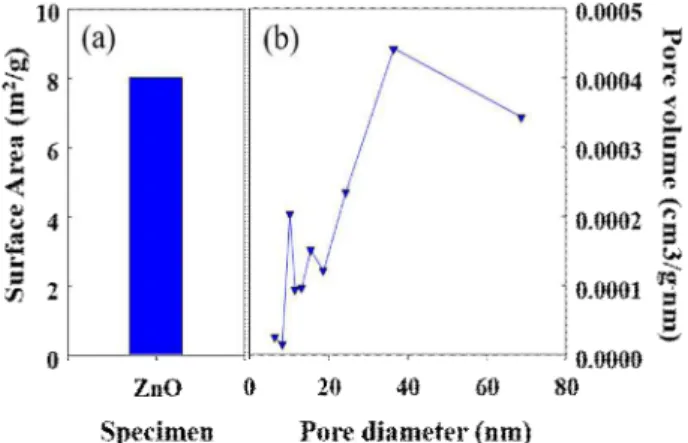
ZIF-7의 열분해에 의해 합성된 ZnO 나노 입자의 BET 분석 을 진행했다. ZnO 나노 입자의 비표면적은 약 8 m
2/g였으며 (Fig. 6a), 10 - 70 nm 크기의 mesopore가 많았으며, 특히 40 nm 크기의 기공이 가장 많이 분포하였다 (Fig. 6b). 이는 기존에 ZIF-7이 지니고 있던 benzimidazole이 고온에서 분해되고 ZnO 로 산화될 때 형성 된 기공으로 판단된다. 크기 2-50 nm의 mesopore 는 가스센서에서 비표면적을 증가시키는 동시에, 빠른 가스 확 산 가능하게 하여 가스 감도를 증가시키는 데 효과적이다 [19,20].
특히 가스와 기공의 충돌을 고려하는 Knudsen 확산기구에 의 해 가스가 확산할 경우, Knudsen 확산계수는 가스의 기공크기 에 비례하므로, 본 연구에서 합성한 상대적으로 큰 메조기공(~
40 nm) 은 피검가스가 감응소재 표면에 빨리 확산되는 데 기여 할 것으로 판단된다.
3.4 가스 감응 특성 평가
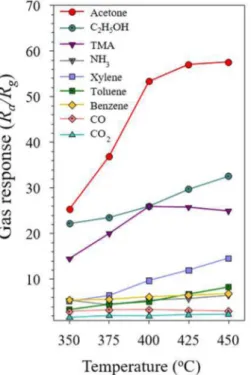
5 ppm 농도의 9가지 가스에 대한 가스감응 특성을 350 - 450
oC 에서 측정했다 (Fig. 7). 동작 온도가 증가함에 따라 모든 가스의 감도가 증가하는 양상을 나타냈다. 센서는 acetone에 가장 높은 감 도를 나타내었고, 450
oC 에서 S=R
a/R
g=57.6 를 보였다. 400~450
oC Fig. 4. SEM images of (a,b) ZIF-7 nanoparticles, and (c,d) ZIF-7
derived ZnO nanoparticles.
Fig. 5. TEM images of (a) ZIF-7 derived ZnO nanoparticle, (b) lat- tice-resolved image, and (c) SAED patterns of nanoparticles.
Fig. 6. (a) Specific surface area and (b) pore size distribution of the
ZIF-7 derived ZnO nanoparticles.
동작 온도 구간에서는 ethanol 대비 평균 1.92의 선택성(S
acetone/
S
ethanol) 을 나타내었으며, 암모니아, 벤젠, 자일렌, 톨루엔, 일산화
탄소, 이산화탄소에 대해서는 매우 우수한 선택성을 나타내었다.
5 ppm 의 acetone을 노출시킨 후 저항이 정상 상태 센서 저항 의 90%에 도달하는 응답시간 (t
response), 공기에 다시 노출되었을 때 정상상태 저항의 90%에 도달하는 회복시간 (t
recovery) 을 계산 하였다. 425
oC 에서의 5 ppm의 acetone 응답시간은 2초 내외, 회복시간은 124초로 매우 빠른 감응과 회복시간을 보였다. 센 서 소자의 acetone 선택성, 반응 속도와 회복 속도를 모두 고려 했을 때 최적의 동작 온도는 425
oC 로 판단된다. 센서의 acetone 검출 한계를 알아내기 위해 0.1-5 ppm의 acetone을 425
oC에서 측정하였다 (Fig. 8a). 이때 0.1 ppm acetone에 대한 감도는 6.4 으로 매우 높았다.
또한 R
a/R
g>1.2를 가스 검출의 최소 기준으로 정했을 때, Fig.
8a 의 데이터를 바탕으로 아세톤 검출 하한을 계산하였다. 그 결 과 본 연구의 ZnO 센서는 acetone을 10 ppb까지 검출할 수 있 다는 결과가 도출 되었다 (Fig 8b). 이것은 본 센서가 미량의 acetone 도 감지 할 수 있다는 것을 의미한다. 당뇨 환자의 날숨 에서 배출되는 아세톤 농도가 약 0.1-10 ppm 인 것을 고려하면 본 센서는 당뇨를 진단하는 데에도 효과적으로 활용될 수 있을 것으로 판단된다 [21]. 이외에 대기 중에 존재하는 ppb 수준의 아세톤을 고감도 고선택성으로 검출하는 데에도 이용될 수 있 을 것으로 기대된다. .
4. 결 론
ZIF-7 나노 입자의 합성 후 열분해를 통해 다공성 ZnO 나노 입자를 합성하고, 가스 감응 특성을 평가하였다. 센서는 매우 높 은 5 ppm acetone에 대해서 S=R
a/R
g=57.6 의 매우 높은 감도 를 나타내었으며, 다른 가스들에 대한 선택성도 매우 높았다. 반 응속도, 회복속도와 선택성을 모두 고려하였을 때 425
oC가 최 적 구동온도라 판단하였다. ZIF-7 derived ZnO 나노입자를 이 용한 센서는 425
oC에서 acetone을 10 ppb까지 검출가능하므로 인간의 날숨으로 당뇨병을 진단하는데 활용될 수 있을 것으로 기대된다.
감사의 글