Background: In Korean medicine, carpal tunnel syndrome is treated by stimulating the acupoints around the wrist. Although a deep understanding of anatomy and guidance is needed to stimulate these acupoints to avoid undesirable side-effects, currently there are no published guidelines for acupotomy treatment. The aim of this study is to evaluate the effectiveness and safety of fluoroscopy-guided acupotomy compared with conventional acupotomy treatment.
Methods: This is a randomized, patient-assessor, patient blind, parallel clinical trial. A total of 30 patients will be enrolled at Wonkwang University Gwangju Hospital, and will be allocated to either an experimental group or a control group. The experimental group will be treated using fluoroscopy-guided acupotomy and the control group will be treated using the conventional acupotomy method.
Results: The primary outcome measure will be identification of a cross-section area of the median nerve measured by ultrasonography, and the secondary outcome measure will be the alleviation of pain measured by the Visual Analogue Scale, improvement in the Nerve Conduction Study, Tinel test, Phalen’s test, EuroQol 5-dimension scale, and Boston Carpal Tunnel Questionnaire score. Safety components will be measured by monitoring vital signs, electrocardiographs, blood tests, general chemical tests, urine tests and pregnancy tests. In addition, observations for adverse effects will be performed during the trial.
Conclusion: This study will provide a more effective, and less harmful way of treating carpal tunnel syndrome compared with conventional acupotomy. Fluoroscopy-guided acupotomy will help practitioners to be accurate in direction and depth of the needle for treating carpal tunnel syndrome.
©2019 Korean Acupuncture & Moxibustion Medicine Society. This is an open access article under the CC BY- NC-ND license (http://creativecommons.org/licenses/by-nc-nd/4.0/).
Article history:
Submitted: March 27, 2019 Revised: April 12, 2019 Accepted: April 19, 2019 Keywords:
acupotomy, carpal tunnel syndrome, fluoroscopy, randomized controlled trial
https://doi.org/10.13045/jar.2019.00094 pISSN 2586-288X eISSN 2586-2898
Original Article
Safety and Effectiveness of Fluoroscopy-Guided Acupotomy for Carpal Tunnel Syndrome: Protocol for a Pilot Randomized, Patient-Assessor Blind, Parallel Clinical Trial
Muhack Yang 1 , Jae Kyoun Kim 2, 3 , Gun Woo Park 2 , Eunhye Cha 1 , Jongwon Jang 1 , Jihye Seo 2 , Sangkwan Lee 2 , Sungchul Kim 1, *
1 Department of Acupuncture and Moxibustion Medicine, Gwangju Medical Center, College of Korean Medicine, Wonkwang University, Gwangju, Korea 2 Clinical Trial center, Gwangju Medical Center, College of Korean Medicine, Wonkwang University, Gwangju, Korea
3 Department of Global Public Health and Korean Medicine Management, Graduate School, Kyung Hee University, Seoul, Korea
ABSTRACT
Journal of Acupuncture Research
Journal homepage: http://www.e-jar.org
Introduction
Carpal tunnel syndrome (CTS) is caused by pressure on the median nerve in the wrist. Symptoms include numbness, tingling, and weakness. In Korean medicine, CTS is treated by stimulating acupoints around the wrist, and when the needle is applied to these acupoints accurately, acupotomy shows good results in the treatment of CTS. Acupotomy is a treatment combining the advantages of surgical release technique of Western medicine with conventional acupuncture. The acupotomy needle has a sharp blade-shaped head with a flat tip. This distinguishing shape of the needle aids incision of post-inflammatory adhesion, hyperplasia of
the soft tissue such as transverse carpal ligament in the wrist, and decompresses the internal pressure of carpal tunnel [1].
Whilst treating the median nerve with surgery or acupotomy, there have been reports of side-effects such as claw hand deformity [2,3]. Treating the acupoints around the wrist (PC7, LU9, HT7) with acupotomy may cause side-effects such as fainting during treatment, hemorrhages, pain, hematoma, nerve injuries, and also infection [4]. When acupotomy is applied deeply, the median nerve is at risk of being injured in PC7, the radial artery in LU9, and the ulnar artery and ulnar nerve in HT7 [5,6]. Deep understanding of anatomy and guidance is needed to treat acupoints around the wrist but currently, there are no published guidelines.
* Corresponding author.
Department of Acupuncture and Moxibustion Medicine, Gwangju Medical Center, College of Korean Medicine, Wonkwang University, Gwangju, Korea E-mail addresses: [email protected]
ORCID: Muhack Yang https://orcid.org/0000-0003-3690-1073, Sungchul Kim https://orcid.org/0000-0001-9274-9243
©2019 Korean Acupuncture & Moxibustion Medicine Society. This is an open access article under the CC BY-NC-ND license (http://creativecommons.org/licenses/by-nc-
nd/4.0/).
Using fluoroscopy-guided acupotomy will help the practitioner identify the location of the bones in the region of the wrist, so that acupotomy can be applied accurately for carpal tunnel syndrome avoiding blood vessels and nerves. The direction and depth of fluoroscopy-guided acupotomy can be visualized which is thought to reduce the side-effects of conventional acupotomy treatment using the gol-do-bun-chon method, and derive a better outcome in treating CTS.
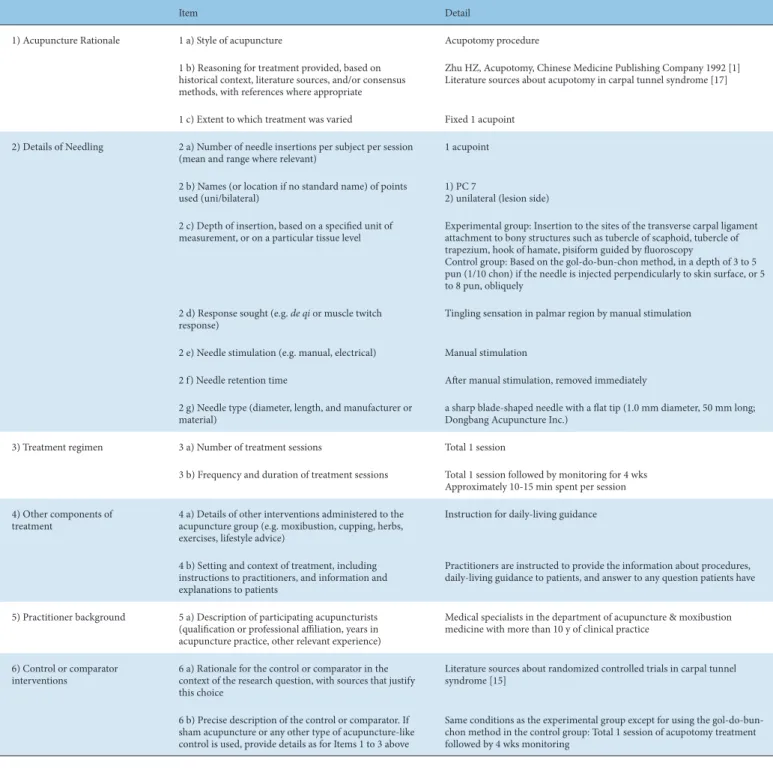
The gol-do-bun-chon method, also called bone proportional measurement, is a conventional way to locate acupoints in traditional Korean medicine [7]. In this method, the location of acupoints and the depth of needle insertion is measured by the practitioner’s eye, in which the length of the lower arm (from one’s elbow crease to wrist crease) of the subject is converted to 12 chon (Korean traditional measuring unit, also called Cun), so if the length of the lower arm is 24 cm, 1 chon is considered as 2 cm, and 1 chon can be converted to 10 pun. According to this method the acupotomy needle should be inserted into the acupoints around the wrist (PC7, LU9, HT7) to a depth of 3-5 pun, if inserted perpendicularly to the skin surface, or 5-8 pun, obliquely.
In this study, the design of the protocol for evaluating the effectiveness and safety of acupotomy on CTS using the portable fluoroscopic X-ray system (PF X-ray) compared with using the gol- do-bun-chon method is provided.
Materials and Methods Objective
The objective of this study is to compare the safety and effectiveness between fluoroscopy-guided acupotomy and the use of acupotomy using the gol-do-bun-chon method for treating CTS.
Design and settings
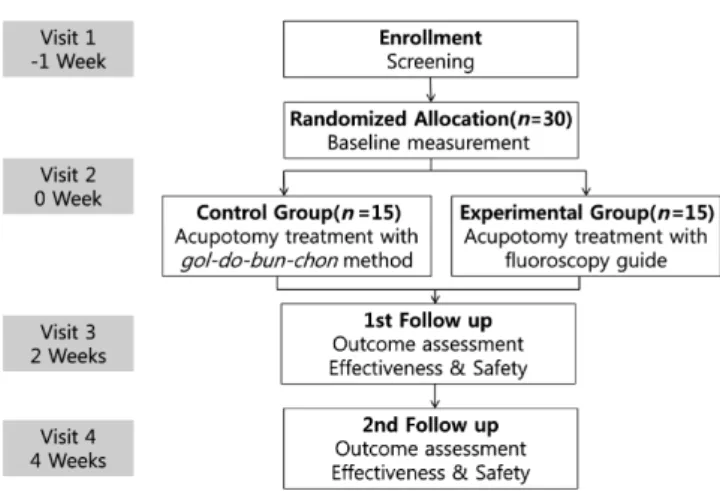
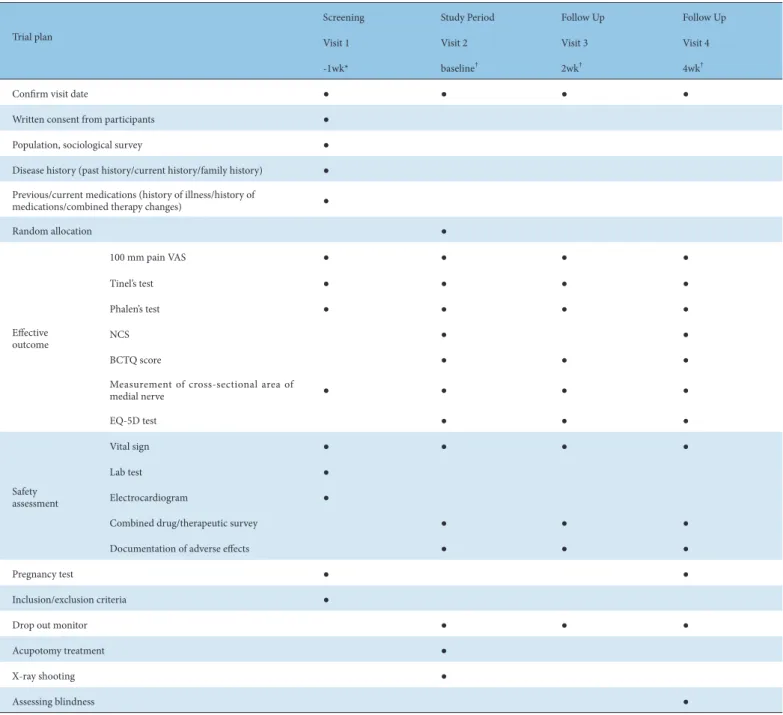
This is a randomized, patient-assessor, blind, parallel clinical trial targeting CTS patients. The trial will be conducted at the South Korea Wonkwang University, Gwangju Hospital. The schedule of study procedures is shown in Table 1 and a flow chart of the study is shown in Fig. 1.
A total of 30 patients will be enrolled in the trial. Patients who sign the clinical trial agreement by voluntary consent will be assessed by inclusion and exclusion criteria. Patients who meet the criteria will be allocated to either an experimental group or a control group. The experimental group will be treated by fluoroscopy-guided acupotomy and the control group will be treated using acupotomy following the gol-do-bun-chon method.
The treatment will be performed after measuring the pun and chon of the subject. After the treatment, the patient will be monitored for adverse events.
In the experimental group, the treatment site will first be observed using fluoroscopy. Using the fluoroscopy-guide, the practitioner will be able to observe the location of the tubercle of the scaphoid, tubercle of the trapezium, the hook of hamate, and the pisiform where the transverse carpal ligament attaches so that acupotomy can be applied accurately thereby avoiding blood vessels and nerves. An acupuncture needle will first be used for probing and then acupotomy will be used.
In the control group, acupoints will be determined by the gol- do-bun-chon method and then acupotomy will be used. In both the experimental group and the control group, acupoints will be checked with surgical markers and disinfected using povidone- iodine swab sticks. After the acupotomy treatment, the site will be disinfected again with povidone-iodine swab sticks and covered with gauze.
Ethics statement and trial registration
The study protocol was approved by the Institutional Review Board of Wonkwang University Gwangju Hospital in Gwangju, Republic of Korea (WKIRB-2017/19), and is registered with the Clinical Research Information Service of the Korea National Institute of Health in the Republic of Korea (KCT0003067), which is a World Health Organization Registry Network registry.
Written informed consent will be obtained from all participants, in accordance with the Declaration of Helsinki.
This trial was registered with the Clinical Research Information Service of the Korea National Institute of Health, Republic of Korea (KCT0003067). Any change in the protocol will be made in accordance with the official procedure, and will be approved by the Institutional Review Board, [Protocol Version: 2.3 (2018.04.03)].
As of March 2019, the trial is ongoing. The first patient was enrolled on 23 March 2018.
Participants
A total of 30 participants will be enrolled in this study. Each participant will receive an explanation of the study procedure and will be asked to sign the consent form. The patients’ vital signs and relevant medical history will be recorded.
Inclusion criteria
① Experiencing numbness, tingling, or nyctalgia symptoms in the hand which result in a visual analogue scale (VAS) score of 5 or more.
② Testing positive for Tinel’s sign or Phalen’s sign.
③ Having a cross-section area of the median nerve over 10 mm
2(measured by ultrasonography).
④ Willingness to participate in the study.
Exclusion criteria
① Patients who had undergone surgery to treat CTS.
② Presence of a physical abnormality in the carpal tunnel such as a tumor or malunion.
Fig. 1. Flow of the study.
③ Patients who are taking medicine related to a mental disorder or an immune disease.
④ Patients taking adrenocortical hormones or a nonsteroidal anti-inflammatory analgesic to treat CTS (A patient can enroll in the study if they have stopped taking the anti- inflammatory analgesic 1 week prior to enrollment).
⑤ Patients who have skin allergies or infections.
⑥ Insulin-treated diabetic patients, patients who have cardiovascular disease or have a pacemaker implanted, and patients who have kidney disease.
⑦ Pregnant women, lactating women, women who test positive
for pregnancy before random allocation, or women who do not agree to use medically appropriate contraceptives (e.g., oral medication, hormone implants, intrauterine devices, condoms, or spermicides).
⑧ Any patients deemed by a clinical research investigator, to be inappropriate for participation in the clinical trial.
Participant recruitment
The participants will be recruited through advertisements on hospital bulletin boards and local newspapers. They will be fully
Trial plan
Screening Study Period Follow Up Follow Up
Visit 1 Visit 2 Visit 3 Visit 4
-1wk* baseline
†2wk
†4wk
†Confirm visit date ● ● ● ●
Written consent from participants ●
Population, sociological survey ●
Disease history (past history/current history/family history) ● Previous/current medications (history of illness/history of
medications/combined therapy changes) ●
Random allocation ●
Effective outcome
100 mm pain VAS ● ● ● ●
Tinel’s test ● ● ● ●
Phalen’s test ● ● ● ●
NCS ● ●
BCTQ score ● ● ●
Measurement of cross-sectional area of
medial nerve ● ● ● ●
EQ-5D test ● ● ●
Safety assessment
Vital sign ● ● ● ●
Lab test ●
Electrocardiogram ●
Combined drug/therapeutic survey ● ● ●
Documentation of adverse effects ● ● ●
Pregnancy test ● ●
Inclusion/exclusion criteria ●
Drop out monitor ● ● ●
Acupotomy treatment ●
X-ray shooting ●
Assessing blindness ●
* Patients who have already taken analgesics should be instructed to stop taking the medicine 1 week prior enrollment in the study.
†