http://dx.doi.org/10.14518/crals.2014.32.2.011 Print ISSN 2287-271x Original Article
Optimization of Drying Conditions for Quality Semi-dried Mulberry Fruit ( Morus alba L.) using Response Surface Methodology
Hui Teng1 and WonYoung Lee1,2*
1School of Food Science and Bio-Technology, Kyungpook National University, 1370-Sankyunk Dong, BukGu, Daegu 702-701, Korea
2Food and Bio-Industry Research Institute, Kyungpook National University, Daegu 702-701, Korea
Received: May 22 2014 / Revised: June 27 2014 / Accepted: June 27 2014
Abstract Mulberry fruits were semi-dried using hot air (60- 100oC) or cool air (20-40oC), and the effects of the drying temperature and processing time on the quality of the final dried mulberry fruits were investigated. Response surface methodology was employed to establish a statistical model and predict the conditions resulting in minimal loss of the total phenolic content (TPC) and ascorbic acid. Thus, using overlapped contour plots, the optimal conditions for producing semi-dried mulberry fruits, which reduced the moisture residue to 45% and minimized the nutrient losses of TPC and ascorbic acid, were determined for the hot-air process (60.7oC for 5.4 h) and cool-air process (34.8oC for 23.3 h). Plus, a higher drying temperature was found to lead to a faster loss of moisture and ascorbic acid, while the TPC was significantly decreased in the cool-air dried mulberry fruits due to the higher activity of polyphenol oxidase between 30 and 40oC.
Keywords: ascorbic acid, drying process, mulberry fruits, total phenolic content, polyphenol oxidase, response surface methodology
Introduction
Mulberry plants are widely distributed throughout Korea, and dried mulberry fruits are used in tonics and commonly consumed for their excellent antioxidant, antimicrobial, and anti- inflammatory properties (Butt et al., 2008). However, mulberries are extremely perishable due to their high moisture content (>70%) and structural weakness (Ercisli and Orhan, 2007), giving them a shelf-life of shorter than one week at room temperature (20oC). Thus, only a small proportion of mulberries are consumed locally after harvest, while most are preserved in a frozen form, which upon defrosting results in substantial dripping and causes great economic loss in Korea.
Drying is an effective alternative to freezing and increasingly used for the preservation of fruits and vegetables. As a viable alternative to fresh fruits, dried fruits have a long shelf-life and allow seasonal fruits to be available for consumption throughout the year (Sumic et al., 2013). However, due to their greatly reduced moisture content, fully dried fruits usually have less flavor and color than fresh fruits. More importantly, fully dried fruits can be too hard to chew, making them a less preferable choice for some consumers (i.e., children and the elderly). Thus, researchers are becoming increasingly interested in developing semi-dried foods, including spices (peppers), fruits (persimmons and tomatoes), and meats (pork and beef), that have softer textures, high nutrient contents, antioxidant activities, and extended shelf- lives (Karathanos and Belessiotis, 1999; Toor and Savage, 2006;
Jeong, 2007; Choi et al., 2008). Currently, dehydration with hot-air (60-100oC) is the most economically viable technique for drying most fruits and vegetables (Ratti, 2001; Ertekin and Yaldiz, 2004).
The drying temperature and processing time have already been identified as the most significant variables affecting the drying process, since these factors greatly affect the overall quality of the dried fruit products (Banga et al., 2003). High temperatures and
*Corresponding author: Won Young Lee Tel: 82-53-950-7763; Fax: 82-53-950-6772 E-mail: [email protected]
This is an Open Access article distributed under the terms of the Creative Commons Attribution Non-Commercial License (http://creativecommons.
org/licenses/by-nc/3.0/) which permits unrestricted non-commercial use, distribution, and reproduction in any medium, provided the original work is properly cited.
© 2014 Institute of Agricultural Science and Technology, Kyungpook National University
long processing times inevitably reduce the product quality and flavor, while drying at low temperatures can prevent product degradation due to the decomposition of thermally sensitive compounds. However, drying at low temperatures necessitates longer processing times to achieve the target moisture levels, resulting in greater energy consumption and increased production costs.
Response surface methodology (RSM) represents a very useful technique for determining the significance of process variables, and for identifying the optimal combination of process conditions.
Most applications of RSM incorporate a central composite design or Box-Behnken design with reduced experiment runs. Polynomial models are empirical methods for fitting experimental data. Three- dimensional surface plots are then constructed from these models to depict the effects of different process variables on the responses. When compared to other statistical methods, RSM is unique since it not only enables evaluation of the main effect of independent variables, but also the effects of interactions between these variables. Moreover, the overlapped contour plots generated by RSM can be used directly to determine optimal conditions.
Accordingly, in the present study, semi-dried mulberry fruits were produced using different drying techniques, including exposure to hot air (60-100oC) or cool air (20-40oC) under a vacuum. The influence of the drying temperature and processing time on the moisture content and quality of the dried fruit was then investigated. By establishing statistical models based on RSM, the optimal drying conditions to achieve the minimal loss of nutrients were predicted. The measured decreases in the ascorbic acid content and TPC were used to evaluate the quality of the dried mulberry fruits.
Materials and Methods
Mulberry Fruits
Fresh mulberry fruits (Morus alba L.), obtained from Mungyeong in the Gyeongbuk area of Korea, were harvested (in June, 2013) by hand and kept refrigerated at 4oC before drying.
Moisture Content Determination
The moisture contents of the fresh and dried mulberry fruits were determined using AOAC method no. 934.06 (AOAC, 1990).
Drying Process
The hot-air drying process was conducted using a lab-scale convective air-dryer (0-2 m/s, 10-120oC), and the temperature was kept constant between 60-100oC using a temperature controller.
Meanwhile, the cool-air drying process was carried out in a forced circulation, batch-type air-dryer manufactured by Shinil Corporation
(Seoul, Korea). The cool-air drying device maintained a temperature between 20-40oC with a 1.0oC variation, and the air velocity was fixed at 1 m/s. The freshly harvested mulberry fruits (approximately 100 g) were weighed and placed on aluminum plates before being inserted in the drying devices. After drying, the residual moisture content was recorded, and the dried mulberry fruits preserved in zipper bags at −20oC until further chemical analysis.
Extraction of Semi-dried Mulberry Fruits
Fifty grams of the semi-dried mulberries were collected in a 50 mL centrifuge tube and macerated with 25 mL of acidified methanol (0.1% HCl) for 10 min. The macerated mulberry fruits were then homogenized using a Polytron PT1200 homogenizer (Kinematika, Littau, Switzerland) and treated in an ultrasonic bath (JAC Ultrasonic 2010P, Jinwoo Engineering Co., Ltd., Hwasung, Gyeonggi, Korea) for 30 min. Thereafter, the treated homogenate was centrifuged at 2000 g for 20 min at 4oC and the supernatant was collected in a brown vial. A 2 mL sample of the extract was then injected through a 0.45μm PTFE syringe filter to analyze the TPC, vitamin C, and ellagic acid contents.
Total Phenolic Content
The TPC was determined using the Folin-Denis method described by Singleton et al., (1999). The mulberry samples (100μL) were mixed with Folin-Ciocalteu’s reagent (50μL) and 2% Na2CO3 (300μL). After keeping the mixture at room temperature for 15 min, 1 mL of distilled water was added, and the absorbance measured at 725 nm. The results are expressed as the percentage (%) loss of TPC present in the untreated mulberry samples (wet basis).
Vitamin C Determination
The vitamin C was analyzed using an HPLC instrument with a C18 reversed-phase column (250 mm × 4.6 mm × 4μm) according to the method described by Phillips et al. (2010) with minor modifications. The mobile phase consisted of 0.15% aqueous formic acid. A 60 mL aliquot of the mulberry samples was injected into the HPLC system, and eluted under isocratic conditions at 1 mL/min. The absorption was detected at 255 nm using a UV detector. Under these conditions, the vitamin C was eluted after 6.8-7.0 min. Ascorbic acid (10-50 µg/mL) was used as the external standard. The results are expressed as the percentage (%) loss of vitamin C present in the untreated mulberry samples (wet basis).
Experimental Design
A central composite design (CCD) generated by SAS (version 9.3, SAS Institute, Cary, NC USA), was employed to optimize the mulberry fruit drying process. When using the hot-air regime, the
drying temperature was maintained between 60-100oC, and the processing time was between 2-10 h. When using the cool-air regime, the drying temperature was kept between 20-40oC, and the processing time was between 22-66 h. The experimental data were fitted to an empirical second-order polynomial model using a regression analysis as presented in the following equation:
(1)
where Y represents the independent responses, ß0, ßi, ßii, and ßij represent the regression coefficients of the process variables for the intercept, linear, quadratic, and cross product terms, respectively, and ε represents the error. The statistical significance of the coefficients in the regression equation was checked using an analysis of variance (ANOVA). Plus, the fitness of the polynomial model equation to the responses was evaluated using the coefficient of R2 and an F-test.
Statistical Analysis
The statistical analyses, including the analysis of variance (ANOVA), fit statistics, and canonical analysis, were performed using SAS software (version 9.3, SAS Institute, Cary, NC). The three-dimensional response surface plots and overlapped contour plots were generated using Statistica 8.0 (Statsoft Inc., NY, USA).
Results and Discussion
The initial moisture content of the mulberry fruits used in this study was found to be 89.6% (wet basis), which was slightly higher than 81.5% previously reported by Doymaz (2004). Plus, the initial TPC and ascorbic acid content in the fresh mulberry fruits were found to be 5.27 mg/g and 0.46 mg/g, respectively,
which were significantly higher than those previously reported for mulberry species cultivated in Turkey (Ercisli and Orhan, 2007).
It has been reported that the plant genotype and environmental conditions at the site of cultivation (among other factors) affect the total phenolic and ascorbic acid contents in fruits (Scalzo et al., 2005; Zadernowski et al., 2005).
RSM was used to optimize the mulberry fruit drying process.
Thus, the effects of the drying temperature using hot air (60- 100oC) and cool air (20-40oC) under a vacuum and the effects of the processing time were determined in terms of the moisture residue ratio (MRR), total phenolic content loss ratio (TPCLR), and vitamin C loss ratio (VCLR). Second-order polynomial models for predicting the MRR, TPCLR, and VCLR were calculated through multiple linear regression analyses. The influences of the linear, quadratic, and interaction coefficients on each response were also tested for significance using ANOVA. The degree of significance of each process variable is represented by its p-value.
To visualize the combined effects of the process variables on each response, the response surface and contour plots were generated for each of the fitted models. Using these contour plots, the optimal drying conditions were then predicted to yield the minimal loss of ascorbic acid and polyphenols from the mulberry fruits.
Effects of Drying Mulberry Fruits with Hot Air
Drying with hot air is the traditional way to remove moisture efficiently, yet high temperatures and improper processing times risk damaging the functional compounds and compromising the nutrient values of agricultural plants. In the present study, the mulberry fruits were dehydrated using a constant hot-air flow, and the effects of different drying temperatures (60-100oC) and processing times (2-10 h) were investigated. The results in Table 1 show that the different drying conditions caused significant variations in the response. Generally, high temperatures and long Y β0 k
i 1=
∑ βixi ∑ki 1= βiixi2 ∑1 i jk≤ ≤βijxixj ε
+ + + +
=
Table 1. Central composite design (CCD) matrix and moisture residue ratio (MRR),vitamin c loss ratio (VCLR), and total phenolic content loss ratio (TPCLR) for semi-dried mulberry fruits produced using hot-air process
Test run Drying temperature (oC) Processing time (h) MRR (%) TPCLR (%) VCLR (%)
1 70 4 65.15 08.17 33.15
2 70 8 26.73 19.90 71.48
3 90 4 26.48 25.46 57.84
4 90 8 25.22 31.34 51.56
5 60 6 45.19 11.29 50.23
6 100 6 21.02 45.18 61.87
7 80 2 80.74 07.22 16.07
8 80 10 20.35 32.18 74.91
9 80 6 24.78 33.30 71.27
10 80 6 25.75 36.91 69.04
11 80 6 24.82 35.87 68.72
12 80 6 20.32 34.25 67.43
13 80 6 22.30 30.79 65.32
processing times were needed to achieve a low MRR. The highest MRR (80.74%, test 7) was achieved when heating at 80oC for 2 h, while the lowest MRR (below 21%) was obtained at a higher temperature (80-100oC) over 6 h. Substantial loss of the total phenolic content (45.18%, test 6) was achieved when heating the mulberry fruits at 100oC for 2 h, while the lowest TPCLR was obtained at 80oC with a short processing time of 2 h. Meanwhile, the highest and lowest VCLR (74.91% and 16.07%) were achieved with the longest and shortest processing times (10 h and 2 h), respectively. The ANOVA results presented in Table 2 show that the regression models were significant for all the responses, at p<0.05. Plus, the fitted model represented the experimental data effectively with high correlation coefficients. The R2 values varied from 0.8196 (for MRR) to 0.9380 (for VCLR), depending on the responses investigated. Table 2 also indicates that the MRR and TPCLR were significantly affected by both the temperature and the processing time, whereas the VCLR was only significantly affected by the processing time. The second-order polynomial equation shown below expresses the investigated response as a function of the process variable:
YHA-MRR=26.55-7.59*Temp−11.70*Time
−0.35*Temp2+0.74*Temp*Time+3.31*Time2
YHA-TPCLR=66.69+2.34*Temp+12.48*Time
−3.18*Temp2−11.15*Temp*Time−5.82*Time2
YHA-VCLR=28.22+8.04*Temp+8.13*Time
−1.67*Temp2−1.46*Temp*Time−1.92*Time2
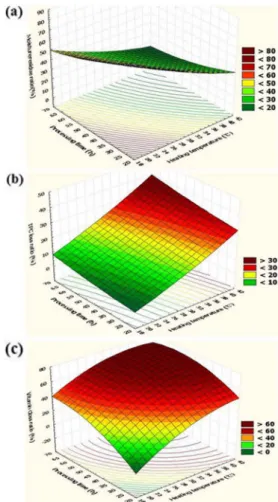
Based on these fitted equations, three-dimensional response surface plots (Figure 1) were constructed, illustrating the relationship of the process variables to the MRR, VCLR, and TPCLR responses of the mulberry fruits dried using the hot-air process. Figure 1(a) shows that the MRR of the mulberries decreased continuously to nearly 20% when increasing the drying temperature and processing time. Increasing the processing time to 6 h also resulted in a significant decrease in the MRR. Yet, increasing the processing time further had little effect on the MMRs of the mulberry samples. To improve the quality of the final product, it is critical to preserve the phenolic compounds and
vitamin C during the drying process, since their concentrations are strongly correlated with antioxidant activity. Table 2 suggests that the TPC was strongly influenced by both the drying temperature and the processing time, exhibiting linear relationships with each variable. Plus, Figure 1(b) indicates that the TPCLR in the mulberry fruits significantly increased (over 40%) when increasing the drying temperature and processing time (up to 90oC and 7 h), yet further increases of temperature or time did not have any significant influence on the TPCLR. Meantime, the vitamin C content was significantly affected by the linear and quadratic terms of the processing time (Table 2), although the drying temperature had no significant effect on the VCLR. An obvious Table 2. Analysis of variance (ANOVA) results for moisture residue ratio (MRR), vitamin c loss ratio (VCLR), and total phenolic content loss ratio (TPCLR) for semi-dried mulberry fruits produced using hot-air process
Model R2 TEMP TIME TEMP*TEMP TEMP*TIME TIME*TIME Stationary point
MRR 21.20** 0.9380 −7.59** −11.70*** −0.35 0.74 3.31** Saddle Point
TPCLR 6.36** 0.8196 8.04** 8.13** −1.68 −1.46 −1.92 Maximum
VCLR 18.45** 0.9295 2.34 12.48** −3.18** −11.15** −5.82** Saddle Point
***represents highly significant with p<0.001; **represents significant with 0.001≤p<0.05.
Figure 1. Three-dimensional surface plots for semi-dried mulberry fruits produced using hot-air process: (a) moisture residue ratio, (b) vitamin c loss ratio, and (c) TPC loss ratio.
linear effect of the processing time on the VCLR is shown in Figure 1(c), which dramatically increased (up to 100%) when prolonging the processing time with hot air. Vega-Gálvez et al., (2009) previously reported that the vitamin C content in red peppers decreased significantly when drying at temperatures above 60oC, explaining this phenomenon as an irreversible oxidative process that occurs with the removal of moisture from the water-soluble vitamin (Miranda et al., 2009).
Effects of Drying Mulberry Fruits with Cool Air
The MRRs, TPCLRs, and VCLRs of the mulberry fruits dried under different conditions with cool air are summarized in Table 3. The temperatures for the cool-air drying ranged from 20 to 40°C, while the processing times ranged from 22 to 66 h. The mulberry samples processed at 20oC for 22 h had the highest MRR (72.98%) and lowest TPCLR (4.63%) and VCLR (3.14%).
Meanwhile, the highest TPCLR (34.78%) and lowest MRR (21.11%, test 4) were obtained at 40oC after 6 h.
Table 4 shows the high significance (p<0.05) and R2 values of 0.9525, 0.9840, and 0.9490 for the fitted model of the MRR, TPCLR, and VCLR of the mulberry fruits when using the cool- air drying process, respectively, indicating a good fitness and reliability for further predictions. The ANOVA results presented in Table 4 also indicate that the drying temperature and processing time both had significant effects on the MRR, TPCLR, and VCLR, yet the drying temperature (p≤0.001) had
a more significant effect on all the responses than the processing time (0.001≤p < 0.05). The fitted models for the cool-air drying of the mulberries are presented as follows:
YCA-MRR=41.61−17.90*Temp−12.65*Time +2.66*Temp2+2.58*Temp*Time+2.86*Time2
YCA-TPCLR=18.15+12.45*Temp+3.71*Time +1.06*Temp2+0.60*Temp*Time+0.58*Time2
YCA-VCLR=60.78+17.65*Temp+16.13*Time−7.96*Temp2
−3.90*Temp*Time−9.23*Time2
The three-dimensional surface plots for the MRR, TPCLR, and VCLR of the mulberries subjected to the cool-air drying regime are shown in Figures 2(a)-(c). A linear reduction of the MRR from 80 to 20% is presented in Figure 2(a). In the case of increasing the temperature and processing time, there appeared to be no effects from the quadratic or interacting process variables on the MRR.
When using cool air, the TPCLR and VCLR were significantly reduced to 30% and 60%, respectively. The quadratic terms of the processing time (p<0.05) and drying temperature (0.05≤p<0.10) also showed significant effects on the VCLR (see Table 4). Figure 2(c) shows the quadratic effects of the process variables, where the VCLR increased rapidly when the drying temperature was increased from 20 to 40oC and the drying time was increased from Table 3. Central composite design (CCD) matrix and moisture residue ratio (MRR), vitamin c loss ratio (VCLR), and total phenolic content loss ratio (TPCLR) for semi-dried mulberry fruits produced using cool-air process
Test runs Drying temperature (oC) Processing time (h) MRR (%) TPCLR (%) VCLR (%)
1 20 22 72.98 4.63 03.14
2 20 66 48.80 9.35 40.62
3 40 22 34.97 27.67 50.35
4 40 66 21.11 34.78 72.24
5 20 44 62.79 05.16 42.99
6 40 44 21.11 31.41 70.07
7 30 22 61.09 12.43 36.55
8 30 66 23.22 23.19 73.96
9 30 44 38.17 18.21 59.58
10 30 44 39.87 15.64 52.22
11 30 44 38.06 19.19 61.36
12 30 44 38.61 17.44 59.54
13 30 44 40.11 16.80 63.07
Table 4. Analysis of variance (ANOVA) results for moisture residue ratio (MRR), vitamin c loss ratio (VCLR), and total phenolic content loss ratio (TPCLR) for semi-dried mulberry fruits produced using cool-air process
Model R2 TEMP TIME TEMP*TEMP TEMP*TIME TIME*TIME Stationary point
MRR 28.07** 0.9525 −17.90*** −12.65** 2.66 2.58 2.86 Minimum
TPCLR 086.12*** 0.9840 12.45*** 3.77** 1.06 0.6 0.58 Minimum
VCLR 26.03** 0.9490 17.65*** 16.13** −7.96* −3.89 −9.23** Maximum
***represents highly significant with p<0.001; **represents significant with 0.001≤p<0.05; *represents less significant with 0.05≤p<0.1.
20 to 55 h, yet no significant increase in the VCLR was observed thereafter.
Process Optimization for Drying Mulberry Fruits
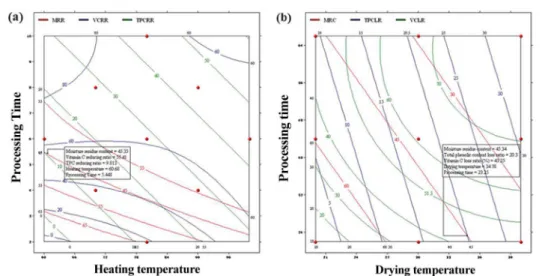
Mathematical models for process optimization can be effectively employed to minimize nutrient losses incurred while drying fruits and vegetables, resulting in improved product quality (Madamba, 2002). Thus, the main objective of this research was to establish mathematical models that could be used to predict the optimal process conditions for the dehydration of mulberries. As a result, the optimum conditions were determined for the production of semi-dried mulberry fruits under a vacuum using hot air or cool air to achieve an MRR of 45% and the minimal TPCLR and VCLR. The fitted second-order polynomial models described above were employed to determine the specified optimal drying conditions. Since only two process variables were considered (temperature and processing time), the most effective means of determining the optimal conditions was to analyze overlapped contour plots of the MRR, TPCLR, and VCLR as a function of
these two variables. Figure 3(a) shows that the optimal drying with the hot-air regime was achieved at 60.7oC for 5.4 h, which incurred the minimal TPCLR (9.8%) and VCLR (55.4%).
Meanwhile, when using the cool-air regime, the overlapped contour plot, shown in Figure 3(b), predicted a drying temperature of 34.8oC for 23.3 h, which also incurred the minimal TPCLR (20.3%) and VCLR (43.3%).
Drying with hot air (>60oC) is already known to greatly reduce the required processing time, energy consumption, and labor involved, thereby minimizing the production costs for the maximum profit. However, a substantial loss of ascorbic acid occurs at high temperatures. Gregory (1996) explained that the loss of ascorbic acid at a high temperature is caused by its oxidation to dehydroascorbic acid, followed by hydrolysis to 2,3- diketogulonic acid and subsequent polymerization, resulting in a decreased nutrient content. The rate of oxidation of ascorbic acid is assumed to increase linearly with the temperature, as seen in the response surface plot presented in Figure 1c. Interestingly, however, when compared to the high VCLR obtained when using the hot-air drying process, the associated TPC was even higher than that obtained when using cool air. Although low temperature treatment is understood to inhibit the degradation of thermally sensitive components in plants, the present study revealed that the cool-air drying in fact led to higher losses of TPC in the mulberry fruits. One possible explanation for this observation is that the polyphenoloxidase (PPO) enzyme, which induces the oxidation and degradation of phenolic compounds, is most active at lower temperatures. According to related studies (Trejo-Gonzalez and Soto-Valdez, 1991; Ding et al., 1998; Concellón et al., 2004), the optimal-activity temperature range for fruit PPO was found to be 30-40°C, which is consistent with the current observation that the cool-air drying process brought about a higher TPCLR in the mulberry fruits than the hot-air process.
When using the second-order polynomial models obtained during this study, the MRRs, TPCLRs, and VCLRs of the mulberry fruits were predicted for both the hot- and cool-air drying processes. The central composite design and response surface plots were also successfully used to simulate the drying process and determine the optimal conditions within the experimental scope.
Thus, the optimal conditions for producing semi-dried mulberry fruits with a moisture residue ratio of 45% and minimal nutrient losses of TPC and ascorbic acid were found to be 60.7oC for 5.4 h using the hot-air process, and 34.8oC for 23.3 h using the cool-air process under a vacuum. Although the cool-air process resulted in higher vitamin C retention than with the hot-air process, the TPCLR was also substantially increased with the cool-air process as it was within the optimal temperature range for the activation of PPO (30-40oC), which is known to cause the decomposition of phenolic compounds in mulberry fruit.
Figure 2. Three-dimensional surface plots for dried mulberry fruits produced using cool-air process: (a) moisture residue content, (b) vitamin c loss ratio, and (c) TPC loss ratio.
While various scientific studies have already proven the high nutrient value of mulberry fruits, semi-dried products have not yet been developed industrially. Therefore, the present study can facilitate the development of dried mulberry fruit products with a pleasant appearance, flavor, and taste, along with an extended shelf- life, which may improve palatability and customer satisfaction.
References
Banga JR, Balsa-Canto E, Moles CG, Alonso AA (2003) Improving food processing using modern optimization methods. Trends Food Sci Tech 14: 131-144.
Butt MS, Nazir A, Sultan MT, Schroen K (2008) Morus alba L. nature’s functional tonic. Trends Food Sci Tech 19: 505-512.
Choi JH, Jeong JY, Han DJ, Choi YS, Kim HY, Lee MA, Lee ES, Paik HD, Kim CJ (2008) Effects of pork/beef levels and various casings on quality properties of semi-dried jerky. Meat Sci 80: 278-286.
Concellón A, Añón MC, Chaves AR (2004) Characterization and changes in polyphenol oxidase from eggplant fruit (Solanum melongena L.) during storage at low temperature. Food Chem 88: 17-24.
Ding CK, Chachin K, Ueda Y, Imahori Y (1998) Purification and properties of polyphenol oxidase from loquat fruit. J Agr Food Chem 46: 4144-4149.
Doymaz I (2004) Pretreatment effect on sun drying of mulberry fruits (Morus alba L.). J Food Eng 65: 205-209.
Ercisli S, Orhan E (2007) Chemical composition of white (Morus alba), red (Morus rubra) and black (Morus nigra) mulberry fruits. Food Chem 103: 1380-1384.
Ertekin C, Yaldiz O (2004) Drying of eggplant and selection of a suitable thin layer drying model. J Food Eng 63: 349-359.
J.F. G (1996) Vitamins. New York Marcel Dekker, Inc.
Jeong JW, Seong JM, Park KJ, Lim JH (2007) Quality characteristics of semi dried red pepper (Capsicum annuum L.) using hot-air drying.
Korean J Food Preserv 14: 591-597.
Karathanos VT, Belessiotis VG (1999) Application of a thin-layer equation to drying data of fresh and semi-dried fruits. J Agr Eng Res 74: 355-361.
Madamba PS (2002) The response surface methodology: an application to optimize dehydration operations of selected agricultural crops.
Lebensm-wiss Technol 35: 584-592.
Miranda M, Maureira H, Rodríguez K, Vega-Gálvez A (2009) Influence of temperature on the drying kinetics, physicochemical properties, and antioxidant capacity of Aloe Vera (Aloe Barbadensis Miller) gel. J Food Eng 91: 297-304.
Phillips KM, Tarrago-Trani MT, Gebhardt SE, Exler J, Patterson KY, Haytowitz DB, Pehrsson PR, Holden JM (2010) Stability of vitamin C in frozen raw fruit and vegetable homogenates. J Food Comp Anal 23:
253-259.
Ratti C (2001) Hot air and freeze-drying of high-value foods: a review. J Food Eng 49: 311-319.
Scalzo J, Politi A, Pellegrini N, Mezzetti B, Battino M (2005) Plant genotype affects total antioxidant capacity and phenolic contents in fruit. Nutrition 21: 207-213.
Singleton VL, Orthofer R, Lamuela-Raventos RM (1999) Analysis of total phenols and other oxidation substrates and antioxidants by means of Folin-Ciocalteu reagent. Method Enzymol 299: 152-178.
Sumic Z, Tepic A, Vidovic S, Jokic S, Malbasa R (2013) Optimization of frozen sour cherries vacuum drying process. Food Chem 136: 55-63.
Toor RK, Savage GP (2006) Effect of semi-drying on the antioxidant components of tomatoes. Food Chem 94: 90-97.
Trejo-Gonzalez A, Soto-Valdez H (1991) Partial characterization of polyphenoloxidase extracted from ‘Anna’ Apple. J Am Soc Hortic Sci 116: 672-675.
Vega-Gálvez A, Di Scala K, Rodríguez K, Lemus-Mondaca R, Miranda M, López J, Perez-Won M (2009) Effect of air-drying temperature on physico-chemical properties, antioxidant capacity, colour and total phenolic content of red pepper (Capsicum annuum, L. var.
Hungarian). Food Chem 117: 647-653.
Zadernowski R, Naczk M, Nesterowicz J (2005) Phenolic acid profiles in some small berries. J Agr Food Chem 53: 2118-2124.
Figure 3. Superimposed contour plots for semi-dried mulberry fruits produced under (a) hot-air drying process and (b) cool-air drying process.