한국정밀공학회 2013 년도 춘계학술대회논문집
1. Introduction
In the past several decades, electro active polymers (EAP) have been rapidly developed with lager deformation, lower power consumption and light weight. Cellulose is the most abundant and almost inexhaustible of natural polymers. Bacterial cellulose (BC) composed of the β-1.4 glucosidic linkage with β-D-glucose is produced by a bacterium, while the plant cellulose (PC) that has impure compounds of lignin, pectin and hemicelluloses is obtained in the natural resources [1]. But, unlike
conventional gel-type bacterial cellulose, Tempo-oxidized bacterial cellulose (TOBC) is dissolved in water in form of cellulose molecular unites that are separated by one sequences. With excellent merits of biodegradability, light weight, low actuation voltage and lager displacement under dry or wet conditions, cellulose-based electro-active polymer actuators have received lots of attention. Polyvinyl alcohol (PVA) is a water soluble, biodegradable and biocompatible polymer with excellent chemical resistance and physical properties. With hydroxyl groups in its structure, it is hydrophilic and expected to form hydrogen bonds and acetal linkages with other materials, such as cellulose. In this study, a novel nanocomposite actuator based on TOBC/PVA membrane has been developed and the conductive polymer (PEDOT: PSS) was deposited on both sides of nanocomposite membranes by using dipping and drying method. To improve the bending actuation, the ionic liquid of 1-Ethy1-3-methylimidazolium tetrafluoroborate (EMI-M-BF4) was added into
TOBC/PVA solution.
2. Experimental
The nanocomposite TOBC/PVA membranes were fabricated by using casting-drying method. And the ionic liquid of 1-Ethy1-3-methylimidazolium tetrafluoroborate (EMIM-BF4) was added into 60 ml
TOBC solution, which concentration is 4.5 g/ml. The composite TOBC solution with 1 wt % EMIM-BF4
was dispersed using the ultrasonic generator for 1 hour. After that process, PVA powder was added into composite solution and stirred for 2 hours at room temperature. Then the composite TOBC/PVA solution with 1 wt % EMIM-BF4 was heated at
90 ℃ under magnetic stirring for 4 hours.
After being heated, the composite solution was cooled down at room temperature for 1 hour. Before being dried in an oven, a vacuum pump was used to remove air bubbles contained in the composite solution. The solution was let in vacuum oven for 1 hour to remove all air bubbles. Finally, the composite solution was poured into a casting mold and placed in the oven at 65 ℃. After 12 hours, the nanocomposite TOBC-PVA membrane was obtained.
The TOBC/PVA actuators were fabricated by depositing conductive polymer PEDOT: PSS on both sides of nanocomposite membranes through using dipping and drying method. The size of the actuator was tailed with dimensions of 5 × 40 × 0.08 mm.
3. Result and Discussion
박테리아 셀룰로오스와 PVA 를 이용한 복합체 작동기
Nanocomposite Actuators based on Tempo-oxidized Bacterial
Cellulose and Polyvinyl Alcohol Membrane
*왕판
1, 김시습
1, 단화위
1, 최선욱
1,
#기창두
2*Fan Wang
1, S.S. Kim
1, H.W. Duan
1, S.U. Choi
1,
#C.D. Kee
([email protected])
2 1전남대학교 대학원 기계공학과, 2전남대학교 기계시스템공학부Key words : Bacterial Cellulose, Polyvinyl alcohol(PVA), Electro-active polymers(EAP), PEDOT:PSS
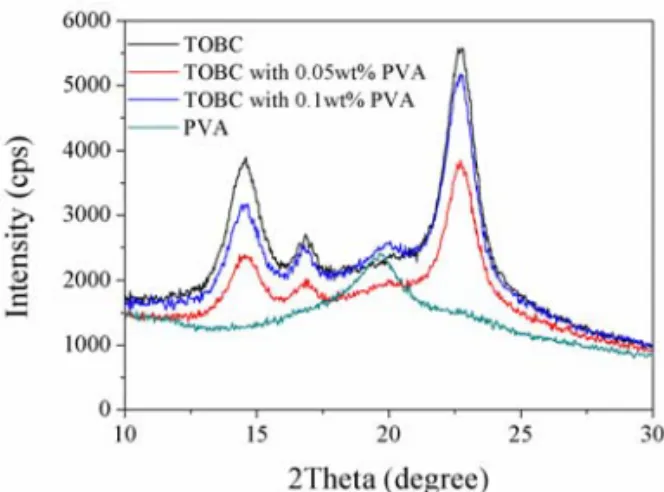
한국정밀공학회 2013 년도 춘계학술대회논문집 The XRD results of TOBC/PVA nanocomposite membranes were shown in Fig. 1 and basically TOBC/PVA profiles exhibited the characteristic peaks of both BC (14.7°, 16.8° and 22.6° in the crystal region) and PVA (19.5° in the crystal region). Although the XRD patterns of TOBC/PVA membranes are apparently similar to that of the pristine TOBC, the TOBC/PVA membrane has a lower crystallinity. It was indicated that PVA content played a role in both the cross-linking density of the network and the degree of crystallinity of TOBC. Present phenomenon exhibits TOBC strongly interacted with hydroxide radical of PVA. Accordingly, the crystallinity of TOBC/PVA compo-site membrane was decreased through the tangling between them which caused steric effect [2].
Fig. 2 shows the harmonic response of the TOBC/PVA composite actuators responding to 0.2 Hz sinusoidal electrical wave signal with ±1.0 V amplitude. It’s found that the tip displacement of the TOBC with 0.1 wt % PVA is about 4.6 times larger than that of the pure TOBC actuator. And also, the TOBC with 0.1 wt % PVA actuator shows larger tip displacement than TOBC with 0.05 wt % PVA actuator. The bending actuations of show much larger tip displacements and faster response time than those of the pristine TOBC actuator. Present results exhibit that an improvement in the electromechanical bending actuation performance can be achieved by TOBC/PVA membrane.
Fig. 1 XRD spectra of PVA/TOBC membranes
Fig. 2 AC response of TOBC-PVA actuator
4. Conclusion
In conclusion, a novel nanocomposite actuator based on TOBC/PVA membrane has been developed. TOBC/PVA membranes were fabricated by using a simple solution-casting method. The polymer (PEDOT: PSS) was deposited on both sides of composite membranes using dipping and drying method. Under harmonic electrical inputs, the corresponding bending actuations of TOBC/PVA actuator show much larger tip displacements and faster response time than those of the pristine TOBC actuators.
Acknowledgment
This work was supported by Mid-career Researcher Program through NRF grant funded by the MEST (No. 2012-0383).
Reference
1. Jin-Han Jeon., ll-Kwon Oh., Chang-Doo Kee, Seong-Jun Kim, “Bacterial cellulose actuator with electrically driven bending deformation i-
n hydrated condition,” Sensor and Actuators,
146, 307-313, 2010.
2. Jiehua Wang., Chuan Gao., Yansen Zhang., “P reparation and in vitro characterization of BC/ PVA hydrogel composite for its potential use as artificial cornea biomaterial,” Materials ence and Engineering, 30, 214-218, 2010.