J Korean Acad Community Health Nurs (지역사회간호학회지) https://doi.org/10.12799/jkachn.2019.30.4.400
A Systematic Review of Studies Using Video-recording to Capture
Interactions between Staff and Persons with Dementia
in Long-term Care Facilities
Kim, Da Eun
1· Sagong, Hae
2· Kim, Eunjoo
2· Jang, Ah Ram
2· Yoon, Ju Young
3 1Visiting Scholar, School of Nursing, University of Wisconsin-Madison, Madison, WI, USA2Doctoral Student, College of Nursing, Seoul National University, Seoul
3Associate Professor, College of Nursing ․ Research Institute of Nursing Science, Seoul National University, Seoul, Korea
Purpose: The use of video-recording offers important advantages in observing and assessing the relationship between specific behaviors in health care settings. The purpose of this systematic review is to investigate and synthesize the methodological characteristics of studies using video-technology for measuring interactions with the older persons with dementia and staff in long-term care facilities. Methods: We searched Medline, Embase and CINHAL databases for published articles in English using a video-recording method for both staff and the residents with dementia. Quantitative research design studies (e.g., descriptive or experimental studies) were included. Results: Among 5,605 searched papers, a total of 20 studies were selected for this review. Situations of video- recording were providing personal care (n=12), mealtime (n=6), and conversation (n=3). Concepts measured by video-recording were classified into two groups: 1) Staff [care practice by staff (n=13) and communication by staff (n=11)] and 2) residents [communication by resident (n=4), activities of daily life function of resident (n=8), and behavioral and psychological symptoms of dementia (n=10)]. Conclusion: This review demonstrates that video technologies are actively used to evaluate the relationship between quality of care and health outcomes of the elderly with dementia in many international nursing studies. This study provides the foundation for a future research using video-recording technologies to examine the interactions and relationships between staff and the residents in Korean long-term care settings.
Key Words: Video recording; Nursing homes; Dementia; Interpersonal relations; Review
Corresponding author: Yoon,Ju Young
College of Nursing, Seoul National University, 103 Daehak-ro, Jongno-gu, Seoul 03080, Korea. Tel: +82-2-740-8817, Fax: +82-2-766-1852, E-mail: [email protected]
- This research was supported by the Basic Science Research Program through the National Research Foundation of Korea funded by the Ministry of Science, ICT & Future Planning(Grant No. 2017R1C1B1002872)
Received: Jun 11, 2019 / Revised: Aug 13, 2019 / Accepted: Aug 16, 2019
This is an open access article distributed under the terms of the Creative Commons Attribution Non-Commercial License (http://creativecommons.org/licenses/ by-nc/3.0), which permits unrestricted non-commercial use, distribution, and reproduction in any medium, provided the original work is properly cited.
INTRODUCTION
1. Background
Since most long-term care residents have some level of dependency in the functional activities of daily living, the quality of care provided by staff, including helping older people to perform these daily activities, has a major im-pact on resident quality of life [1]. In particular, person- centered care for long-term care residents with dementia has a significant effect on decreasing behavioral and psy-chological symptoms such as agitation and negative affect
[2]. Although the effects that interactions between staff and residents in long-term care facilities have on health outcomes is a major research topic, it is difficult to meas-ure resident health outcomes using surveys or interviews since residents with dementia have difficulty clearly com-municating their health status [3]. Therefore, it is neces-sary to explore research methodologies that can improve the validity of assessment results.
Video-recording is a measurement method that enables accurate observation of the duration, intensity, and pat-tern of a behavior [4]. While proxy reporting, which is most commonly used for people with limitations in their
communication, may rely on inaccurate recall or reflect the subjectivity of the proxy, video-recording enables re-searchers to immediately capture emotional expressions or behaviors and directly measure them [5]. In addition, if long-term care staff respond as proxy to questions about resident health outcomes, response bias can result from re-lationships between staff and residents or the stress level of the staff [6]. Compared to direct observation, video ob-servation allows data to be repeatedly reproduced and rated by multiple observers, ultimately increasing the objectivity and accuracy of assessment.
Video-recording enables researchers to measure multi-ple commulti-plex behaviors occurring simultaneously and to investigate the relationships among behaviors that occur in close temporal proximity [5,7]. Gilmore-Bykovskyi et al. [8] consecutively captured mealtimes using video-record-ing in long-term care facilities and coded the video data utilizing a coding scheme, a type of assessment instrument used for quantifying data. They assessed the relative fre-quencies and durations of person-centered and task-cen-tered actions of staff, as well as resident behavioral symp-toms. They then calculated conditional probabilities and odds ratios regarding whether the staff engaged in per-son-centered or task-centered care practices 10~60 seconds before people with dementia showed behavioral symp-toms [8]. The study found a significant sequential relation-ship between staff person-centered care practices and resi-dent behavioral symptoms [8]. Herman & Williams [6] took videos of personal care situations such as bathing or dress-ing from the beginndress-ing of a conversation between a resi-dent and a staff member to the completion of the care acti-vities. They coded the presence of staff elderspeak and res-ident resistiveness to care second-by-second. Afterwards, they examined the association between elderspeak and re-sistive behavior, specifically focusing on the occurrence of resistive behavior within 7 seconds of staff elderspeak [6].
Video-recording may help to both address the limi-tations of existing studies of people with dementia in rela-tion to the difficulty in collecting objective data, and allow researchers to examine the relationships between care quality and health outcomes for people with dementia [9]. Because it is difficult to conduct long-term experimental studies such as randomized controlled trials in long-term care facilities, video-recording may be particularly useful for examining causal relationships between staff care practices or attitudes and resident health outcomes [8]. For this reason, studies using video-recording to measure the interactions between people with dementia and staff in long-term care facilities have been actively conducted. However, in Korea, there is a lack of studies conducting
video observation and comprehensively examining the methodology of video-recording. Therefore, we conducted a systematic review of the literature to examine the meth-odological characteristics of studies using video-recording to assess interactions between people with dementia and staff in long-term care facilities and to verify the applic-ability of this method in Korea. In this regard, it should be noted that because this systematic review was focused on the methodological aspects of research, the research ques-tions of this study were different from those used in the systematic review studies focused on analysis of research outcomes.
2. Purpose
This study aimed to conduct a systematic review of studies using video-recording of residents and staff in long-term care facilities in order to investigate and synthe-size the methodological characteristics such as measure-ment methods, measured variables, and analysis methods.
METHODS
1. Study Design
This study is a systematic review comprehensively ex-amining the methodological characteristics of studies using video-recording to measure interactions between people with dementia and staff in long-term care facilities. This study employed both the Preferred Reporting Items for Systematic Review and Meta-Analysis (PRISMA) guide-lines for systematic reviews [10] and the systematic review guidelines of the National Evidence-based Healthcare Col-laborating Agency (NECA) [11].
2. Data Collection
On February 2, 2018, we conducted literature searches through MEDLINE (Ovid) and EMBASE (Elsevier), the core databases of the COSI (Core, Standard, Ideal) model presented by the US National Library of Medicine, as well as the CINAHL (EBSCO) database, a database specific to nursing and allied health literature [11].
Since this study is a systematic review regarding the methodologies of studies using video-recording in long- term care facilities, P (population) and M (method or mea-surement) were set instead of using the PICO format, a ba-sic format for research questions. Different types of search terms were used according to the databases: MeSH terms were used in MEDLINE, EMTREE terms in EMBASE, and
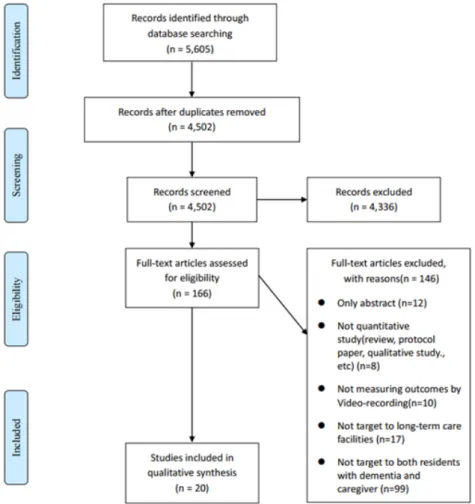
Figure 1. Flow diagram for study selection (PRISMA).
CINAHL Headings in CINAHL [11]. A pilot search was conducted for each database. Two investigators reviewed 4,000 abstracts and supplemented the search query by adding synonyms. The final search query selected through the process was [(assisted living facility) OR (nursing home) OR (residential home) OR (long term care) OR (skilled nursing facility) OR (intermediate care facility) OR (group home) OR (residential facility) OR (dementia)] AND [(video)]. Boolean operators, truncations and wild cards were used to increase the sensitivity of the search [11]. Only human subjects researches written in English were included in data collection.
3. Data Selection
1) Inclusion and exclusion criteria
Eligible studies for this systematic review included both descriptive and experimental studies using video-record-ing to measure interactions between residents with de-mentia and staff in long-term care facilities, regardless of the types of outcome variables measured. Studies not
us-ing quantitative research design, such as systematic view, protocol study, review article, and qualitative re-search, were excluded. In addition, studies which did not include both people with dementia (or cognitive impair-ment) and staff as participants were excluded. Studies conducted in the community or hospitals or mixed set-tings were also excluded. In order to increase agreement among the researchers on the exclusion criteria, four in-vestigators were divided into two teams, with each team independently evaluating 50 studies using the exclusion criteria. They conducted reevaluation until exclusion re-sults coincided. Logs about the reasons for differences in exclusion results and the results of discussions among the investigators were written for future reference.
2) Selection of Studies
A total of 5,605 studies were retrieved from the MED LINE, EMBASE, and CINAHL databases. After removing duplicates using EndNote, the studies were checked for duplicates manually. Consequently, 1,103 studies were excluded (Figure 1). Using the remaining 4,502 studies,
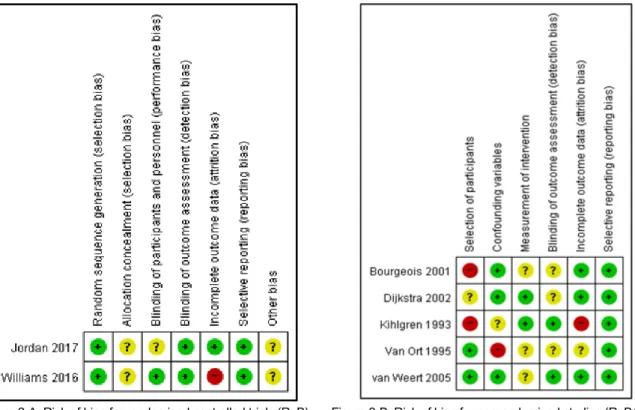
in-Figure 2-A. Risk of bias for randomized controlled trials (RoB) Figure 2-B. Risk of bias for nonrandomized studies (RoBANS)
Figure 2. Quality assessment of selected studies
itial screening was performed by reviewing the titles and abstracts. As a result, 4,336 studies were excluded. When it was unclear whether or not to select a study by reviewing its title and abstract, we included the study. In the second screening, the full text of each study was reviewed and the final decision was made. Finally, a total of 20 studies were selected for analysis.
4. The Risk of Bias Assessment
Among the 20 studies selected, risk of bias assessment was performed for those having an experimental research design. The Cochrane Risk of Bias (RoB) tool was applied to randomized controlled trials and the Risk of Bias for Non-randomized Studies (RoBANS) was used for quasi- experimental studies [11]. Risk of bias assessment was conducted by two investigators independently. When there was a domain where assessment results were not con-sistent, consensus was reached through sufficient discus-sion. The overall results for each domain of the risk of bias assessment were reviewed using the RevMan 5.3 program.
5. Data Extraction
Data about general characteristics, video-recording
re-lated characteristics, video-recording variables, and anal-ysis characteristics for the included studies were extracted. Specifically, year of publication, country, study design, and sample size were extracted to identify the general characteristics of the studies. For video-recording related characteristics, situation, location, and technique of vid-eo-recording, number of video recordings, average record-ing time per video, and the index for inter-coder agreement were extracted. Measured concepts, coding scheme, type of coding, and analysis methods were extracted to identify video-recording variables and analysis characteristics.
RESULTS
1. Risk of Bias Assessment Results
The risk of bias assessment of two randomized con-trolled trials and five quasi-experimental studies was per-formed using RoB and RoBANS respectively (Figure 2). The randomized controlled trials included one study with a high risk of bias in the domain of incomplete outcome data in RoB. The nonequivalent control group design studies included one or two studies with a high risk of bias in the domains of selection of participants, confounding variables, and incomplete outcome data in RoBANS. The
two studies which were rated as having a high risk of bias in the domain of selection of participants in RoBANS were those that divided participants into experimental and con-trol groups at the institutional level [12,13]. Since this sys-tematic review was conducted to examine the methodo-logical characteristics of studies using video-recording to assess people with dementia and staff in long-term care fa-cilities, all of these studies were included in the analysis.
2. General Characteristics of Included Studies
The general characteristics of the 20 studies included in this systematic review are shown in Table 1. 3 studies (15.0%) were published in 1990~2000, 4 studies (20.0%) in 2001~2005, 4 studies (20.0%) in 2006~2010, and 9 studies (45.0%) in 2011 or later, showing that studies using vid-eo-recording as a measurement method have been con-tinuously conducted since 1990. In terms of study design, there were 13 descriptive studies (65.0%) and 7 experi-mental studies, which included 2 randomized controlled trials (10.0%) and 5 non-equivalent control group design studies (25.0%). Regarding sample size, the most frequent number of participants was 11 to 30 for residents (10 stud-ies, 50.0%) and 10 or less for staff (6 studstud-ies, 30.0%).
3. Characteristics of Video-recording Measurement
Methods
Characteristics of the video-recording measurement methods used in the 20 selected studies are as follows (Table 2). The most frequently recorded situations were care for activities of daily living or personal care (12 stud-ies, 60.0%), followed by mealtimes (6 studstud-ies, 30.0%) and conversation (3 studies, 15.0%). In terms of video-record-ing locations, videos were taken in the resident's room (8 studies, 40.0%), dining room (5 studies, 25.0%), bathroom (1 study, 5.0%), and hallway or public area (2 studies, 10.0%). Regarding the technique of video-recording, video cameras were placed in 5 studies (25.0%), while the inves-tigator personally took videos using a hand-held camera in 3 studies (15.0%). Regarding the frequency of video-re-cording, measurements were most often made 2 to 5 times per resident (6 studies, 30.0%). However, the frequency of video-recording varied widely from 1 to 30 times among the selected studies. The total number of video-recordings for each study was 11 to 50 in 5 studies (25.0%) and 51 to 100 in 5 studies (25.0%). In addition, the total number of video-recordings was 1 to 10 in 2 studies (10.0%) and more than 100 in 2 studies (10.0%). The average recording time per video was less than 5 minutes in 6 studies (30.0%) and
20 to 30 minutes in 4 studies (20.0%). Most of the studies using video-recording included an inter-coder reliability test. In terms of index for agreement, the ‘percentage agreement’ was used in 15 studies (75.0%) and ‘Cohen's Kappa’ was used in 8 studies (40.0%).
4. Video-recording Measurement Variables and
Analy-sis Methods
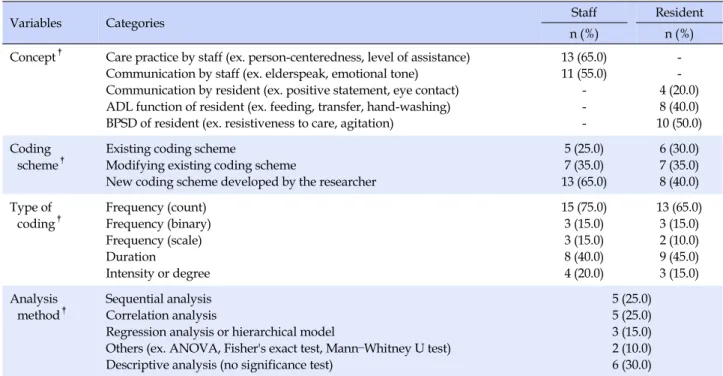
The characteristics of the concepts measured, coding were analyzed by classifying into the groups of staff and residents (Table 3). Regarding the concepts of staff meas-urement, 13 studies (65.0%) measured care practice and 11 studies (55.0%) measured communication style. As for the concepts of resident measurement, behavioral and psychological symptoms were most frequently measured and they were assessed in 10 studies (50.0%). The ability to perform activities of daily living and communication were measured in 8 studies (40.0%) and 4 studies (20.0%) respectively.
In studies using video-recording, a coding which quan-tifies video data according to a specific algorithm is re-quired for quantitative analysis. An instrument used for coding is called a coding scheme. Depending on the re-search, a new coding scheme developed by the researcher or an existing one developed in a prior study can be used [3]. A coding scheme developed by the investigator was used in 13 studies (65.0%) for staff measurement and 8 studies (40.0%) for resident measurement. A modified ver-sion of an existing coding scheme was developed and used in 7 studies (35.0%) for staff measurement and 7 studies (35.0%) for resident measurement. Original versions of previously developed coding schemes were used in 5 studies (25.0%) for staff measurement and 6 studies (30.0 %) for resident measurement.
Type of coding behavior can be classified into fre-quency, duration, and intensity. Of the 20 selected studies, 15 studies (75.0%) coded frequency as count (the number of occurrences) for staff measurement and 13 studies (65.0%) for resident measurement. As for duration coding, 8 studies (40.0%) coded duration of staff's behavior and 9 studies (45.0%) coded duration of resident's behavior. In terms of methods used to analyze relationships between the behaviors of people with dementia and those of staff, 5 studies (25.0%) used sequential analysis and 5 studies (25.0%) used correlation analysis. In addition, 3 studies (15.0%) conducted regression analysis or hierarchical mo-deling, but 6 studies (30.0%) performed only descriptive statistical analysis.
Ta bl e 1 . Ext ract ion Tabl e of Sel ect ed St udi es No Aut ho r (ye ar, typ e o f in te rv en tio n) Situa ti on of rec or di ng Lo ca tion of rec or di ng Nu mbe r of re co rd in gs pe r res iden t To tal num ber o f rec ordi ng s Av er ag e reco rd in g tim e per video Sa m ple size Co nce pt Va ri ab le Codin g sche m e Ty pe of c odi ng Ana lys is me th od D esc rip tive stud y 1 Belzil et al (2015) AD L c ar e (inc ontinen ce ca re, d re ssing , etc. ) Re si de nt's roo m 30 240 11 .7 m in S 43 C ar e p ra ct ic e, com m unic ati on 1) Phys ical be havior 2) Ve rb al be ha vi or G rid fo r ob se rv at io n o f ph ysic al a nd v er bal be haviors o f c areg iv er an d r esid en t † Fre quen cy (c ou nt) , du ra ti on Se qu en tia l anal ys is R 8 BP SD 2C oh en -Ma ns fi el d et a l(200 6) AD L c ar e (d re ssing ) Re si de nt's roo m , ba th ro om 1 20 N /D S 20 C are p ractice, com m unic ati on 1) D re ssing p roce ss 2) Intera ct io n 1) De gr ee o f di ff ic ul ty, etc. † 2) Typ e of co m m unicat ion , e tc . † 1) D egr ee 2) Fr eq ue ncy (c ou nt) C orrela tion anal ys is (Spe arm an) R 20 A D L D re ssing proce ss Invo lv em ent , de gree of diffi cu lty † Degree 3 C un ni ng ha m et a l(200 7) Co nve rsa tion, me al time H allway, dinin g roo m 4 4 2. 5 m in S 3 C ommu ni ca ti on 1) Elders pe ak 2) E m ot io na l t on e 1) Elders pe ak s ca le † 2) E m ot io na l t on e r ati ng sca le C orrela tion anal ys is (Pears on's r) R 1 BP SD Re sistiv ene ss to car e Re sistiv ene ss to c ar e sca le 1) D ur at ion , inten sity 2) D egr ee Fre quen cy (c ou nt) , du ra ti on 4 G ilm ore -By ko vs ky i (201 5a) Me al ti m e Dining roo m 2 22 29 m in S 6 Care p ra ctice Pers on - ce nt er edn es s PCBI , TCBI Freq uen cy (c ou nt) , du ra ti on Des cr ipt iv e anal ys is R 9 BPS D Be haviora l sy m ptom s Pi tts bu rgh agi tat io n sca le Fre quen cy (c ou nt) , du ra ti on 5 Gilm ore -By ko vs ky i et a l(201 5b) Mea lt im e Dining roo m 2 33 24 .5 m in S 8 Care p ractice Pe rs on - ce nt er edn es s PCBI , TCBI Fre quen cy (c ou nt) , du ra ti on La g-ba se d se qu en tia l anal ys is R 12 BP SD Be haviora l sy m ptom s Pi tts bu rgh agi tat io n sca le Fre quen cy (c ou nt) , du ra ti on 6 G ilm ore -By ko vs ky i et a l(201 8) Me al ti m e Dining roo m 2 33 24. 5 m in S 8 Care p ra ctice Pers on - ce nt er edn es s PCBI , TCBI Freq uen cy (c ou nt) , du ra ti on La g-ba se d se qu en tia l anal ys is R 12 BPS D, A D L 1) Be haviora l sy m ptom s 2) S w al lowing dy sf unctio n 1) Pi tts bu rgh agi tat io n sca le 2) O bs erv ab le indicat ors of a sp ira ti on Fre quen cy (c ou nt) , du ra ti on †N ew c odi ng s chem e devel oped b y t he re se ar cher ; ‡Random iz ed cont ro lled t ri als; A D L=act ivit ies of dail y li vi ng ; A N O V A =an al ys is of v ar ian ce; B PS D =b eh av ior al a nd p sych ological sym ptom s of d em ent ia; LoA =l evel of a ssis ta nc e; N /D=not des cr ib ed; PC BI =pers on-c enter ed behavi or invent ory; R=r esi dent ; S=st af f; TC BI =t ask-cent er ed be ha vior invent ory.
Ta bl e 1 . Ext ract ion Tabl e of Sel ect ed St udi es ( C ont inued) No Aut ho r (ye ar, typ e o f in te rv en tio n) Situa ti on of rec or di ng Lo ca tio n of reco rd in g Nu mbe r of rec ordi ng s pe r re si de nt To tal num ber of rec or di ng s Ave rag e reco rd ing tim e per vi deo Sa m ple size Co nce pt Va ri ab le Cod in g sche m e Type o f c odi ng Ana lys is met ho d D esc rip tive stud y 7 He rm an et al (200 9) AD L c ar e (b at hi ng , dr essin g, etc.) Re sident's room N/ D 80 4. 6 m in S 52 Co m m un ica tio n El ders pea k C ommu ni ca ti on s ta te † Fr equ en cy (co unt) Lag -b as ed seq uential an aly sis R 20 BP SD Re sistive ne ss to ca re Re sistive ne ss to ca re sc ale Fr equ en cy (co unt) 8 Lan n-W ol co tt et a l(201 1) AD L c ar e (b at hi ng , dr essin g, etc.) N /D N /D 70 4. 6 m in S 54 C ar e practi ce Pe rs on- centeredn ess 1) P C BI , TCBI 2) G lob al b eha vi or s ca le 1) Fr equ ency (Bi nary ) 2) D egr ee Co rr elat ion an aly sis (Pe ars on 's r), m ul tip le re gr ession an aly sis R 20 BPS D R es ist ive ne ss to ca re Re sistive ne ss to ca re sc ale Du ra ti on , inten si ty 9 Phill ip s e t al (199 3) Mea lt im e Di ni ng ro om 8 8 23 .1~ 24 .1 mi n S N/D Ca re p rac ti ce Beh avio rs b y the fee der Fe edi ng t rac el in e tec hnique † Fr equ en cy (co unt) D esc ri pt iv e an aly sis R 6 AD L Fee di ng be havior 10 So m boo nt an on t et a l(200 4) AD L c ar e (b at hi ng) N /D 2~ 3 27 8. 2 m in S N /D Ca re practi ce Car egiver beha vi or s Car egive r b athing beh avior ob serva ti on inv entory † Fr equ en cy (co unt) Lag -b as ed seq uential an aly sis R 18 BP SD A ss au lt iv e be ha vi or A ssa ul tive be havior † Fr equ en cy (co unt) 11 Th un bo rg et al (201 5) AD L c ar e (tra ns fering ) N/D N/ D N/ D N/D S 9 Ca re p rac ti ce Facil ita tive a ct ion s Dy adic interacti on in dem en tia tr an sf er asse ss m ent sca le † Fr equ en cy (sc ale) D esc ri pt iv e an aly sis R 8 AD L T rans fer -relat ed acti ons 12 W ill iam s et al (200 9) AD L c ar e (b at hi ng , dr essin g, etc.) Re sident's room N /D 80 4.6 m in S 52 C om m un ic at io n Eld er sp ea k 1) E ld er sp eak m et ric s † 2) C ommu ni ca ti on sta te † 1, 2 ) Fre quen cy (co unt) Bayes ia n bino m ial hi er ar ch ic al mo de l R 20 BPS D R es ist ive ne ss to ca re 1) Re sistive ne ss to ca re sc ale 2) Re sistive to c ar e or coop erative † 1) D ur ati on , inten si ty 2) Fr equ ency (bin ary ) 13 W ilson e t al (201 2) AD L c ar e (h an dw ash in g) N/D 6 72 2. 2 m in S 12 C ar e p ra ct ic e, co mmu ni -cati on 1) S te p en ga ge m en t, co mpl et io n 2) C ommu ni ca ti on str ateg ies 1) Si x hand washing step s 2) Ta sk -foc used co mm uni ca tio n str ateg ies † 1) Fr equ ency (bin ary ) 2) Fr equ ency (co unt) Co rr elat ion an aly sis (Pe ars on 's r) R 12 AD L Ta sk suc ce ss (h and w ashin g) Si x hand washing step s Fr equ en cy (bin ary ) † N ew c odi ng s chem e devel oped b y t he re se ar cher ; ‡ Random iz ed cont ro lled t ri als; A D L=act ivit ies of dail y li vi ng ; A N O V A =an al ys is of v ar ian ce; B PS D =b eh av ior al a nd p sych ological sym ptom s of d em ent ia; LoA =l evel of a ssis ta nc e; N /D=not des cr ib ed; PC BI =pers on-c enter ed behavi or invent ory; R=r esi dent ; S=st af f; TC BI =t ask-cent er ed be ha vior invent ory.
Ta bl e 1. Ext rac tion Tabl e of Sel ec ted St udi es ( C ont inued) No Au th or (y ear , ty pe of interven tion ) Sit uat ion of re co rd in g Lo ca ti on of re co rd in g Nu mb er o f reco rd ing s per re si de nt To tal nu m be r of re co rd in gs Av er age rec ordi ng ti m e p er video Sam ple siz e Co nce pt Va ri ab le C oding sc hem e Type of c odi ng An al ys is me th od Exper im enta l s tu dy 14 Bou rg eo is et a l (200 1, C om m u -ni ca tion s tr at egy) Co nv er sa ti on Re si de nt's roo m 2 N/D 5m in S 66 C ommu ni ca ti on Co nv er sa ti on 1) D ur at ion 2) Fr eq ue ncy (c ou nt) Correla tion analys is R 66 C ommu ni ca ti on 15 D ijks tra et a l (2 002 , Co m m u -ni ca tion t ra ini ng) Co nv er sa ti on (fam ily , l ife, ec t.) N/D N /D N/D N /D S 40 C ommu ni ca ti on Di sc ou rs e ch ar ac te rist ics Fre quen cy (c ou nt) Des cri pt ive analys is R 66 C ommu ni ca ti on 16 Jo rdan et a l(2 017 , Co ac hing tr ai ni ng us in g Lo A s trat egies ) ‡ AD L c ar e (dres si ng) N/D N/D N/D N/ D S 17 Care p ractice A ppropriaten ess Lo A s trat egies Fre quen cy (s ca le ) Fishe r's ex ac t te st , Ma nn –Wh it ne y U t es t, et c. R 17 ADL Level of in de pe nd en ce 1) V erb alizati on † 2) Po si ti ve and negat ive statem en ts D is co urs e anal ys is sche m a A ppropriaten ess o f LoA us e to ol Beck dress in g perform anc e s ca le Fre quen cy (s ca le ) 17 Ki hl gr en et a l (1 993 , T ra ining in integ rity prom ot in g c are ) AD L c ar e (m or ni ng c ar e) Re si de nt's roo m 20 100 N /D S 10 Com m unicati on, ca re p ra ct ic e 1) N onver bal co m m unicat ion 2) V erba l co m m unicat ion 3) Ori enta tio n 4) 1) E ye av oid an ce, et c. † 2) Pr aisi ng pat ient s, et c. † 3) A ttem pt to or ie ntat ion † 4) O ppor tu ni ty to pa rt ic ipa te † 1~ 3) Frequency (cou nt , bi na ry ) 4) Fr eq ue ncy (s ca le ) Des cri pt ive analys is R 10 C ommu ni ca ti on , AD L 1) Opp ortu nity to par ticipat e N onver bal co m m unicat ion 2) V erba l co m m unicat ion 3) P ar tic ip at io n 1) E ye av oid an ce, et c. † 2) S triv e f or ve rb al co nt act, e tc . † 3) Ini tiat ing, etc . † 1~ 3) Freq ue nc y (c ou nt , bi na ry ) 18 Va n o rt et a l (1 995 , Prom oti ng self-feedin g) Me al time N/D 22 N/D N/ D S 18 Care p ractice 1) F eeding relat ed in te rp er so na l con tact 2) Level of assistan ce 1) F eeding trac eli ne te ch ni qu e 2) L evel o f a ssistan ce in dic at or s † 1) Fr eq ue ncy (c ou nt) 2) D egr ee Rep eat ed mea su res AN O V A R 7 ADL Feeding relat ed in te rp er so na l con tact Feeding trac eli ne te ch ni qu e Fre quen cy (c ou nt) 19 va n W eert et al (2 005 , Sn oe zelen tr ai ni ng) AD L c ar e (m or ni ng c ar e) Re si de nt's roo m N /D 250 N /D S 11 7 C om m unicati on 1) N onver bal co m m unicat ion 2) V erba l co m m unicat ion 1) Eye co ntact, et c. † 2) R ote r in te ra ct io n an aly sis s yst em 1) D ur at ion , fre qu en cy (c ou nt) 2) Fr eq ue ncy (c ou nt) Des cri pt ive analys is R 11 7 C ommu ni ca ti on 20 W illiam s e t al (2 016 , C ommu ni ca ti on tr ai ni ng) ‡ AD L c ar e (m or ni ng c ar e) Re si de nt's roo m , pu bl ic ar ea N/D N/D N/ D S 29 C ommu ni ca ti on Elders pe ak C om m un ic at ion st at e Dura tio n Li ne ar m ix ed mod el ing R 27 BP SD Re sistiv ene ss to car e Re sistiv e to ca re or coo perat ive Dura tio n †New c odi ng s che m e developed by t he re se ar cher ; ‡Ra ndom iz ed c ontr ol le d tr ia ls ; A D L= ac tivi tie s of da ily l ivi ng; A N OV A =an alysis of v arian ce; BP SD =b ehavior al and p sy chol og ic al sym pt om s of dem enti a; LoA =level of ass ist ance; N /D =not d esc ribed; PCBI =person-cent er ed beha vi or invent or y; R= res ident ; S= st af f; TC BI =ta sk-c enter ed be ha vi or i nventor y.
Table 2. Video-recording Related Characteristics of Selected
Studies (N=20)
Variables Categories n (%)
Situation of
video-recording† ADL care (personal care)
Mealtime Conversation 12 (60.0) 6 (30.0) 3 (15.0) Location of
video-recording† Resident's roomDining room
Bathroom
Hallway or public area Not described 8 (40.0) 5 (25.0) 1 (5.0) 2 (10.0) 7 (35.0) Technique of video-recording Placed Hand-held Not described 5 (25.0) 3 (15.0) 12 (60.0) Number of video-recordings per resident 1 2~5 6~10 11~20 21~30 Not described 1 (5.0) 6 (30.0) 2 (10.0) 1 (5.0) 2 (10.0) 8 (40.0) Total number of video-recordings 1~10 11~50 51~100 ≥101 Not described 2 (10.0) 5 (25.0) 5 (25.0) 2 (10.0) 6 (30.0) Average video-recording time per video
<5 min 5~<10 min 10~<20 min 20~<30 min Not described 6 (30.0) 2 (10.0) 1 (5.0) 4 (20.0) 7 (35.0) Index for inter-coder agreement† Cohen's kappa Percent agreement Others‡ Not described 8 (40.0) 15 (75.0) 3 (15.0) 1 (5.0) † Multiple counts; ‡
Gwet's AC1, Brennan-Prediger, Intraclass correlation coefficient, Pearson's r; ADL=activities of daily living.
DISCUSSION
In this study, we conducted a systematic review of stud-ies that used video-recording to measure interactions be-tween staff and people with dementia in long-term care facilities. A total of 20 studies were included. In terms of study design, 13 studies (65.0%) were descriptive studies and 7 studies (35.0%) were experimental studies. The ma-jority of the descriptive studies conducted sequential ana-lysis of the data to investigate whether there were differ-ences in the risk of certain health outcomes such as behav-ioral and psychological symptoms in people with de-mentia according to the care practices or communication of nursing home staff [6, 8]. If video-recording is applied,
the sequential effects of staff behavior on the behavior of residents with dementia can be identified without a longi-tudinal study design. Thus, video-recording can be so used as a low-cost strategy to increase the feasibility of re-search [8]. In addition, the descriptive studies selected in this review also included studies to assess the correlation between staff care practices and resident involvement in care or communication [14,15]. Studies of the develop-ment of a coding scheme for analyzing video-recording data were also included [16,17]. In terms of experimental studies, the majority of the studies conducted staff educa-tion programs on care practices [18] and communicaeduca-tion [19]. In some studies, a coding scheme to analyze video-re-cording data was developed or relationships between var-iables of interest were identified through descriptive re-search in the initial stage of the serial study [20,21]. Then, video-recording was used to measure outcome variables to evaluate the effects of interventions in subsequent inter-vention studies [19].
Video observation enables researchers to measure the health outcomes of people with dementia, outcomes that are exhibited as responses to the behaviors of nursing home staff. The concepts measured by video-recording for staff included care behaviors such as person-centered care, assistance with activities of daily living, and verbal and nonverbal communication. The measurement concepts for residents included the ability to perform activities of daily living such as feeding and transfer, behavioral and psy-chological symptoms such as resistiveness to care and agi-tation, and communication. For example, Williams et al. [19] used a multi-level model to analyze the effects of eld-erspeak, infantilizing speech used by staff, upon resistive-ness to care in persons with dementia. Somboontanont et al.[22] conducted a sequential analysis regarding whether nursing home staff showed care behaviors such as con-frontational communication, invalidation, or the use of physical restraints five seconds before the occurrence of assaultive behavior by residents with dementia in the sit-uation of taking a shower. They found an association be-tween the assaultive behaviors of people with dementia and care behaviors of the staff [22]. As described above, observational methods using video-recording have the advantage of enabling researchers to measure interactions between nursing home staff and people with dementia by observing the caregiver's behavior and the response of a person with dementia as a pair of behaviors.
Another strength of the video-recording method is that it can be used to observe the pattern of the particular be-havior of a participant in a certain situation [23]. The vid-eo-recording method enables researchers to assess a
de-Table 3. Video-recording Variables and Analysis Characteristics of Selected Studies (N=20)
Variables Categories Staff Resident
n (%) n (%)
Concept† Care practice by staff (ex. person-centeredness, level of assistance)
Communication by staff (ex. elderspeak, emotional tone) Communication by resident (ex. positive statement, eye contact) ADL function of resident (ex. feeding, transfer, hand-washing) BPSD of resident (ex. resistiveness to care, agitation)
13 (65.0) 11 (55.0) -4 (20.0) 8 (40.0) 10 (50.0) Coding
scheme† Existing coding scheme Modifying existing coding scheme
New coding scheme developed by the researcher
5 (25.0) 7 (35.0) 13 (65.0) 6 (30.0) 7 (35.0) 8 (40.0) Type of coding† Frequency (count) Frequency (binary) Frequency (scale) Duration Intensity or degree 15 (75.0) 3 (15.0) 3 (15.0) 8 (40.0) 4 (20.0) 13 (65.0) 3 (15.0) 2 (10.0) 9 (45.0) 3 (15.0) Analysis
method† Sequential analysis Correlation analysis
Regression analysis or hierarchical model
Others (ex. ANOVA, Fisher's exact test, Mann–Whitney U test) Descriptive analysis (no significance test)
5 (25.0) 5 (25.0) 3 (15.0) 2 (10.0) 6 (30.0) †
Multiple counts; ADL=activities of daily living; ANOVA=analysis of variance; BPSD=behavioral and psychological symptoms of dementia.
tailed pattern of behavior when it is difficult to recruit a large number of participants. In this systematic review, 8 studies (40.0%) performed video-recording in a resident’s room and 5 studies (25.0%) performed video-recording in a dining room. This result is attributed to the fact that tak-ing videos in a resident's room or a dintak-ing room in a long-term care facility makes it easy to observe specific sit-uations such as mealtimes and personal care for the study participants alone.
In observation studies using video-recording, it is es-sential to design strategies to improve the validity and re-liability of coding. To this end, it is necessary to use coding schemes whose validity and reliability have already been demonstrated. When developing a coding scheme, its val-idity should be verified regarding whether the coding scheme is constructed with concepts that are appropriate for the behaviors to be observed. As careful consideration should be given to strategies for coder training to increase inter-coder reliability and coding accuracy, standardized coder training should be conducted until a certain level is reached according to protocols and reliability criteria [5]. As for an example of coder training, four observers with previous experience in communication with residents with dementia were trained for one day on the main re-search concepts such as behavioral and psychological symptoms, person-centered care, and task-centered care, as well as on data cleaning and coding [16]. Also, coding
manuals included guidelines for accurate coding deci-sions [16]. The research team met at least once a week to discuss coding schemes that coders had difficulty under-standing and to facilitate re-training [16]. In two studies, coder training was conducted until the inter-coder agree-ment reached 0.8 and 0.9 respectively [20,24]. A video ob-servation study has high reproducibility because its data can be reproduced repeatedly. This gives it the advantage of higher objectivity compared to direct observation study. However, there is a possibility that coders' attitudes, val-ues, and biases may be involved. Therefore, careful con-sideration should be taken in making a plan for systematic coder training during the research design process to mini-mize individual interpretations and increase the reliability of coding.
When designing a video observation study, it is im-portant to note that video-recording itself may affect the behavior of the study participants, such as the Hawthorne effect [25]. For example, due to the presence of unfamiliar cameras, staff may show different behaviors from their usual ways of providing care or more behavioral and psy-chological symptoms may occur in people with dementia. To minimize the bias due to the participants' responsive-ness, Herman & Williams [6] deleted the first 10 minutes of data from video-recordings and only coded the remaining data, considering that the participants may require time to adapt to the setting of video-recording. Williams et al. [20]
stayed in long-term care facilities for one day prior to tak-ing videos in order to allow the participants to adapt to the presence of the camera and investigator. In addition, in one study, the research team took one more video than the required number of videos, and then removed the first re-cording and coded from the second video file [23].
In order to conduct research using video-recording with people with dementia, it should be the first priority to consider the protection of participants in terms of research ethics. With respect to the strategies used to protect partic-ipants in the included studies, the primary strategy was to receive informed consent from the study participants or their legally authorized representatives before beginning the study. Periodically over the course of the study, inves-tigators checked as to whether or not participants express-ed the intention or desire to withdraw from the study. In Gilmore-Bykovskyi [16], participants were observed ev-ery 10 minutes to assess whether the people with dementia expressed a verbal or non-verbal dissent to taking videos. Van Weert et al. [26] discontinued video-recording when the participant showed a negative response in the middle of video-recording. Moreover, the risk of the invasion of privacy should be minimized because unintended scenes may be captured due to the nature of video-recording. Belzil and Vézina [27] placed a video camera in the partic-ipant's room five minutes before providing hygienic care to minimize recording time. In one study, video-recording for capturing the situation of dressing started after resi-dents put on their underwear to minimize the physical ex-posure of participants [14]. In addition, Williams et al. [20] did not take videos of behaviors with the door closed or with the bed curtains pulled down to protect the privacy of people with dementia. Researchers need to ensure that no residents other than the study participants are video-taped. Gilmore-Bykovskyi [16] used video editing soft-ware to delete the parts of video files including people other than study participants through data cleaning be-fore the coding process. In addition, except for the studies which did not clearly describe the location of video-cording, most of the studies included in this systematic re-view performed video-recording in a resident's room in order to minimize the risk of unintentionally taking vid-eos of other residents. Since there have been few studies using video-recording in long-term care settings in Korea, the results of this study can offer helpful strategies em-ployed by previous studies to protect the privacy of par-ticipants.
This systematic review identified the methodological characteristics of video observation studies focusing on the interactions between people with dementia and staff
in long-term care facilities. Based on the findings of this study, we intend to make some suggestions in relation to the applicability of video-recording in Korea and pre-cautions for the use of this technique. First of all, in terms of observational situations, video-recording can be con-sidered to apply to specific situations where one can ob-serve the interactions between staff and people with de-mentia, such as mealtimes. Some previous studies con-ducted video-recording of activities such as dressing [14] and taking a shower in the bathroom [22]. However, in Korea, research using video-recording is still at a rudi-mentary stage in this field. So it will be easier to attempt to apply the method to situations with a low risk of the in-vasion of privacy, such as mealtimes, and take videos in locations such as the resident's room or the dining room [28]. Secondly, effective strategies for coder education should be established at the research design stage in order to increase the reliability of coding. It is also necessary to include an inter-coder reliability test using an index such as ‘percent agreement’ or ‘Cohen's kappa’. In addition, coding schemes whose validity and reliability have been previously demonstrated should be used. If existing cod-ing schemes are difficult to apply to the research concepts to be observed, it may be necessary to conduct research to develop a coding scheme. Third, in order to minimize the Hawthorne effect caused by the presence of video-record-ing, it is recommended to use strategies such as excluding the first video-recording data from analysis. Finally, to protect the study participants, it is necessary to obtain in-formed consent from participants and make a plan to col-lect data to minimize the risk of invasion of privacy.
CONCLUSION
In this study, we conducted a systematic review of stud-ies that used video-recording to measure interactions be-tween residents with dementia and staff in long-term care facilities. We investigated the research areas where the method of video-recording can be applied and the appli-cable methodological characteristics of video-recording. As a result, video-recording can be used to measure the care behaviors and communication of staff, as well as the communication, behavioral and psychological symptoms, and activities of daily living performance of people with dementia. In addition, it was shown that since this method has the advantage of enabling simultaneous and con-tinuous information acquisition, video-recording has been actively applied to investigate the association of or the se-quential relationships between the behaviors of staff and residents. Video observation has the advantage of
enabl-ing us to measure a certain behavior in a particular situa-tion in the persons with dementia who are likely to be ex-cluded from research because of limitations in their ability to participate in surveys or interviews. Considering a lack of research using video-recording in Korea, it is suggested that research be conducted to investigate whether the care practices of staff have sequential effects on health out-comes in older people with dementia based on the find-ings about methodological characteristics of video obser-vation.
REFERENCES
1. Koren MJ. Person-centered care for nursing home residents: The culture-change movement. Health Affairs. 2010;29(2):312-317. https://doi.org/10.1377/hlthaff.2009.0966
2. Li J, Porock D. Resident outcomes of person-centered care in
long-term care: A narrative review of interventional research.
InternationalJournal of Nursing Studies. 2014;51(10):1395-1415.
https://doi.org/10.1016/j.ijnurstu.2014.04.003
3. Ellis-Smith C, Evans CJ, Bone AE, Henson LA, Dzingina M, Kane PM, et al. Measures to assess commonly experienced symptoms for people with dementia in long-term care set-tings: A systematic review. BMC Medicine. 2016;14(1):38. https://doi.org/10.1186/s12916-016-0582-x
4. Latvala E, Vuokila Oikkonen P, Janhonen S. Videotaped
re-cording as a method of participant observation in psychiatric
nursing research.Journal of Advanced Nursing. 2000;31(5):
1252-1257. https://doi.org/10.1046/j.1365-2648.2000.01383.x
5. Haidet KK, TateJ, Divirgilio Thomas D, Kolanowski A, Happ
MB. Methods to improve reliability of video recorded behav-ioral data. Research in Nursing & Health. 2009;32(4):465-474. https://doi.org/10.1002/nur.2033
6. Herman RE, Williams KN. Elderspeak's influence on
resistive-ness to care: Focus on behavioral events. AmericanJournal of
Alzheimer's Disease & Other Dementias®. 2009;24(5):417-423.
https://doi.org/10.1177/1533317509341949
7. Sloane PD, Miller LL, Mitchell CM, RaderJ, Swafford K, Hiatt
SO. Provision of morning care to nursing home residents with
dementia: Opportunity for improvement? AmericanJournal
of Alzheimer's Disease & Other Dementias®. 2007;22(5):369-377.
https://doi.org/10.1177/1533317507305593
8. Gilmore-Bykovskyi AL, Roberts TJ, Bowers BJ, Brown RL. Caregiver person-centeredness and behavioral symptoms in nursing home residents with dementia: A timed-event sequen-tial analysis. The Gerontologist. 2015;55(Suppl_1):S61-S66. https://doi.org/10.1093/geront/gnu164
9. Cook A. Using video observation to include the experiences of people with dementia in research. In: Wilkinson H, editor. The perspectives of people with dementia: Research methods and
motivations. London and Philadelphia:Jessica Kingsley
Publi-shers; 2002. p. 209-222.
10. Moher D, Shamseer L, Clarke M, Ghersi D, Liberati A, Petti-crew M, et al. Preferred reporting items for systematic review and meta-analysis protocols (PRISMA-P) 2015 statement. Sys-tematic Reviews. 2015;4(1):1.
https://doi.org/10.1186/2046-4053-4-1
11. Kim SY, ParkJE, Seo HJ, Lee YJ,Jang BH, Son HJ, et al. NECA's
guidance for undertaking systematic reviews and meta-analy-ses for intervention [Internet]. Seoul: National Evidence-based
Healthcare Collaborating Agency; c2011 [cited 2017June 1].
Available from:
https://www.neca.re.kr/lay1/bbs/S1T11C102/F/39/view.do ?article_seq=5329&cpage=2&rows=10&condition=&key-word=&show=&cat=
12. Bourgeois M, Dijkstra K, Burgio L, Allen-Burge R. Memory aids as an augmentative and alternative communication stra-tegy for nursing home residents with dementia. Augmentative and Alternative Communication. 2001;17(3):196-210.
https://doi.org/10.1080/aac.17.3.196.210
13. Kihlgren M, Kuremyr D, Norberg A, Bråne G, Karlson I, Engström B, et al. Nurse-patient interaction after training in integrity promoting care at a long-term ward: Analysis of
vid-eo-recorded morning care sessions. International Journal of
Nursing Studies. 1993;30(1):1-13.
14. Cohen-MansfieldJ, Creedon MA, Malone T, Parpura-Gill A,
Dakheel-Ali M, Heasly C. Dressing of cognitively impaired nursing home residents: Description and analysis. The Geront-ologist. 2006;46(1):89-96.
15. Wilson R, Rochon E, Mihailidis A, Leonard C. Examining suc-cess of communication strategies used by formal caregivers as-sisting individuals with Alzheimer's disease during an activity
of daily living. Journal of Speech, Language, and Hearing
Research. 2012;55(2):328-341.
https://doi.org/10.1044/1092-4388(2011/10-0206)
16. Gilmore-Bykovskyi AL. Caregiver person-centeredness and behavioral symptoms during mealtime interactions: Develop-ment and feasibility of a coding scheme. Geriatric Nursing. 2015;36(2):S10-S15.
https://doi.org/10.1016/j.gerinurse.2015.02.018
17. Thunborg C, von Heideken Wågert P, Götell E, Ivarsson A-B, Söderlund A. Development of a new assessment scale for meas-uring interaction dmeas-uring staff-assisted transfer of residents in dementia special care units. BMC geriatrics. 2015;15(1):6. https://doi.org/10.1186/s12877-015-0003-6
18. Jordan KJ, Tsai PF, Heo S, Bai S, Dailey D, Beck CK, et al. Pilot testing a coaching intervention to improve certified nursing assistants' dressing of nursing home residents. Research in Ge-rontological Nursing. 2017;10(6):267-276.
19. Williams KN, Perkhounkova Y, Herman R, Bossen A. A com-munication intervention to reduce resistiveness in dementia care: A cluster randomized controlled trial. The Gerontologist. 2016;57(4):707-718. https://doi.org/10.1093/geront/gnw047 20. Williams KN, Herman R, Gajewski B, Wilson K. Elderspeak
communication: Impact on dementia care. AmericanJournal
of Alzheimer's Disease & Other Dementias®. 2009;24(1):11-20.
https://doi.org/10.1177/1533317508318472
21. Lann-Wolcott H, Medvene LJ, Williams K. Measuring the per-son-centeredness of caregivers working with nursing home residents with dementia. Behavior Therapy. 2011;42(1):89-99. https://doi.org/10.1016/j.beth.2010.02.005
22. Somboontanont W, Sloane PD, Floyd FJ, Holditch-Davis D, Hogue CC, Mitchell CM. Assaultive behavior in Alzheimer's disease: Identifying immediate antecedents during bathing. Journal of Gerontological Nursing. 2004;30(9):22-29.
23. Happ MB, Sereika S, Garrett K, TateJ. Use of the
quasi-ex-perimental sequential cohort design in the Study of Patient- Nurse Effectiveness with Assisted Communication Strategies (SPEACS). Contemporary Clinical Trials. 2008;29(5):801-808. https://doi.org/10.1016/j.cct.2008.05.010
24. CunninghamJ, Williams KN. A case study of resistiveness to
care and elderspeak. Research and Theory for Nursing Prac-tice. 2007;21(1):45-56.
25. Caldwell K, Atwal A. Non-participant observation: Using vid-eo tapes to collect data in nursing research. Nurse Researcher. 2005;13(2):42-54.
26. van Weert JC, van Dulmen AM, Spreeuwenberg PM, Ribbe
MW, BensingJM. Effects of snoezelen, integrated in 24h
de-mentia care, on nurse-patient communication during morning care. Patient Education and Counseling. 2005;58(3):312-326. https://doi.org/10.1016/j.pec.2004.07.013
27. Belzil G, VézinaJ. Impact of caregivers' behaviors on
resistive-ness to care and collaboration in persons with dementia in the context of hygienic care: An interactional perspective. Inter-national Psychogeriatrics. 2015;27(11):1861-1873.
https://doi.org/10.1017/S104161021500099X
28. Carpiac-Claver ML, Levy-Storms L. In a manner of speaking: Communication between nurse aides and older adults in long-term care settings. Health Communication. 2007;22(1): 59-67. https://doi.org/10.1080/10410230701310307
Appendix 1. List of Studies Included in a Systematic Review
1. Belzil G, VézinaJ. Impact of caregivers' behaviors on
resistive-ness to care and collaboration in persons with dementia in the context of hygienic care: An interactional perspective. Inter-national Psychogeriatrics. 2015;27(11):1861-1873.
https://doi.org/10.1017/S104161021500099X
2. Cohen-MansfieldJ, Creedon MA, Malone T, Parpura-Gill A,
Dakheel-Ali M, Heasly C. Dressing of cognitively impaired nursing home residents: Description and analysis. The Ger-ontologist. 2006;46(1):89-96.
https://doi.org/10.1093/geront/46.1.89
3. CunninghamJ, Williams KN. A case study of resistiveness to
care and elderspeak. Research and Theory for Nursing Prac-tice. 2007;21(1):45-56.
https://doi.org/10.1891/rtnpij-v21i1a006
4. Gilmore-Bykovskyi AL. Caregiver person-centeredness and behavioral symptoms during mealtime interactions: Devel-opment and feasibility of a coding scheme. Geriatric Nursing. 2015;36(2):S10-S15.
https://doi.org/10.1016/j.gerinurse.2015.02.018
5. Gilmore-Bykovskyi AL, Roberts TJ, Bowers BJ, Brown RL. Caregiver person-centeredness and behavioral symptoms in nursing home residents with dementia: A timed-event sequen-tial analysis. The Gerontologist. 2015;55(Suppl_1):S61-S66. https://doi.org/10.1093/geront/gnu164
6. Gilmore-Bykovskyi AL, Rogus-Pulia N. Temporal associa-tions between caregiving approach, behavioral symptoms and observable indicators of aspiration in nursing home residents
with dementia. TheJournal of Nutrition, Health & Aging.
2018;22(3):400-406.
https://doi.org/10.1007/s12603-017-0943-y
7. Herman RE, Williams KN. Elderspeak's influence on
resistive-ness to care: Focus on behavioral events. AmericanJournal of
Alzheimer's Disease & Other Dementias®. 2009;24(5):417-423.
https://doi.org/10.1177/1533317509341949
8. Lann-Wolcott H, Medvene LJ, Williams K. Measuring the per-son-centeredness of caregivers working with nursing home residents with dementia. Behavior Therapy. 2011;42(1):89-99. https://doi.org/10.1016/j.beth.2010.02.005
9. Phillips LR, Van Ort S. Measurement of mealtime interactions
among persons with dementing disorders.Journal of Nursing
Measurement. 1993;1(1):41-55.
10. Somboontanont W, Sloane PD, Floyd FJ, Holditch-Davis D, Hogue CC, Mitchell CM. Assaultive behavior in Alzheimer's disease: Identifying immediate antecedents during bathing. Journal of Gerontological Nursing. 2004;30(9):22-29.
https://doi.org/10.3928/0098-9134-20040901-06
11. Thunborg C, von Heideken Wågert P, Götell E, Ivarsson A-B,
Söderlund A. Development of a new assessment scale for meas-uring interaction dmeas-uring staff-assisted transfer of residents in dementia special care units. BMC Geriatrics. 2015;15(1):6. https://doi.org/10.1186/s12877-015-0003-6
12. Williams KN, Herman R, Gajewski B, Wilson K. Elderspeak
communication: Impact on dementia care. AmericanJournal
of Alzheimer's Disease & Other Dementias®. 2009;24(1):11-20.
https://doi.org/10.1177/1533317508318472
13. Wilson R, Rochon E, Mihailidis A, Leonard C. Examining suc-cess of communication strategies used by formal caregivers as-sisting individuals with Alzheimer's disease during an activity
of daily living.Journal of Speech, Language, and Hearing
Research. 2012;55(2):328-341.
https://doi.org/10.1044/1092-4388(2011/10-0206)
14. Bourgeois M, Dijkstra K, Burgio L, Allen-Burge R. Memory aids as an augmentative and alternative communication strat-egy for nursing home residents with dementia. Augmentative and Alternative Communication. 2001;17(3):196-210.
https://doi.org/10.1080/aac.17.3.196.210
15. Dijkstra K, Bourgeois M, Burgio L, Allen R. Effects of a commu-nication intervention on the discourse of nursing home
resi-dents with dementia and their nursing assistants.Journal of
Medical Speech-Language Pathology. 2002;10(2):143-158. 16. Jordan KJ, Tsai PF, Heo S, Bai S, Dailey D, Beck CK, et al. Pilot
testing a coaching intervention to improve certified nursing assistants' dressing of nursing home residents. Research in Gerontological Nursing. 2017;10(6):267-276.
https://doi.org/10.3928/19404921-20171013-04
17. Kihlgren M, Kuremyr D, Norberg A, Bråne G, Karlson I, Engström B, et al. Nurse-patient interaction after training in integrity promoting care at a long-term ward: Analysis of
vid-eo-recorded morning care sessions. International Journal of
Nursing Studies. 1993;30(1):1-13.
https://doi.org/10.1016/0020-7489(93)90088-c
18. Van Ort S, Phillips LR. Nursing interventions to promote
func-tional feeding.Journal of Gerontological Nursing. 1995;21(10):
6-9. https://doi.org/10.3928/0098-9134-19951001-04
19. van Weert JC, van Dulmen AM, Spreeuwenberg PM, Ribbe
MW, BensingJM. Effects of snoezelen, integrated in 24h
de-mentia care, on nurse-patient communication during morning care. Patient Education and Counseling. 2005;58(3):312-326. https://doi.org/10.1016/j.pec.2004.07.013
20. Williams KN, Perkhounkova Y, Herman R, Bossen A. A com-munication intervention to reduce resistiveness in dementia care: A cluster randomized controlled trial. The Gerontologist. 2016;57(4):707-718. https://doi.org/10.1093/geront/gnw047