© Korean Powder Metallurgy Institute 1177
-1. Introduction
Energy loss called core loss occurs in electromagnetic parts, under alternating magnetic field. As for dust cores which are used for electromagnetic parts, reducing core loss is strongly demanded. Core loss can roughly be expressed as a summation of hysteresis loss and eddy current loss [1]. In a low frequency range, the contribution of hysteresis loss dominates the core loss.
Annealing at high temperature is one of the effective methods to reduce hysteresis loss, since hysteresis loss is mainly influenced by grain size and strain in the materials [2,3]. However, annealing at high temperature has a possibility of causing a hysteresis loss increase according to making to minute grain by recrystallization [4]. This investigation is intended to reveal a relationship between annealing temperature and magnetic properties, hysteresis loss, and coercivity, as a function of microstructures.
2. Experimental and Results
Water atomised pure iron powder (99.7mass% pure, 250 μm under; 300NH produced by KOBE STEEL, Ltd.) and high-purity fine alumina powder (99.99mass% pure, mean particle size is 1.3μm) were used in this experiments. These powders were mixed with 0.2mass% resin dissolved in an organic solvent. Test specimens were made by compressing the mixture after drying. Rectangular bars (31.75*12.7*5mm) and rings (o.d.= 45mm, i.d.= 33mm, t= 5mm) were compressed at 980MPa using a die wall lubrication process with zinc stearate at room temperature. Density was calculated from the weight and the physical dimensions of the bar specimens, it was 7.05*103kg/m3.
After compressing, the specimens were annealed at 673, 773, 873, 973 and 1073K for 7.2ks in a nitrogen gas flow.
The coercivity of these specimens was evaluated on ring specimens using a B-H curve tracer (model BHS-40, Riken Denshi co., Ltd) for applied field of 3.98kA/m (50Oe). The core loss of these specimens was evaluated on ring specimens using an Epstein machine (model Y-1807, Yokogawa Electric Co.) with an applied field of 0.5T at 200Hz.
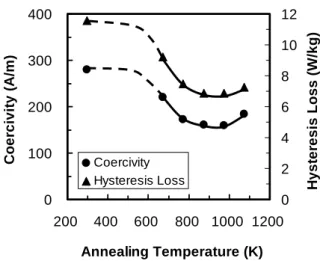
Figure 1 shows the coercivity and the hysteresis loss of specimens as a function of annealing temperature. The coercivity gradually declines to the lowest point at an annealing temperature of 973K, with annealing temperature, and then there is a slight increase. The dust cores annealed at 1073K displayed increased coercivity over the 973K annealing. This reduction up to 973K was associated with a stress relief and with the reduction of the coercivity when the material was annealed at higher temperature. Since hysteresis loss is strongly correlated with coercivity, the hysteresis loss shows a tendency similar to the coercivity.
Figure 2 shows optical micrographs of as-compressed specimens (a) and annealed specimens at 1073K for 7.2ks (b). A white area in the optical micrographs shows iron powder. The thin black lines are grain boundaries and the thicker ones are particle boundaries. Microstructural observation of these specimens shows the formation of smaller grains by recrystallization. The average grain size of each specimen, between as-compressed and annealed to 1073K, was measured by image analysis using the optical micrographs.
Figure 3 shows grain size of specimens as a function of the annealing temperature. This figure indicates that the formation of fine grains by recrystallization starts around 773K and the grain size continues to decrease to at least 2006 POWDER METALLURGY
World Congress
PC09-W-07
Effect of Annealing Temperature on Magnetic Properties
of Dust Cores
Hiroyuki Mitani1,a, Nobuaki Akagi2,b, Hirofumi Houjou2,c and Moriyoshi Kanamaru1,d 1
1-5-5, Takatsukadai, Nishi-ku, Kobe, Hyogo, 651-2271 Japan
2
2-3-1, Shinhama, Arai-cho, Takasago, Hyogo, 676-8670 Japan
a
[email protected], [email protected]
c
[email protected], [email protected]
Abstract
Magnetic Properties of dust cores made of mixtures of atomized pure iron powder and pure alumina powder has been investigated in the temperature range from 673 to 1073K. The effect of annealing on coercivity has been positive effect up to 973K and thus coercivity is gradually reduced form 280A/m (as-compressed) to 160A/m (973K). However, dust cores annealed at 1073K displayed a 15% increasing of coercivity by annealing at 973K. Hysteresis loss shows a tendency similar to coercivity. Microstructure observation of specimens shows grain refinement by recrystallization in the temperature range from 773 to 1073K.
© Korean Powder Metallurgy Institute 1178 -Fig. 1. Coercivity and hysteresis loss of as-compressed
and after annealing specimens as a function of annealing temperature.
Fig. 2. Microstructures of specimens: (a) as-compressed; (b) after annealing at 1073K for 7.2ks.
1073K. Because coercivity increases when grain size is reduced [4], the degree to which the coercivity of a sample annealed to 1073K can increase, is offset by the grain size reduction from recrystallization. The reason for the reduction of the coercivity up to 973K is stress relief.
Fig. 3. Grain size of as-compressed and after annealing specimens as a function of annealing tempera-ture.
Further reduction of coercivity, at temperatures above 973K, is more than offset by the increase due to grain size reduction from recrystallization.
3. Summary
Heat annealing on magnetic properties of dust cores has two effects. First there is a decrease of coercivity by stress relief. Secondly there is an increase of coercivity by the reduction of grain size through recrystallization at temperatures above 973K.
The results of this work have indicated that an ideal annealing temperature should be decided in consideration of recrystallization to minimize hysteresis loss.
4. References
1. L.-P. Lefebvre, I. P. Swainson, Y. Deslandes, G. Pleizier and P. Chartrand, Mater. Sci. Tech., vol. 17, 45 (2001). 2. T. Maeda, H. Toyoda, N. Igarashi, K. Hirose, K. Mimura,
T. Nishioka and A. Ikegaya, SEI Tech. Rev., no. 60, 3 (2005).
3. R. Nakayama, M. Watanabe, G. Uozumi, K. Igarashi and K. Morimoto, J-Jpn. Soc. Powder Powder Metall., vol. 53, no. 3, 285 (2006).
4. C. K. Hou, IEEE Trans. Magn., vol. 32, no. 2, 471(1996). 0 5 10 15 20 25 30 35 200 400 600 800 1000 1200 Annealing Temperature (K) Gr a in S iz e ( µ m ) 0 100 200 300 400 200 400 600 800 1000 1200 Annealing Temperature (K) C o er ci vi ty ( A /m ) 0 2 4 6 8 10 12 H yst er esi s L o ss ( W /k g) Coercivity Hysteresis Loss 50µm (a) 50µm (b)