IJIE
ISSN 1598-3579, http://dx.doi.org/10.7852/ijie.2021.42.1.7© 2021 The Korean Society of Sericultural Sciences ISSN 2586-4785 (Online) Received: 11 Mar 2021 Revised: 25 Mar 2021 Accepted : 29 Mar 2021 Keywords: Cocoon, Silkworm variety, Crystallinity, Heat treatment In the present study, the effect of heat treatment on the crystallinity of the outside of silkworm
cocoon in nine different silkworm varieties was studied using ATR-FTIR spectroscopy. Additionally, the morphological structure and moisture regain of the cocoon were examined. The silkworm cocoon showed different colors and external features depending on the silkworm variety. Moreover, the thickness of the filament (15.3–27.6 μm) and moisture regain of the cocoon (9.0%–11.0%) were quite different depending on the silkworm variety. The crystallinity index of the cocoon outside varied from 52.1% to 56.1%, depending on the silkworm variety. J300 and MO42 showed the highest (56.1%) and the lowest (52.1%) crystallinity index, respectively, indicating that the microstructure of sericin of the outside of the cocoon was affected by the silkworm variety. Regardless of silkworm variety, their crystallinity indexes decreased from 52.1%–56.1% to 49.9%–43.6% depending on the silkworm variety by the heat treatment at 250 °C. Interestingly, the crystallinity degree decrease was somewhat different depending on the silkworm variety, implying that the cocoon sericin microstructure is strongly influenced by the silkworm variety.
© 2021 The Korean Society of Sericultural Sciences Int. J. Indust. Entomol. 42(1), 7-13 (2021)
Introduction
Silk is a naturally occurring biomaterial consisting of fibroin and sericin, which exhibits satisfactory cytocompatibility (Minoura et al., 1995), biodegradability (Arai et al., 2004; Cho et al., 2012), and blood compatibility (Sakabe et al., 1989; Um et al., 2002). Therefore, silk has been applied to biomedical and cosmetic products such as facial mask paper (Wang and Zhou, 2020), membranes for guided bone regeneration (Kim et al., 2016; Seok et al., 2014), wound dressing (Lee et al., 2014), and tympanic membranes (Kim et al., 2010).
Although various silk forms including textile, sponge, film, cocoon, and electrospun web have been studied for these applications, recently, a natural silk nonwoven fabric was developed using a new technique. Specifically, Lee et al. (2018) reported that the new silk nonwoven fabric could be fabricated by wet and hot-press treatments using a binding character of sericin, and the resultant nonwoven fabric demonstrated good mechanical properties.
Because the silk nonwoven fabric is fabricated with silkworm cocoon using hot-press treatment, to improve processibility and performance of natural silk nonwoven fabric, a better *Corresponding author.
In Chul Um
Kyungpook National University, Daegu 41566, Republic of Korea Tel: +82-53-950-7757 / FAX: +82-53-950-6744
E-mail: [email protected]
Crystallinity change of silkworm variety cocoons by heat treatment
Yu Jeong Bae
1, Si Kab Noh
1, and In Chul Um
1,*1Department of Biofibers and Biomaterials Science, Kyungpook National University, Daegu 41566, Republic of Korea
Switzerland) (Park et al., 2018).
(1) The morphologies of silkworm cocoons were examined by scanning electron microscopy (FE-SEM, S-4800, Hitachi, Japan) and the cocoons were coated with Pt–Pd before observation (Choi et al., 2020). The thickness of the silk filament was obtained from the SEM images using an image analysis program (DIMIS-PRO 2.0, Siwon Optical Technology, Republic of Korea).
The molecular conformation and crystallinity of cocoons from different varieties of silkworm were evaluated using Fourier transform infrared spectroscopy (FTIR; Nicolet 380, Thermo Fisher Scientific, USA) through the attenuated total reflection (ATR) method. The scan range, scan number, and resolution of 4000, 650, 16, and 8 cm−1, respectively, were employed. Seven samples of each silkworm variety were used in the measurements. The amide I crystallinity index was calculated as the intensity ratio of the peaks occurring at 1620 and 1650 cm−1 in the FTIR spectrum according to Eq. 2.
(2) A1620cm−1: Absorbance at 1620 cm−1
A1650cm−1: Absorbance at 1650 cm−1
Results and Discussion
Morphological structure and moisture regain of silkworm cocoons
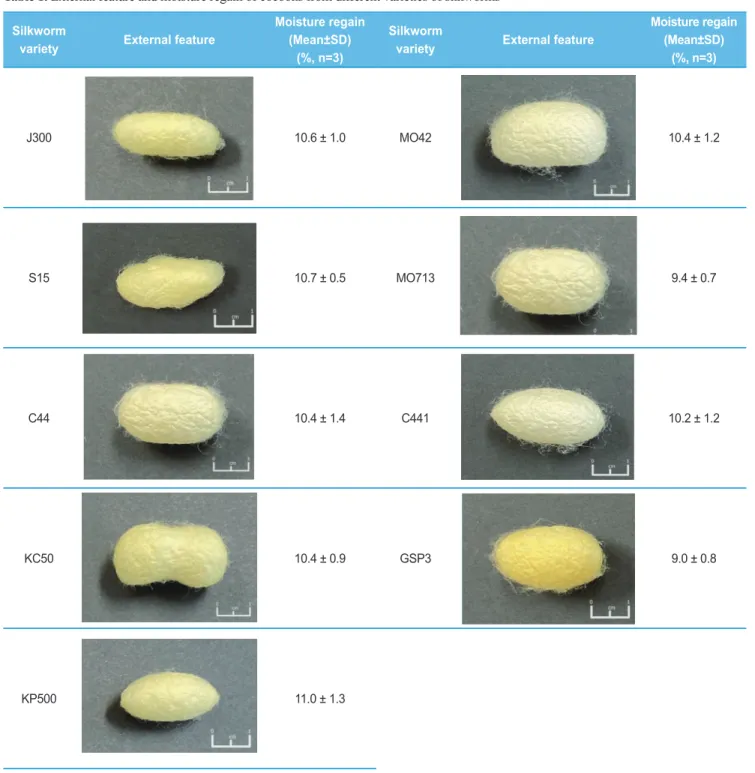
Table 1 showed the external feature and moisture regain of cocoons from different varieties of silkworms. The cocoon color was slightly different depending on the silkworm variety. GSP3 displayed a deep yellow color, while MO713, C44, and C441 exhibited a light-yellow color. It was reported that the yellow cocoon is attributed to carotenoid pigments and the color of cocoon is affected by the genes controlling penetration process from midgut to coelom and silk gland (Lee et al., 2017).
Most cocoons exhibited an oval shape, while KC50 and S15 showed a peanut shape and irregular oval shape, respectively. The distinct color and shape depending on the silkworm variety were also reported previously (Choi et al., 2020; Park et al., 2019a, b).
The moisture regain of cocoons varied from 9.0% to 11.0% understanding for the influence of the heat treatment on the
cocoon characteristics is required.
Meanwhile, there is a large variety of Korean silkworms for Bombyx mori silkworm. Chung et al. (2015) reported that the structures of silkworm cocoon and regenerated silk fibroin are quite different depending on the silkworm variety. Furthermore, Park et al. (2019a, b) reported that the morphology and crystallinity of cocoons depend on the silkworm variety. Choi et al. (2020) reported that the morphology and moisture regain of cocoon were also different depending on the silkworm variety.
In the present study, as a preliminary investigation to understand the cocoon characteristics (the starting material for natural silk nonwoven), the effect of heat treatment on the crystallinity of silkworm variety cocoons was evaluated. Additionally, the morphology and moisture regain of silkworm cocoons with different silkworm varieties were also examined.
Materials and Methods
Cocoon preparation and silkworm rearing
Nine different original Bombyx mori silkworm varieties (J300, S15, C44, KC50, KP500, MO42, MO713, C441, and GSP3) were grown at the Kyungpook National University and the nine silkworm cocoon samples were produced by the same procedure reported previously (Choi et al., 2020). All varieties of larvae were reared at 25°C on fresh mulberry leaves. Furthermore, pupae and cocoons were maintained at 25°C.
Heat treatment
In this study, the silk cocoons were heat-treated by storing the cocoons in a drying oven (WOF-50, Daihan Scientific Co., Republic of Korea) at 250°C for 3 min because thermal decomposition and the crystallite disruption of sericin film was reported to occur at 250°C (Lee et al., 2018; Park and Um, 2018).
Measurement and characterization
The color and external features of the nine silkworm variety of cocoons were photographed using a digital camera (iPhone 11 Pro, Apple Inc., USA).
To determine the moisture regain, the cocoons were conditioned at standard conditions (20°C and 65% relative humidity) for 1 day. The moisture regain of the cocoons was then calculated using Eq. 1. The dry weight of the cocoons was determined with a moisture balance (XM60, Precisa Gravimetrics, Dietikon,
elucidated in this study, it is assumed that distinct varieties of silkworms lead to cocoons with different microstructure and chemical composition. Park et al. (2019a,b) and Choi et al. (2020) demonstrated that the crystallinity index of silk cocoons varied depending on the silkworm variety, indicating that the microstructure of cocoons is different depending on the silkworm variety. Additionally, Kim and Um (2019) described that the sericin content of silk is different depending on the silkworm depending on the silkworm variety. Choi et al. described that
cocoons from several varieties of silkworm displayed moisture regain of 8.56%–10.76% (Choi et al., 2020). The moisture regain of silk materials might be influenced by several factors, including microstructure (such as crystallinity) and chemical composition (related to sericin content, amino acid composition, etc). Although the exact reason for the different moisture regain of cocoons in distinct varieties of silkworms could not be
Table 1. External feature and moisture regain of cocoons from different varieties of silkworms
Silkworm
variety External feature
Moisture regain (Mean±SD)
(%, n=3)
Silkworm
variety External feature
Moisture regain (Mean±SD) (%, n=3) J300 10.6 ± 1.0 MO42 10.4 ± 1.2 S15 10.7 ± 0.5 MO713 9.4 ± 0.7 C44 10.4 ± 1.4 C441 10.2 ± 1.2 KC50 10.4 ± 0.9 GSP3 9.0 ± 0.8 KP500 11.0 ± 1.3
sericin content in distinct silkworm varieties might be one of the reasons for the different moisture regain of the silkworm variety. Considering that the hydrophilicity of silk increased by
increasing the sericin content (Lee et al., 2016), the different
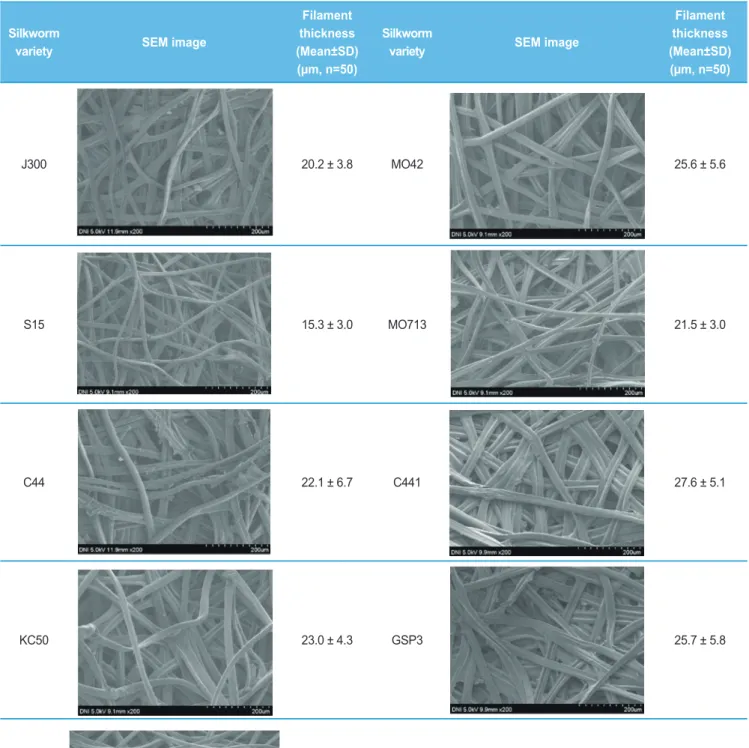
Table 2. FE-SEM images and filament thickness of the outside of the cocoons from different varieties of silkworms
Silkworm
variety SEM image
Filament thickness (Mean±SD) (µm, n=50)
Silkworm
variety SEM image
Filament thickness (Mean±SD) (µm, n=50) J300 20.2 ± 3.8 MO42 25.6 ± 5.6 S15 15.3 ± 3.0 MO713 21.5 ± 3.0 C44 22.1 ± 6.7 C441 27.6 ± 5.1 KC50 23.0 ± 4.3 GSP3 25.7 ± 5.8 KP500 16.2 ± 3.3
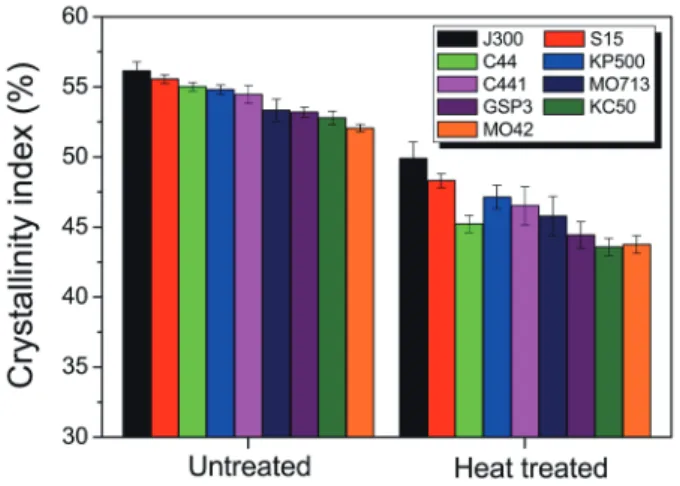
The untreated silk cocoons exhibited a crystallinity index of 52.1%–56.1% depending on the silkworm variety, indicating that the silk sericin in the cocoon exhibits different amounts of the crystalline region. When the cocoon was heat-treated, the crystallinity index of the cocoon decreased to 49.9%–43.6%. Overall, the crystallinity index of all silk cocoons decreased under heat treatment, reconfirming the sericin crystallite disruption. However, the decrease degree of the crystallinity index was somewhat different depending on the silkworm variety. Specifically, the crystallinity index of C44 and KC50 decreased more (by 9.8% and 9.2%, respectively), whereas that of J300 was less reduced (by 6.3%). Other silkworm variety cocoons showed a crystallinity index decrease of 7–8%. This result suggests that the thermal stability of the sericin crystallite is different depending on the silkworm variety.
cocoons.
FE-SEM observation was conducted on the outer surface of cocoons from different silkworm varieties to better examine the morphological structure of the cocoon, and the results are shown in Table 2. As can be seen in the figure, the silk filaments were arranged randomly forming a porous web structure. The thickness of the silk filaments in the cocoons was quite different depending on the silkworm variety. Therefore, the thickness of the silk filament was measured from the image analysis on the SEM pictures. The filament thickness ranged from 15.3 µm to 27.6 µm depending on the silkworm variety, indicating that the silkworm variety determines the morphological structure of the silkworm cocoon.
Effect of heat treatment on the crystallinity of silkworm cocoons
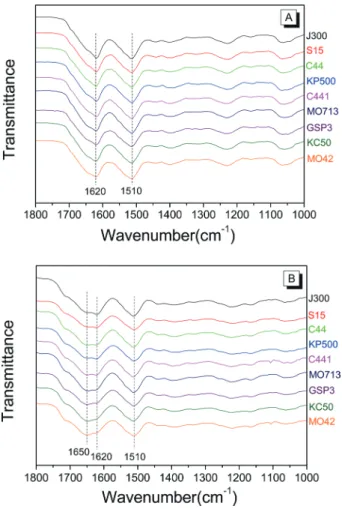
Fig. 1 shows the ATR-FTIR spectra of the outside of silkworm cocoons from different silkworm varieties. All cocoons exhibited IR absorptions at 1620 cm−1 and 1510 cm−1, attributed to the β-sheet crystallites (Um et al., 2001; Park and Um, 2018; Bae and Um, 2020), indicating that the cocoon is mainly composed of β-sheet crystallites. This result is consistent with those previously reported (Chung et al., 2015; Park et al., 2019a,b; Choi et al., 2020). When the cocoons were stored at 250°C for 3 min, a shoulder at 1650 cm−1 became more prominent, indicating that the β-sheet conformation was transferred to the random coil conformation. The IR absorptions at 1620 cm−1 and 1650 cm−1 in the amide I band reflected the sericin, while those in amide III band reflected the fibroin. Also, because the ATR technique used in the IR measurement reflects the surface (i.e., sericin in silk) characteristics of the material, the IR absorption peaks in this study reflect the molecular conformation of sericin rather than fibroin. Therefore, the new IR shoulder at 1650 cm−1 might be attributed to the disruption of the β-sheet conformation of sericin resulting in the formation of a random coil conformation. Lee et al. (2018) also described that the crystallite of sericin is disrupted by a hot-press treatment because the thermal decomposition of sericin occurs at 216°C (Kim and Bae, 2000).
It is interesting to note that the IR peak shape in the amide I band of the raw and heat-treated cocoons is distinct depending on the silkworm variety, implying that the crystallinity of raw cocoons and its change by heat treatment are strongly affected by the silkworm variety. Therefore, the crystallinity index of cocoons was calculated and the result is shown in Fig. 2.
Fig. 1. ATR-FTIR spectra of the outside of the cocoons from
different varieties of silkworms: (A) untreated cocoon and (B) heat-treated cocoon (at 250 °C for 3 min).
References
Arai T, Freddi G, Innocenti R, Tsukada M (2004) Biodegradation of Bombyx mori silk fibroin fibers and films. J Appl Polym Sci 91, 2383-2390.
Bae YJ, Um IC (2020) Effect of addition of methanol on rheological properties of silk formic acid solution. Int J Indust Entomol 40, 28-32.
Cho HJ, Yoo YJ, Kim JW, Park YH, Bae DG, Um IC (2012) Effect of molecular weight and storage time on the wet-and electro-spinning of regenerated silk fibroin. Polym Degrad Stabil 97, 1060-1066. Choi HJ, Noh SK, Um IC (2020) Morphology, molecular conformation
and moisture regain of cocoons of different silkworm varieties. Int J Indust Entomol 40, 6-15.
Chung DE, Kim HH, Kim MK, Lee KH, Park YH, Um IC (2015) Effects of different Bombyx mori silkworm varieties on the structural characteristics and properties of silk. Int J Biol Macromol 79, 943-951.
Kim JH, Bae DG (2000) Alkali hydrolysis of insoluble sericin. Korean J Seric Sci 42, 31-35.
Kim SJ, Um IC (2019) Effect of silkworm variety on characteristics of raw sericin in silk. Fiber Polym 20, 271-279.
Kim J, Kim CH, Park CH, Seo JN, Kweon HY, Kang SW et al. (2010) Comparison of methods for the repair of acute tympanic membrane perforations: Silk patch vs. paper patch. Wound Rep Reg 18, 132-138.
Kim SG, Kim MK, Kweon H, Jo YY, Lee KG, Lee JK (2016) Comparison of unprocessed silk cocoon and silk cocoon middle layer membranes for guided bone regeneration. Maxillofac Plast Reconstr Surg 38, 1-8.
Lee WY, Um IC, Kim MK, Kwon KJ, Kim SG, Park YW (2014) Effectiveness of woven silk dressing materials on full-skin thickness burn wounds in rat model. Maxillofac Plast Reconstr Surg 36, 280-284.
Lee JH, Song DW, Park YH, Um IC (2016) Effect of residual sericin on the structural characteristics and properties of regenerated silk films. Int J Biol Macromol 89, 273-278.
Lee JH, Kang MU, Park KH, Nho SK (2017) Characteristics of genes in carotenoid cocoon, Bombyx mori L. Int J Indust Entomol 35, 71-76. Lee JH, Bae YS, Kim SJ, Song DW, Park YH, Bae DG et al. (2018)
Preparation of new natural silk non-woven fabric by using adhesion characteristics of sericin and their characterization. Int J Biol Macromol 106, 39–47.
Minoura N, Aiba S, Gotoh Y, Tsukada M, Imai Y (1995) Attachment
Conclusions
In the present study, as a preliminary investigation, the morphological structure of cocoons with different silkworm varieties was observed and the effect of heat treatment on the crystallinity index of the outside of cocoon silkworm varieties was examined using ATR-FTIR. External features and morphological structure of the cocoons (especially, silk filament thickness) varied depending on the silkworm variety. Moreover, the moisture regain of cocoons was somewhat different depending on the silkworm variety. The crystallinity index of sericin in the outside of the cocoon decreased with heat treatment. The different crystallinity index and different degrees of decrease in the crystallinity of sericin caused by heat treatment imply that the microstructure characteristics of sericin in the outside of the cocoon are different depending on the silkworm variety. Considering that the sericin characteristics in a cocoon affect the fabrication and properties of new silk forms (e.g., natural silk nonwoven fabric), additional studies on the silkworm variety, cocoon, and raw sericin should be performed in detail in the future.
Acknowledgment
This study was performed with the support of the Research Program for Agricultural Science & Technology Development (PJ016130), National Academy of Agricultural Science, Rural Development Administration, Republic of Korea.
Fig. 2. Effect of heat treatment on the crystallinity of the outside of
compatibility of regenerated silk fibroin. Sen’i Gakkaishi 45, 487-490.
Seok H, Kim MK, Kim SG, Kweon H (2014) Comparison of silkworm-cocoon–derived silk membranes of two different thicknesses for guided bone regeneration. J Craniofac Surg 25, 2066-2069.
Um IC, Kweon HY, Park YH, Hudson S (2001) Structural characteristics and properties of the regenerated silk fibroin prepared from formic acid. Int J Biol Macromol 29, 91-97.
Um IC, Kweon HY, Hwang CM, Min BG, Park YH (2002) Structural characteristics and properties of silk fibroin/polyurethane blend films. Int J Indust Entomol 5, 163-170.
Wang H, Zhou B (2020) Development and performance study of a natural silk fiber facial mask paper. J Eng Fiber Fabr 15, 1558925020975756. and growth of cultured fibroblast cells on silk protein matrices. J
Biomed Mater Res 29, 1215-1221.
Park CJ, Um IC (2018) Effect of heat treatment on the structural characteristics and properties of silk sericin film. Int J Indust Entomol 37, 36-42.
Park CJ, Ryoo JY, Ki CS, Kim JW, Kim IS, Bae DG et al. (2018) Effect of molecular weight on the structure and mechanical properties of silk sericin gel, film and sponge. Int J Biol Macromol 119, 821–832. Park BK, Nho SK, Um IC (2019a) Molecular conformation and
crystallinity of white colored silkworm cocoons with different silkworm varieties. Int J Indust Entomol 38, 18-23.
Park BK, Nho SK, Um IC (2019b) Crystallinity of yellow colored silkworm variety cocoons. Int J Indust Entomol 38, 51-55.