http://dx.doi.org/10.5012/bkcs.2011.32.11.3973
Mechanistic Study of Half-titanocene-based Reductive Pinacol Coupling Reaction
Youngjo Kim, Youngkyu Do,†,* and Sungjin Park‡,*
Department of Chemistry, Chungbuk National University, Cheongju, Chungbuk 361-763, Korea †Department of Chemistry, KAIST, Daejeon 305-701, Korea. *E-mail: [email protected] ‡Department of Chemistry, Inha University, Incheon 402-751, Korea. *E-mail: [email protected]
Received July 13, 2011, Accepted September 14, 2011
The reductive pinacol coupling reaction of aldehydes or ketones creating a new C-C bond has been a major tool to produce 1,2-diol compounds. The reaction mechanism is known to be composed of sequential three steps (activation, coupling, and dissociation). In this work, we studied the dissociation step of half-titanocene-based catalytic systems. Cp and Cp* derivatives of the pinacolato-bridged dinuclear complex were synthesized and evaluated as possible models for intermediates from the coupling step. We monitored 1H-NMR spectra of the reaction between the metalla-pinacol intermediates and D2O. New reaction routes of the dissociation step including oxo- and pinacolato-dibridged dinuclear complexes and oxo-bridged multinuclear complexes have been suggested.
Key Words : Reductive coupling reaction, Pinacol, Half-titanocene, Mechanism, NMR
Introduction
Diol-type compounds, having two alcohol groups in one molecule, have been intensively investigated as synthetic precursors and unique functional groups of various materials. The reductive pinacol coupling reaction of aldehydes or ketones creating a new C-C bond has been a major tool to produce 1,2-diol compounds.1-4 Various transition metal-based organometallic catalysts have been employed in the pinacol coupling reactions.5-7 Among the catalysts, titanium based-catalysts have shown excellent catalytic performances for a wide variety of substrates.
Since Mukaiyama, Tyrlik, and McMurry independently announced a reductive coupling reaction using low-valent titanium catalysts, a wide range of titanium-based catalytic systems such as Mg-TiCl4 or TiCl3, LiAlH4-TiCl3, LiAlH4 -CpTiCl3, Zn-TiCl4, Cp2TiCl-NaCl, and Zn-Cp2TiCl2 (Cp: cyclopentadienyl) have been investigated with the aim of yielding diols.8-13 Recently, catalytic systems giving diols with stereoselectivity have attracted much interest. Accord-ingly, precise understanding of the reaction mechanism is essential to obtain highly stereoselective products and to control the catalytic behaviors.
The generally accepted mechanism of the pinacol coupl-ing reaction uscoupl-ing low-valent titanium complexes is outlined in Figure 1.14-21 The reductive coupling reactions are
com-posed of three steps: (I) an activation step to produce active species by the reductant; (II) a coupling step to produce a dinuclear metalla-pinacolate intermediate; and (III) a dis-sociation step to give the final product, diols. Interest in the reaction mechanism has led to several reports on the activation and on the coupling step through investigation of titanium- and uranium-based systems.14-21 However, to date, the mechanism of the dissociation step is not fully under-stood.
Although titanium chloride systems, such as TiCl4 and TiCl3, have been mainly employed in the reductive coupling reaction, mechanistic study using these systems is difficult owing to their poor crystallinity and instability. Thus, we have examined the reaction pathways of the dissociation step of half-titanocene-based systems, which are more stable and have better crystallinity than the TiCl4 system, while also offering catalytic activity for the reductive pinacol coupling reaction. Herein, we describe the catalytic behaviors of half-titanocene-based catalytic systems for the coupling reaction and new mechanistic features of their pinacol dissociation steps evaluated by NMR study.
Experimental Section
General Considerations. All manipulations were carried out under an inert atmosphere of nitrogen gas that was
deoxygenated with activated Cu catalyst (regenerated by heating to 300oC under H2 gas) and dried with Drierite.
Tetrahydrofuran (THF) was dried with Na/K alloy with benzophenon. Hydrocarbons, n-hexane and n-pentane, were dried with Na/K alloy. CDCl3 were dried over activated
molecular sieves (4 Å). All other chemicals were purchased from the Aldrich.
Measurements. 1H and 13C{1H} NMR spectra were recorded on a Bruker Avance 400 at room temperature. The chemical shifts are referenced to the residual peaks of CDCl3
(7.24 ppm for 1H NMR and 77.0 ppm for 13C{1H}NMR). EI and HR mass spectra were obtained on a VG Auto spectro-meter. Elemental analyses were performed at the Environ-mental Analysis Laboratory at KAIST on an EA1110-FISONS.
Synthesis.
Reductive Coupling Reaction of Benzaldehyde: Distilled THF (10 mL) was added to a mixture of mercury (II) chloride (0.044 g, 0.16 mmol) and 50 mesh magnesium (0.144 g, 6.0 mmol) and the resulting mixture was stirred at room temperature for 30 min, giving a grey slurry. An orange solution of CpTiCl3 (0.660 g, 3 mmol) in 20 mL of THF was
slowly added to the mixture at 0oC and then stirred for 10 min, affording a green mixture. A solution of benzaldehyde (0.212 g, 2 mmol) in 5 mL of THF was added, and the brown mixture was stirred at 0oC for 2 h. The reaction mixture was quenched with Na2CO3/water solution and
stirred at 0oC for 30 min. The resulting mixture was diluted with Et2O and filtered through Celite. The filtrate was
washed with NaCl/H2O solution, dried over MgSO4, filtered,
and concentrated to afford a colorless solid. Column chromatography by EA:hexane = 1:4 eluent gave a colorless crystal in 93% yield (0.198 g).22
Reductive Coupling of Cyclohexane Carboxaldehyde: This reaction was carried out as described for benzaldehyde. Column chromatography by EA:hexane = 1:4 eluent gave a colorless crystal in 75% yield (0.168 g).23
Reductive Coupling of Isovaleraldehyde: This reaction was carried out as described for benzaldehyde. Column chromatography by EA:hexane = 1:4 eluent gave a colorless crystal in 70% yield (0.122 g).24
Reductive Coupling Reaction of Acetophenone: This reaction was carried out as described for benzaldehyde. Column chromatography by EA:hexane = 1:4 eluent gave a colorless crystal in 56% yield (0.130 g).25
Synthesis of {(C5H5)Cl2Ti}2O2C2(CH3)4 (1): Compound 1 was prepared by the method reported in the literature.17
Synthesis of {(C5(CH3)5)Cl2Ti}2O2C2(CH3)4 (2): A reddish solution of Cp*TiCl3 (0.578 g, 2 mmol) in 20 mL of
THF was added slowly to a colorless solution of pinacol (118 g, 1 mmol) in THF (20 mL) containing excess triethyl-amine at −78oC. The reaction mixture was left to react at room temperature under stirring for 12 h. The solution was filtered off through Celite, and the filtrate was reduced in volume and treated with hexane, affording 2 as an orange solid in 66% yield (0.410 g). 1H NMR(400 MHz, CDCl3, 25oC, TMS): δ 2.19 (s, 30H, C5(CH3)5), 1.56 (s, 12H, O2C2(CH3)4), 13C{1H} NMR (400 MHz, CDCl3, 25oC, TMS): δ 131.63 (C5(CH3)5), 97.27 (O2C2(CH3)4), 26.09 (O2C2(CH3)4), 13.22 (C5(CH3)5), MS: m/z (%): 624 (17) (M+), 553 (69) (M+-Cl2), 489 (11) (M+-Cp*), HRMS: Calcd. for C26H42O2Ti2Cl4 [M+H+]: 624.1553; found 624.1553.
Synthesis of {(C5(CH3)5)ClTi}2O2C2(CH3)4(µ-O) (3): Diluted H2O/THF solution was added to an orange solution
of compound 2 (0.624 g, 1 mmol) in toluene (30 mL) and was stirred for 2 h before removal of the solvent. Dissolution of the resulting residue in pentane was followed by filtration. The filtrate was concentrated under vacuum and then cooled in refrigerator, affording 3 as a yellow crystal in 53% yield (0.300 g).26
1H-NMR Study of the Reaction of Compound 1 and
D2O: Several drops of D2O were slowly injected to a
solution of 10 mg of 1 in CDCl3 in a 5 mL NMR cell filled
with inert Ar gas. 1H-NMR spectra were obtained according to the reaction time at room temperature.
1H-NMR Study of the Reaction of Compound 2 and
D2O: Several drops of D2O were slowly injected to a
solution of 10 mg of 2 in CDCl3 in a 5 mL NMR cell filled
with inert Ar gas. 1H-NMR spectra were obtained according to the reaction time at room temperature.
X-ray Structure Determination. A crystal suitable for single crystal X-ray diffraction study was grown from THF/ hexane recrystallization for compound 2. A set of indepen-dent reflections was measured on a Bruker AXS SMART CCD-equipped diffractometer with graphite-monochromat-ed MoKα radiation (λ = 0.71073 Å) at 293 K. The hemi-sphere of reflection data were collected as ω scan frames with a width of 0.3°/frame and exposure time of 10 s/frame. Cell parameters were determined and refined by the SMART program.27 Data reduction was performed using SAINT software,28 which corrects for Lorentz polarization effects. Empirical absorption correction was applied with the SADABS program.29 Structures were resolved and all non-hydrogen atoms were refined by full-matrix least-square techniques with anisotropic parameters by the SHELXTL program.30 Hydrogen atoms except non-coordinated water hydrogen atoms were calculated at idealized positions and refined riding on the corresponding carbon atoms with isotropic thermal parameters.
Results and Discussion
We first investigated the catalytic activity of CpTiCl3
-based system for the reductive coupling reaction then studied the pinacol dissociation step of the system using the reaction of metalla-pinacol intermediate with water. How-ever, we could not isolate the intermediate of the dissocia-tion step. Consequently, we isolated an intermediate com-plex of the reaction between metalla-pinacol comcom-plex and water using Cp*TiCl3 system that is an analogue of the
CpTiCl3 system. Based on new information from NMR
study using the Cp*TiCl3 system, we furthered NMR study
of the pinacol dissociation reaction of the CpTiCl3 catalytic
Catalytic Activity of CpTiCl3-based System. CpTiCl3
has catalytic activities on the asymmetrical and intramole-cular coupling reactions of ketones and aldehydes.31 In order to confirm the catalytic activity of half-titanocene-based systems for intermolecular coupling, we tested the catalytic behaviors for the intermolecular coupling reaction employ-ing CpTiCl3 with amalgamated magnesium as described in
previous studies (see the experimental section for details). In addition to having activity for intramolecular coupling reac-tions as previously reported, the CpTiCl3-Mg (Hg) system
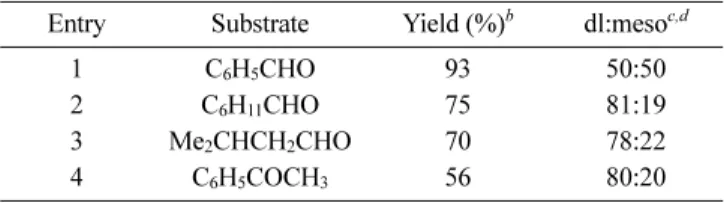
showed catalytic activity for intermolecular homo-coupling reactions with a high yield and moderate diastereoselectivity (Table 1). Consequently, revealing the reaction mechanisms of the half-titanocene-based catalytic systems could be of importance.
Metalla-pinacol Intermediates in Half-titanocene Systems. Because the dissociation step in the suggested reaction mechanism (Figure 1) has been largely unrevealed, we focused on studying the dissociation step using half-titanocene systems. Metalla-pinacol titanium complexes, which have two titaniums bridged by a pinacolate ligand (a diol-type moiety), have been proposed as the intermediate pro-duced via the coupling step.14-21 As a metalla-pinacol inter-mediate of the CpTiCl3-based system, a dinuclear complex,
{(C5H5)Cl2Ti}2O2C2(CH3)4 (1), was prepared by a HCl
elimination reaction (Figure 2).17
The pinacol dissociation step for 1 is of interest to us, since 1 is a possible intermediate of the coupling step in the half-titanocene system (Figure 1). Generally, the final step of the pinacol coupling reaction is known to be the pinacol dissociation step, which proceeds by a hydrolysis reaction of the metalla-pinacol intermediates. Thus, we observed the reaction of H2O and metalla-pinacol compounds, 1.
Treat-ment of 1 with H2O yielded a mixture of an oxo-bridged
titanium tetranuclear compound 9 (see below for compound 9)32,33 and a dissociated free pinacol, supporting that com-pound 1 could be the metalla-pinacol intermediate. Because, however, we could not obtain more information on the intermediate or on the mechanism, we chose Cp*TiCl3 (Cp*:
pentamethyl-cyclopentadienyl), which has a similar struc-ture to that of CpTiCl3, as a control model to study the
mechanism.
The control model, (Cp*Ti Cl2)2O2C2(CH3)4 (2), was
new-ly synthesized by the HCl elimination reaction (Figure 2).
The orange solid 2 is soluble in THF, methylene chloride (MC), and toluene, is slightly soluble in diethyl ether, and is insoluble in hydrocarbon solvents. The molecular structure of 2 is depicted in Figure 3 (see the Supporting Information (SI) for crystallographic data). The pinacolate ligand in 2 behaves as a bridging ligand, connecting two titanium metal centers through two O donor centers. Four methyl groups in the pinacolate ligand are equivalent, as confirmed by the 1 H-NMR spectrum. Generally, the molecular structure of 2 is similar to that of compound 1 reported.17 While the angles of Ct (centroid of Cp group)-Ti-E (E = Cl1, Cl2 and O1) of 1 are similar to each other, the Ct-Ti-O angle in compound 2 is larger than those of Ct-Ti-Cl (Table 2). Ti1-O1-C (in the pinacolate ligand) angle of 2 is greater than that of 1, indicating the presence of the steric repulsion between methyl groups of the Cp* group and the pinacolate ligand.
NMR Study Using Cp*Ti-based System as a Control Experiment. The dissociation steps of the reductive coupl-ing reaction usually progress by the addition of water to the metalla-pinacol intermediate (Figure 1). Consequently, we were interested in the chemical identities of products from the reaction of the half-titanocene-based intermediate with water molecules. The treatment of excess H2O to 2 yielded a
mixture of a titanium trinuclear complex 5 that does not
Table 1. Intermolecular Reductive Coupling Reactions by CpTiCl3 -Mg(Hg)a
Entry Substrate Yield (%)b dl:mesoc,d
1 C6H5CHO 93 50:50
2 C6H11CHO 75 81:19
3 Me2CHCH2CHO 70 78:22
4 C6H5COCH3 56 80:20
aThe CpTiCl3-Mg(Hg) reagent was employed in this reaction. b
Com-bined yields for isolated dl and meso products. cDetermined by 1H NMR
analysis of crude reaction mixture. dStereochemical assignments made
by comparison of spectroscopic data to that reported in the literature.
Figure 2. Synthetic routes for compounds 1 and 2. Table 2. Selected Bond Angles (deg) in 117 and 2
1 2
Ti(1)-O(1)-C(in pinacol) 166.2 177.5 (2)
Ct(1)-Ti(1)-O(1) 118.8 123.03 (12)
Ct(1)-Ti(1)-Cl(1) 115.0 113.13 (11)
Ct(1)-Ti(1)-Cl(2) 114.2 112.54 (11)
Figure 3. Ortep drawing of compound 2 showing 50% probability thermal ellipsoids and atom labeling. Hydrogen atoms were omitted for clarity.
contain any pinacolate ligand (compound 5 was identified by comparison with the NMR spectrum),32-34 and an oxo-and pinacolato-dibridged compound 3. Compound 3 was generated from hydrolysis of 2 via the HCl elimination reaction, as outlined in Figure 4.26 In compound 3, a pinaco-late ligand and an oxygen atom behave as bridging ligands, connecting two titanium metal centers simultaneously. Four methyl groups of a pinacolate ligand in 3 divide into two structurally inequivalent species, one of C23 and C25 and another of C22 and C26 (see the SI for details), while 2 has only one kind of methyl group.26 As displayed in the 1 H-NMR spectra (Figure 5), the methyl groups of the pinacolate in 2 produced one peak at 1.56 ppm (12H). On the contrary, the spectrum of 3 shows two peaks, at 1.36 (6H, two methyl groups) and 1.16 (6H, two methyl groups) ppm, correspond-ing to the methyl groups of the pinacolate ligand.
For detailed observation, we monitored the 1H-NMR spectra of the reaction of D2O and 2 in CDCl3 as the reaction
proceeds. A small amount D2O was added to a CDCl3
solution of 2 in a NMR cell. As illustrated in Figure 6(a), (b), the 1H-NMR spectrum of 2 and D2O was constituted by two
regions of methyl proton: of a Cp* ligand around 2-2.4 ppm and of a pinacolate ligand around 1-1.6 ppm. At 5 min of reaction time, a peak at 2.25 ppm (corresponding to the methyl group protons in Cp* of an oxo-bridged dinuclear titanium complex 4),34 a peak at 2.07 ppm (corresponding to methyl group protons in Cp* of 3),26 two peaks at 1.36 and 1.16 ppm (corresponding to methyl group protons of a pinacolate ligand in 3),26 and a peak at 1.21 ppm (corre-sponding to free pinacol) appeared. At 10 min of reaction time, the intensity of those peaks increased and a peak at 2.19 ppm corresponding to the starting compound 2 decreas-ed and then completely disappeardecreas-ed at 20 min of reaction time. This indicates that both 3 and 4 were produced from the reaction of 2 and D2O. The free pinacol could be
dis-sociated from compound 2, producing compound 4, which does not contain a pinacolate ligand (Figure 6(c)). As the reaction time increased, the intensity of the peak at 2.25 ppm (compound 4) decreased and then disappeared. On the other hand, peaks at 2.10 and 2.08 ppm corresponding to com-pound 5 appeared at 20 min of reaction time. The intensity of these peaks increased as the reaction time increased, indicating that the reaction proceeded along the lower path-way in Figure 6(c). Compound 4 was completely exhausted after 2 hr, reflecting complete transformation of 4 to 5.
Since peaks of 3 and 5 at ~2.07 ppm overlapped each other, it is difficult to monitor compound 3 after compound 5 is generated during the measurement. However, the peaks at
1.36 and 1.16 ppm, corresponding to methyl groups in 3, did not disappear after long reaction time. This might mean that a major portion of compound 3 is stable in these reaction conditions. In addition, a separate experiment, reaction of H2O to 3, gave a mixture of compound 3 and a small amount
of 5. Accordingly, we could deduce that upper path proceeds faster than lower path (Figure 6(c)). From the results noted above, we suggest new reaction routes that pinacol moieties are dissociated from the Cp*Ti-based complex by the addi-tion of water, as outlined in Figure 6(c).
NMR Study of CpTi-based System. Based on the new
Figure 4. Synthetic routes for compound 3.
Figure 5. 1H-NMR spectra (a) of 2 and (b) of 3.
Figure 6. (a) 1H-NMR spectra of reaction of 2 and D 2O as a
reaction time. (b) Magnified at the regions between 2 and 2.4 ppm. (c) Suggest reaction pathways for the reaction of 2 and H2O.
information from the Cp*Ti-based system above, we carried out the reaction of D2O and CpTi-based system (1), which
have good catalytic activities for the pinacol coupling reactions, on a NMR scale. If the NMR cell was shaken, the final products, an oxo-bridged tetranuclear titanium com-pound (9) and a free pinacol, were immediately observed. Consequently, 1H-NMR spectra were observed without any shaking as the reaction time increased. The NMR spectra were composed of two major regions, at around 7 ppm corresponding to Cp groups, and at around 1-2 ppm, corresponding to methyl groups in the pinacolate group (Figure 7(a), (b)).
After the addition of D2O to a CDCl3 solution of 1, two
new peaks at 1.47 ppm and 1.27 ppm appeared (Figure 7(a), (b)). The two peaks correspond to methyl groups of the pinacolate ligand and have the same integral. As mentioned above, the oxo- and pinacolato-bridged titanium complex 3 (Cp*Ti-based system, Figure 6(c)) has two chemically inequivalent methyl groups of a pinacolate ligand, leading to the generation of two peaks with the same integral in the 1 H-NMR spectrum. The peak pattern, two peaks at 1.47 and 1.27 ppm with the same integral, is highly similar to that of compound 3. Consequently, the existence of two peaks could support the generation of an intermediate compound 6, a Cp analogue of 3 having oxo and pinacolate bridges. We attempted to isolate compound 6 from the reaction mixture or to synthesize it separately, however, this was not success-ful. At 10 min of reaction time, another new peak at 1.21 ppm, corresponding to methyl groups of free pinacol, was
also observed, indicating the dissociation of free pinacol from compound 1.
As the reaction progressed, three new peaks appeared, then grew in intensity, and then disappeared finally in the Cp group region; a peak at 6.88 ppm (oxo-bridged dinuclear compound 7),27 a peak at 6.81 ppm (oxo-dibridged dinuclear compound 8),35 and a peak at 6.75 ppm (oxo- and pin-acolato-bridged compound 6) were observed, reflecting the generation of three different kinds of intermediates (Figure 7(c)). Once the reaction was completed, in the Cp region only one peak at 6.60 ppm, corresponding to compound 9,32,33 which is an oxo-bridged tetranuclear complex and does not have a pinacolate ligand, became dominant.
Based on these NMR observations, we identified new pathways for the pinacol dissociation step of the pinacolato-bridged CpTi-based dinuclear system (Figure 7(c)). Three reaction intermediates, (a) via oxo- and picanolato-dibridged dinuclear complex, (b) via oxo-bridged dinuclear complex without a pinacol moiety, and (c) via bis oxo-bridged di-nuclear complex without a pinacol moiety, were generated and then disappeared to produce the final products, an oxo-bridged tetranuclear complex and free pinacol molecules dissociated from the metalla-pinacol intermediate.
Conclusions
The reaction mechanism of the dissociation step of a titanium-based reductive pinacol coupling reaction was investigated. Cp and Cp* derivatives of a pinacolato-bridged dinuclear complex were synthesized as possible models for intermediates from the coupling step. For the first time, the mechanism of the half-titanocene-based dissociation step was proven by monitoring 1H-NMR spectra of the reaction between the dinuclear derivatives and D2O separately. We
confirmed the existence of multinuclear complexes as an intermediate of the pinacol dissociation step. The present findings could be helpful to understand catalytic mechanisms of reductive coupling reactions and to develop new reaction routes.
Acknowledgments. Y. Kim gratefully acknowledges the financial support of the National Research Foundation of Korea (NRF) Grant funded by the Korea Government (MEST) (No. 2010-0007092). S. Park thanks for start-up package from the Inha University.
Supplementary Material. CCDC 638600 contains the supplementary crystallographic data for compound 2. These data can be obtained free of charge via www.ccdc.cam.ac.uk/ conts/retrieving.html. Supplementary data associated with this article can be found in the online version.
References
1. Robertson, G. M. Comprehensive Organic Synthesis, Vol 3., Pergamon: Oxford, 1991; pp 563-611.
2. Fürstner, A. Angew. Chem. Int. Ed. Engl. 1993, 32, 164. 3. Wirth, T. Angew. Chem. Int. Ed. Engl. 1996, 35, 61. Figure 7. (a) 1H-NMR spectra of reaction of 1 and D
2O as a reaction time. (b) Magnified at the regions between 6.3 and 7.2 ppm. (c) Suggest reaction pathways for the reaction of 1 and H2O.
4. Nicolaou, K. C.; Liu, J.-J.; Yang, Z.; Ueno, H.; Sorensen, E. J.; Claiborne, C. F.; Guy, R. K.; Hwang, C.-K.; Nakada, M.; Nantermet, P. G. J. Am. Chem. Soc. 1995, 117, 634.
5. Mukaiyama, T.; Sato, T.; Hanna, J. Chem. Lett. 1973, 1041. 6. Tyrlik, S.; Wolochowicz, I. Bull. Soc. Chim. Fr. 1973, 2147. 7. McMurry, J. E.; Fleming, M. P. J. Am. Chem. Soc. 1974, 96, 4708. 8. McMurry, J. E. Chem. Rev. 1989, 89, 1513.
9. Fürstner, A.; Bogdanovic, B. Angew. Chem. Int. Ed. Engl. 1996, 35, 2442.
10. Clerici, A.; Clerici, L.; Porta, O. Tetrahadron Lett. 1996, 37, 3035. 11. Barden, M. C.; Schwartz, J. J. Am. Chem. Soc. 1996, 118, 5484. 12. Bandini, M.; Cozzi, P. G.; Morganti, S.; Umani-Ronchi, A.
Tetrahedron Lett. 1999, 40, 1997.
13. Lipski, T. A.; Hilfiker, M. A.; Nelson, S. G. J. Org. Chem. 1997, 62, 4566.
14. Aleandri, L. E.; Bogdanovic, B.; Gaidies, A.; Jones, D. J.; Liao, S.; Michalowicz, A.; Rozière, J.; Schott, A. J. Organomet. Chem. 1993, 459, 87.
15. Aleandri, L. E.; Becke, S.; Bogdanovic, B.; Jones, D. J.; Rozière, J. J. Organomet. Chem. 1994, 472, 97.
16. Bogdanovic, B.; Bolte, A. J. Organomet. Chem. 1995, 502, 109. 17. Huffman, J. C.; Moloy, K. G.; Marsella, J. A.; Caulton, K. G. J.
Am. Chem. Soc. 1980, 102, 3009.
18. Pasquali, M.; Floriani, C.; Chiesi-Villa, A.; Guastini, C. Inorg. Chem. 1981, 20, 349.
19. Ephritikhine, M.; Maury, O.; Villiers, C.; Lance, M.; Nierlich, M. J. Chem. Soc., Dalton Trans. 1998, 3021.
20. Ephritikhine, M. Chem. Commun. 1998, 2549.
21. Villiers, C.; Ephritikhine, M. Chem. Eur. J. 2001, 7, 3043. 22. Fürstner, A.; Hupperts, A. J. Am. Chem. Soc. 1995, 117, 4468. 23. Souppe, J.; Danon, L.; Namy, J. L.; Kagan, H. B. J. Organomet.
Chem. 1983, 250, 227.
24. Balsells, R. E.; Frasca, A. R. Tetrahedron 1982, 38, 245. 25. Fürstner, A.; Csuk, R.; Rohrer, C.; Weidmann, H. J. Chem. Soc.
Perkin Trans. 1988, 1729.
26. Yoon, S. W.; Kim, Y.; Kim, S. K.; Kim, S. Y.; Do, Y.; Park, S. Macromol. Chem. Phys. 2011, 212, 785.
27. SMART, Version 5.0, Data Collection Software, Bruker AXS, Inc.: Madison, WI, 1998.
28. SAINT, Version 5.0, Data Integration Software, Bruker AXS, Inc.: Madison, WI, 1998.
29. Sheldrick, G. M. SADABS, A Program for Absorption Correction with the Bruker SMART System, Universität Göttingen: Germany, 1996.
30. Sheldrick, G. M. SHELXL-97: Program for the Refinement of Crystal Structures, Universität Göttingen: Germany, 1997. 31. Corey, E. J.; Danheiser, R. L.; Chandrasekaran, S. J. Org. Chem.
1976, 41, 260.
32. Köpf, H.; Grabowski, S.; Voigtländer, R. J. Organomet. Chem. 1981, 216, 185.
33. Carofiglio, T.; Floriani, C.; Sgamellotti, A.; Rosi, M.; Chiesi-Villa, A.; Rizzoli, C. J. Chem. Soc., Dalton Trans. 1992, 1081. 34. Palacios, F.; Royo, P.; Serrano, R.; Balcázar, J. L.; Fonseca, I.;
Florecio, F. J. Organomet. Chem. 1989, 375, 51.
35. Gowik, P.; Klapötke, T.; Pickardt, J. J. Organomet. Chem. 1990, 393, 343.