Background: Evidence for opioid-induced hyperalgesia (OIH) has been shown in animal and human studies, but the clinical implications of this phenomenon remain unclear.
Objectives: We examined whether cancer patients taking opioids differ in their sensitivity to a clinical pain stimulus using a local anesthetic injection compared to those not taking opioids. We also evaluated the effect of the opioid dose, duration of opioid therapy, and patients’ pain severity and functional status on this clinical pain stimulus.
Study Design: Prospective observational study.
Setting: University outpatient department for interventional pain management, Republic of Korea.
Methods: Eighty-two cancer patients including 20 patients not taking opioids (non-opioid group) and 62 taking opioids (opioid group) who were scheduled for an interventional procedure were enrolled in this study. Patients received a standardized subcutaneous injection of lidocaine prior to a full dose of local anesthetic (LA). Before the injection, patients completed the Brief Pain Inventory (BPI) questionnaire and were asked to rate their current pain using numeric rating scales. Immediately following the injection, LA injection-specific pain was evaluated using pain intensity, unpleasantness, and behavior pain scores.
Results: LA injection-specific pain intensity, unpleasantness, and behavior pain score were significantly higher in the opioid group compared with the non-opioid group (P < 0.001). In the opioid group, these post-injection pain scores were higher in patients taking high-dose opioids than those taking low doses (P < 0.05). In addition, we observed a strong correlation between the baseline BPI pain interference score and the LA injection-specific pain score (r = 0.695, P < 0.001). Limitations: This study is limited by its sample size and observational design. Various opioid medications, which were not standardized, may have inadvertently biased our results. Finally, the pain assessed by a brief stimulus does not fully reflect disturbances in endogenous pain inhibitory processes.
Conclusion: The results of this study suggest that opioid medication is an important contributing factor to pain perception accompanying LA injection, and cancer patients using high-dose opioids may be highly susceptible to hyperalgesic responses to this clinical stimulus. We also suggest that the possible presence of OIH may be intensified among cancer patients with poor physical and psychosocial functional status.
Key words: Adverse effects; analgesics, opioid; anesthetics, local; cancer; hyperalgesia; injections, subcutaneous; nociceptive pain; pain measurement; pain perception; quality of life
CLINICAL TRIAL: NCT01704469. IRB No: 4-2012-0066 Pain Physician 2013; 16:E247-E256
Prospective Study
High-Dose Daily Opioid Administration
and Poor Functional Status Intensify Local
Anesthetic Injection Pain in Cancer Patients
From: Department of Anesthesiology and Pain Medicine, and Anesthesia and Pain Research Institute, Yonsei University College of Medicine, Seoul, Republic of Korea. Dr. Kim is a Clinical Assistant Professor with the Department of Anesthesiology and Pain Medicine, and Anesthesia and Pain Research Institute, Yonsei University College of Medicine, Seoul, Republic of Korea. Dr. DM Yoon is a Professor with the Department of Anesthesiology and Pain Medicine, and Anesthesia and Pain Research Institute, Yonsei University College of Medicine, Seoul, Republic of Korea. Dr. Choi is a Clinical Fellow with the Department of Anesthesiology and Pain Medicine, and Anesthesia and Pain Research Institute, Yonsei University College of Medicine, Seoul, Republic of Korea. Dr. KB Yoon is a Professor with the Department of Anesthesiology and Pain Medicine, and Anesthesia and Pain Research Institute, Yonsei University College of Medicine, Seoul, Republic of Korea Address Correspondence: Kyung Bong Yoon, MD, PhD Department of Anesthesiology
and Pain Medicine Anesthesia and Pain Research Institute, Yonsei University College of Medicine 50 Yonsei-ro, Seodaemun-gu, Seoul 120-752, Republic of Korea. E-mail: [email protected] Disclaimer: There was no
external funding in the preparation of this manuscript.
Conflict of interest: None. Manuscript received: 12-17-2012
Accepted for publication: 01-02-2013 Free full manuscript: www.painphysicianjournal.com
Shin Hyung Kim, MD, Duck Mi Yoon, MD, PhD, Kwan Woong Choi, MD, and Kyung Bong Yoon, MD, PhD
cancer patients not receiving opioid treatment.We also evaluated the effect of opioid dose, duration of opioid therapy, and patients’ pain severity and functional sta-tus on the sensitivity to this clinical pain stimulus.
M
ethodsThis study was approved by the Institutional Review Board, and written informed consent was ob-tained from all patients. Eighty-two cancer patients aged 20 – 70 years who were scheduled for a diagnos-tic/therapeutic nerve block were enrolled in this study. Patients with any change in opioid or other analgesic medications less than 2 weeks prior to the scheduled procedure, evidence of recent disease progression by laboratory testing and imaging studies, and psychiatric/ central nervous system disturbance that would pre-clude completion of the pain-related questions were excluded. In addition, no patients took any analgesics, sedatives, or opioids on the day of their procedure. All patients were divided into patients not taking opi-oids (non-opioid group) and patients receiving opioid therapy (opioid group).
Thirty minutes before the scheduled procedure, all patients completed the Brief Pain Inventory (BPI) questionnaire (8). The BPI pain severity score includes 4 items (worst, least, average in the last 2 weeks, and now) that are scored with numeric rating scales (NRSs) that ask the patient to rate the pain intensity on a 0 to 10 point scale. Each scale is presented as a row of equidistant numbers where 0 = no pain and 10 = worst possible pain. Patients’ functional status was measured according to 7 items using the BPI pain interference score (7). The BPI pain interference score is measured with 0 representing “no interference” and 10 repre-senting “interferes completely” with regard to how much pain interferes with enjoyment of life, general activity, walking ability, mood, sleep, normal work, and relations with other people.
All interventional procedures were done as part of standard clinical care under either fluoroscopic- or ultrasound-guided techniques. The needle entry point was marked on the skin (all needle entry points were in the lumbar area), and prepared and draped in an aseptic manner. All patients were then informed that they were going to receive a little numbing medication. The subcutaneous LA injection was carried out by one pain physician (S.H.K.) using a 25-gauge needle and one ml 1% lidocaine to raise a small skin wheal on the previ-ously marked needle entry point.
Before the LA injection, patients were asked to
P
ain is the most persistent, incapacitating, and distressing symptom experienced by cancer patients (1). Opioid-based pharmacotherapy is the mainstay approach for the long-term treatment of chronic pain in populations with active cancer (2). However, the use of opioids in cancer patients is associated with the potential for detrimental side effects, such as constipation, drowsiness, sleep disturbance, cognitive impairments, opioid-induced hypogonadism, and tolerance (2). Moreover, many studies suggest that opioids may cause yet another problem, which is often referred to as opioid-induced hyperalgesia (OIH) (3). OIH is most broadly defined as a state of paradoxical sensitization to noxious stimuli caused by exposure to opioids (4). In animal studies, the evidence supporting OIH, which includes several neurobiological mechanisms, is compelling, despite the fact that studies are mostly limited to rodents (3). In humans, the evidence for OIH is mounting, but still controversial. Most clinical studies support the development of OIH in a few specific settings such as former opioid addicts undergoing methadone maintenance therapy or after acute exposure to short-acting opioids in postsurgical patients and healthy volunteers using experimental pain stimuli (4,5). In these studies, opioid use was initiated in opioid-naive patients at or just before surgical incision, and the experimental stimuli used to assess OIH may not reflect real-life conditions. Other studies have sought to quantify OIH based on non-standardized surgical pain stimuli. On the contrary, a recent study using a standardized, clinical pain stimulus (subcutaneous administration of a local anesthetic [LA]) in non-cancer patients with chronic pain demonstrated that both the opioid dose and duration of treatment are directly correlated with pain intensity and unpleasantness in patients receiving opioid therapy compared with patients not receiving opioids (6). In clinical pain practice, cancer patients with chronic or acute pain are easily exposed to opioids and often experience interventional procedures as alternatives or adjuvants of opioid therapy for their pain control (2). Also, many cancer patients suffer physical and psychosocial problems such as depression and anxiety, catastrophizing, social impairment, and functional disability that can influence individual pain sensitivity (1,7).The aim of the present study was to determine whether cancer patients who are treated with opioids differ in their sensitivity to a clinical pain stimulus us-ing a standardized subcutaneous LA injection from
rate their present pain score associated with their main pain site using a single-measure NRS (0 = no pain, 10 = worst possible pain). Immediately after LA injection, injection-specific pain was evaluated using the follow-ing 3 pain assessment methods:
1. Pain intensity score using a 0 to 10 NRS (0 = no pain, 10 = worst possible pain);
2. Unpleasantness score using a 0 to 10 NRS (0 = no un-pleasantness, 10 = worst possible unpleasantness); 3. Behavior pain score using a 0 to 10 NRS (negative
vocalization: 0 = none, 1 = quiet moaning or groaning, 2 = loud moaning or groaning, crying; breathing: 0 = normal, 1 = labored breathing, 2 = noisy labored breathing, hyperventilation; facial expression: 0 = inexpressive, 1 = sad, frightened or frown, 2 = facial grimacing; body movement: 0 = relaxed, 1 = tense, fidgeting, 2 = rigid, pulling or pushing away, striking out; consolability: 0 = no need, 1 = distracted or reassured by voice or touch, 2 = unable to console, distract, or reassure) (9).
All data were recorded by an independent in-vestigator (K.W.C.). After LA injection, patients were additionally given a full dose of LA to complete the scheduled procedure.
Clinical and demographic data were collected for analysis, including age, gender, procedure type, loca-tion of pain, duraloca-tion of pain, duraloca-tion of opioid ther-apy, opioid type, and opioid dose. The primary site of cancer and time elapsed since diagnosis were recorded. For patients receiving opioid therapy, regular dose was converted to an oral morphine equivalent dose (MED) according to standard accepted guidelines (10). The daily MED was reconverted to none, low (one to 59 mg), intermediate (60 to 199 mg), and high (≥ 200 mg) opi-oid doses for our study population. A lot of controversy and variation exist in determining opioid dose ranges, especially in high-dose ranges. However, a daily MED more than 200 mg seems to be considered a high dose of opioids in clinical practice (2). For sub-analysis in the opioid group, patients were divided into those with an NRS injection-specific pain score more than 7, which is typically thought to indicate severe pain (hyperalgesic group), and those with an NRS pain score less than 7 (non-hyperalgesic group).
Statistical Analysis
Sample-size calculation was performed based on a previous study in non-cancer patients (6) with the following assumptions: 80% power to detect a 1.5
difference in the LA injection pain score between the non-opioid group and the opioid group with a stan-dard deviation of 2.8 and an alpha level of 0.05 with an independent t-test using the power analysis and sample size package (NCSS, LLC, Kaysville, UT). We cal-culated that 55 patients would be required. Continu-ous data are reported as mean and standard deviation unless otherwise indicated. Normality of data distribu-tion was assessed using the Kolmogorov–Smirnov test. Categorical data are reported as both the number of patients and percentage. Statistical analyses were per-formed with the SAS (version 9.2; SAS Institute, Inc., Cary, NC). Demographic data were analyzed with an in-dependent t-test, chi-square test, or Fisher’s exact test, as appropriate. By designating one variant as a factor and the other variants as dependents, one-way analy-sis of variance was used to detect overall differences between means. When significant main effects were observed, post-hoc Tukey Honestly Significant Differ-ence testing was performed to determine the source(s) of the differences. This analysis was repeated for each factor analyzed (e.g., age, gender, opioid dose, opioid treatment duration). The Pearson correlation analysis was used to test the associations between pre-injection and post-injection pain scores. To identify independent predictors for a hyperalgesic response to LA injection stimulus, multivariate logistic regression analysis (Exact logistic regression model) was used and adjusted odds ratio (OR) with 95% confidence interval (CI) was cal-culated. A P value < 0.05 was considered statistically significant.
R
esultsDemographic Data
Eighty-two cancer patients were enrolled in this study. Patients consisted of 20 patients not taking opi-oids (non-opioid group) and 62 patients taking opiopi-oids (opioid group). Patient characteristics, pain duration, and cancer-related data for the 2 groups are shown in Table 1. There were no significant differences in gen-der, age, weight, pain duration, primary sites of cancer, and time elapsed since cancer diagnosis between the 2 groups. Lower back (n = 62), buttocks (n = 19), legs (n = 12), and abdominal region (n = 4) were noted as the main pain sites. Patients enrolled in this study under-went a variety of interventional procedures including interlaminar epidural block (n = 13), selective transfo-raminal epidural block (n = 21), medial branch block (n = 28), sympathetic block (n = 7), trigger point injection
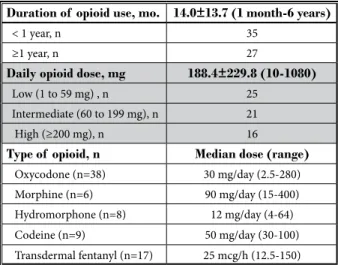
(n = 9), and others (n = 4). Table 2 shows daily opioid dose (MED), duration of opioids, and opioid medication type in the opioid group. Thirty-one percent of patients were taking more than one type of opioid. There were no differences in average daily MED, duration of opi-oids, or duration of pain between male and female patients.
Pain Scores Before and After LA Injection Stimulus
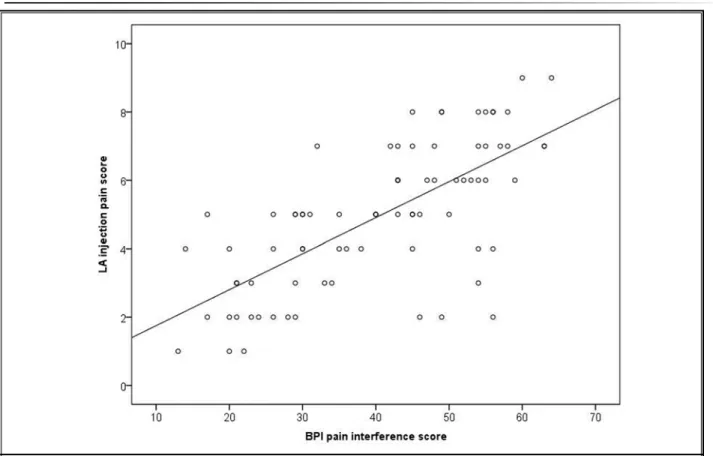
Table 3 shows the overall pain assessment scores before and after standardized LA injection between the non-opioid group and the opioid group. The mean baseline BPI scores and pre-injection pain score (pain score associated with the patient’s main pain site) were higher in the opioid group than in the non-opioid group. The mean injection-specific pain intensity, unpleasantness, and behavior pain scores were signifi-cantly higher in the opioid group compared with the non-opioid group. These differences were independent of the pain duration, cancer duration, and gender (P > 0.05). There were no differences in post-injection pain, unpleasantness, and behavior pain scores between men and women (P = 0.132, P = 0.413, and P = 0.337, respec-tively). In addition, the injection-specific pain intensity score was correlated with the baseline BPI pain severity score (r = 0.315, P = 0.005), pre-injection pain score (r = 0.401, P < 0.001), and most strongly with the BPI pain interference score (r = 0.695, P < 0.001; Fig. 1).
Pain Scores Based on Opioid Dose and Duration of Opioid Use After LA Injection Stimulus
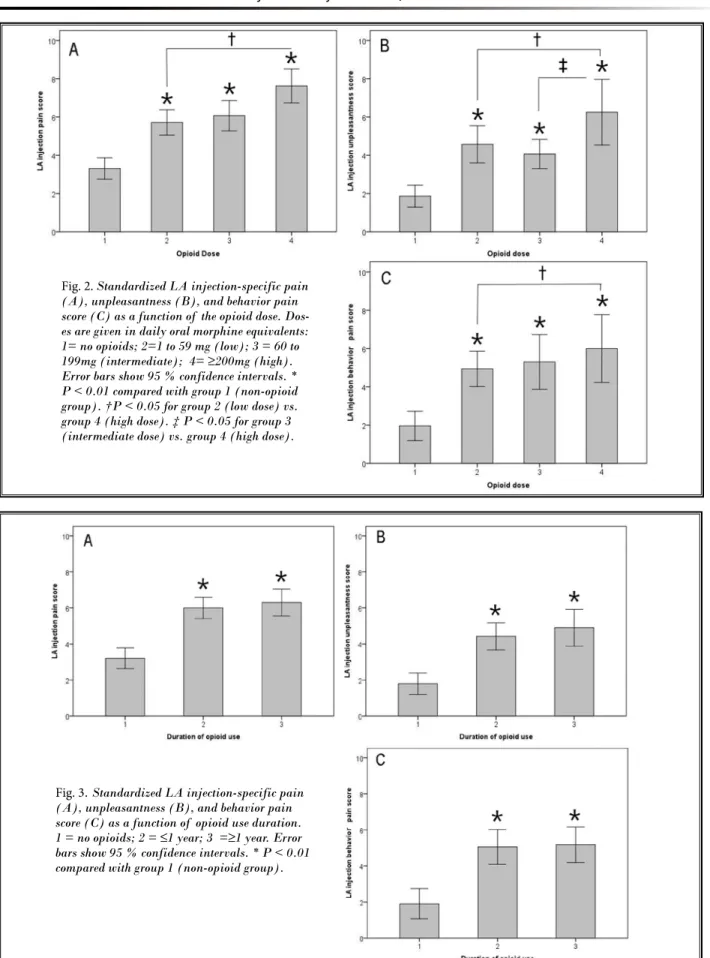
Opioid use was categorized by dose, and post-injection pain intensity, unpleasantness, and behavior pain score based on the daily opioid dose are shown in Fig. 2. Post-injection pain intensity, unpleasantness, and behavior pain scores were significantly higher in patients receiving a daily MED of more than 200 mg (high dose) compared with patients receiving a low dose of opioids (P = 0.017, P = 0.021, P = 0.012, respec-tively). Unpleasantness scores were significantly higher in patients receiving high dose opioids than those re-ceiving intermediate doses (P = 0.019). Opioid use was next categorized by duration, and post-injection pain intensity, unpleasantness, and behavior pain scores based on opioid duration are shown in Fig. 3. There were no differences in overall post-injection pain scores between patients taking opioids < one year and ≥ one year (P = 0.799, P = 0.673, P = 0.910, respectively). In the opioid group, there were no significant differences in baseline BPI and pre-injection pain score in the catego-ries of opioid dose and duration of opioid use, except for the BPI interference pain score, which was higher in patients taking a high opioid dose than those taking a low dose (P = 0.01).
Table 1. Demographic characteristics
Non-opioid
group (n=20) Opioid group (n=62)
Gender (M/F), n 9/11 35/27
Age, years 62.8±12.7 (52-85) 62.4±9.9 (45-82) Weight, kg 62.3±10.4 (54-84) 57.7±9.8 (42-81) Pain duration,
months (3 months-8 years)24.0±24.5 (3 months-9 years)18.0±23.0 Time elapsed since
cancer diagnosis, months
31.6±34.8
(3 months-10 years) (6 months-10 years)39.4±29.5
Primary sites of cancer, n
Lung 5 14 Breast 5 10 Liver 3 9 Colon 4 11 Prostate 3 9 Other sites 1 9
Values are means ± SD (range) or number of patients. No significant differences were noted between the 2 groups.
Table 2. Opioid medications data in the opioid group (n=62).
Duration of opioid use, mo. 14.0±13.7 (1 month-6 years)
< 1 year, n 35
≥1 year, n 27
Daily opioid dose, mg 188.4±229.8 (10-1080)
Low (1 to 59 mg) , n 25
Intermediate (60 to 199 mg), n 21
High (≥200 mg), n 16
Type of opioid, n Median dose (range)
Oxycodone (n=38) 30 mg/day (2.5-280) Morphine (n=6) 90 mg/day (15-400) Hydromorphone (n=8) 12 mg/day (4-64) Codeine (n=9) 50 mg/day (30-100) Transdermal fentanyl (n=17) 25 mcg/h (12.5-150) Values are means ± SD (range), median (range) or number of patients. Doses are given in daily oral morphine equivalents.
Hyperalgesic vs. Non-hyperalgesic Patients in Response to LA Injection Stimulus Among Patients Taking Opioids
The results of comparison between hyperalgesic and non-hyperalgesic patients in response to the LA injection stimulus in the opioid group are shown in
Table 4. Patient characteristics and pain duration were similar between the 2 groups. The mean daily opioid dose was significantly higher in hyperalgesic patients than in non-hyperalgesic patients (P = 0.004). There were no differences in baseline BPI pain severity and Table 3. Pain assessment scores before and after LA injection stimulus.
Non-opioid group
(n=20) Opioid group (n=62) P value
Baseline pain scores (0 to 10 NRS)
BPI pain severity score (4 items) 23.9±5.2 29.7±7.4 < 0.001
BPI pain interference score (7 items) 32.9±12.5 46.1±12.0 < 0.001
Pre-injection pain score* 5.7±1.2 6.7±1.6 0.007
Injection-specific pain scores (0 to 10 NRS)
Pain intensity score 3.3±1.6 6.1±1.5 < 0.001
Unpleasantness score 1.9±1.6 4.7±1.9 < 0.001
Behavior pain score 2.0±1.7 5.3±1.8 < 0.001
Values are means ± SD. LA, local anesthetic; BPI, Brief Pain Inventory; NRS, numeric rating scale. * Pre-injection pain score means pain score associated with patient’s main pain site.
Fig. 1. Relationship between the baseline BPI pain interference score and the LA injection-specific pain score (r = 0.695, P < 0.001).
Fig. 2. Standardized LA injection-specific pain (A), unpleasantness (B), and behavior pain score (C) as a function of the opioid dose. Dos-es are given in daily oral morphine equivalents: 1= no opioids; 2=1 to 59 mg (low); 3 = 60 to 199mg (intermediate); 4= ≥200mg (high). Error bars show 95 % confidence intervals. * P < 0.01 compared with group 1 (non-opioid group). †P < 0.05 for group 2 (low dose) vs. group 4 (high dose). ‡ P < 0.05 for group 3 (intermediate dose) vs. group 4 (high dose).
Fig. 3. Standardized LA injection-specific pain (A), unpleasantness (B), and behavior pain score (C) as a function of opioid use duration. 1 = no opioids; 2 = ≤1 year; 3 =≥1 year. Error bars show 95 % confidence intervals. * P < 0.01 compared with group 1 (non-opioid group).
pre-injection pain scores between the 2 groups, but the BPI pain interference score was significantly higher in hyperalgesic patients compared with non-hyperalgesic patients (P = 0.001). Multivariate regression analysis showed that high opioid dose (reference-low dose, OR 11.01, 95% CI: 1.42 - 41.02, P = 0.024) and the BPI pain interference score (per 10 points, OR 3.27, 95% CI: 1.10 - 9.84, P = 0.033) remained independent risk factors for a hyperalgesic response to LA injection pain after controlling for age, gender, pain duration, pre-injection pain scores, duration of opioid use, and daily opioid dose.
d
iscussionIn this study, we demonstrated that pain intensity, unpleasantness, and behavior pain scores in response to an LA injection stimulus were significantly higher in cancer patients receiving opioid therapy compared with cancer patients not taking opioids. We also found that high-dose opioid administration and poor functional status intensified this clinical pain in cancer patients receiving opioid therapy.
We sought to assess OIH based on the same clinical model previously described by Cohen et al (6). However, our study design has several differences
and attempts to complement some shortcomings of their study. First, our study was conducted in a cancer patient subgroup. In our country, opioid prescriptions in non-cancer patients are relatively rare (11). Second, LA injections were only performed in the lumbar re-gion in our study. The perception of LA injection pain showed different responses in different injection sites in their study. Third, in addition to patient-reported pain scores, we used observer-assessed pain scores to evaluate injection-specific pain intensity. Finally, we in-dependently considered the patients’ functional status including several physical and psychosocial factors.
We used 3 methods to assess LA injection-specific pain sensitivity because different tests for pain sen-sitivity do not necessarily lead to the same results. For instance, unpleasantness may be a more reliable indicator of pain tolerance, whereas pain score bet-ter reflects the nociceptive threshold (6). Pain-related behavior may represent involuntary responses to acute pain, although the behavioral pain score was originally developed in unconscious patients, dementia patients, and children (12). Our results showed that patient-reported pain intensity, unpleasantness scores, and observer-assessed behavior pain scores in response to LA injection pain were significantly higher in patients Table 4. Comparison between non-hyperalgesic (<7 NRS) and hyperalgesic (≥7 NRS) patients in response to LA injection stimu-lus in the opioid group.
Non-hyperalgesia
(n=39) Hyperalgesia (n=23) P value
Duration of opioid use, months (1 month-3 years)10.1±11.0 (1 month-6 years)16.4±17.4 0.155
<1 year, n 24 11
≥1 year, n 15 12
Daily opioid dose, mg 101.3±77.0(10-300) 298.5±304.6(20-1080) 0.004
Low (1 to 59 mg) , n 22 3
Intermediate (60 to 199 mg) , n 14 7
High (≥200 mg), n 3 13
Baseline pain scores (0 to 10 NRS)
BPI pain severity score (4 items) 29.8±9.3(18-36) 29.6±4.3(20-36) 0.905 BPI pain interference score (7 items) 40.9±12.4(16-59) 52.4±8.2(32-64) 0.001
Pre-injection pain score* 6.4±1.6(3-9) 7.2±1.4(4-10) 0.109
Values are means ± SD (range) or number of patients. Doses are given in daily oral morphine equivalents. LA, local anesthetic; BPI, Brief Pain Inventory; NRS, numeric rating scale. * Pre-injection pain score means pain score associated with patient’s main pain site.
receiving opioid therapy compared with those not taking opioids. We also observed that all pain assess-ment scores in response to LA injection pain were significantly higher in patients receiving a high dose of opioids compared with those receiving a low dose. Although the overall effect of a given opioid dose is the composite response resulting from activation of opioid-dependent pronociceptive and antinociceptive systems according to human and animal studies (3), OIH has been more commonly reported in patients receiv-ing high doses of opioids rather than low or moderate doses (3,4). The majority of the previous human data regarding high dose OIH are associated with very high, clinically unusual doses of opioids via systemic or intra-thecal administration, but our observation shows that patients taking higher doses of opioids that are com-monly used in an outpatient setting tend to perceive more pain to a clinical stimulus. On the contrary, the relationship between the duration of opioid treatment and the perception of pain accompanying an LA injec-tion was unclear in our study. A previous study in which long-acting oral morphine was given to chronic back pain patients demonstrated measurable hyperalgesia within one month of beginning therapy (13). Also, a recent study with a mouse model of post-surgical pain showed that remifentanil induces a pronociceptive effect that is dose dependent but not altered by the duration of administration (14). Apart from opioid dose and duration of opioid use, opioid type accord-ing to structural difference and distinctions between long- and short-acting opioids due to subliminal with-drawal may affect pain sensitivity (3,15). We could not standardize this potential confounding factor because selection of the opioid was influenced by our referring doctor’s judgment, preconceptions concerning opioid therapy, and limited types of opioids predominantly used in our institution. However, baseline pain scores were not statistically different among patients using opioids in our analysis.
On the other hand, there was no gender difference in post-injection pain scores regardless of opioid dose in our study. In cancer patients, few research studies on gender differences in pain have been published and are restricted to studies of the differences in severity scores; they have mostly yielded inconsistent results (16). Collectively, our study suggests that opioid medi-cation itself, regardless of opioid treatment duration, is an important contributing factor to pain perception accompanying LA injection, and patients using high doses of opioids are highly susceptible to hyperalgesic
responses to this clinical stimulus. This result is generally consistent with previous studies involving methadone maintenance patients (17), surgical patients (18), and patients with non-cancer chronic pain, all of which support the OIH phenomenon (6). However, although our study design was straightforward, we focused on exploring evidence for OIH in a real medical setting. Namely, various opioid medications and interventional procedures are important treatment modalities for pain in cancer patients, and LA injection pain as the nociceptive stimulus is more realistic than experimental stimulation.
The BPI is a well-known multidimensional pain questionnaire that provides information about pain severity and the degree to which the pain interferes with physical and social functioning, mood, sleep, and enjoyment of life (8). An interesting observation in our study was the strong negative correlation between post-injection pain scores and functional status, which is represented as the BPI pain interference score. Cancer patients with poor functional status tended to show a more painful response to an LA injection stimulus in our study. Although pain level in cancer patients has been shown to have a negative association with their func-tional status (7), definitive information regarding an as-sociation between the OIH phenomenon and patients’ functional status or psychosocial conditions is currently lacking. However, a previous study in patients undergo-ing methadone maintenance treatment showed that chronic severe pain is closely linked to low physical and social functioning and psychiatric distress (19). Recent studies also demonstrated the important role of psy-chopathologic and psychosocial conditions as predictors of failed opioid effectiveness (20), and hyperalgesia to pressure pain is associated with decreased quality of life in non-cancer chronic pain subgroups (21).
Among the neurobiological mechanisms proposed to explain OIH, the central glutaminergic system is the most common possibility (4,5). The excitatory neurotransmitter N-methyl-d-aspartate (NMDA) plays a central role in the development of OIH because ad-ministration of the NMDA receptor antagonist MK-801 or ketamine reverses the development of OIH (22,23). Similarly, pathologic activation of NMDA receptors is closely related to various aspects of emotionality in-cluding fear, anxiety, and depression, as well as impair-ment of cognitive function (24). Consequently, these current data suggest that the OIH phenomenon and worsening of psychosocial function, even though dis-tinct processes, may share common cellular mechanisms
R
efeRences1. Koyyalagunta D, Bruera E, Solanki DR, Nouri KH, Burton AW, Toro MP, Bruel BM, Manchikanti L. A systematic review of randomized trials on the effective-ness of opioids for cancer pain. Pain
Physician 2012; 15:39-58.
2. Portenoy RK. Treatment of cancer pain.
Lancet 2011; 377:2236-2247.
3. Angst MS, Clark JD. Opioid-induced hy-peralgesia: A qualitative systematic re-view. Anesthesiology 2006; 104:570-587. 4. Lee M, Silverman SM, Hansen H, Patel
VB, Manchikanti L. A comprehensive review of opioid-induced hyperalgesia.
Pain Physician 2011; 14:145-161.
5. Chu LF, Angst MS, Clark D. Opioid-in-duced hyperalgesia in humans: Molecu-lar mechanisms and clinical consider-ations. Clin J Pain 2008; 24:479-496. 6. Cohen SP, Christo PJ, Wang S, Chen L,
Stojanovic MP, Shields CH, Brummett C, Mao J. The effect of opioid dose and treatment duration on the perception of a painful standardized clinical stimulus.
Reg Anesth Pain Med 2008; 33:199-206.
7. Vallerand AH, Templin T, Hasenau SM, Riley Doucet C. Factors that affect func-tional status in patients with cancer-re-lated pain. Pain 2007; 132:82-90. 8. Yun YH, Mendoza TR, Heo DS, Yoo
T, Heo BY, Park H, Shin HC, Wang XS, Cleeland CS. Development of a cancer pain assessment tool in Korea: A vali-dation study of a Korean version of the brief pain inventory. Oncology 2004; 66:439-444.
9. Warden V, Hurley AC, Volicer L. Develop-ment and psychometric evaluation of the Pain Assessment in Advanced Dementia (PAINAD) scale. J Am Med Dir Assoc 2003; 4:9-15.
10. Berdine HJ, Nesbit SA. Equianalgesic dosing of opioids. J Pain Palliat Care
Pharmacother 2006; 20:79-84.
11. Park HJ, Moon DE. Pharmacologic man-agement of chronic pain. Korean J Pain 2010; 23:99-108.
12. Li L, Liu X, Herr K. Postoperative pain in-tensity assessment: A comparison of four scales in Chinese adults. Pain Med 2007; 8:223-234.
13. Chu LF, Clark DJ, Angst MS. Opioid tol-erance and hyperalgesia in chronic pain patients after one month of oral mor-phine therapy: A preliminary prospective study. J Pain 2006; 7:43-48.
14. Cabañero D, Campillo A, Célérier E, Romero A, Puig M. Pronociceptive ef-fects of remifentanil in a mouse model of postsurgical pain: Effect of a second
sur-gery. Anesthesiology 2009; 111:1334-1345. 15. Mao J. Opioid-induced abnormal pain
sensitivity: Implications in clinical opi-oid therapy. Pain 2002; 100:213-217. 16. Turk DC, Okifuji A. Does sex make a
difference in the prescription of treat-ments and the adaptation to chronic pain by cancer and non-cancer patients?
Pain 1999; 82:139-148.
17. Doverty M, White JM, Somogyi AA, Bochner F, Ali R, Ling W. Hyperalgesic responses in methadone maintenance patients. Pain 2001; 90:91-96.
18. Guignard B, Bossard AE, Coste C, Ses-sler DI, Lebrault C, Alfonsi P, Fletcher D, Chauvin M. Acute opioid tolerance: Intraoperative remifentanil increas-es postoperative pain and morphine requirement. Anesthesiology 2000; 93:409-417.
19. Karasz A, Zallman L, Berg K, Gourevitch M, Selwyn P, Arnsten JH, Arnstein J. The experience of chronic severe pain in pa-tients undergoing methadone mainte-nance treatment. J Pain Symptom
Man-age 2004; 28:517-525.
20. Jage J. Opioid tolerance and depen-dence -- do they matter? Eur J Pain 2005; 9:157-162.
21. Laursen BS, Bajaj P, Olesen AS, Del-and behavioral manifestations. Thus, the development
and severity of OIH seem to be closely associated with individual functional status such as emotional status, physical activities, social relationships, and sense of well-being. In this context, it should be emphasized that a multidisciplinary therapeutic approach for pain in cancer patients is necessary not only with opioid pharmacotherapy, but also for comprehensive manage-ment of the physical, psychological, and social needs of patients and their surroundings (2). This supportive care for improvement of functional status may prevent the development of OIH and be helpful for preventing hy-peralgesic symptoms in cancer patients receiving opioid therapy, especially in patients using high daily doses of opioids.
This study has several limitations. First, this study used a relatively small sample size, and the racial back-ground of the patients was quite homogenous. Second, various types of opioids and non-opioid drug medica-tions, which were not standardized, may have inad-vertently biased our results. Finally, the pain assessed
by a brief stimulus does not fully reflect disturbances in endogenous pain inhibitory processes (25). Despite these limitations, we believe that this study achieved its goal of generating hypotheses that could guide future studies and provided another piece of clinical evidence supporting the OIH phenomenon.
c
onclusionsOur findings using a simple model of transient pain are consistent with the proposed clinical impli-cations of OIH (15,26). We found that cancer patients receiving a high daily dose of opioids were paradoxi-cally more vulnerable to a hyperalgesic response to a standardized clinical stimulus. Thus, the issue of OIH should be considered when an adjustment of opioid dose is contemplated, because increasing the dosage may not always be the solution to ineffective opioid therapy. Our results also suggest that the possible presence of OIH may be intensified among cancer pa-tients with poor physical and psychosocial functional status.
mar C, Arendt Nielsen L. Health relat-ed quality of life and quantitative pain measurement in females with chronic non-malignant pain. Eur J Pain 2005; 9:267-275.
22. Koppert W, Sittl R, Scheuber K, Alsheimer M, Schmelz M, Schüttler J. Differential modulation of remifentanil-induced analgesia and postinfusion hyperalgesia by S-ketamine and cloni-dine in humans. Anesthesiology 2003; 99:152-159.
23. Chen HV, Lipton SA. The chemical bi-ology of clinically tolerated NMDA re-ceptor antagonists. J Neurochem 2006; 97:1611-1626.
24. Barkus C, McHugh SB, Sprengel R, See-burg PH, Rawlins JN, Bannerman DM. Hippocampal NMDA receptors and anxiety: At the interface between cogni-tion and emocogni-tion. Eur J Pharmacol 2010; 626:49-56.
25. Lautenbacher S, Spernal J, Schreiber W, Krieg JC. Relationship between clinical pain complaints and pain sensitivity in patients with depression and panic dis-order. Psychosom Med 1999; 61:822-827. 26. Silverman SM. Opioid induced
hyper-algesia: Clinical implications for the pain practitioner. Pain Physician 2009; 12:679-684.