Seung Jun Kim1,2, Hye-won Park2,3,
So Yeon Yu2, Jun-Sub Kim2, Jung-mi Ha2,3, Jong-Pil Youn2, Yu Ri An1, Moon-Ju Oh2, Youn-Jung Kim4, Jae-Chun Ryu4
& Seung Yong Hwang1,2
1Department of Biochemistry, Hanyang University, Sangnok-gu, Ansan, Gyeonggi-do, Korea
2GenoCheck Co. Ltd., Sangnok-gu, Ansan, Gyeonggi-do, Korea 3
Department of Bio-Nanotechnology, Hanyang University, Sangnok-gu, Ansan, Gyeonggi-do, Korea
4Cellular and Molecular Toxicology Laboratory, Korea Institute of Science & Technology P.O. Box 131, Cheongryang,
Seoul 130-650, Korea
Correspondence and requests for materials should be addressed to S. Y. Hwang ([email protected])
Accepted 16 November 2009
Abstract
Some environmental chemicals have been shown to cause liver-toxicity as the result of bioaccumulation. Particularly, fungicides have been shown to cause varying degrees of hepatictoxicity and to disrupt steroid hormone homeostasis in in vivo models. The principal objective of this study was to evaluate the liver-toxic responses of environmental chemicals-in this case selected fungicides and parasiticides-in or-der to determine whether or not this agent differen-tially affected its toxicogenomic activities in hepatic tumor cell lines. To determine the gene expression profiles of 3 fungicides (triadimefon, myclobutanil, vinclozolin) and 1 parasiticide (dibutyl phthalate), we utilized a modified HazChem human array V2. Addi-tionally, in order to observe the differential alterations in its time-dependent activities, we conducted two time (3 hr, 48 hr) exposures to the respective IC20 values of four chemicals. As a result, we analyzed the expression profiles of a total of 1638 genes, and we identified 70 positive significant genes and 144 nega-tive significant genes using four fungicidic and para-siticidic chemicals, using SAM (Significant Analysis of Microarray) methods (q-value⁄⁄0.5%). These genes were analyzed and identified as being related to apop-tosis, stress responses, germ cell development,
cofactor metabolism, and lipid metabolism in GO functions and pathways. Additionally, we found 120 genes among those time-dependently differentially expressed genes, using 1-way ANOVA (P-value⁄⁄ 0.05). These genes were related to protein metabo-lism, stress responses, and positive regulation of apoptosis. These data support the conclusion that the four tested chemicals have common toxicogeno-mic effects and evidence respectively differential ex-pression profiles according to exposure time. Keywords: Fungicide, Toxicogenomics, HazChem, Liver-toxicity, HepG2
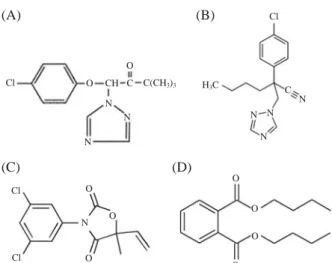
Fungi can cause serious damage to agricultural crops, resulting in critical losses in yield, quality, and profits. Fungicides are chemicals that are utilized to inhibit fungi or fungal spores and are used both agriculturally and to fight fungal infections in animals. However, some fungicides have been shown to cause varying degrees of hepatic toxicity and to disrupt steroid hor-mone homeostasis in in vivo models1. Some triazole fungicides evidence some degree of toxicity in mam-mals, and the effects reported from fungicide exposure in rodents include male infertility for myclobutanil and triadimefon in rats2. Some fungicides are known to be dangerous to human health, including vinclozolin, which is no longer used3. In this study, we utilized four fungicides and parasiticides-myclobutanil, triadime-fon, vinclozolin, and dibutyl phthalate (Figure 1). Myclobutanil and triadimefon are agrichemical fungi-cides that block ergosterol biosynthesis, and thus con-trol several species and strains of fungi4,5. Dibutyl phthalate can affect you when breathed in, and may be absorbed through the skin; high-level exposure can cause headache, nausea, drowsiness, and seizures. Thus, it may cause mutations, cause reproductive damage, or affect the nervous system. Vinclozolin is a fungicide that is commonly used in vineyards and is known as an endocrine disruptor chemical that inter-feres with the normal functioning of reproductive hormones6. In order to evaluate the toxicogenomic effects of these environmental toxicants, we utilized a modified HazChem human array V27. It was manu-factured using VOCs- and PAHs-specific genes and
Toxicogenomic Effect of Liver-toxic Environmental Chemicals
in Human Hepatoma Cell Line
commonly expressed genes. We chose to modify and add certain liver-toxicity-related genes, as the four chemicals utilized herein have been shown to evidence varying degrees of hepatic toxicity8. In this study, genomic data from in vitro studies of four fungicidal and parasiticidal chemicals were analyzed, demonstrat-ing that there are regulated hepatic biological functions in active human hepatocytes that are commonly dis-rupted by these chemicals. These differentially ex-pressed genes and affected functions contributed to our understanding of the liver-toxicity induced by fungicidal and parasiticidal chemicals.
Cell Viability of Four Chemicals
The respectively cytotoxicity of four fungicides and parasiticides were assessed via MTT (3-(4,5-Dime-thylthiazol-2-yl)-2,5-diphenyltetrazolium bromide, a tetrazole) assays in a HepG2 cell line. The absorbance of this colored solution was quantified via measure-ment at a wavelength of 540 nm by a spectrophoto-meter, and the IC20 values were determined from the linear concentration-response curve (Figure 2). The cultured HepG2 cells were exposed to various doses of 4 chemicals over a range of 0-1000μM. The ob-served IC20 values of the four chemicals were calcu-lated, respectively, as 96μM (triadimefon), 72 μM (myclobutanil), 320μM (vinclozolin), and 340 μM (dibutyl phthalate).
Modified HazChem Human Array V2
The HazChem human array V2 is composed of 600 genes that selected from VOCs and PAHs shown in previous studies to be expressed specifically on each type of chemicals or commonly expressed on the two types. In order to assess the toxicogenomic effects of these environmental toxicants, we utilized a modified HazChem human array V2. We modified and added 1038 liver-toxicity-related genes, because the four chemicals have been reported to evidence varying degrees of hepatic toxicity. 1038 liver toxicity-related genes were selected that were previously shown in rat
in vivo studies to be homologous with human genes.
The modified HazChem human array V2 is comprised of a total of 1638 genes.
Gene Expression Profile
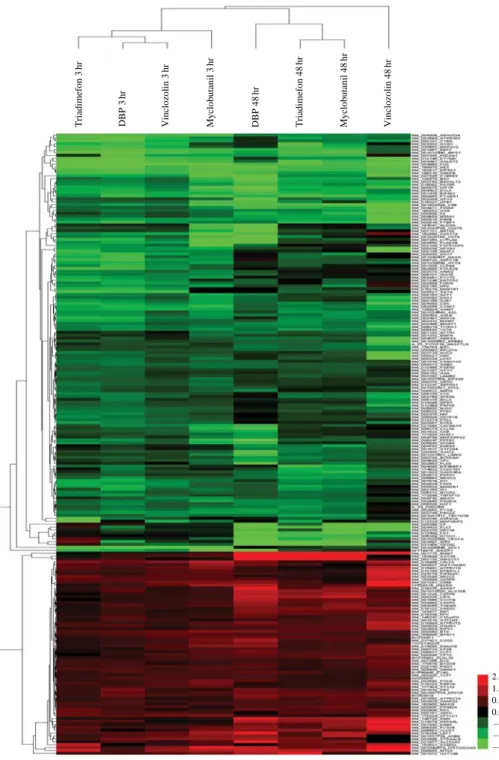
Extracted data from Agilent Feature Extraction v10.7 software log-transformed on the background-subtracted signals were analyzed using GeneSpring GX 10 software. LOWESS normalization was con-ducted to eliminate intensity-dependent dye bias from each array. Total gene expression profiles of eight sam-ples were analyzed using the Euclidean distance and the average linkage algorithm (Figure 3). The results of hierarchical clustering showed that the similarity between gene expression induced by the four fungici-dal and parasiticifungici-dal chemicals. Red colors indicate upregulation, green indicates downregulation, and black indicates no expressional change. The expression profiles of four chemical-exposure samples exhibited very similar patterns.
Significant Common Expressionally Changed Genes
Significant expression changes were analyzed via comparison with the exposed and control groups of all chemicals using the Significant Analysis of Microar-Figure 1. Chemical structure of 4 fungicidal and parasiticidal
chemicals. (A) Triadimefon, (B) Myclobutanil, (C) Vinclo-zolin, (D) Dibutyl phthalate.
Figure 2. Cell viabilities of 4 chemicals using MTT assay.
IC20 values (20% inhibition concentration of control) are respectively 96μM (triadimefon, box), 72 μM (myclobutanil, circle), 320μM (vinclozolin, triangle), and 340 μM (dibutyl phthalate (DBP), inverse triangle).
Cl O N N N N N N O CH C C(CH3)3 Cl Cl O O O O O O O N N C H3C Cl (A) (B) (C) (D) Cell viability (%) 100 80 60 40 20 0 0 100 200 300 400 500 Conc. (μM) Triadimefon Myclobutanil Vinclozolin DBP
ray (SAM) method (score¤±1, q-value⁄0.05). In all chemical groups, a total of 214 genes were selected (Figure 4), 70 genes were significantly positively regu-lated, and 144 genes were significantly negatively re-gulated. These genes were identified as being related with apoptosis, stress responses, germ cell develop-ment, cofactor metabolism, and lipid metabolism in GO functions and pathways (Table 1). In particular, 26 genes (12%) related with apoptosis were identified as significantly expressionally altered by treatment with 4 chemicals. This data supports the notion that the 4 chemicals were barely toxic.
Time-dependent Varied Gene
In order to determine whether the differential res-ponse between early (3 hr) and late (48 hr) times after the exposure of 4 chemicals, we compared them with the expression profiles at early and late times, and then
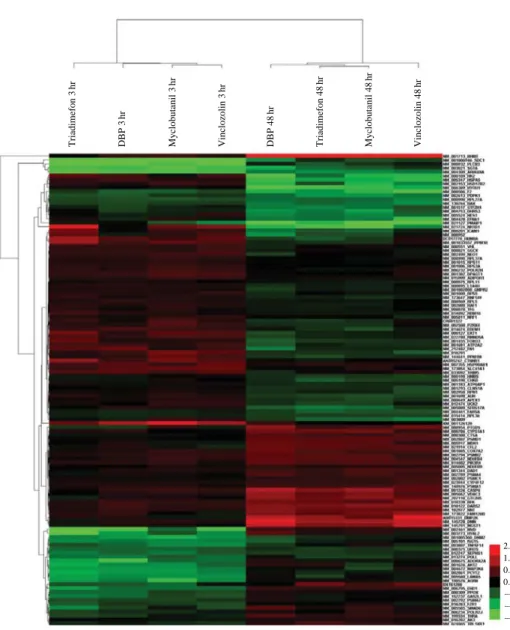
observed the differences in responses. We conducted a statistical analysis using a time-parametric Welch’s t-test, and the Benjamini-Hochberg false discovery rate (FDR-adjusted P-value⁄0.05). As a result, we were able to identify 120 genes that were differentially expressed in a time-dependent manner between early and late phases (Figure 5). Among those, 47% (56/120) were relatively upregulated at a late time as compared to an early time, whereas 53% (64/120) were relatively downregulated. These genes were found to be asso-ciated with protein metabolism, stress responses, and positive regulation of apoptosis.
Discussion
Fungicides are known chemicals that are used to inhibit fungi. They are utilized both in agriculture and Figure 3. Total gene
expres-sion profiles. A total of 1638 genes with similar expression patterns are clustered. Simi-larity Measure is a Euclidean distance, the clustering algo-rithm is an average linkage. Red color indicates overex-pression, green color indicates downregulation, and black color is normal. Sample DBP 3 h r Sample triadimefon 3 h r Sample triadimefon 48 hr Sample myclobutanil 3 h r Sample myclobutanil 48 hr Sample vinclozolin 3 h r Sample vinclozolin 48 hr Sample DBP 48 hr 5.0 4.0 2.5 2.0 1.5 1.2 1.0 0.8 0.7 0.6 0.4 0.3 0.2 0.0
to fight fungal infections in animals. However, some fungicides have been demonstrated to induce varying degrees of hepatic toxicity. The principal objective of this study was to compare the gene expression profiles of four fungicide and parasiticide chemicals, and to identify common expression changes that better char-acterized toxicities by exposure. The differences in time-dependent responses in human hepatoma cells were also evaluated via this toxicogenomic
approa-ch9,10. Observing changes in gene expression across different chemicals and exposure times allowed us to confirm the differential gene expression patterns common to the four fungicidal and parasiticidal chem-icals, and also that they differed significantly across exposure times. As shown in previous studies, we assessed the toxicogenomic effects associated with apoptosis, stressresponses and lipid metabolism result-ing from exposure to fungicides and parasiticides.
Figure 4. Genes commonly
expression-altered by four chemicals. To select common expression-changed genes, we used significant analysis of microarray (SAM) meth-ods. Cut-off values were q-values of less than 0.5% and scores in excess of ±1.214
common expressionally alter-ed genes with similar expres-sion patterns are clustered.
Triadimefon 3 h r DBP 3 h r Vinclozolin 3 h r Myclobutanil 3 h r Myclobutanil 48 hr DBP 48 hr Triadimefon 48 hr Vinclozolin 48 hr 2.00 1.33 0.67 0.00 -0.67 -1.33 -2.00
Some of the genes are related to germ cell develop-ment. Our results support the conclusions of previous
studies, in which it was asserted that bioaccumulations of fungicides and parasiticides can induce
abnormali-Table 1. GO ontology classification of common changed 214 genes.
Category Common genes % of Genes in category P-value
Apoptosis 26 13.61 3.80E-06
Germ cell development 5 2.618 1.40E-05
Lipid metabolism 23 12.04 8.88E-05
Response to stress 31 16.23 9.65E-05
Cofactor metabolism 10 5.236 0.000497
Hydrogen transport 6 3.141 0.000506
Catabolism 20 10.47 0.00103
Alcohol metabolism 11 5.759 0.00222
Energy reserve metabolism 4 2.094 0.0023
Response to endogenous stimulus 12 6.283 0.00233
Insulin-like growth factor receptor signaling pathway 2 1.047 0.00282
BMP signaling pathway 3 1.571 0.00299
Figure 5. Time-dependent
distinct genes. Benjamini-Hochberg correction for false discovery rate (FDR) was used for examine time-dependent differences. We selected ex-pressed genes that a FDR-adjusted P value of less than 0.05 according to the ANOVA (test type is Welch’s t-test). 120 distinct genes with simi-lar expression patterns are clustered. Triadimefon 3 h r DBP 3 h r Vinclozolin 3 h r Myclobutanil 3 h r DBP 48 hr Triadimefon 48 hr Myclobutanil 48 hr Vinclozolin 48 hr 2.00 1.33 0.67 0.00 -0.67 -1.33 -2.00
ties of reproducibility11. Responses to toxicant treat-ment at early and late times differ greatly12. In the present study, we confirmed the findings of these pre-vious studies showing an obpre-vious and distinct gene expression pattern. These patterns were clearly related to stress responses and positive regulation of apopto-sis, as shown by GO ontology analyses. As time pro-gressed, acute responses were reduced and cell death increased in the gene expression profiles.
In this study, we utilized toxicogenomic analysis, identified common changes in four chemicals, and assessed distinct changes over exposure time. These toxicogenomic approaches were applied to delineate the molecular mode of actions and to assess the risks of environmental toxicants13. This approach should prove quite useful and may also be effective as a rou-tine basic tool in the field of toxicology.
Materials & Methods
Chemicals and Reagents
Dibutyl phthalate (CAS No, 84-74-2), triadimefon (CAS No. 43121-43-3), vinclozolin (CAS No, 50471-44-8), myclobutanil (CAS No. 88671-89-0), Dime-thylsulphoxide (DMSO) and 3-(4,5-dimethylthizol-2-yl)-2,5-diphenyltetrazolium bromide (MTT) were pur-chased from the Sigma-Aldrich Chemical Company (USA). RPMI-1640 Culture Medium, Dulbecco’s Phosphate Buffered Saline (PBS) and Fetal Bovine Serum (FBS) were obtained from GIBCOTM(USA). All other chemicals used in this study were of analyti-cal grade or the highest available grade.
Cell Line and Culture
A human hepatocellular carcinoma cell line (HepG2), purchased from the Korean Cell Line Bank (Korea), was used throughout the study. HepG2 cells were grown in DMEM medium supplemented with 10% inactivated FBS plus 0.044 M sodium bicarbonate, 10 mM sodium pyruvate, and 1% penicillin at 37�C in an atmosphere of 5% CO2. For cell growth, the medi-um was renewed every two or three days. The HepG2 cells were brought to approximately 80% confluence by plating 2×10⁶cells/mL in 100 mm culture dishes14.
Determination of Cell Viability
MTT assays15 were conducted to determine cell viability. 24-well plates were utilized for cytotoxicity assays. Cells were seeded at a seeding density of 80
×104cells/mL on a well in 500μL of media. Cells were exposed for 48 h to various concentrations of triadimefon, myclobutanil, vinclozolin, dibutyl phtha-late in culture medium at 37�C. 75μL of MTT (4 mg/
mL in PBS) solution was added to each well and incu-bated for 3 hrs. DMSO solution was added to each well and transferred to 96-well plates. The optimal density (OD) of the purple formazan product was mea-sured at a wavelength of 540 nm. The 20% inhibitory concentration (IC20) of cell proliferation in a particular chemical was defined as the concentration required to cause a 20% reduction in the cell viability versus the solvent-treated control. The IC20 values were deter-mined directly from the linear dose-response curves. Preparation of HazChem Array
The HazChem human array V2 was composed of 600 genes selected from those shown in previous stud-ies to be specifically expressed in response to specific VOCs and PAHs or commonly expressed in respons-es to the two typrespons-es of chemicals. In order to assrespons-ess the toxicogenomic effects of these environmental toxi-cants, we used a modified HazChem human array V2. We have modified this by the addition of 1038 liver-toxicity related genes, because the four chemicals used herein were reported to evidence varying degrees of hepatic toxicity. The 1038 liver toxicity-related genes were all shown in previous rat in vivo studies to be homologous to human genes. Thus, our modified HazChem human array V2 included a total of 1638 genes.
RNA Extract & Hybridization
Total RNA was extracted from the cells with Trizol reagent (Invitrogen Life Technologies) and purified with an RNeasy Mini Kit (Qiagen, USA) in accordance with the manufacturer’s instructions. Genomic DNA was removed using an RNase-free DNase set (Qiagen, USA) during RNA purification. The quantity of each RNA concentration was quantified using Nanodrop, and the RNA quality was evaluated using an Agilent Bioanalyzer 2100 (Agilent Technologies, CA).
Each extracted total RNA sample (30μg) was labeled with Cyanine (Cy3) or Cyanine (Cy5) conjugated dCTP (Amersharm, Piscataway, NJ) via a reverse transcrip-tion reactranscrip-tion using reverse transcriptase, PrimeScrip Reverse Transcriptase (TaKaRa, Japan). The labeled cDNA mixture was then concentrated via ethanol precipitation. The concentrated Cy3 and Cy5-labeled cDNAs were resuspended in 10μL of hybridization solution (GenoCheck, Korea). The two labeled cDNAs were then mixed, placed on a modified HazChem human array V2 (GenoCheck, Korea), and covered with an Agilent 8-plex Gasket chamber (Agilent Tech-nologies, CA). The slides were then hybridized for 12 hr at 62�C with an Agilent hybridization system (Agi-lent Technologies, CA). The hybridized slides were washed in 2 X SSC, 0.1% SDS for 2 min, 1 X SSC for
3 min, and 0.2 X SSC for 2 min at room temperature. The slides were then centrifuged for 20 seconds at 3000 rpm to dry.
Microarray Data Analysis
The hybridized slides were scanned with an Agilent scanner and the scanned images were analyzed with the Feature Extraction v10.7 (Agilent Technologies, CA) and GeneSpring GX 10 software (Agilent Tech-nologies, CA). Spots that were adjudged as substan-dard via the visual examination of each slide were flagged and excluded from further analysis. Spots that harbored dust artifacts or spatial defects were manu-ally flagged and excluded. In an effort to filter out the unreliable data, spots with signal-to-noise ratios (sig-nal-background-background SD) below 10 were ex-cluded from our data. The data were normalized by intensity LOWESS normalization for data reliability. The expression profile data were clustered into groups of genes that behaved similarly across the drug treat-ment experitreat-ments using GeneSpring GX 10 (Agilent Technologies, CA). We utilized an algorithm based on Euclidean distance and average linkage to separate genes evidencing similar patterns. In order to select commonly expressionally-altered genes, we used sig-nificant analysis of microarray (SAM) methods. Q-values of less than 0.5% and scoresin excess of ±1
were used as cut-off values. Thus, the Benjamini-Hochberg correction for false discovery rate (FDR) was used to evaluate time-dependent differences. We selected expressed genes with FDR-adjusted P values of less than 0.05 according to ANOVA results (test type is Welch’s t-test) using GeneSpring GX 10, ArraytoKegg software (GenoCheck, Ansan, Korea) was utilized for the functional analysis of genes within differentially expressed genes16.
Acknowledgements
This subject was supported by the Korean Ministry of Environment as part of “The Eco-technopia 21 project”.
References
1. Goetz, A. K. & Dix, D. J. Toxicogenomic effects com-mon to triazole antifungals and conserved between rats and humans. Toxicol Appl Pharmacol 238:80-89 (2009).
2. Goetz, A.-K. et al. Disruption of testosterone home-ostasis as a mode of action for the reproductive toxi-city of triazole fungicides in the male rat. Toxicol. Sci. 95:227-239 (2007).
3. Herelia, P. et al. The genetic and non-genetic toxicity of the fungicide Vinclozolin. Mutagenesis 11:445-453 (1996).
4. Ghannoum, M. A. & Rice, L. B. Antifungal agents: mode of action, mechanisms of resistance, and correla-tion of these mechanisms with bacterial resistance. Clin Microbiol Rev 12:501-517 (1999).
5. VandenBossche, H., Marichal, P., Gorrens, J. & Coene, M.-C. Biochemical basis forthe activity and selec-tivity of oral antifungal drugs. Br J Clin Pract Suppl 71:41-46 (1990).
6. Anway, M. D., Cupp, A. S., Uzumcu, M. & Skinner, M. K. Epigenetic transgenerational actions of endo-crine disruptors and male fertility. Science 308:1466-1469 (2005).
7. An, Y. R. et al. Classification of environmental toxi-cants using HazChem Human Array V2. Mol Cell Toxicol 5:250-256 (2009).
8. Jung, J. W. et al. Gene expression analysis of peroxi-some proliferators- and phenytoin-induced hepatotoxi-city using cDNA microarray. J Vet Med Sci 66:1329-1333 (2004).
9. Vrana, K. E., Freeman, W. M. & Aschner, M. Use of microarray technologies in toxicology research. Neuro Toxicology 24:321-332 (2003).
10. Nuwaysir, E. F., Bittmer, M., Trent, J., Barrett, J. C. & Afshari, C. A. Microarray and toxicology: The advent of toxicogenomics. Mol Calcinog 24:153-159 (1999).
11. Tully, D. B. et al. Gene expression profiling in liver and testis of rats to characterize the toxicity of triazole-fungicides. Toxicol Appl Pharmacol 215:260-273 (2006).
12. Kim, S. J. et al. Gene expression profiles of nonylphe-nol as representative EDCs in normal human kidney HK-2 cells. Biochip J 2:135-140 (2008).
13. Teuschler, L. K., Groten, J. P., Hertzberg, R. C., Mum-taz, M. M. & Rice, G. Environmental chemical mix-tures risk assessment: current approaches and emerg-ing issues. Comments on Toxicology 7:453-493 (2001). 14. Park, H. W. et al. Gene expression patterns of environ-mental chemicals in human cell lines using HazChem Human Array. Biochip J 3:65-70 (2008).
15. Mosman, T. Rapid colorimetric assay for cellular grow-th and survival: Application to proliferation and cyto-toxicity assays. J Immmunol Meth 65:55-63 (1983). 16. Kim, J. S. et al. SOP (Search of Omics Pathway): A
Web-based tool for visualization of KEGG pathway diagrams of omics data. Mol Cell Toxicol 3:208-213 (2007).