https://doi.org/10.20307/nps.2021.27.1.10
10
Changes of Prosapogenin Components in Tienchi Seng (Panax notoginseng)
by Ultrasonic Thermal Fusion Process
Jae Bum Lee1,†, Byung Wook Yang2,†, Do Hyeong Kim1, Dezhong Jin3,*, and Sung Kwon Ko1,* 1Department of Oriental Medical Food & nutrition, Semyung University, Jecheon 27136, Korea
2School of Industrial Bio-Pharmaceutical Science, Semyung University, Jecheon 27136, Korea
3International Education College, Jiangxi University of Traditional Chinese Medicine, Nanchang 330004, Jiangxi, China
Abstract – The purpose of this study is to develop a new method of producing tienchi seng (notoginseng, Panax notoginseng) extracts featuring high concentrations of the ginsenoside Rg3, Rg5, and Rg6, special components of Korean red ginseng. The chemical transformation from ginseng saponin glycosides to prosapogenin was analyzed by HPLC. Tienchi seng was heat-processed at 100oC and the optimum conditions were identified. The highest concentrations of total saponin (29.723%) and the ginsenoside Rg3 (1.769%), Rg5 (5.979%), and Rg6 (13.473%) were produced at 48 hours. Also, when tienchi seng was subjected to the ultrasonic thermal fusion (100oC) process, the concentrations of total saponin (30.578%), ginsenoside Rg3 (2.392%), Rg5 (6.614%), and Rg6 (13.017%) were highest at 36 hours. On the other hand, the 2-hour heat-processed extract and 2-hour ultrasonic thermal fusion-processed extract did not contain ginsenoside Rg3, Rg5, and Rg6. The ultrasonic thermal fusion process had an extraction yield that was approximately 1.26 times greater than that of the heat process. These results indicate that the highly functional tienchi seng extracts created through the ultrasonic thermal fusion process are more industrially useful than those produced using the heat process.
Keywords – Panax notoginseng, Rg3, Rg5, Rg6, Tienchi seng, Ultrasonic thermal fusion
Introduction
Tienchi seng (Notoginseng, Panax notoginseng) is a traditional Chinese medicine that has been used in Yunnan province, China for hundreds of years. In traditional Chinese medicine, tienchi seng is used to treat thrombosis, for its hemostatic activity, to relieve inflamma-tion, and to produce analgesia. Its clinical applications include treatment of pulmonary hemorrhage, gastrointestinal bleeding, nosebleeds, physical trauma, pain in the chest and abdomen, and inflammatory pain.1 Physiological activity studies have demonstrated that tienchi seng extract results in: improvements in blood circulation,2 antithrombotic activity,3 inhibition of cancer metastasis,4 alterations of female hormone levels,5 protection of
neuronal cells,6 amelioration of liver damage,7 anti-cancer activity,8 anti-arteriosclerosis activity,9 hematopoietic proliferation activity,10 inhibition of NO synthetase,11 inhibition of cyclooxygenase-2,11 neuroprotective activity,12 inhibition of hemolysis,13 inhibition of diabetes,14 amelio-ration of angina pectoris,15 antioxidative activity and anti-inflammatory activity.16
Component analysis has been used to investigate the components of ginseng saponin grown in various countries.17 The ginseng saponin contents of roots and rhizomes of the tienchi seng plant were studied,18 and a comparative study was done on the ginsenoside com-position of various plant parts of different ages.19 On the other hand, many studies have been conducted on Korean ginseng (Panax ginseng) and American ginseng (Panax quinquefolium) in attempts to identify a functionally enhanced extract.20-28 Though optimized conditions that produce ginsenoside Rg3 and Rg5 at high concentrations via microwave and vinegar treatment have been identified,20 the development of a functionally enhanced tienchi seng extract has not yet been systematically studied. Therefore, we investigated the optimum con-ditions for production of the characteristic functional †Byung Wook Yang and Jae Bum Lee were equal contributors to this
manuscript
*Author for correspondence
Sung Kwon Ko, Department of Oriental Medical Food & Nutrition, Semyung University, Jecheon 27136, Korea
Tel: +82-43-649-7431, E-mail: [email protected]
Dezhong Jin, International Education College, Jiangxi University of Traditional Chinese Medicine, Nanchang 330004, Jiangxi, China Tel: +86-791-8711-8675, E-mail: [email protected]
ingredients of Korean red ginseng and black ginseng,21,29 ginsenoside Rg330-36 and Rg5,37-41 to enhance the com-position through an ultrasonic thermal fusion process.
Experimental
Materials – The tienchi seng (notoginseng, Panax notoginseng) used in this study was 2 kg of three-year-old roots purchased on May 18, 2018 in Changsha, Hunan, China. The tienchi seng specimens were kept in the Oriental medicine science laboratory at Semyung Uni-versity (Fig. 1).
Preparation of heat-processed tienchi seng extract – A heat-processed extract of tienchi seng (HPN) was obtained by adding 30 L of distilled water to 300 g of tienchi seng, extracting it once for 2, 4, 8, 12, 16, 20, 24, 36, 48, 60, or 72 hours at 100oC, and freeze-drying it.
Preparation of ultrasonic thermal fusion-processed tienchi seng extract – Tienchi seng (300 g) was added to 30 L distilled water, put in an ultrasonicator (KODO, Hwaseong, Kyung-ki-do, South Korea) with an output voltage and frequency of 1200 W and 20 KHz, respec-tively, at 100oC, and processed for 2, 4, 8, 12, 16, 20, 24, 36, 48, 60, or 72 hours. The resultant solutions were concentrated by vacuum evaporation and freeze-dried to obtain an ultrasonic thermal fusion-processed tienchi seng extract (UHPN).
Preparation of crude saponin – Precisely 50 mL of diethylether was added to 1 g of tienchi seng extract, the mixture was sonicated three times, then the diethylether layer was separated to remove the supernatant and fat-soluble component. The residue was treated with 50 mL of n-butanol three times. The n-butanol fraction that built up in the ultrasonicator was filtered and concentrated by a
vacuum evaporator. The entire process was performed quantitatively. The amount of the concentrate was equi-valent to that of the crude saponin.20
Preparation of a standard solution – 1 mg of ginse-noside standard substance was used to make a 1,000 ppm standard solution by dissolving it in 1 mL of methanol solution. The standard solution was used in 0.l mL aliquots, which were diluted sequentially with 0.1, 0.4, 0.9 and 1.9 mL methanol to make 500, 200, 100 and 50 ppm standard solutions, respectively, which were used to prepare the calibration curve.
HPLC Analysis – Crude saponin (10 mg) was dissolved in 1 mL of methanol and filtered for use as a test sample. The ginsenoside composition of the concentrate was analyzed with HPLC according to the method of Jo et al.20 The total ginsenoside content and ginsenoside com-position of each sample were analyzed three times. The pure ginsenoside standards (99% purity) used in this experiment were purchased from Chromadex (SantaAna, CA, USA) and Koyeon (Jecheon, Chung-cheong-bukdo, Korea). The HPLC instrument used was a Waters 1525 binary HPLC system (Waters, Milford, MA, USA) with a Eurospher II 100-5 C18 column (250 × 3 mm; Knauer, Berlin, Germany). The mobile phase was a mixture of acetonitrile (HPLC grade; Burdick&Jackson, 718 Cheo-yong-ro Nam-gu Ulsan, Korea) and distilled water (HPLC grade; Burdick&Jackson, 718 Cheoyong-ro Nam-gu Ulsan, Korea). The acetonitrile content was sequentially increased from 17% to 25% (25 min), 25% to 41% (50 min), 41% to 60% (105 min), and 60% to 100% (120 min) and finally adjusted from 100% to 17%. The operating temperature was set at room temperature, with a flow rate of 0.8 mL/min. The elution profile was obtained on a chromatogram using a UV/VIS detector at 203 nm (2487 dual absorbance detector, Waters).
Results and Discussion
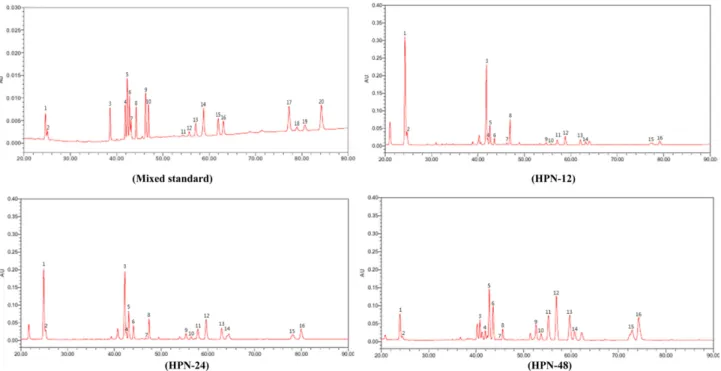
The purpose of this study was to investigate the optimum conditions for production of high concentrations of the ginsenoside Rg3, Rg5, and Rg6 by comparing and analyzing the individual ginsenoside contents of the tienchi seng extract obtained through an ultrasonic thermal fusion process. The ginseng saponins that were analyzed included ginsenoside Rb1, Rc, Rd, Re, Rg1, Rg2, Rg3(s), Rg3(r), Rg5(e), Rg5(z), Rg6, Rh2, Rh4, Rk1, Rk3, F1, and F4; these were directly compared with the standard samples and confirmed through HPLC (Fig. 2, 3).
Rg3(s), Rg3(r), and Rg5(e) were measured using their respective contents, and Rg5(z) and Rk1 were calculated
from the sum of the two components. Tienchi seng was subjected to an ultrasonic thermal fusion process and heat process for 2, 4, 8, 12, 16, 20, 24, 36, 48, 60 and 72
hours, and the saponin content of each extract was calculated. When tienchi seng was subjected to ultrasonic thermal fusion, the crude saponin content was 60.86% for
Fig. 2. HPLC chromatogram of ginsenosides in the heat process extracts (HPN) of tienchi seng (Panax notoginseng)
* 1: ginsenoside Rg1, 2: ginsenoside Re, 3: ginsenoside Rb1, 4: ginsenoside Rg2, 5: ginsenoside Rh1, 6: ginsenoside Rc, 7: ginsenoside F1, 8: ginsenoside Rd, 9: ginsenoside Rg6, 10: ginsenoside F4, 11: ginsenoside Rk3, 12: ginsenoside Rh4, 13: ginsenoside Rg3(s), 14: ginsenoside Rg3(r), 15: ginsenoside Rk1+Rg5(z), 16: ginsenoside Rg5(e), 17: ginsenoside Rh2.
Fig. 3. HPLC chromatogram of ginsenosides in the ultrasonic thermal fusion process extracts (UHPN) of tienchi seng (Panax notoginseng) * 1: ginsenoside Rg1, 2: ginsenoside Re, 3: ginsenoside Rb1, 4: ginsenoside Rg2, 5: ginsenoside Rh1, 6: ginsenoside Rc, 7: ginsenoside F1, 8: ginsenoside Rd, 9: ginsenoside Rg6, 10: ginsenoside F4, 11: ginsenoside Rk3, 12: ginsenoside Rh4, 13: ginsenoside Rg3(s), 14: ginsenoside Rg3(r), 15: ginsenoside Rk1+Rg5(z), 16: ginsenoside Rg5(e), 17: ginsenoside Rh2.
4, 53.46% for 2, and 47.91% for UHPN-12. Therefore, tienchi seng extract processed with ultrasonic thermal fusion for 4 hours showed the highest crude saponin content. The content of crude saponin in the heat-processed extract was 56.82% for HPN-8, 51.62% for HPN-12, and 51.39% for HPN-4. The highest crude saponin content was observed in the 8-hour heat-processed extract (Table 1).
In addition, the content of total saponin, which is the total of ginsenoside in extract processed to ultrasonic thermal fusion, was 30.446% for UHPN-36, 25.555% for UHPN-48, and 23.804% for UHPN-20. The 36-hour ultrasonic thermal fusion-processed extract showed the highest total saponin content (Table 3). The heat-processed extract had a total saponin content of 29.665% for HPN-48, 27.917% for HPN-60, and 24.745% for HPN-36, and the 48-hour heat-processed extract showed the highest total saponin content (Table 2).
Natural ginseng saponin glycosides are chemically converted into ginseng prosapogenin components by heat or acid. These prosapogenin components are known to have stronger physiological activity than the glycoside components because of their good cell affinity. The highest total content of these prosapogenin components was 27.594% (UHPN-36), which was obtained from 36 hours of ultrasonic thermal fusion, followed by UHPN-48 (23.649%) and UHPN-24 (19.389%). On the other hand, the content of prosapogenin in the heat-processed extract was 26.476% for HPN-48, 25.609% for HPN-60 and 22.241% for HPN-72; the highest prosapogenin content was seen in the 48-hour heat-processed extract.
These findings showed that the 36-hour ultrasonic thermal fusion process produces a higher proapogenin
concentration in a shorter processing time than the 48-hour heat process. Among the prosapogenin components, ginsenoside Rg3, which is a specific component of red ginseng (Panax ginseng), exhibits anticancer activity, hypotensive action, brain nerve cell protective activity, antithrombotic activity and antioxidant activity.30-36 The highest content of Rg3 was 2.392%, which was produced by the 36-hour ultrasonic thermal fusion process, followed by UHPN-48 (1.958%) and UHPN-60 (1.779%). In addition, the 48-hour heat-processed extract showed the highest Rg3 content, 1.769%, followed by HPN-60 (1.751%) and HPN-72 (1.483%). Therefore, the content of ginsenoside Rg3 was about 1.35 times greater in the extract subjected to ultrasonic thermal fusion for 36 hours than the extract subjected to heat (100oC) treatment for 48 hours.
On the other hand, the heat-processed extract (HPN) of tienchi seng contained more Rg3(s) than Rg3(r). These results showed the same tendency in the case of ultrasonic thermal fusion and heat extracts of Korean red ginseng.29,42
However, the ultrasonic thermal fusion extract of tienchi seng tended to have similar Rg3(s) and Rg3(r) contents.
Ginsenoside Rg5, which is a specific component of black ginseng (Panax ginseng), exhibits anti-inflammatory activity, improves cognitive function, ameliorates breast cancer and renal toxicity, and suppresses atopic dermatitis.37-41 The highest content of Rg5(e), 6.614%, was seen in the 36-hour ultrasonic thermal fusion extract, followed by UHPN-48 (5.797%) and UHPN-24 (4.549%). Furthermore, the heat-processed extract showed the highest content of 5.979% at 48 hours, followed by HPN-60 (5.859%) and HPN-72 (5.202%). Therefore, the content of ginsenoside
Table 1. Crude saponin contents in heat process extracts (HPN) and ultrasonic thermal fusion process extracts (UHPN) of tienchi seng (Panax notoginseng) (% W/W)
sample crude saponin sample crude saponin
HPN-2a) 39.74 UHPN-2b) 53.46 HPN-4a) 51.39 UHPN-4b) 60.86 HPN-8a) 56.82UHPN-8b) 47.51 HPN-12a) 51.62UHPN-12b) 47.91 HPN-16a) 47.38 UHPN-16b) 43.95 HPN-20a) 48.96 UHPN-20b) 43.84 HPN-24a) 49.41 UHPN-24b) 42.62 HPN-36a) 39.84 UHPN-36b) 29.62 HPN-48a) 40.42UHPN-48b) 28.63 HPN-60a) 39.42UHPN-60b) 33.15 HPN-72a) 35.66 UHPN-72b) 29.18
* a) HPN-2 to HPN-72: Tienchi seng extract processed with heat (100oC) for 2 to 72 h, b) UHPN-2 to UHPN-72: Tienchi seng extract
Ta bl e 2. Ginsenoside com positi on of the h ea t proce ss extrac ts (H PN) o f ti en chi seng (Panax not oginseng ) a ccor di ng to proc essi ng tim e (%,w/w) G ins enos ide s HP N-2 H PN-4 H PN-8H PN -1 2 HP N -16 HP N-20 H PN-2 4 H PN -3 6 H PN -4 8 HP N-60 H PN-7 2 Rb 1 0.852 ±0.0 11 1.71 4±0 .019 2.2 71 ±0.00 8 1. 56 1± 0.0 08 1. 60 0±0.0 12 1.77 4±0 .01 6 1.5 54 ±0.01 2 0.891 ±0.0 12 0. 42 5±0 .0 02 0.1 58±0 .00 9 0.0 98 ±0.00 6 Rc -0.0 84 ±0.00 1 0. 260 ±0.0 00 0. 34 4±0.0 01 0.60 9±0 .00 1 0.5 98 ±0.00 1 1. 249 ±0.0 01 1. 59 8±0 .0 01 1.5 93±0 .00 2 1.4 23 ±0.01 3 Rd 0. 182±0.0 02 0.41 9±0 .005 0.4 97 ±0.00 1 0. 422 ±0.0 02 0. 41 6±0.0 02 0.486±0 .00 5 0.3 84 ±0.00 2 0.360 ±0.0 10 0. 23 3±0 .0 03 0.1 31±0 .00 2 0.0 77 ±0.00 1 Re 0. 95 0±0.0 15 1.03 5±0 .020 1.0 46 ±0.00 5 0. 927 ±0.0 22 0. 787±0.0 49 0.8 55 ±0 .04 0 0.6 73 ±0.01 5 0.495 ±0.0 21 0. 23 9±0 .0 07 0.1 51±0 .02 3 0.0 20 ±0.00 0 Rg 1 2.64 5±0.0 24 3.00 7±0 .040 2.828±0.00 6 2. 63 0± 0.0 13 2.36 0±0.0 33 2.62 6±0 .03 1 1.7 49 ±0.01 0 1. 462 ±0.0 13 0. 69 4±0 .0 07 0.2 75±0 .00 3 0.1 29 ±0.00 4 Rg 2 0.03 3±0.0 02 0.04 5±0 .001 0.0 45 ±0.00 1 0. 062 ±0.0 01 0. 06 0±0.0 06 0.083±0 .00 4 0.0 68±0.00 2 0. 103 ±0.0 01 0. 10 8±0 .0 00 0.0 93±0 .00 1 0.0 94 ±0.01 0 Rg 3( r) -0.01 7±0 .001 0.0 48 ±0.00 0 0. 12 7± 0.0 02 0.15 8±0.0 15 0.22 8±0 .00 5 0.1 70 ±0.01 8 0. 297 ±0.0 54 0. 51 5±0 .0 03 0.5 23±0 .00 3 0.4 39 ±0.01 3 Rg 3( s) -0.03 2±0 .000 0.0 78±0.00 1 0. 19 5± 0.0 01 0.27 3±0.0 02 0.49 7±0 .00 3 0.4 95 ±0.00 9 0. 996 ±0.0 07 1. 25 4±0 .0 07 1.2 28 ±0 .00 8 1.0 44 ±0.01 4 Rg 5( e) -0.07 7±0 .007 0.2 86 ±0.00 5 0. 691 ±0.0 03 1. 15 8±0.0 22 2.28 4±0 .02 2 2.3 65 ±0.03 9 4. 792 ±0.0 65 5. 97 9±0 .0 69 5.8 59±0 .13 2 5.2 02 ±0.17 6 Rk 1+ Rg5 (z ) -0.00 7±0 .000 0.0 23 ±0.00 0 0. 060 ±0.0 01 0. 09 1±0.0 01 0.19 6±0 .00 2 0.1 98±0.00 3 0. 396 ±0.0 10 0. 483±0 .0 03 0.4 73±0 .00 5 0.4 02 ±0.01 3 Rg 6 -0.184±0 .006 0.7 06 ±0.00 5 1. 740 ±0.0 01 2. 780±0.0 46 5.09 2±0 .02 7 4.866 ±0.083 9.776 ±0.1 71 13 .47 3±0 .07 9 12.9 56 ±0.06 3 10 .992 ±0.3 08 Rh 1 0.084±0.0 02 0.13 9±0 .002 0.1 85 ±0.00 1 0. 276 ±0.0 04 0. 31 8±0.0 02 0.485±0 .00 2 0.4 38±0.00 3 0. 743 ±0.0 04 0. 85 7±0 .0 03 0.803±0 .00 5 0.7 61 ±0.04 3 Rh 2 - --- - ---Rh 4 -0.02 8±0 .000 0.0 86 ±0.00 1 0. 199 ±0.0 01 0. 30 5±0.0 01 0.54 8±0 .00 2 0.5 34 ±0.00 5 1.049 ±0.0 06 1. 28 0±0 .0 09 1.2 49±0 .00 5 1.1 12 ±0.0 02 Rk 3 -0.03 4±0 .001 0.1 02 ±0.00 3 0. 223 ±0.0 04 0. 36 6±0.0 09 0.62 2±0 .00 4 0.6 04 ±0.00 3 1.2 22 ±0.01 1 1. 37 7±0 .0 09 1.3 26±0 .02 1 1.1 82 ±0.02 1 F1 0. 00 5±0.0 01 0.00 7±0 .000 0.0 10 ±0.00 0 0. 019 ±0.0 00 0. 01 7±0.0 00 0.01 9±0 .00 1 0.0 15 ±0.00 0 0.010 ±0.0 06 0. 00 9±0 .0 01 0.0 07±0 .00 2 0.0 07 ±0.00 0 F4 -0.02 4±0 .001 0.0 72 ±0.00 3 0. 144 ±0.0 02 0. 232 ±0.0 11 0.42 5±0 .01 5 0.4 26 ±0.00 6 0. 904 ±0.0 13 1. 13 9±0 .0 081.0 92±0 .02 1 1.0 07 ±0.02 3 To ta l gi nse nosi de s a) 4. 75 1 6. 77 0 8. 366 9. 53 8 11 .2 65 16 .830 15 .13 7 24. 74 5 29 .6 65 27 .9 17 23 .988 To ta l pr os ap og enin b) 0. 12 2 0. 59 5 1. 640 3. 73 85. 75 8 10 .4 80 10 .17 9 20. 28 8 26 .4 76 25 .6 09 22 .24 1 Extr ac tio n w eig ht c) 0. 2480 .77 9 0.59 5 0.4 55 0.493 0. 61 80.6 50 1.2 54 1. 01 4 1.22 5 1.9 01 * a) Sum o f individual ginsenoside cont en ts, b) R g2 + Rg3(r ) + R g3(s) + R g5(e ) + R g5( z) + Rk1 + Rg6 + Rh1 + Rh2 + Rh4 + Rk3 + F1 + F4 , c ) W ei ght o f solids in 300 m L of ex tract. Va lue s repr esent the m ean ± S .D. (n = 3).
Ta ble 3. G inse nos ide com pos ition of the ultrasonic therm al fu sion proc ess extrac ts (UHPN) of tienchi seng (Panax notogi nse ng ) acc ording to p ro cessing tim e (%, w/ w) G ins enos ide s UH PN -2 UH PN-4 U H PN-8UHP N -12 UHP N -1 6 UH PN-2 0 U HP N-2 4 U HP N-36 UHP N -48 UHP N -6 0 UH PN-7 2 Rb1 1.22 6±0 .032 1. 35 8±0.0 22 1. 461 ±0.0 26 1.6 91 ±0.00 3 1.1 92 ±0 .01 0 1.43 5±0 .01 2 0.67 3±0 .0 07 0. 44 6±0.0 02 0. 250 ±0.0 09 0.1 94 ±0.00 9 0.1 80±0 .00 1 Rc 0.03 5±0 .000 0. 39 0±0.0 01 0.608±0.0 01 0.3 40 ±0.00 2 0.7 71 ±0 .00 1 1.12 7±0 .00 1 1.14 0±0 .0 02 1. 67 4±0.0 02 1. 499 ±0.0 05 1.1 98±0.00 2 1. 11 1± 0.00 1 Rd 0.26 4±0 .002 0. 30 4±0.0 03 0.394 ±0.0 02 0.4 20 ±0.00 3 0.3 15 ±0 .00 9 0.31 2±0 .00 7 0.185±0 .0 04 0.10 4±0.0 02 0. 03 0± 0.0 01 0.0 07 ±0.00 0 0.0 06±0 .00 0 Re 0.79 2±0 .007 0. 65 4±0.0 03 0.770 ±0.0 06 0.875 ±0.00 8 0.5 82 ±0 .02 1 0.52 4±0 .00 9 0. 32 0±0 .0 21 0.15 7±0.0 05 0. 02 3± 0.0 02 0.0 61 ±0.00 5 0.01 1± 0.00 2 Rg1 2.43 0±0 .014 2. 02 9±0.0 01 2.425 ±0.0 15 2.801 ±0.02 4 1.899 ±0 .01 5 1.57 4±0 .01 6 0.988 ±0 .0 37 0. 47 1±0.0 06 0. 104 ±0.0 04 0.0 22 ±0.00 1 0.0 39±0 .00 1 Rg2 0.03 2±0 .002 0. 06 2±0.0 06 0.072 ±0.0 02 0.0 66 ±0.00 8 0.0 75 ±0 .00 4 0.089±0 .00 2 0.080±0 .0 03 0.10 0±0.0 01 0. 07 9± 0.0 03 0.0 50 ±0.00 2 0.0 42±0 .00 0 Rg3 (r) -0.43 6±0.0 01 0. 373 ±0.0 07 0.1 83 ±0.00 2 0.3 35 ±0 .00 7 0.65 6±0 .00 6 0.71 2±0 .0 20 1. 13 9±0.0 26 0. 926 ±0.0 28 0.9 31 ±0.03 7 0.6 69±0 .00 5 Rg 3(s ) -0. 349 ±0 .0 01 0. 46 5± 0. 01 1 0. 26 5± 0. 002 0. 60 3± 0. 01 3 0. 856 ±0 .0 05 0. 854 ±0 .0 28 1. 25 3± 0. 00 8 1. 03 2± 0. 03 7 0. 84 0± 0. 027 0. 64 1± 0. 00 5 Rg 5(e ) -1. 320 ±0 .0 04 2. 19 5± 0. 06 4 1. 17 0± 0. 01 1 2. 985± 0. 02 4 4. 322 ±0 .0 40 4. 54 9± 0. 14 4 6. 614 ±0 .0 05 5. 79 7± 0. 21 0 4. 31 0± 0. 141 3. 61 0± 0. 02 5 Rk1 +Rg 5( z) -0.12 4±0.0 01 0. 175 ±0.0 09 0.0 95 ±0.00 2 0.2 48 ±0 .00 9 0.36 0±0 .00 3 0.36 8±0 .0 12 0. 53 6±0.0 01 0. 455 ±0.0 16 0.3 66 ±0.01 3 0.2 87±0 .00 2 Rg 6 -3. 16 1± 0. 09 8 4. 987± 0. 09 2 3. 00 8± 0. 032 6. 57 3± 0. 03 3 9. 018± 0. 072 9. 24 5± 0. 30 7 13 .0 17 ±0. 09 7 11. 16 0± 0. 41 7 8. 42 2± 0. 265 7. 14 9± 0. 07 4 Rh1 0.10 8±0 .002 0. 31 9±0.0 02 0.468±0.0 10 0.3 37 ±0.00 5 0.5 68± 0.01 0 0.72 5±0 .00 9 0.69 5±0 .0 24 0. 93 4±0.0 02 0. 779 ±0.0 28 0.5 16 ±0.01 7 0.4 34±0 .00 5 Rh2 -0.00 7±0 .00 0 0.00 8±0 .0 00 0. 01 5±0.0 01 0. 012 ±0.0 00 0.0 11 ±0.00 1 0.0 07±0 .00 1 Rh4 -0. 32 6±0.0 01 0.546 ±0.0 10 0.3 31 ±0.00 5 0.7 13 ±0 .00 4 0.95 5±0 .00 6 0.986±0 .0 32 1.382±0.0 05 1. 208±0.0 45 0.832 ±0.02 5 0.7 70±0 .00 6 Rk3 -0. 37 2±0.0 15 0.650 ±0.0 03 0.3 63 ±0.00 7 0.827 ±0 .00 4 1.1 15±0 .00 9 1.1 15 ±0 .046 1. 45 2±0.0 18 1. 23 0± 0.0 47 0.843 ±0.00 8 0.7 02±0 .00 9 F1 0.00 9±0 .000 0. 01 0±0.0 00 0.020 ±0.0 03 0.0 19 ±0.00 1 0.0 17 ±0 .00 1 0.01 8±0 .00 4 0. 01 2±0 .0 01 0.01 5±0.0 04 0. 01 0±.00 1 0.0 09 ±0.00 0 0.0 04±0 .00 0 F4 -0.27 6±0.0 03 0. 396 ±0.0 14 0.2 27 ±0.00 4 0.5 22 ±0 .00 3 0.71 2±0 .00 6 0.76 5±0 .0 35 1. 13 8±0.0 24 0. 96 0± 0.0 46 0.6 76 ±0.01 7 0.6 37±0 .03 0 Tota l gin se no sid es a) 4. 89 7 11 .49 1 16 .005 12 .1 91 18.2 26 23 .80 4 22 .69 5 30 .44 6 25 .5 55 19.2 87 16.2 99 Tota l pr osa po ge ni n b) 0. 15 0 6.756 10 .347 6.0 64 13.4 67 18.83 2 19 .38 9 27 .59 4 23 .6 49 17.2 87 14.9 52 Ex trac tion w ei ght c) 0. 07 80 .203 0.4 24 0.5 680.74 0 0.8 781 .06 0 1. 592 1.8 40 2.0 71 2.40 0 * * a) S um o f i ndividual ginsenoside contents, b) R g2 + Rg3(r) + R g3(s) + Rg5( e) + Rg5( z) + Rk1 + Rg6 + Rh1 + Rh2 + Rh4 + Rk3 + F1 + F4, c ) W eight o f solids in 300 m L of ex tra ct . V al ue s r ep re se nt th e m ea n ± S .D . ( n = 3) .
Rg5 was about 1.11 times greater in the extract subjected to ultrasonic thermal fusion for 36 hours than the extract subjected to heat (100oC) treatment for 48 hours.
Recent research has shown that ginsenoside Rg6 suppresses the growth of lymphoma cells and induces cellular apoptosis.43 The highest content of Rg6 was 13.017%, in the 36-hour ultrasonic thermal fusion extract, followed by UHPN-48 (11.160%) and UHPN-24 (9.245%). Furthermore, the 48-hour heat-processed extract showed the highest content of 13.473%, followed by HPN-60 (12.956%) and HPN-72 (10.992%). As a result, the content was about 1.03 times as high in the extract subjected to heat treatment for 48 hours than the extract subjected to ultrasonic thermal fusion for 36 hours.
On the other hand, ginsenosides Rg3, Rg5, and Rg6 did not appear in the 2-hour ultrasonic thermal fusion or heat treatment extracts. In addition, the weight of the solid extract created from 300 mL subjected to an 72-hour ultrasonic thermal fusion process was 2.400 g, and the weight of the solid extract of the 72-hour heat process was 1.901 g. These results show that the extraction yield of the ultrasonic thermal fusion process was approxi-mately 1.26 times greater than that of the heat process. Therefore, we can confirm that the ultrasonic thermal fusion process is a more industrially efficient extraction method than the heat process for production of an extract containing a high concentration of tienchi seng pro-sapogenin component.
In conclusion, the 2-hour ultrasonic thermal fusion and heat processes did not produce functional prosapogenin components, such as ginsenoside Rg3, Rg5 and Rg6, but after 4 hours, functional prosapogenin components were contained in the extracts. In addition, the 36-hour ultrasonic fusion extract contained the highest concentration of prosapogenin among all ultrasonic fusion extracts. However, the highest concentration of prosapogenin in a heat-processed extract was seen in the 48-hour extract. The extraction yield of the ultrasonic thermal fusion process was approximately 1.26 times greater than that of the heat process. Therefore, we confirmed that the ultrasonic thermal fusion-based method for the extraction of a high concentration of tienchi seng prosapogenin is a more industrially efficient process than the heat-based method in terms of both extraction time and extraction yield.
Acknowledgements
This paper was supported by the Semyung University Research Grant of 2018
References
(1) Ko, S. K.; Im, B. O. The science of Korean ginseng; Yakupsinmunsa: Korea, 2009, p 47.
(2) Chen, F. H. Cardiovasscular Division. Treatment of angina pectoris and animal experiments of Panax notoginseng (Burk) National coronary Heart Diseases Conference; China People's Health Publishing House: China, 1974, p 262.
(3) Park, J. A.; Choi, S. H.; Ahn, K. S.; Moon, J. J. Korean Journal of Oriental Medical Pathology 1992, 7, 15-26.
(4) Wakabayashi, C.; Hasegawa, H.; Murata, J.; Saiki, I. Oncol. Res. 1997, 9, 411-417.
(5) Chan, R. Y. K.; Chen, W. F.; Dong, A.; Guo, D.; Wong, M. S. W. J. Clin. Endocrinol. Metab. 2002, 87, 3691-3695.
(6) Ng, T. B. J. Pharm. Pharmacol. 2006, 58, 1007-1019.
(7) Shin, J. C.; Moon, J. Y.; Park, W. H. Korean J. Oriental Physiology and Pathology 2006, 20, 724-729.
(8) Xie, J. T.; Aung, H. H.; Wang, C. Z.; Mehendale, S. R.; McEntee, E.; Wicks, S.; Li, J.; Yuan, C. S. Oriental Pharmacy and Experimental Medicine 2006, 6, 286-292.
(9) Kim, J. G.; Park, S. D.; Park, W. H. Korean J. Physiology & Pathology 2006, 20, 1187-1195.
(10) Gao, R. L.; Lin, X. J.; Chen, X. H. Zhongguo Zhong Xi Yi Jie He Za Zhi 2007, 27, 999-1003.
(11) Jin, U. H.; Park, S. G.; Suh, S. J.; Kim, J. K.; Kim, D. S.; Moon, S. K.; Lee, Y. C.; Park, W. H.; Kim, C. H. Phytother. Res. 2007, 21, 142-148.
(12) Park, Y. K.; Jung, H. W. Kor. J. Herbology 2006, 21, 93-101. (13) Lee, J. Y.; Lee, J. H. Korean J. Orient. Int. Med. 2011, 32, 1-9. (14) Uzayisenga, R.; Ayeka, P. A.; Wang, Y. Phytother. Res. 2014, 28, 510-516.
(15) Duan, L.; Xiong, X.; Hu, J.; Liu, Y.; Wang, J. Phytomedicine 2018, 47, 23-33.
(16) Wang, Y. R.; Kim, E. S.; Lee, J. A. J. Korean Society of Cosmetology 2018, 24, 1014-1020.
(17) Park, J. D. Korean . J. Ginseng Sci. 1996, 20, 389-415.
(18) Bai, C.; Chai, X.; Gao, X.; Li, P.; Tu, P. China Journal of Chinese Materia Medica 2009, 34, 677-680.
(19) Lee, S. A.; Liu, T.; Jo, H. K.; Im, B. O.; Cho, S. H.; Whang, W. K.; Ko, S. K. Kor. J. Pharmacogn. 2010, 41, 319-322.
(20) Jo, H. K.; Cho, S. H.; Ko, S. K. Kor. J. Pharmacogn. 2014, 45, 320-325.
(21) Lee, J. B.; Ko, S. K. The Korean Society of Cosmetics and Cosmetology 2018, 6, 41-48.
(22) Hong, J. T.; Nam, Y. M.; Kim, S. J.; Ko, S. K. Yakhak Hoeji 2016, 60, 58-63.
(23) Nam, Y. M.; Shin, H. J.; Yang, B. W.; Park, J. D.; Cho, S. H.; Kim, H. C.; Ko, S. K. Kor. J. Pharmacogn. 2016, 47, 352-359.
(24) Nam, Y. M.; Kwon, J. H.; Hong, J. T.; Yang, B. W.; Ko, S. K. Kor. J. Pharmacogn. 2016, 47, 73-78.
(25) Kim, S. J.; Kim, J. D.; Ko, S. K. The Korean Society of Cosmetics and Cosmetology 2017, 7, 121-127.
(26) Jo, H. K.; Im, B. O.; Ko, S. K. Kor. J. Pharmacogn. 2014, 45, 77-83.
(27) Jo, H. K.; Gwak, H. H.; Im, B. O.; Cho, S. H.; Ko, S. K. Kor. J. Pharmacogn. 2014, 45, 107-112.
(28) Kim, S. J.; Kim, J. D.; Ko, S. K. Kor. J. Pharmacogn. 2013, 44, 149-153.
(29) Yoon, S. H.; Nam, Y. M.; Hong, J. T.; Kim, S. J.; Ko, S. K. J. Ginseng Res. 2016, 40, 300-303.
(30) Keum, Y. S.; Han, S. S.; Chun, K. S.; Park, K. K.; Park, J. H.; Lee, S. K.; Surh, Y. J. Mutat. Res. 2003, 523-524, 75-85.
Pharmacol. 1999, 367, 41-49.
(32) Yang, L.; Hao, J.; Zhang, J.; Xia, W.; Dong, X.; Hu, X.; Kong, F.; Cui, X. J. Pharm. Pharmacol. 2009, 61, 375-380.
(33) Lee, W. M.; Kim, S. D.; Park, M. H.; Cho, J. Y.; Park, H. J.; Seo, G. S.; Rhee, M. H. J. Pharm. Pharmacol. 2008, 60, 1531-1536.
(34) Keum, Y. S.; Park, K. K.; Lee, J. M.; Chun, K. S.; Park, J. H.; Lee, S. K.; Kwon, H.; Surh, Y. J. Cancer Lett. 2000, 150, 41-48.
(35) Shin, D. H.; Cha, Y. J.; Yang, K. E.; Jang, I. S.; Son, C. G.; Kim, B. H.; Kim, J. M. Phytotherapy Res. 2014, 28, 1088-1095.
(36) Lim, C. J.; Choi, W. Y.; Jung, H. J. Biol. Pharm. Bull. 2014, 37, 1583-1590.
(37) Lee, Y. Y.; Park, J. S.; Jung, J. S.; Kim, D. H.; Kim, H. S. Int. J. Mol. Sci. 2013, 14, 9820-9833.
(38) Lee, S. M. Phytother. Res. 2014, 28, 1893-1896.
(39) Chu, S.; Gu, J.; Feng, L.; Liu, J.; Zhang, M.; Jia, X.; Liu, M.; Yao, D. Int. Immunopharmacol. 2014, 19, 317-326.
(40) Kim, S. J.; Kim, A. K. J. Ginseng Res. 2015, 39, 125-134. (41) Li, W.; Yan, M. H.; Liu, Y.; Liu, Z.; Wang, Z.; Chen, C.; Zhang, J.; Sun, Y. S. Nutrients 2016, 8, 566.
(42) Kim, S. J.; Shin, J. Y.; Ko, S. K. J. Ginseng Res. 2016, 40, 86-89. (43) Chin, Bin.; Jix, X. B. Molecules 2013, 18, 8109-8119.
Received November 18, 2020 Revised January 28, 2021 Accepted February 5, 2021