2019 ⦽ǎႊᔍᖒ⠱ʑྜྷ⦺⫭ ⇹ĥ⦺ᚁݡ⫭ םྙ᧞Ḳ
271
Development of Decommissioning Process of the Kori Unit 1 Reactor Vessel Internal
Using Full-scale Mockup
Sunghoon Hong* and Young Hwan Hwang
KHNP Central Research Institute, 70, Yuseong-daero 1312beon-gil, Yuseong-gu, Daejeon, Republic of Korea *
1. Introduction
Since permanent shutdown of the Kori unit 1 was determined in 2017, the importance of decommissioning technology has been emphasized. Development of segmentation and dismantling process for reactor vessel internals (RVI) is mightily important in comparison with other component of the nuclear power plant. The large component was highly activated by the neutron during the commercial operation. Accordingly, it could be the time-consuming process in the decommissioning. And the decommissioning of the Kori unit 1 is expected to be at least 15 years from the decommissioning preparation to the site remediation [1]. Therefore, the development of decommissioning process using the mockup, which is similar to the actual scale of RVI, is necessary to confirm the applicability of segmentation technology, the minimize worker exposure in the radiation environment and the work efficiency for decommissioning schedule.
In this study, the development of dismantling process for the Kori unit 1 RVI using the full-scale mockup will be discussed.
2. Design of RVI Mockup
The reactor vessel internals, which is a representative component of nuclear power plant, is massive, complicated and significantly activated. The
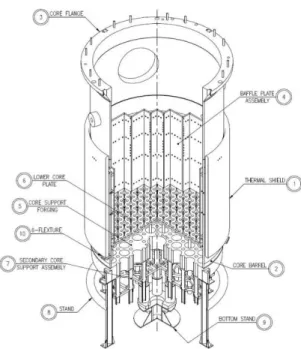
reactor internal consist of thermal shield, core barrel, core flange, baffle plate assembly, core support forging, lower core plate, secondary core support assembly ,and etc. The RVI of the Kori unit 1 is a stainless steel (STS304) structure with an outer diameter of about 3.1 m, a height of about 9.4 m, weight of 120 ton and a maximum thickness of about 340 mm.
To verify the applicability for promising segmentation and dismantling technology, the RVI mockup is being fabricated in a size and material that is similar to that of the Kori unit 1 as shown in Fig.1 and Fig.2.
272
2019 ⦽ǎႊᔍᖒ⠱ʑྜྷ⦺⫭⇹ĥ⦺ᚁݡ⫭םྙ᧞Ḳ Fig. 2. Mockup of (left) core support forging and (right)secondary core support.
3. Development of Decommission Process
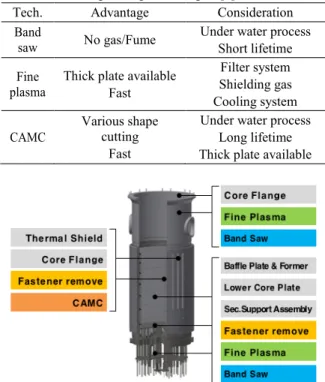
The RVI components of the Kori unit 1 are fastened by bolts and nuts. For efficient cutting process, components are dissembled by removing the fastener. And then, each components will be cut off by promising cutting technology which is considered with respect to the thickness, the design, and degree of activation. The promising cutting technologies and target component for the Kori unit 1 summarized in Table 1 and Fig. 3. Because of high activity caused by neutrons, the dismantling process should be conducted underwater using lower cavity and upper cavity. The decommissioning of the mockup will be performed as following the procedure in Table 2.
Table 1. Promising cutting technologies [2]
Tech. Advantage Consideration Band
saw No gas/Fume
Under water process Short lifetime Fine
plasma
Thick plate available Fast Filter system Shielding gas Cooling system CAMC Various shape cutting Fast
Under water process Long lifetime Thick plate available
Fig. 3. Applied dismantling technology for RVI.
Table 2. Concept of procedure for RVI decommissioning Lv. 1 Lv. 2 Process 1 Preparation 1.1 Document 1.2 Plan 1.3 Equipment setup 2 Conduct
2.1 Upper RVI seg. & dismantling. 2.2 Lower RVI seg. & dismantling. 2.3 Capture the sec. waste 2.4 Check the foreign in cavity
3 Clean up
3.1 Removal internals 3.2 Removal workstation 3.3 Removal equipment
3.4 Move the container 3.5 Remover filter system
3.6 Clean up for etc.
4. Conclusion
To develop the segmentation and dismantling process for the decommissioning of the Kori unit 1, the full size mockup for RVI is being fabricated. The performance of mockup test will be considered with respect to the applicability of promising cutting technologies, the feasibility of the procedure, and the workability underwater.
ACKNOWLEDGEMENT
This work was supported by the Korea Institute of Energy Technology Evaluation and Planning (KETEP) and the Ministry of Trade, Industry & Energy (MOTIE) of the Republic of Korea (20161510300430)
REFERENCES
[1] Y.H. Hwang, ³Conceptual Design for Kori Unit 1 Reactor Vessel and Internal Segmentation Process´, Proc. Of the KRS 2017 Fall Conference (2017).
[2] R. Heim, Evaluation of Technologies for Segmentation of Reactor Vessel Internals, EPRI Technical Report (2017).